Hits: 190
|
|
|


|
|
|
|
|
|

|
Hits: 190
|
|
|
|
|
|
|
|
|
|
Hits: 169
|
|
|
|
|
|
|
|
|
|
|
|
|
|
|
Hits: 225
WESTCHESTER COUNTY OPENS NEW MENTAL HEALTH SAFETY CLINIC IN WHITE PLAINS
Clinic to Help Address Service Gaps and Growing Demand for Mental Health Services
Watch the News Conference Here:
https://www.youtube.com/watch?v=kqSmEqUfreQ
(White Plains, NY) – Westchester County Executive Ken Jenkins has officially opened a new Mental Health Safety Net Clinic in White Plains, restoring the County’s direct role in providing outpatient behavioral health services. The state-of-the-art facility, located at 112 East Post Road in White Plains, expands the County’s capacity to address service gaps, reduce waitlists, and respond to the growing demand for mental health care in Westchester County.
Jenkins said:
“Nearly 15 years ago, the doors of Westchester County’s Safety Net Clinic were forced to close. Restoring that system of care for our residents was not an option, it was essential. For too long, our hospitals and emergency rooms have been forced to carry a responsibility they were never designed to bear – but that ends now. This clinic will provide the consistent, compassionate outpatient treatment that people need to rebuild their lives, because in Westchester County, no one faces a mental health crisis alone.”
Since 2020, the demand for outpatient behavioral health services has increased significantly, contributing to extended wait times and added strain on emergency departments and hospitals.
The reopening of the Safety Net Clinic restores a critical community-based resource, and strengthens Westchester County’s broader strategy to improve access to care, and reduce unnecessary hospitalizations.
Department of Community Mental Health Commissioner Michael Orth a White Plains resident said:
“This clinic represents a major step forward in strengthening Westchester’s behavioral health continuum of care. I want to thank County Executive Jenkins for his steadfast commitment to expanding access for our residents. The reopening of the Safety Net Clinic compliments our crisis response system, including 988 services and hospital diversion efforts, and reflects the commitment to providing accessible, recovery-oriented, and integrated care for individuals with mental health and co-occurring substance use challenges. I also want to recognize the dedicated staff, under the leadership of Melanie Montalto, who worked tirelessly to make this day possible.”
The Clinic will provide comprehensive outpatient mental health services for adults age 18 and older. Services are trauma-informed, culturally responsive, and person-centered, with a focus on recovery, wellness and connection to community supports. Operating under a “no wrong door” philosophy, the Clinic will ensure individuals with complex or co-occurring mental health and substance use needs receive coordinated and integrated care.
Comprehensive services will include individual therapy, crisis intervention, medication management, group therapy, health assessments, referrals, peer services, referrals, peer services, interfaith support, integrated treatment for co-occurring mental health and substance use disorders. Spanish-speaking services are available, along with interpretation through Language Line for additional languages.
The Clinic accepts Medicaid and private insurance, as well as uninsured individuals. Services are provided in accordance with the New York State Office of Mental Health Article 31 regulations.
For more information or to schedule an appointment, please contact the Department of Community Mental Health
(914) 995-7200.
Hits: 258
|
 |
Enjoying this newsletter? Why not share it with a friend?

A lot is changing in U.S. health policy, and New York is feeling the ripple effects. Changes are showing up in New Yorkers’ appointments, prescriptions, and prevention tools.
This week’s Dose covers disruptions to youth gender-affirming care in NYC, a vaccine access package moving through the state legislature, and an update on measles cases in Rockland County.
NYU Langone has closed its gender-affirming care program for trans youth, and Mount Sinai has reduced or cut some services, leaving families scrambling for alternatives.
For a lot of families, gender-affirming care isn’t an abstract policy, it’s part of daily life. It’s a standing appointment. A prescription refill that keeps things steady. A clinician who knows their child, their history, what’s worked, what hasn’t.
So when that care changes suddenly, it can be destabilizing, with families describing abrupt changes and referrals to private clinics.
And this isn’t a small slice of NYC. While we don’t have data available on the number of trans youth in NYC, we do have an estimate for adults. Based on NYC survey data, about 0.6% of NYC adults identify as transgender—roughly 50,000 people. If kids make up about 20% of NYC’s population, the back-of-the-envelope math suggests there may be at least 10,000 transgender youth in NYC, too.
 |
Sexual and gender identification among NYC adults. Gender minority refers to individuals who identify with a gender identity other than cisgender, including transgender. Sexual minority refers to individuals who identify with a sexual orientation other than heterosexual. Figure from the NYC Epi Data Brief.
These stories are unfolding because federal funding cuts and regulatory pressure are disrupting gender-affirming care for minors across the country, including in New York.
The Trump administration has threatened to pull funding from hospitals and practices associated with hospitals that provide these services. They are also trying to end Medicaid coverage for gender-affirming care, which would mean that even if a family can find non-hospital-based care, they wouldn’t be able to access it if their insurance is through Medicaid.
I also want to call out some of the fear-based language in these federal documents.
Phrases like “sex-rejecting procedures” and “chemical and surgical mutilation” are meant to alarm and make people think of non-reversible treatments or “removing body parts.”
But that’s not what most families are facing right now. Most of the access being cut off is for puberty blockers—medication which pauses puberty and is reversible (when stopped, puberty resumes). Puberty blockers actually give families, children, and their clinical teams more time to make longer-term decisions. For a more detailed explanation, Those Nerdy Girls has a helpful post on puberty blockers.
It’s also worth putting surgery in context: a 2024 analysis of insurance data found that among minors aged 15–17, gender-affirming surgeries were rare—for every 100,000 minors, there were only ~2.1 surgeries.
The ray of light is that New York is pushing back.
The attorney general’s office told NYU Langone to resume care, noting the federal funding threats they cited aren’t currently in effect, and raising concerns the pause could violate state anti-discrimination law.
There is also a bill going through NY state legislature that would ensure that Medicaid covers gender affirming care in the absence of federal funding.
For many families, “just go somewhere else” isn’t a real option—it’s waitlists, insurance challenges, travel across the city (or out of state), and clinical disruption piled onto a situation that can be stressful and sensitive. And when care gets interrupted, the ripple effects aren’t just medical, they also affect mental health, school, stability, and trust.
If your child is currently receiving care:
If you’re searching for care:
If you’re a clinician or educator:
At the end of the day, the most important things for kids affected right now are making them feel safe and maintaining access and continuity of care. This means steady and coordinated, not abrupt and fragmented.
In response to the rapidly shifting federal vaccine landscape, New York State Senate Democrats are moving a package of vaccine-access bills through the state legislature this week.
Together, these seven bills would protect insurance coverage for vaccines regardless of changes in federal recommendations, expand who can vaccinate (like pharmacy techs, nursing students, and medical assistants), and ensure clinicians are reimbursed for the full cost of vaccination.
These bills still need to pass through the state assembly and be signed by Governor Hochul to become law, and the package could reach the Assembly as early as next week.
This isn’t about changing the science, it’s about protecting the infrastructure that helps maintain vaccine access in New York—insurance coverage, staffing, reimbursement—when federal guidance is actively damaging those systems.
Measles: Three measles cases were just reported in Rockland County, all international tourists visiting the county. Residents who were exposed to these measles cases have been notified and are being closely monitored.
Rockland County has had large outbreaks of measles previously—last year there were more than 20 cases, and in 2019 there were more than 300. The county has some pockets vulnerable to measles—in some zip codes, fewer than 50% of eligible infants are vaccinated, far below the 95% needed for community protection.
The best thing to do right now is check the vaccination status of everyone in your family, and get up to date if needed. If you’re unsure whether you or your child is immune, talk to your healthcare provider.
RSV: For the tenth week in a row, RSV remains quite high.
Who should pay extra attention right now because of RSV risks:
 |
RSV cases in NYC. Figure from the NYC Department of Health Respiratory Illness Dashboard. Annotations by YLE.
What to do:
Flu: Across New York state and in NYC, flu cases have increased slightly. Flu is still relatively low compared to the season so far, but it’s something to keep an eye on.
 |
New York state flu hospitalizations, this season and last season. Figure from New York state respiratory report. Annotations by YLE.
Covid: Covid cases are holding steady, while ED visits are going down. Overall, Covid remains low compared to previous winters.
 |
Covid cases in NYC. Figure from the NYC Department of Health Respiratory Illness Dashboard. Annotations by YLE.
If you or your loved ones are affected by disruptions to gender affirming care, prioritize continuity (records, refills, and a written transition plan) and supporting mental health. For other community members, now’s the time to support the kids and families navigating these disruptions.
Love,
Your NY Epi
Dr. Marisa Donnelly, PhD, is an epidemiologist, science communicator, and public health expert. This newsletter exists to translate complex public health data into actionable insights, empowering New Yorkers to make informed and evidence-based health decisions.
Hits: 185
SEE IT NOW!
westchestercountyny.gov/podcast
(White Plains, NY) – Westchester County Government has launched a new podcast segment titled Westchester, Explained, a special series designed to give residents a deeper understanding of the policies, programs and decisions shaping life across the County.
Anchored by Westchester County Government Communications Director Catherine Cioffi, the series expands on conversations introduced in the County’s weekly This Week in Westchester podcast by slowing down the headlines and bringing listeners inside the work being done by County leaders and departments.
Westchester County Executive Ken Jenkins said: “Residents deserve to understand how the decisions we make in County government affect their daily lives. Westchester, Explained is about pulling back the curtain and having real conversations about the policies, programs and investments shaping our communities. We want people to hear directly from the experts doing the work and understand why these efforts matter for families across Westchester.”
Cioffi said: “Government works best when people understand not just what decisions are being made, but why they matter. Westchester, Explained is about transparency and clarity, taking the time to break down important issues so residents can see how County government is working for them.”
The first episode focuses on lead prevention and remediation, highlighting Westchester County’s new Lead Registry Program, an initiative aimed at identifying and addressing potential lead hazards to better protect children and families.
Joining Cioffi for the inaugural conversation are Westchester County Health Department Deputy Commissioner for Environmental Health Christopher Ericson and Health Services Coordinator for the Westchester County Health Department, Immunization Action and Childhood Lead Poisoning Prevention Programs Leslie Liberatore. Together they discuss the risks associated with lead exposure, how the new registry works and what residents should know to keep their homes safe.
Episodes are available on Apple Podcasts, Spotify and at westchestercountyny.gov/podcast.
Hits: 225
A NEW VISION FOR HPN: WESTCHESTER COUNTY MOVES FORWARD ON TERMINAL MODERNIZATION
HNTB Selected to Design Passenger-Focused Improvements that Enhance Comfort, Efficiency and Experience – Without Expansion
Watch the News Conference Here:
https://www.youtube.com/watch?v=o1aK2MToZwA
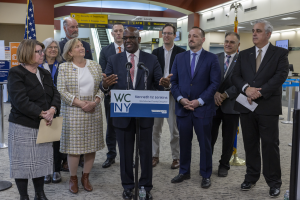
(White Plains, NY) – Westchester County Executive Ken Jenkins today announced the selection of HNTB to lead the comprehensive feasibility study and concept design for the modernization of the terminal at Westchester County Airport (HPN).
Most recently HNTB supported Garden City Regional Airport in the delivery of a new terminal and currently serves as the program manager for the John F. Kennedy International Airport Redevelopment Program. HNTB also served as architect- and structural engineer-of-record on the Des Moines International Airport’s 22-gate expansion project.
The selection marks a significant milestone in the County’s effort to reimagine the decades-old terminal and deliver a more modern, efficient and passenger-friendly experience, while maintaining full County ownership and operational control of the Airport.
Jenkins said: “We all deeply value flying out of Westchester County Airport, but the reality is the currently terminal is not functional for basic needs like having a cup of coffee, sitting down on a chair or going to the bathroom. When flying out of HPN, we want our passengers to be safe and comfortable. Selecting HNTB with industry-leading expertise in airport planning and design is an important step toward delivering that experience. This is not expansion this is modernization – and we desperately need it.”
A Pre-Qualification Board convened in August, followed by review by the Professional Selection Board in September. Eleven nationally recognized firms were approved to participate in the Request for Proposals (RFP) process. After careful evaluation of submissions, interviews and technical review, HNTB was recommended to the County Executive for final approval.
The RFP called for a comprehensive feasibility study that will produce distinct terminal modernization concepts. The study will include:
Throughout the study and all future phases, the County will uphold all Terminal Use Regulations (TUR), including the 240-passenger-per-half-hour operational limit. The County will continue to engage the Airport Advisory Board and stakeholders as the project advances.
The selection follows a rigorous and transparent procurement process. The County’s Department of Public Works and Transportation (DPW&T) conducted national research to identify firms with demonstrated expertise in terminal concept planning and aviation design.
HNTB’s New York office leader Mike Mangione said: “We’re proud to partner with Westchester County on this important next step for the airport. Our focus will be collaborating with the airport and stakeholders to explore modernization concepts that improve comfort and efficiency for travelers and create a terminal experience that truly matches how people travel today.”
Chair of the Airport Advisory Board Nick Hartman said: “The passenger terminal at HPN has served our community for decades, but it’s time to bring the customer experience in line with what travelers expect in 2026 and beyond — within the operational limits that define HPN’s unique character. The Airport Advisory Board is eager to partner with the County in shaping what comes next for this vital gateway for our region.”
Westchester County Board of Legislators Chairman Vedat Gashi said: “This is great news for Westchester residents and everyone who travels through our airport. Today’s announcement moves us closer to giving airport visitors the experience they deserve. We’re taking a careful, responsible approach to modernizing an aging terminal while ensuring the County remains firmly in control of its future. I’m happy we’re taking this important step forward.”
County Legislator Nancy Barr said: “Westchester County residents and visitors enjoy the convenience of traveling in and out of HPN but people often complain about the lack of adequate seating, bathrooms and eating options, particularly once they have gone through security. Changes that were made post 9-11 have created challenges for those who have to get to the terminal two hours early or whose flights get delayed. I look forward to seeing creative ideas for modernizing the space.”
Hits: 156
BOARD OF LEGISLATORS AND COUNTY EXECUTIVE KEN JENKINS
DELIVER JOINT LEGISLATIVE PACKAGE TO NEW YORK STATE DELEGATION
County Leaders Present Shared Legislative Priorities to State Officials
WHITE PLAINS, NY—The Westchester County Board of Legislators and County Executive Ken Jenkins submitted their 2026 Joint State Legislative Package to the New York State Delegation this afternoon. The annual convening is an opportunity to advocate for legislation addressing priority issues for Westchester County residents.
This year’s package includes a range of budgetary and legislative initiatives proposed by our State Senators and Assembly Members, focusing on affordable childcare, healthcare, flood mitigation, and increased support for residents facing rising costs and economic challenges.
Held as part of the Board’s regular Legislative Committee meeting, the gathering is an important opportunity for County legislators and the County Executive to meet with State lawmakers and discuss the County’s most pressing priorities for the year ahead.
In attendance from the New York State Delegation were Senate Majority Leader Andrea Stewart-Cousins and State Senator Shelley Mayer. State Senators Pete Harckham, Jamaal Bailey, and Nathalia Fernandez attended virtually or were represented by staff. Assembly Members Amy Paulin, MaryJane Shimsky, Chris Burdick, Steve Otis, and Nader Sayegh were present. Assembly Members Dana Levenberg, Gary Pretlow, and Matt Slater attended virtually.
Board Chairman Vedat Gashi (D–New Castle, Ossining, Somers, Yorktown) said, “At a time when too many Westchester residents are navigating rising costs and economic strain, leadership means standing together and staying focused on solutions. This joint effort reflects our shared commitment to listen carefully, act deliberately, and deliver meaningful support for the people who count on us every day.”
Westchester County Executive Ken Jenkins said, “This joint legislative package is about working for the people of Westchester in unity. From making childcare more affordable to strengthening support for working families and investing in our communities, these priorities reflect what residents need right now. I am grateful to our State Delegation for their partnership and their willingness to work with us to advance solutions. Together, we are ensuring Westchester’s voice is heard in Albany.”
Legislator Colin D. Smith (D–Cortlandt, Peekskill, Yorktown), Chair of the Board’s Legislation Committee, said, “I’m proud that our 2026 State Legislative Package is complete and focused on the everyday pressures Westchester residents are feeling—affordability, public health, safety, and resilience. From sustaining child care support for working families, to strengthening maternal and environmental health, to improving transit funding and helping communities move flood-mitigation projects faster and more cost-effectively, these priorities are practical and urgent. I’m grateful to our State partners for carrying these proposals in Albany, and to my team at the Board of Legislators for pulling this package together so we can deliver timely results for Westchester.”
Majority Leader Judah Holstein (D–Eastchester, New Rochelle, Tuckahoe) said, “This State Legislative Package reflects our commitment to ensuring that Westchester County is prepared for the challenges ahead, especially as changes at the federal level create new pressures for local governments. Working closely with our State delegation, we are focused on securing the resources and authority needed to protect and serve our residents. I thank my colleagues in County Government and our partners in the State Delegation for their continued collaboration on behalf of the people of Westchester.”
Minority Leader Margaret A. Cunzio (C–North Castle, Mount Pleasant, Pleasantville, Sleepy Hollow, Harrison) said, “The items in the NYS legislative package that were voted out in the Legislation committee, are an important ask for the constituents of Westchester County. These items address key local priorities such as funding for infrastructure and roads. While some of these items would require a lot more data and discussion to work out any unintended consequences—calling on our NYS representatives in Albany to deliver the resources our communities need is imperative.”
The full meeting replay can be found on this page, when it becomes available.
Hits: 190
|
|
|
|
|
|
|
|
Westchester County District Attorney Susan Cacace announced today that a New Rochelle contractor was re-arrested and charged with new felony offenses for allegedly stealing over $50,000 in wages from his workers.
Artemio Fuerte, 40, of New Rochelle, was arraigned Tuesday morning in New Rochelle City Court on one count each of Grand Larceny in the Second Degree, a class C felony, and Scheme to Defraud in the First Degree, a class E felony, as well as five counts of Failure to Pay Wages When Due Under Labor Law, a class A misdemeanor.
Judge Michelle Bernstein released Fuerte on his own recognizance as none of the charges are bail eligible. He is due back in court on March 12.
DA Cacace said: “As my office has alleged in a felony complaint, these hard-working employees were taken advantage of by the defendant to the tune of over $50,000. Deliberately withholding wages from your employees is not a bookkeeping trick, it is a crime. I stand with the labor community in demanding that all workers in Westchester be paid fairly, in accordance with the Labor Law. With today’s charges, we are making good on that demand.”
Fuerte is the owner/operator of Fuerte Construction Services LLC. As alleged in a felony complaint, between September 2022 and October 2025, Fuerte stole approximately $51,720 in wages from five of his employees by failing to pay them the amounts owed.
One worker (Employee-1) worked for Fuerte Construction Services LLC performing demolition, painting, carpentry and drywall services between February 2024 and September 2024, at a set rate of $900 per week. During this period, Fuerte failed to pay Employee-1 at all for much of his labor or paid Employee-1 using bounced checks. Based on the statutory minimum wage and the amount of unpaid labor performed by Employee-1, Fuerte owes Employee-1 approximately $19,583, according to the complaint.
Another worker (Employee-2) worked for Fuerte performing similar services between September 2022 and October 2025. Employee-2’s daily rate was $160, according to the complaint. However, Fuerte allegedly failed to pay Employee-2 at all or failed to pay him the full amount owed. Based on the statutory minimum wage and the amount of unpaid or underpaid labor performed by Employee-2, Fuerte owes Employee-2 approximately $8,400, according to the complaint.
The investigation was conducted by the Westchester County District Attorney’s Office in conjunction with the New York State Department of Labor.
The case is being prosecuted by Senior Assistant District Attorney Emily-Rowe Smith, of the Economic Crimes Bureau, with assistance from Michael Frenza, Forensic Accountant.
Hits: 152
|
|
Dear neighbor,
Over the weekend, President Trump’s policies entered the United States into a war with Iran. Shortly after, Iran unleashed a string of attacks on surrounding Middle East countries, Israel, and United States air bases abroad. President Trump’s policies entered us into this war – a war by his own words – and six brave American service members and their families have made the ultimate sacrifice. We do not know what will come next but we are seeing escalations which can draw the United States into a protracted regional conflict. Moreover, a declaration of war is mandated in the constitution to be voted on by Congress so that we can represent the opinions of those we serve when making a harrowing decision like this one.
|
|
I will continue to monitor this situation and work with my colleagues in Congress to find a solution forward. |
|
IN THE NEWS: This past weekend, I spoke to News12 and PIX on Politics regarding new legislation I am introducing and the current state of our foreign affairs.
Watch the full clips here: NEWS12:
PIX on Politics: NY Congressman George Latimer on Pres. Trump’s State of the Union Address | PIX on Politics Daily |
|
If you are traveling internationally in the near future, I would urge you to enroll in STEP (Smart Traveler Enrollment Program) to receive updates from the Department of State regarding travel safety. Find the link here: https://tinyurl.com/4shyhfek |
|
You can follow me on Instagram, Facebook, Bluesky, Twitter/X and YouTube and can sign up for our newsletter here: https://latimer.house.gov/contact/newsletter-subscribe. |
|
Sincerely, |
|
|
Rep. George Latimer Member of Congress |
|
|
|
Washington D.C. Office (202) 225-2464 |
|
Bronx Office (718) 530-7888 |
|
White Plains Office (914) 323-5550 |
Hits: 315
WPCNR WESTCHESTER Covid Log 2026 (based on New York Health Department Covid 19 Tracker. By John F. Bailey. March 3, 2026:
To supplement Caitlin Rivers Northeast Outlook in the March 1 report earlier, WPCNR brings you up to date on covid-19 positives the first two months of 2026 in Westchester County.
There were 1,122 persons tested positive in Westchester County in January, and those 1122, spread the disease to 977 others through 27 days of February. This is very positive. It means covid is still with us but it is spreading the disease at a rate one infected person infecting only one other person.
The number new cases of covid the first two months of 2026 is 2099 , is 53% less than the 4,439 new persons testing positive the first two months of 2025.
The 4,439 new cases of covid last year in January and February 2025 passed covid on to 1,917 pers a 1 person infecting 2 spread rate.
This year as March and April offer more socializing, we should keep up to date with covid shots and socialize with respect for covid being out there in Westchester. At the present spread rate in the county with 977 infected in February we can possibly still approach 1,000 infections in March and more in April.
The figures on positives the last two months, it should be noted in light of Caitlin Rivers concern about the number of hospitalizations for covid growing in New York. The positives are those who came in to pharmacies, health services to be tested. There may be quite a population out there not testing, thinking they have a common cold when they have a light case of covid and do not test themselves.


