Governor Announces $15 Million in Community School Grants. Get Your Applications In Now

Hits: 355

WPCNR SCHOOL DAYS. From the Governor’s Press Office Auguat 26, 2013: Governor Andrew M. Cuomo today launched the NYS Community Schools initiative, a new statewide program he announced in the 2013 State of the State address that will transform schools in distressed communities into hubs for a wide range of support services for children and their families including health care, counseling, nutrition and job preparation services.

“NYS Community Schools will help give New York students and families a brighter future by
transforming our public schools into community institutions that serve the needs of our neighborhoods,” Governor Cuomo said. “The State is empowering schools in distressed communities to give students extra help through health care services, family counseling, and employment assistance, all of which will strengthen our neighborhoods and give students in those areas additional support, both in and out of the classroom.”

Under NYS Community Schools, approximately 30 schools will be selected in the first
round to receive grants of up to $500,000 each over three years. These grants
will go toward building strong community partnerships that deliver critical
academic, health, extra-curricular and social services primarily in the school
building.

The NYS Council on  Children and Families, which comprises of the State’s 12 health, education and human services agencies, in coordination with the State Education Department has
developed a Program Overview and Grant Implementation Plan to describe how NYS Community Schools will be implemented.

To view the plan, go to:

http://ccf.ny.gov/Comm/CommResources/CCF_SED_CommunitySchools_Plan.pdf.

To view the application, go to: http://www.p12.nysed.gov/funding/2013-community-schools-grant-initiative/home.html.

The State Education Department will accept applications until September 18. Participants will be selected at the beginning of the 2013-14 school year.

Governor Cuomo first announced the Community Schools initiative during his 2013 State of the State address to support students and families in New York’s neediest neighborhoods. The initiative aims to replicate successful models such as Children’s Aid Society, Cincinnati Community Learning Centers, Harlem Children’s Zone, Say Yes to Education, and Strive Network in distressed communities across New York State.

Community Schools emphasize family engagement and include strong partnerships with
non-profit community-based organizations, local and state government agencies,
higher education institutions, and the philanthropic and business communities.
Their goal is to align programs and services to meet the needs of students and
their families, while avoiding duplication and improving efficiency.

To ensure that existing funds are fully aligned to support the communities selected in the
first round of this program, Governor Cuomo is directing all state agencies to prioritize Community Schools and their partners for related health and social service grants and programs.

The establishment of Community Schools was a key recommendation of Governor Cuomo’s
New NY Education Reform Commission, which found that “by providing the comprehensive supports that students need within the school setting at every stage, we can ensure that our students are on track to be college and career ready.”

Commission Chair Richard (Dick) Parsons said, “Along with my fellow Commission members, I applaud the Governor for taking this important step to implement the Community Schools initiative. This is one of many important recommendations provided by the New NY
Education Reform Commission that the Governor is putting in place. The evidence shows that Community Schools will have a significant impact on student performance and family well-being in distressed communities, and we look forward to their success.”

State Education Commissioner John B. King, Jr. said “The New York State Board of
Regents has a history of advocating for establishing programs for students and
families that provide academic enrichment activities along with a broad array of
student and family development opportunities within their communities. We are
pleased to be partnering with the Governor to foster Community Schools across
the state.”

Posted in Uncategorized

Irresistible Singel is Oliver! Inspiring Lucy Braid as Nancy! Tugs Heartstrings. Tears You Up. Cheers You Up in Schmaltzy Tasty Concoction

Hits: 2725

JVP_0617(2)(1280x1024)


Starting with the towheaded 7 year old huggable, wonderstruck Oliver, 7 year old Brandon Singel, the audience just loves him to pieces, as he wanders about rough and tumble, desperate and humble Victorian London. That’s John Anthony Lopez as Fagin, the pickpocket boss, on the left, and Todd Ritch on the right as The Artful Dodger.

WPCNR BALCONY OBSERVER. Theatre Review By John F. Bailey August 25:

Standing Ovation Studios, Westchester’s leading incubator and training stage for  talented young aspiring thespians, is  staging  its fourth collaboration with the Westchester Broadway Theatre in Elmsford, OLIVER! For two more weeks.

It is a faithful, win-you-over company of energetic young charmers who deliver an emotional musical memory of schmaltz, hope and entertainment for all ages.

The old favorites wind into life in this Tony Award-winning relic, from the company of orphans at Mr. Bumble’s orphanage singing of Food,Glorious Food  (when master Singel asks for ‘More” to  the little charmer, asking and singing the musical question, Where Is Love when he is turned out into the street by his funeral parlor employer to the pickpocket recruiter, Fagin.castwkids(2)(1280x1024)

The Artful Dodger (Todd Ritch above)) welcoming Oliver into Fagin’s pickpocket gang with a rambunctious tempo Consider Yourself (One of the Family) Oliver settles you in your seat like an old friend you’re feel comfortable with whom you have not seen in a long time. He’s changed but you love him anyway.

oompahpah(3)(1280x1024)

 Lucy Braid (at top of picture) leading Oom Pah Pah! above, in her Westchester Broadway Theatre debut as the doomed Nancy, who with Oliver, is the focus of the show and really sparkles.

She loves Bill Sykes, a ruthless criminal whom she loves inexplicably. Braid and Cali LaSpina performing a rollicking It’s a Fine Life  get the production rolling,  explaining the glamor side of pickpocketing and a ladys’ rolls in the underworld, doing dirty laundry.

Braid’s Nancy starts the second act with smashing version of Oom-Pah-Pah. She further endears herself to the audience by making As Long as He Needs Me an anthem, a lament, a definition of the mystery and affliction of  unrequited love any woman who has ever loved a difficult man will identify with. Braid’s stalwart proud heartbreak tears you up the way she wrangles this signature song.  You will be reading Ms. Braid’s name in many a playbill in the years to come. Braid shines on her other big song, the tear-jerking song of pathos rendering the definitive song of those without hope that society has cast aside,  Who Will Buy?

Act II finds Oliver messing up his first attempt at pickpocketing, being caught by the London Bobbies and remanded to a long lost relative and it looks like our resourceful scamp who appears to let things happen to him with just the right amount of innocent pluck is going to be all right. But the malevolent Bill Sykes is looking for him because Oliver can identify him to the police. Sykes  is played over-the-top ugly by  Brian Kinsky, with a truly evil sense, scary and gives young audiences an insight into what people who behave badly are really like. Sykes kidnaps Oliver in an attempt to silence him

Nancy intercedes to protect Oliver at her peril and is an appealing heroine.

John Anthony Lopez is a rascally Fagin (the leader of the pickpocket gang) with his big number You’ve Got to Pick a Pocket or Two,  a crowd pleaser. Young persons seeing Mr. Lopez’s unseemly worship of  money and the way he exploits his pickpockets get a valuable insight into what bad people are really like: they use you under the premise of helping you. Fagin is totally unsympathetic and this is the strength of Mr. Lopez’s performance. Fagin may be cute but even a young mind can see the selfishness in Mr. Lopez’s Fagin.

Bumble&Widow(2)(1024x1280)

Mr. Bumble and  Widow Corney are a great comedy pair (John Treacy Egan and Regina Singel, above–Oliver’s real life mom) as the very nasty orphanage overseers.  Their I Shall Scream is a hoot.

Oliver! Plays through September 8 and is a diversion, deftly brought back by Standing Ovation Studios. Standing Ovation Studios following its game production of In The Heights for WBT has mounted a production that should be a delight and in its winsome company in  full stride in its final two weeks.

For information, go to www.BroadwayTheatre.com OR CONTACT  914-592-2268. And you get dinner, too!

Parents Note Content: Threatening physical conflict between the Sykes and Nancy characters. There is some light playful innuendo.There is gunplay

All Photos by John Vecchiola, Courtesy, Westchester Broadway Theatre

Posted in Uncategorized

Federal Court Stymies Sunrise Suit Against City For Blocking Detox Center Project in Carhart. Appeal Forthcoming

Hits: 543

WPCNR WHITE PLAINS LAW JOURNAL. AUGUST 25, 2013:

On July 10, The U.S. Court of the Southern District of New York dismissed a lawsuit filed by Sunrise Detox Center against the City of White Plains for in effect denying their plan to turn the former Nathan Miller Center in the city Carhart neighborhood into a alcohol and drung detox center.

Gannet reported Sunday the suit was dismissed by Judge Vincent Briccetti on the reasoning that Sunrise had not appealed the City Building Commissioner’s objection to the application to the city Zoning Board and therefore had not exhausted all Sunrise options before going to court.

Gannet reports the attorney for Sunrise has said the company will appeal the decision.

Posted in Uncategorized

FASNY PROPOSES TRAFFIC CIRCLE ENTRANCE ON NORTH STREET OR SIGNAL ON BRYANT AVENUE ENTRANCE. GEDNEY ASSOCIATION SAYS MORE HEARINGS NEEDED. URGES NORTH ST CORRIDOR DEMAND NEW HEARINGS

Hits: 345

WPCNR SOUTH END TIMES. By John F. Bailey. August 23, 2013:

The Gedney Association is calling for the city to schedule new hearings  to examine in depth 2 new alternative entrances to the proposed new French American School of New York campus (under review for 2-1/2 years) outlined in the Draft Final Environmental Impact Statement now being considered by the Common Council.

20130823fasny 003

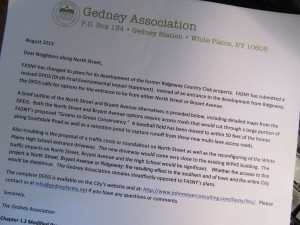
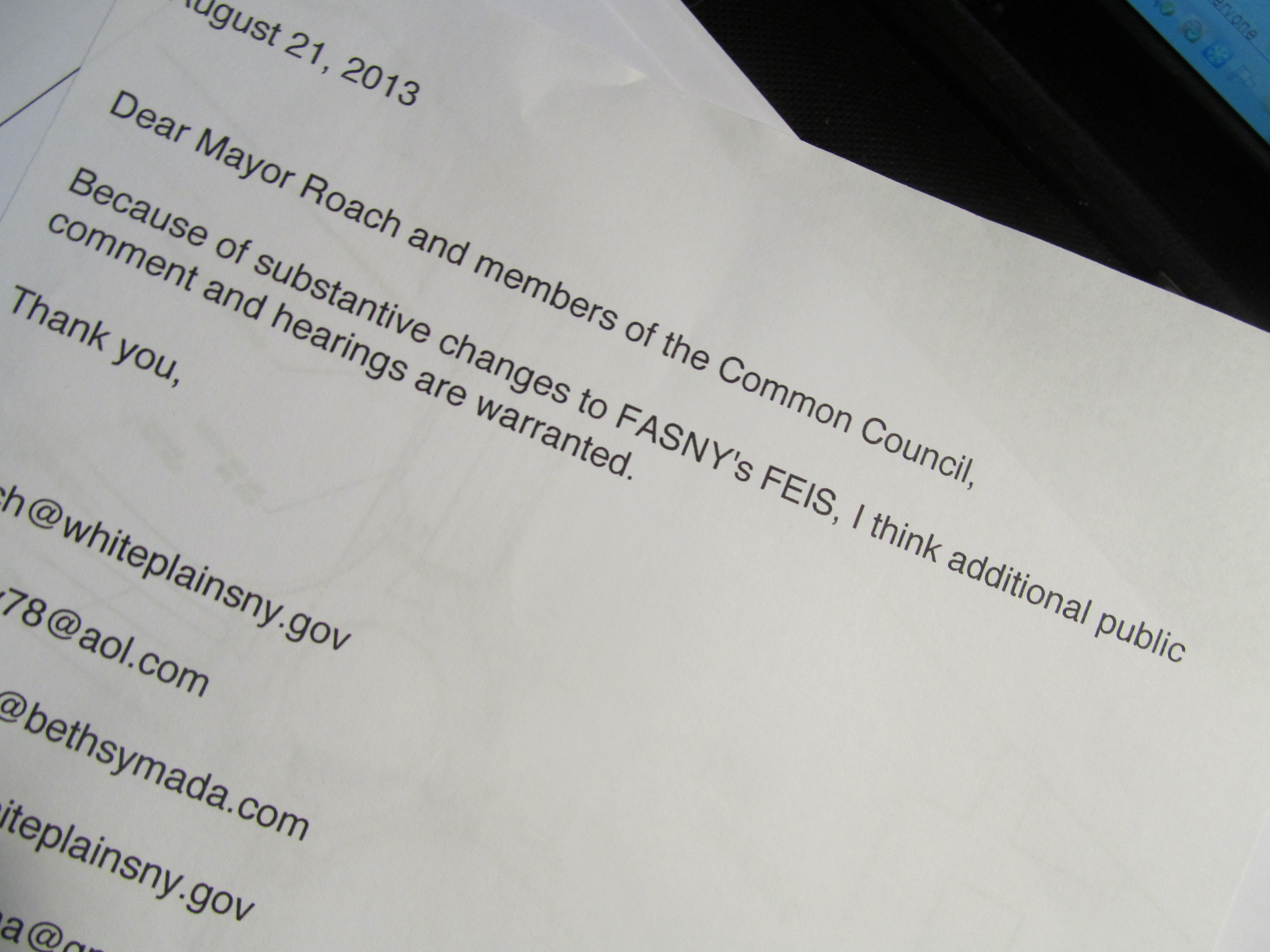
Residents up and down the North Street corridor (that we know of)this afternoon received a letter and copies of the proposed new entrances and were urged to write the Mayor and Common Council demanding scheduling of new hearings, encougaging them to send a letter saying:

“Because of substantive changes to FASNY’S FEIS, I think additional public comment and hearings are warranted.”

20130823fasny 002


Geof Thompson, spokesperson for the French Amercan School of New York, asked if the new proposals were developed with the city planners and departments, told WPCNR  FASNY has spent the last five months working with city officials on answering some of the questions raised from the previous Draft Environmental Impact Statement hearings. Asked if FASNY was under the impression that the proposed new entrance routes were city professionally acceptable solutions developed by the FASNY consultants and planners as a result of this deliberation process, Thompson said he would have to check with the French American School of New York.

Thompson contacted WPCNR moments ago to clarify that the DEIS hearing testimony and comments called for studying alternative entrances at either North Street or on Bryant Avenue as issues to be addressed.

John Callahan,  city Corporation Counsel,   speaking to WPNCR this afternoon confirmed that the two new entrances were developed with city officials and planners working with FASNY consultants. Asked if the city professionals on staff had indicated to FASNY these were acceptable alternative solutions to the traffic problems alleged to be created by the previously proposed Ridgeway Avenue entrance, Callahan said he had not participated in the meetings. Asked if the city recommended these solutions, Callahan said it was up to the Common Council to decide that.by either approving or denying the project.

Callahan said as Corporation Counsel he was not in a position to judge whether a council denial of such solutions would be defensible legally, until any such suit should arise. Again, he pointed out he was not at the meetings where the city and the FASNY consultants worked out the proposed alternative entrances

The letter from the Gedney Association received by residents in the North Street area today, read, in part, “Instead of an entrance to the development from Ridgeway, the DFEIS calls for options for the entrance to be from either North Street or Bryant Avenue.”

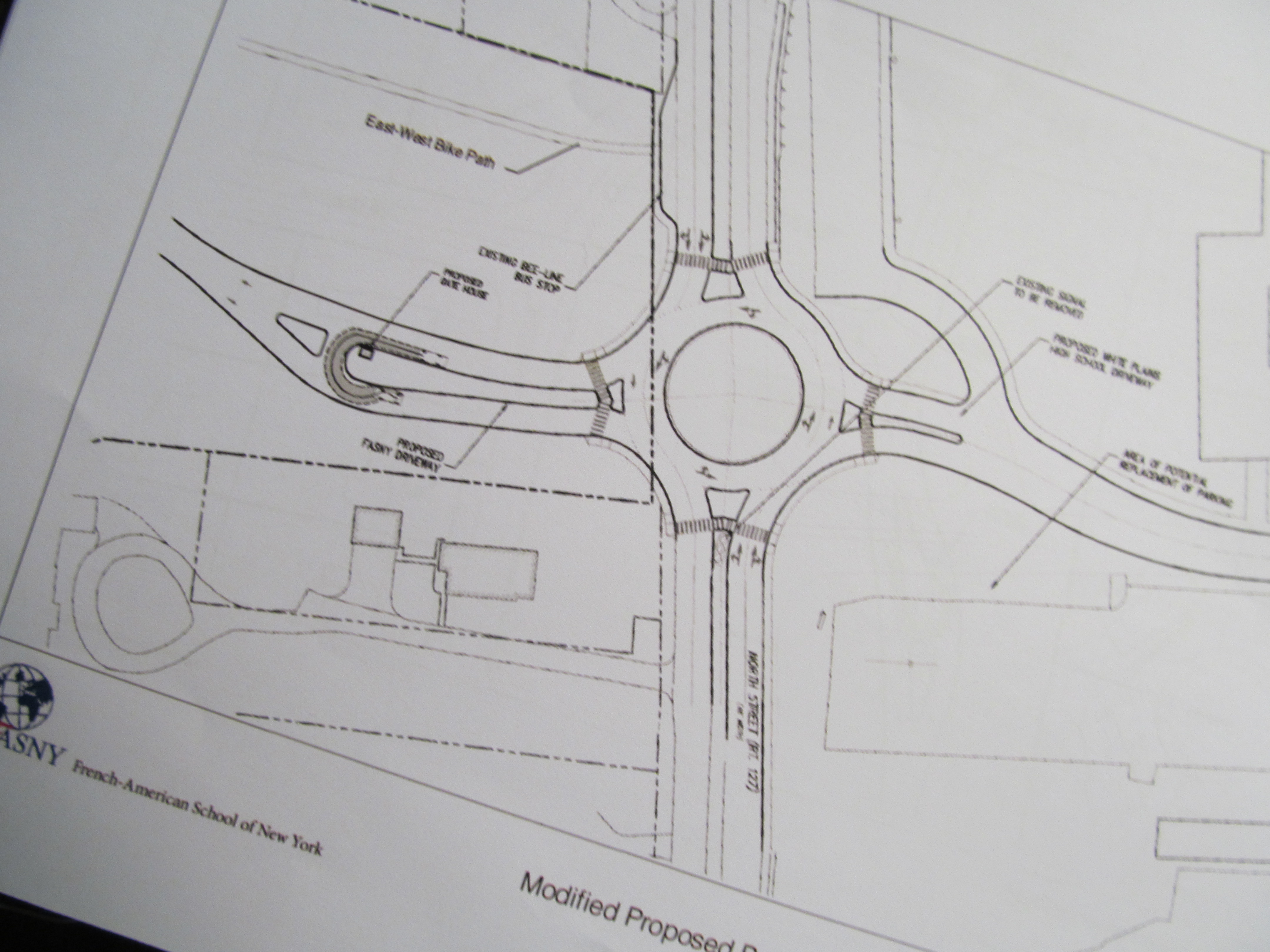
The proposed entrance on North Street would at the entrance to the White Plains High School, and be in a roundabout, traffic circle design, allowing flow without a traffic light.

20130823fasny 001

THE NORTH STREET ROUNDABOUT TRAFFIC CIRCLE PROPOSED SOLUTION TO ENTRY TO THE NEW FASNY RIDGEWAY CAMPUS. IT PROPOSES REDESIGNING THE WHITE PLAINS HIGH SCHOOL ENTRANCE

The suggested entrance on Bryant Avenue would have a traffic signal allowing turns into an entrance road cutting south from the golf course to the campus.

20130823fasny 004

THE ENTRANCE TO THE PROPOSED NEW FASNY RIDGEWAY CAMPUS THAT WOULD HAVE TRAFFIC ENTERING AT A TRAFFIC SIGNAL ON BRYANT AVENUE AT TOP OF PICTURE.


The Gedney Association opposes each solution.

The complete DFEIS in on the city website at http://www.johnmeyerconsulting.com/fasny/feis/

Posted in Uncategorized

MORE VOLLEYS THAN THE US OPEN: WHITE PLAINS WEEK VOLLEYS AGAIN TONIGHT 7 PM ON 76 AND 45 AND ON THE NET.

Hits: 335

THE THREE ACES!

BLUNT.

BLATANT.

UNFAIR.

UNBALANCED.

BRUTAL TRUTH

Overhand smashes!

2012612newstudios 001.

BAILEY

BENEROFE

AND KATZ

YOUR WHITE PLAINS GUYS REPORTING FOR YOU

ON

THE AWARD WINNING

WHITE PLAINS WEEK

TONIGHT

ON

THE ROBBERY ARRESTS.

THE MASS TRANSIT TASK FORCE FARCE

THE NEW WESTCHESTER AVENUE MIXED USE PROJECTS–DETAILS REVEALED

WHITE PLAINS LAGS BEHIND YONKERS, MOUNT VERNON AND NEW ROCHELLE IN RETAIL ACTIVITY–WHY?

THE VOCATION SCHOOL CLOSING IN WP

THE OBAMA CHARADE.

AND MORE

NEWS

YOUR POLITICIANS WON’T TELL YOU

7 PM ON WHITE PLAINS TV CHANNELS 45 AND 76

WORLDWIDE

ANYTIME ON

www.whiteplainsweek.com


Posted in Uncategorized

Vorperian and Marty Glickman’s HBO Biographer…on WHITE PLAINS TV TONIGHT

Hits: 171

Mal-Kirpich_Marty-Glickman_Nat-Asch_Kyle-Rote_Al-DeRogatis1

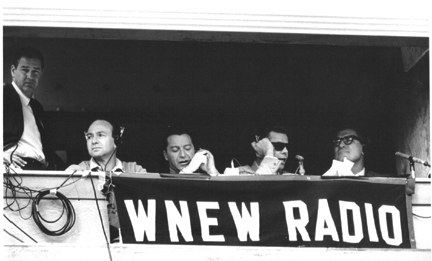
iT’S GOOD! LIKE NEDICKS! MARTY GLICKMAN, SECOND FROM LEFT ON A WNEW NY GIANTS BROADCAST FROM THE PAST. GLICKMAN’S HBO BIOGRAPHER IS INTERVIEWED ON BEYOND THE GAME THIS EVENING AT 9 P.M.

WPCNR MEDIA MONITOR. From Beyond The Game, White Plains TV. August 23, 2013:

 
            Before Marv Albert and Bob Costas, there was Marty Glickman. A gifted Jewish-
 
American athlete who was denied the chance to represent the U.S. at the 1936 Berlin
 
Olympics, he went on to become one of the most revered and influential sportscasters in
 
history, pioneering many of the techniques, phrases and programming innovations that are
 
commonplace in sports reporting today. Chronicling his remarkable life and career,
 
            TONIGHT, Aug 23rd  at 9:00p.m.White Plains Community Media’s BEYOND
 
THE GAME (Cablevision 76; Verizon Fios 45; & www.wpcommunitymedia.org)
 
will feature GLICKMAN, writer, producer and director James L. Freedman. BEYOND
 
THE GAME host John Vorperian said, “As a high school senior James Freedman
 
 produced Marty Glickman’s late-night NYC sports radio program. GLICKMAN is
 
Freedman’s first documentary, but clearly his film illuminates the life and legacy of the
 
man who pioneered modern sports reporting.”
 
            WPPA viewers who wish to see more about GLICKMAN prior to its HBO 
 
Monday, August 26 premire can visit: www.glickmanthefilm.com
GLICKMAN debuts MONDAY, AUG. 26 (9:00-10:30p.m.)  exclusively on HBO.
Posted in Uncategorized

Moody’s Moves NY Up to Positive. Governor Says Future Looks Bright Ahead

Hits: 88

WPCNR ALBANY ROUNDS. From the Office of Governor Andrew M. Cuomo. August 22, 2013:

Upon Moody’s Investors Service revising New York State Outlook today, Governor Andrew Cuomo issued this statement:

“Today’s action by Moody’s Investors Service to revise our State’s outlook from stable to positive is another strong affirmation of the progress we have made to put New York’s fiscal house in order. After years of late budgets and legislative gridlock, we have been able to show that New York State is working again and confidence in government is being restored. Since taking office, my administration has delivered three on-time and balanced budgets, controlled government spending, and cut taxes for the middle class to their lowest levels in 60 years. New York has gained over 300,000 private sector jobs with more being added every day, and this momentum is leading us to fiscal stability and economic prosperity.”

Excerpt of Moody’s Report Included Below
###
Moody’s moves New York State outlook to positive; affirms GO at Aa2
State has $62.1 billion in net tax-supported debt outstanding

 Moody’s Investors Service has changed the outlook on New York State to positive, and affirmed the Aa2 rating on New York’s $3.5 billion of General Obligation Bonds. Moody’s has also affirmed the ratings on all outstanding appropriation-backed and G.O.-related bonds as well as various state intercept programs (see detailed list below).
SUMMARY RATING RATIONALE The positive outlook reflects improvements in the state’s economy, governance, financial position and fiscal outlook that, if continued, would allow the state to improve its reserves and draw closer to structural balance.
New York’s Aa2 general obligation rating reflects the relative strength and recent resilience of its economy; governance constraints including a history of late budgets and limited executive authority to reduce appropriations; a financial position that has improved but remains below average; a moderate combined debt and pension burden; and sound debt management and frequently updated financial forecasting. The rating incorporates notable improvements in the state’s economy, governance, financial position, and budgetary balance over the past three fiscal years, as well as remaining risks, including weakness in the financial services sector, continued revenue volatility, and relatively low fund balance and liquidity positions.
STRENGTHS:

· Broad-based, mature, and wealthy state economy that attracts a highly-educated and global workforce, and has shown above-average resilience during the recovery· Long track record of closing annual budget gaps, and more recently, with more structurally balanced solutions· Accumulated rainy day reserves have remained stable for 10 consecutive years, providing cash flow flexibility, although at comparatively low levels· State pension system is well funded compared to other states and unfunded liability is modest, placing state’s fixed costs at the 50-state median relative to total revenues· Recent reversal of history of political gridlock, reflected in timely budgets, implementation of spending controls and move toward structurally balanced budgets

.CHALLENGES

Revenue volatility stemming from the state’s dependence on the financial services sector and income taxes, posing risks to budgetary balances, liquidity, and financial stability· Relatively low fund balances provide minimal protection against revenue volatility· Above-average state tax-supported debt burden partly reflects a past record of deficit-related bondingDETAILED CREDIT

DISCUSSION
FINANCIAL POSITION IMPROVES BUT REMAINS EXPOSED TO VOLATILE REVENUE TRENDS
New York finished fiscal 2013 with a $1.61 billion budgetary general fund balance (3.1% of receipts and net transfers), slightly diminished from a nearly $1.8 billion closing balance the previous year. The closing balance included $1.1 billion in the Tax Stabilization Reserve, $175 million in the Rainy Day Reserve, $75 million in undesignated fund balance and $77 million in unrestricted reserved administratively designated for prior year labor agreements. The state operating funds closing balance increased to $4.3 billion (4.9% of receipts and net transfers) from $3.8 billion in fiscal 2012. State operating funds include the General Fund, state-financed special revenue funds and debt service funds.
The state has had difficulty achieving the enacted budget revenue forecasts in recent years, and total receipts in 2013 fell $281 million below the initial projection. However, the state was able to maintain budget balance largely through restraining disbursements.
Based on GAAP fiscal 2013 figures (ending 3/31), New York’s financial position improved but remained slightly negative and well-below pre-recession levels. Available General Fund balances (unassigned balances plus the Rainy Day Fund) increased to negative $2.2 billion (-3.6% of revenues and net transfers) in fiscal 2013, marking significant improvement from the negative $5.6 billion low in fiscal 2010.
With a $100 million deposit in fiscal 2012, the $1.1 billion (1.8% of revenues) Tax Stabilization Reserve Fund has remained fairly stable for more than ten years, providing consistent but moderate liquidity support. However, reserves are small relative to revenues and given the historic volatility of the state’s revenue base.
The state’s liquidity position has strengthened, and the lowest General Fund monthly cash balance in fiscal 2013 was $1.5 billion, compared to negative $87 million in fiscal 2011. As a result, the state has not deferred school aid payments, STAR distributions or tax refunds in the past two fiscal years, nor has it borrowed internally from its short-term investment pool ($3.8 billion ending balance in fiscal 2013) during the same period. The state’s fund balance and liquidity position remain below pre-recession levels and provide limited cushion against historically volatile revenue trends. In the past two recessions, sharp revenue losses have led to rapid decreases in GAAP fund balance.
THIRD CONSECUTIVE ON-TIME BUDGET REDUCES PROJECTED SHORTFALLS
For the third consecutive year, the state adopted a timely budget for fiscal 2014. From the mid-1970s until 2004 the state’s budget was more than 30 days late 14 times, and exceeded the 30 day threshold in all but one year from 1994 to 2004. Since 2005, state budget adoption exceeded that threshold only in 2010.
The state operating budget increases $1.9 billion (2.1%) over fiscal 2013, driven by growth in aid to school districts, Medicaid, various local assistance grants and debt service.
Budget gaps at the time of enactment were projected to grow from about $2 billion in fiscal 2015 to $2.9 billion in fiscal 2017. This picture is brighter than that painted prior to budget enactment when the budget office placed the 2016 gap at $5.7 billion. The reduction in the projected gaps stems primarily from the extension to fiscal 2017of increases in several taxes, including the personal income tax.
Fiscal 2014 revenues through July 2013 have benefited from a $250 million financial settlement with Bank of Tokyo-Mitsubishi and settlement of tribal compacts, which will add $204 million to the state’s coffers this year.
STATE REGAINS JOBS LOST IN RECESSION
Despite strong job gains coming out of the recession, New York remains vulnerable to adverse financial market conditions given its dependence on income tax payments from the wealthy and its high exposure to securities industry employment. Through the recession, job losses in the state were less severe than the nation, and year-over-year growth has surpassed or closely approximated the U.S. through the recovery. As a result, the state has regained its pre-recession peak payroll employment level in 2012 while the US has not yet achieved that benchmark. But while US payroll employment growth gained momentum in 2012, increasing to 1.7% from the 1.2% pace in 2011, New York’s 1.4% pace stayed on par with the previous year. Both the state and the US have seen more muted job gains through the first half of 2013.
The state’s unemployment rate remained consistently below the U.S. average but has proved more stubborn in the economic recovery. In June 2013, the state’s unemployment rate was 7.6%, versus 7.5% in the US, compared to a recession peak of 8.9% for the state and 10% for the nation.
The overall employment figures in New York State are themselves not as meaningful as they are elsewhere, due to the state’s high reliance on taxes paid by those in the high-paying financial services industry. The state lost over 69,000 financial activity jobs from peak to trough during the downturn.
The loss of these highly paid jobs affects the state finances disproportionately given the progressive tax structure and the high percentage of total tax revenue coming from income taxes (60% in fiscal 2012). Personal income declined further during the recession than in the US. More recently, personal income growth been slightly slower than the US, growing 2.4% in 2012 compared to 3.5% for the US. The state’s per capita personal income remains very strong at 122% of the US level.
WELL-FUNDED PENSION PARTLY OFFSETS HIGH DEBT POSITION
New York State bonded debt position is the fifth highest in the nation on a per capita basis. Total net tax supported debt (NTSD) of $62.1 billion comprises 5.4% of gross state product, compared to the 2.4% national median. Debt per capita is $3,174, compared to the median $1,074, and debt as a percent of personal income is 6.3% compared to 2.8% nationally.
New York has a below-average employee unfunded pension liability burden, based on its share of the NYS Employees Retirement System and the Police and Fire Retirement System. We estimate the state’s portion of the reported combined $8.9 billion of unfunded pension liabilities for the two systems was $3.8 billion as of March 31, 2011. Together, these reported unfunded liabilities total 2.9% of New York’s 2011 all governmental fund revenues.
Due to the state’s amortization of pension contributions, which we view as a form of deficit borrowing, state contributions to its pension plans were 67% of the required contribution in 2013. According to the state’s amortization payment schedule, it will contribute an increasing percentage of the required contribution until 2018, at which point its contributions will exceed the required amount.
The state’s adjusted net pension liability, under our methodology for adjusting reported pension data, is $22 billion or 16.6% of all governmental fund revenues, compared to a state median of 45.1%. Moody’s adjusted net pension liability applies a bond index rate to determine the present value of plan liabilities, incorporates the market (rather than actuarial) value of plan assets and makes certain other changes to improve comparability of reported pension liabilities. The adjustments are not intended to replace New York’s reported liability information, which reflects the state’s long-term funding plans, but to improve comparability with other rated states. New York’s share of liability for both pension plans was determined in proportion to its contributions to each plan.
The state recently implemented pension reforms for new employees that will raise the retirement age, increase employee contributions to their pension plan, and increase the number of years included in the calculation of final average salary, upon which pension benefits are based.
EXPOSURE TO VARIABLE RATE DEBT AND INTEREST RATE DERIVATIVES MODEST
As of March 31, 2013, New York had $2.3 billion of variable rate debt outstanding, which comprised a modest 4% of net tax supported debt. The state has approximately $2.1 billion in swaps outstanding, with a combined mark-to-market of negative $255 million at mid-August 2013. The state is exposed to potential interest rate volatility related to the recent downgrade of liquidity provider Bank of America, which provides letters of credit on 34% of the state’s variable rate debt. The state reports, however, that remarketings have been successful.
OUTLOOK
The positive outlook reflects improvements in the state’s economy governance, financial position and fiscal outlook that, if continued, would allow the state to improve its reserves and draw closer to structural balance.

Posted in Uncategorized

Block adjacent Westchester Burger Company Targeted for Mixed Use by Armonk Developer Last December.

Hits: 173

Keystone Square

Original Project Targeted for Westchester Avenue and proposed last year by Saber Realty Advisors to the White Plains Planning Department. It is unclear whether this vision proposed for across the street from The Westchester retains its same components.


WPCNR BIG DEALER. August 22, 2013:

The proposal to develop a large mixed use project declared by Saber Real Estate Asvisors is not new.

It was originally proposed in December of 2012 and detailed in the Westchester Business Journal in its December 6, 2012 issue. Thanks again to another WPCNR reader, and diligent “archivist,” Tom Amenedo, for digging this out of the past.

Alex Philippidis noted the April reference to Robert Weitz’s RPW Group 1133 Westchester plan yesterday.

The Westchester Business Journal reported some details on the location where Saber Real Estate Advisors was going to try and develop a mixed use project on Westchester Avenue 8 months ago. Read the article right here:


http://westfaironline.com/50662/developers-pitch-mixed-use-plan-for-white-plains/


The developer behind the project was reported to be Chauncey Station Partners.Ltd, of White Plains.

The location is 80 to 96 Westchester Avenue opposite The Westchester,  long a troubled block plagued by poor parking opportunities. The only business that stayed for a long period of time was Copies Unlimited that eventually moved to Valhalla after a decade.

The Business Journal reported last December, the project will contain either a hotel or senior living project, a restaurant and some retail.. The Business Journal reported in that article by Sam Barron, no plans had been filed  with White Plains at the time, but had discussed it with the planning department..

Whether the project still contains the same components is not known, since Saber Real Estate Advisors did not expand on details when they ballyhooed the project at last week’s real estate conference in White Plains.


Posted in Uncategorized

Assemblyman Buchwald on the Importance of Renewing Your STAR Exemption

Hits: 119

WPCNR ALBANY ROUNDS. From Assemblyman David Buchwald’s Office. August 21, 2013:

Assemblyman David Buchwald (D-Westchester) is letting homeowners who receive a Basic STAR exemption know that they must register with the New York State Department of Taxation and Finance by December 31 of this year in order to continue receiving the exemption for 2014 and subsequent years.

According to the State Department of Taxation and Finance, homeowners in Westchester County should be receiving information by mail between September 16th and October 4th on how to register. Once homeowners have received a STAR code in the mail, they may register online at http://www.tax.ny.gov/pit/property/star13/default.htm.

“Westchester families depend on this tax relief program, and maintaining it is a priority,” Assemblyman Buchwald said. “With new registration procedures in place, I urge homeowners to learn the new requirements and register as quickly as possible before the year ends. This is an important deadline for many of us and my office will be here to help with any questions.”

A recent state audit found that homeowners falsely claiming STAR exemptions could end up costing taxpayers tens of millions of dollars.[1] Legislation passed this year requiring new registration procedures for Basic STAR will help deter improper STAR exemption claims. The new law does not affect current year STAR exemptions.

“We cannot allow a few dishonest individuals to disrupt this valuable tax break for honest homeowners,” Buchwald said. “Protecting the STAR program from fraud and abuse allows these savings to continue to help families keep more money in their pockets.”

The Basic STAR exemption is available only on the primary residence of homeowners with a household income under $500,000 and exempts the first $30,000 of the full value of a home from school taxes. Homeowners will only have to register once.

Seniors receiving the Enhanced STAR exemption are not affected by this new law, and must continue to apply annually, or participate in the Income Verification Program. First-time Basic STAR applicants also are not affected, and must file with their local assessor.

Assemblyman Buchwald is encouraging new homeowners to apply for Basic STAR and seniors to participate in the Income Verification Program, and wants individuals with any questions to call his office at 914-244-4450 or email him at BuchwaldD@assembly.state.ny.us.

Posted in Uncategorized