Hits: 2


THE NEWS YOU NEED ON WHITE PLAINS WEEK EVERY WEEK
THIS WEEK


Hits: 2


THIS WEEK


Hits: 3855

WPCNR HEALTH ADVISORY. From the Westchester County Department of Health. May 20, 2022:
The Westchester County Health Department is urging residents to never dilute/water down infant formula in an attempt to extend their supply, try to make formula at home, or use milk or toddler formula to feed infants. While the FDA has announced plans to ease the national shortage of baby formula, it will take at least another six to eight weeks before an ample supply of formula is available on store shelves again.
Westchester County Department of Health Commissioner Dr. Sherlita Amler said: “I particularly caution parents that while it may be tempting to water down formula to stretch it out, it is not safe to do so. This practice can have severe consequences beyond malnourishment. As a pediatrician, I have personally seen an infant who suffered seizures due to an electrolyte imbalance caused by diluted infant formula.”
The Federal Government has issued the following links on their webpage to help families feed their babies:
Manufacturer Hotlines:
Community Resources
WIC-Eligible Families
General Guidance
Additionally, locally the Health Department is notifying the public about the New York Milk Bank in Valhalla. The New York Milk Bank is the first comprehensive nonprofit milk bank based in New York State where breast milk is collected from carefully screened donors, pasteurized and distributed to infants in need. Women looking to donate breast milk can also reach out to the New York Milk Bank to provide excess breast milk to babies in need.
Clients of the Health Department’s WIC Program should contact their WIC clinic for support if their grocery store is out of their WIC infant formula. Yonkers WIC clients should call (914) 231-2510 and
Port Chester WIC clients should call (914) 813-7244.
The Department of Health will continue to monitor the situation and communicate with families. For more information, support and WIC eligibility, visit the Health Department’s website at https://health.westchestergov.com/
Hits: 304

Hits: 350
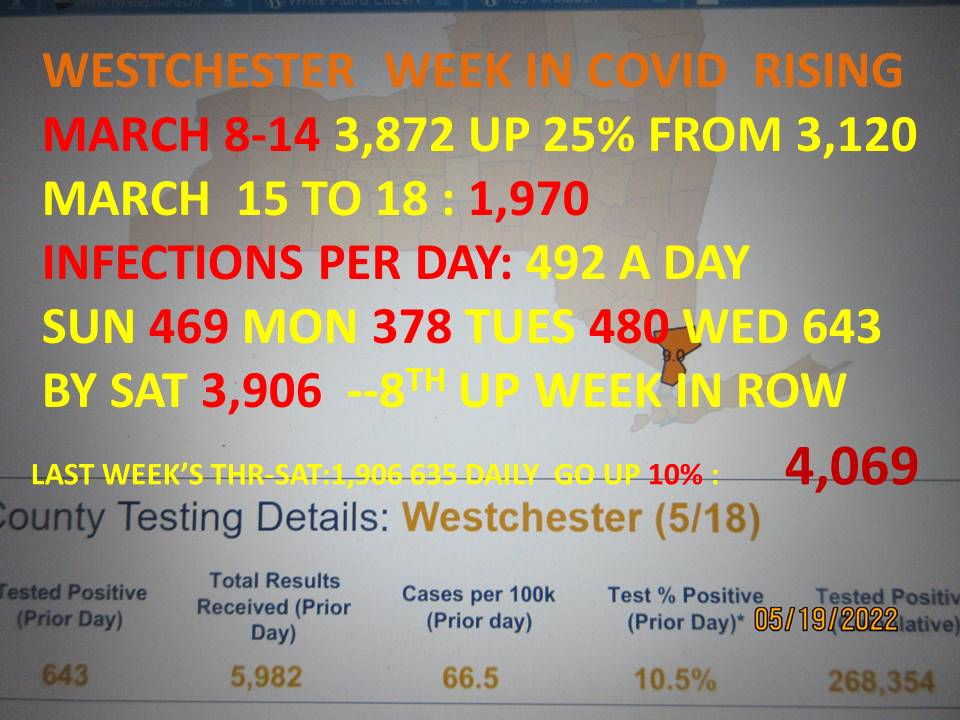
WPCNR COVID DAILY BULLETIN 11 P.M. EDT 05/19/22
WESTCHESTER COUNTY RECORDED 643 NEW COUNTY RESIDENTS POSITIVE WEDNESDAY 34% MORE POSITIVES THAN TUESDAY (480).
THE FIRST 4 DAYS THIS WEEK TOTAL 1,970, AN AVERAGE OF 492 POSITIVES PER DAY.
THE STATE’S 7-DAY POSITIVE DAILY AVERAGE IS A DAY FOR WESTCHESTER, AT THAT NEW POSITIVES PACE, THE COUNTY WILL HAVE 3,220 POSITIVES FOR THIS WEEK BY SATURDAY, DEPENDING ON THE NEXT THREE DAY POSITIVE TALLY.
LAST 4 DAY TOTAL OF 492 POSITIVES A DAY WILL YIELD 1,476 NEW POSITIVES THROUGH SATURDAY, CREATING 3,446 POSITIVES FOR THE WEEK WHICH WOULD MARK THE EIGHTH CONSECUTIVE WEEK OF INCREASES A WEEK.
THE 1,970 NEW COUNTY POSITIVE INFECTIONS AVERAGE 9.88% ON AN AVERAGE OF 4,787 TESTS PROCESSED PER DAY.
THE LOW NUMBER OF TESTS AND THE HIGHER RATE OF INFECTION ON THE LOW NUMBERS COULD MEAN THAT IF 10,000 PEOPLE WENT FOR TESTING WERE TESTED PERHAPS 1,000 A DAY WOULD BE POSITIVE WITH THE SAME 10% PER CENT RATIO THAT WOULD REVEAL AN ENTIRELY DIFFERENT PICTURE OF THE INFECTIONS AHEAD.
Hits: 362
Narcotics Reduction Program targeted large-scale fentanyl suppliers, sought to address rising overdose deaths in Westchester
WPCNR POLICE GAZETTE. From the Westchester County Department of Communications. May 19, 2022:
Beginning in June 2020, in response to the opioid epidemic and a rising number of overdose deaths, Westchester County Police launched a Narcotics Reduction Program that targeted large-scale suppliers of fentanyl and other illegal narcotics.
By leveraging the resources of the multi-agency Real Time Crime Center, collaborating with federal law enforcement partners, and utilizing precision policing strategies, the Narcotics Reduction Program has led to the seizure of significant quantities of fentanyl and fentanyl-laced pills and cocaine. Several dozen suspects have been charged by federal prosecutors with significant drug-trafficking crimes.
“Fentanyl is deadly, even in the smallest amounts. Its presence in a variety of illegal narcotics is a leading contributor to the overdose deaths we have seen in Westchester,” County Executive George Latimer said. “Reducing the flow of fentanyl into our County is literally a way we can save lives.”
Latimer said the County is focused on getting drug treatment to low-level drug offenders while targeting criminal investigations toward those who manufacture and distribute fentanyl and other narcotics in large quantities.
“Instead of investing time and effort arresting low-level users, most of whom would benefit more from treatment than incarceration, we have been able to leverage law enforcement intelligence and shared resources to directly target so-called ‘bigger fish,’ ” Latimer said.
Commissioner Thomas A. Gleason of the Westchester County Police said that the Narcotics Reduction Program utilizes investigators assigned to the Real Time Crime Center; detectives assigned to the County Police Narcotics Unit; federal agents from multiple agencies; and Patrol officers from the County Police Conditions Unit.
He said since June of 2020, investigators from the Real Time Crime Center have initiated narcotics cases that led to the seizure of:
· 453,422 bags of fentanyl packaged for individual sale;
· 94 kilograms of fentanyl packaged in bulk;
· 863 fentanyl pressed pills disguised as real prescription medication;
· 66 kilograms of cocaine;
· 41 vehicles equipped with aftermarket hidden compartments, and
· 27 firearms.
“Using cutting edge, precision-policing tactics that RTC has developed, as well as establishing a deliberate focus on inter-agency collaboration and intelligence sharing, the Narcotics Reduction Program has resulted in record breaking success,” Gleason said. “We would not be seeing these results without the invaluable assistance of our federal partners.”
Gleason thanked the Federal Bureau of Investigation, Drug Enforcement Administration, Department of Homeland Security and the U.S. Attorney’s Office for the Southern District of New York for its partnership in the Narcotics Reduction Program.
“Because Narcotics Reduction Program arrests are predominantly prosecuted at the federal level, and because one investigation is often connected to another, the County Police are not able to share the fruits of this program on a day-to-day basis,” Gleason said. “We wanted to provide this update to the public to ensure them that we are hard at work, and very successfully at work, in the effort to keep fentanyl out of our communities.”
Gleason noted that the County Police also continue to work collaboratively with local law enforcement and the Westchester County District Attorney’s Office on narcotics investigations.
Hits: 306
WPCNR THE LETTER TICKER. By Dr. Katelyn Jetelina YourLocalEpidemologist@substac.com May 18, 2022: We are clearly in the middle of an infection surge in the U.S. Hospitalizations are increasing but not reflecting case acceleration, and deaths are nearing pandemic lows. The individual risk of severe disease continues to decline thanks to immunity and treatments. This changing dynamic has sparked an intense tug-of-war among scientists, leaders, and the public—a push towards “normalcy” from some and push back towards “urgency” from others. Where one lands on this spectrum is centered around the answer to one question: Are we in a public health emergency? Challenging answer This debate will ultimately decide if, when, and how we differentiate a country-wide emergency (epidemic) from a manageable situation (a middle phase) until we reach a predictable, static state of disease (endemic). Essentially we’re collectively deciding where we place SARS-CoV-2 in our repertoire of threats. This isn’t something the U.S. has navigated in the modern day with a novel respiratory virus. In reality, our collective answer isn’t purely epidemiological, but also physiological, cultural, political, and moral. I think this is difficult, particularly in the U.S., for four reasons: No goal. The CDC defines an epidemic as “an increase, often sudden, in the number of cases of a disease above what is normally expected in that population in that area.” For the past two years, there’s no doubt we experienced a country-wide epidemic—it was novel and, by definition, above normally expected—causing a public health disaster of over 1 million deaths. Because we know SARS-CoV-2 will be with us in the foreseeable future, what is now an “unexpected increase” in disease? For example, U.S. deaths are starting to plummet which looks relatively great, but how low is low enough? One group suggested that an “acceptable” endemic level of SARS-CoV-2 would be to keep peak COVID-19 deaths in a surge below the peak of a bad flu season. As I charted below, we are far from the flu threshold. The worst flu season was in 2017-2018 where 61,000 deaths were recorded. In the first 5 months of 2022, we already surpassed this number more than 2-fold. This lands SARS-CoV-2 as the third leading cause of death. Is this truly an “acceptable” level for the U.S.? Unpredictability. If we are not in an epidemic, then we are floating in a weird middle-ground because we’re not in an endemic either. Transmission is not stable or predictable, the virus is changing quickly, and we have no idea what it will do next: Will Omicron continue to mutate in a ladder-like fashion or will it mutate to an entirely different Variant of Concern and throw us for a loop, like Omicron did after Delta? We have no idea. If we do get an Omicron-like event, when will it happen? We have models suggesting it will be in 1.5 years or 10 years. In other words, we have no idea. Will the virus mutate to become less severe or more severe? Unfortunately, viruses mutate randomly. We don’t know the next move.This means that if we’re not in an emergency today, we may be in one tomorrow. The dynamic nature of the virus is also changing the meaning of “emergency” over time. For example, during the Delta wave and before vaccines, the emergency was mortality. But during Omicron, the emergency was hospital capacity (and mortality). Some have argued that the next emergency is already in the works: morbidity due to long COVID. Our definition of an emergency will change, making it even more difficult for us to collectively define the “end” of an emergency. Fatigue. In a series of polls, it’s clear that about half the country would like to move on from this virus. In one poll, 55% of voters think COVID-19 should be “treated as an endemic disease that will never fully go away” while 38% say it should be “treated as a public health emergency.” Pandemic fatigue is real. People are losing hope. And, individual-level risk is low, so the population-level threat feels distant. The collective, national-level psyche plays a huge role in defining our collective threshold of concern about SARS-CoV-2. No safety net or trust. During the Omicron peak, Denmark boldly declared the emergency over. I was not surprised given their high vaccination rate, ability to track the virus with comprehensive data, and wide safety net of universal healthcare coverage, paid time off, etc. More than 90% of Danes approved ending the state of emergency, too. In Australia, public trust enabled them to dodge death until the vast majority of the population was vaccinated. But safety nets and trust are in short supply in the U.S. Because of this, the decision to end a public health emergency in the U.S. is particularly difficult, as it’s a question of leaving people behind and trusting institutions. This is really important to get right Practically speaking, defining an emergency is really important for funding and thus our capacity to fight. The current public health emergency declaration, for example, goes until July 15, 2022. The Biden Administration promised states 60 days notice before the declaration expires, which would have been two days ago. I would be very surprised if they let the emergency expire in the middle of a surge, but as I outlined above, the answer isn’t clear. As the Kaiser Family Foundation clearly laid out, if the emergency declaration goes away, it will be a big deal. We will see changes in almost every aspect of this pandemic response as outlined below. Together it will be more difficult to fight the virus and easier to accept the current state of affairs as “normal.” Concurrently, the White House is also trying to push two pandemic preparedness funding packages. These need to go through, but it’s unclear whether the public will prioritize pandemic preparedness if we’re not in an emergency (we tend to have short term memory loss). If pandemic preparedness is not funded, the U.S. public health system will continue the deadly and exhausting cycle of neglect and panic that we’ve experienced for decades. But is this reason alone sufficient to declare an emergency? Bottom line We are in a strange phase of the pandemic—caught somewhere between epidemic of emergency and endemic of manageable disease, determined by the push and pull of epidemiology, culture, politics, and psychology. We haven’t clearly defined our end goal, so it’s incredibly confusing to know what to think, who to listen to, or what to do. And we are tired of trying to figure it out. We, as a nation, will ultimately decide what we accept from SARS-CoV-2 based on national-level decisions (Do we fund public health to improve data systems, discover the next generation of vaccines, and support testing for Medicaid and Medicare?), institutional-level decisions (Do businesses improve ventilation and filtration? Can we build trust with the public again?), and individual-level decisions (Do we use antigen tests to break transmission chains? Do we wear masks when surging? Do we get vaccinated?). Every day we unconsciously (or consciously) inch towards the collective answer. The decision is up to us. This week we got more tools to help:You can now order 8 more antigen tests to be delivered to your home. Go to the USPS website now. The FDA approved age 5-11 boosters, but the CDC needs to approve. They meet Thursday and should approve it quickly thereafter. On June 8, 21, and 22, the FDA meets to discuss the under 5 vaccine. The FDA approved a 3-in-1 Labcorp test that can detect COVID, the flu, and RSV. Specimens have to be mailed for testing (questioning broad feasibility), but this is a step in the right direction. “Your Local Epidemiologist (YLE)” is written by Dr. Katelyn Jetelina, MPH PhD—an epidemiologist, biostatistician, wife, and mom of two little girls. During the day she works at a nonpartisan health policy think tank, and at night she writes this newsletter. Her main goal is to “translate” the ever-evolving public health science so that people will be well equipped to make evidence-based decisions. This newsletter is free thanks to the generous support of fellow YLE community members. To support the effort, please subscribe here:Subscribe nowLikeCommentShare Thanks for subscribing to Your Local Epidemiologist. This post is public, so feel free to share it.Share© 2022 Your Local Epidemiologist Unsubscribe 548 Market Street PMB 72296, San Francisco, CA 94104 |
Hits: 362
WPCNR POLICE GAZETTE. From the Westchester Office of the District Attorney. May 18, 2022:
Westchester County District Attorney Miriam E. Rocah announced that Ingrid Aquino, the former Director of Finance of Hudson Valley Community Services in Hawthorne, was indicted for stealing over $700,000 from the non-profit healthcare organization between 2017 and 2021.
Aquino, 31, of the Bronx, was indicted by a Westchester County Grand Jury for Grand Larceny in the Second Degree, a felony. The defendant was arraigned on May 17, 2022.
It is alleged that between November 2017 and September 2021, Aquino stole over $700,000 from Hudson Valley Community Services while employed as the Director of Finance. During that time, the defendant allegedly wrote more than 150 checks from the non-profit healthcare organization that were payable to her and her husband.
The District Attorney’s Office arrested Aquino on May 2, 2022, following an investigation.
The case is before Judge Anne Minihan in Westchester County Court, and is being prosecuted by Assistant District Attorney Cooper Gorrie of the Trials and Investigations Division.
The charges against the defendant are merely an accusation, and the defendant is presumed innocent unless and until proven guilty.
Hits: 296
WPCNR WESTCHESTER CRITICAL. By John F. Bailey. May 18, 2022:
Last Sunday, as America became aware of the formula crisis when the Food & Drug Administration announced it to everyone’s surprise.
One, just one public leader in the entire state immediately suggested a way to do it, Paul Feiner, Town Supervisor of Greenburgh came up with an idea to “find that formula,” in a letter to the public, which WPCNR printed:
“Many parents with babies are stressed because they are having a difficult time getting the formula they need for their child. I would like to help. If you are having difficulty finding a formula your child needs please e mail me at pfeiner@greenburghny.com. I will be asking student interns and volunteers to help you find the formula and will also connect you to resourrces that we become familiar. There are formula finder sites on social media. Will also reach out to medical professionals, other parents and find out if there are substitute formulas that your child can use.”
Two days since that letter appeared, I contacted Mr. Feiner this morning and asked him how the Formula Finding operation has started.
He issued this statement Wednesday morning to WPCNR:
“I have helped a few residents so far -100% success.
In each of the cases I have posted on social media requests for bottles/cans of formula and residents have donated unopened or unused formulas.
I thought more people would contact me. Have also been posting on the town website advisories on what parents can do if they need a formula.
Some student interns are working in my office – preparing a fact sheet –listing social media sites parents can access for help.
Also people can contact Amazon Canada and get formulas.
The students are going to interview doctors, nutritionists, host a cable TV show highlighting their findings. Working on this. Will share their fact sheet when it’s completed.”
For perspective, WPCNR has seen no news conferences on formula availability locally, no information from the state, the county, any Department of Health, doctors organizations, hospitals, or any other towns, pharmacies, food chains in the county, or local stores in either White Plains or any city for that matter, on the state of formula supply in the county.
Where is the urgent information on breast feeding how to get women who are delivering today can use their own breast milk to keep their babies alive, and prepare to do so?
Now I am not a doctor, or even pretend to make medical decisions, but the mothers scheduled to deliver babies in the next two months need to be briefed by their hospitals, delivering doctors and pediatricians (if not already which I automatically assume the moms-about-to-deliver have been briefed) on the need to be able to breast feed their babies for at least 2 months.
Or 3 months because the Food & Drug Administration has given Abbott, the manufacturer of formula 8 weeks to clean up their plant that they closed after the contamination was found.
Reuters Explainer reported Tuesday that once the FDA approves that “initial” requirements have been metanufacturing could begin in two weeks. Peter Pitts of the Center for Medicine in the Public Interest, a former FDA commissioner said after the 2-weeks to reopening, full plant capacity could happen in 4 to 6 weeks.
Peter Pitts, president of the Center for Medicine in the Public Interest and former FDA associate commissioner, said Abbott should be able to meet its two weeks target for re-opening the facility, and expects it to be fully operational in another four-to-six weeks.
No explanation from the NY Times press report Tuesday on why Abbott Laboratories did not start cleaning out the Sturgis, Michigan plant when they closed it in February which manufactures Abbott baby formula, because cronobacter bacteria, from which 4 babies (according to Reuters Explainer yesterday) who had consumed Abbot formula sickened and two died.
Abbot Laboratories has denied that that the cronobacter bacteria was in the formulas the 4 babies consumed, Reuters Explainer chronicled the possible connection that started the recall of Abbott products Similac, Alimentum and EleCare powdered formulas. A specialty liquid formula called Similac PM 60/40 was added at the end of February. Of the four infants found sick, three had cronobacter sakazakii infections, and one Salmonella newport
Consumers reported four infants who were sick, including three with Cronobacter sakazakii infections and one with Salmonella newport, who had been fed formula products made at the Sturgis plant. A fourth infant with cronobacter sakazakii was later added.
Cronobacter sakazakii can cause life threatening sepsis infections or meningitis and may have contributed to the death of two of the infants, the U.S. Food and Drug Administration has said.
Abbott says there is no evidence to link its formulas to these illnesses.
The FDA and the CDC has not put out any information that connects the illnesses and the plant. FDA officials said that the investigation was impeded by having only two of the four sickened babies’ clinical samples.
The CDC analyzed clinical samples from two of the infants and did not find a genetic match to the environmental strains found at the plant. It also said the bacteria from the patient samples were not closely related to one another.
The FDA and Abbott tested environmental and product samples at the plant. They found five environmental samples containing Cronobacter sakazakii. The product samples tested negative.
At this writing there have not yet been reports of such infections or deaths of babies from the Cronobactor sakazakii from products shipped overseas

Hits: 226
WPCNR ALBANY ROUNDS. From the Governor’s Press Office. May 18, 2022:
Governor Kathy Hochul today announced the New York State Division of Human Rights has filed a complaint against Amazon, Inc. alleging the company engages in discrimination against pregnant workers and workers with disabilities by denying them reasonable accommodations.
The Division also alleges that Amazon has policies that force pregnant workers and workers with disabilities to take an unpaid leave of absence rather than allowing them to work with a reasonable accommodation.
“My administration will hold any employer accountable, regardless of how big or small, if they do not treat their workers with the dignity and respect they deserve,” Governor Hochul said. “New York has the strongest worker protections in the nation and was one of the first to have protections for workers who are pregnant and those with disabilities. Working men and women are the backbone of New York and we will continue to take a stand against any injustice they face.”
The New York State Human Rights Law requires that all employers, upon request, reasonably accommodate workers with disabilities or pregnancy-related conditions.
This can include modification of job duties that allow an employee to perform the essential functions of their jobs.
Amazon, which operates 23 worksites with over 39,000 workers across New York State, employs in-house “Accommodation Consultants” to evaluate such requests and recommend appropriate action. The Division alleges that Amazon’s policy of allowing worksite managers to override the recommendations made by the Accommodations Consultant have caused Amazon employees to be denied reasonable accommodations for their disabilities and pregnancy-related conditions.
The Division further alleges that under Amazon’s accommodation policy, employees with disabilities are forced to take unpaid medical leave even in situations where the Accommodation Consultant has identified a reasonable accommodation that would allow the employee to perform the essential functions of their position without an undue burden. The policy or practice of forcing employees to take an unpaid medical leave of absence diminishes the terms and conditions of employment for employees with disabilities and is against the Human Rights Law.
Division of Human Rights Deputy Commissioner for Enforcement Melissa Franco said, “Since the 1970s – years before the Americans with Disabilities Act – New York State has prohibited discrimination against pregnant employees in the workplace. The Division will work to ensure that everyone in our state is fully afforded the rights and dignities that the law requires.”
In its complaint, the Division alleges a pregnant worker requested and was approved to receive a reasonable accommodation to avoid lifting packages over 25 pounds. However, the worksite manager refused to follow the accommodation – forcing the worker to continue lifting heavy packages.
Despite internal complaints about the lack of accommodation, Amazon took no action to ensure the needed change was carried out and the pregnant worker suffered an injury while lifting heavy packages. Subsequently, the worker required further accommodations as a result of the injury. Amazon denied the request and forced the pregnant worker into indefinite unpaid leave.
The Division alleges that another Amazon worker was improperly denied when they requested a modified work schedule due to a documented disability.
The worker’s condition necessitated a specific sleep schedule and the worker submitted supporting medical documentation with the request. Prior to the request, the worker had been swapping shifts with a coworker to accommodate this condition without objections from management.
Amazon’s Accommodations Consultant recommended that the worker be given the requested modified work schedule. However, the worksite manager refused to implement the accommodation without offering any explanation. The Accommodations Consultant did not challenge the manager’s refusal. Rather, the Accommodations Consultant reversed their recommendation and denied the request citing a lack of a qualifying condition – despite the medical documentation they had previously received.
In another instance from the Division’s complaint, the agency alleges that a worker who requested a reduction of work hours due to disability was denied an accommodation, despite initial approval by an Accommodations Consultant.
The Amazon worksite manager refused to change the worker’s schedule even after several weeks of correspondence with the Accommodations Consultant. Eventually, Amazon determined that the request was not supported by sufficient medical documentation. Rather than continuing a dialogue with the worker to obtain appropriate medical documentation as New York State law requires, Amazon denied the request and closed the matter.
The Division’s complaint seeks a decision requiring Amazon to cease its discriminatory conduct, adopt non-discriminatory policies and practices regarding the review of requests for reasonable accommodations, train its employees on the provisions of the Human Rights Law, and pay civil fines and penalties to the State of New York.
The Division of Human Rights is empowered by law to investigate and prosecute systematic patterns of discrimination through their Division Initiated Action Unit. This Unit can, upon its own motion, initiate investigations and file complaints alleging violations of the state anti-discrimination law. Once filed, a separate unit within the Division investigates the complaint and issues findings. Complaints that are found to have probable cause are then set for an administrative hearing before the Division’s Hearings Unit. Although the complaint is a private document, the Division’s final determination on the complaint will be available to the public. For more information on the Division of Human Rights’ process visit www.dhr.ny.gov.
Hits: 219