Hits: 456
|
|||||||||
|
|||||||||
|

Hits: 456
|
|||||||||
|
|||||||||
|
Hits: 252
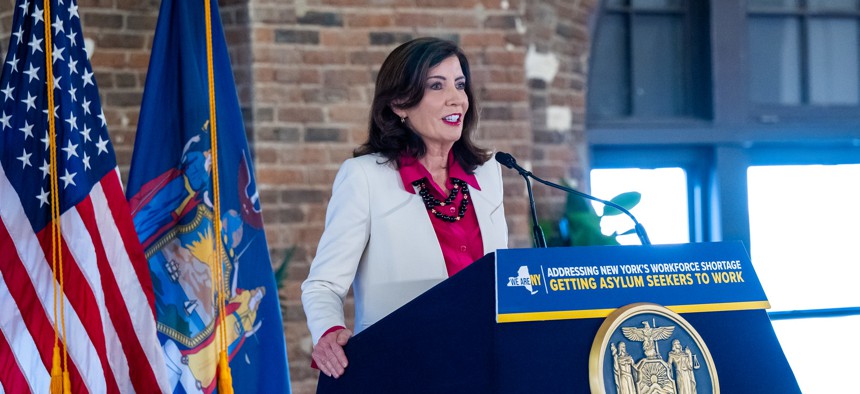
Gov. Kathy Hochul announces 18,000 jobs available to asylum-seekers and migrants as part of statewide initiative to move individuals out of shelters. SUSAN WATTS/OFFICE OF GOVERNOR KATHY HOCHUL
As both New York City and state officials continue to try and discourage more migrants from coming to New York, Gov. Kathy Hochul said on Monday that employers in the state are ready to hire asylum-seekers once they receive work permits.
During a press conference in Manhattan, Hochul announced that nearly 400 employers from across the state had signed up to participate in a state Department of Labor program meant to connect migrants authorized to work with jobs. According to her, that translated to roughly 18,000 jobs.
“That can help solve our problems, at least a start towards reducing the number of people who need shelter in our city,” Hochul said. Venezuelans who arrived in the country by July 31 will be eligible to apply for Temporary Protected Status beginning on Tuesday, meaning that some would be eligible to receive work authorization and can begin filling those jobs.
According to data released by Hochul’s office, over half of the jobs would be in New York City, with the rest scattered across the rest of the state. After the city, the Hudson Valley, Western New York and Long Island would have the most jobs among employers who have signed up. The 379 employers also represented a range of industries, with the most – 24% – from the hospitality and food service industries.
“When I think about all the folks that have come to New York City seeking asylum … they want to work hard, they want opportunity,” said Andrew Rigie, executive director of the New York City Hospitality Alliance. “And we know our city’s restaurant industry represents that opportunity.” Rigie was one of three representatives of the food and hospitality industries to speak at the Monday press conference.
Health care and social assistance were 79 of the employers, or 21% of the program’s participants. That made it the second-largest industry to sign up to connect with migrants, but no representatives from the field spoke at the press conference hosted by the governor.
Asked for a list of the largest participating employers, particularly in health care, a spokesperson for the state Department of Labor said they did not have a full list, but added that Premier Home Health Care Services is one of the larger health care employers participating in the program.
The company has offices in Manhattan, Long Island, Westchester County and Staten Island. And a spokesperson for the Greater New York Hospital Association told City & State that it is currently trying to determine if any of its members are participating. A spokesperson for the New York Health Plan Association also did not immediately have information regarding which, if any, of its members signed up.
Other industries made up smaller percentages of participating employers. The third-largest number of employers came from manufacturing, from which 38 companies signed up, or 10% of all employers so far. After that was 8% in administrative support, 7% categorized as “other,” and 5% each for construction and retail. No representatives from any of these other fields spoke at the Monday press conference.
The announcement came on the heels of comments that Hochul made over the weekend on CBS’ “Face the Nation” calling on the federal government to impose “a limit on who can come across the border.” She said that the border is “too open right now” and that many people asking for asylum are “ending up in the streets of New York.” A top adviser for New York City Mayor Eric Adams also called on federal officials to “close the border” on Sunday.
Asked by reporters whether the statement went too far as Republicans seized on it, Hochul demurred. “I’ve been in the business long enough to know that no matter what I say … they will interpret it and misinterpret it and lie about it in any way that suits their political interest,” Hochul said.
Hits: 256

COVID CASES IN COUNTY DOWN 42% AFTER 14 INCREASING WEEKS
BEYOND PLASTICS WEBINAR EXPOSED THE PLASTIC PLAGUE OF ENDOCRINE-INTERRUPTERS CHEMICALS. DR. PETER MEYERS OF ENVIRONMENTAL HEALTH NETWORK EXPLAINS IN KEY VIDEO

STATE SENATOR PETER HARCKHAM SPONSORS NY PLASTIC PACKAGING LAW THAT WOULD MAKE PLASTIC PACKAGING HAVE TO RECYCLABLE IN 12 YEARS

AFTER CITIZENS COMPLAIN, COUNCIL REVISES BAN ON COMBUSTION-FUELED LEAF BLOWERS ALLOWING THE USE OF THE PREVIOUS BANNED IN WHITE PLAINS BLOWERS IN FALL.

CAITLIN RIVERS DEBUTS ON WPCNR “THIS WEEK IN OUTBREAKS–THE NORTHEAST”
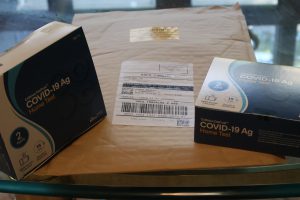
FREE ANTIGEN TESTS FROM WASHINGTON ARE GOING OUT ACROSS AMERICA ORDER YOURS FREE
KEEP LOWERING COVID INFECTIONS BY MAKING SURE YOU ARE NOT POSITIVE

JOHN BAILEY AND THE NEWS THAT AFFECTS YOU MR. AND MRS AND MS. WHITE PLAINS
REPORTING EVERY WEEK ON WHITE PLAINS WEEK FOR 22 YEARS
Hits: 405

THE NEW SEASON
HOW THE WPPAC HAS GROWN IN 20 YEARS
THE GALA IN NOVEMBER
PREVIEWS OF THE NEW SEASON.


Hits: 253
White Plains Hospital Continues seeing 60% of Patients Admitted positive for covid.
WPCNR COVID SURVEILLANCE. Data from New York State Covid Tracker. Observation & Analysis by John F. Bailey. October 4, 2023 UPDATED WITH FREE ANTIGEN TESTS ORDERING INFO:
Westchester County new covid cases dropped the first week in 14 weeks (dating back to the last week in June, sEPT 24-30 last week, recording 1,081 persons testing positive for covid, down from 1,242 the week of Sept 17-23.
In the last week, the prevalence of covid in the area is evidenced by White Plains Hospital official admissions figures reported to the New York State Board of Health.
White Plains Hospital reported September 22- Oct 2, 73 persons were admitted to beds, and after being admitted 43 or 59%, were found positive with Covid. This continues the trend at White Plains hospital established the last 9 months with half to 60% of admissions found with covid after admission.
What I take from this is that people are not testing themselves when a procedure is scheduled. Or not testing in a timely manner. Like 3 days before they go in for what every procedure they have scheduled.
However in two weeks since mid-September the spread of the disease has dropped significantly.
As of September 22 Covid disease was spreading in the boroughs of New York City at the rate of 1,537 new covid cases a day. As of October 4, the New York city cases were down to 683 a drop of 56%!
Nassau and Suffolk were spreading at the rate of 700 new cases a day on September 22,.
On October 4, Nassau and Suffolk Counties reported 297 covid positives, also down 50%
The Mid-Hudson Region two weeks ago September 22 saw Westchester leading infections with 161, Orange and Rockland with 78, Dutchess, 48, and Sullivan, with 11 and Putnam 7 for a total of 383 cases a day.
In my opinion, Orange, Rockland and Dutchess had been gaining in cases in midweek up to about a week ago, now those counties seemed to have stabilized their spread, somewhat
October 4 Westchester dropped to 93 cases from 161 – a 42% DECREASE in cases!
The other 6 Mid-Hudsons showed Orange at 45, Rockland, 34, Dutchess, 24, Ulster, 11, Sullivan 11 and Putmam 5
The number of antigen (home test positives) lab verified is running 33% of new covid cases in New York City.
In Westchester, 38 of Westchester’s 93 positives October 4, were as a result of lab tested antigen tests. Indicating that persons who are experience cold or slight fever, should take this as a reason to take a home test to see if they might be positive and go for treatmemt if you test positive.
In Westchester the antigen test verified cases of the 161 Westchester total is 32%. In Nassau and Suffolk County people are getting covid at the highest rate of all 7 counties and New York City. Of 700 total covid positives in Nassau and Suffolk Counties, 52% of the case, 361 were verified antigen positives. That says to me people are getting sick, and going for antigen tests, testing positive with the ominous “+” sign and going for treatment.
This seems to indicate that Westchester residents are taking having antigen tests at home is a good idea to test if they seem sick or have heard of persons infected they have seen recently.
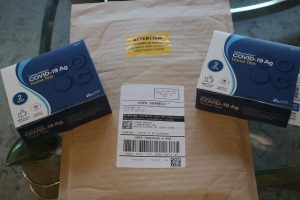
A reminder: The U.S. Government is supplying antigen tests free. The tests are free and you receive them within a week by mail. If you have none you might want to get some and mingle with confidence, rather than infect friends and relatives, buddies or significant others.
They are available online direct from the United States Postal Service and they are FREE.
BEWARE of any one calling you at home offering Antigen tests, and wanting a credit card number. It is a scam.
Hits: 1667

The White Plains Common Council voted 4-3 Monday evening, to modify the city’s ban on gas-powered leaf blowers all year long, the original leaf blower law.
Beginning October 15 residents and businesses will be allowed through the fall season through the end of November to use gas powered leaf blowers. Previously, they were banned throughout the year, which according to residents’ observations of violations was widely ignored by groundskeeping businesses servicing neighbors, residents themselves themselves and even the White Plains DPW using gas blowers to clean up the July fireworks night with authorization, the Mayor said. The school district has also been alleged to use gas leaf blowers
As a result of numerous videos and pictures submitted by residents to the Mayor’s office and councilpersons documating violations, the Common Council discussed the situation among themselves and Councilperson John Martin “crafted” a compromise ordinance, eliminating the ban of gas-powered leaf blowers beginning October 15 THROUGH DECEMBER 15,
in the video replay of Monday’s meeting, Councilpersons Martin, Jennifer Puja, Nadine Hunt-Robinson,and robert Paine voted to amend and allow the the fall use of gas blowers. Mayor Roach, Councilperson Brasch, Councilperson Victoria Presser voted against weakening the law.
All 7 councilpersons had extensive comments and those may be viewed on the city website at
http://whiteplainsny.swagit.com/play/10032023-520
and select item 4 on the program
Mayor Roach speaks for 20 minutes on why he voted against the law.
Hits: 253


Yesterday, the 2023 Nobel Prize Winners for Physiology or Medicine went to Drew Weissman and Katalin Karikó for their discoveries in the biotechnology behind our Covid-19 mRNA vaccines.
Behind the amazing story of perseverance and collaborative spirit (it’s a fascinating story) is an absolutely revolutionary scientific discovery.
Here is the problem they solved, how we leveraged it for the pandemic, and the far-reaching implications.

In 1961, we discovered RNA in living things. RNA is a string of letters that gives our cells instructions on how to function.
At first, scientists explored how synthetic messenger RNA (mRNA) could be leveraged in gene therapy. This was attractive because it meant we didn’t actually have to change our DNA. There would be no risk of accidentally introducing mutations that could affect how healthy genes work or, worst case, cause cancer.
But, every time mRNA was introduced to cells for gene replacement, it caused a profound immune response. In other words, our immune system was doing its job: recognizing a foreign agent and trying to get rid of it.
This caused scientists to pivot as there is an obvious application for a situation where you want an immune response: vaccination. In 1993, an mRNA influenza test showed successful induction of anti-influenza T cells in mice. This was incredibly exciting.
But there was a major challenge: the mRNA vaccines activated the immune system too early. This resulted in a mediocre antibody response and diverted T cells from a pathway that supported antibody production.

Enter Karikó, an RNA biochemist, and Weismann, an immunologist.
Karikó was confident she could fashion a vaccine from mRNA but encountered the same stubborn problem: the mice had trouble coping with the immune response after the mRNA vaccine. The quality of the immune response wasn’t as good as she’d hoped for either. Why did Karikó’s synthetic RNA do this when our cells constantly made mRNA with no such problem? Karikó’s RNA had to differ from the RNA our cells made, but how?
In 2005, Karikó and Weissman found the secret sauce: a group of RNA letter changes (i.e. modifications). A particular modification stood out: the change of U (uridine) to Ψ (pseudouridine, a common modification in our own RNA) prevented the immune system from recognizing the mRNA as foreign. They published these findings in Immunity, one of the top journals in the field of immunology.

As the 2010s progressed, mRNA vaccines trickled into early-phase clinical trials. However, another matter still limited confidence in the approach: mRNA is so fragile that it is very difficult to work with and requires very cold storage conditions.
Then the pandemic came. While we had a key puzzle piece above, there were also other things that needed to come together:
All of these were accomplished; the perfect storm that brought together scientific discovery, extensive investment, and global teamwork.
It is not an understatement to say that their discovery totally transformed our approach to vaccines. You would have a hard time naming a virus of public health importance for which an mRNA vaccine isn’t being attempted, but there are uses beyond that:
Your mRNA Covid-19 vaccine is Nobel Prize-worthy. And an excellent example of our gains from the decades-long road of scientific discovery.
Congratulations to Karikó and Weissman! Their work has saved millions of lives already and will continue to save millions more in the decades to come.
Love, YLE and EN
“Your Local Epidemiologist (YLE)” is written by Dr. Katelyn Jetelina, M.P.H. Ph.D.—an epidemiologist, wife. During the day, she is a senior scientific consultant to several organizations. At night, she writes this newsletter. Her main goal is to “translate” the ever-evolving public health world so that people will be well-equipped to make evidence-based decisions. This newsletter is free, thanks to the generous support of fellow YLE community members. To support this effort, subscribe below:
Hits: 243
Editor’s Note from John Bailey, The White Plains CitizeNetReporter: Good morning! Today introduces a new timely addition to White Plains CitizeNetReporter. Dr. Caitlin Rivers of Johns Hopkins University, who publishes Force of Infection, is introducing a new regional edition of her newsletter which zeros in on the numbers up close and personal in the northeast. WPCNR is a paid subscriber of this new source of clarity on covid as the New York metropolitan area is matching last September covid cases and enters the fall season when last year new infections lead to thousands of infections last January. This Week in Outbreaks is published for the first time today and is reprinted with permission.
Welcome to the Northeast edition of Outbreak Outlook, formerly called This Week in Outbreaks! This content is only available to paid subscribers. As I am launching the regional editions, your feedback and support is invaluable. Thanks for reading! -Caitlin
Influenza-like illness (ILI) has increased for several weeks now in the Northeast. Around 2.3% of visits to the doctor were for ILI symptoms, which include fever and cough or sore throat. This is a significant increase over last week’s 1.8%. Current levels are similar to what the Northeast region saw at this time last year.
While most states in the region fall in the “minimal” or “low” ILI activity categories, New York City stands out, currently categorized as “high.”
Since it’s still the off-season, I was not able to find additional details about what is going on in NYC. More detailed information on influenza-like illness will become available later this month, when states begin to turn on their ILI surveillance systems and pay closer attention to what is going around.
At the national level, the littlest kiddos are still the most affected by ILI. Nearly 7% of visits to the doctor’s office were for ILI symptoms among kids ages 0-4, up from a recent low of 4%. Older kids, ages 5-24, are faring better at 3.2%. All adult age groups report rates below 2%.
Covid-19 activity has not yet peaked in the Northeast, but the number of new hospitalizations has begun to level off. Wastewater concentration has also plateaued, according to data from Biobot. Taken together, I think the summer Covid-19 wave is currently at peak in the Northeast and should begin dropping soon. The other three regions have already started seeing a decline. It’s reassuring that hospitalizations in the Northeast are still significantly lower than last summer’s uptick.
Don’t forget that the new Covid-19 vaccine is now widely available, and you can get four free at-home tests from covid.gov/tests. I ordered my tests last week, and they haven’t arrived yet; delivery may be delayed.
RSV activity is low in the Northeastern region. As a reminder, new shots are available for infants, older adults, and now pregnant women.
All the other respiratory virus that I keep an eye on — seasonal coronavirus, human metapneumovirus, parainfluenza virus, and adenovirus —look good for the Northeast.
Norovirus activity increased for several weeks during the summer but is now on the decline in the Northeast. PCR test positivity was 5.8% at last report, a decrease from the recent peak of 9%. Despite the decline, these figures still highlight a moderate level of ILI activity. Norovirus rates are usually lowest in summer, then rise through autumn and winter before peaking in springtime.
The following foods were sold and are now being recalled because they are contaminated. Please check your cupboards and throw out any of these items:
New this week:
Previously reported:
Hits: 275
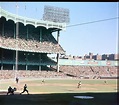
“GLORY DAYS” PASS YOU BY
WPCNR View from the Upper Deck By “Bull” Allen. October 1, 2023 UPDATED OCTOBER 3, 12 NOON::
Hello there, Everybody!
This is Bull Allen and this is the last day of the baseball season. I’m greeting you from the mezzanine Press Box of the Old Big Ball Park as the Old Redhead used to call it, behind the PIX microphone.
The old Yankee Stadium went out to 461 feet to three monuments that were in play and 301 down the line in left and 296 down the rightfield line. The yard swiftly curved out deep to an immense cow pasture of outfield to the leftfield bull pen to 457 feet in left center and dead center 461 feet, then cut sharply back in front of the majestic bleachers to 357 feet in dead right in front of the Yankee Bullpen down to 344 feet and short four foot wall over to the 296 foot foul pole
New York was in 9 World Series in the 1950s, and games were started at 1 PM in New York and the left field in the stadium became a blinding sun field as the regal shadows of the sharp-raked grandstand caused the sun sinking around 3 PM early to make it very tough for leftfielders and centerfielders to pick up the ball. I saw Norm Siebern, the Yankee leftfielder lose two balls in the sun in the 4th game of the 1958 World Series to give Milwaukee 3 runs in and give Warren Spahn a 3-0 shutout. It was brutal.
Nowadays most playoff and World Series games are played at night for television. No longer does the sun play like a 10th player at the new Yankee Stadium
The series was played in 70 degree weather, too. Kids listened to the last innings on transistor radios at their desks if teachers were tolerant.
With expanded playoffs and the expensive lineups fielded by the Yankees and Metropolitans, they were picked to win at least a playoff spot.
Neither did.
I am greeting you from the sun splashed diamond in The Bronx. No game today. No games until next April, except of course, for the baseball playoffs, 12 teams going through 162 games to get to the World Series, with the possibility that a 6th place finisher could make it to the World Series.
Neither New York team made the playoffs—how I hate that word – and some profound changes in the way the game was played under the new rules in the interest of speeding up the game — just might have had something to do with that.
The Yankees almost finished below .500 for the first time in 30 years, Going on a 7-0 burst to assure a .500 season. The irony is they had been able to do one 10 game winning streak earlier in September they would have nosed out Toronto for a playoff spot.
Watching up here in the Mel Allen Memorial WPIX Television booth looking at the empty autumn splashed park of memory, I remember the pall of the 1965 season when the Yankees of the early 60s collapsed in 1965 under the managership of Johnny Keane, who replaced Yogi Berra. The Yankees went 77-85 that year, sixth in a 10-team league. But even then, the team never gave up. Mantle played hurt. This year something happened. The game had changed: hitters had to learn to hit faster because the pitches were coming faster every 20 seconds. Hitters did not have time to think.
They lost Judge to an injury because the Dodger Stadium did not pad their rightfield bullpen fence.
This took the fear out of the lineup.
But the hitting was not there all season, even before Judge was carrying the team. Funny thing is, I figure having Judge in the lineup at his 2022 62 homer season form would have won them 10 more games at least which would have given the Yankees 92 wins, enough to make the playoffs.
Aaron Boone could not motivate this team for any kind of a “stretch drive.” (Remember 1978? The Yanks were 14 out in early August. Bob Lemon replaced Billy Martin as manager, and the Yankees caught the Red Sox.
But for some reason there was no urgency in the last three months of the season. This is a problem.
But the Bronx Bombers management cannot just say we’ll be all right next year with Judge at his old best.
When Joe D hurt his heel in 1948, he returned in mid-1949. However His homers dropped by half in his final 3 seasons. 1950-1953.
I think the new pitching rules hurt the Yankee free-swinging hitters because pitchers pitched faster and the hitters did not have the time to adjust as to what pitch was coming next, making good pitches better, causing “GUESS SWINGS.”
Think of it:
In 5 pitches if the pitcher throws every 20 seconds, the hitter has less than 2 minutes in the box. In the past hitters could call time, get set and think. This season the Yankees struck out a lot, left too many on base or did not situational-hit or even try to hit the ball behind the runner either by bunt, hit and run, or hitting to the right or left side. They had big problems getting sacrifice flies when they needed them. The manager, Aaron Boone never played for building a run, waiting for the power hitters to homer. They did, not enough with runners on base.
The other problem the Yankees had was starting pitchers going more than 5 innings.
Gerrit Cole was the only pitcher who consistently approached that standard, including a complete game shutout, 2-0.
With “lift them early or too late” Aaron Boone, the Manager created a pitching nightmare for his bullpen. With half a game starters departing in the 4th, 5th or maybe beginning in the 6th , he needed four to 5 pitchers from the bullpen every day.
Manager Boone used a squad of relievers who were notoriously sketchy and unreliable in their appearances. The bullpen was either very very good, or very very bad. Aaron Boone’s pitching management wore out the bullpen, and Yankee failure to add a starter or two who could pitch via a trade before the trade deadline, I believe lost the playoff spot..
How do you fix the Yankees to contend next season and score more runs, and give up less?
The infield defense has to be improved. The team did not make plays in the clutch especially in the crucial extra innings sudden death situation.
Manager Boone just played Extra innings straightway. He did not walk a hitter with the inning starting with the go-ahead runner at second base which forces the team to bunt to move the runner, and if they do not bunt you have a shot at a double play. If he does not want to take chance for a double ball he needs to hang up the runner between 2nd and third and protect third base. he Yankees were hideously unsuccessful in extra inning games, 9-10. That’s 10 games right there and you’re in the playoffs.
The batting strategies Aaron Boone used were few. Not enough bunts, hit and runs, more stolen base attempts. The hitters got worse and worse all season long, striking out dismally when runners were in scoring position.
The Yankees cannot “wait til next year” to get better starting pitchers, more consistent starting pitching and relievers who can start innings with the bases empty and not walk people, and not throw first pitch fastballs.
They need to develop their better minor league starters into 2nd starting pitchers who come in in the sixth and start pitching well with the bases empty, that’s what starters learn to do. That could replace the bullpen committee inconsistency which cost us a lot of ball games.
The closer and setup men cannot come in every day—they tire as they showed so often this season. This is bad pitching management.
Younger hitters have to be developed to be contact hitters able to connect with men on the bases.
Looking over to Queens at Citi Field where the Mets faded in June and never got brighter.
They too were hurt by by non performance by their hitters and bitterly mediocre performances by Verlander and Scherzer.
I have a hunch that those two control pitchers who relied on making the hitters wait and had to pitch faster.
I believe this pitch and pitch again in 20 seconds, affected their abiliy to throw the pitches they wanted both in pitch selection and ability to throw their “out” pitches as accurately due to the pitch clock making their deliveries hurried. Speeding up the interval between their pitches may have hurt their arms just a tad reducing their effectiveness and control. Whatever they were not the pitchers they were. On the other hand the pitchers were “fast-pitching” the hitters and keeping them off-balance, affecting the free swingers greatly.
The Mets had an inconsistent defense in their infield which cost them a lot of games due to errors, not knowing game situations, throwing to the wrong base, and outfielders throwing behind the runner allowing an extra base, not hitting the cutoff man.
There was also a lot of poor base running by the Mets, killing rallies.
For that matter the Mets big boppers did not bop under the new 20 seconds to pitch rule. I believe two teams, Yankees and Mets loaded with veteran power hitters experiencing the same inabilities to hit with the power and ability to connect striking out so much it was stunning, is no coincidence.
I think both teams need new managers, and younger players used to the 20 seconds game with better pitchers.
This managerial change is being brought to you by the Mets: Buck Showalter, Met manager relieved today by Met management, saying Mr. Showalter’s contract would not be renewed. The Met players left the dugout and gave him a standing ovation when Buck walked up to homeplate with the lineups.
Out in Kansas City, where it is 90 degrees and sunny there is no word whether this is the last game for Aaron Boone out in Kansas City where the Yankees will keep him on. They lost 5-2, to finish 82-80. Had the Yankees played better and won 10 more games in July and August they make the playoffs at 92 and 70.
July and August were a dismal, very un Yankee performance by players, front office and the manager and the owner.
The younger players coming up are faster and better defensively especially in the outfield. Speed in the outfield is very essential for both clubs—as well as good hands and heads on the infields.
The pitching coaches have to be better. Pitching effectively is not just pitch counts. Until the Yankees and Mets develop 5 pitchers who can start and deliver 7 innings, they will not improve.
Here is my take on the new rules:
The Extra Inning runner on second I detest. It is not needed because the pitching is so thin.
The anti-shift rule is making outfield play better and once the pitch is thrown infielders can shift run where they expect the ball to be hit. They just need to be faster.
Attendance is up according to my colleague, John Vorperian. So the rules are here to stay.
But ballplayers are smart. They are already adjusting.
Now if only commercials during radio broadcasts can be limited only between innings, and not every in-inning event be followed by a ”brought to you by tagline.”


19 mins ago
Thank you so much for this! I was so excited to see your newsletter, for the north east region, in my inbox this morning. Your work is so valuable. So thankful for you.