Hits: 376
|
Hits: 376
|
Hits: 1698
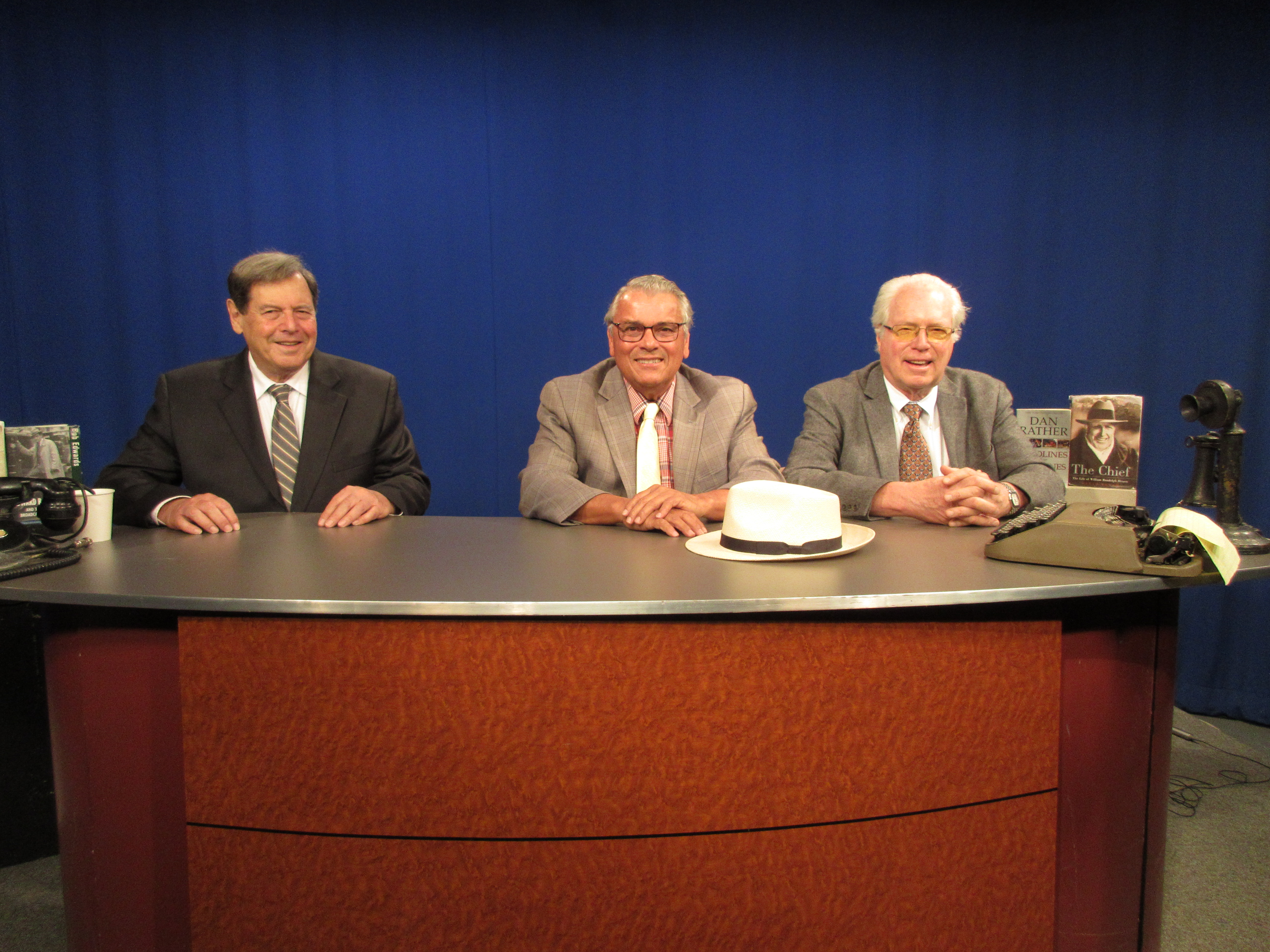
MORE REAL NEWS THAN REAL NEWS IS
WHITE PLAINS WEEK
THE AUGUST 26 PROGRAM
ON THE INTERNET NOW

JOHN BAILEY
JIM BENEROFE
PETER KATZ ON
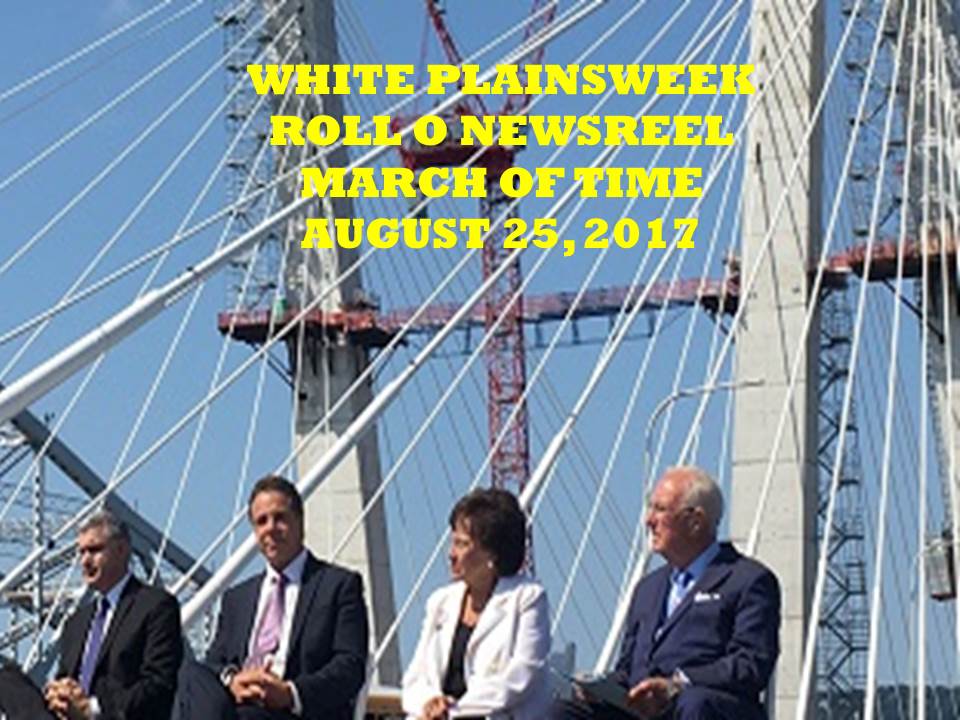
VIDEO COVERAGE OF MARIO CUOMO BRIDGE OPENING
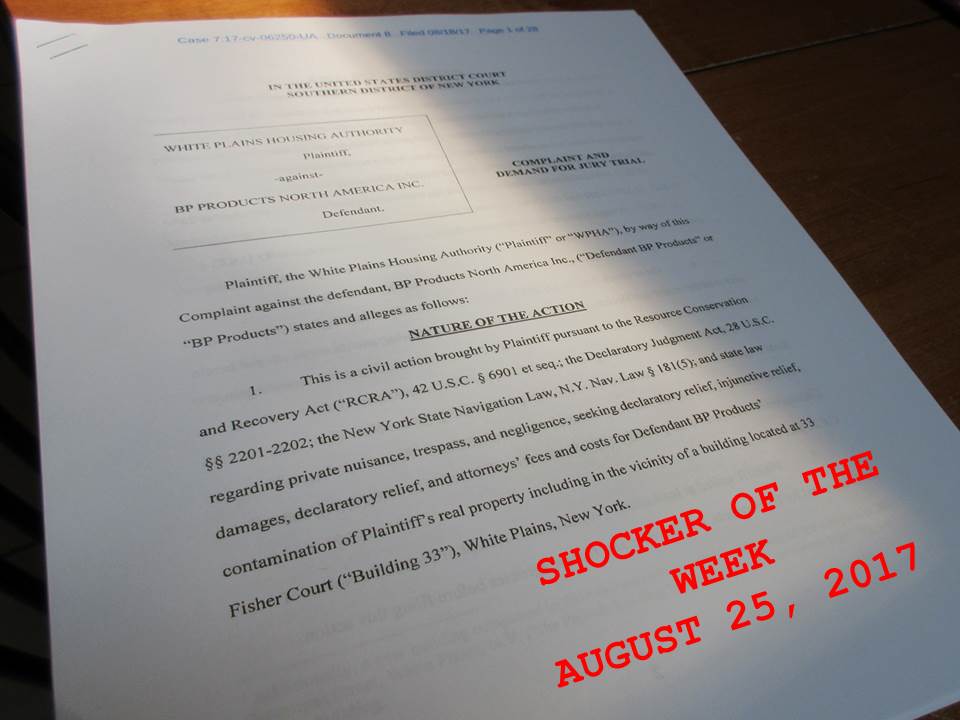
WINBROOK LAWSUIT SHOCKER OF THE WEEK
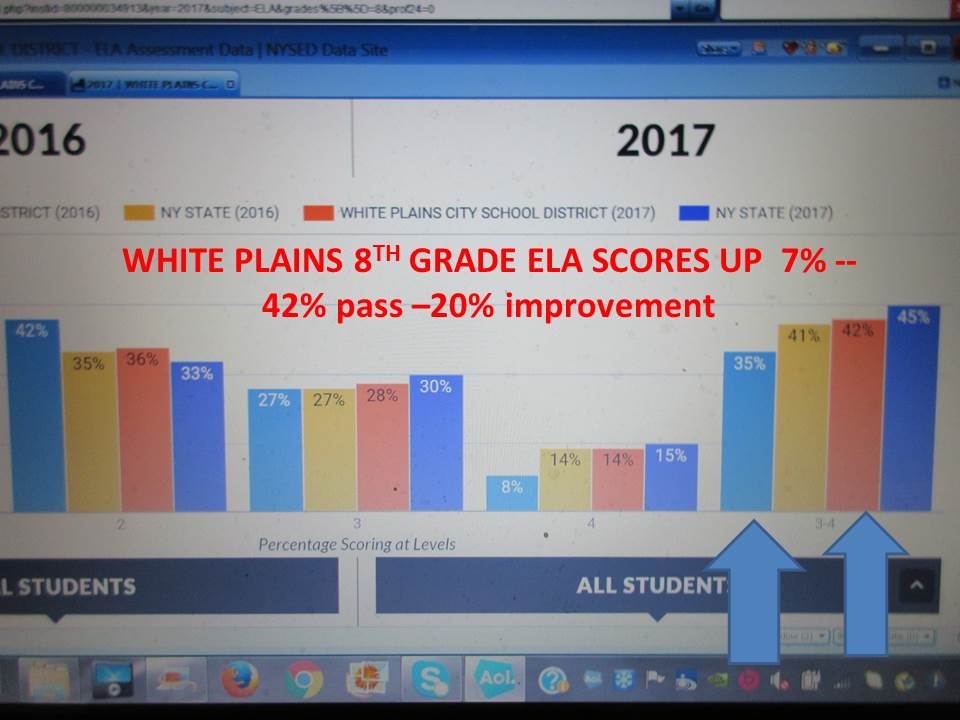
LARGEST ADVANCE IN WHITE PLAINS SCHOOLS 8TH GRADE ENGLISH SCORES IN A DECADE
PLUS
NITA LOWEY DRAWS BUDGET LINE
JERRY LEWIS VIDEO
DICK GREGORY COMMENTARY
THE ASTORINO-BORGIA DUSTUP
THE DEBATE WHERE THE CANDIDATES WERE NO SHOWS
AND TRUMP THE PRESIDENT
Hits: 395
WPCNR HEALTH ADVISORY. From the Westchester County Department of Health. August 26, 2017:
Westchester County has learned of its first human case of West Nile Virus this year, which was confirmed in a 63-year-old Briarcliff Manor resident who had been hospitalized, and is now recovering at home.
The Westchester County Department of Health found signs of mosquito breeding activity around the resident’s home and removed them.
“Tthis first case of West Nile Virus should serve as a reminder to residents to take precautions against mosquito bites by removing standing water from their property after it rains and using repellents when they spend time outdoors, especially from dusk to dawn, when mosquitoes are most active,” said Sherlita Amler, MD, Commissioner of Health.
The Health Department prepared for the mosquito season by educating the public through news releases and Keep Healthy and Bug Off messages distributed through flyers, social media, and on our website, by giving fathead minnows to residents with ponds to reduce the mosquito population and by evaluating and treating as needed with larvicide all catch basins on county and municipal roads throughout Westchester. Throughout the season, the Department also traps and tests mosquitoes to track the presence of mosquito-borne viruses in the county. West Nile Virus was identified in two local mosquito batches starting July 18. Manual pdf
West Nile Virus infection most often causes a mild or moderate flu-like illness, but can be more serious particularly for people 60 and older, and those with other health complications. No residents were diagnosed with West Nile Virus last year, but from 2010 to 2015, two to four residents were diagnosed each year and all recovered.
To reduce the chances for mosquitoes to breed and bite around your home, watch Assistant Commissioner Peter DeLucia in this brief video on the Department of Health website at http://health.westchestergov.com/west-nile-virus and follow these tips:
Residents who notice large areas of standing water on public property should report this to the Westchester County Department of Health at (914) 813-5000.
###
Additional news available at health.westchestergov.com/health
Connect with us on Facebook: https://www.facebook.com/wchealthdept
Follow us on Twitter: @wchealthdept
Hits: 2013
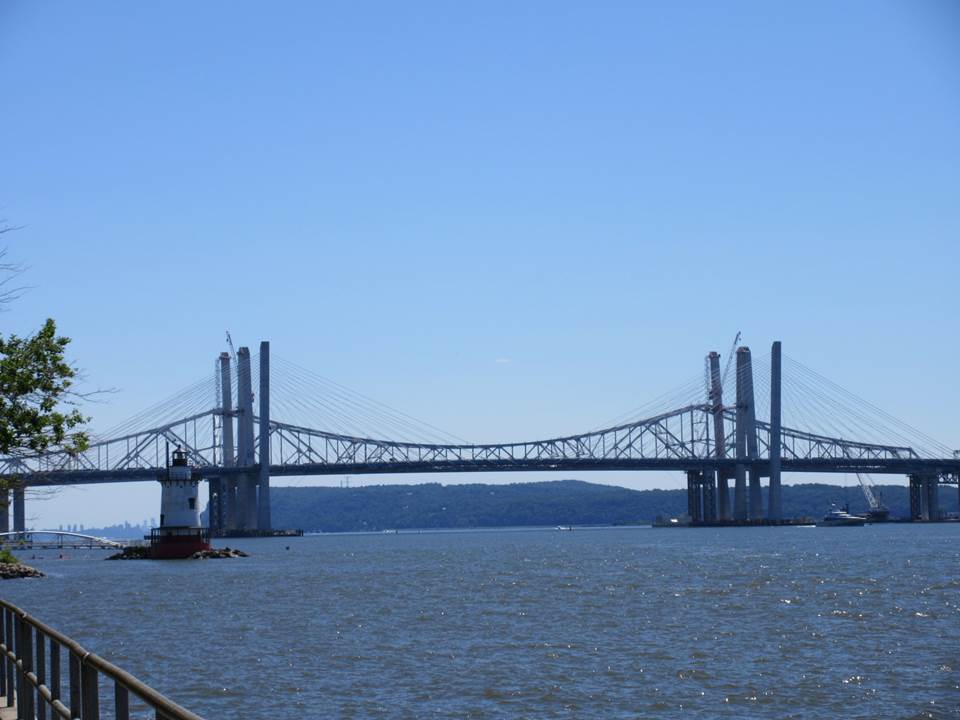
WPCNR ALBANY ROUNDS. From the Governor’s Press Office. (Edited) August 24, 2017:
Governor Andrew M. Cuomo today announced the opening of the first span of the Governor Mario M. Cuomo Bridge, an iconic twin-span cable-stayed crossing that will serve the Hudson Valley for the next century.
The Governor commemorated the milestone with a ribbon-cutting ceremony that featured more than 800 dignitaries and residents from Rockland and Westchester counties on the cable-stayed area of the first span.
The construction project is one of the largest in the nation and the biggest in the history of the New York State Thruway Authority. Four lanes of Rockland-bound traffic will begin crossing the first span late Friday night into Saturday morning.
“The new Mario M. Cuomo Bridge is much more than a magnificent, cutting-edge structure, it is a symbol for this state and this nation. The opening of this new span shows the world that we have our energy and our boldness back, that we will continue to accomplish greats things, and that we are building bigger and better than we have in decades,” Governor Cuomo said. “Excelsior reminds us that the motto of this state says reach even higher, and we’re not only building a new bridge with this in mind – we are building a new state and a stronger economy. This historic project is providing quality jobs, hope and opportunity to both residents and visitors of this state, and I look forward to future generations of New Yorkers crossing the Hudson River on this new bridge for the next 100 years.”
Governor Cuomo drove on the new bridge span in a 1955 Corvette with Armando “Chick” Galella, who drove the same model year Corvette as part of the inaugural procession that crossed the Tappan Zee Bridge on December 15, 1955. The Sleepy Hollow resident is a veteran and Bronze Star recipient who survived the December 7, 1941 attack on Pearl Harbor.
The Governor Mario M. Cuomo Bridge will partially open to four lanes of Rockland-bound traffic overnight on Friday, August 25, weather permitting. For the next few months, northbound/westbound drivers on the New York State Thruway (I-87/I-287) will cross the Hudson River on the new bridge, while southbound/eastbound drivers will use the old bridge, each having four traffic lanes available. Later this fall, the new bridge will completely replace the 62-year-old Tappan Zee Bridge when four lanes of Westchester-bound traffic are also shifted onto the first span.
At Governor Cuomo’s direction, the New York State Thruway Authority has managed the bridge replacement project since 2013 with two fundamental objectives – first, to fully open the bridge to traffic in 2018, and second, to finish the bridge at or below the budgeted cost of $3.98 billion. Currently, the project remains on budget and on schedule, as construction of its second span continues to progress.
After all traffic has been shifted onto the first span, design-builder Tappan Zee Constructors will demolish the landings of the old bridge, which occupy the same footprint of the second span, and connect the second span to land. When completed, drivers will reap the full benefits of the 3.1-mile twin-span, which will include:
The original Tappan Zee Bridge, linking Rockland and Westchester, opened in December 1955 and there are now more than 140,000 vehicles crossing it daily.
As the first cable-stayed bridge ever built across the Hudson River, the new Governor Mario M. Cuomo Bridge uses steel cables placed at an angle to connect the bridge deck to vertical towers that extend high above the roadway. The bridge features eight 419-foot towers standing at a five-degree angle, and has a total of 192 stay cables that would stretch 14 miles if laid end-to-end. More than 110,000 tons of all-American steel is being used to build the bridge, and approximately 7,000 people have contributed to the project to date, totaling nearly 9 million work hours.
Hits: 499
WPCNR BRIDGE OVER TROUBLED WATER. From the Westchester County Association and the New NY Bridge website. August 24, 2017:
|
|
|
|

This aerial photo, taken in June, shows where the first span of the new bridge will connect to the New York State Thruway in Westchester County.
When is the first span of the new bridge opening?
The new bridge will partially open to traffic during the overnight of Friday, Aug. 25, weather permitting. The Thruway Authority will release details about the traffic shift in the coming days. Motorists will also be advised via Variable Message Signs along the New York State Thruway and highways in the region and Thruway Highway Advisory Radio will soon begin broadcasting updates.
Hits: 373
WPCNR SCHOOL DAYS. From the New York State Education Department. August 26, 2017:
The State Education Department Tuesday released the results of the 2017 Grades 3-8 English language arts (ELA) and mathematics tests. In ELA this year, the percentage of students in grades 3-8 who scored at the proficient level (Levels 3 and 4) increased by 1.9 percentage points to 39.8, up from 37.9 in 2016. In math, the percentage of students who scored at the proficient level increased this year to 40.2, up 1.1 percentage point from 39.1 in 2016.
|
% of Students Proficient in Grades 3-8 |
|||
|
2016 |
2017 |
Percentage Point Change |
|
|
Statewide Combined Grades ELA |
37.9 |
39.8 |
1.9 |
|
Statewide Combined Grades Math |
39.1 |
40.2 |
1.1 |
“I’m encouraged by the modest improvements we’re seeing in our test scores,” Board of Regents Chancellor Betty A. Rosa said. “As I’ve always said, testing is just one piece of the puzzle to understand how students are performing. And that’s why our draft ESSA plan takes a more holistic approach to accountability – an approach that looks at multiple measures of school and student success. This allows us to continually evolve and adapt so we can ensure that our systems are culturally responsive and place an emphasis on educating the whole child.”
“Real progress takes time,” State Education Commissioner MaryEllen Elia said. “So, the test scores we’re announcing today are a positive sign that we continue to steadily head in the right direction. We’ve taken a deliberate, inclusive and transparent approach to develop the State’s draft ESSA plan as well as changes to our standards and assessments. We’re confident that this careful approach will continue to yield benefits for our students.”
2017 Results
The State did not make significant changes to the ELA or math assessments administered in 2017. Therefore, the 2017 results can be compared with the 2016 results.
Big 5 City School Districts
In ELA this year, the percentage of all test takers in grades 3-8 who scored at the proficient level increased over last year in each of the Big 5 City School Districts. New York City’s proficiency increased by 2.6 percentage points to 40.6 percent, slightly exceeding the statewide average.
In the other Big 5 cities, student proficiency increased over last year as follows: Buffalo increased by 1.4 percentage points; Rochester increased by 0.9 percentage point; Syracuse increased by 2.2 percentage points; and Yonkers increased by 3.6 percentage points.
|
% of Students Proficient in ELA Across All Grades, 3-8 |
|||
|
2016 |
2017 |
Percentage Point Change |
|
|
NYC |
38.0 |
40.6 |
2.6 |
|
Buffalo |
16.4 |
17.8 |
1.4 |
|
Rochester |
6.7 |
7.6 |
0.9 |
|
Syracuse |
10.9 |
13.1 |
2.2 |
|
Yonkers |
26.0 |
29.6 |
3.6 |
In math, the percentage of students in grades 3-8 who scored at the proficient level increased over last year in each of the Big 5 City School Districts; the gains in math were smaller than those in ELA. New York City’s proficiency increased by 1.4 percentage points; Buffalo increased by 1.1 percentage points; Rochester increased by 0.7 percentage point; Syracuse increased by 0.6 percentage point; and Yonkers increased by 3.7 percentage points.
|
% of Students Proficient in Math Across All Grades 3-8 |
|||
|
2016 |
2017 |
Percentage Point Change |
|
|
NYC |
36.4 |
37.8 |
1.4 |
|
Buffalo |
16.1 |
17.2 |
1.1 |
|
Rochester |
7.2 |
7.9 |
0.7 |
|
Syracuse |
10.4 |
11.0 |
0.6 |
|
Yonkers |
24.6 |
28.3 |
3.7 |
Black and Hispanic Students
In 2017, ELA proficiency across all grades for black and Hispanic students increased over last year, with increases seen both statewide and in New York City. Statewide, black students saw a 2.8-percentage-point increase in those achieving proficiency while Hispanic students experienced a 2.4-percentage-point increase. In both cases, the increases were greater than those seen by white students, who experienced a 1.1- percentage-point increase statewide. As a result, the achievement gap in ELA that separates the proficiency of black and Hispanic students from their white peers closed slightly statewide.
In New York City, black students scoring at the ELA proficiency level increased 2.3 percentage points; Hispanic students increased 2.5 percentage points; and white students increased 2.1 percentage points.
|
Statewide % of Students Proficient in Grades 3-8 ELA |
|||
|
2016 |
2017 |
Percentage Point Change |
|
|
Asian/Pacific Islander ELA |
59.0 |
60.8 |
1.8 |
|
Black ELA |
26.2 |
29.0 |
2.8 |
|
Hispanic ELA |
26.8 |
29.2 |
2.4 |
|
American Indian/ Alaska Native ELA |
29.9 |
32.7 |
2.8 |
|
White ELA |
46.0 |
47.1 |
1.1 |
|
NYC % of Students Proficient in Grades 3-8 ELA |
|||
|
2016 |
2017 |
Percentage Point Change |
|
|
NYC Asian/Pacific Islander ELA |
58.8 |
61.0 |
2.2 |
|
NYC Black ELA |
26.6 |
28.9 |
2.3 |
|
NYC Hispanic ELA |
27.2 |
29.7 |
2.5 |
|
NYC American Indian/ Alaska Native ELA |
34.9 |
37.4 |
2.5 |
|
NYC White ELA |
58.9 |
61.0 |
2.1 |
Proficiency on the math exam statewide and in New York City also increased for black and Hispanic students this year; the gains, however, were less than in ELA.
|
Statewide % of Students Proficient in Grades 3-8 Math |
|||
|
2016 |
2017 |
Percentage Point Change |
|
|
Asian/Pacific Islander Math |
66.5 |
67.2 |
0.7 |
|
Black Math |
23.0 |
24.4 |
1.4 |
|
Hispanic Math |
25.7 |
27.0 |
1.3 |
|
American Indian/ Alaska Native Math |
29.5 |
31.3 |
1.8 |
|
White Math |
50.0 |
50.4 |
0.4 |
|
NYC % of Students Proficient in Grades 3-8 Math |
|||
|
2016 |
2017 |
Percentage Point Change |
|
|
NYC Asian/Pacific Islander Math |
67.2 |
67.8 |
0.6 |
|
NYC Black Math |
20.0 |
20.7 |
0.7 |
|
NYC Hispanic Math |
24.3 |
25.3 |
1.0 |
|
NYC American Indian/ Alaska Native Math |
32.2 |
33.1 |
0.9 |
|
NYC White Math |
57.8 |
59.0 |
1.2 |
English Language Learners
Statewide in ELA, proficiency increased for both “Ever ELLs” (students who received ELL services prior to, but not during, the 2016-17 school year) and “Current ELLs” (students who received ELL services in the 2016-17 school year). Ever ELL students performing at the proficiency level significantly increased by 5.5 percentage points this year and outperformed all grade 3-8 test-takers combined, statewide. Performance by Current ELL students improved by 1.2 percentage points.
In math, Ever ELL students scoring at the proficiency level increased by 3.2 percentage points, while Current ELL students experienced a 1.7 percentage-point increase.
|
% of Students Proficient in Grades 3-8 |
|||
|
|
2016 |
2017 |
Percentage Point Change |
|
Current ELLs ELA |
4.0 |
5.2 |
1.2 |
|
Ever ELLs ELA |
39.7 |
45.2 |
5.5 |
|
Never ELLs ELA |
40.8 |
42.6 |
1.8 |
|
Current ELLs Math |
11.5 |
13.2 |
1.7 |
|
Ever ELLs Math |
43.6 |
46.8 |
3.2 |
|
Never ELLs Math |
41.7 |
42.7 |
1.0 |
Students with Disabilities
Across the state, the percentage of students with disabilities who scored at the proficient level increased in both ELA and math. While a greater percentage of students with disabilities reached proficiency in 2017, their performance on the state assessments continues to be significantly lower than the performance of general education students.
|
% of Students Proficient in Grades 3-8 |
|||
|
|
2016 |
2017 |
Percentage Point Change |
|
Students with Disabilities ELA |
7.9 |
9.3 |
1.4 |
|
Students with Disabilities Math |
10.9 |
11.4 |
0.5 |
Charter Schools
The percentage of charter school students who scored at the proficient level on the ELA exam across grades 3-8 increased this year. Similar to last year, that increase was greater for students attending charter schools in New York City. Statewide, the proficiency of students in charter schools increased by 4.7 percentage points on the ELA exam; in New York City, proficiency increased by 5.2 percentage points. Charter schools outside of New York City increased by 2.0 percentage points, which is slightly higher gain than total public schools. However, the proficiency for students at rest of state charters remains below the statewide public school proficiency.
In math, student proficiency increased, but not as much as in ELA. Statewide, students in charter schools scoring at the proficient level increased by 2.8 percentage points on the math exam; in New York City, proficiency increased by 3.0 percentage points; and for rest of state charters, proficiency increased 1.5 percentage points. However, the proficiency for students at rest of state charters remains below the statewide public school proficiency.
|
% of Students Proficient in Grades 3-8 |
||||
|
2016 |
2017 |
Percentage Point Change |
||
|
Charter Schools Combined Grades ELA |
40.3 |
45.0 |
4.7 |
|
|
NYC Charter Combined Grades ELA |
43.0 |
48.2 |
5.2 |
|
|
Rest of State Charters Combined Grades ELA |
28.8 |
30.8 |
2.0 |
|
|
Charter Schools Combined Grades Math |
45.4 |
48.2 |
2.8 |
|
|
NYC Charter Combined Grades Math |
48.7 |
51.7 |
3.0 |
|
|
Rest of State Charters Combined Grades Math |
30.9 |
32.4 |
1.5 |
|
Test Refusals
In 2017, the statewide test refusal rate was approximately 19 percent, a decline of two percentage points from last year’s refusal rate of approximately 21 percent.
A test refusal file by school district is available at: http://www.p12.nysed.gov/irs/pressRelease/20170822/home.html
Prior to 2016, SED tracked only the number of students not tested for an invalid or unknown reason. These students were categorized as “not tested.” The not tested count included students who were absent during the test administration period as well as students who refused the test; the count did not include students who were medically excused.
|
% of Students Statewide Not Tested & Test Refusal |
||
|
2015 Not Tested |
2016 Test Refusal |
2017 Test Refusal |
|
20% |
21% |
19% |
In 2017, students who refused the test were much more likely to be from low-need or average-need districts; much more likely to be white; less likely to be economically disadvantaged; and much less likely to be an English Language Learner.
Similar to last year, this year’s proficiency rates represent the more than 900,000 students who took the ELA and math tests. There is no statewide measure of knowledge and skill for those students who refused the test.
School and District Results
A summary of the test results, as well as individual school and district results, is available at: http://www.p12.nysed.gov/irs/pressRelease/20170822/home.html
Video and Audio Available
Video and audio of Commissioner Elia are available for download.
Video: http://www.nysed.gov/video/2017-grades-3-8-ela-and-math-assessment-results
Question & Answer Video: http://www.nysed.gov/video/2017-grades-3-8-ela-and-math-assessment-results-questions-and-answers
Question & Answer Audio: http://www.nysed.gov/common/nysed/files/2017-grades-3-8-ela-and-math-assessment-results-questions-and-answers.mp3
Hits: 2
WPCNR WHITE PLAINS LAW JOURNAL. By John F. Bailey August 22, 2017:
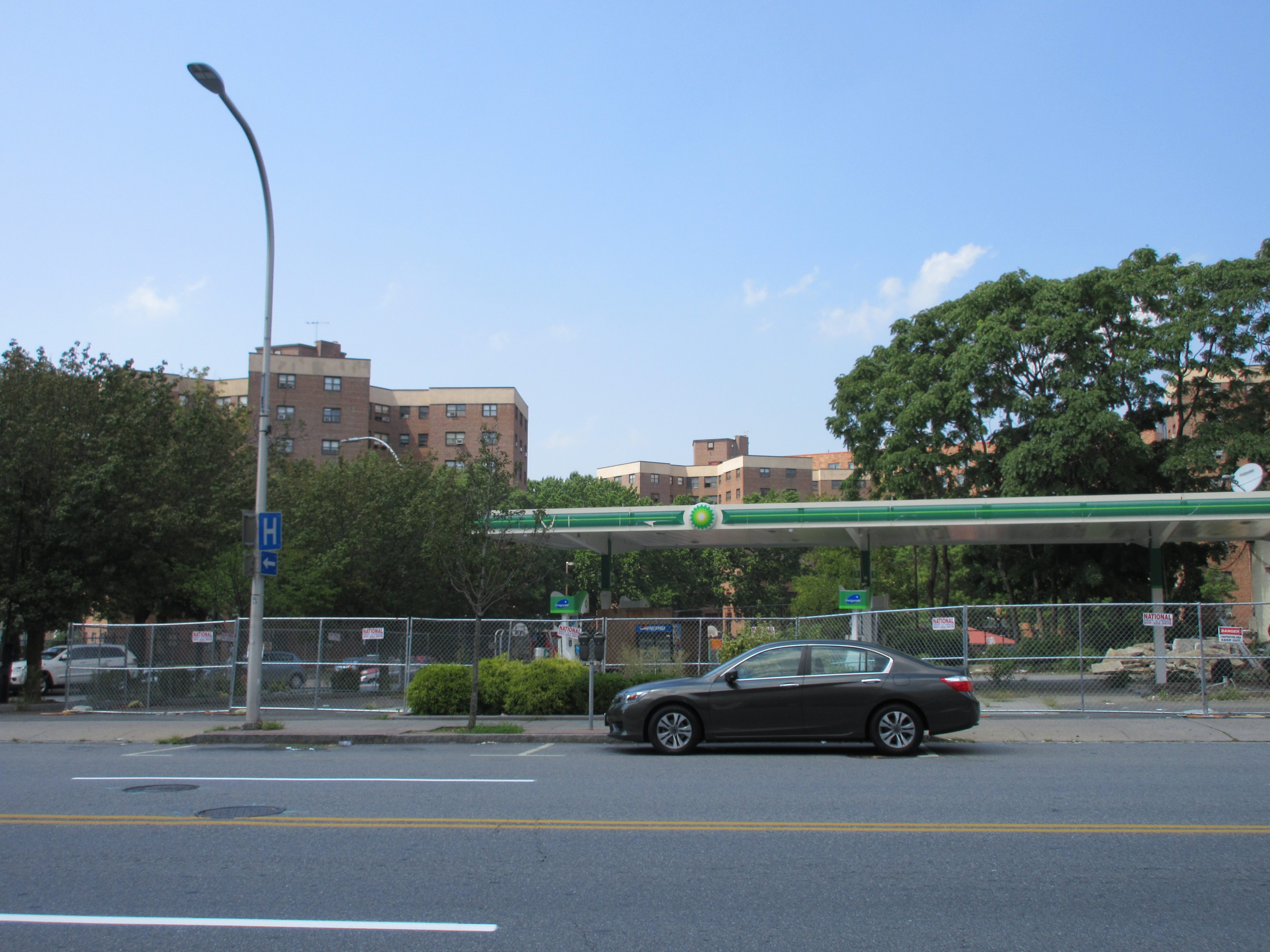
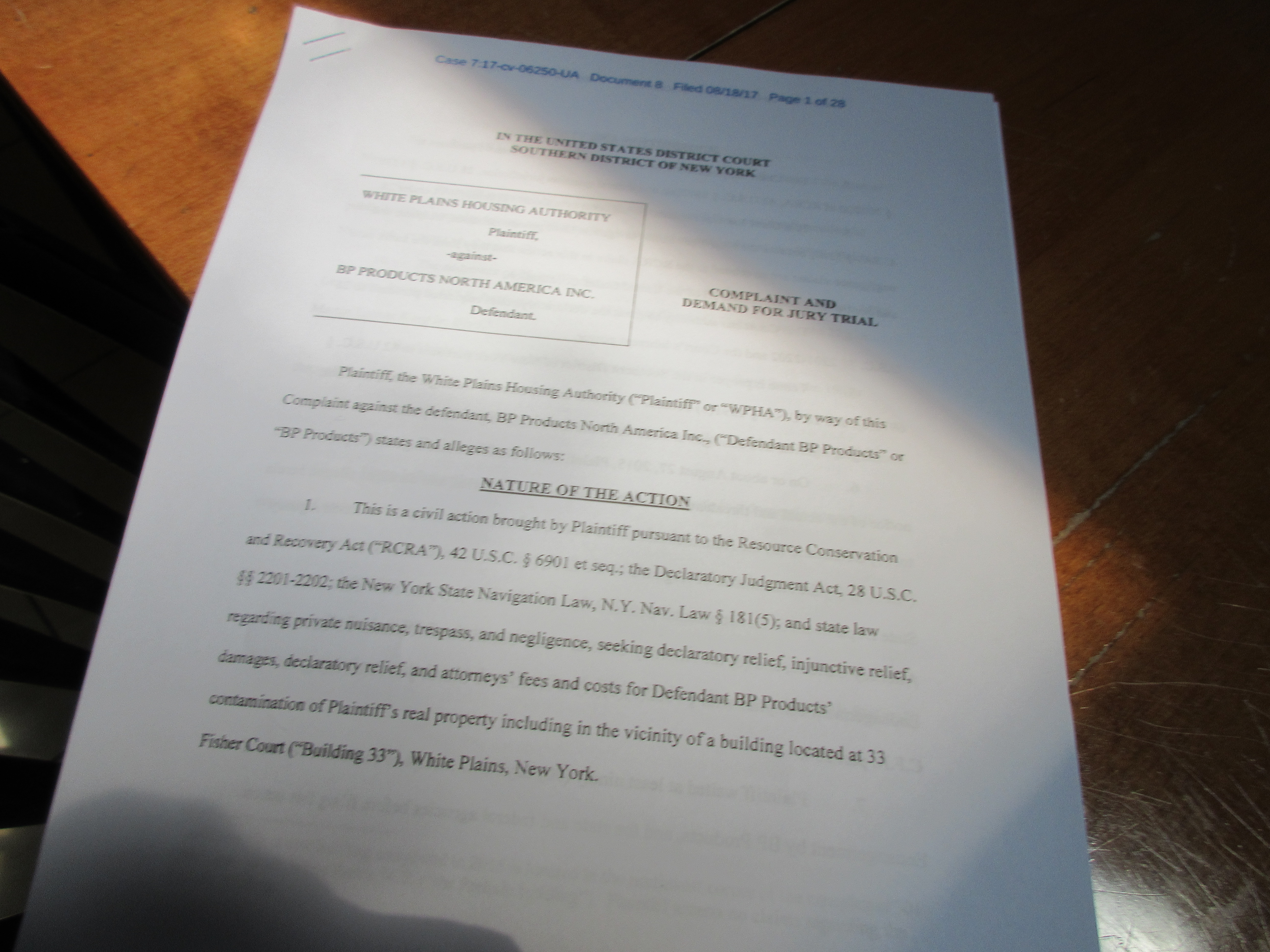
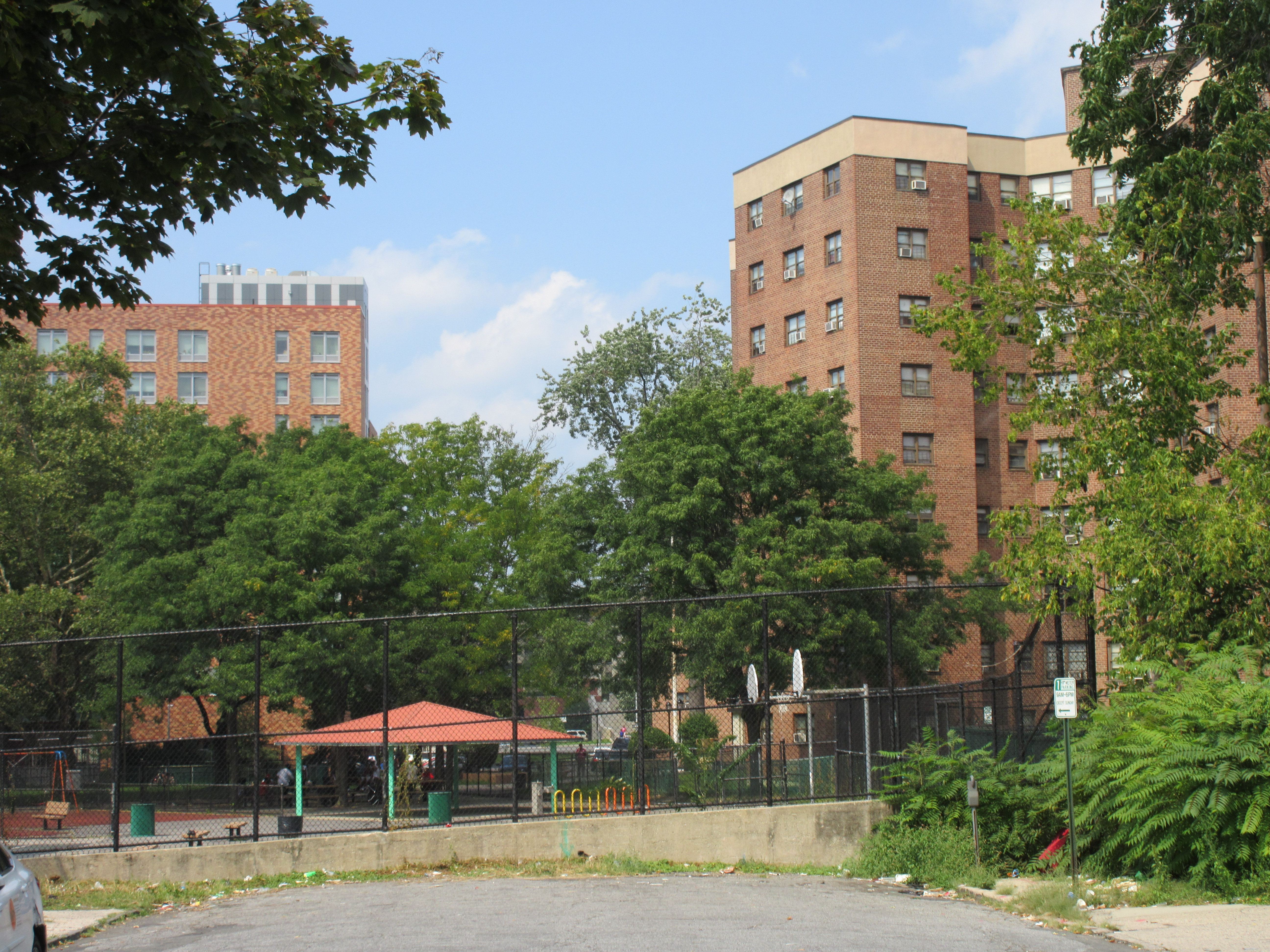
City of White Plains Corporation Counsel John Callahan confirmed to WPCNR Monday evening that the White Plains Housing Authority, owner of the Winbrook residential complex, located in a quadrangle between South Lexington Avenue,Fisher Avenue, Fisher Court, Dr. Martin Luther King Boulevard and East Post Road is suing BP Products North America in a damage complaint filed August 18, last Friday in U.S. Federal Court in White Plains.
In a written statement, Callahan wrote:
Hits: 311
WPCNR CAMPAIGN 2017. by John F. Bailey. August 22, 2017:
John Sheehan of the Gedney Association confirmed to WPCNR this morning that Mayor Thomas Roach’s Campaign Manager, Barry Caro had in an email informed him the Mayor would not attend tonight’s Democratic Primary Forum at 7 PM at The Woman’s Club of White Plains.
Mr. Roach’s three running mates, incumbent Councilman John Kirkpatrick and John Martin and first-time council nominee, Justin Brasch would also not attend, Sheehan said.
Last Thursday he received an e-mail from Caro saying the Mayor would not attend. Sheehan said the Mayor has been give a choice of three dates, the 8th, 15th and 22nd, but no response had been received before last Thursday.
Sheehan said the Mayor challenger, Milagros Lecuona, and council challengers, Michael Kraver, Arthur Goldman and Saad Siddiqui had been willing to come on all three dates and would be attending this evening.
Sheehan noted that the candidates who are coming will be asked why they are running, and asked about some southend town issues.
He said if any of the “no-show” candidates wanted to change their mind at the last minute they should just walk on in.
The Mayor was said to have a prior personal committment.
Hits: 91
WPCNR NEWS AND COMMENT. By John F. Bailey. August 21,2017:
After an 8-Year Total Eclipse of leadership on the Common Council in favor of procrastination, lipservice to residents, smiles without sincerity, and overly compliant with the city administration wishes , White Plains has the opportunity to infuse the Common Council horseshoe in city hall with some new blood, new perspective, should they wish to do so. Or at least stay with the same tired but comfortable and lovable team of plowhorses clip-clopping along.
On Tuesday, August 22, tomorrow at 7:30 at The Woman’s Club of White Plains, 305 Ridgeway an Election Forum sponsored by the Gedney Association, North Street Area Civic Association and the Rosedale Residential Association will be held featuring invited candidates who are competing in the September 12 Democratic Party Primary:
Invited are the Democratic Party official nominees: incumbent Mayor Thomas Roach, incumbent councilpersons John Kirkpatrick and John Martin and first time runner for Council, Justin Brasch.
Also invited are the challengers to these official nominations, Mayor hopeful, present Common Councilmember, Milagros Lecuona, who is also nominated by the Republican Party to run in November on the Republican slate, so she will face the Mayor anyway regardless of the primary result. Then there are the three council challengers, Alan Goldman, Michael Kraver and Saad Siddiqui who are aiming to wrest the Democratic Party line from the the two incumbents Kirkpatrick and Martin, and the newcomer Justin Brasch.
The Primary was declared “go” last week when Judge Lawrence Ecker validated the disputed petitions of Milagros Lecuona, Mr. Goldman, Mr. Kraver, and Mr. Siddiqui. The Democratic candidates declined to appeal the Judge’s decision.So here we are.
At the beginning of this Democratic Primary Candidates’ Forum, being characterized by some in the Democratic Party as an anti-French American School of New York inspired effort, WPCNR would like to suggest a few questions that the moderator of the debate, Allen Flissler, President of the North Street Area Civic Association, might consider which would be a complete departure of these forums from forums of the past.
WPCNR suggests ask those who would be Mayor or Councilperson, what they would do (if elected), how hard can they work; would they listen, who would they listen to? what they would seek to achieve on specific issues? Why is the city in need of your leadership?
And Incumbents: Would you begin to pay attention? Would they stand on principle and what is right? There’s more to leadership than earnestness, mindful compassion and a smile. (As a politician, the first thing you learn to do is put on a smile, you’re never completely dressed without it it’s so essential to seducing people’s confidence in you.)
Along these thoughts:
Issues:
DEVELOPMENT:
Continue current pace of multi-apartment, mixed use complexes or declare moratorium.
Require performance bond when a project is improved.
Reverse long Common Council habit of renewing site plans for years instead of removing approval.
Transit District Construction: What Should Be Built on Battle Hill? How Big Should New Metro North Station Be—What does Metro North Want?
TAXES—
Should there be a moratorium on Payments In Lieu of Taxes for developers applying for new projects?
Do you support a no tax increase policy similar to the Astorino policy of the last 8 years?
CITY ECONOMY
The White Plains City sales tax receipts are down 5% in the last three years. Taking inflation into account, that should be at least even, but instead are a good 10% below what they should be. What will you do to reverse this trend? Should we wait and hope the new developments save the economy? (That is 6 years away.) Or start fixing things to attract people to White Plains again—if so, what?
TRAFFIC
Are you in favor of the city’s bicycling and pedestrian friendly downtown, traffic flow redirections going forward? Is mass transit needed to a greater degree?
CITY INFRASTRUCTURE
FOR incumbents are you confident the city is infrastructurally ready for our increased population in the downtown? What needs to be addressed?
For those who would be taking office for the first time: What are the infrastructure issues you feel, based on your knowledge that are not being addressed by the present administration?
ILLEGAL, OVERCROWDED HOUSING
What would you do about cleaning up illegal overcrowded housing in the city?
SCHOOLS
The school district will be most impacted by the 5,000 new apartments coming into town. If 10% of the new apartment dwellers coming to down in the next 6 years bring new children into those apartments this would equal 500 new students in the White Plains Schools in the next 6 to 7 years, requiring at least one new elementary school to accommodate the input. If 20% bring new children, you would need two new schools.
This potential tax impact due to new construction upwards of $100 Million has to be thought about. Do you defend the present growth in residential? Do you feel city should use its bonding power to contribute to new school expansion.
Just trying to be of help.
Hits: 136

WHITE PLAINS WEEK
ON THE INTERNET AROUND THE WORLD
ON YOUTUBE AT


