SEIU 32BJ HAILS HOUSE PASSAGE OF BILL PROTECTING THE DREAMERS– NOW THE SENATE HAS TO STAND UP AND DO THE RIGHT THING

Hits: 159

WPCNR BORDERLINE. Statement from the Service Employees International Union 32BJ June 4, 2019:


32BJ Statement on House Passage of Dream and Promise Act
 

The following statement may be attributed to Héctor Figueroa, President 32BJ SEIU:  

“Today the House of Representatives took a major step forward for immigrants and America’s highest ideals by passing the Dream and Promise Act. The bill would create a path to citizenship for some two and a half million immigrants, including Dreamers, who came to the U.S. as children, and recipients of Temporary Protected Status (TPS) and Deferred Enforced Departure (DED), who came to the U.S. from countries devastated by natural or human-made disasters.

These immigrants have lived and worked in this country legally for years, often decades. They include college students, parents, homeowners, business owners, and union members. At 32BJ, one of the nation’s largest unions with majority-immigrant membership, we estimate that between 3,000 and 5,000 of our building service workers are recipients of TPS. The attempt to end their legal protections and leave them open to detention and deportation cuts at the heart of America’s workplaces, communities, families, schools, churches and economy.

“Anyone with a conscience can understand that there is nothing temporary in a life built over 20 years by TPS and DED recipients, nor in the foundational roots planted by Dreamers who were raised here. 

These two and half million immigrants also have 6 million family members and over 1 million U.S. citizen children. Their removal would annually end $2.5 billion in mortgage payments, $17 billion in federal taxes, and $75 billion in household spending power.

The House today voted to allow these immigrants’ lives —these American lives — to continue flourishing. This is the first major step on the road to reforming our nation’s broken immigration system, and we urge the Senate and President to walk this road with a nation committed to the motto e pluribus unum —out of many, one.”

Declaración de la 32BJ sobre el Acta de Sueño y Promesa de la Cámara de Representantes

La siguiente declaración puede ser atribuida a Héctor Figueroa, Presidente de la 32BJ SEIU:

“Hoy, la Cámara de Representantes dio un gran paso adelante en apoyo a los inmigrantes y conjunto a los ideales más altos de Estados Unidos al aprobar la Dream and Promise Act. El proyecto de ley crearía una vía hacia la ciudadanía para unos dos millones y medio de inmigrantes, incluidos los llamados Soñadores, que llegaron a los Estados Unidos cuando eran niños, además de las personas con Estado de Protección Temporal (TPS, por sus siglas en inglés) y la Salida Obligatoria Diferida (DED, por sus siglas en inglés), que vinieron a los Estados Unidos de países devastados por desastres naturales o desastres provocados por el hombre. Estos inmigrantes han vivido y trabajado legalmente en este país durante años, a menudo décadas. Incluyen estudiantes universitarios, padres, propietarios de viviendas, dueños de negocios y miembros de sindicatos. En la 32BJ, uno de los sindicatos más grandes de la nación con membresía de mayoría inmigrante, estimamos que entre 3,000 y 5,000 de nuestros trabajadores de servicios a los edificios son beneficiarios de TPS. El intento de poner fin a sus protecciones legales y exponerlos a la posibilidad de detención y deportación amenaza la fibra de los lugares de trabajo, las comunidades, las familias, las escuelas, las iglesias y la economía de los Estados Unidos.

“Cualquier persona de conciencia puede comprender que no hay nada temporal cuando se habla de una vida construida durante 20 años por las personas con TPS y DED, ni en las raíces fundamentales plantadas por los Soñadores que se criaron aquí. Estos dos millones y medio de inmigrantes además tienen 6 millones de miembros de familia y más de 1 millón de niños ciudadanos de los Estados Unidos. La eliminación de sue status legal terminaría anualmente con $ 2.5 mil millones en pagos de hipotecas, $ 17 mil millones en impuestos federales y $ 75 mil millones en poder adquisitivo de los hogares. La Cámara de Representantes votó hoy para permitir que las vidas de estos inmigrantes, estas vidas de Estados Unidos, continúen floreciendo. Este es el primer paso importante en el camino hacia la reforma del sistema de inmigración roto de nuestra nación, e instamos al Senado y al Presidente a que recorran este camino con una nación comprometida al lema e pluribus unum: de muchos, uno “.

Posted in Uncategorized

ALL YOU NEED TO KNOW ABOUT CLIMATE CHANGE AND WHAT TO DO TO FIX IT –IF WE WANT TO.

Hits: 503

A TIMELY REALITY CHECK AT THE ARCHBISHOP STEPINAC ANNUAL SYMPOSIUM FROM THE STEPINAC HONORS ACADEMY

How to prevent storm surge damage to New York City: one of the possible solutions a research time presented Thursday evening. WPCNR video.
The perfect energy efficient, climate soothing house as designed by one of the Stepinac “Scientist-Philosophers” Groups. Once you get past the complicated Einsteinian formulas determining components, stay with it. Mohab El-Hakim, an environmental engineer empanelled to hear and question the presentations said the house was a excellent concept, but its materials (in existence for decades) were still too high priced for general widespread use. One of the student presenters said they estimated such a house would cost 5% more than a typical one of its size being constructed now.

WPCNR ANSWERS TO ISSUES. By John F. Bailey. May 31, 2019:

President Trump should have attended.

Only parents, friends, teachers attended the Archbishop Stepinac High Second Annual Symposium dealing with climate change Thursday evening.

They watched a chilling narrative that was no science fiction, no invention of the left, but instead a riveting, sweeping reality check delivered somberly by 21 members of the Stepinac Honors Academy in a superbly organized series of presentations that gained momentum, gravity and urgency as they moved along.

A distinguished panel of professionals quizzed the students on conclusion of their presentations. They included Mohab El-Hakin, Assistant Professor in Manhattan College’s Civil and Environmental Engineering Department; Dr. Rocco J. Lafaro, M.D. of White Plains, a Stepinac alumnus, 1968; Damon A. Amadio, P.E., also a Stepinac alumnus (Class of 1980), Commissioner of Building in White Plains; and Andrew Ratzkin, Esq., Senior Vice President and General Counsel for Burns and Roe Group, Inc., provider of engineering, procurement, construction and maintenance services to power and water utilities.

The Stepinac 21 methodically let history tell the story how polluting gases, carbons and the industrial revolution and its escalating aftermath the last 100 years has created a planet environment change not seen in millions of years.

They showed how progress that pollutes has become the progenitor of escalating destruction from the rapidly deteriorating environment we are living in–choking on– being destroyed by — today.

What was ominous and frustrating to learn was the way the young men presented the facts and solutions to fix the problem within our grasp that we are not taking in our hands.

The pre-autopsy of the planet and very achievable reversibility in the immediate window of time was fascinating, flowing like a continuing detective story.

The presentations were conducted by Matthew Halas, William Henderson, Moeen Ahmed, Zach Barnes, John Howard, Daniel Cregin, Raymonmd Monis II, Justin Rasche-Hotetz, Ethan Tieng, Marcus Tiratsuyan, Anthony Abraham, Stephen Buckley, Jordan Crichlow, Oluwatosin Gbotosho, Matthew Guadagnolo, Joshin Johnkutty, Omar Loayza, Stephen Magliocchino, Nicholas Morillo, Mychal Riccio, and Joel Ythier.

They pulled no punches.

Told it like it is from the spread of insect-borne diseases to increasingly frequent major storms, the costs of climate change, impacts of carbon Tax and success of Cap and Trade and threats we face in the future. The evidence was up there on the compelling graphics and pained tone of their voices.

The symposium is intended to provide a platform for student researchers to exchange information and identify needs and solutions in an important area. It was organized by Roxanne Calvello, Health Sciences; Cynthia Kilkelly, Honors Academy Counselor; Carole Mendelson, Economics and Finance; Patricia Murphy, Engineering; and Rick Yapchanyk, Esq.,Law

This year—the worst year ever for climate disasters in this country—the topic was climate change.

The presenters provided how they would stop the bleeding of the planet.

In the future days WPCNR will provide clips of the presentations, because you need to see them. 

The “cover the waterfront” handling of climate change and tying the affects  together with the historical evidence got your attention. The students presentations done without scripts and with poise and impressive depth gave the evidence for action insurgency.

They also present possible solutions. The two presentations at the beginning of this article given last night to show how we have the technology to calm the environment. (We just have to want to do it.)

Other projects presented were a commercial filter that can remove carbon dioxide from the air and then re-direct it to plants growing in a sealed environment for use in farming.

Frank Portanova, Vice Principal for Curriculum and Academic Studies, closes the gathering on the Stepinac “Scientist-Philosophers” leave to applause.

Posted in Uncategorized

Justice in Brooklyn: The Brezler Decision–that Puts Kat Brezler into the June 25 White Plains Democratic Primary

Hits: 426

The 2nd Department Court of Appeals, Brooklyn, USA where the following decision below was issued putting Kat Brezler on the June 25 Primary Ballot

WPCNR FOR THE RECORD. Appellate Court decision handed down today on the Kat Brezler Appeal of her being denied a place on the ballot. May 29, 2019:

“After a hearing, the Supreme Court concluded that numerous signatures on the designating petition were invalid because they did not match the signatures on those signatories’ buff cards.

Additionally, the court invalidated numerous other signatures on the basis that the subscribing witness, Kimberly Cooley, did not provide her correct residence address in her subscribing witness statement.

Since, after eliminating the invalidated signatures, the designating petition did not contain the requisite number of signatures, the court, in effect, granted the petition, inter alia, to invalidate the designating petition (hereinafter the invalidation petition), and invalidated the designating petition. Brezler appeals.

“The Supreme Court may entertain specific objections to signatures on a designating petition that were not asserted before a board of elections to the extent the respondent was given adequate notice of which signatures on his or her designating petition are being challenged and the grounds thereof” (Matter of Lancaster v Nicolas, 153 AD3d 829, 830-831; see Matter of Edelstein v Suffolk County Bd. of Elections, 33 AD3d 945, 946; Matter of Levitt v Mahoney, 133 AD2d 516).

Here, Brezler was not given notice, until the hearing on the invalidation petition was underway, that the petitioners were challenging numerous signatures on the ground that they did not match those signatories’ signatures on their buff cards and that the Supreme Court would be comparing the majority of the challenged signatures to those voters’ buff cards to determine whether the signatures on the designating petition matched those on the buff cards.

Contrary to the petitioners’ contention, their specifications of objections filed with the Westchester County Board of Elections (hereinafter the Board) and incorporated by reference into the invalidation petition did not provide notice of this [*2]basis for challenging the signatures.

Since the lack of notice deprived Brezler of an opportunity to adequately prepare a defense, the court should not have invalidated the subject signatures on the basis that they did not match the signatures on the buff cards (see Matter of Santoro v Schreiber, 263 AD2d 953; Matter of Levitt v Mahoney, 133 AD2d at 516; see also Suarez v Sadowski, 48 NY2d 620, 621; cf. Matter of Master v Davis, 65 AD3d 646Matter of Edelstein v Suffolk County Bd. of Elections, 33 AD3d at 946).

The Supreme Court also should not have invalidated those signatures witnessed by Cooley.

A subscribing witness is required to include, in the Statement of Witness, his or her residence address (see Election Law § 6-132[2]). This requirement “protects the integrity of the nominating process by assuring that a subscribing witness is subject to subpoena in a proceeding challenging the petition” (Matter of Pisani v Kane, 87 AD3d 650, 651-652).

The Election Law defines the term “residence” as “that place where a person maintains a fixed, permanent and principal home and to which he [or she], wherever temporarily located, always intends to return” (Election Law § 1-104[22]; see Matter of Dilan v Salazar, 164 AD3d 713, 714).

The “crucial determination whether a particular residence complies with the requirements of the Election Law is that the individual must manifest an intent [to reside there], coupled with physical presence without any aura of sham'” (Matter of Dilan v Salazar, 164 AD3d at 714, quoting People v O’Hara, 96 NY2d 378, 385).

Here, Cooley included in her Statement of Witness a residence address in Baldwin, New York. Although Cooley had been displaced for several months from those premises due to construction, she testified that she intended to return to the Baldwin residence once the construction was completed.

This testimony was supported by evidence that she had stayed at numerous different places since her displacement, that she still had furniture at the Baldwin residence, and that her other belongings had been placed in storage.

Notably, there was no evidence that Cooley had established a fixed residence elsewhere (cf. Matter of Willis v Suffolk County Bd. of Elections, 54 AD3d 436, 438). Under these circumstances, the signatures witnessed by Cooley should not have been invalidated on the ground that she did not provide her correct residence address on her witness statement (cf. Matter of Dilan v Salazar, 164 AD3d 713).

In light of our conclusion that the signatures eliminated based upon the comparisons to the buff cards and those eliminated because they were witnessed by Cooley should not have been invalidated, the petitioners failed to demonstrate that Brezler’s designating petition lacked the requisite number of signatures. Accordingly, the invalidation petition should have been denied and the proceeding dismissed.

Posted in Uncategorized

FLASH ! APPELLATE COURT PUTS KAT BREZLER ON THE JUNE 25 DEMOCRATIC PRIMARY BALLOT

Hits: 439

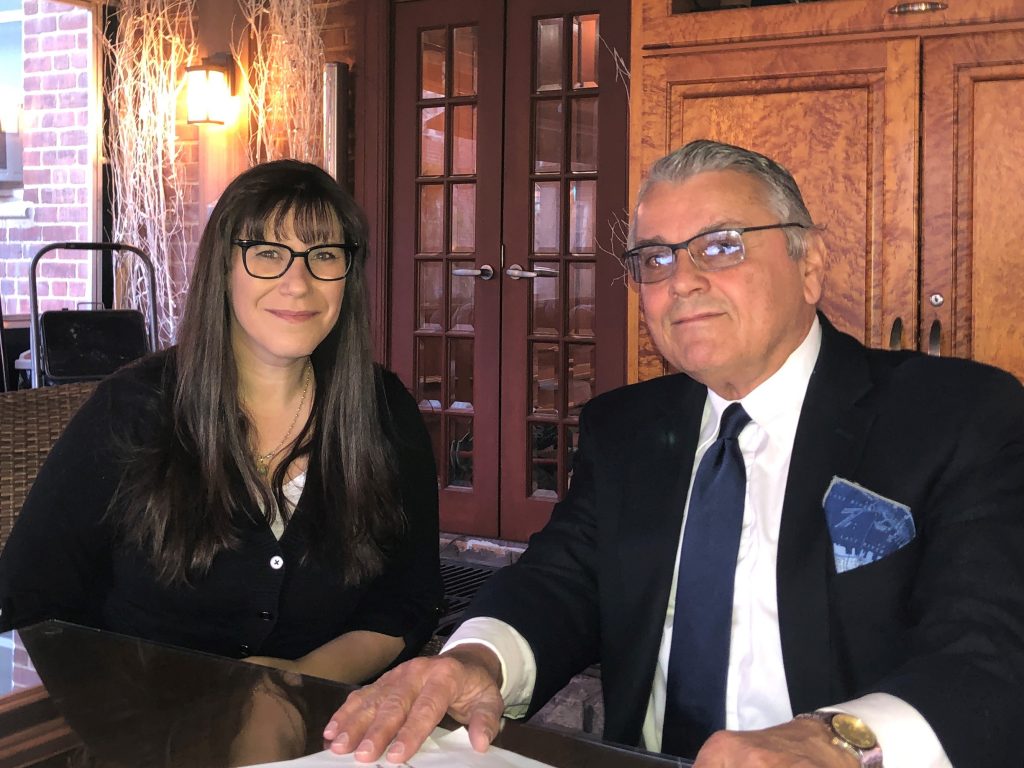
KAT BREZLER, on WHITE PLAINS TELEVISION’S “PEOPLE TO BE HEARD”

WPCNR WHITE PLAINS LAW JOURNAL By John F. Bailey May 29,2019:

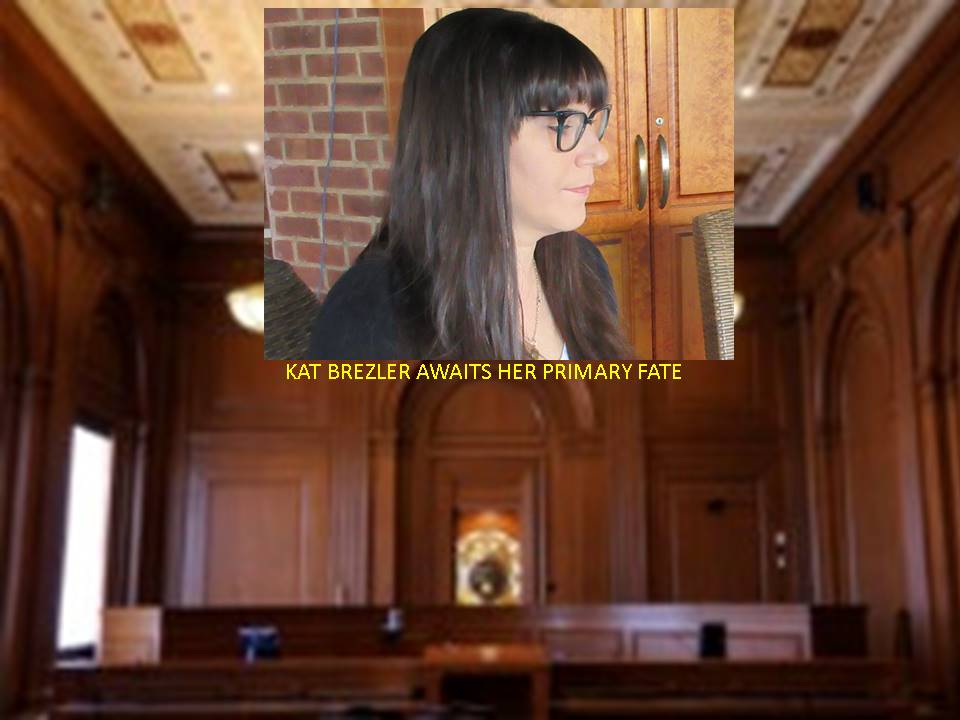
The Appellate Court, Second Department in Brooklyn ruled today to overrule the County Supreme Court decision invalidating White Plains Kat Brezler petition signatures (though they were approved by the Westchester County Board of Elections, clearing the way for her to be put on the ballot in a June 25 Democratic City Primary.

She will be completing on the ballot with Democratic City Committee nominees to the Common Council Nadine Hunt-Robinson, Victoria Presser and Jennifer Puja.

Posted in Uncategorized

Gedney neighbors Appeal Lefkowitz Pro-FASNY Decision to Appellate Court.

Hits: 390

WPCNR WHITE PLAINS LAW JOURNAL. Special to WPCNR. May 29, 2019:

A consortium of residents has appealed the Judge Joan Lefkowitz decision of August 24 of last year, that ruled that SEQRA regulations had not been violated by The City of White Plains in approving the French American School of New York school campus plan, and simultaneously ruling that the 1925 covenent that went with any sale of the former Gedney Farms /later the Ridgeway Country Club, could not be used for any institutional use. Lefkowitz in her decision said the word institution was ambiguous and did not necessaryily prohibit a school from being built on the property.

The appeal means the case may last through 2020.

The appeal papers were filed yesterday.

Posted in Uncategorized

Standard Amusements Files Bankruptcy; asks Bankruptcy Court to Suspend the County Termination Agreement; Blames County for their Bankruptcy. FINAL HEARING JUNE 27.

Hits: 479

WPCNR Westchester County Clarion Ledger. From the Westchester County Department of Communications. May 28, 2019 UPDATED, MAY 29:

In an appearance at New York Southern Bankruptcy Court Tuesday afternoon, Judge Robert D. Drain set June 27 at 10 AM for a “Final” hearing on Standard Amusements bankruptcy filing in which it asks the court to void the Westchester County termination of the county contract with Standard to run Playland that the county terminated yesterday.

WPCNR has asked the Westchester County Department of Communications to clarify the judge’s authorization of continued payment and debtor obligations and “relief” until that Final Hearing date.

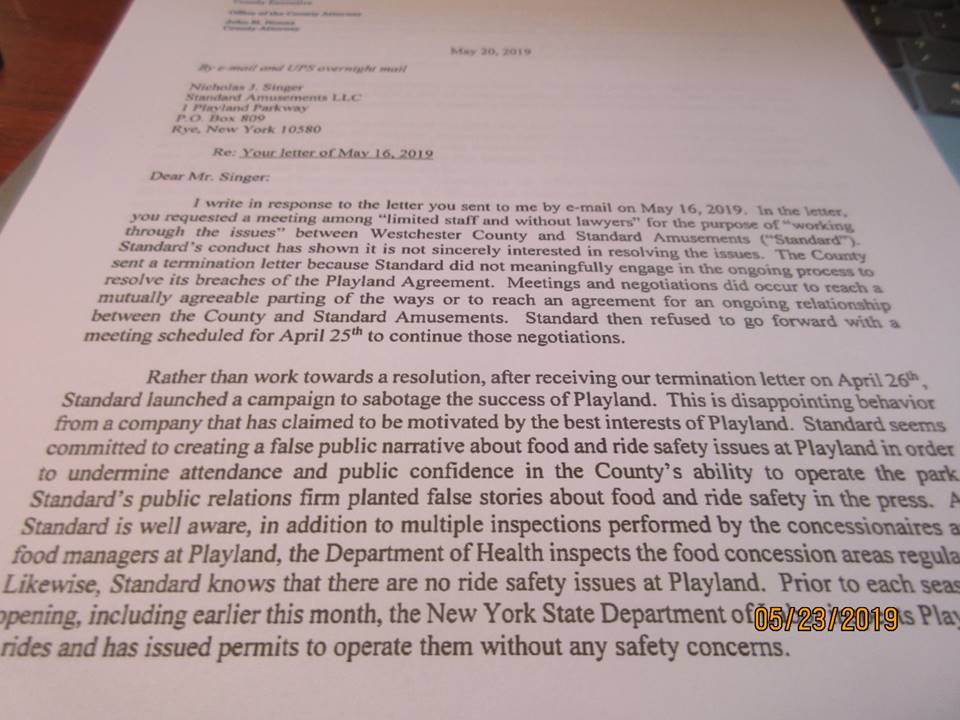
Westchester County Executive George Latimer issues this statement yesterday, on being informed of Playland “former” managing firm, Standard Amusements filing for Chapter 11 Bankruptcy today, in a filing that asks the bankruptcy court to suspend the County termination of the Westchester County agreement with Standard Amusements to manage Playland entered into in 2016.

Mr. Latimer’s statement:

“We have been notified that Standard Amusements has filed for bankruptcy.  Our legal team will continue to address this matter as it will now be dealt with by the bankruptcy court.  At this point we are continuing to focus on Playland having a vibrant and successful 2019 season.”   

Posted in Uncategorized

Memorial Day: A Legacy of the Civil War

Hits: 391

WPCNR STARS AND STRIPES. Contributed by Carl Albanese. Originally published  by WPCNR May 30, 2011:

Memorial Day is not about division. It is about reconciliation; it is about coming together to honor those who gave their all.

“Let no vandalism of avarice or neglect, no ravages of time testify to the present or to the coming generations that we have forgotten as a people the cost of a free and undivided republic.” — General Logan – May 5, 1868

We need to remember with sincere respect those who paid the price for our freedoms; we need to keep in sacred remembrance those who died serving their country. We need to never let them be forgotten. However, over the years the original meaning and spirit of Memorial Day has faded from the public consciousness.

Memorial Day, originally called Decoration Day, is a day of remembrance for those who have died in our nation’s service. There are many stories as to its actual beginnings, with over two dozen cities and towns laying claim to being the birthplace of Memorial Day.

There is also evidence that organized women’s groups in the South were decorating graves before the end of the Civil War: a hymn published in 1867, “Kneel Where Our Loves are Sleeping” by Nella L. Sweet carried the dedication “To The Ladies of the South who are Decorating the Graves of the Confederate Dead” (Source: Duke University’s Historic American Sheet Music, 1850-1920).

While Waterloo N.Y. was officially declared the birthplace of Memorial Day by President Lyndon Johnson in May 1966, it’s difficult to prove conclusively the origins of the day. It is more likely that it had many separate beginnings; each of those towns and every planned or spontaneous gathering of people to honor the war dead in the 1860’s tapped into the general human need to honor our dead, each contributed honorably to the growing movement that culminated in Gen Logan giving his official proclamation in 1868.

It is not important who was the very first, what is important is that Memorial Day was established. Memorial Day is not about division. It is about reconciliation; it is about coming together to honor those who gave their all.

Memorial Day was officially proclaimed on 5 May 1868 by General John Logan, national commander of the Grand Army of the Republic, in his General Order No. 11, and was first observed on 30 May 1868, when flowers were placed on the graves of Union and Confederate soldiers at Arlington National Cemetery. The first state to officially recognize the holiday was New York in 1873. By 1890 it was recognized by all of the northern states.

The South refused to acknowledge the day, honoring their dead on separate days until after World War I (when the holiday changed from honoring just those who died fighting in the Civil War to honoring Americans who died fighting in any war).

It is now celebrated in almost every State on the last Monday in May (passed by Congress with the National Holiday Act of 1971 (P.L. 90 – 363) to ensure a three day weekend for Federal holidays), though several southern states have an additional separate day for honoring the Confederate war dead: January 19 in Texas, April 26 in Alabama, Florida, Georgia, and Mississippi; May 10 in South Carolina; and June 3 (Jefferson Davis’ birthday) in Louisiana and Tennessee.

Posted in Uncategorized

WHITE PLAINS WEEK OF MAY 24 NOW ON AT www.wpcommunitymedia.org, YOUTUBE and WHITE PLAINS WEEK DOT COM

Hits: 358

WPWeek for 5-24 has been posted  the YouTube link is https://youtu.be/7mp21RiYf6k 

The whiteplainsweek.com link is  http://www.whiteplainsweek.com/

KAT BREZLER PRIMARY APPEAL

GEORGE LATIMER BURNS A BRIDGE WITH PLAYLAND SUITOR
SCHOOL BUDGET VOTE ANALYSIS
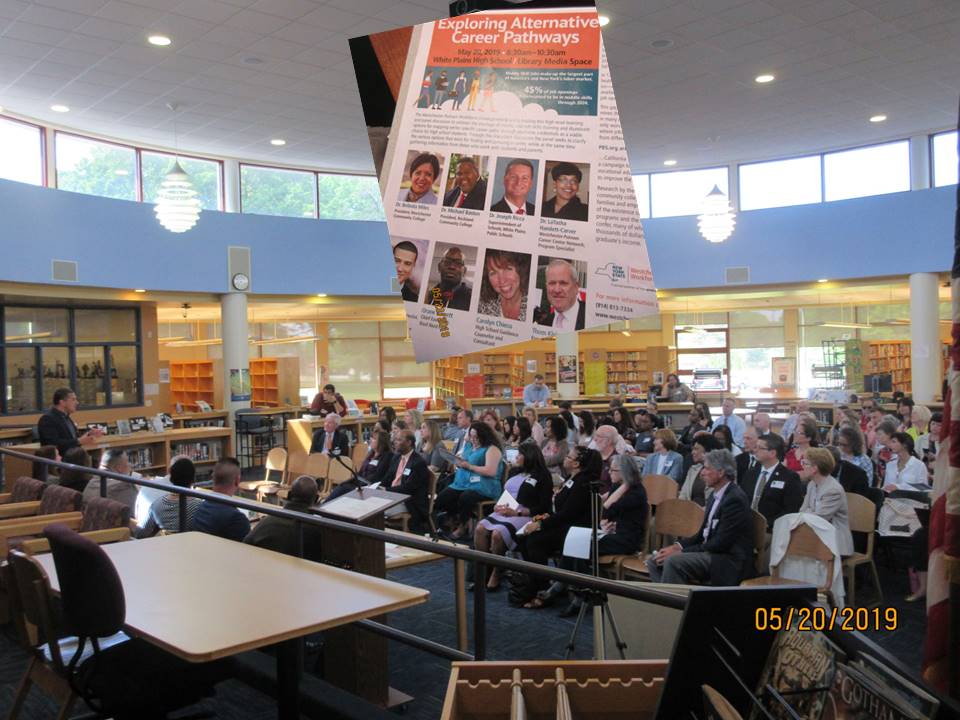
WESTCHESTER PUTNAM WORKFORCE BOARD DETAILS WESTCHESTER STUDENTS LACK MIDDLE AND SOFT SKILLS TRAINING FOR WESTCHESTER’S “GROWTH FIELDS”
NOW TELECASTING IN OUR 19TH YEAR
Posted in Uncategorized