Home Menu ↓
Home - Page 173 1 2 171 172 173 174 175 1,435 1,436

STATE OF THE STATE

Hits: 532

The State of the State

WPCNR QUARTERLY STATE OF LIFE SERIES # 3. News & Comment  By John F. Bailey. March 26, 2023:

The state government has us in their hands and they are being very careless with us.

They have bad hands as they say in the dugouts.

They never make a play in the clutch.

They are afraid of getting their expensive suits dirty.

I have just seen in the last year the most irresponsible, partisan, unprincipled management of state affairs and actions by the leadership of the State Senate and State Assembly I can remember since the three-men-in-a-room days of past.

The Democratic Party decided last year  just decided they would take away seats held by Republicans in central New York by  redrawing  election districts in Westchester County to get rid of first term congressman who defeated previous long serving Congressman who had been defeated in primaries.

They gerrymandered districts and did not obey the law requiring the  new districts be submitted for approval by the proper committee. Republicans gerrymandered out of districts sued. Democrats lost, they took it to the Appellate court in the region and boom they lost again, then it went up to the Court of Appeals and Governor Cuomo-appointed Chief Justice ruled against the Democrats, too.

How stupid were they in doing this under the present Democratic Leadership?

Very stupid—6-lost-seats-to-Republicans-in November-stupid.

Those Republicans that won in NY turned over the house of Representatives to the Republicans in this new about-to-do-nothing Congress for the next two years.

The defeats cost Westchester Mondaire Jones, (now out of politics), when Sean Maloney carved up his district to kick Mondaire Jones out of it and run himself for what he thought was safer seat.

Instead Republican Mike Lawler defeated Mr. Maloney, who is now in political limbo. And Mr. Lawler is a New York political factor now.

But that is not the only stupid, illegal thing the Democrats did. Their “abuse” of power also cost us Carolyn Maloney, also gerrymandered out of congress.

Though Governor Hochul defeated Lee Zelden for Governor, the Democrats now have turned on her for their own political gains shooting to make her a one term governor.

The State Senator Andrea Stewart-Cousins is aiming for that gubernatorial nomination in 2024.

Assemblyman Heastie may be eyeing it, too. So might other State Senators (Shelley Mayer)  or possible County Executives out of a job i n 2024.

The Democrats and Republicans in Albany are refusing to pass Governor Hochul’s Housing Compact.

After the Democrats stripped Governor Cuomo of his epaulets by taking away his control of calling a state of emergency over covid, in an effort to lift covid restrictions which the people wanted.

Mr. Cuomo immediately did lift all restrictions which opened up society and let covid infections rise for 3 months into July 2022 giving us 10,000 infections in July. (Thanks to the vaccines, this rise has been cut down to where it has lowered for 13 straight weeks in August, heading for a 14th.)

The State Senators and Assembly persons were out to sweep Cuomo out of their way by  keeping the right to declare a State Emergency for themselves.

This move they threw on Cuomo while he was accused of sexual harassment of women who worked for him, took away a very important responsibility from all future governors.

This is not a good thing.

The State Senate and State Assembly cannot make decisions when decisions have to be made if a decision that should be made would possibly cost them votes.

None of them up there will vote to shut down the state if covid gains more momentum. (It already has momentum.)  Shutting down the towns, ruling for masking, demanding schools report cases as Mr. Cuomo did, can you really see them doing that? This might be unpopular.

That is why we were so lucky when covid hit that Governor Cuomo took action. You may not like Governor Cuomo but he saved this state by his actions on Covid.  Both houses of the state legislature hated him for that took positions that opposed it when it was not their decision.

Now they have that power. Will they use it if the covid tide rolls back in?

Look at the huge discrepancies between new covid cases (quite low by official dissemination of results, while hospitalizations across the 7 counties are running 2,539 two weeks into March. Latest hospitalizations are indicating we may get 4,000 hospitalizations (actual admission to the hospitals, not emergency room walk-ins and walk-outs).

Westchester daily cases as reported are significantly lower than actual cases being discovered. Does this mean escalation of infections? Well now they have to decide that. Governor Hochul’s hands are tied by inability to declare an State of Health Emergency herself unless the state houses support it.

Do you think anyone in Albany wants to do that?

The game in Albany among the Democratically controlled houses is “Get Hochul.”

Senator Stewart-Cousins signaled  so eagerly and prematurely with totally no class. She declared the Hochul sisterhood with her Democratic Controlled State Senate  was over when she pulled another fast one.

When it was clear Governor Hochul’s nominee for Chief Justice of the New York Court of Appeals was unacceptable to the Democrats living in their own hubris of righteousness,  she acted.

She had the votes from Republicans to confirm him, State Senator Stewart-Cousins added three Democrats to the Senate Judiciary Committee and Judge Hector LaSalle, head of the Appellate Court, 2nd Department, was defeated.

He would have been the first Hispanic Chief Justice.

By the way, the Appellate Court second department was the court that declared Adam Bradley did not get a fair trial in his  trial on charges brought by his wife.  This decision by the 2nd Department paved the way for a retrial that cleared Bradley. The very same court also threw out the Judge Lefkowitz decision allowing the French American School to build, thus finally defeating that project that the City of White Plains had fought to get through the courts for 11 years.

The Second Department stopped it.

Then Governor Hochul in submitting the budget two weeks ago offered the Housing Compact attempting to create 800,000 units of affordable housing across the state. It also set goals of 3% increase in affordable housing building for downstate Westchester, Nassau and Suffolk and the 6 counties in the Mid-Hudson region.

When the leaders of towns, villages and cities screamed about upholding the “quality” of their community, and overriding their zoning laws, true to form, Hochul was seen as vulnerable.

For 23 years since I’ve been doing this website I have heard Democrats talk about affordable housing, workforce housing.

When a bill is submitted that would do something about it they kill it.

Instead of setting quotas they want to pay communities to build their own and see what happens, leaving zoning intact. They are attacking her daily on the budget providing more money for schools, refusing to revise the bail law.

Do we see a pattern here?

There is.

The Democrats now are taking the position Robert Astorino the former County Executive when the Department of Housing and Urban Development sued Westchester  for not using community funds for building  affordable housing. HUD withheld the funds.

The Democrats fully supported HUD on that issue which dragged on for 11 years until the Trump administration took over. The suit was settled when in making a  submission of an 11th  analysis of zoning practices  that  the Monitor approved.

The Journal News reported the settlement this way:  (Approved)Version 11 was that Westchester removed many of its most antagonistic statements that resisted any link between zoning and demographics. For example, this line in the 10th AI about the Village of Port Chester got zapped in the 11th: “…there is no pattern between where minority populations live and zoning for multi-family housing.”

Now the Democrats are taking the position against  the Housing Compact essentially letting local zoning which has denied apartments, high rise, townhouse types of construction in certain toney communities (and you know who they are).

Governor Hochul sent out a flyer to voters this week urging them to contact the Senators and Assembly to pass her budget. She has not yet submitted a new Chief Justice candidate.

Meanwhile court is short one judge. After the denial of Judge LaSalle by the State Senate Judiciary Committee and the Senate as a whole, (at Hochul’s insistence) it be put to a vote of the whole State Senate.

The court cannot hear cases effectively.

Pay attention Mr. and Mrs. And Ms. White Plains and Westchester the politicians smile and say they care and they understand your complaints. They may listen and nod “Yes” but they aren’t really. It is all about power and their personal growth in politics they care about.

With these type of people acting as they have the last three years, the state problems will be tentatively dealt with. We can expect no hard decisions from this gang and it is not a party it is a gang. They deceive, set you up and ruin you.

The antitdote to this is to realize that politicians only need you on election day.

They are fast talkers, old or young they are old smoothies. So believable, so righteous. Sincere. They look you in the eye and they can tell you anything and you believe them.

That is a talent. They are actors. They have been doing it for a long time. They know all the lines that work by heart.

Your job is to pay attention on the local level.

But I can write the truth for 20 years as I have done and the same things keep happening, and the same things we wanted 23 years ago we still do not have.

Affordable housing?  Try getting it now, throwing money at towns won’t do it. Developers do not love building affordable housing. They’d rather buy out of the commitment as they do in White Plains.

More money for  housing for the disabled? More homes for the growing disabled population?

Investigation of medicare-medicaid fraud by hospitals? Does not happen.

Bail reform without thinking it through? That has happened

Oversight of school district malfeasance and mismanagement? Never happens often.

But make no mistake, those legislators up their in both Senate and Assembly do not have it –the ability to make decisions that will solve problems.

They do have the ability to yes to policies that preserve the status quo and their seat or aid lobbyists’ clients. That they do without hesitation and a twinge of conscience.

How though, getting back to the Housing Compact delivery to the Albany Legislation Morgue in the Hudson River, will any town in the communities of suburban Westchester ever be able to have affordable starter homes, condos, co-ops in the present Westchester zoning? it is as restrictive as it was in the 1950s

73 years ago.


Posted in Uncategorized

State of the City

Hits: 527

State of the City

WPCNR QUARTERLY STATE OF LIFE SERIES # 2: STATE OF THE CITY . News & Comment by John F. Bailey. March 25, 2023:

The times they are-a-changin’ in White Plains New York USA.

They are always changing.

White Plains has changed every 50 years.

From the sleepy grand boulevards with elegant large single family houses the first 10 years of the twentieth century to tearing down of those homes and turning them into business buildings, movie houses by the 20s and 30s. Building out to the residential north and south and east in the 1950’s . Then came doing away with the old Senator Hotel and rooming houses and the old train station with urban renewal in the 1960s.

Westchester One  set the pace,  leading to the  building of the Galleria in the 70s, followed by the elimination of the old department stores, Macy’s then Alexander’s and A &S in the 1990s . A new train station finally replaced the hole in the ground left by the old station. Then came The Westchester Mall after much argument. Apartments were built on Bank Street. The Gateway One was built.

Now in the first 23 years of the 21st Century the city is in a long period of high rise building 40 story towers in downtown. The future started rising in 2001 when the City Center was first proposed bringing another upscale mall, movies back to downtown, followed by the concept of “connected or adjacent” zoning “finesse” which lead to the Ritz Carlton Renaissance Square condominiums and the concept of “mixed-use” development of residential buildings rising high with retail

Still the developments keep on coming:

Redesign of the 440 Hamilton and separate residential building (not completed yet). Tearing down of the Westchester Pavilion for a new mixed-used apartment and retail delayed by the recession of 2008 through the present day. We are still waiting for the design changes on that new hole in the ground.  The Saks Fifth Avenue store was torn down and Fortunoff’s built another retail, business mall.  The Crowne Plaza had appeared close by.

The White Plains Mall was sold and a new development, Hamilton Green has finally begun construction with excavation.

The Mitchell has just opened. The Gateway II apartments and mixed retail is going up very close to 20 stories now and could be finished and open by the end of  this year. We  still await the apartments now under construction at the old Esplanade being converted to apartments.

The apartments across from the Westchester are show signs of site preparation. The Waterstone assisted living residence has opened on Bloomingdale Road. Grid Properties sold their property between Maple Avenue and Post Road and White Plains Hospital is planning another hospital to be built on that property, no concrete plans yet presented. Two apartment buildings were opened on Maple up the road from Fortunoffs.

How has this changed the city? A lot.

What does city leadership have to consider? More than ever.

First, the city is heavy with traffic now. Before developments are finished.

We have a very real rush hour now with cars backing up  bumper to bumper on Main Street going into the city. Talk about congestion pricing!

There is heavy traffic on North Broadway south into the city in the mornings and going out in the evenings. There is big time backups coming into the city from the East in the A.M. and out the P.M. Up from the South on Mamaroneck Avenue the traffic is zipping and trying to judge whether they can get through the yellow without getting caught in a photo violation of the red light rule at the Bryant and Mamaroneck intersection.

The traffic is complicated throughout the day by construction work on the roads possibly connected with building as well as needed maintenance.

Pedestrians are a problem because there are a lot of jaywalkers crossing the street that drivers must watch for. I tell you jaywalking (crossing in the middle of the block) and looking at cellphones while walking instead of watching for traffic is the new way to walk around White Plains New York USA. The pedestrians also cross in the striped cross walk against the light. However the timing  on countdown lights seconds before the light changes is a terrific feature of the city traffic system.

The building has been amping up literally for the last two years. As you can tell, from the by no means complete rundown of approved projects not yet going up and starting to go up, we have yet to see the full impact of traffic when the new residents start adding their cars to the mix of traffic.

Take it from me the notion the new residents  are not going to have cars is a fantasy. If you believe the electric car predictions we need a lot of recharging stations we do not have now!

The city needs to be looking at how it  brings relief to the growing traffic congestion now, before it turns into gridlock when The Mitchells, the Hamilton Greens, the Gateway IIs  start to fill up with tenants and that’s just two more building chock full of people with cars.

Should roads be widened in the downtown? (I don’t see how.)

Should there be express lanes out on Main and Hamilton in the rush hours? Bring on the traffic consultants nowwwwwwwwwww.

The city and Common Council need to start a bunch of task forces and studies—A traffic in-flow and outflow study, a study of pedestrian enforcement before some jaywalker miscalculates Crossing gates in the roadways at lighted intersections– time for thinking out of the box.. A trolley system study to get folks from the high rises to the train station. I think about 15 years ago, the city did do a trolley study for about $160,000 but it was never made public.

And while it enters my mind those bus only lines really jammy up the traffic because Main, Mamaroneck Ave and Hamilton Avenue are too narrow.

Development is going non-stop in White Plains.

As George Gretsas once said, a town that does not develop, dies.

Right now development is looked on as the future of White Plains. It may make the city survive but it might strangle us too.

Another mixed use project: the new Galleria development is being contemplated. No site plan has been officially submitted. Peter Katz of the Westchester County Business Journal  reported  in Monday issue, the Mayor is not interested in discussing with Pacific Retail Partners until they come in with a request for a zoning change.

The Mayor also told Mr. Katz that the city owns the parking garage and expected to be paid for the garage. This city stance is interesting. Usually the city goes along with whatever a developer wants, they get: height, parking capacity. This will be a huge project that will afflict the traffic flow into and out of the city for at least 5 years, once they start it. The question is when they will get approval to raze the existing ruin of the Galleria that will be closed March 31.

The White Plains Hospital expansion, on the other hand is  receiving utmost cooperation from the White Plains city government in developing its latest project.  But…but….but it also deserves real traffic scrutiny, Maple and Post Road and South Lex are main routes out to the south side of town. The traffic situation is lousy in the mornings at the Dickstein Center and City Garage that the city built for the hospital.

The drivers dropping  off patients  in traffic lanes on Maple for the new office complex are rear-enders waiting to happen – and to charge for parking there is an outrage. In Greenwich Hospital, you get valet parking free. The traffic patterns in that development the hospital wants is another mess if they do not pay attention at city hall .

In real estate, White Plains remains a very attractive place to live because of the low real estate taxes and the school system. However as County Legislator Benjamin Boykin said in this week’s People to Be Heard interview, the county is still trying to get small businesses back to full strength. The legislator is worried that the economy is iffy.

Nowhere is it more iffy for people buying real estate, selling real estate, and representing real estated.Real Estate is flopping around on the dock because the banks are folding.

As residents in White Plains know, people want to buy their houses. Realtors want White Plains homeowners to put their homes on the market because the realtors need inventory, more houses to sell so prices can come down within reach of the first time buyers, and the moving-on-uppers.

The seller if he or she put their home, condo, co-op or two family home up for sale, can they get their price they planned on?

With this latest big time bank failures in the billions last week, compounded by the  8% inflation rate, first time buyers are getting mortgage rates that literally kill their ability to buy. You have to put 20% down on a 30 year mortgage. On a $400,000 home, that’s $100,000 down. Those of us who put middle market homes are already seeing prices escalate on those.

The median market price of Westchester  homes in the third quarter was $872,000 driven by the higher priced properties which have had to come down in their prices.

Homeowners now have to think seriously about fixing up conditions that may easily force them to lower their price to sell, allowing for repairs future homeowner might have to do. (It is a negotiation. If the owner invests to make his or her  home acceptable,  will they get their investment in repairs back?) Living in White Plains you will sell your home fast if you lower the price, but can you afford to do so?

The schools continue to have  a good reputation. The student body is very diverse. The atmosphere is good there. The school budget at a 1.9% increase up for approval May 18,is not a problem, increasing the average $650,000 single family house taxes $200. However the rise in the budget would not have been possible without the massive school aid freed up by the state legislators–made possible by covid aid.

If the County and City are afflicted with another covid sixth wave this summer (what happened last year) there may be some serious budget problems in 2024-25 school year. The enrollment is declining, but as Brenda Starr always tells me you cannot cut budgets year to year and deliver the same service (or academic atmosphere) in any organization.

Politics: the city will again be controlled this fall by an all Democratic Common Council, since the Republican Party has not announced any candidates yet.

What this Common Council has to do is develop the ability to ask questions of developers, examine the plans they present in the light of ancillary effects on the city and make changes. Each site plan in the ever flowing White Plains Development Pipeline, not yet submitted has to be viewed more in relation to the  environment it is going to affect. Impacts count!

The city solar project placements should continue. The panels on roofs of city owned buildings and availability of incentives to put solar on privately buildings built or  not built yet – should have been pushed for that Every new project should be put to the task.

The Common Council should explore utility prices with Con Edison and Westchester Power, and the Public Service Commission and the New York Independent Systems Operator. They need to find out the reasons behind why Westchester Power was forced to pay a higher rate than Con Edison, with Escos unable to compete with a lower bid. No one else is doing this. We should. This was a move to prevent consortium purchasing of electric power which has really hurt Con ED

This really hurt a Westchester Power-city like White Plains which by participation made it work. If I were on the council I would have asked to have the power establishment of New York State explain. The Escos and the power giant operated as a monopoly in restraint of trade which is against the law.

On another pressing environmental issue coming on the week when the U.N. said we have 10 years to save the world from climate change,  I would explore the advantages of requiring existing Houses and new houses to be built in White Plains should use geo-thermal units, and I suggest this to The  Mayor and Council should explore this, perhaps subsidize it.

Have I left anything out. I am sure I have forgotten something.  If I have overlooked an issue in the city I have missed and is important to you, write me at wpcnr@aol.com.

Your opinion counts.

Use it.

This is the second in the States of Life Series of First Quarter Reports where the White Plains, Westchester, New York Stage, the Mid-Hudson Regions are, in coping with their lives, expectations of government, things to watch for, situations to be alarmed about. You might call the States of Life series a reality report. You may not agree that what I write is true real or what, but my observations are put forth in your best interests to sort out your personal priorities always moving forward and draw out your own personal opinions which can be forwarded to wpcnr@aol.com.

Posted in Uncategorized

BAIL THAT MAKES SENSE: GOVERNOR HOCHUL ON CRIME IN NEW YORK. HIGHLIGHTS SAFETY INVESTMENTS, NEED FOR COMMON SENSE BAIL POLICYAND REFORMS IN 2024 BUDGET

Hits: 1022


Common-Sense Bail Proposal to Eliminate Confusion in Conflicting Laws and Hold Repeat Offenders and Violent Criminals Accountable   

Governor Kathy Hochul Wednesday announced new statewide crime data and highlighted the need for public safety investments and reforms included in her Fiscal Year 2024 budget.

During a speech at the Capitol, the Governor outlined her $491.9 million investment in proven strategies to address and prevent gun crime and violence, reduce recidivism, and help the criminal justice system continue to rebound from pandemic-era disruptions.

Shooting incidents with injury declined 17 percent in New York City and 15 percent in the 20 communities that report gun violence data to the state when comparing last year to 2021, and those incidents continued to decline in early 2023.

The number of reported murders declined 11 percent statewide in last year, with 94 fewer individuals killed, and while overall index crime increased 21 percent, those numbers are nowhere near those seen in three decades ago. Governor Hochul also made the case for her common-sense proposal to remove the “least restrictive” standard the state’s bail law, which is key to restoring judicial discretion and holding accountable those who continually reoffend and commit violent crimes.     

New Yorkers deserve a criminal justice system that prioritizes both safety and justice,” Governor Hochul said. Protecting New Yorkers is my number one priority, which is why my budget proposal includes record-level investments and proven strategies to ensure my administration can do just that. We are working overtime to fight crime across our state and are moving in the right direction but won’t stop until every New Yorker can live in safety.”   

Governor Hochul also reiterated the need for her common-sense bail proposal to eliminate any confusion in the law.  It would build upon other revisions made to the law since it took effect on January 1, 2020, which also focused on making sure that judges have discretion to set bail for those accused of serious crimes and repeat offenses.     

On one hand, the law limits judges to making pretrial determinations based solely on the “least restrictive means” necessary to ensure a defendant’s return to court.

On the other hand, the law also directs judges to consider a range of other factors when setting bail. This results in finger-pointing and confusion when defendants commit additional crimes of violence.

 Governor Hochul’s proposal restores a judge’s discretion to consider factors already included in the law and make the appropriate individualized determination. 

Governor Hochul highlighted her comprehensive criminal justice platform, additional crime trends that show progress achieved to date and improvements that still need to occur to ensure the effectiveness and efficiency of the system.


 Shooting incidents with injury continue to decline this year, with 55 fewer people (-34 percent) shot in the 20 communities that report gun violence data to the state and participate in the Gun Involved Violence Elimination (GIVE) initiative and 44 fewer individuals (-21 percent) wounded by gunfire in New York City, as of March 12, 2023. Overall index crime increased 21 percent: violent crime (murder, rape, robbery, aggravated assault), 10 percent, and property crime (burglary, larceny, motor vehicle theft), 24 percent, during the same timeframe.      


Key criminal justice system metrics have not rebounded to pre-pandemic levels in 2019, when New York State experienced an all-time low in reported crime after seven consecutive years of declines.


Misdemeanor and felony arrests increased in 2022 but are still tracking lower than numbers reported by police agencies from 2017 through 2019.

At the same time, the state’s courts resolved fewer cases last year: 118,378 dispositions reported when compared to dispositions that occurred annually from 2017 through 2019.      


New York State Division of Criminal Justice Services Commissioner Rossana Rosado said, “Equity and fairness are two pillars of the criminal justice system that are vital to ensure it is working effectively for all New Yorkers. Everyone who calls New York home should be able to rest assured that the system is continually improving to keep us safe. I am thankful for Governor Hochul’s support and partnership in our commitment to true justice and safety for all.”  


Governor Hochul’s budget proposal doubles down on programs that have proven successful, investing $337 million$110 million increase from FY 2023 budget, which contained the largest investment in public safety funding in a generation. The FY 2024 proposal includes:     


  • $84.1 million for youth employment programs, of which $37 million is for programs in Gun Involved Violence Elimination (GIVE) jurisdictions.     
  • $70 million for communities to respond to the aftermath of gun violence, of which $50 million is for community capital needs.       
  • $36.4 million for the Gun Involved Elimination (GIVE) initiative.     
  • $31.1 million for crime reduction, youth justice, and gang prevention programs.     
  • $25.9 million for State Police Community Stabilization Units (CSUs), increasing the number of these units from 16 to 25.     
  • $25 million for the SNUG Street Outreach program.     
  • $18 million for the state-supported Crime Analysis Center network, including the establishment of a new center in New York City, bringing the number of centers statewide to 11.     

The Executive Budget proposal also includes significant funding to improve the effectiveness and efficiency of the criminal justice system:  

  • $52 million in aid to prosecution funding for all 62 district attorneys’ offices.     
  • $40 million to funding to support discovery reform implementation.     
  • $31.4 million for alternatives to incarceration programs.     
  • $20 million for pretrial services. 
  • $11.5 million for 20 County Re-entry Task Forces, which help individuals reintegrate to their communities after serving prison sentences.     

Taken together, these investments fund a comprehensive plan that address all facets of the system. 

Since taking office, Governor Hochul has taken actions to strengthen New York State’s gun violence prevention laws by banning ghost guns, large capacity magazines and body armor; expanding bail eligibility for gun crimes; raising the age to purchase semi-automatic weapons to 21; and launching the first-in-the-nation Interstate Task Force on Illegal Guns, which met again in mid-March, among other initiatives.     


Posted in Uncategorized

State of Covid

Hits: 602

WPCNR QUARTERLY STATE OF LIFE SERIES # 1: STATE OF COVID. News & Comment by John F. Bailey. March 24, 2023:

The State of Covid will now be whatever our leaders say it is.

Because they who control the reports of covid spread or decline will now be only reporting results once a week on Fridays.

This is not a good development.

Those of you who make my weekly Covid Surveillance Reports developed from the daily trends of the communities in Westchester, Orange, Rockland, Dutchess, Ulster, Putnam and Sullivan Counties (the seven counties in the Mid-Hudson region) reported by the New York State Covid-19 Covid Tracker will not be worried any more or encouraged by lower numbers of new covid infections. You will understand whatever the state chooses to tell you.

Why?  Any figures  they will tell you will not reflect in real time the resurgence of the disease or the continued “diminution” of the disease. (What a lovely word! Diminution presents a very comforting feeling to the person who reads or hears it.

Once a week the authorities will analyze a week results, and who knows if they will level with us as to the real extend of the spread.

Why should they?

Because they have softened the real picture for a year and a half.

The state computerized data collection formats used the very questionable method of  the Center for Disease breaking down the number of new cases reported per county by increments of 100,000 of population.

In order to know how many infections you have in a day, I the reporter, and you the person concerned about statistics must know the population of your county to know how many infections of covid are really happening a day.

Then multiply that out by week and 4 weeks of a month. The state could very easily report the infections by total population automatically without leaving us out here in queryland to do the math.

What this format has done is provide a false sense the disease is not as spreading a lot each day.


But unless you multiply it out according to 100,000 increments of population, the growth of cases is being  reported with an error factor of as much as 50%.

Now the State  as the Center for Disease Control announced a month previously,  said Friday statistics are not going to be issued by the major stat providers. (I guess they are tired.)

This announcement by the state coincided with President Biden announcing the State of Emergency would end May 11.

Now Governor Hochul and the legislature currently controls covid policy and the right to announce a covid state of emergency  again if needed.

To refresh your memory, the  State Senators and Assemblypersons  took this away from the Governor’s office during the sunset of the former governor (Andrew Cuomo).  Now the senators and assemblypersons are now following suit.

The Governor’s updates on covid released to the press via email  have basically stayed the same issuing new statistics based on the former day, sometimes on time and sometimes not — now are going to issue the stats for a week on new covid cases beginning this  week. The day-by-day results will be on the New York State Covid Tracker dailyl

However the state is also looking at relaxing the amount of reporting hospitals have to provide on covid cases coming in, admissions.

It is unclear how detailed or curtailed the hospitalization figures will be. The statkeepers in the hospitals do not for the most part do hot treat patients.

I see no reason why that cannot still be reported the same way it is now. Hospitalizations broken down by daily covid cases compared to total hospitalization admissions.

My concern may be way off base, but the hospitalization stats you can get by hospital off the New York State Health Department Hospitalization site are hard to get a true picture because they are tough for the non-technical person to  even access a hospital without knowing the hospital code. The hospitalization numbers are very difficult to access comparative information fast. (Perhaps that’s why few media report them in a comparative way that actually means something.)

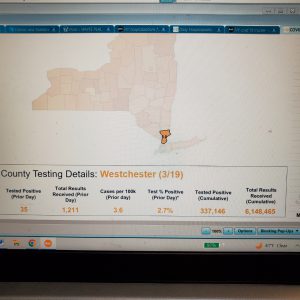
Since the March 17 statistics came out, here is where Westchester County stands:

First the good news that the present daily statistics put out ended March 17

Westchester county had 35 positives if 1,211 tested 2.7%. The county over 7 days average 3.6 new cases a day per 100,000 population.

Westchester has completed a 13th week of decline in new covid cases with 175 cases compared to 254 last week. 989 for the 2 weeks and 3 days of March so far..

However, not so fast. At 3.6 new cases per 100,000 population a day over 7 days, you have to multiply that by 23.26 the number of 100,000 uncrements in Westchester population (1,040,000) to get the true daily figure.

The true daily number of cases for 1 day is 90 a day. Which is 634 for a week and over the month of March would give us 2,559 new cases in the month.

Perhaps this explains the high number of hospitalizations the 7 counties are experiencing the first three weeks of March

According to the report statistics on the hospitalizations graph for the Mid-Husdson Region of the 7 counties this is the hospitalizations were for the counties which have a total population of :

The population of the 7 counties in the Mid-Hudson Region is 2,326,000. That means there are 23.26 segments of 100,000 in the 7 county population. Multiply that daily figure of new covid patients hospitalized in 7 counties (55.56  per 100,000 people, you get 129 hospitalized patients with covid  being hospitalized in 1 day March 16 in the 7 counties as of March 13.

Hospitalizations for  17 days in March for all 7 counties look like this:

MARCH   COVID HOSPITALIZATIONS  ICU INTUBATED  COVID/DAY/100KPop    DAY/WEEK/MONTH


17                  117                              11                            5.56               129  /905 /3,621

16                 129                               10                           5.56                 129  /905/3,621

15                 128                                14                           5.51                128  /897/3,588

14                 129                                13                           5.56                129  /905/3,621

13                  137                               15                           5.9                  137  /960/3,842

10                  136                                12                           5.86                136  /954/3,816

9                  145                                  7                           6.24                145 /1,015/4063

8                  147                                  7                           6.33                147/1,029/4,116

7                  153                                 11                           7                    162/1,139/4,558

6                  151                                 11                            6.50              151/1,058/4,233

3                 147                                  15                            6.33               147/1029/4116

2                 155                                  15                            6.68               155/1,087/4,350

1                  178                                 12                            7.67               178/1,246/4,984

FEB 28         164                                  13                           7.06               164/1,149/4,598

The above chart shows you what the probable hospitalizations will be across 7 Mid-Hudson Counties for the month of March– approximately 4,500 if the current average covid hospitalizations for covid continue

The hospitalizations for covid as you can see are going down  from 164  as of February 28 to 129 last Friday..110but not by much. The average for the 7 counties for the 13 days is 144 for the 7 counties  the new infections a day give you 1,015 infections a day, 4,000 cases in the month.

This covid is out there and we need to be aware.

How does this affect White Plains Hospital Center?

WHITE PLAINS HOSPITAL SITUATION

However, in White Plains alone, in the 30 days since February 15, White Plains Hospital Center has admitted 329 patients and 130 (40% of those admitted) were admitted for treatment of covid.

In the last week, White Plains has  Hospital has seen some slowdown. Of  68 admissions, 42 were admitted for treatment of covid (62% of admissions) from March 8 to 15. March 1st through March 8, 42 persons of the 72 admitted (62%) were for treatment of covid.

Westchester County had 2,906 cases lab verified positive with covid in the month of February. But why all the hospitalizations across the 7 counties?

I worry there are just more covid positive persons out there who of antigen tested saw they were positive but have not  gone to get lab verified becaus they need to work, need to take care of children and covid makes them sick and they eventually get so sick they have to have go to the hospital for treatment. This is just a hunch.

Significantly there is no data now telling the true nature of our covid situation.

If the state is thinking seriously about cutting data from the hospitals because they think it is no longer needed how with the State Senators and Assembly persons and county health officials decide if covid is under control or not.

We need more data not less.

If I was a health administrator I would demand, no, WANT to know:

  1. How long each covid infected person is now staying in the hospital.
  2. How many are reinfectees, so we can judge how many will come  back. (They have to be coming back now)
  3. How many have long covid
  4. How much additional medications to they need.
  5. Do our hospitals have enough medication to take in these persons so sick they need to be admitted to the hospital at a 40% rate of admissions a day?
  6. We should stop worrrying bout keeping empty beds and worry about and find out aggressively what the disease is doing. Are we seeing new variants?
  7.  The schools should be told to report new cases of covid, flu so we can see how the new laissez fair State Education Department you do not have to report cases of covid policy is working out. We do not know. Let me repeat that, we do not know.
  8. The disease roared back last July with 10,000 new cases in a month, and here after almost 7-1/2 months later we still seeing new cases over 7 counties at a 4,000 a month pace, what if this happens again, only on a larger scale, what will the leadership do?
  9. Vaccine boosters for the fall, will county residents have to pay for them? The public is not getting their full compliment of shots when they are free. It is not their fault. They have been told it’s O.K. with no reason except hopeful optimism. If covid throws a 6th wave at us by summer, somebody has to think about how they are going to get the unvaccinated and not completely vaccinated vaccinated.
  10. Restrictions have been completely relaxed. Leaders say we are getting back to a new normal. We’re told all about the wonderful things being done in Albany in the budget. Could do a little thinking about the covid situation please.

Thinking is something the leaders in Albany and Counties and cities and towns should do more of.


Posted in Uncategorized

GREENBURGH MOVES AHEAD ON AFFORDABLE HOUSING AT THE 4 CORNERS

Hits: 492

WPCNR THE FEINER REPORT. By Geenburgh Town Supervisor Paul Feiner. March 23, 2023:

At Tuesday’s Greenburgh Town Board work session the Greenburgh Town Board spent some time meeting with our Albany lobbyist, John Emrick. We discussed seeking state funding to help the town implement one of Governor Kathy Hochul’s goals: more housing (including affordable housing) near train stations.

The 4 corners in Hartsdale (East Hartsdale Ave, Central Ave, West Hartsdale Ave)  would be an excellent location for mixed use housing. But, we will need state financial help creating turning lanes and safety improvements on West and East Hartsdale Ave (to reduce traffic congestion) and will also need state funding to address flooding conditions on Central Ave.

Because housing near train stations is such a high priority for the Governor, we believe that this is a perfect opportunity to seek help from Albany.  The discussion with John Emrick can be watched on the link below (first topic on work session agenda).

This is a link to the Hartsdale Neighbors Association posting about the four corners in Hartsdale: a nice history of community efforts to create mixed use housing at this site.

https://hartsdaleneighbors.org/wp/4corners/

https://greenburghny.new.swagit.com/videos/222432

The Greenburgh Town Board also supports a county grant that will help us move the 4 corner redevelopment initiative forward.

 Westchester County has a Downtown Improvement Grant (if chosen the County provides a Consultant no cost to carryout market studies which we would use to focus on the redevelopment potential of Four Corners; if chosen the grant also provides $250,000 for use following the market studies – this is envisioned as funding for a consultant to prepare Zoning Code language to enable redevelopment at Four Corners).
2.       A resolution approving a NYSDOT contractor to rent the Town owned site on West Hartsdale Avenue for a monthly fee for 3-6 months. This contractor will be carrying out a NYSDOT project to update the traffic signal and make new ADA compliant curb ramps at each 4C intersection.
 PAUL FEINER
Greenburgh Town Supervisor
Posted in Uncategorized

BOOSTERS. DO YOU NEED A SPRING COVID BOOSTER? NEW ANALYSIS BY YOUR LOCAL EPIDEMIOLOGIST

Hits: 535

Posted in Uncategorized

BUDGET UPDATE MARCH 22,2023 11 A.M.– WHERE THE NEW YORK STATE BUDGET IS TODAY FROM ASSEMBLYWOMAN MARY JANE SHIMSKY

Hits: 311


Dear Friends,

New York State’s annual budgets are the product of a fast-moving, multistage process. When Governor Hochul presented her Executive Budget for the 2023-24 fiscal year on February 1, the Legislature had exactly two months to review the $227 billion Executive Budget, generate and present counterproposals, and negotiate with the Governor to develop the final State budget by the April 1 deadline.

Since February 1, the Assembly and State Senate have conducted 13 joint hearings on the Executive Budget, analyzed thousands of documents, and received information from seemingly countless State employees and private advocates. In the Assembly, individual and groups of Assembly members also sent hundreds of budget letters to Assembly Speaker Carl Heastie, making specific funding requests and suggesting specific means of raising revenue.

Late last week, the Assembly and the Senate reached a critical point in the process. By passing their respective One-House budget bills, each legislative house has put forward its suggested changes and revisions to the Executive Budget. At this point, negotiations will proceed among the “three people in a room” — Governor Hochul, Speaker Heastie, and Senate Majority Leader Andrea Stewart-Cousins — to come up with a final fiscal plan. Supporting those negotiations is a joint General Conference Committee process between both houses of the Legislature. (I am participating as an alternate on the subcommittee evaluating programs and funding for general government and local assistance).

The Governor and Legislature have voiced agreement on numerous major issues, including completing the Foundation Aid funding for our public schools, moving toward all-electric buildings, and raising the minimum wage. Other issues, such as the Governor’s housing proposals and her aid packages for SUNY and CUNY, have been rejected in major part by the Legislature. It remains to be seen whether there will be a comprehensive budget agreement, or if areas of disagreement will remain. The process for resolving any such disagreements is analogous to the process for other legislative disputes — the Governor can reject specific legislative appropriations and line items, and the legislature may override her decisions by a two-thirds vote of both houses.

Here is a list of some of the highlights from the Assembly’s One-House bill:

Public Schools and Childcare:

  • $2.6 billion for Foundation Aid (fully funding our public schools for the first time ever);
  • $280 million for free school meals for all students statewide;
  • No increase in the charter school cap;
  • $200 million for universal pre-K (Executive Budget proposed $125 million);
  • $198 million for child care funding, and two-year tax incentive for employer-provided child care

Higher Education:

  • No tuition hike at SUNY or CUNY;
  • $1.8 billion increase for SUNY funding (Executive Budget proposed an $879 million increase);
  • $1.3 billion increase for CUNY funding (Executive Budget proposed a $397 million cut);
  • Expansion of the Tuition Assistance Program income threshold from an $80,000 to $100,000;
  • 4% increase in community college funding

Health and Mental Health Care:

  • $2.7 billion for Medicaid funding;
  • $1.32 billion for hospitals;
  • $266.5 million for nursing homes;
  • 8.5% cost-of living adjustment for home care workers and direct support professionals

Housing and Development:

  • $1.5 billion for assistance programs for homeowners and tenants;
  • $500 million in housing creation incentives for villages, towns, and cities ex-New York City;
  • Exclusion of the Executive Budget proposals to override local zoning laws and mandate transit-oriented development within 50 miles of New York City

Environment:

  • All-Electric Building provisions, phasing out gas service in all new buildings by 2029;
  • $600 million for clean water infrastructure (Executive Budget proposed $500 million);
  • $435 million for the Environmental Protection Fund (Executive Budget proposed $400 million);
  • $400 million for energy affordability and home retrofit assistance programs

Transportation:

  • $1.33 billion to maintain and repair aging transportation infrastructure;
  • $275 million for PAVE-NY program (Executive Budget proposed $175 million);
  • $8.3 billion to the MTA, and no fare increase;
  • Exclusion of the Executive Budget’s MTA payroll tax increase for New York City and its suburbs; alternative funding proposals include an increase in the top corporate tax and fees on three remaining downstate casino licenses

Public Safety and Criminal Justice:

  • $275 million for discovery within the court system;
  • $198 million for the Office of Indigent Legal Services;
  • $69.3 for SNUG, GIVE, and other anti-gun violence initiatives

Workforce and Communities:

  • Increase in the minimum wage and indexing it to the inflation rate;
  • $102.5 million for the New York State Council on the Arts (NYSCA)

If you would like to do a deeper dive into this process, please see the Summary of the Assembly Recommended Changes to the Executive Budget.

Sincerely,

MaryJane Shimsky
Assembly member, 92nd District

Posted in Uncategorized

STATE OF AFFAIRS:”REPRIEVE IS HERE” MARCH 21 FROM YOUR LOCAL EPIDEMIOLOGIST

Hits: 309

(Reprinted with permission)

Happy spring! With warmer weather comes a calming of the respiratory season. Hopefully. Viruses are definitely still circulating, but we are seeing some encouraging signs.

A look back

Doctor visits for fever and a cough (i.e., “influenza-like illnesses” or “ILI”) were back to pre-pandemic levels this season, but had some uncharacteristic patterns:

  1. Shifted to earlier in the season;
  2. Descended as quickly as it ascended (ILI usually peters out);
  3. Stalled just above epidemic levels for weeks.

ILI just dipped below epidemic levels.

Hospitalizations for respiratory viruses peaked in December, which is ~3 months early. COVID-19 continues to take the lead for hospitalizations. Interestingly, RSV, COVID-19, and flu peaked at different times. This no doubt helped our healthcare systems and makes me continue to wonder if there is some sort of virus-to-virus interaction (RSV pushes flu and then pushes COVID-19, for example).

Black=overall; Red=COVID-19; Blue=Flu; Green=RSV; Solid line=current season; Dotted line=2018-2019 season. Source CDC

Different age groups experienced very different risks of hospitalization this winter:

  • 0-4 years: RSV was out of control, peaking at 65 hospitalizations per 100,000. This was 244% higher than the 2018-2019 season. (We really need an RSV vaccine for our kiddos.)
  • 65+ years: COVID-19 clearly led hospitalizations.
Hospitalizations per 100,000. Black= overall; Green=RSV; Blue= Flu; Red=COVID (Keep in mind that the y-axis is different, which drives me insane, but beyond my control).

During this respiratory season (week 40-week 10), we lost 64,180 Americans to COVID-19. This number is higher than any pre-pandemic flu season (see yellow in graph below).

Excess deaths (red line below) continue to be above the “epidemic threshold” (black line). We haven’t had a national conversation defining the new baseline. What do we now consider normal given that we have an additional threat in our repertoire? As we move out of the pandemic phase, this black line needs to shift up.

Source CDC

A look forward

SARS-CoV-2 in wastewater is nosediving. However, levels in the Northeast have started to plateau. If this trend continues, having a high baseline throughout the year would be incredibly inconvenient.

SARS-CoV-2 continues to mutate quickly, as expected. The international community is keeping an eye on two Omicron subvariants:

  • XBB.1.9- In the U.K., this is causing a slow uptick across metrics, including hospitalizations. In the U.S., the growth advantage of this subvariant is only ~35%. (As a comparison, the original Omicron had a 500% growth advantage causing the tsunami.) In other words, we shouldn’t fret.
  • XBB.1.16–This has a case growth advantage of ~250% in India (17% increase in deaths). But, it’s hard to tell how much this is due biased testing and/or changing behavior due to the celebration of Holi.

XBB.1.16 could possibly disrupt a quiet spring in the U.S. But, a wave is not only dependent on weather, a new subvariant, or changing behavior, but also the number of susceptible people. This precise number is incredibly difficult to grasp because it depends on a number of factors: Who has been infected, when, and by what variant?

In other words, future waves are getting harder and harder to forecast.

With COVID-19 declining, flu may have the opportunity to start inclining for an out-of-season resurgence, especially since the Flu B strain hasn’t shown its colors yet in the Northern Hemisphere. No signs yet, but time will tell.

Norovirus

Norovirus wasn’t part of the “triple-demic” winter talk, but positive tests keep going up. It’s not entirely clear how high this will go, but in pre-pandemic times it typically peaked in March. Regardless, wash your hands.

Bottom line

Every pandemic winter has been unique and, thus, created unique challenges. While disease levels may be back to normal, the usual patterns are off. It may be years until we know how COVID-19 permanently changes the landscape.

In any case, reprieve is now here. For parents, flu and RSV are in the rearview mirror. For older adults and immunocompromised people, COVID-19 is declining. It will sure be interesting to watch how the rest of the year plays out.

Love, YLE


“Your Local Epidemiologist (YLE)” is written by Dr. Katelyn Jetelina, MPH PhD—an epidemiologist, data scientist, wife. During the day she works at a nonpartisan health policy think tank and is a senior scientific consultant to a number of organizations, including the CDC. At night she writes this newsletter. Her main goal is to “translate” the ever-evolving public health science so that people will be well equipped to make evidence-based decisions. This newsletter is free thanks to the generous support of fellow YLE community members. To support this effort, subscribe below:

Posted in Uncategorized

NEW! FIRST QUARTER WPCNR STATE OF LIFE SERIES ON WHITE PLAINS, WESTCHESTER AND THE WORLD.

Hits: 323

WPCNR QUARTERLY NEWS & COMMENT. By John F. Bailey March 24, 2023:

It is the last week of the first quarter of 2023.

This week marks the beginning of a new series of that WPCNR hopes to continue at key intervals in the year ahead.

It used to be leaders used to do State of Everythings in a county, a city, a state, but these addresses are now sporadic at best and given to favored groups and not on a regular basis.

This is a unique opportunity for me to fill the breach this comprehensive lack information gap has left you the concerned, the bewildered, eager for information, what there is of it, what reality is, and what the future can bring.

I am writing this quickly to bring you a full week’s up date on where White Plains, Westchester, New York Stage, the Mid-Hudson Regions are in coping with their lives, expectations of government, things to watch for, situations to be alarmed about. You might call the States of Life series a reality report. You may not agree that what I write is true real or what, but my observations are put forth in your best interests to sort out your personal priorities always moving forward and elicit your own personal opinions which can be forwarded to wpcnr@aol.com.

Posted in Uncategorized

STATE SENATOR SHELLEY MAYER ON ALBANY

Hits: 504


Dear Friends,

It was another busy week in Albany, with a snowstorm putting session on pause for a day, the One House Budget Resolutions being introduced and passed in each house of the Legislature, and several of my bills passing the Senate.  

The Senate One House Budget Resolution represents the Senate’s priorities and policy positions. I am pleased with many aspects of our budget, including important measures for education. Read more about it below.

With the April 1 deadline approaching, negotiations continue between the Governor, Senate, and Assembly, and I remain hopeful that a final budget will be put forth with policies that are reflective of the needs of all New Yorkers, and those in District 37. 

This Friday, I will co-host a Women’s History Month panel alongside Majority Leader Andrea Stewart-Cousins, featuring three women writers from Westchester County. More details on this event and how to join are below.  As always, if there is anything my office can assist you with, please email me at smayer@nysenate.gov or call (914) 934-5250. Warm regards,Shelley B. MayerState Senator37th DistrictLegislative Update

One House Budget Proposals In response to the Governor’s proposed budget, the Senate and the Assembly have each presented their own budget resolutions. 

Education: Our resolution proposes historic investments in schools – including the full phase in of the Foundation Aid Formula. We propose to continue and increase our investment in full-day Pre-K for four- year-olds, to provide universal free breakfast and lunch for every eligible school in New York, and to increase investments in our 853, 4201, and Special Act schools to help put them on a sustainable path for the future. I am proud to be part of a Senate Majority that believes deeply in investing in our education system that serves the next generation and supports the diverse needs of our students.

Housing Compact: 

The Senate resolution also responds to the Governor’s housing proposal by rejecting the mandatory housing growth targets and the overriding of local zoning while increasing the available incentives for smart growth and creating a land use advisory council to review municipal growth over the next three years.

The Senate also included language in support of the principles of placing reasonable limits on residential rent increases and ensuring tenants are not removed from their homes without “good cause,” as well as providing $250 million for a new Housing Access Voucher Program.

We are committed to addressing the affordable housing crisis in a way that honors the unique character and existing efforts of all of our communities. Our work is not complete.

The Governor’s office, the Senate, and Assembly will begin negotiations to craft our final enacted budget, due April 1st. I will continue to fight for the needs of Westchester residents and all New Yorkers, and I look forward to providing details about the final budget. Here’s a description of the NYS budget process which shows the stages of the process
Posted in Uncategorized