Hits: 276
|

Hits: 276
|
Hits: 265
|
 |
Si quiere leer la versión en español, pulse aquí.
Starting today, you can order another 4 free at-home COVID tests to be delivered to your house. If you did not yet order tests this fall, you may place two orders for a total of 8 tests. Go here to place your order.
It’s the holiday season! My favorite time of year.
We are also in “epidemic” mode for our fall and winter respiratory season. We can take small steps in the “background” to minimize sickness and maximize family time. That is, if you want to maximize time with your family. 😉
Here is an update on the latest on flu, RSV, and Covid-19.
 |
Photo by Sixteen Miles Out on Unsplash
Yes.
I was surprised by a KFF report last week: 1 in 2 Americans still take precautions for the holiday season. Some groups do more than others, but there is a little bit of everything from everyone.
 |
Getting sick and missing holiday parties is a huge bummer. There are a few things we can do to prevent this:
For what it’s worth, I’m doing these, including wearing a mask at the airports.
 |
Photo by Kelsey Chance on Unsplash
It’s almost impossible to know if you’re asymptomatic and/or contagious for any virus. This is a big bummer, especially for our high-risk family members also in attendance.
What am I doing? We always have Thanksgiving outside in California. I’m not doing asymptomatic testing anymore with my family, given the expense and low catch rate.
 |
Photo by Rex Pickar on Unsplash
We can be smarter and healthier during the fall and winter. Small steps will maximize the probability of being healthy, staying healthy, reducing disruption, and enjoying the holiday season. To me, this is worth it.
Have a wonderful Thanksgiving!
Love, YLE
Hits: 1090
The Westchester County Department of Planning, with the support of the Westchester County Department of Health, has launched a survey as part of its Transportation and Food Access Study.
The survey asks Westchester residents ages 18 and older to share their experiences traveling to get groceries, as well as information on the type and affordability of food available to them in the County.
The goal of the study is to develop effective strategies to increase Westchester County resident access to affordable, quality food, with the goal of decreasing food insecurity, improving health outcomes, and increasing the quality of life in Westchester.
Take the survey here by Sunday, November 26.
Hits: 289
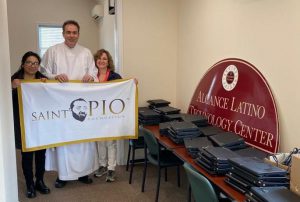
Sandra and Nancy, officers of the Saint Pio Foundation, delivering the sixty laptops to the Alcance Latino at the Church of St. Bernard in White Plains, NY, on Friday, November 17, 2023.
The laptops will be used by the students enrolled in computer literacy courses offered by the Alcance Latino Technology Center at St. Bernies.
The Saint Pio Foundation in Tuckahoe, NY, announced that it has donated sixty refurbished laptops and tablets to the Alcance Latino Technology Center, to fulfill a request from the pastor of the Church of St. Bernard, Father Robert J. Morris, to provide these for the young students of the center.
The Alcance Latino’s Mission is to provide resources and services to immigrant families residing in White Plains, New York, to enhance and sustain their quality of life.
Father Robert Morris, Pastor of the Church of St. Bernard and Executive Director of Alcance Latino said “Alcance Latino at the Church of St. Bernard is so grateful to the Saint Pio Foundation for generously donating 60 laptop computers to our Technology Center. This will allow us to offer computer literacy courses that will benefit the immigrant population in White Plains and Westchester.”
“The Saint Pio Foundation intends to get more involved within our community, and to do all we possibly can to change lives, for the better, in the name of Saint Pio,” said Founder and CEO Luciano Lamonarca. “We were truly inspired by Father Morris’ persuasive way of supporting the parish’s community, and to the immigrant families of the city of White Plains. Being an immigrant myself, I know how it feels to adapt and to face the challenges that come from living in a new country, most of the time without family.”
About the Saint Pio Foundation
The Saint Pio Foundation is a non-profit, charitable organization that promotes the knowledge of and devotion to Saint Pio of Pietrelcina. It works with institutions and individuals that share the same vision to serve those in need of relief of suffering and that seek to alleviate the physical and emotional hunger of the underserved in a dignified and supportive manner. This includes providing spiritual, physical, and emotional nourishment.
Hits: 212
WPCNR THE LETTER TICKER. November 20, 2023:
A senior fellow at think tank Brookings Metro is predicting that New York State’s impending congestion pricing tax will spread to cities throughout the state and nation in virtually no time, laying the groundwork for additional driving taxes all across the U.S., the group Keep NYC Congestion Tax Free today reports.
In a controversial 1,440-word piece in Bloomberg last week, Brookings senior fellow Adie Tomer writes: “…chances are the idea will quickly spread to other cities. Residents and officials in Boston, Los Angeles, San Francisco, Seattle and Portland, Oregon are already considering congestion pricing.” He continues: “Once congestion pricing gets off the ground, it can unlock the Holy Grail of transportation pricing: vehicle miles traveled (VMT) fees, which would charge for every mile driven, not just those in specific zones.”
Mr. Tomer’s piece follows a November 7 article in The Atlantic in which environmental activist and former Transportation Alternatives leader Charles Komanoff suggests that the congestion pricing tax should eventually be raised to $100 per trip, per vehicle. “I am a total incrementalist,” he said. The current congestion pricing tax estimate has a $23 cap to enter Manhattan south of 60th Street by vehicle.
“The public needs to know what’s about to hit them, and their pro-Congestion-Pricing-Tax legislators are doing everything in their power to keep them in the dark,” said spokesman Joshua Bienstock. “The Congestion Pricing Tax has nothing to do with congestion, air quality, or progressivism; it’s all about sucking additional tax dollars out of already beleaguered New Yorkers. If New York’s Congestion Tax goes through, just watch how many personal transportation taxes will follow all over the state and nation.”
Keep NYC Congestion Tax Free argues that a Congestion Pricing Tax is unfair and unnecessary. The tax would disproportionately target lower-income New Yorkers, increase dangerous particulate matter in inner city communities already struggling with some of the highest asthma rates in America, and it would slow the revival of Manhattan’s core business districts. The City and State have reported that hundreds of millions of dollars in tax revenues have been lost following workplace changes prompted by the Covid 19 Pandemic.
Keep NYC Congestion Tax Free
Hits: 243
|
|
||||||||||||
|
Hits: 223
Welcome to the Northeast edition of Outbreak Outlook! It is only available to paid subscribers. If you wish to become a paid subscriber and access region-specific information, please click the Subscribe Now button below. Thanks for reading! -Caitlin Rivers Respiratory diseasesInfluenza-like illnessThe past week has seen a general rise in influenza-like illness (ILI) rates across the Northeast. On average, ILI rates in the region have increased from 2.6% to 2.9%, which is similar to the national average. Multiple states are already near or above 4%, including New Jersey, New York, and Connecticut. New Jersey posted the largest increase at +0.9%, followed by Connecticut at +0.4%, and New York at +0.4%. Nearly all Northeast states experienced rising ILI, except for Rhode Island which saw a small 0.1% decline. Flu season is definitely underway in the region. Northeast Region: ILI Activity
Percent of doctors visits for ILI symptoms
 Covid-19Although the Northeast currently has the highest Covid-19 hospitalization rates in the nation, most states in the region are seeing a decline in activity. The regional weekly admission rate dropped from 5.3 to 4.9 per 100,000. The recent summer peak was 7, for reference. Multiple states saw notable declines, including New York, Massachusetts, and New Jersey. New Hampshire posted the largest decrease. Nearly all Northeast states experienced falling hospitalization rates except for Vermont, which saw a 1.2 increase in hospitalizations per 100,000. Northeast Region
Weekly change in key health indicators. COVID: new hospitalizations per 100,000.

I have something new for you this week! The plot above shows how Covid-19 activity changed for each state from one week to the next. The points at the start and the end of the arrow are the hospitalization rates during each of the weeks. The number given in a percent is the percent change. Love it? Hate it? Let me know in the comments. RSVRSV continues to make rapid gains across the Northeast—activity increased another 2 percentage points in the past week. Test positivity is now 10%, up from 8% last week and 6% two weeks ago. Nearly all states in the region are reporting increases this week. Those trends have been sustained for several weeks now. Massachusetts continues to report the highest case positivity in the region at 15.8%. Pennsylvania has increased to 11.4%, up from 9.4% last week. Maine, New York, Connecticut and New Jersey are all reporting PCR test positivity rates of 6-8%. Vermont continues to stand apart, with a low test positivity of 1.3%; there is insufficient data for Rhode Island. There is no suggestion that RSV has peaked in the region yet; last year test positivity rose to nearly 20% test positivity before declining. As cases continue to rise, remember to wash your hands frequently, clean frequently touched surfaces, and avoid touching your face. Northeast Region: RSV Activity
Test Positivity, Percentage
 Other Respiratory + Stomach BugsI’m keeping an eye on several other respiratory and stomach bugs, but overall things are looking relatively quiet at the moment in the Northeast.
Northeast Region: Norovirus Activity
Test Positivity, Percentage
 Food recallsThe following foods are being recalled because they are contaminated. Please check your cupboards and throw out any of these items: New this week:
Previously reported:
If you have food allergies, you may wish to review these FDA safety alerts and USDA alerts for foods with undeclared allergens. In Other News
|
Hits: 330

THE EPIDEMIOLOGISTS ON AMERICA’S “COVID CASE” SAY THE EPIDEMIC IS COMING BACK 
NORTHEAST COVID EXPECTED TO RISE. WESTCHESTER ON TARGET FOR 2,000 COVID CASES IN NOVEMBER . THE FLU STARTS

GALLERIA “FORUMS” START TO PROMOTE ADVANTAGES GALLERIA PROJECT TO GET WHITE PLAINS “INFLUENCERS” BEHIND THE $3 BILLION PROJECT WESTCHESTER’S LARGEST DEVELOPMENT

INSURANCE KILLING! PREMIUMS FOR MEDICARE SUPPLEMENT COVERAGE BALLOON 9%
WHEN INFLATION IS ONLY 4%. THOUSANDS A YEAR OUT OF SENIOR INCOMES!

COUNTY ADDS 60 TEMPORARY PARKING PLACES TO SUPPLEMENT SHORTAGE OF PARKING FOR THANKSGIVING TRAVELERS. 25 MONTHS LEFT TO START COMPREHENSIVE PLAN BEFORE ADMINISTRATION CHANGES. INADEQUACY OF TERMINAL, PARKING, CAPACITY OBVIOUS.

JOHN KIRKPATRICK SERVED ON COMMON COUNCIL DEPARTS
A CITIZEN’S CITIZEN. ALWAYS WORKED TO PROMOTE WHITE PLAINS GROWTH

JOHN BAILEY AND THE NEWS
THIS WEEK EVERY WEEK ON WHITE PLAINS WEEK
FOR 22 YEARS
ON THE LEGACY OF THANKSGIVING 2023
Hits: 344
Reservations are NOT accepted over the phone. Customers must reserve via the website at:
https://www.westchestercountyairportparking.com/
This link is found from the County airport website by going to: Airport link at the bottom of “Departments” tab
– Departments
– Westchester County Airport (way bottom)
– Ground Transportation (left side bookmarks)
– Parking Areas (left side bookmarks)
– Only link there under “Airport Overflow Lot”
On-airport parking phone number for customer service (NOT reserving parking):
914-946-0843. Available 4:30am to last arriving flight (with enough time for customers to get through front of terminal).
Hits: 284
Si quiere leer la versión en español, pulse aquí. State of Affairs: November 16RSV activity is high. Covid and flu are increasing.
Well, we are officially in full-on “epidemic” mode for our fall and winter respiratory season. RSV, Covid-19, and flu are increasing across the nation. Here is your State of Affairs. Influenza-like illnessesThe climate of respiratory health in the United States (coined “influenza-like illnesses by CDC) reached the “epidemic” level threshold this week. This year continues to land somewhere between pre-pandemic years and last year.
Influenza-like illnesses over time (Source: CDC; Annotations KKJ) We’ll start with the star of the show… RSV: Very highWe have a bad RSV season. RSV moves through the nation like a wave, starting in the South and spreading outwards nationally. So, on a national level, positive RSV tests are exponentially increasing but not yet as high as last year.
National percent positivity rate of RSV tests (Source: CDC) In Southern states, hospitalizations are as high (or higher) than last year. For example, Georgia hospitalizations below have exceeded the past two years. It looks like it’s starting to peak in the South.
RSV Hospitalizations in Georgia (Source: CDC; Annotations KKJ) This is surprising. We had such an intense RSV season last year that we thought things would be calmer this year. Mainly because RSV immunity lasts longer than, for example, Covid-19 or flu. Two possible explanations:
Unfortunately, the new RSV vaccines and monoclonal antibodies also aren’t impacting the population-level viral transmission because coverage is poor (see more below). Covid: IncreasingCovid-19 wastewater—the earliest transmission indicator—is slowly creeping up nationwide. ED visits remain plateaued for now.
(Source: Biobot) Covid-19 hospitalizations are decreasing but lag cases by about 3-4 weeks, so this will change soon. Covid-19 hospitalizations today are lower than last year but remain the leader compared to other respiratory viruses.
Hospitalizations for Covid, RSV, and flu, United States (Source: CDC; Annotated: KKJ) The NYT published some pretty jarring graphs showing an increase in young adults having “serious difficulty” remembering, concentrating, or making decisions. This is undoubtedly long Covid, but I think various other factors, like managing full-time childcare on top of full-time work, could also drive this. It’s worth probing (as some have); this is concerning.
(NYT) Flu: IncreasingFlu is increasing, too. The number of positive tests and the percent positivity rate are increasing exponentially. Hospitalizations remain low for now.
(CDC) Vaccination ratesVaccine uptake for respiratory diseases is not great, to say the least. The latest data shows Covid-19 (among those 18+) and RSV vaccination (among those 60+) remain significantly lower than flu (among those 18+). Rates are tracking last year’s.
There are significant sociodemographic disparities—more so than during the pandemic—due to suboptimal access and cost. Data will be coming out very soon. Bottom lineRespiratory season is officially in full throttle. It’s not too late to get your vaccines. I have also started wearing a KN95 mask again in crowded indoor areas, like airports. As a working mom, I just don’t have time to get sick. Risk reduction is the name of the game. Love, YLE “Your Local Epidemiologist (YLE)” is written by Dr. Katelyn Jetelina, MPH Ph.D.—an epidemiologist, wife. During the day, she is a senior scientific consultant to several organizations. At night she writes this newsletter. Her main goal is to “translate” the ever-evolving public health world so that people will be well-equipped to make evidence-based decisions. This newsletter is free, thanks to the generous support of fellow YLE community members. To support this effort, subscribe below: |