WHITE PLAINS WESTCHESTER DAILY NEWS SERVICE VISITS SINCE 2000 A.D. 25TH YEARl REPORTING THE NEWS YOU NEED TO KNOW News Service Since 2000 A.D. 2026 WILL BE OUR 26TH YEAR OF COVERING WHITE PLAINS NEW YORK USA . John F. Bailey, Editor (914) 997-1607 wpcnr@aol.com Cell: 914-673-4054. News Politics Personalities Neighborhoods Schools Finance Real Estate Commentary Reviews Policy Correspondence Poetry Philosophy Photojournalism Arts. The WHITE PLAINS CITIZENETREPORTER. TELEVISION: "White Plains Week" News Roundup, 7:30 EDT FRI, 7 EDT MON & the incisive "People to Be Heard" Interview Program 8PM EDT THURS, 7 PM EDT SAT on FIOS CH 45 THROUGHOUT WESTCHESTER AND, ALTICE OPTIMUM WHITE PLAINS CH 1300 Fighting for Truth, Justice and the American Way. TOP 10 VISITORS FROM AROUND THE WORLD :1. USA. 2.BRAZIL3.VIET NAM 4. CHINA 5. JAPAN 6.UK. 7.CANADA. 8.INDIA. 9.AUSTRALIA 10.IRELAND 11.GERMANY 12..ARGENTINA 13.BANGLADESH 14.RUSSIA. 15.NEWZEALAND. 16. FRANCE. 17.MEXICO. 18.UKRAINE. 19.SOUTH AFVRICA. 20. IRAQ.
The Daily Voice and The New York Times reported this morning Westchester County Executive George Latimer, is apparently seriously considering running a primary against Jamaal Bowman to run for the 16th Congressional District, or is at least seriously considering it, though not saying he is running.
The Times on page A13 this morning, reporter Nick Fantos wrote “The American-Israel Public Affairs Committee, a pro-Israel lobby has spent millions of dollars targeting Mr. Bowman’s left-leaning allies in recent cycles, has privately offered its support to Mr. Latimer. So have local businesses…two dozen local rabbis have condemned his (Bowman’s) calls for a ceasefire as “a position of appeasement toward Hamas’s terror regime.”
In reporter Fantos’ interview with Mr. Latimer, the County Executive said he would announce “his plans” in mid November
The Daily Voice reported today Michael Gerard announced yesterday he was “pausing” his campaign to primary Mr. Bowman, “until Latimer decides if he is running for the same seat or not.”
This “pause” indicates Mr. Gerard who was going to primary Mr. Bowman, believes Mr. Latimer is seriously considering the run. However, if Mr. Latimer does not run, it hurts Mr. Gerard. Gerard told the Voice,Latimer would be a great candidate.
Mr. Latimer, Mr. Fandos, the Times Reporter noted Mr. Latimer appeared at Kol Ami in White Plains to offer support to the Jewish congregation.
Michael Gerald, a Democratic candidate for the NY-16 Congressional District seat, announced on Tuesday, Oct. 31 that he would be pausing his campaign until Latimer decides if he is running for the same seat or not.
The 16th district is made up of White Plains, Mount Vernon, Yonkers, New Rochelle, and Rye, and a small portion of the northern Bronx.
It should be noted the Democratic Party was furious that Mr. Bowman a black man, defeated the former Congressman Eliot Engle in a primary for the seat Engle had held for decades. No connection, but shortly thereafter the party redrew the 16th to make the district more white in population to make it a more difficult race for Mr. Bowman, who is black. The district is 50% Black and Latino.
Last week, an Idaho teenager and his mother were arrested for bringing the teen’s girlfriend out-of-state for an abortion. The pair were charged with multiple felonies, including second degree kidnapping, for taking a minor under 16 years-old “with the intent to keep or conceal [her] from her custodial parent…by transporting the child out of the state for the purpose of obtaining an abortion.”
The 15 year-old, identified in court records as K.B., was living in Pocatello with her 18 year-old boyfriend Kaydn* and his mother, Rachael, when she became pregnant. In May, they brought her to Oregon, where K.B. received abortion medication. Idaho’s ‘abortion trafficking’ law went into effect that same month.
The investigation into the mother and son began shortly after K.B.’s mother reported to police that her daughter had been sexually assaulted. Though K.B. became sexually active when Kaydn was 17 years-old, he turned 18 during the course of their relationship; so in addition to the kidnapping charge, court documents show that he’s also been charged with rape and sexual exploitation of a child.
During this conversation with law enforcement, K.B.’s mother also reported that her daughter had been taken to Oregon for an abortion without parental permission. This sparked a far-reaching investigation that included accessing geolocation data to place the teenager at a Planned Parenthood clinic in Bend, and tracking her movement with Kaydn and Rachael from Idaho to Oregon. (A search warrant, for example, shows that law enforcement accessed the phones of all three, and found that they were pinging cell towers in the area of the clinic.)
What’s also noteworthy is that while Kaydn and Rachael were charged with second degree kidnapping based on the fact that they brought K.B. out-of-state for an abortion, prosecutors declined to use the ‘abortion trafficking’ statute specifically. This may have something to do with the fact that the law is being challenged, and abortion rights advocates are asking for a temporary injunction against it while the case makes its way through the courts.
A ruling is expected in the next few weeks: if the judge blocks the law, prosecutors wouldn’t be able to enforce it in this, or any other, case. And so instead of citing the trafficking statute, prosecutors used the exact language of the trafficking law in the kidnapping charge.
I mean that literally: Idaho defines ‘abortion trafficking’ as an adult who “with the intent to conceal an abortion from the parents or guardian of a pregnant, unemancipated minor…procures an abortion.” The kidnapping charges against both Kaydn and Rachael accuse them of taking a child “with intent to keep or conceal K.B. from her custodial parent…by transporting the child out of the state for the purpose of obtaining an abortion.” It’s actually a pretty slick move, allowing prosecutors to charge the two with abortion trafficking without citing the statute specifically in case it gets blocked.
All that said, it’s evident from multiple court documents that this is a complicated story and a really sad situation. In one of the affidavits, for example, Bannock County prosecutor Erin Tognetti reports that Rachael was providing K.B. with methamphetamine and smoking it with her regularly. (In addition to kidnapping, Rachael has been charged with a litany of drug-related offenses.)
It’s also clear that K.B was treated poorly by her boyfriend and his mother. K.B. told law enforcement that her relationship with the pair deteriorated after she ended the pregnancy. Prosecutor Tognetti writes in the affidavit that they would “pick at everything she did and make her feel like everything she did was wrong.”
And while texts show the teen saying that she’s glad she ended the pregnancy, Tognetti writes that K.B. reported that Kaydn and Rachael pressured her into the abortion and dissuaded her from telling her mother—threatening to kick her out if she did.**
It’s unclear where the teen’s parents were during all of this; K.B. was supposed to be living with her father, but had moved in with her boyfriend six months prior.
It’s not surprising that the people at the center of this case seem to be having a really difficult time—we know that the most marginalized among us are much more likely to be charged or targeted by law enforcement in abortion-related cases (and all others). We also know that prosecutors seeking to test out laws like this are likely to go after people who won’t garner much sympathy from the public.
The hope is that people will be a little less outraged over an objectively outrageous law.
Abortion, Every Day will continue to bring you more information on this story as we get it. In the meantime, I’m sure like all of you—I’m just hoping that K.B. is safe.
Support independent feminist media and more stories like this one by signing up for a subscription to Abortion, Every Day:
PLANNING COMMISSIONER CHRISTOPHER GOMEZ COMMENTS ON HOW REVIEW OF THE GALLERIA DEVELOPMENT WOULD BE HANDLED UNDER NEW ONEWHITEPLAINS DRAFT COMPREHENSIVE PLAN
WPCNR COMMON COUNCIL CHRONICLE LEDGER.By John F. Bailey. October 31, 2023:
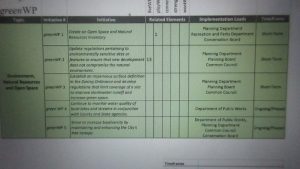
White Plains Commissioner of Planning, Christopher Gomez went into more detail on the OneWhitePlains draft Comprehensive Plan last night with a 20-minute address to the Common Council at the Monday night Special Meeting at City Hall. Citizens are urged to provide the city with their comments on the draft statement 7 days from now, November 7. Comments may be made in writing by letter or by writing comments on the OneWhitePlains.com website.
The complete worksession may be viewed on the City of White Plains website at
The Commissioner’s remarks to the council begin at the 30-minute in mark, as well as details on the implementation schedule with a decision on the Common Council approval or disapproval of the plan targeted for March or April
Common Council members expressed admiration and thanks to all citizens who participated and made comments on the plan. Councilpersons Jennifer Puja was enthusiastic about the plan. Victoria Presser said it included a 2021 trolley/shuttle system suggestion and a Multi-Generational Center, which she thought were essential.
Councilwoman Nadine Hunt-Robinson was complimentary to the citizens who participated and praised them for being “Questioning” and “very opinionated.”
Councilman Justin Brasch said he was still in process of reading the document and appreciated the great effort. Mayor Roach said he was proud of the plan, proud of the citizens who contributed their judgement and experience and we have to try and make it better.
Councilman Richard Payne praised the plan but raised the question on the Galleria mall, now vacant and awaiting a detailed site plan and how the recommenations for that site will be handled. The Commissioner responded in this clip:
Commissioner Gomez, said the Draft plan commentary He said the “very targeted recommenations” for areas as well as the draft plan itself were to be a “Guiding Policy Document” and that zoning changes suggested in the plan were needed to be enacted in order to implement the plan suggestions. The Commissioner said the plan is meant to “guide policy,” and set up the zoning to that. Here is what the Commissioner said:
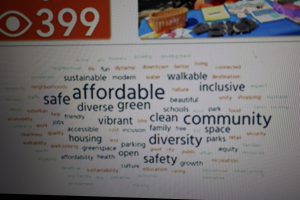
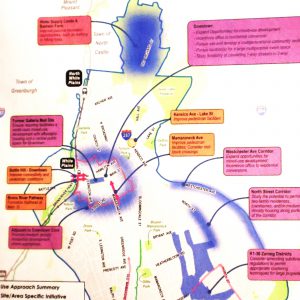
The Commissioner emphasized that given the “Front-loaded” community outreach of 16 Listening Tour presentations over 2-1/2 years that the expressions of the citizens’ visions of what the city appeared to be clear, expressed in the larger words illustrated in this slide:
WPCNR DOWNTOWN DAILYBy John F. Bailey. October 31, 2023:
The Chairman of the Board of Montefiore White Plains Hospital Medical Center, William Null of Cuddy & Fedder presented a request to the Common Council last night for zoning changes needed to proceed with the hospital development of a new Emergency Room across from Davis Avenue including new operating rooms.
A new parking garage across from the main buildings of the present hospital
.The completion date is envisioned in five years, Mr. Null explained to the Common Council at a Special Meeting last night. The entrance to the new Emergency Room would be from East Post Road.
Davis Avenue in front of the present main hospital entrance would be closed.
Null said the design of the new medical building has not been completed yet.
He said the facility is needed because the previous White Plains Emergency Room expansion opened in January 201013 years ago,( before Montefiore acquired the hospital) has doubled its visits since theprevious emergency room expansion.
He said the new parking garage envisioned would increase the already stressed parking facilities on Davis Avenue.
The present bridge between the present entrance to the hospital from the Davis Avenue facility would be removed and a new entrance cul-desac entrance would be built. A new bridge would be built between the new Emergency Room and the original “Legacy” hospital and the present Emergency facility, connecting the two.
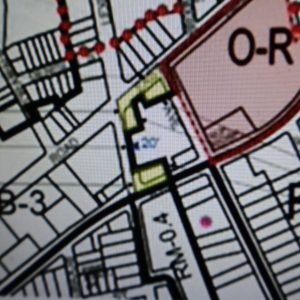
Proposed rezoning of yellow areas to be included in Central Parking District, enabling contruction of new Emergency Building with parking garage in the white square. Temporary Parking would be on surface level parking outlined by the red dots.
Welcome to the Northeast edition of Outbreak Outlook! It is only available to paid subscribers. If you wish to become a paid subscriber and access region-specific information, please click the Subscribe Now button below. Thanks for reading! -Caitlin
Covid-19
Covid-19 activity is declining overall, but the Northeast still has higher activity levels compared to other regions of the country. The New England states, in particular, have been slow to turn the corner.
However, test positivity and emergency department visits for Covid-19 are falling across the region, marking several weeks of decline. Wastewater concentration is also decreasing, according to data from Biobot.
All in all, I think better times are ahead. However, while overall activity is lower than at this time last year, it may remain elevated compared to the summer lows as we head into the winter months.
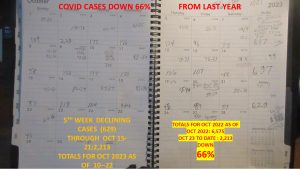
(EDITOR’S NOTE FROM JOHN BAILEY: WESTCHESTER HAS CUT THE RATE OF INFECTIONS THE FIRST 3 WEEKS IN OCTOBER 2023 BY 66% LOWER THAN THE FIRST 3 WEEKS OF OCTOBER 2022. 6,575 IN OCTOBER 2022 THROUGH OCT. 22 AND AS OF THE END OF OCTOBER 15 THROUGH 21, 2023 ONLY 2,213 WESTCHESTER PERSONS CAME DOWN WITH COVID. PROJECTING AHEAD THIS MAY LIMIT DECEMBER INFECTIONS TO BELOW 6,000 IN DECEMBER. THE MIDDLE OF WEEK HIGH POSITIVES HAVE DROPPED TO AN AVERAGE OF 72! LAST WEEK DELIVERED JUST 629 INFECTIONS 89 A DAY.
THE ONLY TROUBLING STAT IS WHITE PLAINS HOSPITAL FROM OCTOBER 13 TO OCTOBER 24 (11 DAYS) WAS OF 129 PATIENTS ADMITTED TO THE HOSPITAL 74 WERE FOUND WITH COVID—57% WITH COVID WHICH IS WHAT THE HOSPITAL IS AVERAGING.)
Respiratory diseases
Influenza-like illness
The Northeast continues to experience relatively low flu levels, though activity is beginning to pick up in some states as we enter the heart of flu season.
New York saw influenza-like illness tick up slightly over the past week from 3.5% to 3.8% of doctor’s visits. Nearby New Jersey declined from 3.6% to 3.3% ILI.
Further north, Massachusetts and Connecticut experienced minimal flu changes week-over-week, holding around 1.5% and 1.7% ILI respectively.
Maine and New Hampshire remain on the lighter side for flu activity, with ILI rates of 0.8% and 0.3%. However, Vermont did see a notable jump from 0.5% to 0.8% influenza-like illness.
Rhode Island and Pennsylvania were essentially flat, with ILI rates holding below 1.5%.
Overall flu prevalence is still relatively low across most of the Northeast as we head deeper into fall. But some states are beginning to see upticks, so do get your flu vaccine sooner rather than later.
At the national level, young kids (still!) continue to experience the highest rates of influenza-like illness. Nearly 9% of doctor visits for children aged 0-4 involve symptoms like fever, cough, or sore throat. This rate compares to approximately 4% in the 5-24 age group and less than 2% in older age groups.
RSV
Respiratory syncytial virus (RSV) is ramping up across the Northeast as we head into the winter virus season. Several states saw jumps in RSV prevalence over the past week. I expect test positivity to continue to rise in the weeks to come.
Massachusetts experienced one of the largest increases regionally, with RSV positivity rising from 6.2% to 7.2% of samples tested. This indicates more than 1 in 14 tests are coming back positive for RSV.
New Hampshire and Connecticut also saw sizable RSV gains over the past week. Positivity increased from 2.7% to 3.6% in New Hampshire and 2.6% to 3.1% in Connecticut.
While still lower compared to other states, New York and New Jersey reported RSV upticks as well, rising to 1.0% and 2.1% positivity respectively.
Vermont and Maine continue to show relatively low RSV activity, with positivity holding below 1% in both states.
Other Respiratory + Stomach Bugs
Seasonal coronavirus activity in the Northeast remains low, with no concerning increases. Adenovirus and parainfluenza virus activity appears to be trending upward slightly nationally; no data is available at the regional level.
Human metapneumovirus activity has picked up in the Northeast. Metapneumovirus causes cough, runny nose, fever, and sometimes wheezing or difficulty breathing.
Norovirus (stomach bug) activity appears to be ticking up a bit in the region, now at 5.7% from a recent low of 4.2%. It’s something I will keep an eye on, though current levels of activity still remains far below typical winter surges.
Food recalls
The following foods are being recalled because they are contaminated. Please check your cupboards and throw out any of these items:
New this week:
Over the counter eye drops sold at CVS, Leader, Rugby, RiteAid, Target or Velocity Pharma (more info)
The Stock Market Crash of 1929 occurred on Friday, October 29, 1929, when Wall Street investors traded some 16 million shares on the New York Stock Exchange in a single day. Billions of dollars were lost, wiping out thousands of investors. In the aftermath of that event, sometimes called “Black Tuesday,” America and the rest of the industrialized world spiraled downward into the Great Depression, the deepest and longest-lasting economic downturn in the history of the Western industrialized world up to that time.
What Caused the 1929 Stock Market Crash?
During the 1920s, the U.S. stock market underwent rapid expansion, reaching its peak in August 1929 after a period of wild speculation in the Roaring Twenties. By then, production had already declined and unemployment had risen, leaving stocks in great excess of their real value.
Among the other causes of the stock market crash of 1929 were low wages, the proliferation of debt, a struggling agricultural sector and an excess of large bank loans that could not be liquidated.
Did you know? The New York Stock Exchange was founded in 1817, although its origins date back to 1792 when a group of stockbrokers and merchants signed an agreement under a buttonwood tree on Wall Street.
Black Tuesday
On October 29, 1929, Black Tuesday hit Wall Street as investors traded some 16 million shares on the New York Stock Exchange in a single day. Billions of dollars were lost, wiping out thousands of investors. Shown: the interior of the New York Stock Exchange on Black Friday, October 25, 1929.
The U.S. stock market underwent rapid expansion after a period of wild speculation during the roaring twenties. By then, production had already declined and unemployment had risen, leaving stocks in great excess of their real value.Messengers from brokerage houses crowd around a hard-to-obtain newspaper after the first Wall Street stock market crash on October 24, 1929. READ MORE: What Caused the Stock Market Crash of 1929?
The front page of the Brooklyn Daily Eagle with the headline “Wall St. in Panic as Stocks Crash,” published on the day of the initial 1929 Wall Street crash.
A World headline on October 25, 1929.
Right after October 29, 1929, stock prices had nowhere to go but up. Overall, however, prices continued to drop as the country slumped into the Great Depression. Shown here, millions of dollars in securities and records are transported on October 25, 1929 on Wall Street.
The Sub-Treasury Building (now Federal Hall National Memorial) opposite the Wall Street Stock Exchange in Manhattan, New York, at the time of the Wall Street Crash.
A stock broker at the New York Stock Exchange at one o’clock in the night, November 1929READ MORE: Warning Signs Investors Missed Before the 1929 Crash
New York stock brokers and their clerks worked until early October 30, 1929, checking up transactions. This photo shows some of the clerks catching up on their sleep in a gym.
In a London club, members watch fluctuations in the New York stock market on October 31, 1929 as changes are chalked up by telephone operators in direct contact with New York.
By 1933, nearly half of America’s banks had failed. Here, investors rush to withdraw their savings during a stock market crash, circa 1929.
An office force clears up the order room of the Carlisle, Mellick & Company, one the biggest brokers, in the Wall Street section at 50 Broadway on November 1, 1929.
A Wall Street investor tries to sell his car after losing all of his money in the stock market crash.
Apple sales were an organized attempt to get unemployed men back to work during the Great Depression.READ MORE: How Apples Became a Weapon Against the Great Depression
A man making his own protest against unemployment. The sign on his back reads: “I know 3 trades, I speak 3 languages, fought 3 years, have 3 children and no work for 3 months, but I only want one job.”
Notorious gangster Al Capone attempts to help unemployed men with his soup kitchen “Big Al’s Kitchen for the Needy.” The kitchen provided three meals a day consisting of soup with meat, bread, coffee and doughnuts, feeding about 3,500 people daily at a cost of $300 per day.READ MORE: Mobster Al Capone Ran a Soup Kitchen During the Great Depression
Unemployed squatters at the Hard Luck Camp at the foot of 9th and 10th Streets and the East River in New York City, waiting for eviction by the police on May 9, 1933.
Two Dust Bowl refugees in 1937 walk along a highway towards Los Angeles, passing by a billboard saying, “Next Time Try the Train—Relax.” READ MORE: How the Dust Bowl Made American Refugee’s in Their Own Country
Stock prices began to decline in September and early October 1929, and on October 18 a big drop in stock prices began. Panic soon set in, and on October 24, Black Thursday, a record 12,894,650 shares were traded. Investment companies and leading bankers attempted to stabilize the market by buying up great blocks of stock, producing a moderate rally on Friday.
On Monday, however, the storm broke anew, and the market went into free fall. Black Monday was followed by Black Tuesday—October 29, 1929—during which stock prices collapsed completely and 16,410,030 shares were traded on the New York Stock Exchange in a single day. Billions of dollars were lost, wiping out thousands of investors, and stock tickers ran hours behind because the machinery could not handle the tremendous volume of trading.
Effects of the 1929 Stock Market Crash: The Great Depression
After October 29, 1929, stock prices had nowhere to go but up, so there was considerable recovery during succeeding weeks. Overall, however, prices continued to drop as the United States slumped into the Great Depression, and by 1932 stocks were worth only about 20 percent of their value in the summer of 1929.
The stock market crash of 1929 was not the sole cause of the Great Depression, but it did act to accelerate the global economic collapse which it was also a symptom. Stock prices continued to drop through 1932 when the Dow Jones Industrial Average—a widely-used benchmark for blue-chip stocks in the United States—closed at 41.22, its lowest value of the 20th century, 89 percent below its peak.
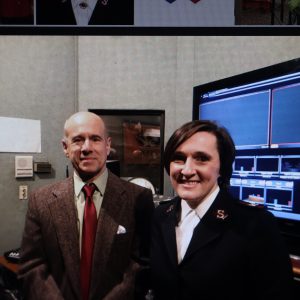
JOHN BAILEY INTERVIEWS WHITE PLAINS MAJOR JEN HEAD OF SALVATION ARMY OF WHITE PLAINS AND JOHN VORPERIAN NEW CHAIR OF THE BOARD OF THE WHITE PLAINS SALVATION ARMY
ON THE RECORD NUMBER OF PERSONS ASKING FOR MEALS FROM THE SALVATION ARMY THIS YEAR
IMPACTS OF COVID AFTER 2020, THE START OF THE EPIDEMIC
We are approaching the end of October, and at least 10 million Americans have gotten the Fall 2023 Covid-19 vaccine. This amounts to ~3% of the eligible population (only 7% of nursing home residents). This is severely trailing typical flu vaccine coverage, just like last fall.
For those interested in nuance: Is this year trailing last year’s Covid-19 coverage too?
Well, yes, as seen in the line above. But, we are comparing apples to oranges. The end of the public health emergency meant that states were no longer required to report vaccine uptake to the CDC, but some are still reporting. So, the 2023 numbers are the bare minimum. Models considering differential reporting show Covid-19 coverage is about the same as last year.
This is nothing to brag about.
Five reasons
Covid-19 is more transmissible, more severe, has more long-term implications, and is more unpredictable than the flu.
So, why is coverage so much lower than flu?
Covid-19 circulates year-round, while flu circulates seasonally. This means that ~15% of the population was infected with Covid-19 this summer and do not need the fall vaccine yet.
Debate on eligibility. There is a debate about whether those under 65 “need” a Covid-19 vaccine. Many physicians I highly regard (but disagree with) are on the fence about recommending it for everyone. We don’t have this with flu.
Lack of access. The choppy rollout this fall is well documented. Even with distribution smoothed out, there is a lack of access. For some local health clinics, the vaccine costs more than they can afford or willing to financially risk. This is causing grave inequities. The closest place for my youngest is 50 miles away.
Fatigue. We have been hammered to get Covid-19 vaccines for the past three years. People are just… tired… of hearing about it.
Lack of resources There is now zero federal money for a Covid-19 vaccine campaign for education and outreach. Health departments are on their own, too. (The panic and neglect cycle is too real in public health.)
So what should we do?
All of us—friends, family, neighbors, schools, pharmacies, doctor offices, health departments, employers—need to be laser-focused on “passive positives.”
This approach works with organ donations. We should do it with vaccines. And it’s beyond time we leverage behavioral science to get vaccinationsin arms as much as we do bench science to get vaccines in vials.
In a Scientific American piece last week, I partnered with two leading psychologists on the what, how, and why behind passive positives. Check it out HERE.
Bottom line
Increasing trust, access, and coverage of vaccines will take an all-hands-on-deck approach. We are exhausted, but it’s worth the push—fewer lives will be lost, fewer work and school days will be missed, and our quality of life will improve.
Love, YLE
“Your Local Epidemiologist (YLE)” is written by Dr. Katelyn Jetelina, MPH Ph.D.—an epidemiologist, wife. During the day, she is a senior scientific consultant to several organizations. At night she writes this newsletter. Her main goal is to “translate” the ever-evolving public health world so that people will be well-equipped to make evidence-based decisions. This newsletter is free, thanks to the generous support of fellow YLE community members. To support this effort, subscribe below: