REPORT FROM THE NEW YORK STATE ASSEMBLY: THE 2025-26 BUDGET

Hits: 215

Dear Friends,

In my last newsletter, I provided an update on the Governor’s proposed budget for fiscal year 2026, which spans from April 1, 2025, through March 31, 2026. After joint budget hearings between the State Senate and Assembly, along with further review by staff, committee chairs, and senior leadership, the Legislature has completed its evaluation of the proposed budget. On March 13, both chambers adopted their One House Budget resolutions, which contain summaries of recommended changes to the Executive Budget.

Conference committees — made up of representatives from both the State Senate and Assembly — have met to reconcile the differences between the two chambers. These reconciled recommendations will form the basis for negotiations with the Executive to reach a three-way agreement on the final budget. While there are areas of disagreement, I am happy to report those disagreements are not as significant as last year’s budget cycle.

Before I delve into the highlights of the One House Budget, however, I wanted to take this opportunity to remind everyone of some important upcoming dates.

The deadline to nominate a 93rd Assembly District 2025 Woman of Distinction is coming up THIS Monday, March 24th.

Thank you to everyone who has submitted a nomination. If you have not yet nominated someone and would like to, please click here.

Also, please join me on April 4th for our New Office Open House! Originally scheduled for today, we unfortunately needed to move the date due to a conflict.

The Open House will be a great opportunity to connect… and there will be refreshments! RSVPs requested, not required, by clicking here.

Finally, there are a couple of other important deadlines coming up, including for recipients and caregivers who rely on the Consumer Directed Personal Assistance Program (CDPAP), as well as those of you who may not have transitioned your existing form of DMV ID to a REAL ID. More on both of those below.

The Assembly One House Budget

The Assembly’s One House budget builds on the Governor’s Executive budget, adding key funding for healthcare, school aid, higher education, the environment, and childcare. The total budget proposed by the Assembly is $256.5 billion, which is $4.5 billion, or 1.8%, higher than the Executive’s proposal. While there are no major disagreements between the Assembly’s and the Governor’s proposals, the Assembly’s version excludes certain non-budget-related policy issues, such as changes to laws regarding discovery and involuntary commitment. This doesn’t necessarily imply opposition; rather, the Assembly believes these non-fiscal policy issues should be addressed through the legislative, rather than budgetary, process.


Education

Unlike last year’s budget, the Governor’s budget includes no cuts to Foundation Aid for public schools.

It proposes a minimum 2.0% annual increase, while the Assembly has proposed a 2.9% increase. The Assembly would also boost funding for universal pre-kindergarten, expand the universal school meals program to include breakfast and snacks, and increase funding and tuition assistance for both the SUNY and CUNY systems.


The Environment

The Assembly proposal includes several increases in environmental funding, including $100 million to boost the Environmental Protection Fund (bringing the total to $500 million) and a $100 million increase for clean water infrastructure (bringing the total to $600 million). 

The Governor’s budget proposed an unspecified allocation of $1 billion over five years for climate mitigation and adaptation capital grants. The Assembly, however, has earmarked specific funds for energy efficiency and clean energy projects, including:

– $330 million to NYSERDA for energy efficiency programs

– $200 million for zero-emission transportation projects

– $150 million for thermal energy networks

– $100 million for electric vehicle fast charging stations and supporting infrastructure

– $100 million to NYSERDA for school-based efficiency and renewable energy

– $100 million for Charge Ready NY, and $20 million for municipal buildings, public hospitals, and schools


Child Tax Credit and Afterschool Programs

The Assembly’s budget proposal strengthened the Governor’s proposed child tax credit expansion by adopting the Working Families Tax Credit. This will consolidate existing credits to provide qualified families with up to $1,600 per child annually. It includes:

– A $1,000 credit for children aged three and under.

– A $500 credit for children aged four through 16.

The credit will be phased in over five years, starting with a maximum of $550 per qualifying child in the first year and reaching $1,600 per child by the final year.

The Assembly’s proposal also increased funding for programs administered by the Office of Children and Family Services (OCFS) by $372.6 million, bringing the total to $6.2 billion. This includes $100 million for afterschool programs in high need districts that serve youth up to age 18.

We also proposed $5 million in funding for afterschool providers who are not eligible for other state-funded programs but primarily serve economically disadvantaged students. I led my Assembly colleagues in advocating for this $5 million allocation, which would provide a source of funding for the afterschool programs left out of the most recent funding round.

Housing

The Assembly’s proposal includes $4.6 billion for the Division of Housing and Community Renewal (HCR), $2.4 billion more than the Executive’s proposal. A major component of the Assembly’s budget to reduce homelessness is the inclusion of the Housing Access Voucher Program, which allocates $250 million to provide rental assistance to those who are homeless or at risk of homelessness. The Assembly also proposed an additional $100 million for Mitchell-Lama and NYC Housing Authority units, and $750 million for Mitchell-Lama preservation and homeownership.

Additionally, I was pleased to see the adoption of a proposal I worked on with Assemblywoman Dana Levenberg. The Governor’s budget allocates $10.5 million for “technical assistance” to municipalities seeking certification as pro-housing communities. At our request, the proposal now provides that the funds may be used for grants to help municipalities carry out their housing plans.  


Inflation Rebate Checks & Middle-Class Tax Cuts

The Assembly’s budget includes the Governor’s proposal for a one-time $3 billion inflation refund credit, providing:

– $500 for taxpayers filing jointly with incomes below $300,000

– $300 for single filers with incomes below $150,000

Additionally, the Assembly would enhance the Governor’s proposed Middle-Class Tax Cut to include an immediate 1% tax cut for taxpayers with incomes below $323,200.


I hope this update is helpful. As always, I will continue to advocate for the priorities that matter most to our community. Thank you for your ongoing support!

CDPAP Transition Deadline – March 28th

Recipients and caregivers who rely on the Consumer Directed Personal Assistance Program (CDPAP) have until March 28 to transition to the state’s new Statewide Fiscal Intermediary, Public Partnership, LLC. CDPAP provides services to an estimated 250,000 New Yorkers – not only to people with disabilities but also others with long-term needs under Medicaid.
Individuals and personal assistants who are currently participating in CDPAP should call 1-833-247-5346 to be walked through the process, and further information can be found here. Caregivers who register by the deadline will receive a $100 bonus.


A list of community-based organizations that are approved to help consumers transition to PPL, along with the languages they speak and medical focus, can be found here.

As a member of the NYS Assembly Standing Committee on People with Disabilities, I have shared my constituents’ concerns with Assembly leadership regarding the significant changes that will result from this transition (indeed, some of you may remember my discussion of this in last year’s budget newsletter). To that end, my staff and I have been monitoring the transition since Governor Hochul put it in place last year.

My biggest concern centers on potential disruption or suspension in the delivery of critical services for individuals who, through no fault of their own, are not registered in the PPL system. My staff and I have been in close contact with PPL. While the PPL representatives with whom we work are responsive and helpful, we are nonetheless aware of the significant time it takes and snafus that occur while registering with the system – even for individuals very conversant and experienced with CDPAP.

We understand the NYS Department of Health has contingency plans should there remain individuals who are not registered by the deadline. We continue to monitor the situation very closely. In the meantime, please reach out to my office if you are having any issues with this transition and we will do everything we can to assist you.

REAL ID Deadline – May 7, 2025

After a two-year delay, the deadline to get your REAL ID from the Department of Motor Vehicles (DMV) is rapidly approaching! Starting May 7, 2025, all residents will be required to have a REAL ID to board domestic flights or enter certain federal buildings, unless they have a valid passport. For more information, including a list of necessary documents, please click here.

Ramadan Mubarak

Finally, to all those who are celebrating Ramadan, I wish you and your family peace, happiness, and harmony.
As always, please do not hesitate to reach out to my office with any questions or if there is any assistance we can provide. You can always reach me at burdickc@nyassembly.gov or by calling (914) 244-4450. My staff and I are always ready to help.

Please also follow me on FacebookTwitter/X, and Instagram for continued up-to-date information.

Miss any of our previous newsletters? You can find them here.


Sincerely yours,
Office of Assemblymember Chris Burdick | Website
Posted in Uncategorized

WHITE PLAINS WEEK NEWS NOW THE MARCH 21 REPORT WITH JOHN BAILEY AND THE NEWS ON WWW.WPCOMMUNITYMEDIA.ORG

Hits: 200


THE IMPACT NEWS NETWORK!

BANKRUPTING NEW YORK BEGINS


DOT DEMANDS MTA MAKE SUBWAYS SAFER OR ELSE

STARVING HUNGRY WESTCHESTER 

37 YEARS OF A WESTCHESTER THAT GOES HUNGRY EVERY DAY

FEDERAL GOVERNMENT CUTS FUNDS

FOR THE HUNGRY 25% OF 2025-26 BUDGET

ALBANY ADOPTS WAIT AND SEE IF THEY HAPPEN ATTITUDE ON CUTS

YONKERS TAKES CON ED RATE INCREASES TO COURT

CONSIDERS GOOD CAUSE EVICTION LAW  –THE EFFECT

WHILE WHITE PLAINS COMMON COUNCIL MULLS SAME LAW

AND MORE

THE WHITE PLAINS HIGH SCHOOL PERFORMANCE

NITA LOWEY PASSES AWAY

JOHN BAILEY AND THE NEWS

THE BIG STORIES YOU DO NOT HEAR ABOUT

EVERY WEEK ON WHITE PLAINS WEEK

FOR THE LAST 24 YEARS

WESTCHESTER’S NEWSMAN


Posted in Uncategorized

March 20—Administration Rejects Alternative Social Security Office Location in White Plains

Hits: 219

COUNTY EXECUTIVE KEN JENKINS BLASTS TRUMP ADMINISTRATION FOR ABANDONING WESTCHESTER RESIDENTS

BY REJECTING BIPARTISAN PLAN TO KEEP SOCIAL SECURITY HEARING OFFICE IN WHITE PLAINS

(White Plains, NY) – Westchester County Executive Ken Jenkins is slamming the Trump administration’s decision to reject a bipartisan effort—led by Jenkins, U.S. Congressman George Latimer, and U.S. Congressman Mike Lawler—to keep the Social Security Hearing Office in White Plains open. Despite the County’s offer to house the office in County-owned space to ensure continued access, Acting Social Security Commissioner Leland Dudek turned his back on Westchester residents.

In a letter to Latimer, Dudek stated that residents seeking Social Security services could instead travel to Lower Manhattan, New Haven, CT, the Bronx, or Goshen. Jenkins said the Trump administration is indifferent to seniors, individuals with disabilities and other vulnerable residents who depend on these services.

Jenkins said: “This is a disgraceful decision that prioritizes bureaucratic indifference over the well-being of Westchester residents. The Trump administration is effectively cutting off access to Social Security resources for those who need them most. Westchester County will not stand by while Washington abandons our communities. I will continue fighting alongside Congressman Latimer and Congressman Lawler to ensure our residents are not left behind.”

With the lease on the current Hearing Office at 75 S. Broadway in White Plains set to expire on May 31, Jenkins said they are exploring more options.

Posted in Uncategorized

MARCH 20–NEWCOMER TO WHITE PLAINS REACTS TO THE WHITE PLAINS OF TODAY, DEVELOPMENT.

Hits: 234


WPCNR THE LETTER TICKER. MARCH 20, 2025:


Dear White Plains Week:

I would like to suggest that you interview neighborhood association representatives about the communities of White Plains. I had no idea that there were so many! And I don’t know where they are all located and the area they encompass. It would be interesting to hear how developments impact each community.   

I’ve been in contact with Martin Berger about the project on Westchester Ave. I live on Franklin Ave. and I’m President of the co-op board where I live. Until I saw the Common Council meeting a couple of years ago, I had no knowledge of what was proposed. I contacted Mr. Berger, and he was very receptive to speaking with me, met with the board, and reached out to me again when changes to the development were going to be proposed.

I am not a fan of the Galleria property proposal.

I think that it is too much for that space and talk about congestion! As you presented a few years back when bus and bike lanes were going to be part of the Tarrytown Rd. corridor, and as mentioned over the years, there is one primary way in and out of White Plains (Main St. and Hamilton Ave)….

can you imagine what it is going to look like when 5,000 people are added to that two block area!

Not everyone works in NYC and will take Metro North.

Not everyone wants to walk where they have to go or have business in the area which makes it a sensible alternative to walk.

And the high-end restaurants that are proposed! As Councilman Brasch mentioned, there are lower income families in White Plains.

Do you realize that we don’t have any fast-food restaurants in downtown White Plains? No McDonalds, Burger King, Tocco Bell, Wendy’s. Or even restaurants like Olive Garden and Apple Bee’s. Maybe these types of restaurants should be considered.

Signed  (A new  Resident of White Plains recently moved to White Plains.)

Posted in Uncategorized

MARCH 20–FEEDING WESTCHESTER FACES $2 MILLION LOSS OF GOVERNMENT FUNDING– 25% OF NEW YEAR BUDGET

Hits: 346

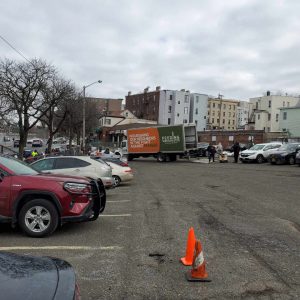
A Feeding Westchester breadline on a 30 degree morning last year. Inflation and defunding threaten the food supply.

 INFLATION FROM TARIFFS, BIRD FLU SKYROCKET COSTS OF SUPPLYING MEALS TO COUNTY

WPCNR THE HUNGER STORY. By John F. Bailey. March 20, 2025:

Feeding Westchester announced  last night it faces a $2 Million loss of government funding .

Ryan Brisk Vice President of  Operations and Procurement addressing the audience including many politicians and representatives reported the lost $2 million dollar reduction on the zoom last night. And, there could be more government cuts by July the start of the next fiscal year, Feeding Westchester does not know.

He cited two other situations aggravating the loss of  operating funds:

Planned tariffs on Mexico and Canada could be  expected to create commensurate inflation prices on foods imported from those two countries.

One example is the cost of eggs. He cited a truck of eggs $50,000, but the latest contracted order was raised to $150,000 for a truck of eggs, and Feeding Westchester did not have the financial resources to pay 200% hike.

The spread of bird flu  further complicates staples because of the rising cost of eggs (now $6 a dozen).

Karen Erren, CEO of Feeding Westchester said  Feeding Westchester ability to feed county residents that currently  makes 229,000 Neighborhood visits each month that deliver 19.3 million months and distributes 23 million pounds of food  would be impacted and the organization was planning how to replace the as of now 25% loss of funds for the 2025-6 fiscal year.

When Feeding Westchester was founded in 1988 the organization fed  between 175,000 and  140,000 a month. Today that has grown to 275,000 monthly. Westchester County population is 1,000,400 persons.

Other non profits that distribute food will be similarly affected.

Posted in Uncategorized

MARCH 19—OPEN HOUSE WITH ASSEMBLYMAN CHRIS BURDICK APRIL 4 FRIDAY 3 PM

Hits: 160

Due to an unexpected conflict, the date for our New Office Open House has been changed to FRIDAY, APRIL 4th. We hope you can join us on this new date!

RSVPs requested (not required) at tinyurl.com/BurdickOpenHouse.

We apologize for any inconvenience and will reach out to all who have already RSVPd to ensure they know about the new date.

We hope to see you then!

Office of Assemblymember Chris Burdick | Website
Facebook  X  Instagram
Posted in Uncategorized

MARCH 18 — PAUL FEINER CALLS FOR CITIZENS COMMITTEE AGAINST HATE BIGOTRY

Hits: 227

WPCNR THE LETTER TICKER MARCH 18,2025:

WANTED—A CITIZENS COMMITTEE TO ORGANIZE A STUDENT CONTEST AGAINST HATE AND BIGOTRY

WINNING POSTERS WILL BE PLACED AROUND GREENBURGH –CONTEST TO BE ANNUAL

Last Tuesday I suggested to the Greenburgh Town Board that the town sponsor an annual poster competition among school children against hate and bigotry.

Members of the Board asked me to come up with a more specific proposal. The next step: A committee of residents should be formed to help come up with criteria for an annual contest and assist in implementation of this student art contest. The committee may choose to organize two or three different competitions based on grades – grade school, middle school and high school.

I suggest that the winning posters be placed at the entrance to Greenburgh Town Hall, the Theodore Young Community Center, The Police and Court House, the Library, AF Veteran Park and at the entrances to Greenburgh streets for one year.

I think that the winning posters should highlight what a welcoming community Greenburgh is. Those entering the competition should highlight  opposition to all forms of bigotry—against Blacks, Hispanics, Jews, Irish, Indian, Italians, Muslims, Chinese, Japanese, Hindu’s, Sikh’s and the LGBTQ community among others.

The winning posters should be placed at the above locations for one year. Each year the town should sponsor another student competition.   This contest is also a great opportunity to teach students about racism and bigotry and to encourage our  youth to welcome those who are different.

Are you interested in helping develop a proposal?  And, working as a member of the committee.? If yes – please e mail me at pfeiner@greenburghny.com.

I would like to present the Town Board with a proposal that could be considered and hope that the first competition could be organized this year.

Let’s celebrate our diversity and let’s send a message to anyone entering Greenburgh that we will not tolerate bigotry against anyone.

PAUL FEINER

Greenburgh Town Supervisor

Posted in Uncategorized

MARCH 17– YOUR LOCAL EPIDEMIOLOGIST REPORTS: IF BORN AFTER1959 YOU NEED A MEASLES SHOT. LOCAL IMPACT OF FDA FOOD PROGRAM CUTS. NOROVIRUS INFECTIONS DOUBLE OVER LAST YEAR

Hits: 295

Si quiere leer la versión en español, pulse aquí.


Happy Saint Patrick’s Day! Here’s the public health news you can use to start your week. Some virus stuff, but also a lot happening in the nutrition world.


Your national disease report: Flu is out, norovirus is (still) in

Influenza-like illness (e.g., fever, cough, runny nose) remains moderate across most of the U.S., but trends are sharply declining. If this continues, we could be out of respiratory virus season in a few weeks. The Northeast is still seeing high levels.

Influenza-like illness levels. Source: CDC; Figure annotated by YLE

Covid-19 spread continues to decrease after a lackluster winter. But eyes are on a highly mutated variant in South Africa—called BA.3.2—which has 50 new spike mutations. This is a lot of changes in one variant. We haven’t seen this many since the Omicron tsunami in 2021.

Phylogenic Covid-19 tree showing the number of mutations per variant. Source: Ryan Hisner

The number of spike changes doesn’t necessarily mean it will be easily spread among humans, so we must pay attention to other metrics. According to wastewater trends in South Africa, transmission is increasing, which suggests the variant is something to pay attention to. We have not detected it in other countries yet. Will this fizzle out, drive a summer wave, or become a tsunami? Time will tell.

Norovirus—think diarrhea and vomiting—is having. a. year. Test positivity rates remain nearly double last year’s. The virus mutates slightly every few years, triggering a surge—and we’re in one now. Fortunately, norovirus season is typically November–April, so I’m hopeful this will be winding down soon.

Source: NREVSS Dashboard

What does this mean to you? Sickness in your family should slow down soon, as respiratory season is in the rearview mirror. If you have the stomach bug, use a separate bathroom in your house and wear a mask if possible. Hand sanitizer doesn’t kill this bugger, either—soap and water are your best bet.


Measles situation report

As of Friday, the U.S. has reported 326 measles cases—more than the annual total in 12 of the past 15 years, and it’s only March.

Figure by YLE

Measles cases surge every five years for reasons we don’t fully understand. Pair that with declining vaccination rates in the U.S. and worldwide, and you get the perfect storm. Last year, Europe saw its highest measles case count in 25 years.

In the Texas/New Mexico outbreak, measles cases continue to climb—and estimates suggest the true count could be 4 times higher than reported. The outbreak is spreading beyond the Panhandle to East Texas, OklahomaMexico, and possibly Kansas. The vast majority of cases are in unvaccinated, school-aged children.

Measles is increasing beyond this outbreak and is linked to international travel. In the past week, cases have popped up in VermontMichiganNew YorkHouston, California, and Pennsylvania.

Source: YLE

What does this mean to you? Check your vaccination status. If you’re up-to-date on vaccines, you’re very well-protected against measles. People around you may start having more questions about vaccines, though, given confusing statements from HHS. The best thing you can do is listen from a place of empathy and point them to evidence-based information or a trusted messenger, like a clinician (or YLE :)).


West Virginia bans some preservatives and dyes. But don’t lose the forest for the trees

West Virginia has become the first state to prohibit certain artificial food dyes and preservatives, a groundbreaking move that more states have already begun to adopt.

Supporters applaud the bill. The FDA approved these additives over 30 years ago, and since then, the amount availablepurchased, and consumed have increased considerably. Some research has also found:

  • Correlation between some dyes and potential hyperactivity in a subset of susceptible children.
  • BHA (one of the banned preservatives) as a possible carcinogen based on rodent studies (although not considered relevant to humans).
  • Propylparaben (one of the banned preservatives) is a possible endocrine disruptor.

However, additives in foods at the market aren’t at levels that harm humans, as many studies have been done on rodents at very high doses. In addition, the bans could drive up food costs and reduce accessibility.

The U.S. typically takes a risk approach to policy (identifying a hazard and assessing the probability of the exposure doing harm) rather than a hazard approach (as in Europe, where if a study shows a substance can be toxic, even to animals, they aim to eliminate the hazard completely). This West Virginia policy is taking a European approach.

But let’s not lose sight of the forest for the trees. West Virginia leads the nation in rates of obesitydiabetes mortality, and depression but also ranks poorly in food insecurity and heart disease. Candy is candy, with or without Red Dye #40. Unfortunately, this will unlikely make a meaningful impact without addressing deeper issues such as access to nutritious food, affordable healthcare, and investing in public health infrastructure.

What this means to you: If signed into law, the ban will go into effect in 2028. If you live in West Virginia, this means certain candies, snack foods, drinks, jams and dessert items will be pulled from shelves. This could impact businesses, employment and food costs. This may be coming to more states. However, remember what keeps you healthy is the same boring advice: physical activity, a balanced, nutritious diet, and limiting substance use.


USDA cuts Local Food cooperative programs

The USDA is eliminating two federal grant programs that helped fund state-level local agriculture, schools, and food programs:

  1. Cutting the Local Food for Schools Cooperative Agreement Program will affect over 40 states. States were using these funds in different ways, for example:
    1. South Carolina purchased local foods for schools, particularly from 29 socially disadvantaged farmers and 46 small farm businesses. Around 213,000 students in underserved areas received increased access to local foods.
    2. Wyoming purchased unprocessed or minimally processed local and regional food products for schools.
    3. West Virginia encouraged local farmers and producers to grow food that could be incorporated into public school menus.
  2. Cutting the Local Food Purchase Assistance Cooperative Agreement Program, which supports local feeding programs and food banks with local foods.

What this means to you: The U.S. government will save $1 billion. If you live in one of these states, your Department of Agriculture will have fewer federal funds to purchase and distribute local foods for schools, food banks, and childcare centers. If states don’t foot the bill, then cuts will affect school meal menus, food programs, local farmers, and local economies. Here’s an email from a local Mayor, as an example:


Question grab bag

“I’m still so confused about measles vaccine protection. I was born between 1958 and 1963, which wasn’t included in your table. What should I do here?”

It is very confusing. If you were born:

  • Before 1959: You didn’t get a vaccine and do not need one.
  • Between 1959 and 1963: No MMR vaccine was available. But you still need to be vaccinated.
  • Between 1963 and 1989: Vaccines were available, and you most likely got one dose. You don’t need another dose unless you got the inactivated vaccine OR you are high risk.
  • After 1989: You likely got two doses.

What you should do: Look at your vaccine records. If you can’t find them, you should be vaccinated. Or, at the very least, talk to your physician.

Figure by YLE


Bottom line

That’s your public health dose for the week! Have a great Monday.

Love, the YLE team


Your Local Epidemiologist (YLE) is a public health newsletter with one goal: to “translate” the ever-evolving public health science so that people feel well-equipped to make evidence-based decisions. This newsletter is owned and operated by Dr. Katelyn Jetelina— an epidemiologist and mom. This is free to everyone, thanks to the generous support of fellow YLE community members. To support the effort, subscribe or upgrade below:

Posted in Uncategorized