Vorperian and Marty Glickman’s HBO Biographer…on WHITE PLAINS TV TONIGHT

Hits: 168

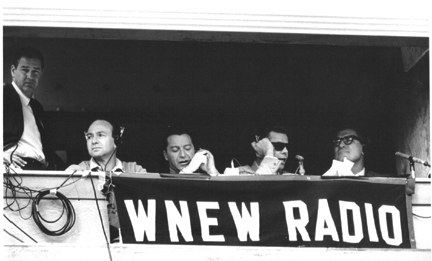
Mal-Kirpich_Marty-Glickman_Nat-Asch_Kyle-Rote_Al-DeRogatis1

iT’S GOOD! LIKE NEDICKS! MARTY GLICKMAN, SECOND FROM LEFT ON A WNEW NY GIANTS BROADCAST FROM THE PAST. GLICKMAN’S HBO BIOGRAPHER IS INTERVIEWED ON BEYOND THE GAME THIS EVENING AT 9 P.M.

WPCNR MEDIA MONITOR. From Beyond The Game, White Plains TV. August 23, 2013:

 
            Before Marv Albert and Bob Costas, there was Marty Glickman. A gifted Jewish-
 
American athlete who was denied the chance to represent the U.S. at the 1936 Berlin
 
Olympics, he went on to become one of the most revered and influential sportscasters in
 
history, pioneering many of the techniques, phrases and programming innovations that are
 
commonplace in sports reporting today. Chronicling his remarkable life and career,
 
            TONIGHT, Aug 23rd  at 9:00p.m.White Plains Community Media’s BEYOND
 
THE GAME (Cablevision 76; Verizon Fios 45; & www.wpcommunitymedia.org)
 
will feature GLICKMAN, writer, producer and director James L. Freedman. BEYOND
 
THE GAME host John Vorperian said, “As a high school senior James Freedman
 
 produced Marty Glickman’s late-night NYC sports radio program. GLICKMAN is
 
Freedman’s first documentary, but clearly his film illuminates the life and legacy of the
 
man who pioneered modern sports reporting.”
 
            WPPA viewers who wish to see more about GLICKMAN prior to its HBO 
 
Monday, August 26 premire can visit: www.glickmanthefilm.com
GLICKMAN debuts MONDAY, AUG. 26 (9:00-10:30p.m.)  exclusively on HBO.
Posted in Uncategorized

Moody’s Moves NY Up to Positive. Governor Says Future Looks Bright Ahead

Hits: 86

WPCNR ALBANY ROUNDS. From the Office of Governor Andrew M. Cuomo. August 22, 2013:

Upon Moody’s Investors Service revising New York State Outlook today, Governor Andrew Cuomo issued this statement:

“Today’s action by Moody’s Investors Service to revise our State’s outlook from stable to positive is another strong affirmation of the progress we have made to put New York’s fiscal house in order. After years of late budgets and legislative gridlock, we have been able to show that New York State is working again and confidence in government is being restored. Since taking office, my administration has delivered three on-time and balanced budgets, controlled government spending, and cut taxes for the middle class to their lowest levels in 60 years. New York has gained over 300,000 private sector jobs with more being added every day, and this momentum is leading us to fiscal stability and economic prosperity.”

Excerpt of Moody’s Report Included Below
###
Moody’s moves New York State outlook to positive; affirms GO at Aa2
State has $62.1 billion in net tax-supported debt outstanding

 Moody’s Investors Service has changed the outlook on New York State to positive, and affirmed the Aa2 rating on New York’s $3.5 billion of General Obligation Bonds. Moody’s has also affirmed the ratings on all outstanding appropriation-backed and G.O.-related bonds as well as various state intercept programs (see detailed list below).
SUMMARY RATING RATIONALE The positive outlook reflects improvements in the state’s economy, governance, financial position and fiscal outlook that, if continued, would allow the state to improve its reserves and draw closer to structural balance.
New York’s Aa2 general obligation rating reflects the relative strength and recent resilience of its economy; governance constraints including a history of late budgets and limited executive authority to reduce appropriations; a financial position that has improved but remains below average; a moderate combined debt and pension burden; and sound debt management and frequently updated financial forecasting. The rating incorporates notable improvements in the state’s economy, governance, financial position, and budgetary balance over the past three fiscal years, as well as remaining risks, including weakness in the financial services sector, continued revenue volatility, and relatively low fund balance and liquidity positions.
STRENGTHS:

· Broad-based, mature, and wealthy state economy that attracts a highly-educated and global workforce, and has shown above-average resilience during the recovery· Long track record of closing annual budget gaps, and more recently, with more structurally balanced solutions· Accumulated rainy day reserves have remained stable for 10 consecutive years, providing cash flow flexibility, although at comparatively low levels· State pension system is well funded compared to other states and unfunded liability is modest, placing state’s fixed costs at the 50-state median relative to total revenues· Recent reversal of history of political gridlock, reflected in timely budgets, implementation of spending controls and move toward structurally balanced budgets

.CHALLENGES

Revenue volatility stemming from the state’s dependence on the financial services sector and income taxes, posing risks to budgetary balances, liquidity, and financial stability· Relatively low fund balances provide minimal protection against revenue volatility· Above-average state tax-supported debt burden partly reflects a past record of deficit-related bondingDETAILED CREDIT

DISCUSSION
FINANCIAL POSITION IMPROVES BUT REMAINS EXPOSED TO VOLATILE REVENUE TRENDS
New York finished fiscal 2013 with a $1.61 billion budgetary general fund balance (3.1% of receipts and net transfers), slightly diminished from a nearly $1.8 billion closing balance the previous year. The closing balance included $1.1 billion in the Tax Stabilization Reserve, $175 million in the Rainy Day Reserve, $75 million in undesignated fund balance and $77 million in unrestricted reserved administratively designated for prior year labor agreements. The state operating funds closing balance increased to $4.3 billion (4.9% of receipts and net transfers) from $3.8 billion in fiscal 2012. State operating funds include the General Fund, state-financed special revenue funds and debt service funds.
The state has had difficulty achieving the enacted budget revenue forecasts in recent years, and total receipts in 2013 fell $281 million below the initial projection. However, the state was able to maintain budget balance largely through restraining disbursements.
Based on GAAP fiscal 2013 figures (ending 3/31), New York’s financial position improved but remained slightly negative and well-below pre-recession levels. Available General Fund balances (unassigned balances plus the Rainy Day Fund) increased to negative $2.2 billion (-3.6% of revenues and net transfers) in fiscal 2013, marking significant improvement from the negative $5.6 billion low in fiscal 2010.
With a $100 million deposit in fiscal 2012, the $1.1 billion (1.8% of revenues) Tax Stabilization Reserve Fund has remained fairly stable for more than ten years, providing consistent but moderate liquidity support. However, reserves are small relative to revenues and given the historic volatility of the state’s revenue base.
The state’s liquidity position has strengthened, and the lowest General Fund monthly cash balance in fiscal 2013 was $1.5 billion, compared to negative $87 million in fiscal 2011. As a result, the state has not deferred school aid payments, STAR distributions or tax refunds in the past two fiscal years, nor has it borrowed internally from its short-term investment pool ($3.8 billion ending balance in fiscal 2013) during the same period. The state’s fund balance and liquidity position remain below pre-recession levels and provide limited cushion against historically volatile revenue trends. In the past two recessions, sharp revenue losses have led to rapid decreases in GAAP fund balance.
THIRD CONSECUTIVE ON-TIME BUDGET REDUCES PROJECTED SHORTFALLS
For the third consecutive year, the state adopted a timely budget for fiscal 2014. From the mid-1970s until 2004 the state’s budget was more than 30 days late 14 times, and exceeded the 30 day threshold in all but one year from 1994 to 2004. Since 2005, state budget adoption exceeded that threshold only in 2010.
The state operating budget increases $1.9 billion (2.1%) over fiscal 2013, driven by growth in aid to school districts, Medicaid, various local assistance grants and debt service.
Budget gaps at the time of enactment were projected to grow from about $2 billion in fiscal 2015 to $2.9 billion in fiscal 2017. This picture is brighter than that painted prior to budget enactment when the budget office placed the 2016 gap at $5.7 billion. The reduction in the projected gaps stems primarily from the extension to fiscal 2017of increases in several taxes, including the personal income tax.
Fiscal 2014 revenues through July 2013 have benefited from a $250 million financial settlement with Bank of Tokyo-Mitsubishi and settlement of tribal compacts, which will add $204 million to the state’s coffers this year.
STATE REGAINS JOBS LOST IN RECESSION
Despite strong job gains coming out of the recession, New York remains vulnerable to adverse financial market conditions given its dependence on income tax payments from the wealthy and its high exposure to securities industry employment. Through the recession, job losses in the state were less severe than the nation, and year-over-year growth has surpassed or closely approximated the U.S. through the recovery. As a result, the state has regained its pre-recession peak payroll employment level in 2012 while the US has not yet achieved that benchmark. But while US payroll employment growth gained momentum in 2012, increasing to 1.7% from the 1.2% pace in 2011, New York’s 1.4% pace stayed on par with the previous year. Both the state and the US have seen more muted job gains through the first half of 2013.
The state’s unemployment rate remained consistently below the U.S. average but has proved more stubborn in the economic recovery. In June 2013, the state’s unemployment rate was 7.6%, versus 7.5% in the US, compared to a recession peak of 8.9% for the state and 10% for the nation.
The overall employment figures in New York State are themselves not as meaningful as they are elsewhere, due to the state’s high reliance on taxes paid by those in the high-paying financial services industry. The state lost over 69,000 financial activity jobs from peak to trough during the downturn.
The loss of these highly paid jobs affects the state finances disproportionately given the progressive tax structure and the high percentage of total tax revenue coming from income taxes (60% in fiscal 2012). Personal income declined further during the recession than in the US. More recently, personal income growth been slightly slower than the US, growing 2.4% in 2012 compared to 3.5% for the US. The state’s per capita personal income remains very strong at 122% of the US level.
WELL-FUNDED PENSION PARTLY OFFSETS HIGH DEBT POSITION
New York State bonded debt position is the fifth highest in the nation on a per capita basis. Total net tax supported debt (NTSD) of $62.1 billion comprises 5.4% of gross state product, compared to the 2.4% national median. Debt per capita is $3,174, compared to the median $1,074, and debt as a percent of personal income is 6.3% compared to 2.8% nationally.
New York has a below-average employee unfunded pension liability burden, based on its share of the NYS Employees Retirement System and the Police and Fire Retirement System. We estimate the state’s portion of the reported combined $8.9 billion of unfunded pension liabilities for the two systems was $3.8 billion as of March 31, 2011. Together, these reported unfunded liabilities total 2.9% of New York’s 2011 all governmental fund revenues.
Due to the state’s amortization of pension contributions, which we view as a form of deficit borrowing, state contributions to its pension plans were 67% of the required contribution in 2013. According to the state’s amortization payment schedule, it will contribute an increasing percentage of the required contribution until 2018, at which point its contributions will exceed the required amount.
The state’s adjusted net pension liability, under our methodology for adjusting reported pension data, is $22 billion or 16.6% of all governmental fund revenues, compared to a state median of 45.1%. Moody’s adjusted net pension liability applies a bond index rate to determine the present value of plan liabilities, incorporates the market (rather than actuarial) value of plan assets and makes certain other changes to improve comparability of reported pension liabilities. The adjustments are not intended to replace New York’s reported liability information, which reflects the state’s long-term funding plans, but to improve comparability with other rated states. New York’s share of liability for both pension plans was determined in proportion to its contributions to each plan.
The state recently implemented pension reforms for new employees that will raise the retirement age, increase employee contributions to their pension plan, and increase the number of years included in the calculation of final average salary, upon which pension benefits are based.
EXPOSURE TO VARIABLE RATE DEBT AND INTEREST RATE DERIVATIVES MODEST
As of March 31, 2013, New York had $2.3 billion of variable rate debt outstanding, which comprised a modest 4% of net tax supported debt. The state has approximately $2.1 billion in swaps outstanding, with a combined mark-to-market of negative $255 million at mid-August 2013. The state is exposed to potential interest rate volatility related to the recent downgrade of liquidity provider Bank of America, which provides letters of credit on 34% of the state’s variable rate debt. The state reports, however, that remarketings have been successful.
OUTLOOK
The positive outlook reflects improvements in the state’s economy governance, financial position and fiscal outlook that, if continued, would allow the state to improve its reserves and draw closer to structural balance.

Posted in Uncategorized

Block adjacent Westchester Burger Company Targeted for Mixed Use by Armonk Developer Last December.

Hits: 169

Keystone Square

Original Project Targeted for Westchester Avenue and proposed last year by Saber Realty Advisors to the White Plains Planning Department. It is unclear whether this vision proposed for across the street from The Westchester retains its same components.


WPCNR BIG DEALER. August 22, 2013:

The proposal to develop a large mixed use project declared by Saber Real Estate Asvisors is not new.

It was originally proposed in December of 2012 and detailed in the Westchester Business Journal in its December 6, 2012 issue. Thanks again to another WPCNR reader, and diligent “archivist,” Tom Amenedo, for digging this out of the past.

Alex Philippidis noted the April reference to Robert Weitz’s RPW Group 1133 Westchester plan yesterday.

The Westchester Business Journal reported some details on the location where Saber Real Estate Advisors was going to try and develop a mixed use project on Westchester Avenue 8 months ago. Read the article right here:


http://westfaironline.com/50662/developers-pitch-mixed-use-plan-for-white-plains/


The developer behind the project was reported to be Chauncey Station Partners.Ltd, of White Plains.

The location is 80 to 96 Westchester Avenue opposite The Westchester,  long a troubled block plagued by poor parking opportunities. The only business that stayed for a long period of time was Copies Unlimited that eventually moved to Valhalla after a decade.

The Business Journal reported last December, the project will contain either a hotel or senior living project, a restaurant and some retail.. The Business Journal reported in that article by Sam Barron, no plans had been filed  with White Plains at the time, but had discussed it with the planning department..

Whether the project still contains the same components is not known, since Saber Real Estate Advisors did not expand on details when they ballyhooed the project at last week’s real estate conference in White Plains.


Posted in Uncategorized

Assemblyman Buchwald on the Importance of Renewing Your STAR Exemption

Hits: 115

WPCNR ALBANY ROUNDS. From Assemblyman David Buchwald’s Office. August 21, 2013:

Assemblyman David Buchwald (D-Westchester) is letting homeowners who receive a Basic STAR exemption know that they must register with the New York State Department of Taxation and Finance by December 31 of this year in order to continue receiving the exemption for 2014 and subsequent years.

According to the State Department of Taxation and Finance, homeowners in Westchester County should be receiving information by mail between September 16th and October 4th on how to register. Once homeowners have received a STAR code in the mail, they may register online at http://www.tax.ny.gov/pit/property/star13/default.htm.

“Westchester families depend on this tax relief program, and maintaining it is a priority,” Assemblyman Buchwald said. “With new registration procedures in place, I urge homeowners to learn the new requirements and register as quickly as possible before the year ends. This is an important deadline for many of us and my office will be here to help with any questions.”

A recent state audit found that homeowners falsely claiming STAR exemptions could end up costing taxpayers tens of millions of dollars.[1] Legislation passed this year requiring new registration procedures for Basic STAR will help deter improper STAR exemption claims. The new law does not affect current year STAR exemptions.

“We cannot allow a few dishonest individuals to disrupt this valuable tax break for honest homeowners,” Buchwald said. “Protecting the STAR program from fraud and abuse allows these savings to continue to help families keep more money in their pockets.”

The Basic STAR exemption is available only on the primary residence of homeowners with a household income under $500,000 and exempts the first $30,000 of the full value of a home from school taxes. Homeowners will only have to register once.

Seniors receiving the Enhanced STAR exemption are not affected by this new law, and must continue to apply annually, or participate in the Income Verification Program. First-time Basic STAR applicants also are not affected, and must file with their local assessor.

Assemblyman Buchwald is encouraging new homeowners to apply for Basic STAR and seniors to participate in the Income Verification Program, and wants individuals with any questions to call his office at 914-244-4450 or email him at BuchwaldD@assembly.state.ny.us.

Posted in Uncategorized

Mystery Projects Rumored About for WP. Nobody’s Talking. Look for 2017 Opening?

Hits: 151

WPCNR BIG DEALER. August 21, 2013:

Last week at a RealShare Conference in White Plains held in the Crowne Plaza Hotel, RPW Group head Robert Weisz spoke of a 300-unit  housing project he said he was planning to build on the 1133 Westchester Avenue property.

Martin Berger of Saber Real Estate in Armonk also announced a mixed-use project of 600,000 feet somewhere in the White Plains area. Alex Phillippidis, a journalist who follows White Plains developments sent WPCNR a link to an article by John Jordan for Globe Street –a real estate website that provides a teasing bit of detail, but no steak and potatoes on the Weisz project–high rise, low-rise, shopping mall, upscale market, impacts on neighborhood, what’s he have in mind?

WPCNR placed several calls to RPW group’s public relations  person  Monday and then  when that person did not respond placed one to Mr. Weisz asking for details on his project for 1133 Westchester. So far Mr. Weisz has been able to return the call.

WPCNR met Mayor Tom Roach on Main Street today and I  asked about the Weisz 1133 Westchester Avenue project. The Mayor said he did not know anything concrete about it until he has seen the plans.

The article on Globe Street  is at http://www.globest.com/news/12_672/westchester/medical_office/RealShare-Westchester-Development-Pipeline-Gets-Deeper-336675.html )

It says that Weisz told the gathering he was going to build 300 units of residential housing near his 1133 Westchester Avenue office building and that he planned to spend $60 Million on it and he has not filed plans with the city.

The project is not really as new as it appears, Weisz said the same thing on a Westfair Panel last April, talking about building a residential project on the 1133 site.

Daniel Offner, writing in  The Harrison Report had better luck talking with Mr. Weisz than WPCNR did. The Harrison Report website reported this week (it is no longer up, the site is reported under construction)  that Weisz said it would be “affordable housing,” however the reporter did not clarify in the article what Weisz meant by “affordable housing,” but quoted Weisz extensively on the need for housing for young working men and women. The Harrison Report article also said the new housing would be built on top of the 1133 site.

Needless to say, details are sketchy and the timetable for the projects, both Berger’s and RPW’s look like they will be helping White Plains in the very distant future along about Election Time 2017.


Posted in Uncategorized

Yonkers, Mount Vernon, New Rochelle Sales Tax Receipts UP while White Plains Continues Flat.

Hits: 126


WPCNR QUILL & EYESHADE. By John F. Bailey. August 20, 2013:

In the first seven months of 2013, the cities of Mount Vernon, New Rochelle and Yonkers are all generating more sales tax receipts growth than the City of White Plains based on figures from the New York State Department of Taxation and Finance.

White Plains sales tax receipts are off  2.3% from 2012.

However Mount Vernon is experiencing a 4% increase in sales tax receipts; New Rochelle, a 1% increase, and Yonkers, a robust 7% ahead of 2012 figures after seven months.

Westchester County as a whole is enjoying a 6% increase overall, despite the White Plains lagging behind and not participating in the gathering Westchester County recovery.

If Westchester County continues on its steady growth, it stands to set a record for sales tax receipts, while White Plains will drawn in less than 2012.

Posted in Uncategorized

Police Collar 10 Youths Alleged Responsible for String of Cellphone Robberies. Chong: “Great Job”

Hits: 136

WPCNR POLICE GAZETTE. From the White Plains Department of Public Safety. August 20, 2013:

The Department of Public Safety has announced the arrests of 10 youths, (8 from White Plains)  they say are responsible  for 9 related robberies in the White Plains downtown occurring between February and May this year in which cellphones and cash were taken from pedestrians by small groups of assailants.

Commissioner of Public Safety David Chong issued this statement to WPCNR:

“The Detectives did a great job in putting all the pieces together and linking
this group of youths up. This should send a clear message that no one gets away
with this  behavior in this city.

We also hired 8 police officers , two civilian dispatchers, and promoted two sergeants and 1 Lieutenant these past two weeks.  This clearly shows the Mayor and his Staff are committed to keeping Public Safety well staffed and this city one of the safest cities of its dynamics in the country.”

All have been charged with First Degree Robbery, a felony.


Posted in Uncategorized

The Bud Bungle III: Instant Replay is a Pandora’s Box, Baseball Dare Not Open.

Hits: 147

The Bud Bungle 3: Replay Disrespects Umpires and Umpires,Fans, Players should Throw  it Out.

imagesCAA0MN8Z

New Busch Stadium in St. Louis, Missouri. (Word Press)

WPCNR VIEW FROM THE UPPER DECK.  “Bull” Allen on Baseball. August  19, 2013:

Bud Selig, the Commissioner of Baseball is making a serious mistake.

He has recommended instant reply to review umpire’s calls that managers disagree with (from as much as 100, 200, 400 feet away).

Why instant replay? Too many bad calls they say. We need to get the calls right they say.

Umpires do get them right. More than 99% of the time.  A lot better than any other officials in any other pro sport.

With replay,   a dignified and awesome profession is being  humiliated:

What baseball really needs is to only have the best senior umpires with a low percentage of arguments and comment assigned to the post season (not rotated) and stop cutting slack for umpires who consistently make mistakes.

Umpires consistently showing questionable calls and consistently inconsistent strike zones and a high percentage of questionable calls should be addressed by departure back into the minors for “rehab.”

But they never do that. When you get to the show, you  can do no wrong. Umpires are in better shape, but there is still portliness that afflicts some (not many) when they have to become mobile.

Baseball umpires are professional sports best officials. There may be one bad call every two weeks that makes headlines and that is exaggerating.  That’s about 50 errors a  year out of millions of plays—teams make hundreds of errors a season.The men in blue, gray, and natty black are full-time umpires.

They are not amateurs like the NFL  zebras who I guarantee you make the one bad call every game that decides the contest they are officiating.

If baseball games were consistently being decided by bad calls, the media  might have a point. Most games are decided by bad fielding and lousy pitching (in the pinch) and timely hitting.

Post season gaffes have been committed by umpires who have not concentrated.

Egregious calls come to mind that have to be concentration lapses:  the foul double that allowed the Yankees to win a playoff game with the Twins that turned around that series; the home run on fan interference when a fan caught a ball that an outfielder was  camped under in another key Yankee playoff win, ( with I believe the Orioles);  the miscall of a homer by an entire crew this year in Cleveland, and going way back, the infamous Ken Burkhart calling a Cincinnatti Red out  at the plate with Burkhart’s back to the plate in the 1970 Series, perhaps the worst call of all time. None of Burkhart’s umpire compatriots would overrule him on that one. And that play  turned around the series.

The umpires did not get those calls right because they were not concentrating and were out of position. Not ready for the play.

I umpire and I know why I make incorrect calls when I think I may have—

1.) I am not in position to make the call,

2.) I am moving when I make the call (distorting my headview on the ball’s movement, and

3.) Choose the wrong angle.

No call should ever be made when the ump is hustling to make the call. (Factors in each of the above egregious calls) He or she needs to stop and watch the play as it happens. Pause. Then make the call.

The replay decision will also take away the wonderful fun of the baseball rhubarb.

The most exciting thing a fan sees short of a game winning hit or a great play is the heated argument. On the radio, Mel used to say, ” And Casey’s  (Stengel) out of the dugout,” to announce that the Ol Perfessor was incensed over a Nestor Chylak call.

There will be no more kicking of dirt like Ralph Houk did on umpires’ shoes. No more Earl Weaver drop-kicking his hat. No more Billy Martin jaw-to-jawing with the arbiter, his veins standing out on his neck. No patient Jim Leyland eyes bugged infuriated.

Watching the Jet football game Saturday night, I timed the first challenge play that Rex Reed threw. It took two minutes with the replay right on the field.

It will be fun shooting a complex baseball replay  to New York for a baseball guy to review it as baseball proposes. That is two minutes if baseball’s great umpire review panel  executes in Manhattan correctly. Are they going to have a replay crew for every game in the bigs? Every day?

They should.

With the possibility of  8 allowed challenges a game one for each manager in the first 5 innings and three for each manager in the last four.  Three challenges in the late innings is a travesty.Make them unlimited. What if you’ve used up the challenges and an ump absolutely misses one. They’ll change that as soon as that happens once.

There is great room for strategic gamesmanship here.

The banger at first, costing a rally killing doubleplay anytime will be challenged.

The over the bag foul or fair call that maybe gets a piece of the bag.

Fan interference will bring a challenge, particularly on foul pops into the stands with ducks on the pond.

Close pitches that may nick a uniform and put a man on base could be challenged (big rally-builders).

Alleged balks will be cause for challenged. It is unclear if judgment calls like infield fly will be grounds for debate.

And of course the always popular phantom tag (will “Bud Replay” make the gentleman’s agreement allowing a no-touch at second on a double play to avoid rolling blocks taking out the Robby Canos and Jeters for a season, be continued?).

The managers can use the challenge as a “freeze weapon” to disrupt a pitcher who may be humming along, or if your pitcher is tiring, throw a challenge to give him a rest.

Unscrupulous managers like Leo Durocher whose sign stealing scheme in the Polo Grounds won the pennant for the Giants in 1951, would have a field day with instant replay.

Great catches will be challenged, particularly for “traps” in the outfield. Balls brushing a wall. Snowcone catches.

This  replay is a foolish decision, the product of a media obsessed with improving the game so they can see justice done.

Nonsense.

That’s why baseball is so wonderful: It is filled with irony, human error, unscrupulousness, heros, villains, and the umpire is the guardian of the game. Taking it out of his hands challenges the integrity of the game.

Suppose it’s the Dodgers and say the  Pirates in the seventh game of a playoff to get into the Series? Suppose a play happens at the plate in the lates. Did the catcher have possession long enough to record an out, he appears to juggle as a Bucaneer slides across the plate with the winning run.

Don Mattingly challenges. It goes to New York for a replay. Now bear in mind that L.A. in the series will have much more viewers for the networks than Pittsburgh. Will the replay reviewer be influenced by this very well-known fact?

It is well-known that the Detroit St. Louis series and the Tampa Bay-St. Louis  Series just did miserable in the ratings.

This is a factor. As we all know we can count on baseball for its unscrupulous integrity. Like its secret loan to the Wilpons to meet the Mets payroll. Like failing to suspend good-guy press darlings for drug use when they admitted it. Like suspending a Red Sox pitcher only 5 days after he throws at A-Rod four times. Yeah, they have real integrity.

Moreover, technology can lie to you.

The cameras major league baseball intends on using  are high resolution, but they do not deliver true depth of field.

This, in my opinion is why players look safe or out on replay. If you see a tag, face on, instead of to the side…the umpire cannot tell depth or whether the tip of the glove actually clipped the shoulder or thigh or hand. You can see this on the picture of Joba Chamberlain tagging a Blue Jay out in Wednesday’s sports sections.

MLB will have to install a lot of cameras to review 8 angles on a play (12 o’clock, 2 o’clock, 3 o’clock, 4 o’clock, 6 o’clock, 8 o’clock, 9 o’clock, 10 o’clock). Then the reviewer has to see several angles. 1 and a half minutes. You have to be kidding me. Figure 5 minutes at least.

However this is an excellent opportunity for a sponsorship.

I can hear John Sterling now. “This challenge is brought to you by Fussy & Feuder , the official Replay  consultants to the New York Yankees…when you care enough to make sure”

For a leader of an umpire school to embrace the concept of getting the call right as justification for replay, is troubling.

Except for the plays I have mentioned at the top of this article, less than a handful of games in the post season have been lost by a poor call by an umpire.

Players lose games. Not umpires.

Players win games. Not umpires.

Umpires make the calls as they see ‘em.

The great ones have the best view in the house

They make the call in real time. Not slow motion distortion.

And when you come down to it, there is nothing more exciting than a great call on a close play. You talk about that the entire rest of the game.

Whereas an overturning of a call by instant replay is as exciting as getting a traffic ticket.

It is anti-climactic and as the game continues there is a bad taste. A pall that lingers over the game. You never get the game momentum back. Watching any NFL game will tell you that.

At the ballpark, when there is a controversial call it becomes the stuff of conversation through to the final out and backhome on the subway after the game. Was your team able to overcome it? Justice! Delerium. Did you lose because of it? “We was robbed.”

With instant replay, the fan will never have the satisfaction of his team beating adversity by overcoming a bad call, or the justification of saying “We was robbed again.”

Instant replay is Out if I’m making the call!

Posted in Uncategorized

City, Police Department Sued in Federal Court by Woman Police Officer Alleging Discrimination.

Hits: 179

WPCNR WHITE PLAINS LAW JOURNAL. From Justia.com Dockets & Filings. August 17, 2013:

A White Plains Police Officer, Jeanette Parra, filed a Civil Rights-Employment suit in U.S. District Court in White Plains, against The City of White Plains, the White Plains Police Department and seven supervisors over her eight years of employment with the department.

The suit was filed August 9.

Ms. Parra is represented by Marjorie  Mesidor of Phillips & Associates, New York.

Posted in Uncategorized