WESTCHESTER COVID POSITIVES BELOW 3% FOUR CONSECUTIVE DAYS (THRU FRIDAY). NATIONAL GEOGRAPHIC SAYS COVID VARIANT B.1.1.7 PRESENTS NEW CHALLENGE. CURRENT VACCINES VERY EFFECTIVE DEFENSE AGAINST B.1.1.7. MIDWEST FINDINGS SHOW. URGE FIRST SHOTS SOON AS POSSIBLE.

Hits: 229

WPCNR CORONAVIRUS ROUNDUP. By John F. Bailey From New York State Covid Tracker and Article from National Geographic. APRIL 11, 2021:

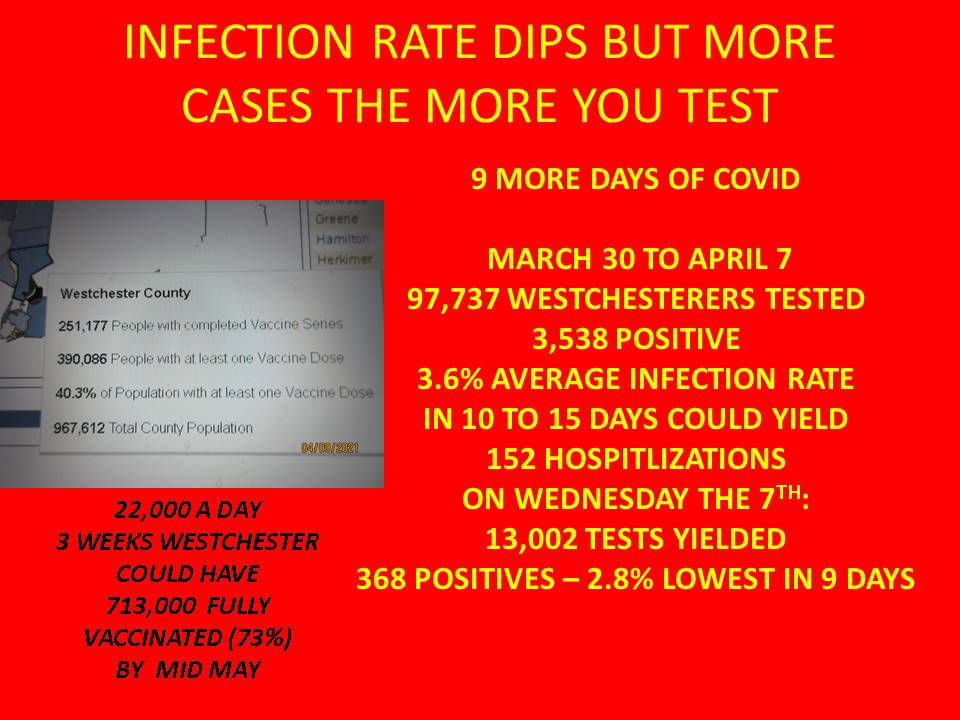
From Tuesday, April 6 through Friday April 9, Westchester County lowered the number of new Covid infections to below 3% for the first time in two months.

The 3% of the total 49,789 tested those four days yielded 1,482 covid positive persons, which can still mean 64 new hospitalizations by next week at a 4.3% hospitalization rate.

Previous to those four days, 25,042 people were tested half the 49,789 tested Tuesday, Wednesday Thursday and Friday, (and county persons testing postive had been 4.3% on April 5, 3.7% on April 4 and 3.6% on April 3. On those three days numbers of positive covid persons was 942, which could yield 40 hospitalizations next week added to the 64, meaning about a hundred new cases hospitalized. Saturday the 10th infection results will be out this afternoon.

The reduction of the infection rate by almost a full percent over three days is positive despite the 1,483 covid infections (because more persons were tested) is significant.

The troubling factor is how spreading of disease, either through Covid-19 or the new variant highlighted by Governor Andrew M. Cuomo Friday is that the spread of the disease has spread ominously to the more lightly populated suburbs which are fueling the infection rate by no enforcement whatsoever accept voluntary restrictions recommended by the County Department of Health.

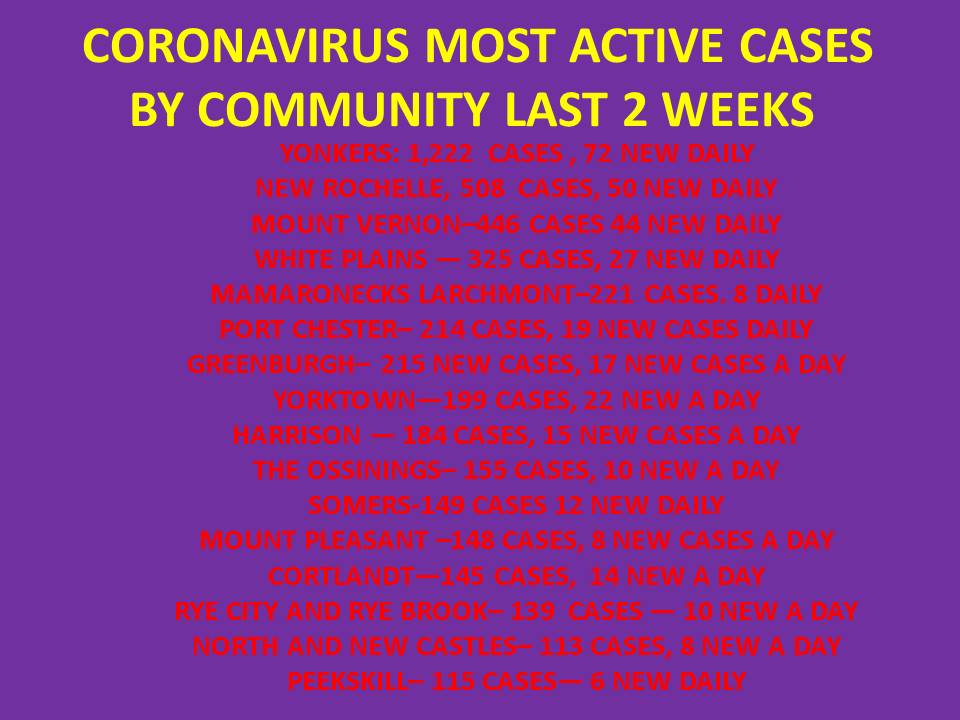
Notice the town by town figures on infections the past two weeks compiled by WPCNR from the Westchester County Covid Tracker by towns and cities. The town infections are rising.
THE NEW VARIANT B.1.1.7 PROFILE bY Dr. Sanjay Mishra.

The following article by Dr. Sanjay Mishra, Mishra, a child psychiatrist in Carmel, Ind., and a partner and medical director of Indiana Health Group, a large medical practice specializing in mental health was circulated to WPCNR.

This article appeared in Saturday’s edition of National Geographic and appears on the NG website. Dr. Mishra delves into the reasons why the new variant arriving in New York is perhaps more serious than the first Covid, requiring continued covid precaution:

The coronavirus variant known as B.1.1.7, which studies show is both more deadly and more transmissible than the original version of SARS-CoV-2, is now the most common strain circulating in United States, and its growing prevalence has alarmed prominent epidemiologists.

Earlier in the pandemic, not many children were becoming infected with the coronavirus, and they did not appear to be major sources of virus transmission to other age groups. “That changed with B.1.1.7,” says epidemiologist Michael Osterholm, director of the Center for Infectious Disease Research and Policy. “We’re now seeing substantial numbers of outbreaks in schools and in school-related activities.”

In a study conducted in the U.K., where this variant was first detected, more children were infected with B.1.1.7 than other SARS-CoV-2 variants, compared to older age groups. The same scenario is now emerging in the U.S.

A rapidly growing outbreak of COVID-19 in Carver County, Minnesota, has been linked to school-sponsored and club sports activities. In a study done by the Minnesota Department of Health, researchers produced a detailed map of COVID-19 transmission showing that the B.1.1.7 variant caused about a quarter of these cases. A similar outbreak was reported in Wisconsin, where all the children at a Dane County childcare center who tested positive were 6 years or younger.

The upside, if there is one, is that one study suggests younger children were less likely than adults to pass the virus to others. In addition, the current vaccines authorized for use in the U.S. are effective against B.1.1.7 and can help us reverse the course of the pandemic, as long as people also continue to limit exposure by following the current public health precautions and restrictions.

“If you need another reason to get vaccinated, here it is,” says William Schaffner, a physician and professor of infectious diseases at Vanderbilt University Medical Center. “Not only is it more contagious, but when you are infected with it, you’re more likely to get serious disease. And so we’re concerned about it.”

A more contagious virus enters the U.S.

In early December, as optimism was rising about the U.K.’s ambitious vaccine rollout, British scientists and public health officials were seeing a surge of cases in Kent County in southeastern England. While only 4 percent of those cases were sequenced, almost half were found to be the new variant of SARS-CoV-2.

Because this variant, now called B.1.1.7, is much more contagious, it spread quickly worldwide, and by December 29 the Colorado Department of Public Health & Environment reported the first case in the U.S. However, several studies have now shown that B.1.1.7 likely entered the U.S. multiple times between November 2020 and January 2021—earlier than previously thought.

In early February, Karthik Gangavarapu, a graduate student at The Scripps Research Institute in La Jolla, California, co-authored a study that predicted B.1.1.7 would become dominant in the U.S. by late March 2021.

“Based on what we had seen in other parts of the world with this variant, there was no reason for us to believe that this wouldn’t happen in the U.S., and I think, for most epidemiologists, this is not a huge surprise,” Gangavarapu says.

Currently in U.S., the number of cases caused by B.1.1.7 is increasing at a rate of about 7.5 percent per day.

Researchers believe the variant spreads so rapidly because B.1.1.7 accumulated a large number of genetic changes17 in total—including eight in the virus’s hallmark spike protein. The spike protein attaches to the ACE2 receptor protein, which is found on the outer wall of 72 types of human cells. After the virus latches onto the ACE2 receptor, it can enter the host cell, make more copies of itself, and trigger infection.

By binding more tightly to the ACE2 receptors, “these mutations provide selective advantage to B.1.1.7, so that’s why now it is spreading everywhere” says Olivier Schwartz, head of the Virus and Immunity Unit of the Pasteur Institute in Paris, France. “It’s a kind of a Darwinian selection process.”

A study analyzing more than 100,000 people who had been infected with either B.1.1.7 or the original strain also shows that the new variant is more deadly.

When the researchers compared the two groups of patients, B.1.1.7 had greater mortality by somewhere between 32 and 104 percent, says team leader Robert Challen, a clinician at the University of Exeter in the U.K.

Some researchers believe that B.1.1.7 behaves so differently from the original strain that it can even be “treated as a separate epidemic,” says Ravindra Gupta, a professor of clinical microbiology at the University of Cambridge.

B.1.1.7 also been causing problems in other ways. It carries a couple of genetic mutations in the spike protein called deletions, because they eliminate part of the genetic code, that help this variant escape antibodies during the body’s immune response after an infection.

These deletions can also cause certain commercial testing kits to give a false negative result because they fail to detect its spike protein gene. The U.S. Food and Drug Administration has issued recommendations to address possible false negative results that arise due to increasing prevalence of B.1.1.7 and other deletion variants in the U.S.

Implications for kids

The risk of B.1.1.7 to children, and subsequently to their families, may not arise as much from higher transmissibility, but from kids’ inability to maintain social distancing and masking and avoid contact sports, says Osterholm.

According to Schwartz, since the virus is more infectious for all age groups, children can now get infected more easily because of close contact in schools and day care. Then they can transmit more virus to each other, and to their families at home.

Because of increasing demand to reopen schools, there is now higher transmission of the B.1.1.7 variant among kids. That means more schools will have difficulty maintaining in-class learning.

The good news is that people who have been vaccinated, or people who were previously infected with another variant, have antibodies that will still neutralize B.1.1.7, says Schwartz, who led a study showing this to be the case. Already, vaccine makers are releasing clinical data showing that the available shots protect children age 12 to 15, and studies in younger children are forthcoming.

“The challenge is we’re not going to have nearly enough vaccine fast enough” to rein in the pandemic unless people stick to safety restrictions in the meantime, Osterholm lamented. “If we don’t limit our exposures to this virus, and try to defy viral gravity, we will not be able to do that.”


Posted in Uncategorized

WEATHER WHITE PLAINS 9:30 A.M. EDT: 55 FOGGY HUMID WPCNR DEGREES

Hits: 354

Today Showers. Patchy fog before 10am. High near 58. East wind 7 to 13 mph. Chance of precipitation is 90%. New precipitation amounts between a quarter and half of an inch possible.

Tonight Showers likely and possibly a thunderstorm. Cloudy, with a low around 45. East wind 10 to 13 mph. Chance of precipitation is 70%. New rainfall amounts between a quarter and half of an inch possible.

Monday Showers likely. Cloudy, with a high near 51. East wind 8 to 11 mph. Chance of precipitation is 60%. New precipitation amounts between a tenth and quarter of an inch possible. (From National Weather Service)

Posted in Uncategorized

WHITE PLAINS WEEK APRIL 9 REPORT ON ON wpcommunitymedia.org (SCROLL DOWN THE PROGRAM WALL TO “WHITE PLAINS WEEK” AND PULL UP A CHAIR.

Hits: 324

WHERE THE NEWS IS
JOHN BAILEY AND THE NEWS
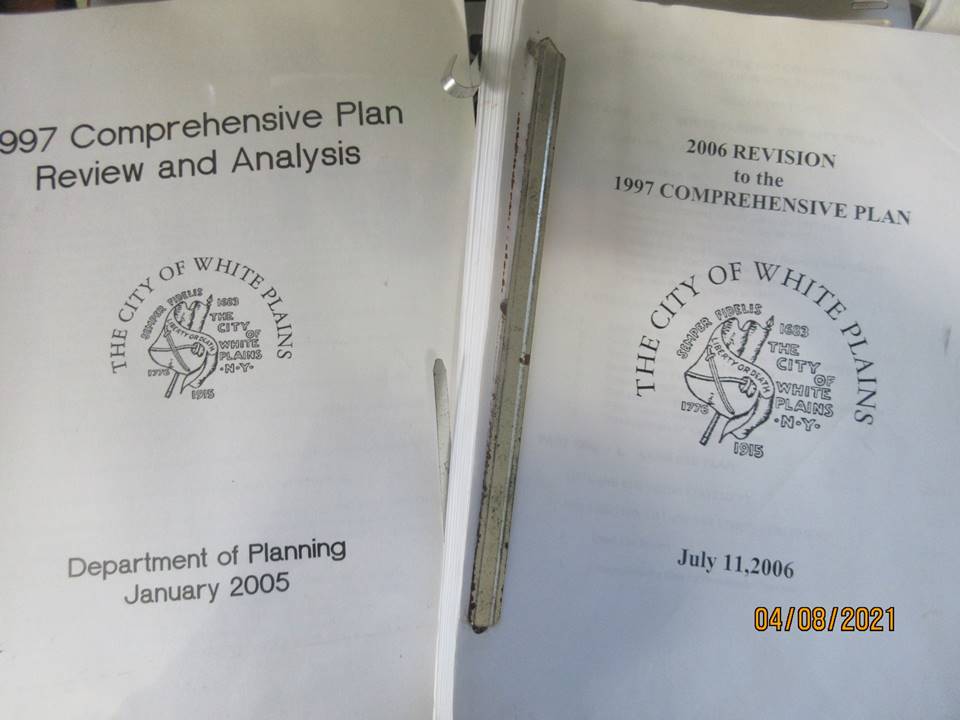
MASTER PLAN–HERE WE GO!
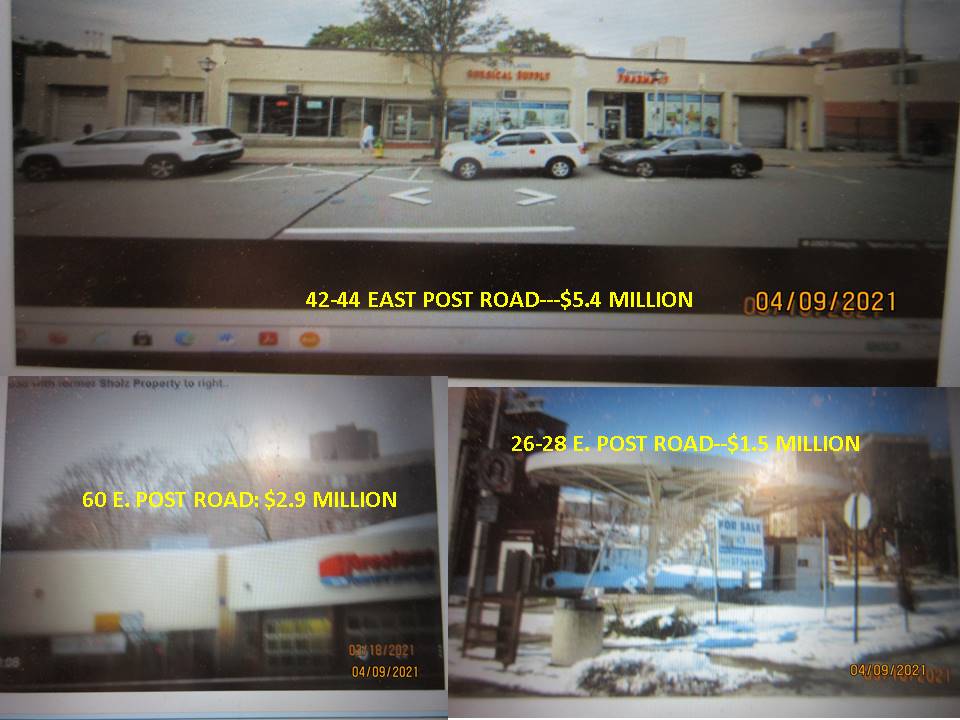
URBAN RENEWAL RIDES AGAIN
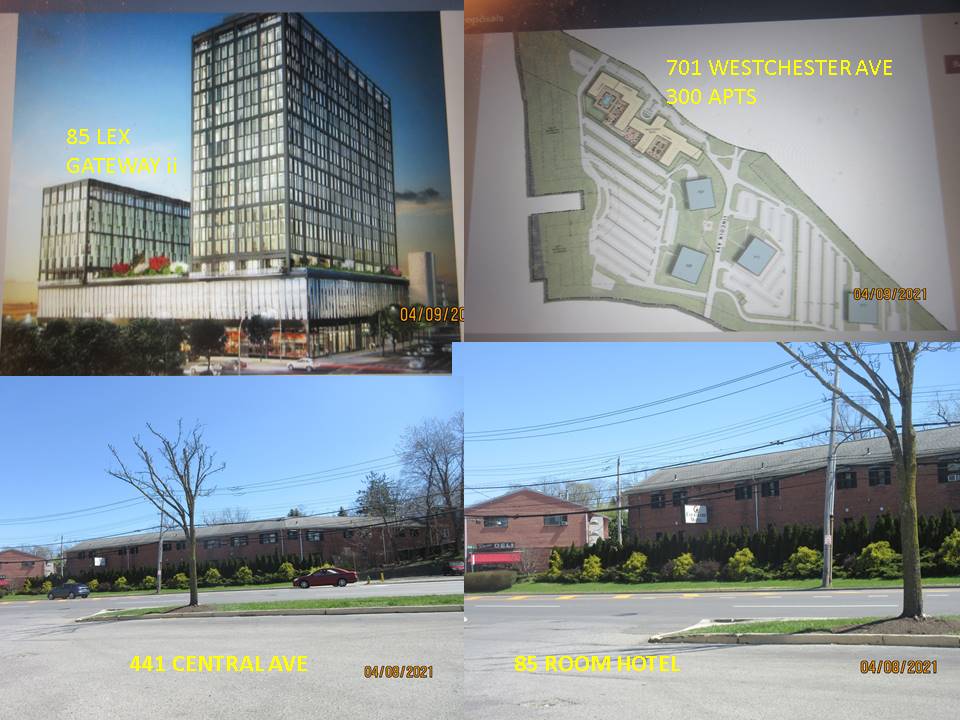
GATEWAY II COMPLEX APPROVAL, 701 HEARING. HOTEL ON CENTRAL AVE
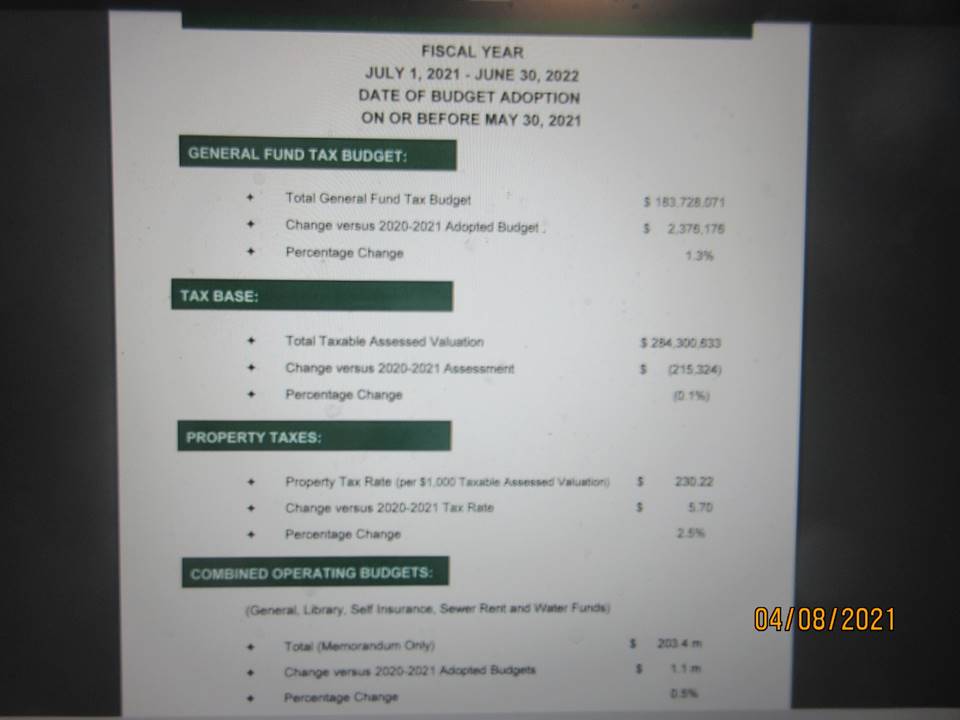
BUDGET LIGHT AND BALANCED TIGHT BELTED
THIS WEEK IN COVID–INFECTION RATE LOWERS. CASES UP-MIXED MESSAGE
MULTITUDES GATHER TO PRAY FOR DMX

INSTANT LINK TO THE WHITE PLAINS WEEK PROGRAM:

http://wpcommunitymedia.org/white-plains-week–2/04092021-693

Posted in Uncategorized

JONES OF THE 37TH ON PRESIDENT BIDEN CALL TO REFORM THE SUPREME COURT–ADD TO NUMBER OF JUDGES

Hits: 322

WASHINGTON, DC — Today, after President Biden announced the creation of a Presidential Commission to examine reforms to the Supreme Court, Congressman Mondaire Jones (D-NY) released the following statement:

“Today, the President of the United States acknowledged that it is time to reform the Supreme Court, following the example of Thomas Jefferson, Abraham Lincoln, and Ulysses S. Grant.

By convening this commission, President Biden has spoken clearly: The question is no longer if we will reform the Supreme Court, but how we will reform the Supreme Court.

The answer to that question is equally clear: to restore our democracy, we must expand the Supreme Court. Anything less would leave the future of our nation, our planet, and our fundamental civil rights at the whim of a far-right supermajority that is hostile to democracy itself.

Of course, many Americans will rightly be skeptical of a commission composed almost entirely of people protected from the real-life consequences of the Supreme Court’s right-wing extremism. Nevertheless, I remain hopeful that the commission will join our rising movement for Court expansion.

In the meantime, Congress has the power, and the constitutional duty, to set the size of the Court, as it has seven times throughout our history. My colleagues and I need not wait for the findings of a commission. We already know the obvious: we must expand the Supreme Court, before it’s too late.”

Posted in Uncategorized

Planning Forum Sponsored by League of Women Voters ZOOMING APRIL 22

Hits: 346

SAVE THE DATE!
White Plains: Who Are We Planning For?

A Zoom Roundtable Discussion
Thursday, April 22 at 7:30 p.m. 
Register Now!
As part of the League of Women Voters of White Plains mission to promote an informed and engaged electorate, we invite you to join us on Thursday April 22, 7:30 p.m. for a Zoom roundtable discussion, “White Plains: Who Are We Planning For?”.  

One year into the pandemic and with local elections for mayor and common council later this year, now is a good time to consider the future of city planning here in White Plains. What are the needs of White Plains going forward, how can competing needs be balanced? How has the pandemic influenced thinking about the needs of our city? What can residents do to influence the direction of development in our city?

We have invited Mary Cavallero, former member of the White Plains Planning Board, David Schiff, retired city planner, and Chris Gomez, commissioner, White Plains Planning Department for a lively roundtable discussion. 

To register and receive a link for this Zoom program click here. We will take audience questions in advance.

For further information contact lwvwp.info@gmail.com
Posted in Uncategorized

HOME SALES “STAGGERING” !!!!

Hits: 1503

NUMBERS OFF THE CHARTS
REAL ESTATE KEEPS ON MOVING FAST AND UP
(ALL Charts courtesy, HGAR)

WPCNR REALTY REALITY. From the Hudson Gateway Association of Realtors. (Edited) April 7, 2021:

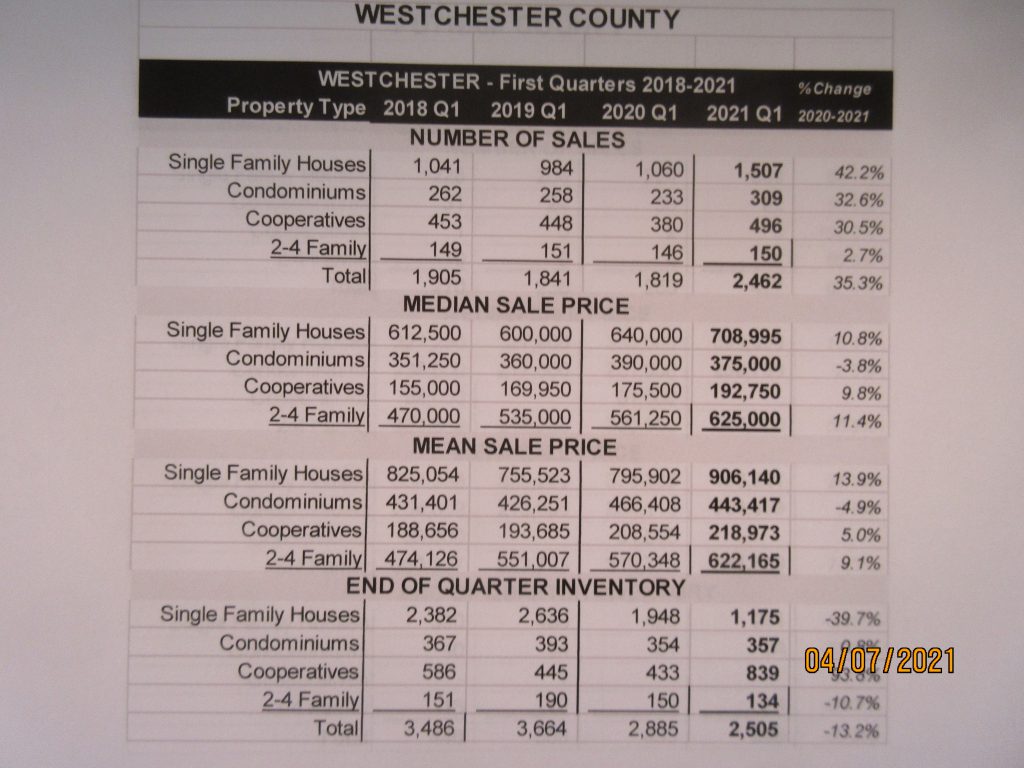
 Residential home sales in the lower Hudson Valley for the first quarter of 2021 were staggering.

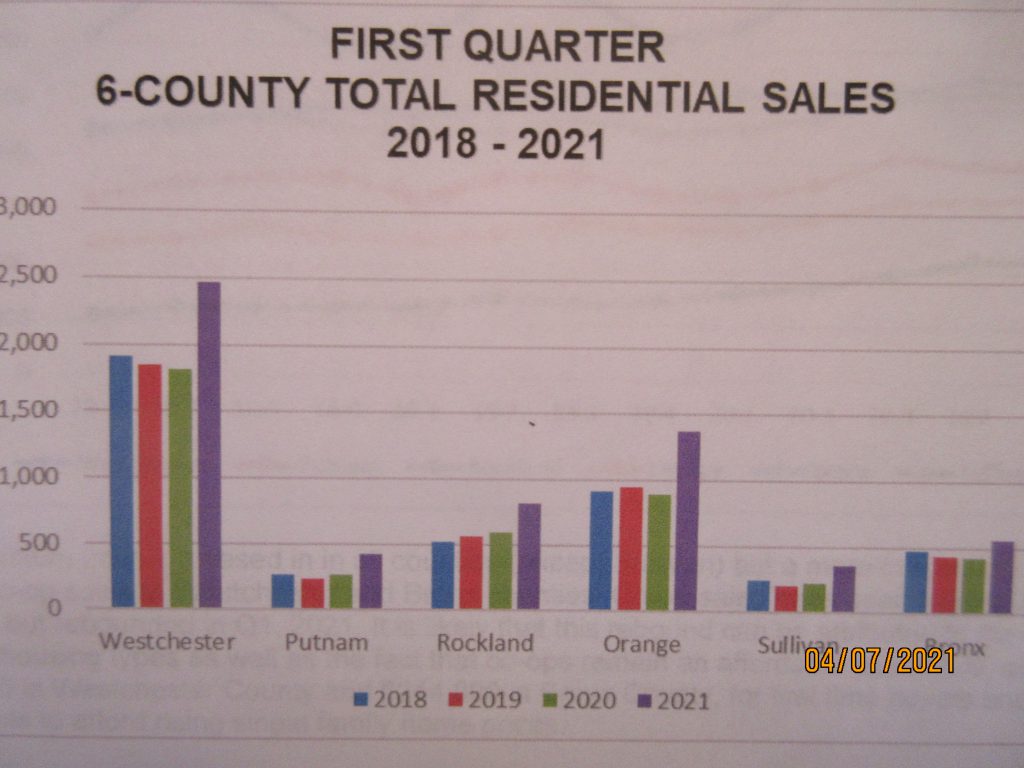
Sales in Westchester were up 35.3% or 2,462 units as compared to 1,819 units in 2020.

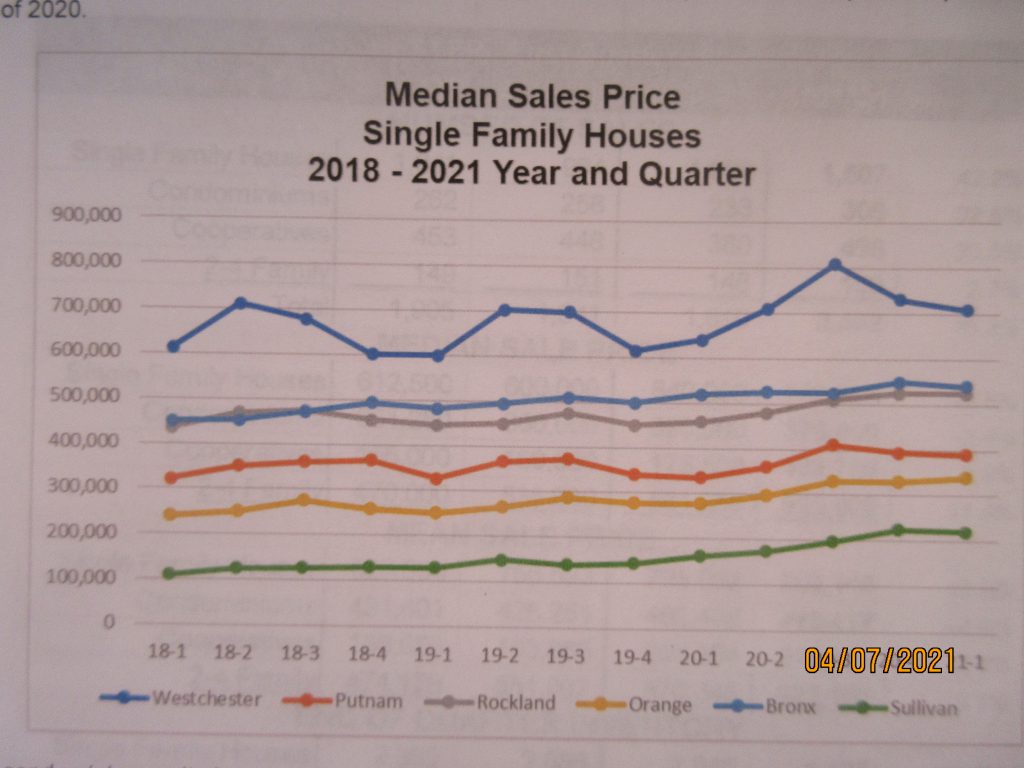
The median price in Westchester County, rose 10.8% to $708,995 from $640,000 last year.

Homes are in demand county to county, up and down the valley

Orange County experienced a 54.2% increase in sales going from 896 units in 2020 to 1,382 units in 2021 first quarter.

Putnam and Sullivan counties were each up over 62%,

 Putnam with 427 sales compared to 263 in 2020 and Sullivan County with 362 units sold from 223 units in 2020.

In Rockland County sales increased 36.5% to 823 units from 603 in 2020.

Bronx County increased 31.6% at 567 units sold compared to 431 units in the first quarter of 2020.

.The median sale price for a single-family residential unit in Orange County rose 22.5% to $340,000 (from $277,450 one year ago) exceeded by an increase of 36.2% in Sullivan County to $221,00 from $162,250 one year ago.

.The median sale price for a single- family residence rose in Putnam County by 16.4% to $390,000 (from $335,000), in Rockland County by 14.4% to $525,000 (from $459,000), in Sullivan County by 36.2% to $221,000 (from $162,250) and in Bronx County to $541,000 (from $520,000) as compared to the first quarter of 2020.

 The residential market is normally cyclical with seasonal low sales in the first quarter as sellers begin to prepare their homes for the traditional “spring selling season”. This did not happen. The buyers kept on buying.

Covid-19 has served to create a marketplace that defies that predictability.

While first quarter sales in 2020 last year were relatively strong, a reflection of activity that occurred in late 2019, the true effects of the pandemic were seen in the second and third quarters of 2020 when sales, not unexpectedly, took a strong hit.

During that time, however, a migration from city to suburbs began taking hold as people felt the need to escape the close confines of city living and working from home created a need for larger living spaces.

Co-op sales have been lagging in both counties for the past year but rebounded in Q1, 2021. Condominium sales were up in every county except Sullivan.

It is likely that this Co-op rebound can be attributed to the dearth of choices in other housing types as well as the fact that co-ops remain an affordable alternative, at a median sale price of $192,750 in Westchester County and $244,000 in Bronx County.

Buyers and other potential purchasers unable to afford rising single family home prices.

While the overall economy has been struggling during the pandemic, real estate isn’t.

The suburban real estate market has seen increasing sales, rising prices and increased demand.

THE PURPLE BAR IS THE FIRST QUARTER 2021 SALES.

 This raises questions about the sustainability of the current market.

At what point will prices become too high, at what point will a lack of inventory (choice) discourage some buyers and while interest rates remain at historic lows, ameliorating some of the effects of rising prices, there have been recent upticks in mortgage rates which will affect affordability for some buyers.

This being said, current properties in contract remain high indicating that the market will remain strong in the near term.

Posted in Uncategorized

WHITE PLAINS COVID CASES UP, MAYOR WARNS ON COVID CALL. NEW WESTCHESTER CASES HIT 2,824 IN ONE WEEK MONDAY TO MONDAY

Hits: 1037

WPCNR CORONAVIRUS REPORT. By John F. Bailey Statistics from NY Covid WorkBook Tracker and Westchester County Covid Tracker. April 7, 2021 UPDATED 5 PM EDT

:

Mayor Thomas Roach of White Plains warned residents that coronavirus cases and a new strain of the Covid killer virus is affecting the city. In his weekly Covid Call, Mayor Roach said:

“There are currently an estimated 347 active cases in our City, up 38 from our call last week. Over the last 7 days we are averaging 24 new cases per day. 

CDC data is showing that COVID-19 cases throughout the country, including in New York, are on the rise.

Part of the reason for this trend is the highly contagious B.1.1.7 variant. This variant appears to be affecting younger people in greater numbers.

It remains critical that we all double down on the common sense safety measures that have proven effective: Continue to wear a mask when you are within 6 ft. of others and practice social distancing. Taking these precautions, along with expanded vaccine eligibility in New York, is what will ultimately get us across the finish line safely.

As of today, New Yorkers age 16 and up are eligible for the vaccine. Given that the B.1.1.7 variant seems to impact younger people at a higher rate, this expanded vaccine eligibility is Great News for all of us. I strongly urge you to make your vaccination appointment as soon as possible for whichever vaccine is available to you.  All three vaccines authorized for use in the United States are safe and effective. Delaying your vaccination in an attempt to obtain a particular vaccine will expose you to risk unnecessarily.

How do I get an appointment? 

  • Check vaccinefinder.org for local pharmacies, clinics, and other locations that have received doses of the vaccine and schedule your appointment online or call the provider directly for an appointment. VaccineFinder was developed by Boston Children’s Hospital with support from the CDC.
  • Check the State website, ny.gov/GetVaccinated for appointments at state–run vaccination sites. Check the site regularly, as new appointments become available throughout the day.
  • Go to Health.Westchestergov.com, to check availability and schedule an appointment at the County-run vaccine clinic located at Westchester Community College. 
  • For those who need assistance securing an appointment, call our White Plains COVID Angels at (914) 422-1378 between 8:00 am and 6:00 pm.

Our next call is on Tuesday, April 13th. Until then remember, we’re standing together by staying apart.”

On the County Covid Tracker, Westchester County recorded 2,824 new covid cases through Monday April 5.

The County daily infection rate continues to be slightly below 4% (3.8) testing positive each week.

Of 73,736 tests administered in Westchester County March 30 through April 5, , 2,824 tested positive.

Looking ahead, in 10 to 15 days at a 4.3% hospitalization rate, this would put 121 persons into Westchester hospitals. Currently according to the state hospitalization tracker, 40% of Westchester County Intensive Care beds remain open and available. It is unclear whether occupancy of ICU beds is going up or staying the same. This reporter’s guess is the continued infection rate, if not keeping ICU bed occupancy steady could fill more beds in two to three weeks than the present levels.

(EDITOR’S NOTE: At 2 PM today the results of positive tests for Tuesday, April 6 showed 346 New persons testing positive for covid of 10,999 tested the lowest infection rate since Friday, 3.1%. That brings the total newly covid-infected in 8 days in Westchester County to 3,170 testing positive of 84,735 tested, an Infection Rate percentage of 3.7%

In perspective the 3,170 new infections of covid in 8 days at a 4.3% infection rate could generate 142 new covid hospitaltions in 10 to 15 days in Westchester ICUs.)

County Executive George Latimer warned WVOX audiences Tuesday , Covid infections have been going up for a month on his weekly 7:10 radio interview on the Dennis and Tonny Good Morning Westchester program. He said that the more persons are vaccinated and complete their doses will stay the spread of new cases by June.

These are the cities and villages where the most infections are, for the last two weeks. March 24 through April 5:

YONKERS: 1,276 CASES , 62 NEW DAILY

NEW ROCHELLE, 511 CASES, 25 NEW DAILY

MOUNT VERNON–439 NEW, 20 NEW DAILY

WHITE PLAINS — 347 NEW, 33 NEW DAILY

MAMARONECK TOWN, VILLAGE, LARCHMONT–221 NEW. 8 NEW DAILY

PORT CHESTER– 217 NEW, 13 NEW CASES DAILY

GREENBURGH– 208 NEW CASES, 17 NEW CASES A DAY

HARRISON — 184 CASES, 15 NEW CASES A DAY

THE OSSININGS– 155 CASES, 10 NEW A DAY

MOUNT PLEASANT –148 CASES, 8 NEW CASES A DAY

RYE CITY AND RYE BROOK– 139 NEW CASES — 10 NEW A DAY

NORTH AND NEW CASTLES– 113 CASES, 8 NEW A DAY

PEEKSKILL– 115 NEW — 6 NEW DAILY

Posted in Uncategorized

Jones on Fully Funded Foundation for School Aid

Hits: 467

Today, Congressman Mondaire Jones (D-NY) released the following statement on the New York State legislature’s agreement to fully fund Foundation Aid. (Editor’s Note: In his news conference today on the State Budget, Governor Andrew M. Cuomo announced the foundation aid to school districts is funded for the next two years, providing the SALT Reduction Act is repealed by the U.S. Senate and House of Representatives).

“This is a monumental moment in the fight for education equity in New York State.

After nearly a decade, New York is finally making good on its court-mandated obligation to provide full funding under the Foundation Aid formula to ensure that every child in New York State receives the sound, basic education to which they are entitled under the state constitution. Complete funding will be transformative for the Harmed Suburban Five school districts, including Ossining and Port Chester, which are in my district. It will also be a major boost to school districts like East Ramapo, North Rockland, and Peekskill, among others, which have for too long been unjustly denied the level of state funding to which they are constitutionally entitled.

To be clear, this victory was made possible by the tireless work of parents, educators, activists, and Democratic state legislators who organized for years to get the state to make good on its moral and legal obligation to our young people. Justice should never have been delayed, and thanks to their dedication, today, our students are finally getting the investment they deserve. I was proud to fight alongside this coalition as a community organizer before I ran for Congress, and I’ll continue to work in partnership with them to ensure we invest in our children.”

Posted in Uncategorized

Governor Announces Agreement 2021-22 Budget. Assembly Still Working on the Budget.

Hits: 502


Governor Andrew M. Cuomo, Senate Majority Leader Andrea Stewart-Cousins and Assembly Speaker Carl Heastie today announced an agreement on the FY 2022 New York State Budget. (As of midnight last night the Assembly is still working on the budget, and not officially passed it. )

The final budget accomplishes major legislative priorities, including:

  • A record $29.5 billion in aid to schools aid;
  • $29 billion in public and private green economy investments;
  • $2.4 billion for rent and homeowner relief;
  • $2.4 billion for child care;
  • $2.1 billion for excluded workers;
  • 1 billion for small business recovery;
  • A first-in-the-nation plan to make broadband internet affordable;
  • Legalizing mobile sports betting; and
  • Implementing comprehensive nursing home reforms.


Additionally, the Enacted Budget closes the deficit and invests in the ongoing response to the pandemic and recovery efforts.

Spending

The budget agreement includes spending in the following categories:

  • Total State Operating Funds: $111 billion
  • All Funds spending $212 billion
  • School Aid: $29.5 billion, a $3 billion increase.

“New York was ambushed early and hit hardest by COVID, devastating our economy and requiring urgent and unprecedented emergency spending to manage the pandemic,” Governor Cuomo said. “Thanks to the State’s strong fiscal management and relentless pursuit to secure the federal support that the pandemic demanded, we not only balanced our budget, we are also making historic investments to reimagine, rebuild and renew New York in the aftermath of the worst health and economic crisis in a century. This budget continues funding for the largest-in-the-nation $311 billion infrastructure plan, establishes a groundbreaking program to provide affordable internet for low-income families and enhances public safety through police reforms, all while continuing to provide relief to New Yorkers and small businesses as we recover from the pandemic. I thank the legislative leaders – Senate Majority Leader Stewart-Cousins and Assembly Speaker Heastie – for their partnership in helping make this critical budget a reality and delivering results for the people of this state.”

“New York State approached this year’s budget with many challenges and the ongoing Covid-19 pandemic.” Senate Majority Leader Andrea Stewart-Cousins said. “However, driven by a commitment to long-term equity and prosperity for all, we have accomplished a great deal. I am proud of the strides we have made in funding our schools, helping businesses rebuild, and protecting New York’s most vulnerable. Working and middle-class taxpayers will receive the relief they desperately need, while the wealthiest New Yorkers will help their neighbors. This budget makes New York better for all. In the remaining months of session, the Senate Majority will continue to deliver results that are reflective of our progressive values and priorities.”

Assembly Speaker Carl Heastie said, “Budgets are a statement of values, and in my two decades of service to the people of New York I can’t think of a more far-reaching and impactful budget than this. It meets longstanding goals of our Assembly Majority and addresses the historic inequities that have existed for too long. My colleagues and I have worked tirelessly to deliver a budget that will help New York rise from this health crisis and recover from its devastating economic impacts while upholding our commitment to putting New York families first. I am particularly proud that we have been able to make historic investments in our schools, keep higher education within reach, deliver the relief that our small businesses need to get back on their feet, and provide critical funding for child care that families need. I thank all my colleagues, especially Ways and Means Committee Chair Helene Weinstein, for their tireless efforts and advocacy in crafting a budget that truly meets the needs of all New Yorkers.”

The Senate Majority is passing the 2021-2022 State Budget that makes historic investments in education, the environment, and economic recovery. The enacted State Budget delivers tax breaks for working and middle-class New Yorkers while ensuring that millionaires and billionaires pay their fair share to build a balanced and equitable fiscal foundation capable of  providing vital support and services for families and businesses still struggling as New York recovers from the Covid-19 pandemic. 

The Enacted Budget also renews the Senate Majority’s commitment to investing in the arts and in agricultural industries to spur the economic rebound. Further, this Budget recognizes the sacrifices that healthcare and other frontline workers made during the pandemic and takes steps to help many struggling workers who have been left behind.  

“New York State approached this year’s budget with many challenges and the ongoing Covid-19 pandemic.” Senate Majority Leader Andrea Stewart-Cousins said. “However, driven by a commitment to long-term equity and prosperity for all, we have accomplished a great deal. I am proud of the strides we have made in funding our schools, helping businesses rebuild, and protecting New York’s most vulnerable. Working and middle-class taxpayers will receive the relief they desperately need, while the wealthiest New Yorkers will help their neighbors. This budget makes New York better for all. In the remaining months of session, the Senate Majority will continue to deliver results that are reflective of our progressive values and priorities.”

REBUILDING OUR ECONOMY
The Senate Majority is working to build back a stronger economy as New York recovers from the Covid-19 pandemic. The Enacted Budget supports small businesses who have suffered throughout this pandemic and delivers investments to support job growth opportunities across New York State. The 2021-2022 Enacted Budget includes:

  • A historic $1 billion investment in New York’s small businesses to supplement federal aid.
    • Providing $800 million for small business grants.
    • Providing $200 million in small business tax credits.
  • Providing $40 million for the Arts and Cultural Organization Recovery Grant Program to help the non-profit arts sector in New York State recover from effects of the COVID-19 pandemic.
  • The Pandemic Recovery and Restart Program that creates a $35 million Restaurant Return-to-Work Tax Credit. 
  • Expansion of the amount available for the new New York City Musical and Theatrical Production Tax Credit to $100 million over two years. 

HISTORIC INVESTMENTS IN NEW YORK’S EDUCATION SYSTEMS
New York students and educators have navigated tough times in adapting to remote learning and safely reopening our schools. The Enacted Budget takes transformational steps to increase state and federal resources to ensure that all of New York’s students receive the high quality education they deserve and that all teachers are adequately supported. The 2021-2022 Budget: 

  • Provides a $1.4 billion increase in Foundation Aid and a three-year Foundation Aid phase-in that will finally fulfill the State’s commitments under the Campaign for Fiscal Equity. 
  • Provides a $105 million expansion of full-day prekindergarten, providing pre-K funding to 210 districts who don’t currently receive state-funded full-day Pre-K. 
  • Ensures that additional Federal Aid will supplement, and not supplant State funding.
  • Prevents continuing tuition increases at SUNY and CUNY by putting in place a three-year freeze on the rational tuition plan.
  • Increases the maximum award under the Tuition Assistance Program by $500 to assist the neediest students in the State, the largest growth in the program in 20 years.
  • Commits to eliminate the TAP Gap in four years, providing millions of additional recurring operating aid to SUNY and CUNY.
  • Restores of $72 million in operating aid cuts to SUNY and CUNY.
  • Restores of $35 million in Bundy Aid to support the State’s private independent colleges and universities.
  • Provides a 20% increase to opportunity programs. 

ENSURING THE ULTRA-WEALTHY PAY THEIR FAIR SHARE AND NEW REVENUE OPPORTUNITIES
As New York State works to address the impacts of the COVID-19 pandemic, ultra-wealthy New Yorkers and large corporations need to pay their fair share. The Enacted Budget addresses these new revenue opportunities, which will help equitably fund crucial services such as public education, infrastructure, and assistance for small businesses. The 2021-2022 State Budget: 

  • Increases the current top state personal income tax rate of 8.82 percent rate to 9.65 percent for individual filers whose income is over $1 million and joint filers over $2 million.
    • Establishes two new brackets at a rate of 10.30 percent for those whose income is between $5 million and $25 million and 10.90 percent for those whose income is over $25 million.
  • Increases the Corporate Franchise Tax Rate from 6.5% to 7.25% for three years, while leaving the rate of 6.5% unchanged for companies with under $5 million in income.
  • Restoring the capital base test at a rate of 0.1875%, while exempting coops, manufacturers and small companies.
  • Legalizes Mobile Sports Wagering.
    • This proposal will increase education revenue by $99 million in SFY 2021-22, growing to $357 million in SFY 2022-23, before reaching $500 million in SFY 2025-26.
    • The proposal authorizes the Gaming Commission to issue an RFA to interested platforms (a minimum of 2) and operators (a minimum of 4) to solicit bids for licenses to conduct mobile sports wagering in the State. The open RFA process will maximize revenue while ensuring that the State selects the most qualified and capable providers to deliver world-class wagering platforms to the State’s consumers. Platforms which opt to partner with a Native American tribe or nation will be given additional points in the bidding/scoring process.
    • In addition to adding hundreds of millions of dollars annually to the State’s education system, this proposal will double the State’s investment in problem gaming addiction treatment and resources to $12 million, as well as create a new statewide youth sports activities and education grant program for underserved youth under the age of eighteen, which will be funded annually at $5 million.
    • The new mobile sports wagering system will feature comprehensive safeguards to mitigate problem gaming, while also combating corruption and match fixing. Extensive record keeping and reporting requirements will allow regulators to closely monitor the system and ensure that it maintains the highest level of integrity and transparency.

RELIEF FOR WORKING AND MIDDLE-CLASS TAXPAYERS
The Senate Majority is committed to providing working and middle-class New Yorkers with the financial relief that they need and deserve. The 2021-2022 State Budget:  

  • Delivers $440 million in property tax relief for 1.3 million New Yorkers earning under $250,000 based on the proportion of their income spent paying property taxes. The income tax credits will range between $250 and $350. 
  • Ensures that $400 million in middle-class personal income tax cuts are not delayed.

BUILDING A STRONGER INFRASTRUCTURE AND TRANSPORTATION SYSTEM
Infrastructure and transportation help keep our economy moving. New Yorkers rely on transportation every day, and the Senate Majority is committed to funding projects that will bring New York’s infrastructure into the 21st Century. To build a strong infrastructure and transportation system, the 2021-2022 State Budget includes:  

  • $350 million in transportation infrastructure investments:
    • $100 million increase for CHIPS.
    • $100 million in new funding for Extreme Winter Recovery funding.
    • $50 million increase for PAVE-NY.
    • A new $100 million highway and bridge project fund for localities called the City Touring Routes program.
  • $100 million each for SUNY and CUNY capital programs, and $70 million for other education priorities.
  • $385 million for additional eligible capital projects to support local infrastructure and regional construction priorities.  
  • $851 million for other critical infrastructure projects across New York State.
  • Directing the Public Service Commission to publish a detailed map of broadband access in the State and conduct a comprehensive study on the availability, reliability and cost of broadband. 

BOOSTING TENANT AND HOMEOWNER RELIEF
The Senate Majority is committed to meaningful change in communities grappling with housing instability and to reduce homelessness. The 2021-2022 State Budget includes:

  • $2.4 billion in COVID-19 Emergency Rental Assistance Program with 12 months’ arrears for rent and utilities, three prospective months of rent, a year of eviction protection, and eligibility of up to 120% AMI, regardless of immigration status.
  • $600 million in homeowner assistance, including $20 million a year for HOPP for the next 3 years.
  • $100 million to convert hotel and vacant property into affordable housing.
  • $25 million for blighted home rejuvenation.
  • $200 million for NYCHA and $125 million for public housing across New York State.

SUPPORTING LOCAL GOVERNMENT ACROSS NEW YORK STATE

Throughout the pandemic, New York’s local governments have stepped up to work with the State government to provide Covid-19 testing, access to vaccines, and other fundamental services for their community. The Senate Majority understands the need to provide our local governments with additional funding to better serve New Yorkers. To support local governments, the 2021-2022 State Budget includes: 

  • A full restoration of proposed cuts to Aid and Incentives for Municipalities (AIM) funding for local governments.
  • A full restoration of $10.3 million in proposed Video Lottery Terminal (VLT) aid cuts for municipalities that host these facilities.

IMPROVING HEALTHCARE FOR NEW YORKERS

The Covid-19 pandemic has highlighted inequalities in our healthcare system. The Senate Majority prioritizes making healthcare more equitable and ensuring  necessary resources are funded throughout the healthcare system for affordable and quality care. The 2021-2022 State Budget:

  • Restores $415 million in proposed Medicaid cuts for hospitals and healthcare providers.
  • Restores $113 million in proposed cuts to public health programs and adds an additional $81 million in public health funding.
  • Requires nursing homes to spend at least 70% of their revenue on direct patient care and 40% on resident-facing staffing, with $64 million for increased staffing. 
  • Reduces health care costs for low-income New Yorkers by eliminating Essential Plan premiums and out-of-pocket expenses, including dental and vision benefits. 
  • Pushes back the carveout of the Medicaid prescription drug benefit for two years to support 340B providers and community healthcare providers.
  • Expands postpartum coverage for women on Medicaid from 60 days to one year. 

HELPING FAMILIES AND WORKERS

The Senate Majority understands that families continue to recover from the economic downturn of the pandemic. As those families return to normalcy and look to re-enter the workforce, the Senate Majority is committed to providing resources to support them. The 2021-2022 State Budget includes:

  • A $2.4 billion infusion to the child care system to increase access and support providers.
  • A $2.1 billion Excluded Worker Fund to provide one-time unemployment benefits to workers who lost employment or income during the COVID-19 pandemic but were ineligible for Unemployment Insurance or other federal benefits such as stimulus payments. 
    • The benefits program will be administered by the Department of Labor. Applicants must be able to verify their identity, residency, and work-related eligibility. 
    • Based on the ability to demonstrate work-related eligibility, applicants may be able to qualify for one of two benefit tiers.
  • A requirement that every broadband service provider offer broadband with speeds of at least 25mbps at the discounted rate of $15 for every household that is eligible for SNAP benefits, reduced-price school lunches, medicaid benefits, senior citizen rent increase exemption or affordability benefits from a utility. 
  • $600 million for public employee salary increases that were deferred during the pandemic.
  • $100 million for relocation expenses of victims of domestic violence, diaper allowances for low-income families, and emergency food assistance for the elderly.
  • $100 million fund for shelter supplements for low to middle income families, regardless of immigration status.

PROTECTING THE ENVIRONMENT AND NATURAL RESOURCES
The Senate Majority has been at the forefront of protecting and preserving New York’s natural resources. The Enacted Budget builds on those efforts to continue being a national leader and extending renewable energy initiatives to meet goals set in the Climate Leadership and Community Protection Act. The 2021-2022 State Budget: 

  • Authorizes the $3 billion Environmental Bond Act of 2021, “Restore Mother Nature,” to fund environmental improvements that preserve, enhance, and restore New York’s natural resources and reduce the impact of climate change. The Bond Act will appear on the ballot in the 2022 general election.
  • Extends the tax credit for brownfield redevelopment projects subject to Covid-related delays for two years.
  • Modifies the Accelerated Renewable Energy Growth and Community Benefit Act to strengthen the Office of Renewable Energy Siting and to protect farmland.
  • Ensures that good jobs are created on State Renewable Energy Credit projects through the expansion of prevailing wage, labor peace, Buy American, and Buy New York procurement preferences.  

CULTIVATING GROWTH IN AGRICULTURE

Through appropriate aid and support the Senate Democratic Majority aims to expand opportunities in New York’s robust agriculture industry. The 2021-2022 State Budget includes:

  • $25 million for the Nourish NY program (this is a total commitment of $50 million through 2021).
  • An extension of eligibility for a Farm Employee Tax Credit from January 1, 2022 to January 1, 2025.
  • An extension of the Empire State Development Corporation’s authority to administer New York’s agricultural and dairy marketing for an additional 5 years.
  • Restoring $8.4 million in support for statewide agricultural programs.

FUNDING COMMUNITY SAFETY
The Senate Democratic Majority is dedicated to improving support to prevent gun violence and make communities more safe. The 2021-2022 State Budget includes:

  • Establishing the Community Violence Intervention Act, which declares gun violence a public health crisis and creates a funding source for community and hospital-based violence intervention programs.
  • A $25 million addition for the Securing Communities Against Hate Crime Program.
  • Providing a $15 million fund for public education, communication efforts, and outreach to communities disproportionately impacted by the COVID-19 pandemic to disseminate information regarding health and safety measures.

IMPROVING NEW YORK’S DEMOCRATIC PROCESS

The New York Senate Majority is committed to a fair, accessible and transparent election system.The 2021-2022 State Budget:

  • Provides $4 million for the expenses of the Independent Redistricting Commission (IRC). The IRC was established to determine the district lines for congressional and State legislative offices throughout New York State.
  • Provides $5 million for the State Board of Elections’ capital and implementation costs and $20 million for Local and New York City Boards of Elections for reimbursement of eligible costs related to the acquisition of software, technology upgrades, and new equipment.
  • Provides $2 million for reimbursement to Local Boards of Elections for staff costs related to expansion of early voting initiatives.
Posted in Uncategorized