WHITE PLAINS WESTCHESTER DAILY NEWS SERVICE VISITS SINCE 2000 A.D. 25TH YEARl REPORTING THE NEWS YOU NEED TO KNOW News Service Since 2000 A.D. 2026 WILL BE OUR 26TH YEAR OF COVERING WHITE PLAINS NEW YORK USA . John F. Bailey, Editor (914) 997-1607 wpcnr@aol.com Cell: 914-673-4054. News Politics Personalities Neighborhoods Schools Finance Real Estate Commentary Reviews Policy Correspondence Poetry Philosophy Photojournalism Arts. The WHITE PLAINS CITIZENETREPORTER. TELEVISION: "White Plains Week" News Roundup, 7:30 EDT FRI, 7 EDT MON & the incisive "People to Be Heard" Interview Program 8PM EDT THURS, 7 PM EDT SAT on FIOS CH 45 THROUGHOUT WESTCHESTER AND, ALTICE OPTIMUM WHITE PLAINS CH 1300 Fighting for Truth, Justice and the American Way. TOP 10 VISITORS FROM AROUND THE WORLD :1. USA. 2.BRAZIL3.VIET NAM 4. CHINA 5. JAPAN 6.UK. 7.CANADA. 8.INDIA. 9.AUSTRALIA 10.IRELAND 11.GERMANY 12..ARGENTINA 13.BANGLADESH 14.RUSSIA. 15.NEWZEALAND. 16. FRANCE. 17.MEXICO. 18.UKRAINE. 19.SOUTH AFVRICA. 20. IRAQ.
The New York State Assembly voted Friday to move COUNTY, town and village elections across the state with the exception of New York City, to November in even years on the next to last day of the current legislative section.
The existence of the legislation was not known to many Town Supervisors in the state. Paul Feiner, Town Supervisor of Greenburgh who brought this to the attention with his letter to WPCNR Friday, added this comment tonight”
“Municipal officials all over the state are outraged. No discussion, no transparency by the legislature. No debate. Snuck it in for a vote as a surprise.”
The legislation, approved by both houses, now goes to Governor Kathy Hochul for signature.
The law-to-be, if the Governor signs it will not affect School District elections, currently held in the spring of every year.
Amy Paulin of the Assembly sponsored the bill. In the State Senate James Skoufis of of the 42nd Assembly District sponsored the bill.
The description of the bill (A4282B) reads as follows:
 AN ACT to amend the town law, the village law, the county law,  and  the
   municipal  home  rule  law, in relation to moving certain elections to
   even-numbered years
PURPOSE:

Provides that certain local elections held outside of New York City
shall be held on election day in November in even-numbered years.
WPCNR THE LETTER TICKER. From Paul Feiner, Greenburgh Town Supervisor. June 9, 2023:
The New York State Assembly WAS scheduled to vote on Friday on a bill hat would move town elections to even election years (Presidential and races for Governor). Currently, town elections are held in off years -voters only vote for local races.
This proposed bill was not discussed with Westchester town officials prior to introduction
. I just found out about it late Thursday afternoon from other Town Supervisors who also heard about this bill at the last minute.
No public discussion on an issue that is of great importance to local residents. And should be debated.
This is bad for democracy.
During Presidential elections many voters who are not interested in local politics vote. They usually vote the straight ticket.
Many voters don’t pay attention to the election campaigns down on the ballot.
During the more important election years many students who are out of town in college vote absentee. They are registered in the municipalities they grew up in but really are living out of town. They will also be voting in local elections even though they are not interested in local issues.
Another reason why this law is so bad is because it will make government less responsive to the community.
Currently, if a town official is not responsive to a neighborhood request – the neighborhood can organize and be heard.
If elections for town offices are held in a Presidential year it will be much easier for local officials to ignore the will of the people.
Because – many of the people who come out to vote won’t be familiar with the local issues and controversies. It will be easier for developers and special interests to get what they want because the activists won’t have as much influence on election day.
A third reason why this legislation is bad is that fewer people will vote in county elections. In the past competitive local elections encouraged people to also vote in county wide elections. The change does not impact county races.
The legislation bill number is A 04282.
One suggestion: If the state wants to pursue this idea provide local governments with the option of holding their elections in Presidential or Governor election years instead of in odd election years when the focus of an election would be on town issues.
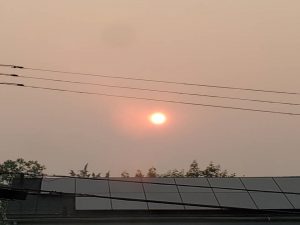
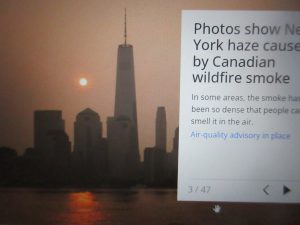
Watching wildfire smoke blanket the Northeast U.S. and parts of Canada over the past few days has been surreal. Air quality is impacted for tens of millions of people, with off the charts pollutant levels in some areas.
New York City PM2.5 measurements. Red dotted line indicates unhealthy levels
I can’t help but notice striking comparisons with this public health problem to another— the pandemic.
Oh …those things called masks
Given wildfire smoke and respiratory droplets are larger than N95’s filtration efficiencies, this means masks work for both.
I’ve heard that more people are wearing masks in the past two days than I did last winter when COVID, RSV, and flu blanketed communities. I chalk this up to three things:
Visible vs. invisible threats. When something is invisible, it’s much more difficult to act. This has long been a menace to public health. Would masking during winter be different if viruses created green plumes of smoke? Tools that make viruses as visible as smoke, like perhaps a viral load indicator on weather apps, could be low-hanging fruit.
Immediate vs delayed effect. Symptoms from smoke are pretty immediate (i.e., watery eyes, coughing). Symptoms from viruses are delayed (takes a few days to replicate in your body). And, in some cases, the immune system will prevent infection or symptoms altogether. So, the causal relationship is less apparent to people.
Novel vs. familiar threat. COVID-19 is not novel anymore; the majority of people have become more comfortable placing its risk among our normal repertoire of threats. Wildfire smoke in the Northeast is novel. Would the same number of people be wearing a mask after 3.5 years of wildfire smoke?
Politicization is on full display… again
It didn’t take long for the politicization of public health and climate change to be on full display with wildfire smoke. Just like with the pandemic, this is gravely dangerous to the health of communities.
One national news station pushed the idea that there are no health harms with wildfire smoke and masks don’t work. That’s just plain wrong. As one epidemiologist said during the pandemic, “Politicizing masks makes as much sense as politicizing gravity.”
Risk communication is key
Clear, timely risk communication is important so people can make evidence-based decisions today. We did this terribly during the pandemic. It was better with smoke.
With a novel threat, like wildfire smoke, it’s best to compare to harms we do know—like cigarettes. This helps gauge risk more accurately. For example, thanks to data from Berkeley Earth, I found breathing in excessive amounts of wildfire smoke (rated “purple” on the Air Quality Index scale) is equivalent to smoking half a pack of cigarettes. Time to wear that mask?
Signs of climate change
Contrary to a few nasty emails I received after my last post, yes… climate change is a problem. Both viruses and wildfires put this on full display:
Smoke: An estimated 82 million Americans will experience a 57% increase in frequency and a 31% increase in the intensity of “smoke waves”—2 or more consecutive days with high wildfire-specific PM2.5—in years to come. Northern California, Western Oregon, and the Great Plains will suffer the most.
Viruses: Climate change is increasing the transmission of viruses. Animals and humans are moving to higher elevations, different biodiversity hotspots, and areas previously uninhabited. For example, mosquitos are migrating to new areas and, thus, introducing diseases to previously protected populations.
Importance of indoor air quality
Both events show that improving indoor air is a powerful mitigation tool that has been underutilized for decades. In addition, some of the best public health interventions are those happening in the background: institutional interventions that work passively and invisibly for the individual. Addressing indoor air in an equitable way is a massive challenge, and I hope we improve with time.
NYT visual depiction of SARS-CoV-2 and the impact from opening windows and air cleaners.
Bottom line
We needto be smarter and better adapt because the environment around us is rapidly changing. Our health depends on it, whether the threat comes from wildfires or viruses.
Love, YLE
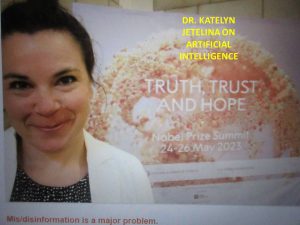
“Your Local Epidemiologist (YLE)” is written by Dr. Katelyn Jetelina, MPH PhD—an epidemiologist, data scientist, wife. During the day she works at a nonpartisan health policy think tank and is a senior scientific consultant to a number of organizations, including the CDC. At night she writes this newsletter. Her main goal is to “translate” the ever-evolving public health science so that people will be well-equipped to make evidence-based decisions. This newsletter is free thanks to the generous support of fellow YLE community members. To support this effort, subscribe below:
WPCNR ALBANY ROUNDS. By John F. Bailey. June 8, 2023 UPDATED JUNE 9, 2023 6 PM EDT:
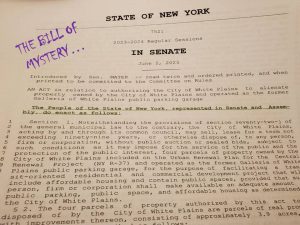
The City of White Plains legislation granting the city the right to “alienate”(divest or sell) the Galleria Parking Garage has been passed by the Assembly, a WPCNR source following the legislation reported to WPCNR Friday evening
WPCNR has learned a bill the City of White Plains submitted to State Senator Shelley Mayer Tuesday, sent to the Assembly Wednesday, where the bill A-7674 has cleared the Assembly Ways and Means Committee today and put on the agenda today, and was heading to the Assembly Floor for a vote has been passed.
The bill was filed and spread by the Common Council on the consent agenda Monday evening. It went to State Senator Shelley Mayer’s office Friday June 2.
John Callahan, the Corporation Counsel for White Plains told WPCNR Thursday night the bill if passed was submitted to State Senator Mayer and Assembly Woman Amy Paulin, “to give the city maximum flexibility if any formal proposals are submitted for the city parking garage.”
He said “No offers have been made on the property. The Common Council would have to approve any sale of the property.”
The bill, already passed by the State Senate as of Wednesday, went to the Assembly ways and means committee which approved it to be sent to the assembly floor by late this afternoon.
Callahan noted to WPCNR, if the legislature did not approve the request for “alienation” of the garage property before the end of this session of the state legislature, it could be months to get the bill passed.
Westchester County Executive George Latimer
Invites you to Join us
Reginald A. LaFayette
Building Dedication Ceremony
Friday, June 16
11 a.m.
100 E. First Street, Mount Vernon, N.Y. 10550
Westchester County Democratic Election Commissioner Reginald LaFayette was a storied veteran of
Westchester County politics and elections. Long a public servant he started his career as the City of Mount
Vernon Commissioner of Human Rights and then as the Deputy Comptroller. Later, he became City Clerk for
the City of Mount Vernon, a position he held for 15 years.
In 1999, he was appointed the Westchester County Democratic Election Commissioner, a position he held for
over 20 years until his passing in 2022. Known for his passion, commitment and dedication to the next generation,
Commissioner LaFayette was Chairman of the City of Mount Vernon Democratic Committee and served eight terms as the Chairman of the Westchester County Democratic Committee. He was an iconic public servant,
trailblazer and mentor.
Climate change has made wildfires more frequent and intense. We certainly don’t need to inform people in Canada and the Northeast, as they can just look outside and see dangerous levels of smoke.
Wildfire smoke contains tiny particles <2.5 microns in diameter (PM2.5) that can enter the lungs and irritate our respiratory linings.
A limited number of epidemiological studies have evaluated the cumulative effects of breathing in wildfire smoke, but most studies have been among firefighters.
One scientific review found exposure to wildfire smoke over multiple days has an impact on lung function and heart problems. However, it’s unclear if and how these results translate to the general population.
Regardless, more caution is warranted the longer you’re exposed to smoke and the more dense the smoke. Symptoms can range from mild (e.g., eye irritation) to serious health impacts (e.g., exacerbation of asthma). Particularly high-risk groups include the following:
Older adults
Pregnant people
Children
People with preexisting respiratory and heart conditions
Keep your indoor air as clean as possible. Run an air conditioner if you have one, but keep the fresh-air intake closed.
Use an air filter. Use a freestanding indoor air filter with particle removal.
Do not add to indoor pollution. Do not use candles, fireplaces, or smoke tobacco. Do not vacuum because it stirs up particles inside your home.
Wear an N95 outside. Recent research found that N95s reduced hospitalizations from wildfire smoke by 30%. In other words, it offers some protection, at least in the short term while running to the grocery store, for example. Cloth, paper masks, and tissues will not filter out the smoke.
Bottom line
Stay safe out there!
Love, YLE
“Your Local Epidemiologist (YLE)” is written by Dr. Katelyn Jetelina, MPH PhD—an epidemiologist, data scientist, wife. During the day she works at a nonpartisan health policy think tank and is a senior scientific consultant to a number of organizations, including the CDC. At night she writes this newsletter. Her main goal is to “translate” the ever-evolving public health science so that people will be well-equipped to make evidence-based decisions. This newsletter is free thanks to the generous support of fellow YLE community members. To support this effort, subscribe below:
In light of the ongoing Canadian wildfires and the subsequent impact on air quality, Westchester County has taken proactive steps to prioritize the health and safety of its residents and employees. The County has announced precautionary measures to mitigate potential risks associated with the poor air quality caused by the fires.
Effective immediately, Westchester County has made the following decisions for today, June 7:
Cancellation of County-Sponsored Outdoor Events: In order to safeguard the well-being of the community, all outdoor events sponsored by Westchester County will be canceled for today, June 7.
Recommendation for Other Organizations: Westchester County strongly advises other organizations within its jurisdiction to consider canceling their outdoor activities as well.
Recommendation for County Employees: The County administration recommends all County employees who are required to work outdoors to wear masks as an added precautionary measure. While not mandatory, the County administration strongly encourages the use of masks as an additional layer of protection against the compromised air quality caused by the wildfires.
The New York State Department of Environmental Conservation and the New York State Department of Health issue Air Quality Health Advisories when DEC meteorologists predict levels of pollution, either ozone or fine particulate matter are expected to exceed an Air Quality Index (AQI) value of 100. To remain updated on the air quality index, monitor the DEC website for air quality index updates.
Exposure can cause short-term health effects, such as irritation to the eyes, nose and throat, coughing, sneezing, runny nose and shortness of breath. Exposure to elevated levels of fine particulate matter can also worsen medical conditions such as asthma and heart disease. People with heart or breathing problems, and children and the elderly may be particularly sensitive. Residents should keep all windows closed if possible.
Westchester County Health Commissioner Sherlita Amler, MD, recommends all residents limit any strenuous outdoor activity and the very young, those with respiratory conditions or heart disease reduce their time outdoors due to the fine particulate matter in the air from Canadian wildfires in Quebec that is causing a haze across our region.
Amler said: “Infants and people with asthma, heart disease or other respiratory conditions should limit their time outdoors while this haze of fine particulate matter is present in our area. With the air quality index at an unhealthy level today, all residents should limit strenuous outdoor activity. This may be a good day to skip that outdoor run.”
The New York State Department of Environmental Conservation and the New York State Department of Health issue Air Quality Health Advisories when DEC meteorologists predict levels of pollution, either ozone or fine particulate matter are expected to exceed an Air Quality Index (AQI) value of 100. To remain updated on the air quality index, monitor the DEC website for air quality index updates.
Exposure can cause short-term health effects, such as irritation to the eyes, nose and throat, coughing, sneezing, runny nose and shortness of breath. Exposure to elevated levels of fine particulate matter can also worsen medical conditions such as asthma and heart disease. People with heart or breathing problems, and children and the elderly may be particularly sensitive.