2,905,611 VISITORS VISIT 8,324,077 TIMES 3 TIMES EVERY DAY IN ONE YEAR. HIGHEST ACTIVITY IN WPCNR HISTORY.White PlainsCitizeNetReporter lifted its worldwide visits from unique visitors to wpcnr.com to 8,324,077,a 1,306,419 increase in visits in one year from 7,017,658 visits to the site last year which covers White Plains and Westchester County. The 8,324,077 visits were made by 2,005,611 unique visitors who visited wpcnr an average of 3 visits a day. ON JULY 20- -2026 visitors have accessed wpcnr and made 3,072 visits an average of 1.6 visits. In the last week 33,495 individual vistors made 54,458 visits, averaging 1.6 visits. In the last month, 152,940 visitors recorded 229,338 visits (1.5 visits)
State legislatures and politicians are pressuring public health officials to keep quiet about Covid vaccine
By Amy Maxmen | KFF Health News (Reprinted as a public service from Meet the Press website)
Katherine Wells wants to urge her Lubbock, Texas, community to get vaccinated against Covid-19. “That could really save people from severe illness,” said Wells, the city’s public health director.
But she can’t.
A rule added to Texas’ budget that went into effect Sept. 1 forbids health departments and other organizations funded by the state government to advertise, recommend, or even list covid vaccines alone. “Clinics may inform patients that COVID-19 vaccinations are available,” the rule allows, “if it is not being singled out from other vaccines.”
Texas isn’t the only state curtailing the public conversation about Covid vaccines. Tennessee’s health department homepage, for example, features the flu, vaping, and cancer screening but leaves out Covid and Covid vaccines. Florida is an extreme case, where the health department has issued guidance against Covid vaccines that runs counter to scientific studies and advice from the Centers for Disease Control and Prevention.
Notably, the shift in health information trails rhetoric from primarily Republican politicians who have reversed their positions on covid vaccines. Fierce opposition to measures like masking and business closures early in the pandemic fueled a mistrust of the CDC and other scientific institutions and often falls along party lines: Last month, a KFF poll found that 84% of Democrats said they were confident in the safety of covid vaccines, compared with 36% of Republicans. It’s a dramatic drop from 2021, when two-thirds of Republicans were vaccinated.
As new vaccines roll out ahead of the expected winter surge of Covid, some health officials are treading carefully to avoid blowback from the public and policymakers. So far, vaccine uptake is low, with less than 5% of Americans receiving an updated shot, according to the Department of Health and Human Services. Wells fears the consequences will be dire: “We will see a huge disparity in health outcomes because of changes in language.”
A study published in July found that Republicans and Democrats in Ohio and Florida died at roughly similar rates before Covid vaccines emerged, but a disparity between parties grew once the first vaccines were widely available in 2021 and uptake diverged. By year’s end, Republicans had a 43% higher rate of excess deaths than Democrats.
Public health initiatives have long been divisive — water fluoridation, needle exchanges, and universal health care, to name a few. But the pandemic turned up the volume to painful levels, public health officials say. More than 500 left their jobs under duress in 2020 and 2021, and legislators in at least 26 states passed laws to prevent public officials from setting health policies. Republican Arkansas state Sen. Trent Garner told KFF Health News in 2021, “It’s time to take the power away from the so-called experts.”
At first, vaccine mandates were contentious but the shots themselves were not. Scott Rivkees, Florida’s former surgeon general, now at Brown University, traces the shift to the months after Joe Biden was elected president. Though Florida Gov. Ron DeSantis initially promoted Covid vaccination, his stance changed as resistance to Covid measures became central to his presidential campaign. In late 2021, he appointed Joseph Ladapo surgeon general. By then, Ladapo had penned Wall Street Journal op-eds skeptical of mainstream medical advice, such as one asking, “Are Covid Vaccines Riskier Than Advertised?”
As bivalent boosters rolled out last year, the Florida health department’s homepage removed information on Covid vaccines. In its place were rules against mandates and details on how to obtain vaccine exemptions. Then, early this year, the department advised against vaccinating children and teens.
The state’s advice changed once more when the CDC recommended updated covid vaccines in September.
DeSantis incorrectly said the vaccines had “not been proven to be safe or effective.”
And the health department amended its guidance to say men under age 40 should not be vaccinated because the department had conducted research and deemed the risk of heart complications like myocarditis unacceptable. It refers to a short, authorless document posted online rather than in a scientific journal where it would have been vetted for accuracy. The report uses an unusual method to analyze health records of vaccinated Floridians. Citing serious flaws, most other researchers call it misinformation.
KFF Health News, formerly known as Kaiser Health News (KHN), is a national newsroom that produces in-depth journalism about health issues and is one of the core operating programs at KFF — the independent source for health policy research, polling, and journalism.
Yesterday, one of my favorite science writers published an important piece: “Legislatures and politicians are pressuring public health officials to keep quiet about Covid vaccines.” Texas and Florida were called out, and Tennessee was briefly mentioned.
I can attest to this. One of these states recently invited me to speak at an event. Before going on stage, I was told what I could and could not say.
These states, in particular, should be doing the opposite: working overdrive in vaccine education given their excess deaths and poor health landscape.
Let’s dig in.
We (still) have excess deaths.
Excess deaths (i.e., the number of weekly deaths above “normal”) have ebbed and flowed. The national average has declined thanks to immunity but remains above pre-pandemic times.
Given myriad complex factors, the cumulative number of excess deaths differs by state. Since 2020, Texas has experienced the highest cumulative number of excess deaths. Florida and Tennessee rank among the top 10.
Total number of deaths above average since 2/1/2020, by jurisdiction (CDC)
When these excess deaths racked up varies greatly across states. For example, FL had relatively low excess deaths before vaccines but high excess deaths after vaccines (which seems counterintuitive). In 2022, excess deaths in TX remained consistently higher than the national average.
Some other causes of death (car accidents) have decreased over time, which would impact overall excess death. So for a comprehensive picture, we need to look at Covid-19 specific deaths, too.
In 2022, Covid-19 remained the 4th leading cause of death.
Today, TN and FL rank high—5th and 8th place—for Covid-19 death rates. (TX is somewhere in the middle.)
(CDC)
Overall health is poor.
Theoretically, states with populations that have more risk factors (i.e., poorer health) should shoot for more vaccine education and higher coverage to save lives and keep hospitals below capacity.
According to America’s Health Ratings, residents in FL, TN, and TX have, on average, poor overall health (ranked #27, #44, and #38 out of 50, respectfully). This is true for high-risk conditions too, like low birth weight and multiple chronic conditions.
Access to care is poor.
In addition, states with poor healthcare access should push for more public education campaigns to reach and prevent illness among everyone (instead of just those with a doctor who can provide information).
Unfortunately, FL, TN, and TX rank as some of the lowest in terms of access to healthcare, poverty, and people avoiding care because of costs.
Vaccines can help.
Vaccines continue to work well against severe disease. We’ve consistently seen this story, for example in the U.K.
In the U.S., we don’t have a universal healthcare system to make the above graph, but we can look at effectiveness. Last fall’s vaccines provided 50-60% additional protection among older adults compared to people who didn’t get the fall vaccine.
We see this on a state level, too. The higher the state vaccination rate, the lower the state death rate.
Some states, including TX, FL, and TN, remain below average. In fall 2022, they reached a vaccination rate of 11% for the general population and 30% for those over 65+ years old.
Percent of the Total Population with 2022 Fall vaccine (CDC)
Bottom line
Communities need public health information, especially those with low access to care and many pre-disposing factors. Actively suppressing evidence-based information about a tool that can prevent the 4th leading cause of death is atrocious. Everyone deserves a fair opportunity to make healthy decisions.
“Your Local Epidemiologist (YLE)” is written by Dr. Katelyn Jetelina, MPH Ph.D.—an epidemiologist, wife. During the day, she is a senior scientific consultant to several organizations, including the CDC. At night she writes this newsletter. Her main goal is to “translate” the ever-evolving public health world so that people will be well-equipped to make evidence-based decisions. This newsletter is free, thanks to the generous support of fellow YLE community members. To support this effort, subscribe below:
WPCNR CAMPAIGN 2023 News & Comment By Professor Stephen Rolandi. November 9, 2023:
While turnout was somewhat down compared to the 2019 off year elections, Democrats overall did somewhat better than expected in yesterday’s off-year elections, particularly Virginia, Ohio, Rhode Island and Kentucky. The losing Democratic gubernatorial candidate in Mississippi did better than expected for a Democrat in that state. Mr. Trump’s endorsements did not seem to help anyone he endorsed.
Closer to home, Mike Spano’s impressive (61%) re-election to an unprecedented 4th term as Mayor of Yonkers sets him as a likely competitive candidate for Westchester County Executive in 2025, when incumbent CE George Latimer is term-limited (I would not be surprised if Mr. Latimer runs for Congress next year).
Kudos to the new-Mayor elect in New Rochelle, Hon. Yadira Ramos-Herbert, who is the first woman of color to become New Rochelle’s chief executive.
We now turn our attention to the 2024 Presidential elections, with the first vote schedule for January 15 with the Iowa Caucuses. Polling indicates a likely rematch between President Biden and former President Trump, with a good prospect of a strong third and fourth party candidacies.
Bottom Line:
The economy/inflation, abortion, border security, foreign affairs and gun safety will all be key issues next year. The polling is fluid right now; and I would not write-off President Joe Biden’s re-election chances, based on yesterday’s results. And the GOP would be wise to nominate someone other than Donald Trump, preferably a more moderate conservative candidate such as former SC Governor Nikki Haley or NJ former Governor Chris Christie. In addition, the new Speaker of the House, Mike Johnson, needs to broaden his base if he seeks to become a full governing partner. Time will tell.
(Professor Stephen Rolandi previously served as Deputy Commissioner for the New York State Division of Human Rights, and the New York City Department of Records and Information Services. A political scientist, he is an Adjunct Professor of Public Administration at Pace University and John Jay College of Criminal Justice, CUNY. His views do not necessarily reflect those of his current/former employers).
The City of White Plains will hold its annual Veterans Day ceremony on Saturday, November 11, 2023. The ceremony will be held outdoors on the steps of City Hall, 255 Main Street, at 10:30 a.m. The City has hosted this ceremony, in conjunction with the Mayor’s Veterans Committee, for over 22 years to thank and honor all who have served, living or deceased.
The event will feature recollections and insights about Veterans Day, featuring guest speaker, Army First Lieutenant Mitchell W. Stogel. He is a decorated officer who served in Afghanistan executing combat operations alongside the Afghan National Army and Afghan Police in addition to executing combat operations in both Somalia and Kenya. He has provided our country with 13 years of military service and currently serves as the Platoon Leader for the 69th Infantry Regiment Scout Reconnaissance Platoon.
The City of White Plains will once again fly a large American Flag across Main Street in honor of veterans.
The ceremony will also include participation from community patrons: River Town Young Marines, who will lead the Pledge of Allegiance; White Plains District school students; and youth from the White Plains Youth Bureau who will read letters of gratitude. The White Plains Color Guard, comprised of members of the City of White Plains Police and Fire Departments, will perform the presentation of our National Colors, and new this year will be the Firemen’s “Ringing of the Bell” in honor of Armistice Day.
Veterans Day originated as “Armistice Day” on November 11, 1919, the first anniversary of the end of World War I. Congress passed a resolution in 1926 for an annual observance, and November 11 became a national holiday beginning in 1938. Unlike Memorial Day, Veterans Day pays tribute to all American veterans—living or dead—but especially gives thanks to living veterans who served their country honorably during war or peacetime. In 1954, President Dwight D. Eisenhower officially changed the name of the holiday from Armistice Day to Veterans Day. Veterans Day commemorates veterans of all wars.
WPCNR CAMPAIGN 2023.From Westchester County Board of Elections. November 7, 2023 updated 11 P.M. EST:
The three Democratic Party Candidates for the White Plains Common Council have won the three open seats on the White Plains Common Council with 55% of the districts counted.
The three Democratic candidates are currently leading by better than 2 to 1 margins in the votes counted so far as of 10:45 p.m. The Democratic candidates are leading Enrique Jinete and Charles Lederman by 25% of the vote to 10%
Victoria Presser and Jennifer Puja have each won reelection to their seats for second terms, and Jeremiah Frei-Pearson has been elected to the Common Council for the first time.
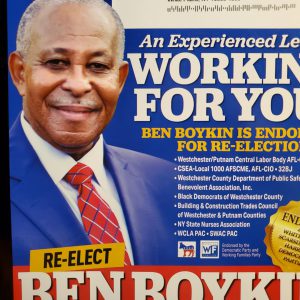
Benjamin Boykin, unopposed has reelected to the County Legislature representing District 5, (White Plains, Scarsdale, Harrison), has been elected to his sixth term as County Legislator.
Trust in institutions is declining across the globe. However, one group, particularly in the U.S., has seen a significant increase in trust: businesses. (This is true across all generations except Gen Z.)
Trust in businesses (percentage). 2023 Edelman Trust Barometer Global Report.
Most employees look to their employers for reliable information: those who say business should deliver more healthcare access and trustworthy information far outnumber thosewho say business is overstepping.
2023 Edelman Trust Barometer Global Report
In other words, businesses are “trusted messengers” to communities.
And for a good reason: people trust who they know. Businesses showed up during the pandemic. They became a key source of information, many recognized the importance of mental health, and some have remained flexible and responsive to employee needs.
Partnering with businesses can make the traditional public health world uneasy. While some businesses do it out of the kindness of their hearts, there is obviously a clear business case for public health action (see more below).
That’s okay. A healthy community is a healthy economy and vice versa. Public health can partner by equipping trusted messengers, like businesses, with the tools, education, and evidence-based resources.
We should start with the current respiratory season.
The business case for public health action
McKinsey estimated that Covid-19 illness was responsible for losing 315 million to 1 billion employee workdays in 2022 alone. Coupled with flu and RSV, work absences because of childcare constraints were at all-time high last year. This impacts productivity, turnover, and burnout.
None of this is going away. Public health action can help. For example:
Increasing vaccine coverage: Flu vaccines reduced work sick days by 1-3 days. In the UK, if 1000 employees are vaccinated for the flu, a business reduces absenteeism by 220 days and should expect a return of £1.03-£5.15 on every pound invested by an employer (depending on the severity of the flu that year).
Upgrade ventilation systems: In a study of 4,000 employees in over 40 buildings, twice as much clean air reduced sick leave by 35%. By investing $40 per person per year to double the ventilation rate, employers can recoup $6,000-$7,000 per person per year in higher productivity.
Build conviction: Educate on the facts. Engage with champions. Approach information apolitically, base actions on science, and act on the same values over time.
Increase convenience and eliminate cost: Nearly 1 in 2 employees state that initiatives targeting convenience and cost would significantly increase their likelihood of getting vaccinated. We see this play out in studies, like providing workers with paid time off to receive Covid-19 vaccines and to recover from potential vaccine adverse effects.
This could look like many things: pop-up vaccine clinics on campuses, paid time off to get vaccinated, ventilation upgrades, mask-friendly environments, a strategy for communication with the workforce, or even just a poster in the bathroom (like this photo someone sent me of an eerily familiar poster).
Need more ideas or support?
This Thursday, I am joining Dr. David Michaels (longest serving Assistant Secretary of Labor for OSHA), the Health Action Alliance, Ad Council, and CDC Foundation for a business solution-oriented discussion for this upcoming respiratory season.
It’s free and open to anyone! If you attend, you’ll also have access to a document we put together: Breathe Easy: 4 Steps to Respiratory Wellness at Work. (I’m biased, but I think it’s pretty great.)
To strive for a healthier community, an all-hands-on-deck response is required. Businesses are key partners in public health, as they are trusted messengers for many communities. Energy is wisely spent equipping them with tools and information so employees can make evidence-based decisions and live healthier lives.
Love, YLE
“Your Local Epidemiologist (YLE)” is written by Dr. Katelyn Jetelina, MPH Ph.D.—an epidemiologist, wife. During the day, she is a senior scientific consultant to several organizations, including the CDC. At night she writes this newsletter. Her main goal is to “translate” the ever-evolving public health world so that people will be well-equipped to make evidence-based decisions. This newsletter is free, thanks to the generous support of fellow YLE community members. To support this effort, subscribe below:
Welcome to the Northeast edition of Outbreak Outlook! It is only available to paid subscribers. If you wish to become a paid subscriber and access region-specific information, please click the Subscribe Now button below. Thanks for reading! -Caitlin
Covid-19
Covid-19 hospitalizations in the Northeast decreased slightly in the past week, declining from around 4,900 to 4,700 per day on average.
The states with the largest drops were New Jersey, Rhode Island, and Connecticut, which fell by 900-1,100 daily admissions. New York and Massachusetts also saw smaller declines of 200-400 each.
Meanwhile, admissions were relatively flat in Pennsylvania, New Hampshire, and Maine.Vermont was the only state that increased, rising by around 100 more per day. Overall, the Northeast experienced a modest decline of about 200 average daily hospital admissions over the past week.
Despite this good news, I have concerns about the weeks ahead. In other regions of the country, I am seeing early signs of increased Covid-19 activity. This aligns with patterns seen in previous years, where activity typically remains elevated through the autumn months and peaks in January. Based on these observations, I would expect Covid-19 hospitalizations to begin rising in Northeastern states in the coming weeks. I will continue monitoring the situation closely and update you on any new developments.
Respiratory diseases
Influenza-like illness
Influenza-like illness is climbing in the Northeast region. Around 2.5% of visits to the doctor are for fever and cough or sore throat in the region, which is similar to the overall national rate.
However, patterns differ widely among states in the region. While the overall regional trend is drifting upward, it’s mostly New York and New Jersey affected right now. New York has the highest rate at 3.9%, up slightly from 3.8% last week.New Jersey follows at 3.6%.
New York City has launched a new public health campaign to raise the city’s average life span to 83 years. Life expectancy fell to 78 in 2020, in part due to the pandemic. In 2019, it was 82.6. The campaign will target six drivers of premature deaths: Covid-19, chronic and diet-related diseases, drug overdoses, suicides, violence, and maternal mortality. By 2030, officials are aiming to reduce deaths from Covid-19 by 60%.
Other Northeastern states have substantially lower rates, all under 2%. New Hampshire, Maine, and Vermont have especially low rates, all holding below 1%.
At the national level, among children ages 0-4, 9% of visits to the doctor were for ILI symptoms, up from 8% twoweeks ago.
In comparison, doctor visits for ILI symptoms was significantly lower in older age groups: only 4.2% in the 5 to 24 age range, and for adults above 24, the rate was even lower, at 2% or less.
Quick update about the plots below: I heard you, readers—the grey lines are getting the boot. Meanwhile, I’m crafting a nice new state-by-state visualization. Hang tight, updates are coming soon!
RSV
Last week, I reported that RSV was increasing across the Northeast, with notable increases in test positivity in several states, including Massachusetts (up to 7.2%), New Hampshire (3.6%), and Connecticut (3.1%). CDC data have not been updated since then (most recent data is from October 21).I will be watching for updates to see how viral spread is shifting in the Northeast.
This year is the first year that RSV vaccines are available for infants and older adults to lower their risk of acquiring severe illness. Shortages in the vaccine for infants have led the CDC to alter its recommendations to prioritize vaccination for those infants most at risk of serious complications of infection; the vaccine for older adults is separate and unaffected by this shortage.
Other Respiratory + Stomach Bugs
Seasonal coronavirus activity in the Northeast remains low, but it does appear to be starting its typical seasonal increase.
Human metapneumovirus activity appears to be low in the Northeast, coming down after a bit of a blip a couple weeks ago.
Adenovirus and parainfluenza virus activity appears to be trending upward slightly, but the data have not been updated since October 21 and are only available at a national level.
Norovirus (stomach bug) activity is bouncing around a little bit. Last week I noted that it had been increasingly bit by bit over the course of the previous month. This week, it’s back down again. Currently levels are not too consequential either way, but I’ll keep an eye on it.
Food recalls
New this week:
Multiple brands of eye drops, including some additional brands (more info)
Multiple brands of Apple Cinnamon Fruit Puree, including some additional (more info)
Previously reported:
Fresh diced onion products by Gills Onions (more info)
If you have food allergies, you may wish to review these FDA safety alerts and USDA alerts for foods with undeclared allergens.
In Other News
Massachusetts has reported its sixth human case of West Nile virus this year. The patient, a man in his 70s, was likely exposed in Middlesex County, which is known to have a moderate risk of West Nile virus. As temperatures decrease throughout the autumn, the risk of West Nile and other mosquito-borne viruses will decrease, but risk will remain until all areas have experienced a hard frost (<28 degrees F). Health officials urge people to continue to take precautions against mosquito-borne illnesses in the meantime: use mosquito repellent, and wear long-sleeve shirts and pants.
West Nile virus is asymptomatic for most people. When symptoms occur, they include fever, body aches, vomiting, diarrhea, and rash. In rare cases, severe illness can develop, with older adults being at higher risk.