Hits: 204

JOHN BAILEY INTERVIEWS
LEONARD LOLIS ON HIS PLANS FOR MAYOR
ON “PEOPLE TO BE HEARD”
YOU’VE SEEN HIS COMMERICIALS. NOW LISTEN AS JOHN BAILEY ASKS
THE QUESTIONS YOU WOULD ASK HIM ABOUT THE FUTURE OF WHITE PLAINS NEW YORK USA
Hits: 204
JOHN BAILEY INTERVIEWS
LEONARD LOLIS ON HIS PLANS FOR MAYOR
ON “PEOPLE TO BE HEARD”
YOU’VE SEEN HIS COMMERICIALS. NOW LISTEN AS JOHN BAILEY ASKS
THE QUESTIONS YOU WOULD ASK HIM ABOUT THE FUTURE OF WHITE PLAINS NEW YORK USA
Hits: 164

September 24, 2025, New York, NY Honoring Constitution Day and the Significance |
| Last week, our nation honored Constitution Day — a powerful reminder of the enduring promise of liberty, justice, and equality enshrined in the U.S. Constitution – and a reaffirmation of the foundational principles that have guided our democracy. The Constitution together with the Bill of Rights provides fundamental protections that safeguard essential freedoms including due process, equal protection under the law, and freedom of speech.
While our country navigates debates around issues such as immigration, national security, and public broadcasting, the importance of upholding these constitutional protections remains paramount. It is essential that governmental regulation be exercised consistently and in accordance with constitutional principles. As legislative and policy reforms evolve and legal challenges on Constitutional issues make their way through the courts, WBASNY stands against unjustified and discriminatory actions that infringe upon due process, free speech, and equal protection under the law.
|
Hits: 189
GOVERNOR HOCHUL DIRECTS DEPARTMENT OF ENVIRONMENTAL CONSERVATION TO ISSUE DROUGHT WARNING FOR 12 COUNTIES, ADD 6 MORE COUNTIES TO DROUGHT WATCH
New Yorkers Urged to Conserve Water During Ongoing Dry Conditions
View Map of New York State Drought Conditions
Governor Kathy Hochul, with the New York State Department of Environmental Conservation, today announced a drought warning was issued in 12 counties in the Adirondack and Southern Tier regions and a drought watch was expanded to include six counties in the Susquehanna region. New York State is encouraging all residents, including those dependent on private groundwater wells, to conserve water whenever possible during the coming weeks.
“The less-than-normal amounts of rain have led to dry conditions for many counties in New York, resulting in the Adirondacks and Southern Tier counties being elevated to drought warning status and Susquehanna counties elevated to drought watch,” Governor Hochul said. “While New York State experts continue to closely monitor the data and conditions on the ground, we are taking proactive steps to support communities, farmers and local water suppliers. At the same time, we are urging everyone to do their part to conserve water so we can reduce stress on our resources and prevent more severe impacts in the weeks ahead.”
A drought watch or warning is now in effect for the entire state except for New York City and Westchester County. Drought conditions in this region are determined by New
York City in close coordination with DEC. There are four levels of State drought advisories: watch, warning, emergency, and disaster. There are no mandatory State restrictions under a drought watch or warning. A warning declaration is a notice of impending and imminent severe drought conditions and includes increasing public awareness and voluntary water conservation. Public water supply purveyors and industries are urged to continue to implement local drought contingency plans.
The counties under the drought warning are Allegany, Cattaraugus, Chemung, Clinton, Essex, Franklin, Hamilton, northern Herkimer, Lewis, Steuben, St. Lawrence, and Warren. The counties added to the drought watch are Broome, Chenango, Cortland, Otsego, Madison, and Tioga.
New York State Department of Environmental Conservation (DEC) Commissioner Amanda Lefton said, “Drought preparedness and prevention requires an active, coordinated effort by all New Yorkers to prevent a water crisis affecting our environment, public health, and economy. Reducing outdoor water use and checking for leaks in homes and businesses can go a long way in conserving water and preventing conditions that could have long-term effects on water resources.”
There is rain in the forecast for many parts of New York State, but the National Weather Service’s forecast suggests a minimal likelihood of significant relief from dry conditions. Observed precipitation over the past 90 days was less than normal across virtually the entire state. Observed precipitation deficits across the state range from two to eight inches. Stream flows and groundwater levels are declining in certain areas.
State Drought Index
In New York, drought status determinations are based on a State Drought Index that uses New York State-specific attributes, so it may differ from national drought assessments. In addition, local conditions may vary, so some areas of the state may make their own determinations of drought stage using locally focused criteria. DEC supports efforts by local governments and other stakeholders to undertake water conservation measures based on specific circumstances.
Drought Preparedness
Certain sectors have the potential to be impacted by drought conditions, including water supply, agriculture, ecosystems, navigation and transportation, energy and manufacturing, and planning and preparedness.
Drought preparedness includes monitoring and evaluation of climatological and conditions for early awareness of a potential drought and the implementation of short- and long-term options for programs and projects to minimize drought impacts. DEC and the U.S. Geological Survey are partners in evaluating hydrologic conditions across the state.
The State’s Drought Management Task Force monitors drought conditions, communicates information, and coordinates with affected communities. The Task Force is governed by the State Drought Management Coordination Annex, which focuses on research, monitoring and possible legislative actions to help prevent and mitigate impacts from droughts. Task Force members include DEC, New York State Office of Emergency Management, Department of Health, Department of Agriculture and Markets, Canal Authority, Thruway Authority, and New York Power Authority. With this coordinated preparedness and response effort, the impact of drought conditions on communities and commerce can be reduced.
Know Your Water
The public can contact their local water system for information about drought preparedness, impacts, and response notices and activities. Additional tips for the public on water conservation can also be found in each water system’s Annual Water Quality Report (AWQR).
Water system contact information and AWQRs can be accessed using the Know Your NY Water website or water systems own websites.
Support for Farmers
It is recommended that on-farm water supplies are monitored regularly, and concerns are communicated with county emergency management and local Soil and Water Conservation Districts. The Cornell Cooperative Extension Disaster Education Network and the New York State Department of Agriculture and Markets offer additional resources and local support.
Ecosystems
Drought conditions can impact aquatic and terrestrial ecosystems. Reduced stream flows can impact the health of aquatic life. Decreased precipitation impacts terrestrial plants and animals through reduced plant growth. Drought conditions may be a contributing factor to Harmful Algae Bloom (HAB) formation. Additional factors, including calm, sunny, and warm days and changing mixing dynamics can create conditions conducive to HAB formation. DEC maintains a HABs Reporting and Notifications page of waterbodies that currently have blooms.
Wildfire Prevention
When wildfire risk is elevated, fire departments should check that their water sources have adequate supply and that the intakes for dry hydrants are sufficiently submerged.
Residents should check with local authorities to see if a burn ban is in place before lighting any fires and ensure that any potential fire sources, including campfires and cigarettes, are fully extinguished.
Private Water Well Assistance
For assistance with water wells that may be affected by drought:
Water Conservation Tips
To protect water resources, water users are encouraged to voluntarily reduce outdoor water use and follow these tips:
For more water saving tips, visit DEC’s Water Use & Conservation webpage. For more information about drought in New York, visit DEC’s website.
Hits: 200
Enjoying this newsletter? Why not share it with a friend? Covid finally declining, EEE in Madison County, confusion around autism and Tylenol, and moreThe NY Dose
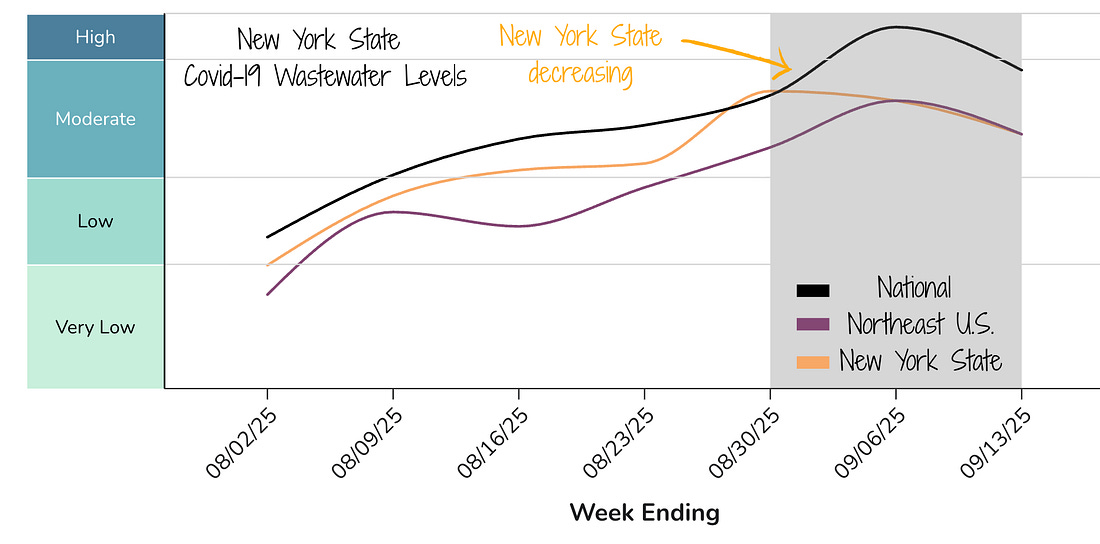
It’s been a whirlwind week in public health. From shifting Covid-19 vaccine recommendations and a debate over Tylenol and autism, to declining Covid levels in New York and even a case of eastern equine encephalitis, there’s a lot to sort through. Here’s what you need to know this week. Infectious disease “weather report”Covid is past its peak in New YorkForecast: Moderate and declining as measured by wastewater data, signaling that we’ve made it through the worst of the summer surge.
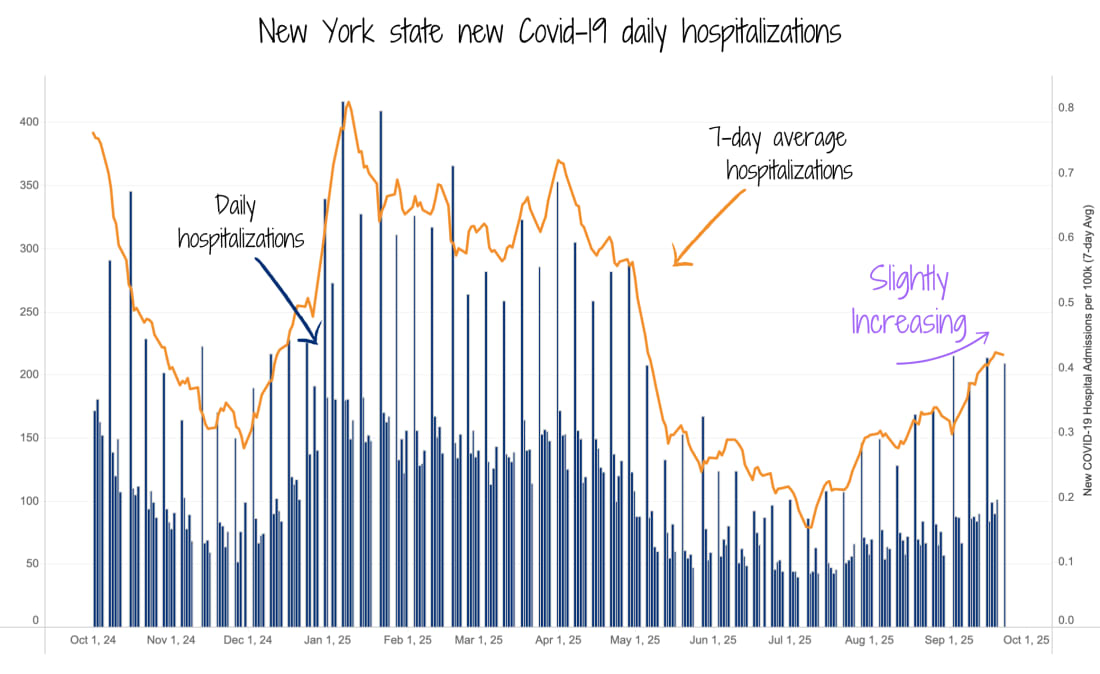
New York state Covid-19 wastewater activity levels. Figure from CDC NWSS. Annotations by YLE. Covid hospitalizations are still elevated. Because wastewater is a leading indicator and has just started decreasing, we can expect hospitalizations to follow and begin decreasing in the next week or two.
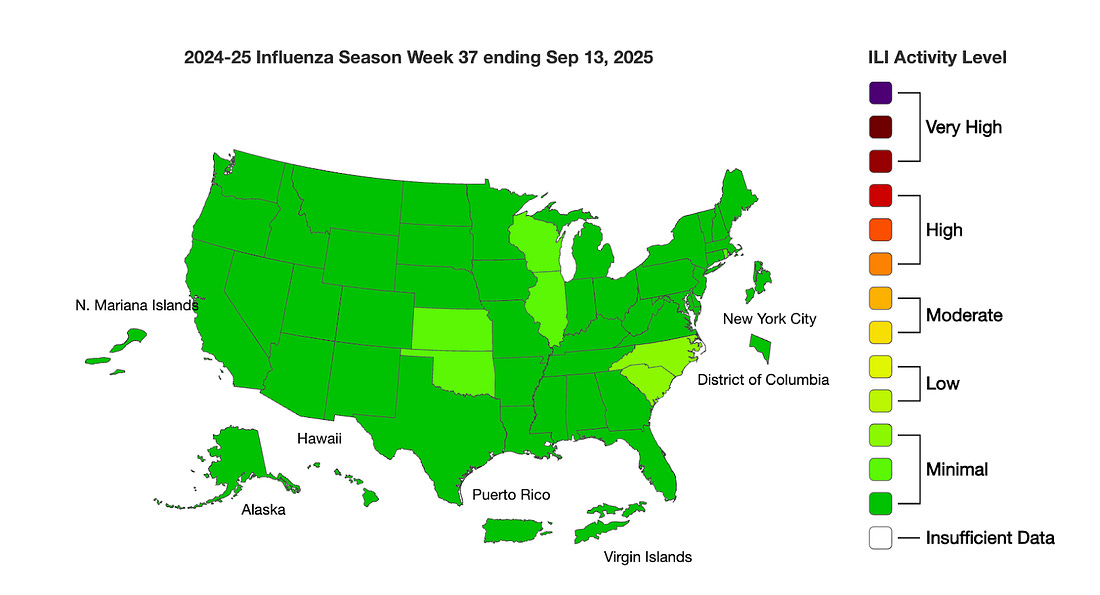
New York state Covid-19 hospitalizations. Figure from the New York State Department of Health. Annotations by YLE. The fluForecast: No activity in New York yet. All states, including New York, are at the minimal influenza-like illness (ILI) level, and New York wastewater shows no flu activity.
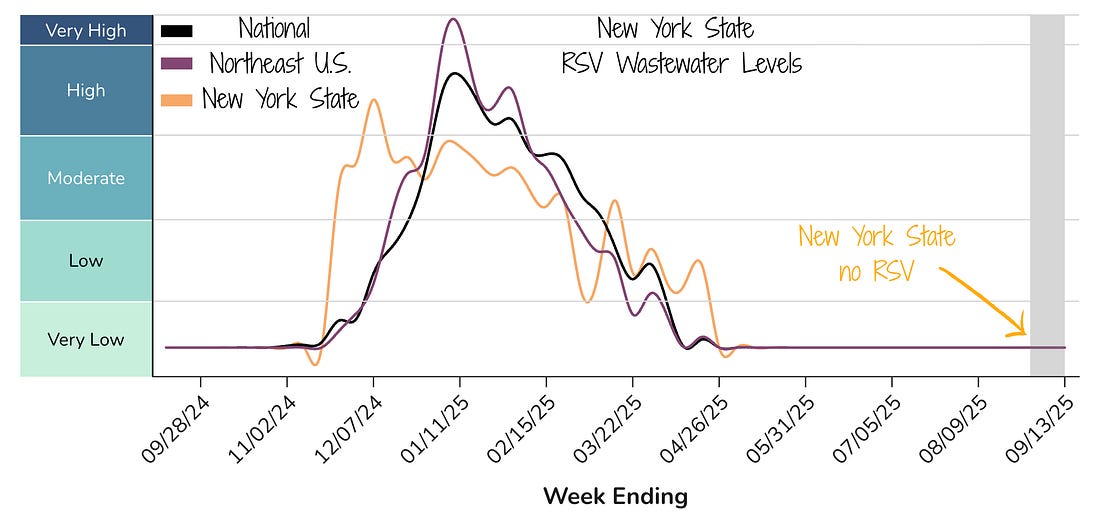
Figure from the CDC. I’m planning on getting my flu shot this week before I travel out of the county in early October. RSVForecast: No activity in New York yet. Wastewater and hospitalizations still show no RSV activity in New York.
New York state RSV wastewater activity levels. Figure from CDC NWSS. Annotations by YLE. Nationally, we moved from 0 hospitalizations per 100k to 0.1, which could be a very early sign that the season is starting or about to start. Mosquito-transmitted virusesHuman infection of eastern equine encephalitis virus in Central New YorkLast week a resident of Madison County was hospitalized with eastern equine encephalitis (EEE), a virus transmitted by some species of mosquitoes. This is the county’s first ever human EEE infection. EEE is rare in New York and the rest of the U.S.—last year, New York had its first human case since 2015 in a resident of Ulster County, who sadly died. Most people infected with EEE won’t have any symptoms. But for those who develop symptoms, the illness can be severe and involve inflammation of the brain (encephalitis) and spinal cord (meningitis).
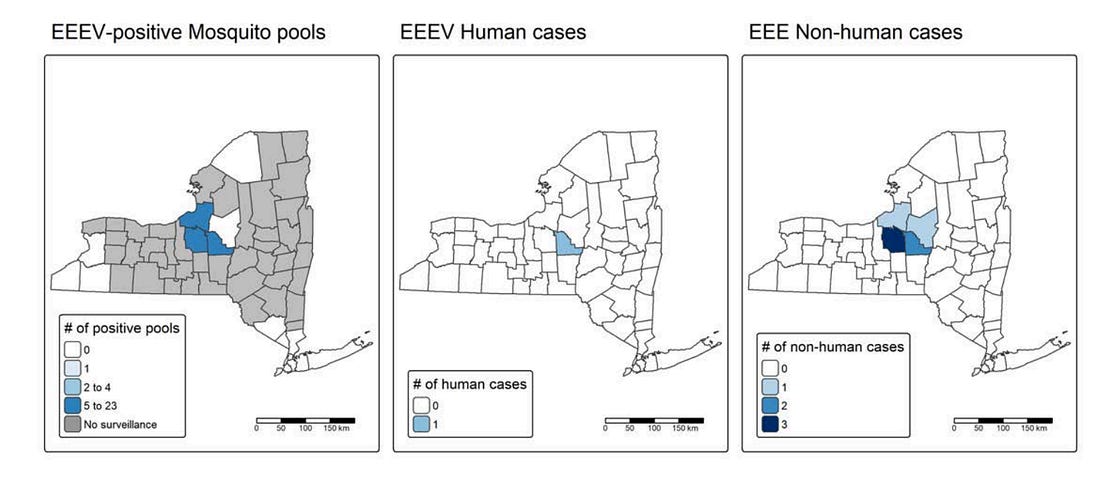
EEE is rare in New York, but is more concentrated in Central New York this year. Since 1971, only 13 human cases have been identified in the state, including the most recent one. Of these patients, seven died. By this time last year, 14 counties across the state detected EEE in mosquitoes, mammals, or birds. So far this year, EEE has only been detected in 4 counties: Madison, Onondaga, Oswego, and Oneida.
Easter equine encephalitis virus (EEE) detections in mosquitoes, humans, and animals. Figure from the NY DOH. But more mosquitoes have tested positive so far this year compared to last. Even though there are fewer counties detecting EEE, the detections are more concentrated in a smaller area—there’s a hotspot in Central New York. Prevention of EEE is the same as for West Nile virus: it’s focused on reducing the mosquito populations and avoiding insect bites. West Nile virus is active across New YorkThe most recent data show mosquitoes tested positive in:
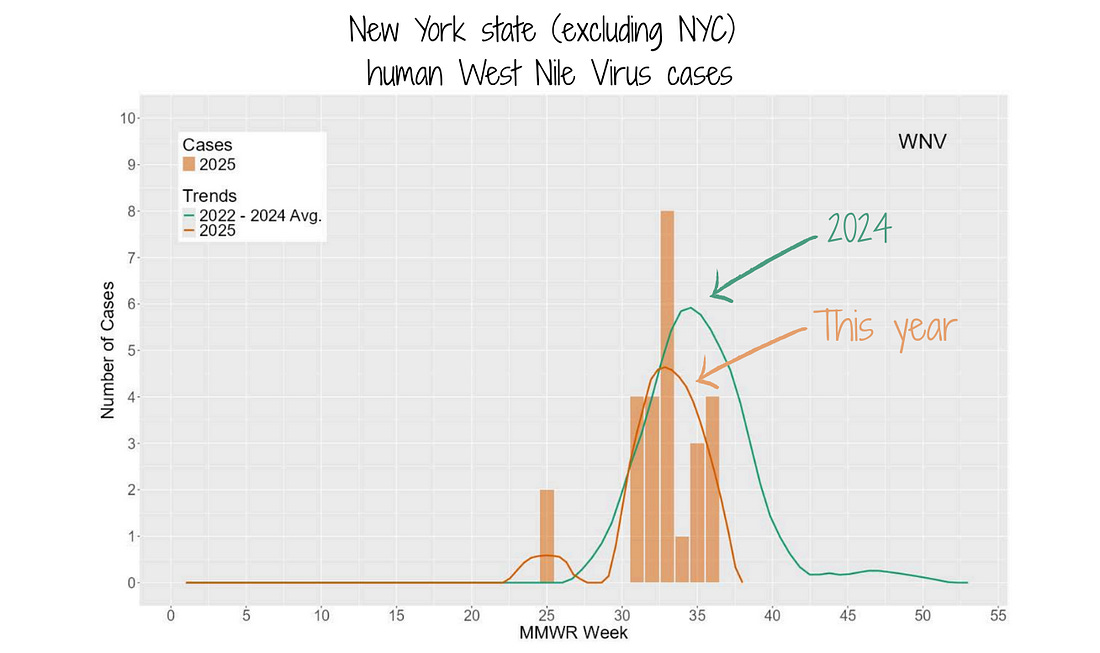
So far, the number of human infections seen this year is comparable to the average of the previous three years.
New York West Nile Virus infections for this year (2025) and the average of the previous 3 years (green). Data from NY DOH. Annotations by YLE. What this means for you:
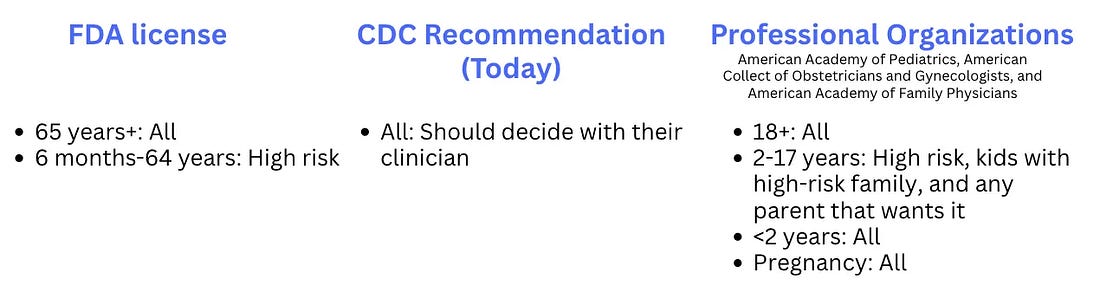
Follow-up on ACIP meeting updatesI tuned into last week’s Advisory Committee on Immunization Practices (ACIP) meeting—and it was messy. Members openly said they weren’t sure what they were voting on, some votes had to be redone or skipped, and there was repeated confusion over whether certain issues even fell within ACIP’s jurisdiction. That said, the outcome was more patient-friendly than many expected. Katelyn covered the details in a recent YLE National piece here. Here are the high-level outcomes: Covid vaccines: ACIP shifted Covid vaccine recommendations to shared clinical decision-making for everyone aged 6 months and older. That means that the decision to vaccinate now falls to conversations between patients (or parents) and clinicians—whether your primary care provider, specialist, or pharmacist.
Figure from YLE National. Depending on what state you live in, though, you may still need a prescription. ACIP’s guidance is now more broad than FDA’s: FDA continues to classify the Covid vaccine as “off-label” for some groups (like healthy adults and children without underlying conditions). In some states, this ACIP/CDC vs. FDA mismatch could mean patients need a prescription to access the vaccine. In New York, this discrepancy will not disrupt vaccine access. Governor Hochul earlier issued an Executive Order that allows pharmacists to both prescribe and administer Covid-19 vaccines for people aged 3 and older without a patient-specific prescription. That law means that even under the new federal guidance emphasizing shared decision-making, folks in New York should still be able to get vaccinated conveniently, including via pharmacies. What this means for New York: The Executive Order put forward earlier this month ensures continued access to Covid-19 vaccines in New York. CDC basically recommended that Covid-19 vaccines off-label (different from FDA’s recommendations). This off-label use means that pharmacists can’t administer them without special authority. In New York, the EO and standing order granted pharmacists that authority, even before the ACIP meeting, which means that you can get vaccinated at your local pharmacy. Most insurers — including Medicaid, Medicare, CHIP and major private insurers (AHIP, ACHP) — have also affirmed they will keep covering the vaccine. New York joins the Northeast Public Health CollaborativeNew York state and New York City joined Connecticut, Maine, Massachusetts, New Jersey, Pennsylvania, and Rhode Island in the Northeast Public Health Collaborative to share expertise and protect evidence-based public health. A cornerstone of the voluntary regional coalition is to collaborate on vaccine recommendations. And they are already making moves. All states in the Northeast Collaborative have taken action through executive orders, legislation, or other means to decouple Covid-19 vaccine guidelines from federal rules, protecting access within their own states. What we do and don’t know about autism and TylenolWhat was said at the presidential press conference earlier this week is not true: we do not have evidence that Tylenol causes autism. The largest and most rigorous study to date—a Swedish sibling study of over 2.5 million pregnancies—found no link between prenatal Tylenol use and autism when controlling for genetics and environment. That said, the picture is more complicated. Some observational studies have reported associations between Tylenol use during pregnancy and autism. But others show that fever itself during pregnancy can increase risk, making it hard to know whether the risk comes from the medication, the underlying illness, or something else entirely. The bottom line: this science is complex, and we don’t have a clear answer. What we do know is that the association is nowhere near as strong as it was described from the podium earlier this week. Many of the statements given were misleading or straight up false. On top of that, they also create stigma against our neurodiverse community members, and pregnant women who are doing the best they can to keep their babies and themselves healthy. Katelyn Jetelina and Kristen Panthagani did a great job breaking it down here for YLE National. For now, guidelines remain unchanged: consult with your doctor and if you need Tylenol during pregnancy, use the lowest effective dose for the shortest possible time. Bottom lineYou’re all caught up on New York public health news this week! And a happy 220th birthday to the NYC Department of Health and Mental Hygiene. 🥳 Love, Your NY Epi Dr. Marisa Donnelly, PhD, is an epidemiologist, science communicator, and public health expert. This newsletter exists to translate complex public health data into actionable insights, empowering New Yorkers to make informed and evidence-based health decisions. |
Hits: 143
Enjoying this newsletter? Why not share it with a friend? Tylenol and autism: What parents deserve to knowNuance and empowerment instead of underestimation.
On Monday, RFK Jr.’s autism “report” landed. This was supposed to be the culmination of RFK Jr.’s months-long promise to “finally uncover” the cause of autism by September. But no report was published, no new science was unveiled, and no fresh data was presented. Instead, we got an X post, a press conference, and politicians coming to far-reaching conclusions from data that obstetricians, pediatricians, and scientists have already spent decades studying.
As an epidemiologist, I could see the falsehoods spewing out like a firehose with a few kernels of truth mixed in. But as a mom, the aftermath was visceral. My DMs and texts lit up with worry. Even the faint suggestion of blame haunts pregnant women and parents, piling more weight on shoulders already carrying enough. Being told to “toughen up”, without regard for the confusion, doubt, and guilt that are placed on us far too often these days. This is where I believe this “report” is making a grave mistake. They are underestimating the power of parents. Parents don’t need fearmongering or false certainty—they want accurate information, context, and respect. Not chaos, but clarity. Not underestimation, but empowerment with the best evidence at their fingertips to help them make the best decisions for themselves and their families. What happened earlier this week is far, far from this. And parents deserve better. Bottom line up frontScientists have been working to uncover autism for decades. This is ongoing, but for now, the balance of evidence shows this: There is no causal link between Tylenol use and autism. To all the mothers out there, you are doing amazing. Where did this claim come from?The idea that Tylenol (acetaminophen) use during pregnancy could be linked to autism has been investigated by the scientific community for more than a decade. Some scientists have wondered if Tylenol might affect a baby’s brain during pregnancy by stressing cells or changing certain chemical pathways. These hypotheses primarily originate from laboratory and animal studies at high doses. There have also been many, many human studies. The paper behind many of the headlines this week is a Harvard/Mount Sinai study that reviewed over 46 studies evaluating the associations between Tylenol and neurodevelopmental disorders, including autism and ADHD, with six studies focusing specifically on autism. They found a mix of conclusions:
These authors found a pattern consistent with rat studies: Tylenol, particularly during third trimester, was associated with higher risk. Also, they found a dose-response relationship: the more Tylenol someone had during pregnancy, the greater the associated risk. Importantly, the overall increased risk they found in these correlative studies was quite small. BUT. These were not randomized controlled trials (the gold standard), because it would be unethical to assign pregnant women to take or avoid Tylenol (the risks of untreated fever are real). Instead, each of these individual studies had to rely on observational methods. And observational studies can be tricky. They’re always vulnerable to confounding variables (what caused moms to take Tylenol in the first place?) or other factors (like genetics or environmental exposures) that may explain the pattern. In 2024, a major study from Sweden took the evidence a step further. Researchers there did something clever: they compared siblings. One child had been exposed to Tylenol during pregnancy, the other had not. This kind of “natural experiment” is powerful because it controls for what siblings share, including genetics and family environment. We know autism has a strong genetic component, so studies like this, controlling for genetics, are critical.
The Tylenol–autism link disappeared when comparing siblings.
When the researchers examined the data without sibling comparisons, they reproduced the same association that older studies had found. That means the study was strong enough to detect the association—but also strong enough to show it evaporated once they controlled for genetic and other environmental factors.
In other words, this evidence leans heavily toward correlation, not causation. (Tylenol is not the cause.) What else could explain changes in autism prevalence numbers?
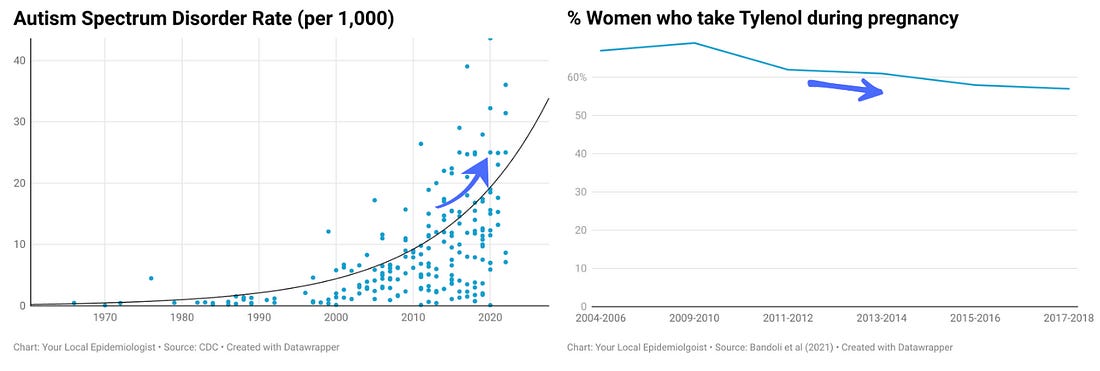
Many epidemiologists do think there is a rise in autism due to improved recognition and diagnostic criteria, but not at the dramatic rate that the “report” insinuated. (Read more here for a deep dive into the data trends.) Autism is rooted in brain development. While neuroscience is still being mapped, we do know that some autistic brains show differences in neuron growth and connectivity—differences that originate in utero, when the brain is forming. So why do some developing brains take this path while others don’t?
Research shows that it’s highly genetic—85% of the risk is attributed to your genes. But genetics haven’t changed over time. Therefore, if there is an increase, it’s likely that environmental exposures. Tylenol use has decreased over time. So, again, another sign this isn’t leading to a dramatic rise in autism.
Other hints include:
So what do parents do with this?All medications have risks and benefits, and that includes Tylenol. For pregnant moms trying to wade through the headlines, here’s where we’re at:
So, here’s how I would think about it:
Oversimplifying scienceIf you’ve watched RFK Jr.’s scientific claims over the last several decades, his claim that a commonly prescribed medicine is causing autism comes as no surprise. He has a long history of pointing fingers at medications—Tylenol, vaccines, you name it—as the root of health challenges. It’s a convenient scapegoat.
This taps into a common fallacy he often defaults to: the idea that “natural” is always good and “chemical” is always bad. This “appeal to nature” fallacy is seductive because it feels intuitive but it isn’t evidence-based. Reality is more complex. Plenty of natural things are harmful (arsenic, poison ivy), and plenty of man-made medicines save lives. Some diseases are naturally occurring. Some conditions—like autism—are part of the natural spectrum of human diversity. Pretending otherwise doesn’t just mislead; it actively harms families by piling on stigma and misplaced blame and providing empty solutions instead of support and real answers. Bottom lineThe “report” made a grave mistake: it underestimated parents and placed an undue burden of anxiety and guilt on them instead of empowering them to make informed decisions. Science is ongoing, but for now, the balance of evidence shows this: There is no causal link between Tylenol use and autism. To all the mothers out there, you are doing amazing. Love, YLE and KP Your Local Epidemiologist (YLE) is founded and operated by Dr. Katelyn Jetelina, MPH PhD —an epidemiologist, wife. YLE is a public health newsletter that reaches over 380,000 people in more than 132 countries, with one goal: to translate the ever-evolving public health science so that people are well-equipped to make evidence-based decisions. This newsletter is free to everyone, thanks to the generous support of fellow YLE community members. To support the effort, subscribe or upgrade below: |
Hits: 155
GOVERNOR HOCHUL ANNOUNCES $1 BILLION SUSTAINABLE FUTURE PROGRAM SUPPORTING CLIMATE ACTION AND JOBS
Major Investment will Advance Clean Energy, Cut Emissions, and Expand Green Infrastructure Statewide
Governor Hochul today, while participating in the U.S Climate Alliance’s roundtable, announced the next steps for her landmark $1 billion Sustainable Future Program to accelerate capital projects in New York’s transition to a cleaner, greener future.
This historic investment will create good-paying jobs, lower energy costs for New Yorkers, and slash harmful emissions in the face of federal rollbacks.
“New York is a national leader in climate action, and we’re proving that we can build a thriving green economy while protecting our planet,” Governor Hochul said.
“While others may retreat, we are doubling down. The $1 billion investment from our Sustainable Future Program will directly benefit New Yorkers by making our homes more energy-efficient, our schools healthier, and our communities more resilient. We are creating jobs, improving public health, and ensuring a just and affordable transition for every community.”
The $1 billion Sustainable Future Program, announced in this year’s State of the State, is the largest climate investment in New York’s history.
Today’s announcement allocates funding to key areas of the state’s climate plan to help make the transition more affordable for all New Yorkers.
Empowering New Yorkers with Energy Efficiency
$50 million will be allocated to the EmPower+ program to provide low- and moderate-income residents with no-cost home energy assessments and energy efficiency upgrades.
NYSERDA will focus this funding on heat pump installations, a key technology for reducing reliance on fossil fuels in residential heating and cooling.
Greening Our Schools
$50 million will be used to help under-resourced public schools across the state decarbonize their building portfolios. This investment will improve indoor air quality for students and staff and reduce the schools’ carbon footprint.
Investing in Thermal Energy Networks
$200 million is dedicated to expanding thermal energy networks, which use a system of pipes to share heating and cooling resources among multiple buildings. This funding will support projects at municipal and State-owned buildings, and will specifically include several projects within the State University of New York (SUNY) system:
Making The Transition To Clean Energy More Affordable for Homeowners and Small Buildings
$150 million will support the launch of a new Green Small Buildings Program, administered by New York State Homes and Community Renewal (HCR) to assist eligible homes with making energy-efficient upgrades, including heat pumps.
Expanding Clean Transportation Infrastructure
To accelerate the transition to electric vehicles, Governor Hochul announced several significant investments:
Accelerating Renewable Energy Projects
$200 million will be provided to the New York Power Authority (NYPA) to finance multiple renewable energy generation projects. This funding will help reduce ratepayers costs as NYPA continues to build new renewables to power New York State.
Any further funding details regarding the Sustainable Future Program will be announced at a later date, as New York is committed to making strategic, high-impact investments that will benefit all New Yorkers.
New York State Energy Research and Development Authority President and CEO Doreen M. Harris said, “Governor Hochul has made clear her commitment to supporting generational investments like the Sustainable Future Program to foster an improved quality of life for all New Yorkers. Cleaning the air we breathe while lowering energy costs by advancing renewable energy projects, zero-emission transportation options and energy efficient building upgrades provides communities across the state with a critical foundation for a sustainable future.”
New York State Department of Environmental Conservation Commissioner Amanda Lefton said, “Governor Hochul is making nation-leading investments to meaningfully fight climate change and make a future truly sustainable in New York. This landmark $1 billion Sustainable Future Program is supporting New York’s transition to an affordable and accessible green future that will offer relief for homeowners, create clean energy jobs, and reduce pollution statewide.”
New York Power Authority President and CEO Justin E. Driscoll said, “The Power Authority is advancing the largest portfolio of utility-scale, clean energy generation in decades, and the Sustainable Future Program will help us move viable projects to fruition. When we build projects, alone or in partnership, we must consider capital costs, long-term maintenance, fuels costs and financing. The Governor’s investment in renewable projects from the sustainability fund will enable us to be shovel-ready sooner on priority projects.”
Hits: 120
Westchester County Executive Ken Jenkins to Join Stop & Shop Pharmacists in Call for Residents to Get Their Flu and COVID-19 Shots
Westchester County Executive Ken Jenkins will join with Stop & Shop Pharmacy experts and receive both his flu and COVID-19 vaccines along with local community members at 2 p.m. on Wednesday, September 24th at the New Rochelle Stop & Shop located at 2425 Palmer Avenue.
(Editor’s note: Stop & Shop in White Plains at 154 Weschester Avenue is also offering covid and flu shots by walk-in or appointment, call your favorite Stop & Shop location to call for an appointment or do a search on Stop & Shop locations in Westchester County))
Westchester County Executive Jenkins is calling on residents of his county to get their flu and COVID-19 shots as early as possible this fall. The flu vaccine helps reduce serious respiratory illness and can help protect a person throughout the entire year. Stop & Shop pharmacies have been providing more immunizations year over year to protect its community, and according to the Centers for Disease Control and Prevention (CDC), the flu vaccine has been shown to reduce the risk of having to go to the doctor with flu by 40% to 60%.
“Stop & Shop Pharmacies are proud to continue our longstanding mission of caring for our communities this flu season,” said Katie Thornell, Director of Pharmacy at Stop & Shop. “We’re fully stocked and ready to provide same-day flu and COVID-19 shots, whether by appointment or walk-in. Our goal is to be a trusted wellness partner not only this fall, but throughout the year, making it simple for everyone to access the care they need to keep themselves and their loved ones healthy.”
Flu shots and COVID-19 vaccines are available for a fee from many area pharmacists and medical offices.
To find a vaccine near you, go to www.vaccines.gov.
Flu vaccines are also available for uninsured and underinsured adults and children covered through the Vaccines for Adults and Vaccines for Children programs at
Westchester County Department of Health clinics by appointment. Call 914-995-5800 weekdays before 4:30 p.m. to discuss eligibility.
“Book a flu and COVID-19 vaccine for you and your children,” said Westchester County Executive Ken Jenkins. “Take time to prioritize your health, as I do, by scheduling these vaccines to help you fight off the worst effects of influenza and COVID-19 throughout the season. Getting sick with these viruses is no fun.”
The CDC also recommends everyone 6 months of age and older, with rare exceptions, receive a flu vaccine each year to help reduce the risk of influenza and its potentially serious complications. September and October remain the best times for most people to get vaccinated.
What: Westchester County Executive Ken Jenkins joins Stop & Shop Pharmacists to receive both his flu and COVID-19 vaccines and calls on residents to get their flu shot. Local community members will also join the County Executive to receive their flu immunizations.
When: Wednesday, September 24th at 2 p.m.
Hits: 2
WPCNR DATA AT LARGE. Printed with permission FROM Elevate-UK https://elevate.uk/
| Job Title | AI Automation RIsk | Projected Job Growth (by 2030) | Risk Estimation by GPT 5 | AI-Only Risk Score |
| Data entry clerk | 95% | -25.00% | 95% | 100 |
| Telemarketer | 94% | -21.50% | 85% | 92 |
| Cashiers | 93% | -10.60% | 75% | 79 |
| Receptionist | 91% | -0.50% | 80% | 71 |
| Billing clerk | 89% | 0.50% | 80% | 69 |
| Legal assistant | 88% | 1.20% | 75% | 66 |
| Admin assistant | 83% | -0.30% | 80% | 66 |
| Proofreader | 85% | -3.40% | 70% | 65 |
| Production workers | 89% | 0.60% | 70% | 65 |
| Customer service representative | 76% | -5.00% | 75% | 62 |
| Human Resources Assistants | 73% | -4.80% | 65% | 56 |
Hits: 143
The August 2025 unemployment rate for the Hudson Valley Region is 3.8 percent. Westchester unemployment rate was 3.7% according to the Department of Labor.
That is up from 3.5 percent in July 2025 and up from 3.7 percent in August 2024. In August 2025, there were 46,300 unemployed in the region, up from 43,600 in July 2025 and up from 45,000 in August 2024. Year-over-year in August 2025, labor force increased by 700 or 0.1 percent, to 1,226,700.
The Hudson Valley Region’s August 2025 unemployment rate (3.8 percent) is tied with the Long Island Region for the second lowest rate among the 10 labor market regions in New York State.
In August 2025, the lowest unemployment rate within the region (3.3 percent) was recorded in Putnam County.
Hits: 124

SUSAN CACACE
WESTCHESTER COUNTY DISTRICT ATTORNEY
|
WHITE PLAINS, N.Y. – Westchester County District Attorney Susan Cacace announced that a fugitive from justice who absconded to Mexico after raping a young child over a decade ago has admitted to his criminal conduct.
Galo Herrera, 53, pleaded guilty Monday to one count of Rape in the First Degree, a class B felony, before Judge Maurice Dean Williams.
DA Cacace said: “The defendant’s cowardly scheme to evade accountability, nearly 20 years in the making, could not outrun the long arm of the justice system. In the intervening years, this office never ceased working to secure his return to the
United States. I am hopeful this guilty plea will provide the victim with the closure she has long deserved.”
Between December 2006 and January 2007, the defendant forcibly raped a young child who was under the age of 13 years old at the time. Herrera fled the jurisdiction before he could be apprehended on these charges.
In 2008, Herrera was indicted on one count of Predatory Sexual Assault Against a Child, a class A-II felony, two counts of Rape in the First Degree, a class B felony, and three counts of Endangering the Welfare of a Child, a class A misdemeanor. He was extradited to Westchester earlier this year. The case was investigated by the Mount Vernon Police Department, the Westchester DA’s Office and the Federal Bureau of Investigation. The Westchester County Department of Labs and Research and the New York State Police Crime Lab were utilized in the course of the investigation. The case was prosecuted by Senior Assistant District Attorney Charlotte Gudis. |