Origins of Halloween

Hits: 477


WPCNR SCARY STUFF. From The History Channel. October 31, 2022:

Halloween’s origins date back to the ancient Celtic festival of Samhain (pronounced sow-in). The Celts, who lived 2,000 years ago, mostly in the area that is now Ireland, the United Kingdom and northern France, celebrated their new year on November 1.

This day marked the end of summer and the harvest and the beginning of the dark, cold winter, a time of year that was often associated with human death. Celts believed that on the night before the new year, the boundary between the worlds of the living and the dead became blurred. On the night of October 31 they celebrated Samhain, when it was believed that the ghosts of the dead returned to earth.

https://16cb573601c970a04d011c6707873313.safeframe.googlesyndication.com/safeframe/1-0-38/html/container.html

In addition to causing trouble and damaging crops, Celts thought that the presence of the otherworldly spirits made it easier for the Druids, or Celtic priests, to make predictions about the future. For a people entirely dependent on the volatile natural world, these prophecies were an important source of comfort during the long, dark winter.

To commemorate the event, Druids built huge sacred bonfires, where the people gathered to burn crops and animals as sacrifices to the Celtic deities. During the celebration, the Celts wore costumes, typically consisting of animal heads and skins, and attempted to tell each other’s fortunes.

When the celebration was over, they re-lit their hearth fires, which they had extinguished earlier that evening, from the sacred bonfire to help protect them during the coming winter.

Did you know? One quarter of all the candy sold annually in the U.S. is purchased for Halloween.

By A.D. 43, the Roman Empire had conquered the majority of Celtic territory. In the course of the 400 years that they ruled the Celtic lands, two festivals of Roman origin were combined with the traditional Celtic celebration of Samhain.

The first was Feralia, a day in late October when the Romans traditionally commemorated the passing of the dead. The second was a day to honor Pomona, the Roman goddess of fruit and trees. The symbol of Pomona is the apple, and the incorporation of this celebration into Samhain probably explains the tradition of bobbing for apples that is practiced today on Halloween.

https://16cb573601c970a04d011c6707873313.safeframe.googlesyndication.com/safeframe/1-0-38/html/container.html

READ MORE: Halloween Costumes That Disguised, Spooked and Thrilled Through the Ages

Halloween-Costume-History_GettyImages-85032733

20

GALLERY

20 IMAGES

All Saints’ Day

On May 13, A.D. 609, Pope Boniface IV dedicated the Pantheon in Rome in honor of all Christian martyrs, and the Catholic feast of All Martyrs Day was established in the Western church. Pope Gregory III later expanded the festival to include all saints as well as all martyrs, and moved the observance from May 13 to November 1.

By the 9th century, the influence of Christianity had spread into Celtic lands, where it gradually blended with and supplanted older Celtic rites. In A.D. 1000, the church made November 2 All Souls’ Day, a day to honor the dead. It’s widely believed today that the church was attempting to replace the Celtic festival of the dead with a related, church-sanctioned holiday.

All Souls’ Day was celebrated similarly to Samhain, with big bonfires, parades and dressing up in costumes as saints, angels and devils. The All Saints’ Day celebration was also called All-hallows or All-hallowmas (from Middle English Alholowmesse meaning All Saints’ Day) and the night before it, the traditional night of Samhain in the Celtic religion, began to be called All-Hallows Eve and, eventually, Halloween.

READ MORE: How the Early Catholic Church Christianized Halloween

Halloween Comes to America

The celebration of Halloween was extremely limited in colonial New England because of the rigid Protestant belief systems there. Halloween was much more common in Maryland and the southern colonies.

As the beliefs and customs of different European ethnic groups and the American Indians meshed, a distinctly American version of Halloween began to emerge. The first celebrations included “play parties,” which were public events held to celebrate the harvest. Neighbors would share stories of the dead, tell each other’s fortunes, dance and sing.

Did you know? More people are buying costumes for their pets. Americans spent nearly $500 million on costumes for their pets in 2021—more than double what they spent in 2010.

Colonial Halloween festivities also featured the telling of ghost stories and mischief-making of all kinds. By the middle of the 19th century, annual autumn festivities were common, but Halloween was not yet celebrated everywhere in the country.

In the second half of the 19th century, America was flooded with new immigrants. These new immigrants, especially the millions of Irish fleeing the Irish Potato Famine, helped to popularize the celebration of Halloween nationally.

READ MORE: Monsters in the White House: The Best Presidential Halloween Costumes

Halloween_White House_1_GettyImages_517251300

10

GALLERY

10 IMAGES

History of Trick-or-Treating

Borrowing from European traditions, Americans began to dress up in costumes and go house to house asking for food or money, a practice that eventually became today’s “trick-or-treat” tradition. Young women believed that on Halloween they could divine the name or appearance of their future husband by doing tricks with yarn, apple parings or mirrors.

WATCH: Trick-or-Treating’s Tricky History 

In the late 1800s, there was a move in America to mold Halloween into a holiday more about community and neighborly get-togethers than about ghosts, pranks and witchcraft. At the turn of the century, Halloween parties for both children and adults became the most common way to celebrate the day. Parties focused on games, foods of the season and festive costumes.

Scroll to Continue

Recommended for you

vampire

Vampire History

Why Do Witches Ride Brooms? The History Behind the Legend

Why Do Witches Ride Brooms? The History Behind the Legend

Parents were encouraged by newspapers and community leaders to take anything “frightening” or “grotesque” out of Halloween celebrations. Because of these efforts, Halloween lost most of its superstitious and religious overtones by the beginning of the twentieth century.

Halloween Parties

By the 1920s and 1930s, Halloween had become a secular but community-centered holiday, with parades and town-wide Halloween parties as the featured entertainment. Despite the best efforts of many schools and communities, vandalism began to plague some celebrations in many communities during this time.

By the 1950s, town leaders had successfully limited vandalism and Halloween had evolved into a holiday directed mainly at the young. Due to the high numbers of young children during the fifties baby boom, parties moved from town civic centers into the classroom or home, where they could be more easily accommodated.

Between 1920 and 1950, the centuries-old practice of trick-or-treating was also revived. Trick-or-treating was a relatively inexpensive way for an entire community to share the Halloween celebration. In theory, families could also prevent tricks being played on them by providing the neighborhood children with small treats.

Thus, a new American tradition was born, and it has continued to grow. Today, Americans spend an estimated $6 billion annually on Halloween, making it the country’s second largest commercial holiday after Christmas.
Posted in Uncategorized

Immigrant Coalition: “FUND EDUCATION OF IMMIGRANT CHILDREN NEW YORK!”

Hits: 454


New York, NY–On Monday, October 31 at 11:30AM the New York Immigration Coalition, Comptroller Brad Lander, City Council Committee on Education Chair Rita Joseph, allies and immigrant New Yorkers will hold a press conference at the Tweed Courthouse steps to call for transparency, full funding for, and proper placement of newcomer asylum seeker students in New York City schools. 

Currently, October 31 is the day that schools submit their final headcounts for budgeting to the NYC Department of Education (DOE). But new asylum seeker children may continue to arrive beyond this date. In order for schools to meet the needs of all of their students, schools must be adequately resourced and receive funding for students who arrive after October 31.

The DOE must also place newcomers, many of whom are English Language Learners (ELLs), in the right schools with the right academic and social-emotional supports to meet their unique needs and unlock their potential.

This includes older newcomer youth, who now have access to six new programs opened by the DOE in Transfer High Schools outside of Manhattan  – a model that should be deepened and fully funded to serve newcomer immigrant youth where they live and work.

Posted in Uncategorized

WESTCHESTER NEW COVID CASES UP 50% OVER LAST OCTOBER.

Hits: 439

Approach 1,500 Cases a week. 184 new cases a day  13th Consecutive Week of 1,000 cases a week.

WPCNR CORONAVIRUS SURVEILLANCE. Statistics from NY Covid Tracker. Observations and Analysis by John F. Bailey. October 30, 2022:

October 2021, Westchester showed 2,682 infections. For October 2022 through 29 days total new covid 19  infections are at 5,216, 50% more than last October infections that created  25,000 infections in the middle of January and shut us down for 5 months.

Through Saturday, Westchester reported 1,287 lab-confirmed cases of covid last week October 23-29. Last week is the 13th consecutive week back through August 1 that Westchester has sustained 1,000 new cases a week.

Covid is sustaining itself and now creeping up to the 1,500 level of infections the county experienced through August. The number of 5,216 cases the last 29 days (168 a day) is double the 80 per day rate of last October that saw December cases of covid skyrocket.

 Let’s look at what has happened the last three months!

After 2,062 cases the first week in August, the county new covid cases  dropped to 1,300 new cases a week the third, fourth and fifth week of August . Schools opened the next week, and in September the County averaged 1,158 new cases a week over 5 weeks, with highs of  1,468 and 1,465 the third and fourth weeks of September with two weeks of opened schools..

In October the infections grew in the Monday Tues Wednesday parts of the week as the diseases infected persons with the bivalient strain that makes you sick within 48 hours. October saw 5,216 infections, 1,304 average each week. This means more cases more often in November with essentially no socialization, masking or capacity restrictions in place throughout the county.

The 1,287 infections last week was the highest week in  October, 90 more than last week, 1,197.

Westchester is infecting covid at 184 persons a day.  This creates about 1,500 infections next week with Armistice Day and Thanksgiving travel and holidays coming up.

The pattern of spread this fall is eerily parallel to last October, but actually more infections this October. Lots more.

October 2021, Westchester showed 2,682 infections. For October 2022 through 29 days total new covid 19  infections are at 5,216 that is 50% more than last October infections that brought over 25,000 infections in the middle of January and shut us down for 5 months.

Posted in Uncategorized

WESTCHESTER COUNTY ELECTION SECURITY

Hits: 497

WPCNR LETTER TICKER. October 30. 2022:


November 8, 2022, is a very important Election Day. As president of the League of Women Voters ofWestchester County, I would like to reassure voters that New York State elections are secure and reliable. New York’s election process is administered by a bipartisan team of election workers. Workers representing both major parties oversee ballot counting, a common practice nationwide to provide checks and balances in the election process. Election administrators, board employees, and election inspectors/poll workers are required to be residents of your county. The people who run our elections are not strangers. They are members of our communities – neighbors, friends, and family.

Every step of our election process is monitored and secured from the voter registration process to the post-election audit. The voter registration process in New York State ensures that only those meeting state eligibility requirements are able to vote, and it helps keep track of who has cast a ballot. Registered voters can vote early in person, or on Election Day in person, or by absentee ballot. All absentee ballots must be returned by mail, or in person during early voting or on Election Day at any poll location in our county, or at the Westchester Board of Elections in White Plains. Secured drop boxes are posted at every poll location, and are monitored by trained election inspectors.

Ballots are submitted to election machines that have been pre-approved by the NYS Board of Elections. Each piece of election equipment is tested before being used on election day and all voting machines are barred from connecting to the internet. Finally, all county boards of elections must conduct post-election audits to further verify results.

Whichever way you choose to vote this year, know that by doing so you are making democracy work.

Kathy Meany, President

League of Women Voters of Westchester County

Posted in Uncategorized

WHITE PLAINS WEEK “FASNY FLASH” — THE OCT. 28 REPORT ON WWW.WPCOMMUNITYMEDIA.ORG

Hits: 328


JOHN BAILEY INTERVIEWS DAN SEIDEL ON THE APPELLATE COURT DECISION (ENDING?) OF 11 YEARS OF LEGAL WRANGLING

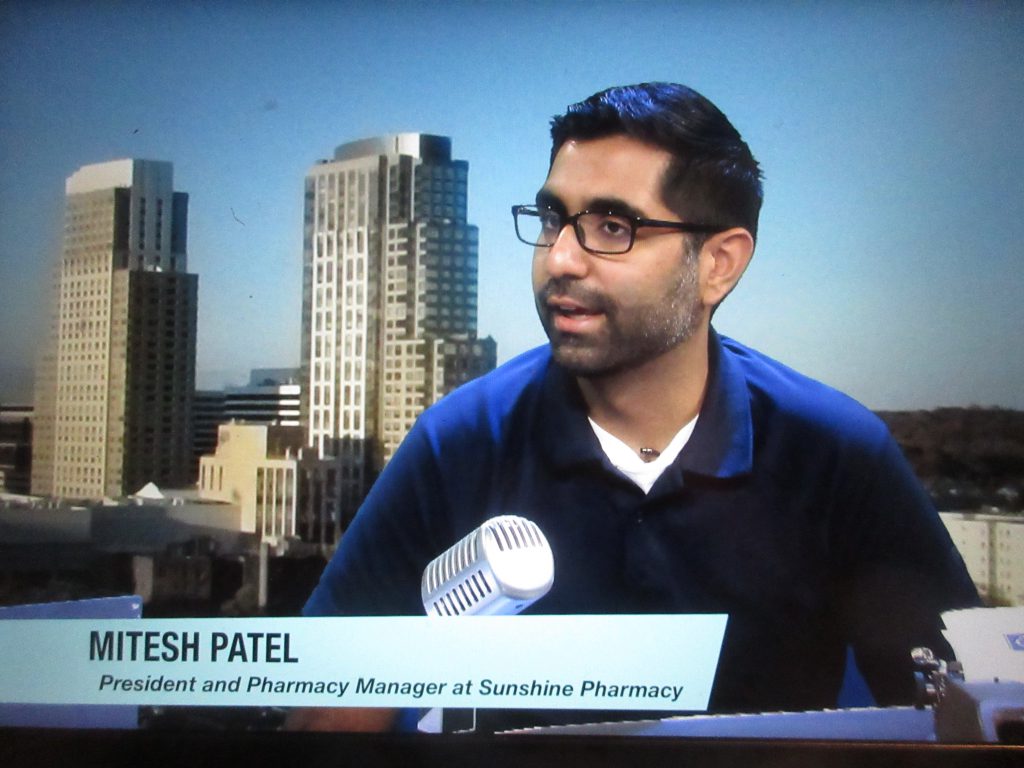
MITESH PATEL ON VACCINATIONS NEXT YEAR — THE ISSUES
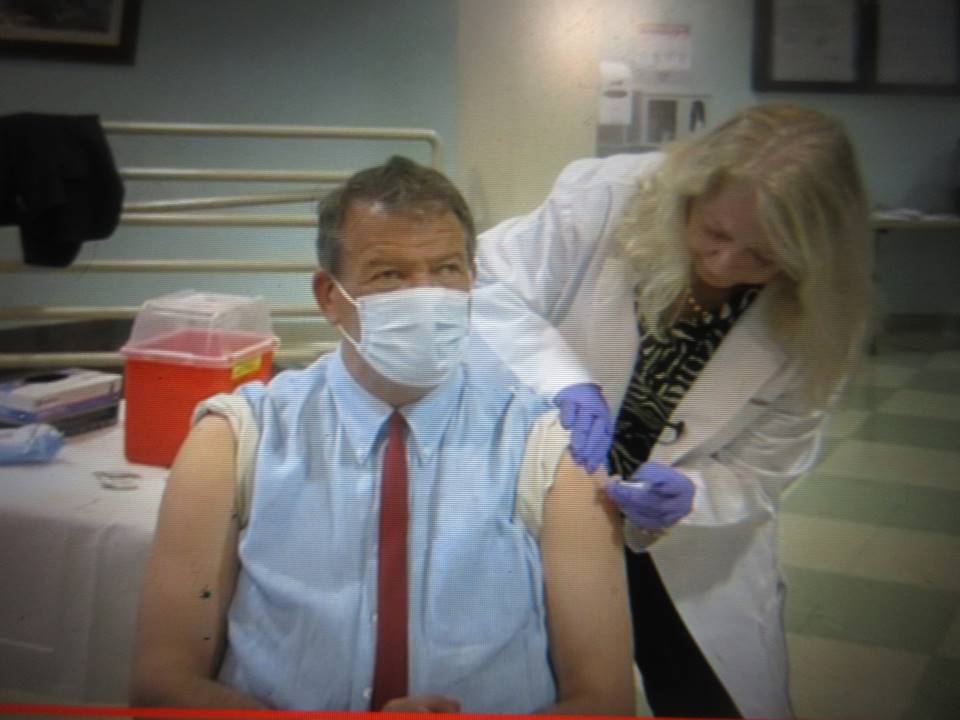
HEALTH COMMISSIONER DR. SHERLITA AMLER WARNS OF COVID SURGE AS BAD AS LAST YEAR NOVEMBER TO DECEMBER CALLS FOR MORE VACCINATIONS
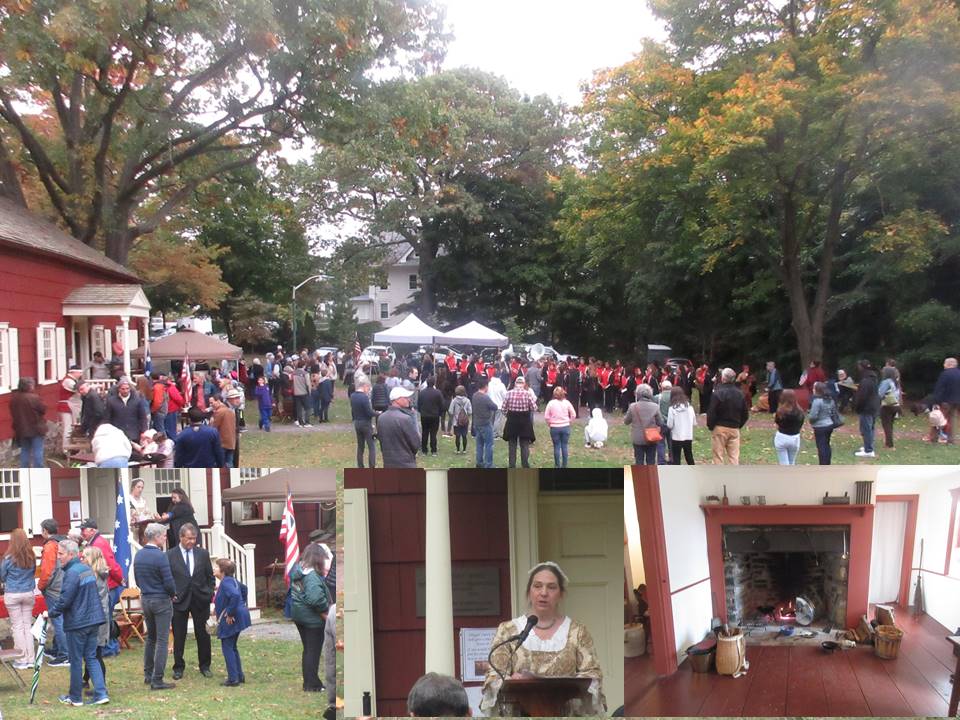
THE BATTLE OF WHITE PLAINS CEMMEMORATION
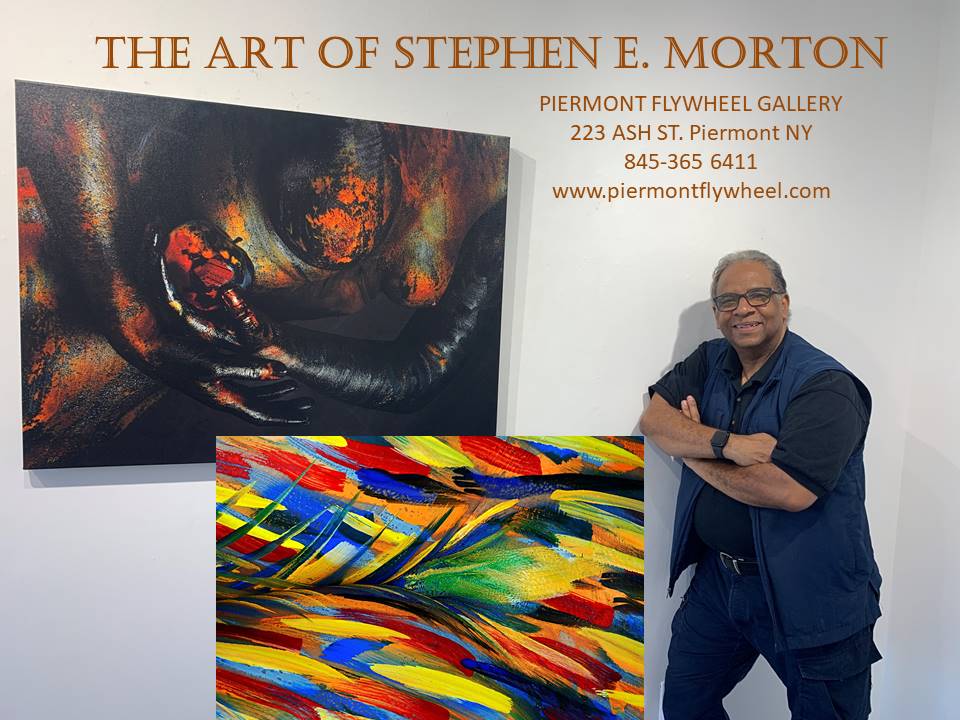
THE ART OF STEPHEN MORTON EXHIBITION OF THE UNIQUE BODY PAINTING ART OF WESTCHESTER’S MAN WITH A CAMERA, STEVE MORTON.
JOHN BAILEY AND THE NEWS THIS WEEK EVERY WEEK ON WHITE PLAINS WEEK FOR 21 YEARS.
Posted in Uncategorized

WESTCHESTER HEALTH COMMISSIONER: “We anticipate an uptick in COVID-19 cases after Halloween and through the upcoming holidays, just as we experienced the past few years.” GET COVID BOOSTERS NOW. FLU SHOTS NOW

Hits: 3

WPCNR CORONA VIRUS Surveillance. From the Westchester County Department of Communications. October 27, 2022:

The Westchester County Department of Health is offering Pfizer COVID-19 boosters for children ages 5-11 starting tomorrow Friday, October 28.

Health Commissioner Sherlita Amler, MD, said: “I encourage parents to schedule their children’s boosters as soon as possible. We anticipate an uptick in COVID-19 cases after Halloween and through the upcoming holidays, just as we experienced the past few years. These boosters will extend your family’s protection against serious COVID-19 symptoms, and help you avoid exposing more vulnerable family and friends.”

Flu season is here, and families can also schedule flu vaccines at the same time at the Health Department Clinic in White Plains.

The Westchester County Health Department will offer both the flu vaccine and pediatric COVID-19 bivalent boosters by appointment, as follows:

·         Fridays, Nov. 3 and 18, 1 p.m. to 3 p.m., at 134 Court Street, White Plains

·         Thursday, Nov. 3, Yonkers Riverfront Library, 2 p.m. to 6:30 p.m.

·         Monday, Nov. 14, 4 p.m. to 7 p.m. at 134 Court Street, White Plains

·         December Friday appointments will be added later, so please check back.

Amler added: “Combining vaccines is safe and it is more convenient to schedule both at the same time. Children often receive multiple shots at once, and you are much less likely to skip a vaccine if both are given together. Vaccines for flu and COVID-19 offer the best protection we have to fight these diseases, so the sooner you get vaccinated, the better.” 

Go to www.westchestergov.com/health to book your vaccine visit.

In the U.S., flu activity is usually highest between December and February, but can last into May. One flu vaccine now provides protection all season long and can prevent illness or reduce the severity of flu symptoms. The vaccine becomes fully effective after about two weeks.

Posted in Uncategorized

TONIGHT ON PEOPLE TO BE HEARD : “THE VACCINATIONS REPORT” 8 PM, FIOS CH 45 AND OPTIMUM CH 76: MITESH PATEL OF WHITE PLAINS SUNSHINE PHARMACY TALKS ABOUT WHITE PLAINS SCHOOLS VACCINATION EFFORTS COMING UP, FUTURE OF COVID VACCINATIONS, THEIR AVAILABILITY ISSUES AND COSTS IN 2023 WITH JOHN BAILEY

Hits: 3

MITESH PATEL, VACCINATOR TO THOUSANDS OF WHITE PLAINS STUDENTS, PARENTS TALKS THE VACCINATION OUTLOOK AHEAD WITH JOHN BAILEY TONIGHT AT 8 AND ANYTIME ON WWW.WPCOMMUNITYMEDIA.ORG
Posted in Uncategorized

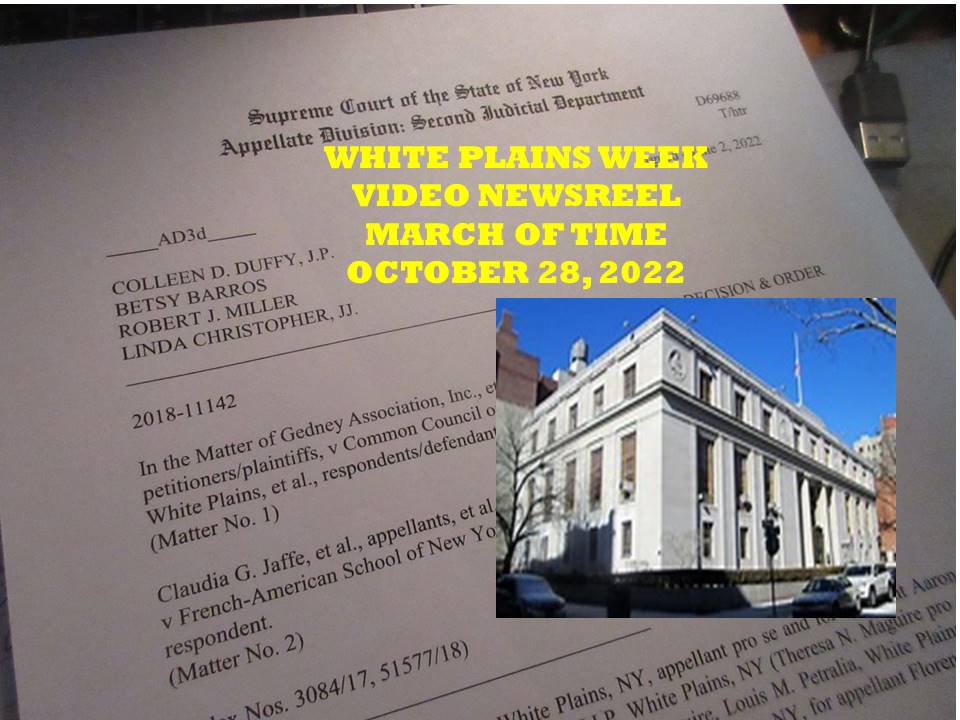
FLASH! GEDNEY ASSOCIATION WINS 12 YEAR LEGAL BATTLE WITH WHITE PLAINS AND FRENCH AMERICAN SCHOOL OF NEW YORK. EFFECT OF 1925 COVENANT ATTACHED TO RIDGEWAY COUNTRY CLUB PROPERTY UPHELD, BUT DEEMED “AMBIGUOUS” ELIGIBLE FOR A DECLARATORY JUDGEMENT IN FUTURE. COSTS OF APPEAL TO BE DETERMINED BY NY COURT, WILL BE AWARDED TO FASNY.

Hits: 2

WPCNR WHITE PLAINS LAW JOURNAL. By Dan Seidel. October 27, 2022:

(Editor’s Note:) The Appellate Court 2nd Department in Brooklyn has upheld the legal binding of the 1925 covenant attached to the Ridgeway Country Club property in a decision issued Tuesday

Dan Seidel, in the statement below, the attorney who handled the Action 1 of the Appeal, which he and John Sheehan filed on the involving environmental issues on the property explains the impact of the decision to WPCNR this morning in this analysis:

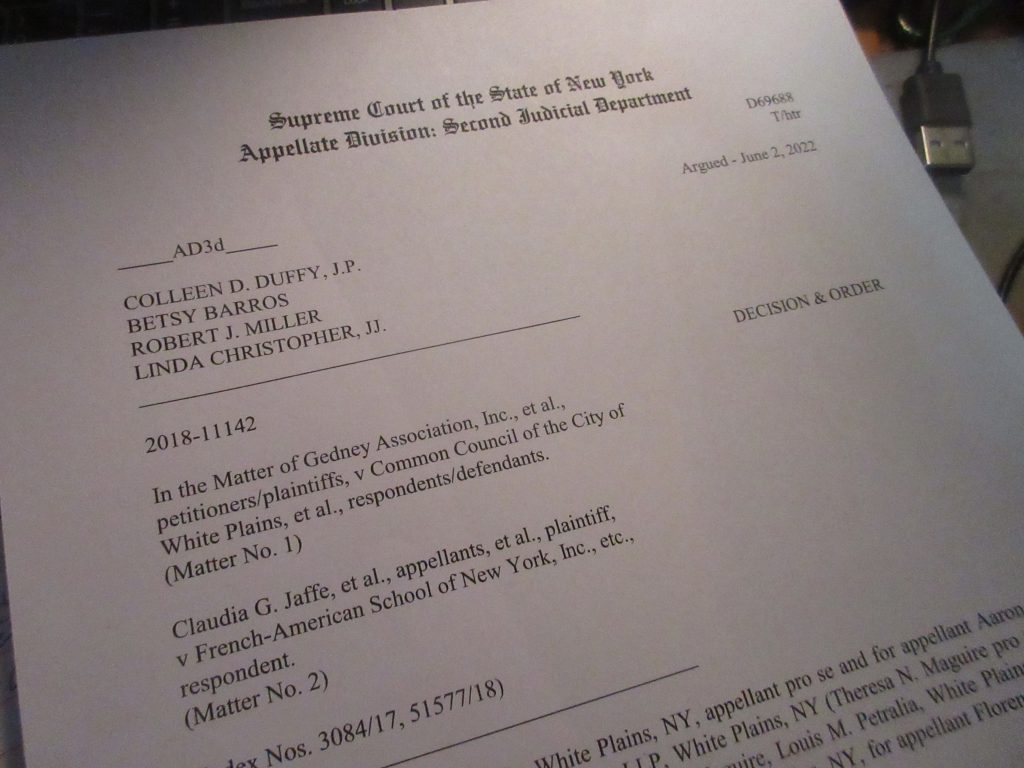
“Yesterday, the Appellate Division, 2nd Dept., published its decision in the “2nd part” of the Appeals filed against Judge Lefkowitz’s decision to allow FASNY to build its school on the old Ridgeway Country Club property.


There were 2 appeals: one by Gedney Association, John Sheehan and me. Dan Seidel, on SEQRA/Environmental/Common Council issues and a second (called “Action #2) contesting the school placement on the property due to a “deed restriction” in Gedney Farms deeds concerning “institutional use”.


When the Ridgeway property was sold in its entirety to Farrell Builders, without contingencies, the property zoned 3/4 acre single family use, as of right, Gedney Assoc, Sheehan and Seidel made a prompt decision to withdraw their appeal as their issues were now moot – it would be a waste of the Court’s time to read all the papers and hear the matter if the matter was moot.

If Action #1 was NOT withdrawn and the Court was made to read papers on moot issues, there was a very good chance Gedney, Sheehan and Seidel COULD be sanctioned and have to pay costs (statutory and printing) to FASNY.


The Action #2 Appeal was not withdrawn, was prosecuted and the decision published yesterday was issued on their arguments, the Appellate Court deciding that Judge Lefkowitz made the correct decision/conclusion, but should have afforded those plaintiffs in Action #2 a chance to prosecute a “declaratory judgment” on the definition of “institution” – again the Appellate Court deciding that a school could be considered legit under a vague and undefined deed restriction
.


The Appellate Court decided against the plaintiffs in Action #2, Action #1 having already been withdrawn with no costs to be awarded to any party, and DID award costs AGAINST the plaintiffs in Action #2 (the deed restriction appeal) to be paid to the defendant FASNY. The Appellate Court “sent the case back to Supreme Court” for the assessment and awarding of costs to FASNY.


The costs of the Appellate printing could be in the tens of thousands of dollars – receipts for those costs must be produced to the Clerk of the Supreme Court, Judgments Section.

The plaintiffs in Action #2 can appeal that award of costs, but the same Appellate judges will be assigned THAT appeal (if filed) and may render a harsher decision on THAT appeal against those plaintiffs, IF an appeal is undertaken.


Bottom line is that White Plains won, kept the property development as “low impact environmentally sensitive grounds” and will get yearly property and school taxes from the McMansions to be built. The action against Judge Lefkowitz’s decision, I am assuming, is finally over.

This is my take on the decision.

The decision may be read at this link: https://www.nycourts.gov/courts/AD2/Handdowns/2022/Decisions/D69688.pdf

Posted in Uncategorized

TEMPORARY PROTECTED STATUS FOR IMMIGRANTS TALKS SUSPENDED INDEFINITELY. ADVOCATES DEMAND PERMANENT PROTECTIONS

Hits: 242

WPCNR IMMIGRATION INTELLIGENCER. From the New York Immigration Coalition. October 27, 2022:

Today, news broke that settlement talks for Ramos v. Nielsen have collapsed, leaving more than 250,000 people who currently have Temporary Protected Status (TPS) at risk of deportation.

The New York Immigration Coalition decries this breakdown of negotiations, and demands that President Biden restore TPS for El Salvador, Honduras, Nepal, and Nicaragua, while also providing a pathway to citizenship.

Murad Awawdeh, Executive Director, New York Immigration Coalition released this statement:

“Today’s news that the settlement negotiations over TPS have collapsed is shocking and disturbing for people and families across our country. TPS has allowed people whose home countries continue to be at risk of violence or climate disaster to raise families, secure jobs, and build futures in the United States.

The breakdown of these negotiations threatens to disrupt the lives of more than 250,000 people for no justifiable reason.

As President Biden continues to stall on passing meaningful immigration reform, while supporting policy designed to appease conservative voters during midterm elections, he cruelly fails the millions of people he pledged to protect during his presidential campaign.

In light of this devastating news, the Biden administration must immediately restore TPS for El Salvador, Honduras, Nepal, and Nicaragua.

President Biden must also provide a pathway to citizenship for the 11 million people who call our country home but lack any permanent protections.

We can no longer look to the courts for protection as they continually deny relief and relentlessly endanger the lives of immigrants and refugees.”
Posted in Uncategorized

STATE OF AFFAIRS 10/26/22 TRIPLE THREAT

Hits: 510

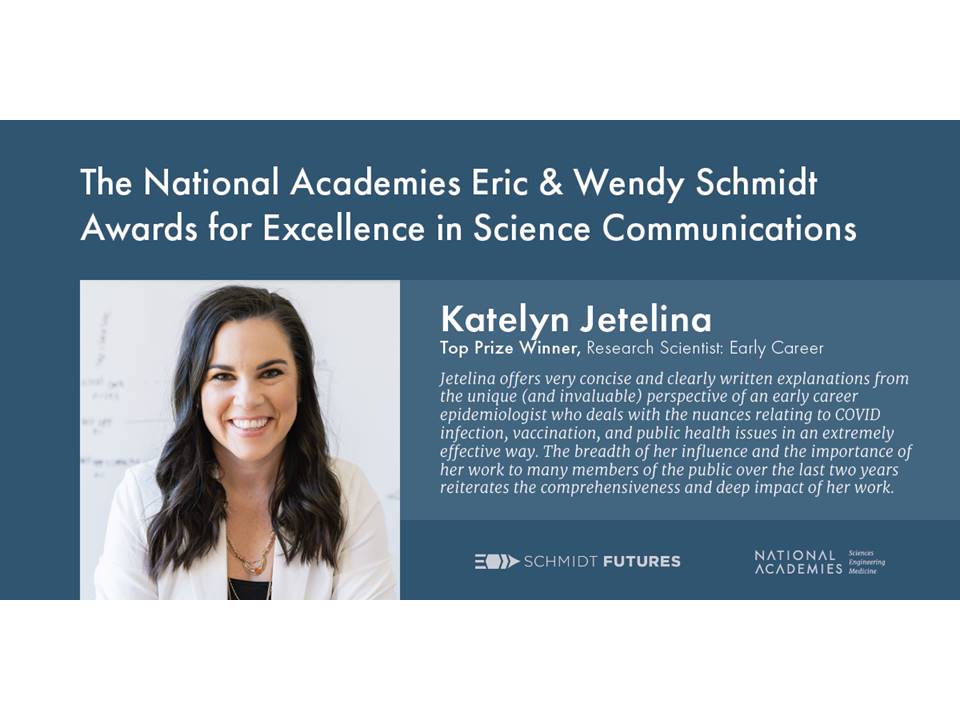
By Dr. Katelyn Jetelina, Reprinted with permission. October 26, 2022 UPDATED 11:00 A.M. with Charts

We are seeing an uptick in RSV and the flu in the Northern Hemisphere and particularly in the United States. Given an anticipated uptick in COVID-19, the media is coining this the “triple threat.” Here is the current state of affairs and what it means for you.

Respiratory Syncytial Virus (RSV)

RSV is a common virus that typically circulates during the fall, winter, and spring. Before the pandemic, everyone could count on being infected at least once before they reached the age of 2. Thereafter, people are typically infected multiple times throughout their lifetime.

Most people recover in a week or two, but it can be serious for two groups:

  • Young children. Before the pandemic, we saw ~2,300 per 100,000 children under the age of 1 hospitalized. (In comparison, the estimated hospitalizations rate is 30-40 per 100,000 children for flu and 48 per 100,000 children for COVID-19, pre-vaccine.) RSV is the most common cause of bronchiolitis (inflammation of the small airways in the lung) and pneumonia (infection of the lungs).
  • Older adultsJust like COVID-19, RSV is rough on older adults because their immune systems are weaker and they are more likely to have underlying health conditions, like heart or lung disease. In the U.S. an estimated 177,000 older adults are hospitalized for RSV each year and 14,000 of them die.

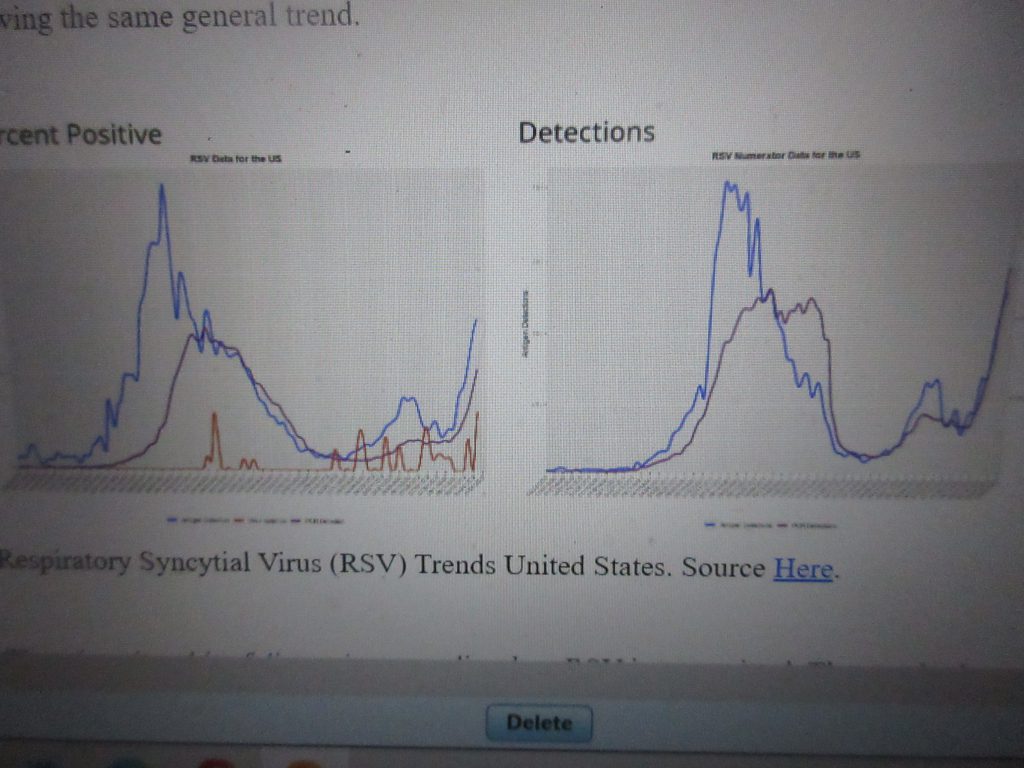
Overall, RSV is on the rise. As shown below, the percent positivity rate is above 10-15% in the U.S.—this means RSV is spreading faster than we can test for it and is causing an exponential growth in cases. However, we aren’t at record numbers yet. In fact, we are still below our very unusual 2021 summer surge. Almost all states are showing the same general trend.

Respiratory Syncytial Virus (RSV) Trends United States. Source Here.

There is quite a bit of discussion regarding how RSV is transmitted. The standard precaution for healthcare workers is hand washing, hospital gowns, and gloves. (Notice masks are not recommended.) These precautions stemmed from older studies showing the main mode of RSV transmission is primarily through large particles in the eye or nose or directly touching contaminated surfaces. RSV does have small particles that travel far, but this doesn’t seem to be a main mode given this older research.

There is currently no vaccine for RSV. However, last week we received very good news from two manufacturers (GSK and Pfizer) that vaccines in development for adults were highly effective: 82% efficacy rate for GSK and 86% for Pfizer. We can’t expect a vaccine for this season, but maybe next year.

Influenza (Flu)

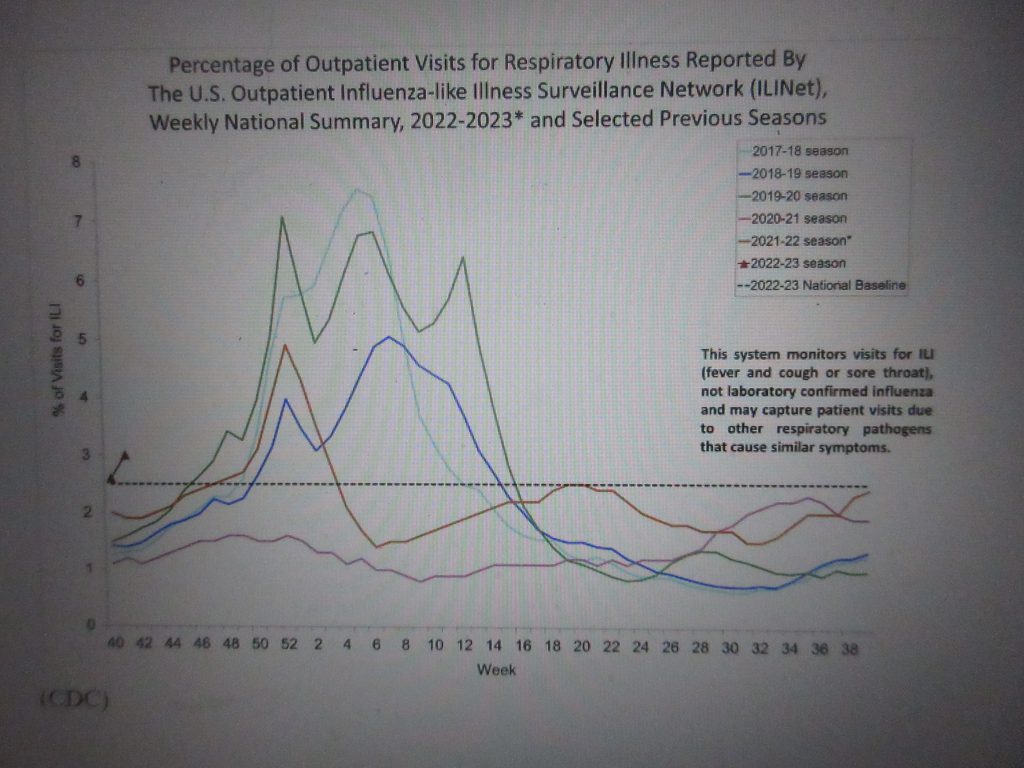
The official “flu season” started two weeks ago and case numbers are higher and earlier compared to the past two pandemic years and compared to before the pandemic. (See red triangles in the graph below.)

(CDC)

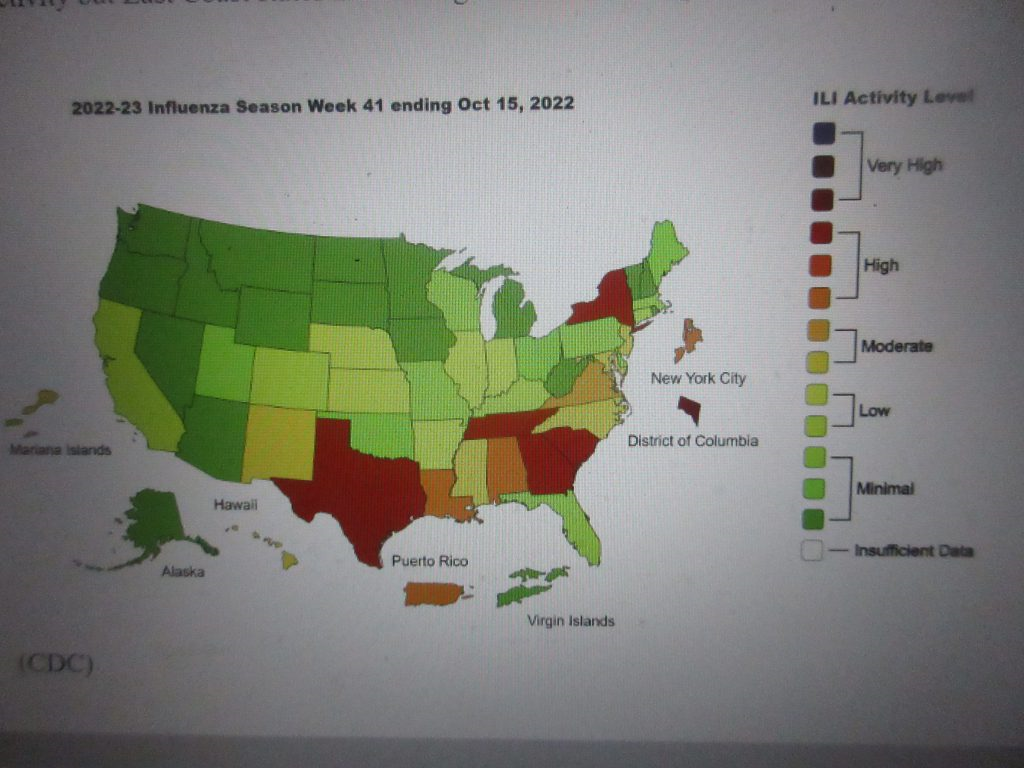
Flu rates are highest among 0-4 year olds, but cases in every age group are increasing. We are seeing regional trends with the flu, as the South has the most activity but East Coast states are starting to increase, too, particularly New York.

(CDC)

Flu viruses can be detected up to 5-7 days after becoming sick, but people are most contagious in the first 3-4 days after symptoms begin. Symptoms typically begin about 2 days (but can range from 1-4 days) after flu viruses infect a person’s respiratory tract. Some people can be infected with flu viruses and have no symptoms but still spread the virus.

There is a flu vaccine. We won’t know how well the flu vaccine works until next year (we collect real world data in real time), but lab data is indicating the vaccine is a good match this year. Unfortunately, flu vaccine uptake dropped during the pandemic.

COVID-19

Then there is COVID-19, which is calming down in Europe, even in Germany. We are also getting good news from Singapore, where the Omicron subvariant XBB took hold and caused an infection wave. Thankfully their XBB infection wave was smaller than the BA.5 wave. (We expected the opposite.)

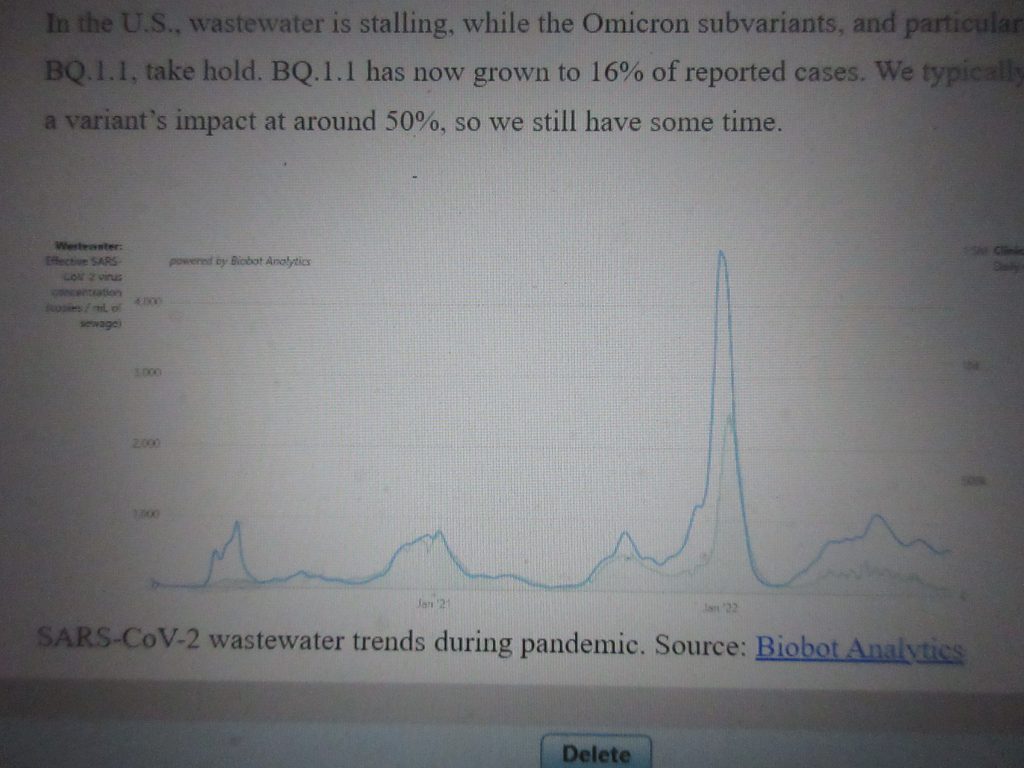
In the U.S., wastewater is stalling, while the Omicron subvariants, and particularly BQ.1.1, take hold. BQ.1.1 has now grown to 16% of reported cases. We typically see a variant’s impact at around 50%, so we still have some time.

SARS-CoV-2 wastewater trends during pandemic. Source: Biobot Analytics

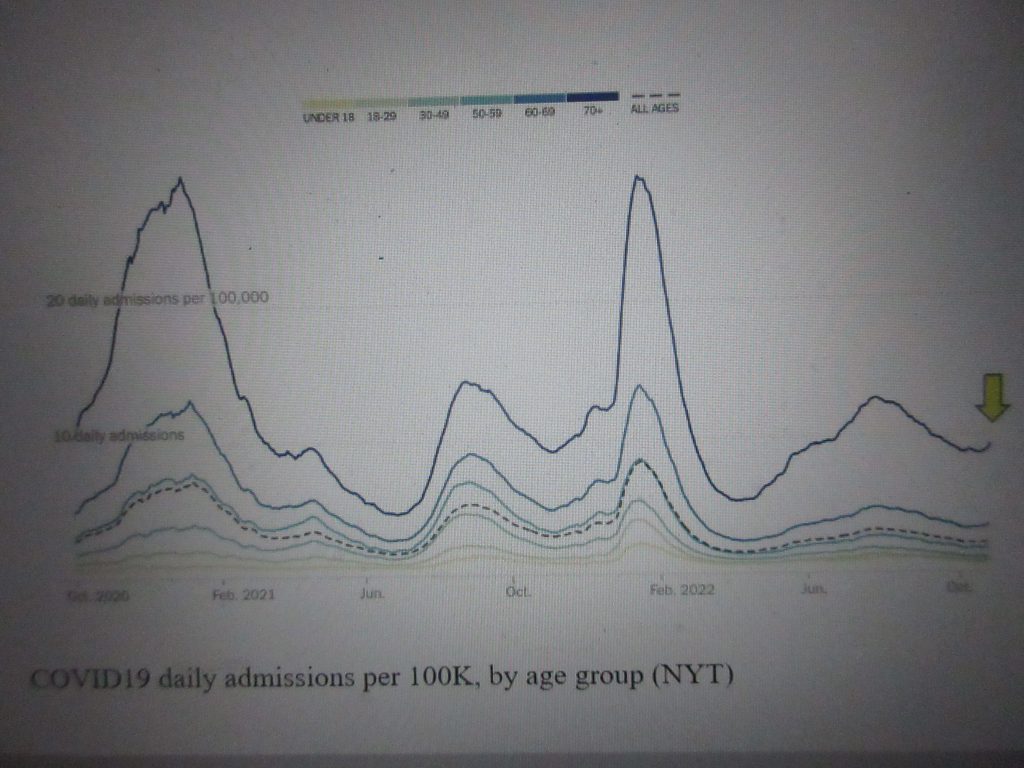
However, hospitalizations have started to rise for those over the age of 65, which is not a welcoming trend given that subvariants have yet to take over.

COVID19 daily admissions per 100K, by age group (NYT)

What does this all mean?

It’s becoming a petri dish out there. The triple threat specifically, though, isn’t in full throttle yet. This is clearly displayed in Chicago’s weekly surveillance report below where some viruses are rising but not all.

Respiratory Virus Laboratory Surveillance in Chicago

Will a triple threat come? This is one of the biggest debates among epidemiologists— the concept of whether we are witnessing virus-virus interaction. We know very little about how well viruses co-circulate with each other. For example, is flu spiking early because COVID-19 isn’t spiking yet? Maybe. Could RSV spike, then decline, then COVID-19 take over, then decline, then flu spike, and then decline? Maybe. Or, could they all spike at the same time? Maybe. We just don’t know what will happen, but a resurgence is expected.

This winter also depends on the strength of our healthcare system. The combination of our usual viruses co-circulating with COVID-19, burnt out healthcare workers, understaffed hospitals (in 2021, over 330,000 workers left healthcare), and staff being out for illnesses themselves, does not paint a pretty picture.

Bottom line

Lots of viruses are spreading right now and it’s a bit earlier than normal. We don’t have a triple threat yet, but I don’t think we want to see one, as I’m concerned for our healthcare systems. Do your part by getting vaccinated, staying at home while you’re sick, and other measures like washing hands, wearing a mask, and getting that airflow moving.

Posted in Uncategorized