Teatown Deer Kill Began Wednesday Night.

Hits: 160

WPCNR ENVIRONMENTALIST. Special to WPCNR from Linda Conte. February 13, 2014:

I have been robbed – robbed of my feeling and experience of our
Teatown (Reservation) area as a peaceful, beautiful, quiet place where nature and
people lived together in peace. A location eagerly sought, containing
old stone walls, huge trees and lots of good memories – the whole
Teatown area has been robbed.

On the way down Blinn Road about 6 p.m. last night, we were
reminded again of how precious and poignant it is, when we
followed, slowly and at a distance, three young deer, beautiful,
majestic and vulnerable, down the road, and watched how difficult it
was for them to find a place to get off the road, a place where they
could navigate the deep snow and icy conditions, to get into the
woods, supposedly to safety.
Shortly after we arrived home at about 9 p.m. everything changed.
Last night, thanks to Teatown “Nature Preserve”, there was secrecy,
trucks plowing through Teatown trails, and people in camouflage
uniforms and carrying rifles. Deer, baited during this difficult time
to find food, wandering into familiar land which recently had boasted
“deer snacks”, pristine areas familiar to the deer as resting places,
suddenly turned into deer-killing fields.
The police were called.
Later, a Teatown Lake Reservation administrator was out in the road
taking pictures of the cars passing in the street and threatening local
neighbors, Teatown members and supporters.
We don’t know how many deer lost their life last night. (The shooters
wouldn’t talk.) We don’t know how many young deer, lost and
orphaned last night, are suddenly alone during this monumental
storm.

We don’t know how much blood and gore is being covered by
the pure white snow today.
But we will NEVER FORGET!

Linda

Conte

Posted in Uncategorized

Police Warn of New Telephone Scam Being Perpetrated

Hits: 202

WPCNR POLICE GAZETTE. February12, 2014:

White Plains Commissioner of Public Safety David Chong addressed the Council of Neighborhood Associations Tuesday evening at 5 Homeside Lane and warned them of a new phone scam purporting to be from official White Plains sources and real vendors in the White Plains Area.

The Commissioner warned listeners they should never give a credit card number over the phone, that they should independently verify with the company or entity what the caller wanting payment is real.

The steps in the scam were explained today in detail on the City of White Plains website.

This is how it works:

The callers call using a spoofed (phone number masked as a legitimate, traceable phone) alleging money is owed and needs to be paid right away or a service will be cut off, a warrant issued, or some other penalty imposed.

The callers have alleged to be from Con Ed, Cablevision, White Plains City Court, and other reputable entities. Again, the phone number may even come back to a reputable establishment, but this is a digital trick they use to hide the real phone number.

The callers will insist that the victim pay by a money card, most frequently the “Green Dot” money card sold at CVS, 7-11, Rite Aid, etc, but there are several different pre paid cards that they may insist be used. The caller will try to direct you to a store that sells the green dot pre-paid card (or similar), then have you call them back within a given time frame and give them the account number off the card.

In general, no legitimate company would insist or mandate this type of payment. If a company is insisting on you making payment as described above, it is almost certainly a scam.

Call the real company to verify whether you owe money and how a payment may be received. (Do not use number given by scammer, use phone number from a bill, receipt, phone listing, etc)

If you are suspicious, call the Police Department at 914-422-6111.

Posted in Uncategorized

The Illinoisan

Hits: 190

WPCNR’s The Daily Bailey. By John F. Bailey. February 12, 2014 From the WPCNR ARCHIVES.

Today marks the birthday of Abraham Lincoln, whose Presidential performance during the Civil War (1861-1865) was perhaps the most admirable of any American President.

He had to create things as he went, dealing with a complex political issue: slavery, while deciding to fight a war to preserve a divided nation.

How did Abraham Lincoln handle pressure and political opportunists? He did not have press agents and spinmasters and talk show hosts and superior punditry critiquing his every move and loading him up with advice.

Though he did have the “crusading editors” and “editorial boards” of his day. Let’s take a look at the Big Guy from Illinois

In the days of Lincoln, media coverage was simply print media. However, the amount of reporting on the burning issues of the day was far more detailed than today with dozens of newspapers presenting the chronicles of burning issues. For Lincoln’s presidency was the presidency of the nation’s greatest crisis in its eighty-five year history:

The Civil War.

It is interesting to note how President Lincoln conducted himself in dealing with America’s interests, its factions, pulling him to free the slaves.

When Lincoln was running for the Presidency in 1860 at the Republican Convention in riproaring Chicago, he was up against James Seward, a powerful New York politician. However, the western states at the time were highly distrustful of the New York political machine. (Has anything really changed? They are still distrustful today!)

Lincoln won over support by taking a position of what was good for the nation as a whole.

Taking a Position and Working To it

Lincoln first gave notice of his potential for the Presidency when he impressed Horace Greeley, influential editor of the New York Tribune with a fiery speech at the Cooper Union in February, 1860, delivering a sharp criticism of the South, hard on the heels of South Carolina’s secession from the Union. The speech included these words,

You say you will not abide the election of a Republican President. In that supposed event, you say, you will destroy the Union; and then, you say, the great crime of having destroyed it will be upon us! (The northern states) That is cool. A highwayman holds a pistol to my ear, and mutters through his teeth, “Stand and deliver, or I shall kill you, and then you will be a murderer!”

Greeley printed the speech in his Tribune the next day, scooping the other New York papers, by simply asking Lincoln for a copy of the speech. The subsequent printing in the popular Trib, sent Mr. Lincoln on his way. As William Harlan Hale’s biography of Mr. Greeley (Horace Greeley: Voice of the People)describes the scene at “The original Trib’s” offices, as remembered by Amos Cummings, a young proofreader:

Amos Cummings, then a young proofreader, remembered the lanky westerner appearing over his shoulder amid the noise of the pressroom late at midnight, drawing up a chair, adjusting his spectacles, and in the glare of the gaslight reading each galley (of the Cooper Union speech) with scrupulous care and then rechecking his corrections, oblivious to his surroundings.

A Comeback President

Lincoln had been a highly successful politician from Illinois in the 1830s and 1840s. He was three times elected to the state legislature, and The Kunhardts’ The American Presidency reports he was “a recognized expert at forming coalitions…he learned how to keep secrets, how to trade favors, how to use the press to his advantage. And he cultivated his relationship with the party hierarchy.”

Graff’s book writes that Lincoln was described as “ruthless,” that he “handled men remotely like pieces on a chessboard.” Humor and frankness were character traits.

Lincoln was elected a congressman, only to serve just one term.

Lincoln had been practicing corporate law privately and had lost interest in politics by 1854, until the repeal of The Missouri Compromise, which had restricted slavery to the southern states. Lincoln felt stirred to come back. He spoke out against the spread of slavery, running for the senate in 1858 against William Douglas, unsuccessfully.

Saving the Union His Mantra

As the furor over slavery and the South’s threats to secede grew, a crisis of spirit and purpose in this nation which makes today’s concerns about terrorism as a threat to America, pale in comparison, Lincoln realized that the Union was the larger issue.

He expressed this in response to Horace Greeley, editor of the New York Tribune, an influential figure at the Republican (Whig) Convention in Chicago in 1860. Greeley was the kingmaker at the 1860 Chicago convention who eventually swung the western states for Lincoln, giving the man from Illinois the nomination on the third ballot over William Seward, the candidate of the Thurlow Weed “New York Machine.”

Greeley then tried to influence the President-Elect to free the slaves. (Lincoln was being lobbied by the still-powerful Weed-Seward faction to compromise with the southern states on the issue of slavery).

Standing Tall Against Pressure.

Lincoln refused to free the slaves as one of the first acts of his presidency, standing firm to hold the union together, when he announced his attention not to do so, on his way to Washington after being elected. His words in this time of international tension, are worth remembering as America considers starting a war for the first time. Lincoln said:

I have often inquired of myself what great principle or idea it was that kept this Confederacy (the Union, he means), so long together. It was not the mere matter of separation of the colonies from the motherland, but that sentiment in the Declaration of Independence which gave liberty not alone to the single people of this country, but hope to all the world, for all future time. It was that which gave promise that in due time the weights would be lifted from the shoulders of all men, and that all should have an equal chance.

Seeing the Big Picture.

After Fort Sumter was fired upon, Lincoln was pressured harder to free the slaves. Still, Lincoln held firm. Mr. Greeley published a blistering open letter to the President, he called “The Letter of Twenty Millions,” meaning his readers (slightly exaggerated)in The New York Tribune.

Greeley’s letter took the President to task for not freeing the slaves now that the Civil War was on, writing, “all attempts to put down the rebellion and at the same time uphold its inciting cause are preposterous and futile.”

President Lincoln responded with an open letter which Greeley published in The Tribune. President Lincoln’s letter is instructive as to how a President moves in crisis, when a nation is ripped apart to calm and state his position. He begins with a conciliatory tone, calming Greeley’s bombast:

…If there be perceptible in it (Greeley’s letter) an impatient and dictatorial tone, I waive it in deference to an old friend whose heart I have always supposed to be right.

As to the policy I “seem to be pursuing,” as you say, I have not meant to leave any one in doubt. I would save the Union. I would save it in the shortest way under the Constitution.

The sooner the national authority can be restored the nearer the Union will be – the Union as it was.

If there be those who would not save the Union unless they could at the same time save slavery, I do not agree with them.

If there be those who would not save the Union unless they could at the same time destroy slavery, I do not agree with them.

If I could save the Union without freeing any slaves, I would do it – if I could save it by freeing all the slaves, I would do it – and if I could do it by freeing some and leaving others alone, I would also do that.

What I do about slavery and the colored race, I do because I believe it helps to save this Union, and what I forbear, I forbear because I do not believe it would help to save the Union.

I shall do less whenever I shall believe what I am doing hurts the cause, and I shall do more whenever I believe doing more will help the cause.

I shall try to correct errors when shown to be errors, and I shall adopt new views so fast as they shall appear to be new views.

I have here stated my purpose according to my views of official duty, and I intend no modification of my oft-expressed personal wish that all men everywhere could be free, Yours

A. Lincoln 

(Editor’s Note:That is Presidential! It leaves no doubt as to who is in charge and who is responsible and why. How refreshing!)

Wearied by War

Horace Greeley described the toll the Civil War had taken on Mr. Lincoln, seeing him in person shortly before General Robert E. Lee surrendered. Greeley wrote:

Lincoln’s face had nothing in it of the sunny, gladsome countenance he first brought from Illinois. It is now a face haggard with care and seamed with thought and trouble…tempest-tossed and weatherbeaten, as if he were some tough old mariner who had for years been beating up against the wind and tide, unable to make his port or find safe anchorage…The sunset of life was plainly looking out of his kindly eyes.”

Posted in Uncategorized

The Board of Regents Explains What They Did Yesterday on the Common Core Controversy

Hits: 143

WPCNR SCHOOL DAYS. From the New York State Education Department. February 11, 2014:

The State Board of Regents P-12 Education and Higher Education Committees today adopted several measures presented in a report from a Regents’ work group to adjust the implementation of the new Common Core Standards.

The full Board is expected to act on the Committee reports tomorrow (Tuesday, February 11th). Included are changes that will delay the impact of Common Core-related state assessments on educators and students, and reduce the level of local school district testing associated with the new teacher evaluation law and higher standards for teaching and learning.

“We have listened to the concerns of parents and teachers,” Board of Regents Chancellor Merryl H. Tisch said.

“We’ve heard the concerns expressed at the hearings and forums, and we regret that the urgency of our work, and the unevenness of implementation, have caused frustration and anxiety for some of our educators, students, and their families. This report is designed to make significant and timely changes to improve our shared goal of implementing the Common Core. We have heard strong support for higher standards, but we have also heard a desire for more time. The Regents work group put together a series of strong adjustments that will help improve implementation without sacrificing the high standards we’ve set for our students. These changes will help give principals, teachers, parents and students the time to adjust to the new standards without stopping our progress toward the goal we all share: college and career readiness for every student.”

“Any major shift – especially one involving 700 school districts, more than 4500 schools, and millions of students—is going to require adjustments and course corrections along the way,” Education Commissioner John B. King, Jr. said. “The implementation of the higher standards has been uneven, and these changes will help strengthen the important work happening in schools throughout the state. As challenging as implementation has been, we have to remember one important fact: the old standards were not adequate. Every year, despite our state’s many excellent districts and schools, 140,000 students leave high school without the skills they need for college and career success. We have to stay focused on giving all of our students the preparation they need to succeed after high school.”

Rochester area Regent Wade Norwood chaired the work group.

“When the Board approved the shift to the Common Core four years ago, we knew we would have to make adjustments as the standards rolled out,” Norwood said. “The work group balanced the concerns all of us have heard with the progress we’ve made toward raising the bar for our students. The changes we’ve made protect teachers and students from unforeseen and unintended consequences of the implementation without damaging the foundation we’ve built to help our students succeed in the 21st century.”

Under the changes, the requirement to pass Common Core-based Regents exams at the college and career ready level will be extended. The class of 2022 will be the first to face the new higher graduation requirements, 12 years after the adoption of the standards in 2010. To ensure that students are not unfairly penalized by the transition to higher standards, the requirements for Academic Intervention Services (mandatory tutoring for struggling students) will be adjusted and guidance will be issued to districts making clear that the State Education Department (SED) neither requires nor encourages districts to make promotion or placement decisions using student performance on state assessments in grades 3-8, but if districts choose to do so, they should make adjustments to ensure students are not negatively impacted by the Common Core transition and should use multiple measures – not grades 3-8 state assessment results alone.

The State has not created any additional tests as part of Common Core implementation. All required state tests other than two high school social studies Regents exams – including all grades 3-8 assessments and high school exams in English, Math, and Science – are required by federal law. However, King noted, the Board recognized that a variety of pressures at the state and local level may have resulted in students in some districts being tested more than needed or rote standardized test preparation that crowds out quality instruction. The measures approved by the two committees today will reduce local testing by:

  • Increasing flexibility for districts to reduce local testing used to inform teacher evaluation
  • Creating an expedited review process for districts that propose to amend their teacher evaluation plans to reduce local testing
  • Eliminating local traditional standardized tests for K-2 used to inform teacher evaluations (The State does not administer traditional standardized tests in K-2.)
  • Capping at 1% the instructional time that can be used for local assessments used to inform teacher evaluations (The federally required State assessments in grades 3-8 English Language Arts and Mathematics account for less than 1% of instructional time.)

In addition, the Board and SED will support reducing standardized testing by local school districts through “Teaching is the Core” grants that require districts to review their local assessments and eliminate any unnecessary or duplicative assessments. King noted that New York’s participation in the Partnership for Assessment of Readiness for College and Careers (PARCC) will be limited to field testing only during the 2013-14 and 2014-15 school years. Although only 1 percent of teachers were rated ineffective in the first year of statewide teacher evaluations, the measure approved by the committees today will provide added protection for educators by approving an emergency regulation to protect teachers and principals from unfair termination based on 2012-13 and 2013-14 assessment results in districts that did not timely implement the Common Core by providing adequate professional development, guidance on curriculum, or other necessary supports.

King also announced the State has delayed the launch of the data dashboards related to inBloom to allow SED to work with legislators to address concerns about data security and third party providers used by the State and districts.

The P-12 committee also approved SED applying to the U.S. Department of Education (USDOE) to renew the State’s waiver from No Child Left Behind (the Elementary and Secondary Education Act). As part of the waiver renewal, SED will ask USDOE to allow students with severe disabilities who are not eligible for alternate assessments to be tested at their instructional level rather than their chronological age level, and allow English Language Learners to be tested in their native language for their first two years of assessments. In addition, the work group reaffirmed the Board’s request to the legislature to fund a three year, $525 million Core Instructional Development Fund aimed at providing increased professional development for Common Core implementation, and to provide increased funding to reduce field testing, allow for the release of more test items, and support the development of native language arts assessments for English Language Learners.

Earlier this year, USDOE approved the request for a waiver from the Elementary and Secondary Act (ESEA) requirement that students who take Regents exams in mathematics when they are in seventh or eighth grade to also take the state mathematics assessment. The waiver will effectively end the “double-testing” of approximately 50,000 students, beginning with the spring 2014 assessments.

The full report of the Work Group is available at:
http://www.regents.nysed.gov/meetings/2014/February2014/214p12hea3.pdf

Posted in Uncategorized

WPCNR WEATHER SCOOP: FRIGID COLD AND MORE WHITE AHEAD

Hits: 140

2014211birds 001crop


A Toronto Blue Jay stopping by on the way to Spring Training at the WPCNR COMMISSARY

The  temperature at Westchester County Airport is 22 degrees, the wind is northwest at 8 MPH . At the WPCNR Studios, the temperature is 28 degrees.

Temperatures are expected to drop into the single digits this evening. Snow is forecast  after midnight Wednesday into Thursday.

The official National Weather Service forecast:

  • Tuesday Night: Mostly clear, with a low around 6. Wind chill values as low as -2. Northwest wind 5 to 10 mph.
  • Wednesday: Sunny, with a high near 23. Wind chill values as low as -1. Light and variable wind becoming east 5 to 7 mph in the morning.
  • Wednesday Night: Snow likely, mainly after 3am. Mostly cloudy, with a low around 21. East wind 5 to 8 mph. Chance of precipitation is 60%. New snow accumulation of around an inch possible.
  • Thursday: Snow. High near 34. Breezy, with a north wind 14 to 20 mph. Chance of precipitation is 90%. New snow accumulation of 4 to 8 inches possible.
  • Thursday Night: Snow likely, mainly before 9pm. Mostly cloudy, with a low around 28. Windy, with a west wind 21 to 26 mph decreasing to 13 to 18 mph after midnight. Chance of precipitation is 70%.
Posted in Uncategorized

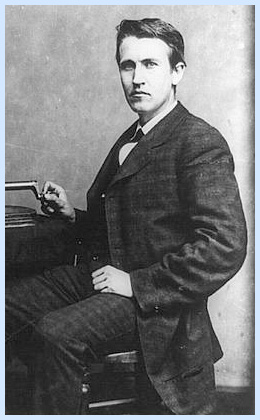
Thomas Edison’s Birthday.

Hits: 332

profile_edison

WPCNR MILESTONES. February 11, 2014: 

Was Thomas Edison America’s greatest entrepreneur?

He was born today in Milan Ohio in 1847, the seventh child. He was homeschooled by his mother, Nancy Matthews Elliot. His father was Samuel Ogden Edison, Jr.

Thomas Edison was born on February 11, 1847 in Milan, Ohio.  His parents were Samuel Ogden Edison, Jr. and Nancy Matthews Elliott. Thomas was their seventh child. He started school late due to a childhood illness and was thrown out of school three months after he started. Teachers said his mind wandered, and his teacher called him “addled.”

His mother home-schooled him and taught him to read and encouraged him to experiment.

He was partially deaf and his first job was as a telegraph operator after he saved the child of a railroad official from being hit by a train. J.U. Mackenzie of Mount Clemens, Michigan the father of the child made Edison an apprentice and taught him to operate a telegraph.

Edison drifted to various railroad towns as a telegrapher, eventually coming to the metropolitan area where he created his first invention, an improved stock ticker, for which he was paid $40,000

Greatest inventions

His inventions include:

  • Electrographic vote recorder, which was Edison’s first patent, through a “yes” and “no” switch
  • Simplified telegraph, which didn’t require manually tapping out the message at the receiving end
  • Faster electric telegraph, which had faster signal speeds than earlier models
  • Stencil pen, which is the predecessor to tattoo pens
  • Phonograph, which recorded and reproduced audible sounds using metallic foil on a cylinder
  • Carbon transmitter, which became the basis of telephone transmitters for more than a century
  • Practical electric lamp, as Edison’s carbon filament light bulb was the first commercially viable electric light. Previous versions weren’t as durable, and used more expensive materials, such as platinum
  • Electric lighting system, which was designed to maintain the same amount of electricity throughout the device
  • Motor that regulates electricity, controlling the supply of electricity between devices such as lamps
  • Fruit preserver, sucking oxygen out of glass jars, producing vacuum-sealed jars of fruit
  • Electro magnetic brake, which was designed to stop vehicles on a railroad
  • Incandescent chandelier, which is the grouping of several incandescent lamps to create the candelier
  • Turn table for electric railway, which is an electric current that ran through the rails to reduce the chances of a short circuit
  • Ore separator, which separates magnetic and non-magnetic materials
  • Kinetographic camera, which showed successive photos in a rapid speed so as to make them appear to be moving
  • Rock crusher, using 2 hard rollers to crush rocks
  • Alkaline battery, which produced an longer-lasting battery
  • Fluorescent electric lamp, which used tungsten of calcium and strontium
  • Improved automobile, designing an automobile whose wheels were better aligned with the car

Family

On December 25, 1871, he married Mary Stilwell, and they had three children, Marion Estelle Edison, Thomas Alva Edison, Jr., and William Leslie Edison. His wife Mary died in 1884. On February 24, 1886, he married 19 year old Mina Miller. They had an additional three children, Madeleine Edison, Charles Edison (who took over the company upon his father’s death) and Theodore Edison.

Edison, who made the famous quote, “genius is 99% perspiration; 1% inspiration” eventually invented the light bulb:

Posted in Uncategorized

Harckham to head up Board of Legislators Review of the Astorino Sustainable Playland Plan–90 Day Process

Hits: 133

WPCNR COUNTY CLARION-LEDGER. From the Westchester County Board of Legislators. February11, 2014:

The Westchester County Board of Legislators (BOL) referred County Executive Robert P. Astorino’s Playland Improvement Plan to the BOL Committee on Labor, Parks, Planning & Housing (LPPH) last night, thereby commencing a substantive review process of the proposal promised by LPPH Committee Chair Peter Harckham (D, I, WF – North Salem).

Legislator Harckham outlined his vision for the review process today, and remarked, “This proposal will have enormous implications for the people and taxpayers of Westchester for generations to come. Playland is an iconic park and we have to use this opportunity to get any changes right. As Chair of the Committee charged with this important oversight responsibility, I will strive to foster a fair, thorough and transparent process.”

Harckham added the process for the review of the Playland plan is critical.

“This will be a collaborative and inclusive process—all stakeholders will have a seat at the table,” said Harckham. “I expect the Committee members will make site visits to Playland to review the specifics, and we will hold at least two public hearings to gather input from the public. There is enormous public interest in this project in both the neighboring communities to the park and throughout the county. Giving residents and other concerned individuals an opportunity to voice their approval and concerns is a crucial element in moving the plan forward.”

The first public hearing, Harckham stated, will be early in the process to get on the record what issues and concerns the public may have about the Playland plan so that the LPPH can address them in its deliberations. The second hearing will be as the LPPH nears the end of its analysis.

Given the ninety-day window laid out in the County Executive’s Asset Management Agreement with Sustainable Playland, Inc. (SPI), Harckham said that a “comprehensive, inclusive and expeditious review “ of the plan would be undertaken, though “no details will be overlooked for the sake of timeliness.” To accomplish this, Harckham said he will schedule LPPH meetings every week devoted exclusively to the Playland review.

After the Committee on Labor, Parks, Planning & Housing votes out the final piece of legislation regarding the Playland plan, it will be referred to the Committee on Budget & Appropriations, as well as the Committee on Economic Development & Capital Projects before going to the full BOL for final approval.

Harckham declined to predict an outcome for the Playland Improvement Plan.

”In all my time on the Board of Legislators, our best work is done when we collaboratively review the facts and seek to understand the best ideas for long-term success that may exist,” he said. “That is my goal for this process.”

Posted in Uncategorized

The Deer Shoot in Teatown.

Hits: 147

WPCNR TALK OF TEATOWN. February 11, 2014:

Letter to the Editor:

Last weekend illustrated vividly some of the incredible juxtapositions of life in our community.

People from near and far traveled to Croton Point Park and nearby locations to attend Teatown’s 10th Annual Hudson River EagleFest to celebrate the re-emergence of bald eagles in the Hudson Valley.

At the same time, the sponsor of that event, Teatown Lake Reservation, a 875-acre nature preserve in the towns of Yorktown and Cortlandt, was completing a three-week deer baiting program, and, the night before Eaglefest, began a program of hiring sharpshooters to kill 75 white tail deer.

Since the deer baiting/killing program had never been made public, visitors to Eaglefest were shocked and dismayed to learn of it there because of a rally by animal lovers at Croton Point Park during the event.

In a recent article in Psychology Today, Marc Bekoff, Ph.D.,  former Professor of Ecology and Evolutionary Biology at the University of Colorado, Boulder, and co-founder with Jane Goodall of Ethologists for the Ethical Treatment of Animals, writes about the problem and how it is being handled in a nearby village in the Hudson Valley, Hastings on Hudson:

Urban deer have become a “problem” in many different communities across the United States because there are simply too many of them.

“Many communities have resorted to “humanely” killing deer but now there’s an option that I hope will be widely adopted. In a recent essay in the New York Times called, “A Kinder, Gentler Way to Thin the Deer Herd” by Lisa Foderaro, Hastings-on Hudson’s (New York) Mayor Peter Swiderski “has settled on a less violent approach: birth control. In an experiment to be undertaken with assistance from Tufts University’s Center for Animals and Public Policy, Hastings hopes to become the first suburb in the United States to control deer through immunocontraception, using the animal’s own immune system to prevent it from fertilizing offspring.”

“Dr. Alan Rutberg, the director of Tuft’s center, calls the idea “brilliant.” He has successfully used immunocontraception in self-contained areas such as Fire Island and elsewhere resulting in a 50% decrease in deer numbers over five years. Dr. Rutberg notes, “Deer have entered our backyards and essentially become unruly guests … We are bound by suburban rules in dealing with them, and violence is not how we deal with neighbors we don’t like.”

“…Peaceful coexistence needs to be the way in which we live with urban neighbors and birth control is a wonderful alternative to killing these magnificent animals.”

Teatown’s refusal to seek less violent alternatives, the lack of public information or opportunity for input casts a big shadow over their mission  and reputation going forward;   more than 1300 people have signed a petition to have the bait/kill  program stopped. ( http://chn.ge/1dzcmrV)

Linda Conte

Croton-on-Hudson, NY

Posted in Uncategorized

Regents Votes to Delay Common Core Incorporation into Regents Tests to 2022; Limits Teacher test success as factor in teacher evaluations, and Limits Assessment Preparation. Governor Says Not Enough.

Hits: 28

WPCNR ALBANY ROUNDS. February 10, 2014:

The New York State Board of Regents Monday voted to accept their own study committee’s recommendations on Common Core standards evaluation and pushed out to 2022 the date when students graduating had to pass Regents exams tied to Common Core standards.

The Board also limited to 1% the role teachers’ success in getting students to pass assessments should have in evalating teachers. The Board also voted to restrict time spent in preparing students specifically for assessments, and said  school districts did not have to use assessment test results as a basis for promotion of students in grades 3 to 8.

The Regents said they would do less field testing of assessment test questions and make more questions available to teachers, however they did not say they would make the complete tests available.

There was no statement from the Board of Regents on whether assessment tests for 2014 would go on as scheduled and designed by Pearson, the designers of last year’s higly criticised tests. At this time,  It appears the assessments are going ahead as scheduled this year.

For the complete memorandum the Board of Regents passed today addressing Common Core alleged deficiencies go to;

The Chancellor of the Board of Regents Merryl Tisch in a statement said:

“We have listened to the concerns of parents and teachers. We’ve heard the concerns expressed at the hearings and forums, and we regret that the urgency of our work, and the unevenness of implementation, have caused frustration and anxiety for some of our educators, students, and their families. This report is designed to make significant and timely changes to improve our shared goal of implementing the Common Core.”

Governor Andrew Cuomo, in a statement, said the Board of Regents did not go far enough:

“Today’s recommendations are another in a series of missteps by the Board of Regents that suggests the time has come to seriously reexamine its capacity and performance. These recommendations are simply too little, too late for our parents and students.

“Common Core is the right goal and direction as it is vital that we have a real set of standards for our students and a meaningful teacher evaluation system. However, Common Core’s implementation in New York has been flawed and mismanaged from the start.

“As far as today’s recommendations are concerned, there is a difference between remedying the system for students and parents and using this situation as yet another excuse to stop the teacher evaluation process.

“The Regents’ response is to recommend delaying the teacher evaluation system and is yet another in a long series of roadblocks to a much needed evaluation system which the Regents had stalled putting in place for years.

“I have created a commission to thoroughly examine how we can address these issues. The commission has started its work and we should await their recommendations so that we can find a legislative solution this session to solve these problems.”


Posted in Uncategorized

Watt Shock! Electric Rates UP 136% in Month. Con Ed Blames Natural Gas Prices, Cold Weather. Will Work With You They Say

Hits: 593

WPCNR THE POWER NEWS. February 10, 2014:

Local Con Edison customers got a rude shock Saturday when Con Edison electric bills arrived.

The charge per kilowatt hour went from 8.1 cents in December to 19.1 cents in January.

The explanation from Con Edison’s Elizabeth Matthews to WPCNR: the high cost of gas and cold weather. Delivery charges per kilowatt hour went down half a cent per kwh.

Ms. Matthews told WPCNR: “We are willing to work with customers (on spreading out  their bills over the course of a year)”:

According to the U.S. Energy Information Administration,

“Natural gas supply into New York City remained constrained during colder-than-normal temperatures as evidenced by the price spikes in mid-December and early January. Spot natural gas prices reached as high as $47.80/MMBtu, higher than in New England—likely because New England was able to meet part of its natural gas demand with imported supplies of liquefied natural gas (LNG) and Canadian offshore natural gas production. Power prices hit $233.59/MWh on January 8.

Several major natural gas pipeline projects came in service ahead of the 2013-14 winter, including theNew Jersey to New York expansion of the Texas Eastern Transmission and the Algonquin Gas Transmission pipelines, which will deliver additional natural gas supplies, particularly from the Marcellus region, into the New York City area, the main demand center of the New York electric system. Despite these developments, natural gas supply into the New York region remains constrained during high demand periods.

An additional strain on the New York system came from the unplanned outage of Entergy’s Indian Point Unit 3 nuclear reactor located near New York City, which went offline on the evening of Monday, January 6. The loss of the 1,044-megawatt (MW) capacity baseload unit required additional higher-cost generators to be brought on line, which put further pressure on power prices.”  (Editor’s Note: Unit 3 was returned to service on January 8, according to the Entergy website.)”

According to a news release on the Con Edison website released January 29:

Con Edison is reminding customers that they can spread their energy costs out over 12 months to ease the impact of gas and electric supply prices, which shot higher in January due to the extreme cold weather.

The company also urges customers to take simple energy-saving steps to reduce their bills while staying comfortable.

Natural gas costs climbed in January, as the region has experienced colder-than-anticipated weather. The high gas prices are also driving up the cost of electricity, since gas is the fuel used in the generation of most electricity in New York.

Con Edison does not control the price of natural gas or electricity and makes no profit on either commodity. The company uses a variety of buying strategies to get the best price possible and then provides the energy to customers at cost.

Con Edison offers level-payment plans and other options to help customers manage their bills. For more information, go here: http://www.coned.com/customercentral/managemybill.asp

Under the level-payment plan, Con Edison will estimate the customer’s energy usage for a 12-month period and then spread those costs out over 12 months. After 12 months, the company will reconcile the estimates with the customer’s actual energy usage.

Con Edison estimates that a typical residential gas heating customer using 215 therms will have a February 2014 bill of about $388, which is $55, or 16.5 percent, higher than the February 2013 bill. Actual bills could be higher, depending on a customer’s usage.

The rise in gas prices is affecting the electric charges for customers who receive their bills in late January and early February.

A typical New York City residential customer who receives an electric bill this week for 300 kilowatt hours of usage will pay about $118, an increase of $21, or 21.6 percent, over the bill for the same period last year. Con Edison projects that bills sent in early February will include similar increases.

For a Westchester customer using 450 kilowatt hours, that late January bill is about $151, an increase of $27, or 21.8 percent, over last year. 

(Editor’s note: Where WPCNR is located, we used 718 KWH at 19.1 cents a kwh for a supply charge of $137.15  as opposed to $53.75 in December.)

Residential customers can save up to $1,000 and cut heating costs up to 30 percent with Con Edison Green Team rebates. The rebates encourage customers to do simple things like replace older equipment with efficient technology and seal leaks in their home heating systems. For energy tips and information on our Green Team programs visit: www.coned.com/greenteamor call 1-877-870-6118.

Customers also can save money with these tips:

  • Set your thermostat at 68 degrees during the day and 60 degrees at night and when no one is home. Each degree over 68 can increase by 3 percent the amount of energy you use for heating.
  • Install a programmable thermostat and set it to lower the heat at night and when no one is home.
  • Inspect ducts to ensure adequate air flow and eliminate loss of heated air.
  • Keep drapes and furniture away from radiators and baseboard heaters so heat can flow freely.


Posted in Uncategorized