
Hits: 220
WESTCHESTER RECORDS 35 CONSECUTIVE WEEKS OF OVER 1,000 NEW COVID INFECTIONS OVER 9 MONTHS.
Hits: 208
WEEK OF NOVEMBER 6 TO 12 REPORTS 1,214 NEW PERSONS POSITIVE FOR COVID THROUGH SATURDAY OVER 3-DAY WEEKEND. ELECTION DAY COMINGLING HAS YET TO SHOW A SURGE.
WPCNR CORONAVIRUS SURVEILLANCE. Statistics from NY State Covid Tracker. Observation and Analysis by John F. Bailey.
Spreading of the Covid virus through the last nine months from March through the first two weeks of November has averaged over 1,000 new cases a week.
The disease after being controlled in March, the month where vaccines started lower cases to 826 a week, ballooned to 1,605 cases a week in April has over the next 31 weeks, has generated an average of 1,579 new covid cases a week over the 9 months, and an average of 14,480 new cases a month.
The week ended Saturday November 12, saw 1,214 cases, or 173 a day, and cases down from 1,356 last week.
From Sunday to Saturday, new lab-verified covid positive persons in Westchester County were 190, 205, 212,180, 186, 124 and 117.
Now it remains to be seen whether the socializing of the 3-day weekend and the mingling on Election Day will result in the typical middle of the week spurts in infections.
On a monthly basis, the average number of infections per month the last 9 months were 14,480 new covid cases a month throughout Westchester County. Those 9 months resulted in 130,322 infections of covid.
Every week of the last 9 months, 1,509 infections were the average of new covid cases in the county, which counted for 127,208 infections on a weekly basis per month, 14,211 a month.
WESTCHESTER COUNTY PROPOSED 2023 BUDGET KEEPS PACE WITH INFLATION, RISES 7% — $148.3 MILLION. TOTAL 2023 BUDGET $2.4 BILLION UP FROM $2.2 BILLION in 2022. INCLUDES $6 MILLION PROPERTY TAX CUT.
Hits: 0
WPCNR COUNTY CLARION-LEDGER. From Westchester County Department of Communications. November 14, 2022:

Westchester County Executive George Latimer has proposed a $6 million dollar cut to the County property tax levy in a preview of his 2023 proposed Operating Budget. This is the fourth County property tax cut in a row presented by Latimer as County Executive.
Watch press conference on YouTube.
Watch the budget compilation video on YouTube
Latimer said: “I have been all around this County; I have heard the stories from families who are feeling the strain of inflation- this budget is for them. We have once again cut taxes, and expanded the programs that the people of this County need. I am proud of this Budget, this is what honest and fair governing is, that is who we are as an administration.”
Closing 2022 with projected $65.9 million operating surplus
No borrowing for tax certs
No borrowing for pension
No use of fund balance
2023 Budget contains no borrowing or one-shots
No borrowing for tax certs
No borrowing for pension and paying down $10.9 million for a prior balance
No use of fund balance
No borrowing for cash flow
Latimer said: “The 2023 Budget reflects a continued commitment to programs that meet the needs of Westchester County residents. We have cut taxes but we have also added $1 million to food security programs that serve 100 pantries, we have increased funding for homeless shelter contracts, and we have put in $500k for New Rochelle Family Court support services.”
Budget Director Larry Soule said: “This budget reflects the steadfast commitment of the County Executive to serve the needs of all residents of Westchester County, while at the same time remaining accountable to the needs of the taxpayers.”
Rating Agencies
The 2023 Budget increases the “rainy day fund” to about 19% of County operating expenditures- a bold way to stabilize the bond ratings for the County.
Latimer said: “For the past four consecutive fiscal years, our administration has been able to propose an Operating Budget that included a cut to the County property tax levy. Westchester County also boasts a AA+, AA+ and Aa1 rating by Standard and Poor’s, Fitch and Moody’s, respectively – among the highest ratings awarded by these three major agencies. These accomplishments are due in no small part to the professional work of the Westchester County Department of Finance.”
Finance Commissioner Karin Hablow said: “I applaud the County Executive for submitting a balanced budget that also includes another consecutive year of a decrease to the tax levy. The County has steadily improved its financial position while continuing to offer the services needed and sought out by its residents. The fiscally responsible budgets that the County Executive has proposed year after year will position Westchester County as a financially stable entity for years to come.”
Public Safety / Corrections / Probation
In a record setting year, the Department of Public Safety, Department of Corrections and Department of Probation are funded at the highest level they have ever been funded in Westchester County history – a total of $260.9 million.
- Correction $156.6 million
- Public Safety $59.1 million
- Probation $45.2 million
This allocation in the Budget includes:
- IT Coordinator and Crime Data Analyst for Public Safety
- Three additional School Resource Officers in Katonah, North Salem and Hendrick Hudson
- New Class of Corrections Officers included in Budget for 2023
Acting Public Safety Commissioner Terrance Raynor said: “The budget proposed by the County Executive fully funds our Department, and enables us to provide the critical law enforcement services that the people of Westchester expect and deserve. This budget will ensure that we can fulfill our core missions, and continue to support all municipal police agencies in our County.”
Corrections Commissioner Joe Spano said: “As part of our robust COVID prevention protocols we are utilizing more of our facility footprint, so keeping pace with employee retirements directly impacts operational safety and quality of life for WDOC staff, and the men and women in our care.”
Probation Commissioner Rocco Pozzi said: “The proposed 2023 Operating Budget continues to reflect the Latimer Administration’s support for Probation operations. The resources provided to the Probation Department will afford Probation Officers the ability to effectively supervise those individuals placed under our authority, which translates into a higher level of community protection.”
Economic Development
Economic Development accounts for $6 million in the 2023 Operating Budget, with a focus on the Life Sciences, Tourism and Healthcare Sectors. This includes $1.4 million for the Downtown Improvement Grant (DIG) Program.
Economic Development Director Bridget Gibbons said: “We are grateful to the County Executive for making this investment in economic development to support our existing businesses and inspire the launch of new businesses in Westchester County. Life sciences companies, advanced manufacturing companies, startups and others are thriving here, and we are proud to provide training, education and other resources to support them.”
Tourism Director Natasha Caputo said: “The County’s hotel industry was hard hit by COVID, with hotel closures changing the type and size of business we can handle. We have evolved tourism marketing efforts to attract leisure, business and meeting clientele that our hotels and tourism partners can serve well, with the intention of prompting repeat business. Momentum with film industry business is strong.”
Health and Mental Health
The Westchester County Health Department accounts for $220.8 million in the Operating Budget, and $17.2 million for the Department of Community Mental Health (DCMH).
Health Budget includes:
- Maternal Mortality $1 million
- Federally Qualified Health Centers / Neighborhood Health Centers expansion $1 million (total $3 million)
Health Commissioner Dr. Sherlita Amler said: “The Health Department has devoted a considerable amount of its resources over the past two years to its COVID response. This budget will allow the Department to refocus its attention on core public health priorities and inequities.”
DCMH Budget includes:
- Project Alliance Mobile Crisis Response Team, Crisis Network and 988 Suicide Crisis Lifeline ($6.1 million)
- Opioid Response and Overdose Prevention Initiative ($565,000)
- Early Childhood Mental Health Services ($737,892)
DCMH Commissioner Michael Orth said: “Through the County Executive’s ongoing commitment to serving the people of Westchester County, the programs and funding in this proposed budget will further foster programs and supports for people with mental health, addiction and co-occurring disorder needs.”
Emergency Services
The Westchester County Department of Emergency Services has a total of $13 million in the County’s Operating Budget. This includes:
- EMS mutual aid support $3.3 million
- Ongoing Threat Assessment Management (TAM) Operations
- Two additional staff for Comprehensive Emergency Management Plan (CEMP) and to coordinate volunteers for Hazmat incidents
Commissioner Richard Wishnie said: “This County Budget includes significant support of the first responder communities’ ability to provide state-of-the-art care in Westchester. Enhanced EMS services are a priority of County Executive Latimer, as is recruitment and retention of EMS and Fire Service members. Also supported is an emphasis on an all-hazards-approach of our office of emergency management as we begin to shift from Indian Point concerns, to a focus on protecting our citizens from the effects of climate change.”
Parks and Recreation
Total amount in the Budget for Parks and Recreation is $60.3 million.
A combined $28 million has been slotted for structural improvements at the Ice Casino and Playland Amusement Park. Additionally, $7 million has been allocated for Hilltop Hanover Farm and Environmental Center, and $3.3 million for Cranberry Lake Preserve improvements.
Latimer said: “As the construction of the County’s historic investment in Playland continues, we look toward other park facilities that have suffered from underinvestment in the past.”
Westchester County Parks Commissioner Kathy O’Connor said: “We are focused on rebuilding and restoring our nationally accredited parks system, which is widely used by residents to maintain their physical and mental health. Park usage has grown since the beginning of the pandemic, and we are appreciative of the support we receive from the County and the County Executive.”
Human Rights Commission
The total amount allotted for the Human Rights Commission in the Budget is $1.3 million. This includes an additional investigator.
Human Rights Commission Executive Director Tejash Sanchala said: “The number of cases that the Human Rights Commission handles has increased significantly in recent years. The addition of another investigator will enable the Commission to more efficiently process and adjudicate complaints of discrimination in employment, housing, places of public accommodations and in certain hate-related matters. As a result, the Commission will be a greater resource to the community.”
Youth Bureau
Total Youth Bureau funding is $4.7 million dollars. Among the new initiatives is an expansion of the Invest-In-Kids program to $250K.
Youth Bureau Executive Director Dr. DaMia Harris-Madden said: “Investments in the Youth Bureau, and its partners, began at the inception of the Latimer administration. From the CE’s first budget to present, there has been consistent and robust support of programs such as Invest in Kids that advance our efforts to improve the overall well-being of children, youth and families. We thank the County Executive for taking action through the budget to address the increased need for positive youth development opportunities.”
REUTERS: BIDEN ADMINISTRATION EXTENDS COVID HEALTH EMERGENCY IN JANUARY–FREE VACCINATIONS WILL CONTINUE TO BE PROVIDED. NUMBERS POINT TO WINTER SURGE.
Hits: 227
REUTERS reported Saturday evening the COVID-19 pandemic, allowing millions of Americans to still receive free tests, vaccines and treatments, according to two administration officials.
The possibility of the private market taking over vaccine distribution at their prices prompted the decision to extend the state of emergency.
Daily U.S. cases are down to an average of nearly 41,300 as of Nov. 9. 335 people a day are still dying from COVID, according to the latest U.S. Centers for Disease Control and Prevention data.
On Thursday, Westchester County recorded 186 new cases of covid according to the New York Covid 19 tracker. After 5 days this last November 6 through 10, the county recorded lab-validated postive covid cases of 973, continuing to average 200 new cases a day (194) on track for a fifteenth consecutive week of 1,000 new persons testing positive a week.
Advertisement · Scroll to continue
Reuters reports U.S. cases are projected to rise slowly 70,000 a day by February, from students students and indoor socializing. returning to schools and cold weather-related indoor gatherings.
Reuters outlined the looming problem of vaccines if you can pay for them in stark terms:
” ‘The biggest motivation from a policy perspective is ensuring a smooth transition to the commercial market and the challenge of unraveling the multiple protections that have been put in place,” said Dr. Jen Kates, senior vice president at the Kaiser Family Foundation. “Extending the PHE provides more time to manage that.’
The biggest challenge is uninsured people, she said. Most Americans have government-backed or private health insurance and are expected to pay nothing for COVID vaccines and boosters, though they will likely incur some out-of-pocket costs for tests and treatments.
Uninsured children will also continue to get free vaccines, but it is unclear how they and some 25 million uninsured adults will avoid paying the full cost of tests and treatments, and how those adults will get vaccines.
Their number is set to grow with the emergency expiring. HHS estimates that as many as 15 million people will lose health coverage after a requirement by Congress that state Medicaid programs keep people continuously enrolled expires and states return to normal patterns for enrollment. “
JOHN MARINO “MR. SPORTS” IN WESTCHESTER HONORED BY WESTCHESTER HALL OF FAME
Hits: 326

WPCNR LETTER TICKER. November 12, 2022:
My sincerest thanks to Commissioner Kathleen O’ Connor, First Deputy Commissioner Peter Tartaglia, Deputy Commissioner Neil Squillante, Recreation Supervisor Kevin Cook and the entire Parks, Recreation and Conservation Department team for the most special award I received on behalf of the Westchester Sports Hall-of-Fame in recognition of the almost two decades I served as Master-of-Ceremonies for the Hall’s annual induction ceremonies.
It was a thrill to be honored along and share the stage with the Class of 2022 at the historic Glen Island Harbor Club in New Rochelle on Thursday, November 10th. The Hall welcomed a most unique class into Westchester County sports immortality:
Sprain Lake Golf Course of Yonkers legendary Pro Tom Avezzano, iconic Lakeland High School of Shrub Oak and Syracuse University lacrosse star Ric Beardsley, renowned Journal News and lohud.com Photojournalist Frank Becerra Jr., who joins his father, the incomparable Frank Becerra Sr. in the Hall, along with fabled White Plains High School two-way lineman, Valhalla High School state champion football coach and noted boxing trainer Ron Berlingo.
The festivities were hosted by our new Master-of-Ceremonies at the Hall, LocaLive Networks Founder and Vice President of Digital Content Kevin Devaney, Jr.
Again congratulations to my fellow honorees, the Class of 2022. Having witnessed so much sports history around Westchester the past 35 years — since 1987, wow! — I’m looking forward to being on hand for so much more that’s still to come.
John Marino
Westchester Talk Radio
THIS WEEK IN COVID: 787 PERSONS TEST POSITIVE FOR COVID FIRST 4 DAYS OF THIS WEEK
Hits: 222
WPCNR COVID SURVEILLANCE From the Covid 19 NY TRACKER. Observations and Analysis by John F. Bailey November 12, 2022:
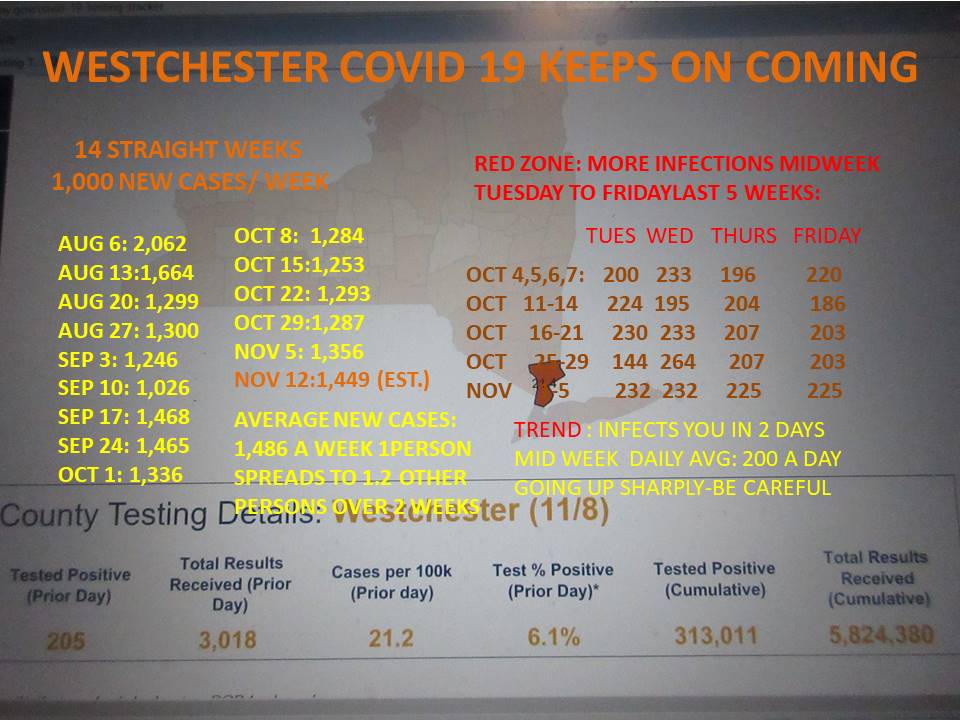
New covid cases in Westchester County continued to be reported by lab-verified positives at the rate of 200 new infections a day with 190 cases Sunday the 6th; 205, Monday, the 7th; 212, Nov.8 and 180 Wednesday the 9th.. an average of 197 new cases a day, with Thursday figures due today from the Tracker.
This does not figure in how much the heavy election day turnout will generate new infections.
The pace of infections in Westchester is well ahead of the fall 2021 rate of infections.
The 14th consecutive week of increase in covid infections last week compared to 2021 had 1,356 new infections–the highest number of new infections since each of the last three weeks of September after Labor Day, One new infected persons is currently infecting 1.2 persons which means in my view the persons coming down with covid are getting infected, showing symptoms faster within 2 days. Why? because midweek infection figures (2 days after a weekend ends) are up.
This week if the trend continues we may have over 1,400 new cases compared to 1, 356 last week.
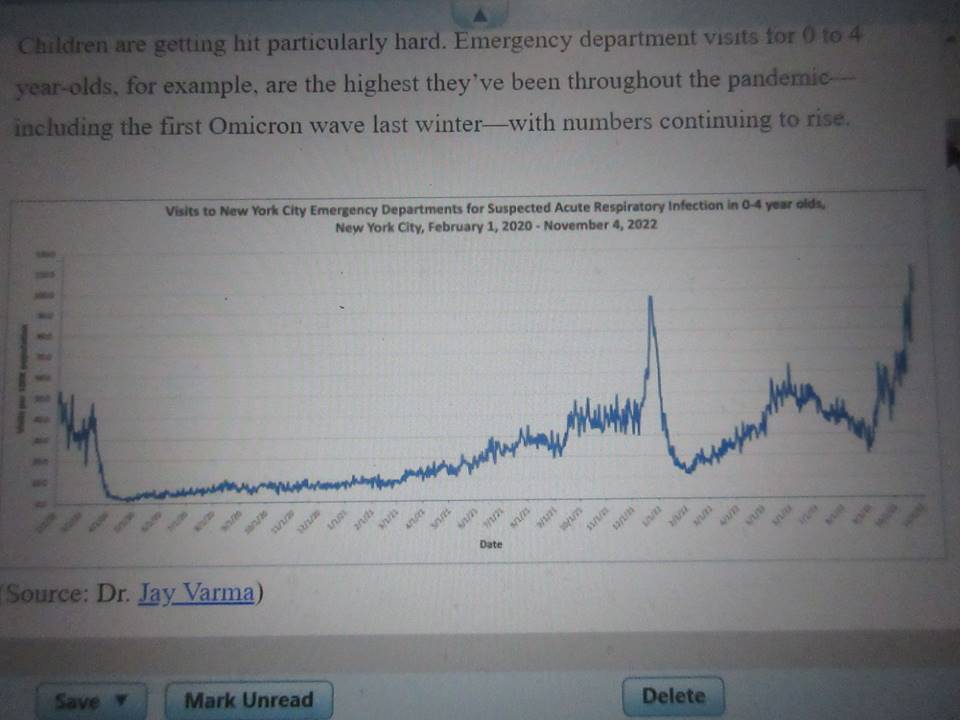
It is out there and spreading double the rate Westchester County spread infections last fall meaning Westchester may be faced with high in cases in mid-December compared to last December. Children under 5 are particularly being affected.
Hospitalizations in New York City for children 0 to 4 with respiratory infections covid are now at the peak of the highest number of hospitalizations at any time during covid according to this chart by Dr. Jay Varma.
MAYOR ROACH MEETS THE COUNCIL OF NEIGHBORHOOD ASSOCIATIONS DECEMBER 13
Hits: 192
MONDAY! MONDAY! 7 PM EST–WHITE PLAINS WEEK THE NOVEMBER 11 VETERANS DAY REPORT ON FIOS CH. 45 COUNTYWIDE; OPTIMUM WHITE PLAINS CH. 76 AND ANYTIME AT www.wpcommunitymedia.org
Hits: 246
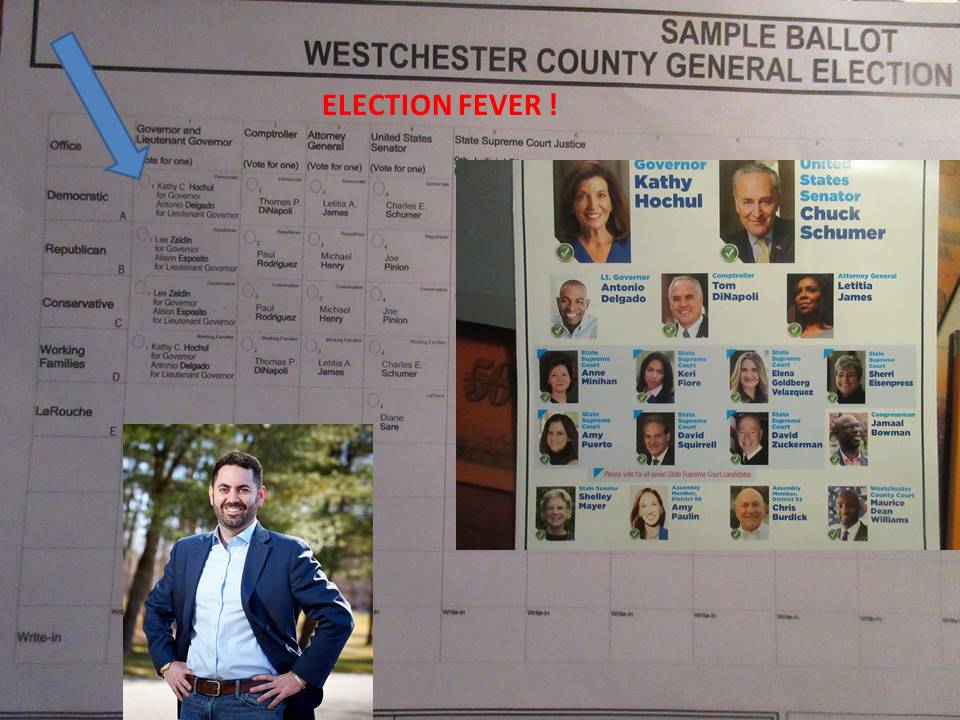
PLUS COUNTY EXECUTIVE GEORGE LATIMER’S VETERANS DAY MESSAGE

MAYOR ROACH, OVER 100 JAM CITY HALL TO PAY RESPECT TO VETERANS AT THE 11TH HOUR OF THE 11TH DAY OF THE 11TH MONTH THIS MORNING
Hits: 167
WPCNR CITY HALL. By John F. Bailey. November 11, 2022:
Despite the threat of weather, White Plains turned out to pay respect and admiration to White Plains Most Valuable Citizens, its veterans of military service in all of America’s 346 years. Boy Scouts and Girl Scouts and parents, White Plains veterans participated in the ceremony, as well as the White Plains High School Marching Band. Here are Mayor Roach’s words on the meaning of Veterans Day, 2022:
RSV IS BACK, SURGING, HIGHLY INFECTIOUS HIGH RISK FOR INFANTS CHILDREN, SENIORS. NO VACCINE AT THIS TIME. RSV VACCINES AWAITING FDA APPROVAL HOSPITALIZATIONS UP SHARPLY IN NYC HOSPITALS
Hits: 0
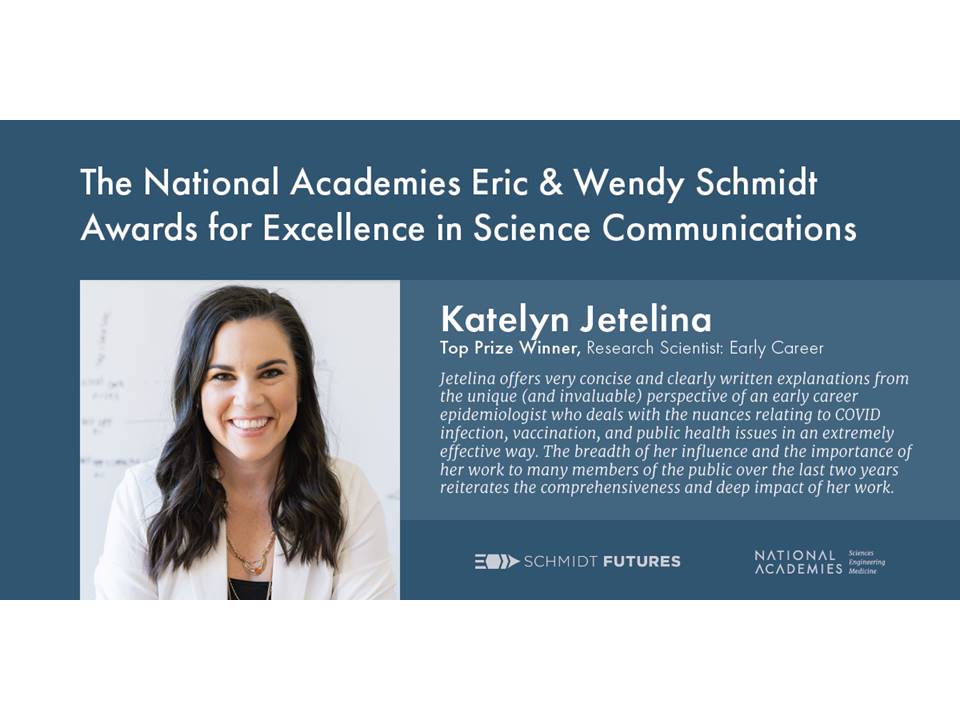
| We are seeing a tsunami of respiratory illnesses and, in its wake, severe disease and overcrowded hospitals. This is mainly driven by RSV, with flu picking up steam. COVID-19 infections have yet to start rising, but we still expect these to uptick soon.(Source: CDC) Children are getting hit particularly hard. Emergency department visits for 0 to 4 year-olds, for example, are the highest they’ve been throughout the pandemic—including the first Omicron wave last winter—with numbers continuing to rise.(Source: Dr. Jay Varma) This, of course, is impacting parents across the country. The latest Department of Labor data found absences from work due to childcare problems hit a record high last month—higher than during the past two years of the pandemic. If you’re home with a sick kid right now, you’re not alone.(Source: Diane Swonk) With a wave of RSV infections comes a wave of questions. Here is what we do (and do not) know about RSV. What is RSV? RSV stands for respiratory syncytial virus. It’s an RNA virus, so it mutates quickly. Historically, RSV hit during the winter. However, the pandemic really threw off viral dynamics. During the first two years of the pandemic, RSV increased during the summer months although at lower than typical rates. It appears RSV is back on track, although it is earlier compared to pre-pandemic years.(Source: CDC RSV-NET)On average, one infected person will infect three other people (R0=3; which is far less contagious than COVID-19 but more contagious than flu). People are typically infected 4 to 6 days after exposure and are usually contagious for about a week. People can be contagious a day or two before they start showing signs.RSV infects cells within our airways. After entering our cells, our immune system sends fighter cells, which cause inflammation and thus symptoms. We have two main airways that can be infected:Upper airway, where infection causes cold-like symptoms, like a runny nose.Lower airway (like lungs), where infection causes difficulty breathing. How is RSV transmitted? There are really two main transmission routes: Respiratory droplets: droplets from coughs and sneezes that contain the virus, but can fall to the ground after a couple feet of travel. Fomites: viral particles that can survive many hours on hard surfaces such as crib rails and toys.With the pandemic, we (scientists, parents, everyone) can’t help but think that aerosols (droplets that stay in the air) are also a main driver. More research is needed, as the latest data was from the 1980s. There is also quite a bit of debate regarding the main mode of transmission. Who is at risk? Anyone can be infected with RSV, and it is very common. In fact, 1 in 4 adults will be infected each year. By the age of 32 months, 100% of children have antibodies. This means that without a vaccine, it’s very likely that your child will get RSV in the first few years of life. The majority of people have mild symptoms that typically mimic a common cold. Some people (but not all) get a fever. RSV can cause severe disease, though, mainly among two groups: Young children. 5 out of 1000 children under 5 years of age will be hospitalized. This is a higher rate than for flu or COVID-19. The younger the child, the more likely hospitalization is. This is because their airways are just so tiny and can’t let air flow through when inflamed. When a child is hospitalized, the average hospitalization stay is 5 days and ~7% require ICU admission. Among those hospitalized, most children were previously healthy. Before the pandemic, RSV killed 100 to 500 U.S. children under age 5 each year.(Source: CDC RSV-NET) Older adults. Each year, between 60,000 to 120,000 older adults in the United States are hospitalized, and 6,000 to 10,000 of them die due to RSV infection. Just like COVID-19, RSV is rough on older adults because their immune systems are weaker and they are more likely to have underlying health conditions, like heart or lung disease. Is there an RSV test? Yes, there are PCR and antigen tests for RSV. (Antigen tests work best on kids compared to adults.) But the tests require a laboratory to process results.There is one at home test that can differentiate between flu, RSV, and COVID19. But, you need to mail it to a lab for results. Is there treatment? There is no medication specifically to combat RSV. The only treatment is to help alleviate symptoms (for example, using oxygen in the hospital).We are working on antivirals, but just like with COVID-19, they are very difficult to make. There is a drug called nirsevimab made by AstraZeneca, though, that had very promising Phase III clinical trial results for infants. The FDA may approve this soon. We do have monoclonal antibodies, called Synagis. This is not a vaccine, but an injection given once a month throughout RSV season. By proactively injecting antibodies, the risk of serious lung infections decreases. This medication is super expensive and in limited supply, so it’s saved for people with the highest risk. How long is someone protected after infection?Unfortunately, not long. RSV is fantastic at evading immunity. This means children and adults can get RSV multiple times, even during a single season. One study found that when scientists followed kids over time, the severity of infection didn’t decline until the children had RSV at least three times. After initial exposures, though, repeat infections are less severe in adulthood (before older age). Why don’t we have a vaccine? Two reasons: We had a vaccine trial back in the 1960s that was a disaster. Kids who got vaccinated were at higher risk for severe disease than those who didn’t. Two kids died. Scientists have since figured out the problem (called antibody-dependent enhancement). The viruses key into our cells has been historically tricky to target with a vaccine. But there is good news on vaccine development In 2013, there was a scientific breakthrough and we figured out how to create an effective and safe vaccine. This past month, we got results from Pfizer’s clinical trials of a bivalent (targets two variants) protein-based (not mRNA) RSV vaccine tested pregnant women. The vaccine was safe and effectively made antibodies that moved across the placenta. Pfizer found high efficacy against severe disease in infants from birth through the first 90 days (81.8%) and 6 months (69.4%) of life. Pfizer plans to submit for FDA approval by end of the year. If approved, this will be the first RSV vaccine, and it will be a game changer. We also got great news about a RSV vaccine for older adults from two manufacturers (GSK and Pfizer): 82% efficacy rate for GSK and 86% for Pfizer. Immune debt? These two words have been floating around parent groups causing a ton of emotional debates on the heels of the pandemic. To be clear, “immune debt” has no official definition and means many things to many people. Here is my epidemiological perspective. The pandemic delayed first infections of common viruses, like RSV, due to shut downs, social distancing, masking, etc. We saved thousands of lives doing this until we could get a COVID-19 vaccine. This was the right call. However, that phenomenon pushed a larger population-level effect of the common viruses that we are seeing now. We always expected a resurgence.But there are things we don’t know yet. Could previous COVID-19 infections impact children’s immune systems? Maybe, but we don’t have evidence on this either way. This needs to be carefully studied. Bottom line The situation right now isn’t great for kids or older adults. It’s not great for hospitals. It’s not great for caregivers. You can help people around you. Do the same things you do with COVID-19—stay home while sick and mask in public. Wash hands and toys—this will help with RSV. Also, don’t let people kiss your baby. This RSV surge reinforces the need to reduce the burden of common viruses, too, which take an enormous toll on our society. Your Local Epidemiologist (YLE)” is written by Dr. Katelyn Jetelina, MPH PhD—an epidemiologist, data scientist, wife, and MOM. During the day she works at a nonpartisan health policy think tank, and at night she writes this newsletter. Her main goal is to “translate” the ever-evolving public health science so that people will be well equipped to make evidence-based decisions. This newsletter is free thanks to the generous support of fellow YLE community members. |