Hits: 364
The County Executive’s remarks on the new covid vaccine begin at 25:33 of this video.

Hits: 364
The County Executive’s remarks on the new covid vaccine begin at 25:33 of this video.
Hits: 207
MID HUDSON COUNTIES SURGE IN MIDWEEK. NYC , 1,433 LONG ISLAND, 658 2 WKS POST LABOR DAY
WPCNR CORONAVIRUS SURVEILLANCE. Statistics from NY STATE COVID TRACKER. Observation & Analysis by John F. Bailey. September 18, 2023:
Post Labor Day new covid cases continue to run 15% ahead of September new covid cases a year ago on pace for over 6,000 new covid cases by October 1.
The 1,045 new covid cases the week after Labor Day spread the disease to 901 persons through last Thursday an average of 209 a day, or 1,463 for the week, pending Friday and Saturday case positives. The state has a 3-day gap in reporting weekly results.
Wesrchester antigen lab confirmed positives are boosting daily numbers over PCR Lab verified tests by 41%.indicating the number persons out there with covid who have tested positive may be running ahead of 40% and have not verified their positive home antigen test yet. It is my concern this may be significantly higher.
This antigen test unknown gap (the numbers of persons in the county walking around knowing they have a positive antigen test result but refusing for whatever reason to confirm the positive or find out if the positive is false make projections probably in my opinion, turn out larger than just the daily confirmed PCR and Antigen test positives we are now seeing reported on 3-day delay by the state.
Through September 14 positives both PCR verified and Antigen Tests (verified) hit 841 Thursday 168 positives a day. That puts Westchester on pace for a 3rd straight week of increased cases in September for a total of 1,177, 132 new cases ahead of the week of September 3-9 which totaled 1,045. That is a per week increase of 13% more cases a week.
With 1,045 possibly infecting 1,177 persons this week, it means every new case of covid in the county may be infecting 1 other person. This means the disease is not declining in spreading it is keeping its spread rate steady.
Disturbing is the number of midweek spread in the other 6 counties in the Mid-Hudson region:
Orange County reported 110 new cases Thursday.
Rockland, 67
Dutchess 36
Ulster 18
Putnam 20
Sullivan,12
With Westchester far and away the covid infection leader with 167 lastThursday
Adding to concern on my part that Westchester is going to continue to grow in covid cases is the 17.2 daily new case rate per 100,000 people (Westchester has 10.04 segments of 100,000 persons)erage from September 7 to 14.
At 17.2 persons new covid cases per 100,000 people, that means Westchester is getting 172 new cases a day;1,208 a week, and 4,835 a month if that daily rate stays where it is.
In New York City, Manhattan last Thursday had 269 covid cases; Brooklyn,413, Queens 414, The Bronx 254, Staten Island, 83 for a total of 1,433.
Long Island, Nassau and Suffolk Counties had 658 new cases combined in one day.
Locally, White Plains Hospital continued its weeks long trend of over 60% of persons admitted to beds in the hospital and finding that 60% of new admissions have covid.
From September 1 through September 15, Friday, of 167 hospital bed admissions, according to the New York State Health Department, 111 were found to have covid. The percentage of persons testing positive for covid after official admission was 66%
Without weekly figures on school infections which is not required by the State Education Department there is no reliable consistent data on the spread of covid cases in the school districts in Westchester County.
Hits: 308
ORANGE, ROCKLAND, DUTCHESS, ULSTER, SULLIVAN PUTNAM NEW CASES RISE TO 40 A DAY A COUNTY FOUR TIMES 10 AND UNDER OVER THE SUMMER
NASSAU, SUFFOLK NEW YORK CITY UP TO 2,257 NEW CASES AS OF 3 DAYS AGO
WPCNR CORONAVIRUS SURVEILLANCE. Statistics from New York State Covid Tracker. Observation & Analysis by John F. Bailey September 16, 2023:
Westchester County leads the Mid Hudson Valley with 172 new cases as of September 12, based on the three-day lag in new case reporting by the CoNew York State Covid Tracker.
This gives Westchester 548 new cases, Sunday through Tuesday, 182 cases a day, on track for 1,278 new cases for the week ending today.
This extends the steady rise in persons testing positive in the hundreds a day since the Labor Day Weekend.
The pace is very close to the 3,740 new cases Westchester County saw last September this week, two weeks after 4-day weekend. That new wave of cases last September resulted in 7,136 cases in January.
The actual numbers since September now reflect antigen tests positives lab verified, included with PCR tests verified by the state. This appears to confirm there are a lot more positives out there walking around spreading the disease. Actual case numbers reported by the Covid Tracker since a year ago did not include verifications of persons verified positive by antigen tests. Those key antigen numbers are now included in the figures the Covid Tracker data is now openly sharing that I am using in downloaded data from the New York State Health Department,
The other 6 Mid Hudson counties on Tuesday show what appears a steady increase in the disease being spread in the rest of the Mid Hudson Counties averaging 40 new cases a day, the first time all summer I have seen counties other than Westchester in the region, have more than 10 cases a day.
Westchester County was reported to have 172 new covid cases Tuesday, 113 PCR verified and 59 Antigen Test Lab verified tested, indicating 34% of the positives were antigen verified and giving you a yardstick by how much previous cases growth was understated.
The last 7 days dating back from September 12, Westchester County averaged 16.8 new daily positives per 100,000 of population (Westchester has 10.04 100,000 segments in its 1,004,000 population. This means in the last 7 days Westchester averaged 169 cases a day, 1,183 cases a week, or possibly 5,540 for the month of September..
That number is chilling.
The midweek numbers of the 7-county and Westchester county positives are in the hundreds the last three weeks.
Folks are socializing giving the disease to other people who are getting sick within 2 days EARLIER in the week.
The 946 positives in Westchester from August 27 through Septermber 2, spread the covid to a possible 1,180 by today, Saturday means each person of those 946 infected 2 other persons.
With the possibility of 1,180 positive covid cases reported this week spreading only to 2 other people, this would mean we would have 2,360 new covid infections the next week.
Those positives would add to the 3,307 cases we already have this month meaning 3,540 more new cases added to the 3,307 we have as of September 12 for a total of approximately 6,847. That is amazingly the exact number Westchester had last September! (6,847)
How are the other Mid-Hudson region counties doing? They’re in trouble. The other Mid-Hudson 6 are spreading at an average of 41 new infections a day per county.
Last Tuesday, September 12, Orange County reported 84 new covid cases.
Rockland reported 58
Dutchess had 52.
Ulster had 24
Putnam, 17
Sullivan 15
WESTCHESTER 172
All summer long the 6 counties other than Westchester, reporting under the old system prior to September 1, averaged under 10 new infections a day. Now they are at 40 a day.
New York City Tuesday the 12th reported 1,512 new cases:
MANHATTAN 293
THE BRONX 295
BROOKLYN 392
QUEENS 452
RICHMOND, S.i. 80
NASSAU AND SUFFOLK BOTH LEAD WESTCHESTER WITH 745 NEW CASES ON TUESDAY THE 12TH
Hits: 310

COUNTY EXECUTIVE GEORGE LATIMER’S INSPIRATION FOR THE FUTURE

MAYOR ROACH REMEMBERS OUR LOST CITIZENS OF 9-11 22 YEARS AGO AT SILVER LAKE
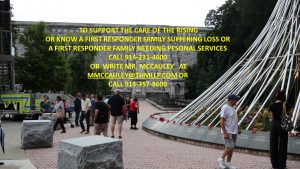
CO CHAIR OF THE 9-11 FIRST RESPONDERS COMMITTEE MATTHEW McCAULEY ANNOUNCES A NEW WALL FOR RISING 9-11 MONUMENT TO RECOGNIZE FIRST RESPONDERS WHO HAVE DIED FROM BEING AT THE GROUND ZERO SITE SINCE THAT DAY
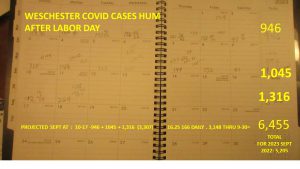
WESTCHESTER NEW COVID CASES HIT 3,307 FOR FIRST 2 WEEKS SEPT 1 -9 ON TRACK FOR 6,455 IN MONTH

THE NEW FALL VACCINES ARE COMING. COVERAGE FROM THE EPIDEMIOGIST TEAM

DR. JETELINA THE “LOCAL EPIDEMIOLOGIST” ON WHEN ELDERLY, KIDS, SHOULD TIME YOUR SHOTS.
THE HIDDEN SPREAD OF COVID IN COUNTIES SURROUNDING NY CITY — THE MOST CASES ARE PERSONS NOT VACCINATED.

GOVERNOR HOCHUL CHALLENGES THE BIDEN ADMINISTRATION TO LET OUR MIGRANTS WORK
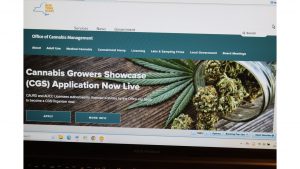
CANNABIS REGULATIONS ANNOUNCED FINALY. APPLY BY OCTOBER 4. COST TO PLAY ASTOUNDS

WITH “YOUR LOCAL ANCHORMAN” JOHN BAILEY AND THE NEWS
ON WHITE PLAINS WEEK EVERY WEEK FOR 22 YEARS
“THE BIG MIKE”
Hits: 222

Hits: 299
Si quiere leer la versión en español, pulse aquí. Everyone over 6 months is eligible for an updated Covid-19 vaccine this fall. We can leverage scientific data to optimize timing, choice, and, thus, protection. Here is the lowdown. How long after infection/vaccination should I wait?This is tricky. We have frustratingly scarce scientific guidance on timing. What we do have tells us this:
BUT waiting is a gamble. Even if a vaccine sooner is not as good as it could be, it’s better than waiting too long and catching Covid with limited protection, especially for high-risk people. SO, this is what I’m suggesting to my family:
Do I wait for Novavax?There is some evidence that mixing Novavax with mRNA is better and some evidence that staying with mRNA is better. It’s a bit hard to know which one is “right.” High-risk people: The data pool is so narrow I’m uncomfortable suggesting that high-risk people wait for Novavax; we don’t know if it’s immunologically better. So don’t wait for this option if it’s been >6 months since your last vaccine and/or infection. Other reasons people may want to wait on Novavax:
What about mixing the mRNA vaccines?If you’ve only had an entire Moderna series, you may see marginal benefit from getting a Pfizer bivalent booster (and vice versa). But, to be honest, the science is mixed and isn’t very strong. So just get the vaccine that is most easily accessible. What about mixing with the flu vaccine?You can get the flu vaccine (and other routine vaccines) and the Covid-19 vaccine at the same visit. It’s recommended to get them in different arms. There have been studies on the safety and effectiveness of the co-administration of these two vaccines. In one database, about 454,000 people got the flu and Covid-19 vaccines. Both worked great. The rate of side effects was the same or a little higher among those that co-administered; however, no specific safety concerns were identified.
(CDC) Under 5 years old and not yet vaccinated for Covid-19I’m getting a ton of questions from parents whose kids have yet to be vaccinated for Covid-19. First, I’m glad you’re taking this step—it will help protect against severe disease and reduce the duration of illness and transmission. I agree that guidance is confusing, but I found this CDC slide helpful:
(CDC) Your unvaccinated younger child (<5 years) needs more doses than, for example, an older child because they are more likely to be immune naive (i.e., never have had this virus). Multiple shots the first time ensure the immune system creates a durable memory. Bottom lineFall is here. Our priority is preventing severe disease among high-risk people, and we can be smart about it. But if this feels too much like gymnastics, get your shot before Halloween. It will help you and those around you. Love, YLE |
Hits: 197
WPCNR IMMIGRATION ISSUES. From New York State Senate, New York State Senator Luis R. Sepulveda, 32ND SENATE DISTRICT,Parkchester, Soundview, West Farms, Hunts Point, Longwood, Concourse, Melrose, Morrisania, Mott Haven, East Tremont, and Westchester Square. September 13, 2023:
Tuesday, Gov. Kathy Hochul said the state was weighing whether to issue work permits directly to recent asylum seekers.
Frustrated by the federal response to the migrant crisis, Gov. Kathy Hochul said on Tuesday that New York State was considering ways to issue work permits to asylum seekers in a bid to circumvent the long wait for permits at the federal level.
Such a drastic step would make New York the first state to openly test federal law, underscoring the depth of a crisis that has sent over 100,000 migrants to New York City over the past year.
The move, which would likely be challenged in court, could also escalate tensions between President Biden and Democratic leaders in New York, who have increasingly criticized his handling of the situation.
“This would be unprecedented,” Ms. Hochul said at a news conference in her Manhattan office. “I believe the federal government believes that we need to have their authority to move forward with state work permits, but, as I’ve said, we have to let them work.”
Lawmakers in Albany have introduced bills that would create a state-level worker permit program for individuals who have filed federal paperwork claiming asylum.
Ms. Hochul, a Democrat, has not endorsed any particular bill and stressed that her lawyers were still exploring multiple ideas. She said she would meet with the state’s legislative leaders on Tuesday, and did not rule out calling a special session in Albany to pass legislation.
Earlier on Tuesday, White House officials pushed back against a state-level work permit system.
In a call with reporters, senior administration officials said that work permits were “very clearly a federal authority,” adding that workarounds were “not something that we would encourage states to pursue.”
Instead, the officials said they were focused this month on helping the city and state accelerate the permit application process for migrants who were already eligible to work but had not yet filled out the necessary paperwork.
The White House was unable to say how many migrants in the city are in that category, but said the number was substantial.
The officials spoke anonymously to discuss the Biden administration’s efforts to assist New York.
The governor said on Tuesday that she had floated the idea during a meeting at the White House in late August with the president’s chief of staff, Jeff Zients; a White House spokesman declined to comment on the record about Ms. Hochul’s statement.
The debate around work permits comes at a critical moment for New York City. An estimated 59,000 migrants are still in city shelters. As space and resources dwindle, New York’s leaders are increasingly concerned services could buckle, with grave humanitarian and political implications.
Mayor Eric Adams said last week that he could see no end to the influx, warning that it “will destroy New York City.” Immigrant rights activists and left-leaning Democrats denounced the statement as xenophobic, but on Saturday the mayor cited the escalating costs as he ordered fresh rounds of budget cuts for every city agency.
Mr. Adams and Ms. Hochul have clamored for the federal government to take steps to speed up the issuance of work permits for migrants as a way for them to gain financial independence, while their cases are processed. Under federal law, migrants who apply for asylum must wait at least 180 days before receiving a work permit.
One state bill, introduced by Assemblywoman Catalina Cruz and State Senator Luis Sepulveda, both Democrats, would task the State Department of Labor with creating a temporary permitting program and issuing permits within 45 days after a person applies. The bill would allow both private and public sector employers to hire the asylum seekers.
“Let’s fight and find a way around the clear powers of the federal government versus the state,” Ms. Cruz said in an interview. “I think we came up with a with a bill that recognizes that in the instance of an emergency, the state has the power to do this.”
Both bill sponsors said they expected the bill to be challenged in court if passed, most likely by Republicans.
“We are in new territory here, but under the circumstances, we have to take a chance,” Mr. Sepúlveda said in an interview.
Assemblywoman Jenifer Rajkumar, a Queens Democrat who introduced similar legislation, argued in a statement that there was legal precedent for localities to respond “in the absence of federal action,” citing the issuance of same-sex marriage licenses in San Francisco before its legalization at the federal level.
But immigration law experts said that such a permitting system would run afoul of federal immigration law.
“A court would be very likely to strike such a state permitting process down if it involves allowing private employers to use these state-issued work permits to hire recent migrants,” said Stephen W. Yale-Loehr, a professor of immigration law at Cornell University.
Mr. Yale-Loehr and other immigration law experts have called for a different approach that they argue is allowed under federal law: having state governments hire asylum seekers directly. The University of California regents, for example, announced earlier this year that the university system would explore a way to hire students who lack legal status and work permits.
Hits: 233
State Announces Over $70 Million in Cannabis Sales Through Late August,
Cannabis Growers Showcase on Pace for $12.5 Million in Sales in 2023
New York State Continues to Pave the Way for Increase Medical Cannabis Access
with Approval of Expanded Registered Organization Application
CCB Approves Cannabis Research License Applications to Drive Scientific
Advancements in the Cannabis IndustrY
WPCNR CANNABIS NEWS. From the NY Cannabis Control Board. September 13, 2023:
Wednessday, the New York State Cannabis Control Board (CCB) voted to finalize the
Office of Cannabis Management’s (OCM) proposed regulations for the adult-use cannabis
market, paving the way for the most significant expansion of the state’s cannabis market since
2021.
With this approval, a broad universe of individuals and small businesses across the state will now
be able to apply for cultivator, processor, distributor, microbusiness, and retail dispensary
licenses beginning on October 4, 2023. In addition to the opening of the general license application,
currently-operational Adult-Use Conditional Cultivators (AUCCs) and Conditional Processors (AUCPs)
will also be able to apply for full, non-conditional licenses.
“Today marks the most significant expansion of New York’s legal cannabis market since
legalization, and we’ve taken a massive step towards reaching our goal of having New Yorkers
being able access safer, regulated cannabis across the state. We are immensely proud to be
building the fairest, most competitive cannabis industry in the nation — one that puts those most
harmed by prohibition first and offers a true opportunity for all New Yorkers — not just large
corporations — to compete and thrive,” said Chris Alexander, Executive Director of the
Office of Cannabis Management.
“The regulations finalized today are the result of robust
engagement with stakeholders across the State who submitted thousands of comments. This final
package truly represents the values of equity and competition that we believe are central to this
market. I want to especially thank Governor Hochul for her leadership, the Board for their
collaboration, the Legislature for their vision, and our advocacy partners for their commitment to
this mission.”
“Today’s unveiling of our cannabis licensing program represents a defining moment for New
York State’s commitment to entrepreneurship and fostering a truly diverse cannabis marketplace.
Starting this October, aspiring business owners can navigate the application process for various
licenses with ease through the New York Business Express (NYBE) platform,” said Tremaine
Wright, Chairwoman of the New York State Cannabis Control Board. “Our pledge to social
and economic equity will continue to take center stage, ensuring that individuals and
communities from all backgrounds have a fair shot at success in this burgeoning industry. With
these comprehensive additions, New York solidifies its reputation as a trailblazing leader in the
cannabis world.”
The Marihuana Regulation and Taxation Act (MRTA) established licensing priority for social
and economic equity (SEE) applicants, defined as those individuals “from communities
disproportionately impacted (CDI) by the enforcement of past prohibition, minority- and womenowned businesses, distressed farmers, and service-disabled veterans.”
In addition, to ensure that individuals and small businesses have real opportunity to compete and
thrive in New York’s cannabis market, the law also established a two-tier system, which prevents
licensees on the supply side of the market from having more than a minimal financial interest in
businesses on the retail side of the market.
The regulations finalized today provide a clearer and
more robust framework for how OCM is to implement these provisions of the MRTA.
With respect to SEE applicants, priority consideration for adult-use cannabis licenses will be
provided to such applicants who qualify as individuals from a community disproportionately
impacted, distressed farmers, and service-disabled veterans.
All SEE applicants will receive a
50% fee reduction in application or licensing fees and will be eligible for application support and
technical training through the Cannabis Hub & Incubator Program (CHIP), which will be
launching this fall.
In addition, to ensure transparency, accountability, and regulatory compliance, OCM will
implement a robust system for tracking the ownership and financial interests of cannabis license
applicants.
This includes the requirement for applicants to list their “True Parties of Interest”
(TPI), which will enable OCM to assess ownership stakes of individuals and businesses
operational in one part of the market in other parts of the market. This critical information will
serve a vital function in upholding the integrity of New York’s two-tier market and the viability
of small businesses across the supply and retail sides of the market.
New Yorkers seeking to apply for licenses will be able to file their applications through the New
York Business Express (NYBE) platform, and OCM will soon be releasing detailed application
instructions on its website. More information regarding license types, the SEE provisions, and
the State’s two-tier system, is available here.
With these regulations, the State ushers in a new era of cannabis regulation in New York, one
defined by inclusiveness, transparency, equity, and economic opportunity.
Outline of Adult-Use Regulation Package
The finalized adult-use regulations create a framework for an equitable and sustainable cannabis
industry grounded in public health best practices, including keeping cannabis products out of the
hands of youth, establishing product quality and safety guidelines, outlining employee training
standards, and defining business security requirements to protect public safety.
These regulations
also incentivize sustainable cannabis operations by prioritizing energy and resource efficiency
and protecting against wasteful business practices. Most importantly, these regulations maintain
the goals of equity initially laid out in New York’s Cannabis Law and the Marihuana Regulation
& Taxation Act (MRTA).
The Adult-Use Cannabis Regulation Package Outlines:
1. The application and license selection and process;
2. The role municipalities play in regulating cannabis businesses;
3. Key social and economic equity program provisions;
4. Environmental and sustainability standards cannabis cultivation, processing and
manufacturing;
5. Ownership and true party of interest provisions; and
6. General business operating requirements, including but not limited to: security, worker
health and safety standards, inventory tracking, record keeping and transportation.
The regulations went through two separate public comment periods, the first from December 14,
2022 until February 13th, 2023, and the second from June 14 to July 31, 2023. Collectively,
OCM and the CCB received more than 4,000 distinct comments from approximately 550
individuals during these periods.
Commenters, representing a broad spectrum of stakeholders, sought clarification on various
provisions, proposed additional amendments, requested technical modifications, and shared their
valuable opinions with both OCM and the CCB. This robust and constructive feedback was
pivotal in guiding the final adult use regulations.
Licensed Dispensaries Reporting $70+ Million in Cannabis Sales Through Late August;
Cannabis Growers Showcases on Pace for at Least $12.5 Million in Sales in 2023
In addition to finalizing the adult-use regulations today, OCM provided an update to the CCB on
the ongoing success of the Cannabis Growers Showcase program, launched in July 2023 by
Governor Hochul to create new avenues for New York’s cultivators and processors to sell their
products. This initiative is a partnership that is enabling cannabis growers and existing, licensed
retail dispensaries to sell cannabis products to consumers. New York State is the first in the
nation to allow the sale of cannabis products at state and locally-sanctioned locations.
Since the announcement of the program, OCM has received close to 50 applications to host
events, and has approved 25 of them, with 15 of those CGS events running through the end of
the calendar year. To date, these CGS events have yielded $600,000 in sales, and at the current
rate of sales, the CGS events are on pace to generate more than $12 million in sales through the
end of the calendar year. That projection may grow as OCM approves additional CGS events in
the coming weeks. View upcoming and previous Cannabis Growers Showcases here.
The State’s 23 licensed dispensaries have reported cumulative sales of over $70 million through
late August of this year, with a marked increase through the summer. From January through
May, total sales were approximately $18.8 million. June’s sales jumped to $8.9 million, with
over $34 million reported in July and August. This equates to more sales in the last two months
than the previous six combined—a trend that will continue in the months and years to come.
New York State Continues to Pave the Way for Increased Medical Cannabis
Access with Approval of Expanded Registered Organization Application
OCM announced that the Registered Organization (RO) Application will be made
available for viewing following today’s CCB meeting to expand access to medical cannabis in
New York.
The application process will be exclusively accessible online and is complemented by a
comprehensive Application Instruction Sheet, providing a seamless guide for interested parties.
As mandated by the Medical Cannabis Regulations, applicants will be required to submit a nonrefundable application fee of $10,000 to apply.
In line with the requirements outlined in the Marihuana Regulation Taxation Act,
(MRTA), applicants must exhibit cultural, linguistic, and medical competence, ensuring they are
well-prepared to cater to the diverse needs of patients who may benefit from medical cannabis.
This innovative approach demonstrates OCM’s continued commitment to creating a more
inclusive and effective cannabis industry in the State.
Additionally, this approach distinctively
puts an emphasis on collaboration; encouraging applicants to form partnerships that demonstrate
their collective capability to fulfill their obligations and serve their respective communities
effectively. This collaborative model addresses the shortcomings of the previous approach to
integrating ROs, aligning with the evolving standards of today’s market.
In order to foster transparency and provide clarity to potential applicants, OCM encourages
interested parties to submit their inquiries and questions to OCM by October 13th. Responses to
these inquiries will be promptly posted on OCM’s website under Frequently Asked Questions
(FAQs), which serves as a valuable resource for applicants looking to apply for a new RO
registration.
CCB Approves Cannabis Research License Applications to Drive Scientific
Advancements in the Cannabis Industry
The CCB voted to approve the Cannabis Research License Applications to produce,
process, purchase and/or possess cannabis for limited research purposes. These licenses will help
further research into cannabis, an area of research that has been severely limited by a century of
cannabis prohibition in the United States.
Researchers, scientists, physicians, cultivators, and
others will now have the ability to study and collect the evidence needed to better understand the
vast potential of the cannabis plant and lead to new robust innovations. The application for the
Cannabis Research License, which requires a $250 application fee and a $500 license fee, must
be completed online and will be accessible on OCM’s Cannabis Research webpage. The
application will be available for submission starting September 13, 2023 and will be accepted on
a rolling basis.
“As we continue to build a comprehensive regulated cannabis market, New York State is poised
to lead the nation in cannabis research and science,” said Nakesha Abel, Deputy Director for
Health and Research for New York’s Office of Cannabis Management. “For far too long, the
ability to conduct high quality scientific investigations on cannabis has been limited by too many
barriers. With the New York State Cannabis Research License, researchers will now be able to
perform studies on the cannabis products that patients and consumers are utilizing in the real
world.”
The draft regulations for the Cannabis Research License were introduced at the March 2, 2023,
CCB meeting, and went out for a 60-day public comment period that concluded on June
5th. OCM received 22 public comments, and there was overwhelming support of the regulations
and New York’s efforts to stimulate cannabis research. Because no substantive changes were
made as a result of the public comment, regulations were voted to be adopted at the July
19th, 2023 CCB meeting and were subsequently effective on August 9th, 2023.
CCB Approves One Additional Laboratory Testing Permit
The Cannabis Control Board approved one additional laboratory permit today, Dope Diagnostics
Lab in Pearl River, NY, bringing the total number of laboratories permitted to conduct adult-use
and medical cannabis testing in New York State to 16.
The approval of this permit serves as a critical part of New York’s equity-first supply chain,
helping to bring safer cannabis products onto the shelves of New York’s first adult-use cannabis
retail dispensaries. CANNIBIS REPORT. From the New York Office of Cannibis Management. September 13, 2023:
Hits: 825
Today Tuesday, ACIP—an external advisory committee to CDC—had a much-anticipated meeting with one goal: determine who is eligible for an updated Covid-19 vaccine this fall in the United States.
This 6-hour meeting was information-packed.
Here are your cliff notes.
Everyone over 6 months is eligible for an updated Covid-19 vaccine this fall. I strongly agree, as the benefits of vaccines outweigh the risks across all age groups.
Yesterday, the FDA approved mRNA vaccines for this fall, but did not include Novavax. FDA isn’t allowed to comment on why. (My guess is Novavax faced delays in approval for manufacturing—they’ve had trouble with this in the past).
CDC recognized the concern on the ground (for the record, this is a fantastic way to build trust) and clarified today’s recommendation was intentionally designed to be broad enough to cover Novavax when the FDA gives the “okay.”
One of the biggest questions was whether vaccine benefits continue to outweigh the risks for kids. Updated stats were presented:


After last fall’s updated Covid-19 vaccine, 2 myocarditis cases were verified out of ~650,000 doses. This is a much smaller rate for than the primary series. (We think this is because the increased time interval between doses reduces risk.) However, there is limited data, so this estimate has some uncertainty.

The benefits of a vaccine for severe disease among adolescents outweigh the risks.

Long Covid is a driving factor for many to remain vigilant. I was happy to see CDC presented data on this. One ACIP member noted: “This is the first time we’ve discussed a vaccine preventing acute and chronic health problems.”

How well? Pretty darn well.
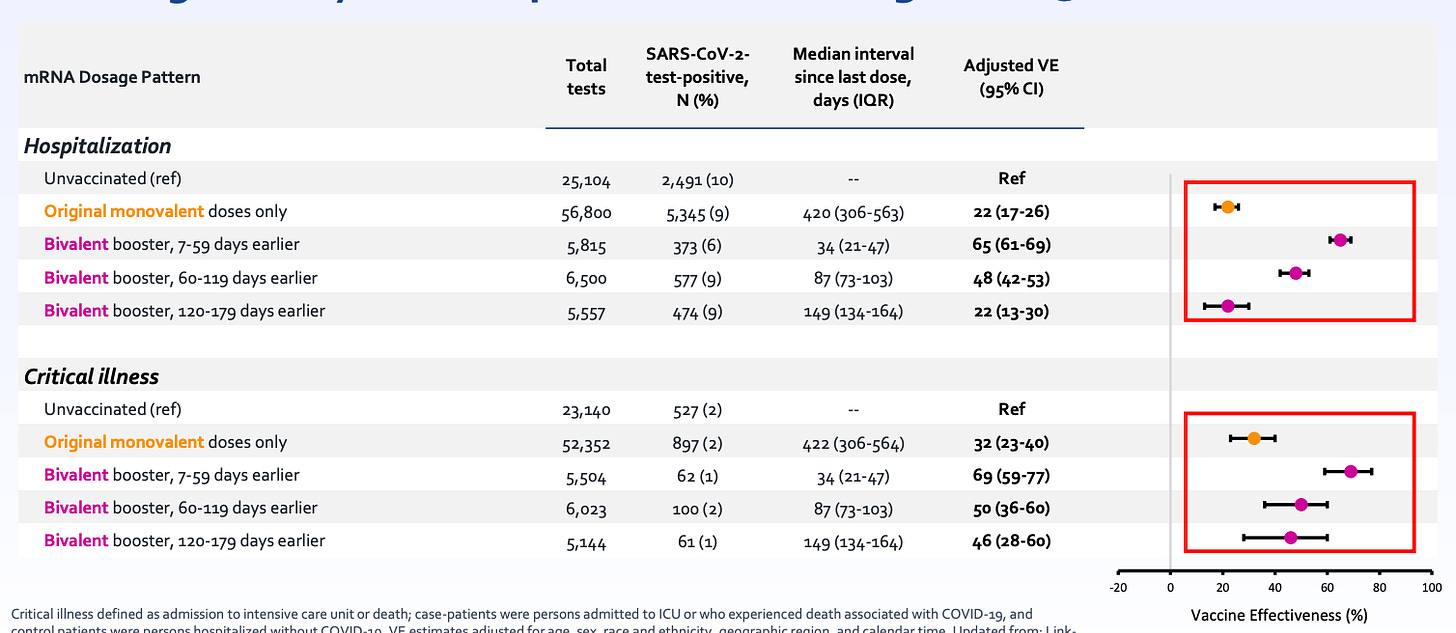
This is the first time the government is not paying for Covid-19 vaccines.
Pfzier/Moderna is charging ~$120-129 per dose and Novavax is ~$130. (I think the cost of these vaccines is absurd given taxpayers funded Operation Warp Speed.)
Nonetheless, is the bang worth the buck? The University of Michigan conducted an analysis and found:

Pharma companies showed increased antibodies against currently circulating variants, including the newer BA.2.86.

Three noteworthy items were brought up:

ACIP voted (13-1) to recommend Covid-19 vaccines for everyone >6 months old. While the benefit profile differs significantly across age groups and time, risks of vaccination and infection remain outweighed for all ages.
This goes to the CDC Director for approval. Then, technically, you’ll be able to get a vaccine. However, access may be delayed or challenging, and waiting may make sense for some (more on this later).
My family will be getting a fall Covid-19 vaccine this fall. I hope you’ll join.
Love, YLE
“Your Local Epidemiologist (YLE)” is written by Dr. Katelyn Jetelina, M.P.H. Ph.D.—an epidemiologist, wife. During the day, she is a senior scientific consultant to several organizations. At night, she writes this newsletter. Her main goal is to “translate” the ever-evolving public health world so that people will be well-equipped to make evidence-based decisions. This newsletter is free, thanks to the generous support of fellow YLE community members. To support this effort, subscribe below:
Hits: 310

WPCNR MILESTONES. September 11, 2023:
It has been 22 years since the Twin Towers fell.
This morning, it seemed like yesterday under overcast skies.
In the White Plains annual acknowledgement of the horror of 9-11-2001,Commissioner of Public Safety, David Chong who was there evacuating the towers that day gave a personal insight into what the day was like (no other) and the Horror still unfolding aftermath has been like. Here is his inspiration.
County Executive George Latimer spoke putting each death into perspective for each of us.
Mayor Roach and the members of the Common Council John Martin, Justin Brasch, Jennifer Puja and Victoria Presser and County Legislator Benjamin Boykin laid wreaths on the memorial to the 6 White Plains citizens who died that day.
Rabbi Lester Bronstein closed the solemn Remembrance with a prayerful message on how we can move into the future