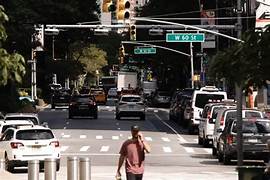
JANUARY 4–MTA ANNOUNCES CONGESTION PRICING TOLLS START SUNDAY

Hits: 266

Starting on January 5, 2025, vehicles entering the Central Business District (CBD), popularly referred to as the Congestion Relief Zone (CRZ), will be charged a toll.

The CRZ includes local streets and avenues at or below 60th St in Manhattan, and excludes trips entirely done on the FDR Drive, West Side Highway/Route 9A, and the Hugh L. Carey Tunnel connections to West Street.

The toll amount depends on several factors: the type of vehicle, time of day, whether any crossing credits apply, and payment method. For example, passenger vehicles with E-ZPass tags entering the CRZ at 60 Street will be charged $9 in the peak period and $2.25 overnight, once daily. To learn more, visit congestionreliefzone.mta.info.

Please review your E-ZPass account to ensure that it has your current license plate number. To receive appropriate discounts, exemptions, and crossing credits, your license plate number is required. Visit the MTA website to learn more about discounts and exemptions for Congestion Relief Zone Tolling.

Posted in Uncategorized

JANUARY 4–JUDGE LEO GORDON CLARIFIES HIS ORIGINAL CONGESTION DECISION. SAYS MTA CAN TURN ON CONGESTION PRICING TOLLS SUNDAY

Hits: 196

THE GOTHAMIST REPORTED THIS MORNING THAT FEDERAL JUDGE LEO GORDON HAS SPECIFICALLY SAID THE MTA CAN BEGIN COLLECTING CONGESTION PRICING BEGINNING AT 60TH STREET SUNDAY.

THE JUDGE FRIDAY EVENING, THE GOTHAMIST REPORTED,  JUDGE GORDON WROTE “IN A NUTSHELL,DENIED”  IN RESPONSE TO  THE NEW JERSEY MOTION  TO  DELAY BEGINNING THE TOLL COLLECTION.


Posted in Uncategorized

JANUARY 4 — NEW YORKERS AGAINST CONGESTION PRICING TAXING STATE ON EAVE OF IMPLEMENTING — CALL FOR INJUNCTION PLEASE

Hits: 259


NJ Federal District Court Ruling Fails the Public Good; Puts Human Lives at Risk

NJ Emergency Appeal Welcome and Has Much Merit

Statement by Susan Lee, President, New Yorkers Against Congestion Pricing Tax


New Yorkers Against Congestion Pricing Tax, the coalition of residents from diverse neighborhoods around NYC who initiated a lawsuit to demand that the Federal Highway Administration (FHWA) perform an Environmental Impact Study (EIS) to show the real impacts of Congestion Pricing on our communities, is deeply disappointed by Judge Leo Gordon’s failure to issue a TRO (temporary restraining order) or Preliminary Injunction tonight.

If left to stand, it will put people’s lives at risk; we, therefore, strongly support New Jersey’s emergency appeal. The MTA’s own counsel stated mitigation – if it could work at all – would take five years. And since 2019, the MTA spent some one-half billion dollars and zero on mitigation!

We filed an Amicus brief supporting the Town of Hempstead state court action based on the MTA’s failure to follow SAPA (the New York State Administrative Procedure Act).

Our Class Action lawsuit raising SAPA also remains pending in SDNY. SAPA requires consideration of socio-economic impacts, including on small business and workers.

It is especially important because the toll tax impacts marginalized New Yorkers who will be hurt by the Congestion Pricing Tax which would cut into their pockets and pocketbooks.

Thus ANY (emphasis intended) MTA attempt to proceed pending a final resolution would be both foolish and costly. We still say to the MTA: “not so fast.”

The implementation of this toll-tax scheme would increase the costs of goods and services in every NYC neighborhood for small businesses and all New Yorkers whether they take public transit, ride a bike, walk, rely on for hire vehicles or drive a car; increase traffic and pollution and incidence of asthma in environmentally sensitive communities including the Lower East Side, Chinatown, and the South Bronx; and kill jobs that many lower income New Yorkers depend on – one cannot get more socio-economic than that!

Last Spring we proposed “A 5-point Plan to Save Public Transit,” especially as a starting point. That plan includes funding MTA Capital Program the same way NYC and NYS fund their regular capital programs. Funding for public transit should be a priority in the same manner the city and state fund schools, hospitals, senior center, roads, libraries, museums and parks. Since Public Transit fuels the City economy that fuels the state economy that fuels the U.S. economy, the Federal government must provide a steady stream of capital funding to the MTA.

The federal government must come through with substantial funding for the Public transit system that fuels the economy of the city and state that fuels the national economy.

As to new revenues, look at the “menu” of one dozen alternatives identified by Keep NYC Congestion Tax Free.

Ultimately we still look forward to an outcome that leads to a path that protects New Yorkers from a deleterious, environment and economy killing toll-tax also harmful to public health and devote public resources as appropriate and outlined above.

Posted in Uncategorized

JANUARY 3 — WHITE PLAINS WEEK BEGINS ITS 25TH YEAR ON THE AIR TONIGHT AT 7:30 ON CH 45 FIOS AND CH.76 OPTIMUM AND WWW.WPCOMMUNITYMEDIA.ORG

Hits: 142

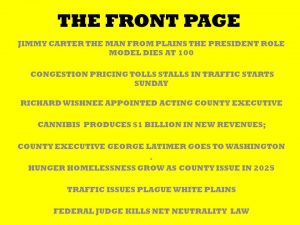
THE FIRST FRONT PAGE OF WHITE PLAINS WEEK’S 25TH YEAR ON THE AIR

JIMMY CARTER PASSES AWAY AT 100 A ROLE MODEL FOR A PRESIDENT

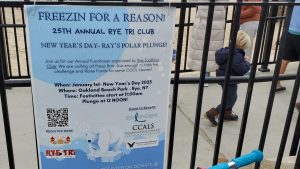
TRI ACT CLUB HOLDS 24TH NEW YEARS DAY SWIM

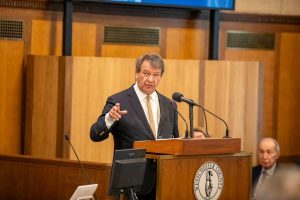
GEORGE LATIMER GOES TO WASHINGTON

CONGESTIVE PRICING STUCK IN A TRAFFIC JAM.

HOCHUL VOWS START AT MIDNIGHT SUNDAY MORNING DESPITE FED COURT DECISION


NY MARIJUANA SALES EARN STATE 1 BILLION DOLLARS–WHAT’S GOOD? WHAT’S WORRISOME.

LEGISLATOR WHISNIE APPOINTED ACTING COUNT EXECUTIVE

DEPUTY COUNTY EXECUTIVE KEN JENKINS EXPECTED TO BE NAMED COUNTY EXECUTIVE FOR 90 DAYS UNTIL SPECIAL ELECTION

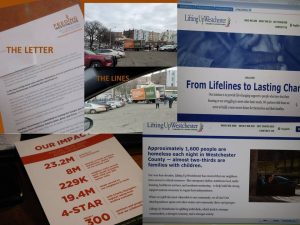
HUNGER HOUSING THE HOMELESS GETTING WORSE IN THE COUNTY

NET NEUTRALITY LAW STRUCK DOWN BY FEDERAL JUDGE

MADNESS ON MOMMARONECK AVE

RECKLESS DRIVERS OBLIVLIVOUS PEDESTRIANS CREATE LIABILITY DANGERS FOR MOTORISTS IN DOWNTOWN

COUNTY HIGHWAYS SPEEDERS AND CUTTING IN SPEEDERS AT 20 MPH AND MORE OVER THE SPEED LIMIT MAKE HIGHWAYS THE MOST DANGEROUS THEY HAVE EVER BEEN WHEN  ANYTHING GOES ON THE WESTCHESTER SPEEDWAYS

THE REAL AULD LANG SYNE

WITH WESTCHESTER’S ANCHORMAN FOR 25 YEARS

JOHN BAILEY AND THE NEWS

EVERY WEEK ON WHITE PLAINS WEEK

SINCE 2001

25TH YEAR ON THE AIR


Posted in Uncategorized

JANUARY 3 –The Dose from Your Local Epidemiologist: FLU AT EPIDEMIC LEVELS NATIONALLY

Hits: 256

Forwarded this email? Subscribe here for more

Si quiere leer la versión en español, pulse aquí.


The Dose (January 3)

Respiratory season is getting ugly, Covid vaccines are effective, Costco eggs, and H5N1, backyard flocks and bird feeders.

Happy New Year! We’re back to it after some much-needed time off. Here’s the public health news you can use this week.


Fall respiratory weather report: High and increasing

It’s getting ugly out there, folks. The number of people going to the doctor for a cough or fever (defined as an “influenza-like illness” or ILI) is well above epidemic levels at this point. The sickest communities are in the West and South, but the entire map below will soon be lit up red.

Levels of ILI; Source: CDC; Annotated by YLE

The “big three”—flu, Covid–19, and RSV—are increasing quickly. Flu is causing the most burden on healthcare systems, but Covid-19 wastewater is increasing fast, which means hospitalizations and deaths will soon follow.

Wastewater viral activity. Source: CDC

Norovirusthink nausea, vomiting, diarrheacontinues to have quite the season, with the number of positive tests and outbreaks abnormally high. Norovirus spreads through contaminated surfaces, so as always, wash those hands. Unfortunately, this virus is one of the hardest viruses to kill, so a quick dose of hand sanitizer doesn’t work. Bleach-based products on surfaces are the best.


Fall Covid-19 vaccine provides additional protection

The first data on the effectiveness of this fall’s 2024-2025 Covid-19 vaccine is in, and it’s looking good!

preprint was released on patients at a Veterans Affairs hospital. Scientists tallied the number of people who did (and did not) have Covid-19 from September- November 2024 and whether they got this fall’s Covid-19 vaccine (specifically the Pfizer 2024-2025 KP.2 formula). Among 44,598 infections, the Covid-19 vaccine reduces:

  • Hospitalizations by 68%
  • Emergency department and urgent care visits by 57%, and
  • Outpatient visits by 56%

The vaccine worked best for those over 65 years old. This study is very preliminary (it only covered two months with little Covid-19 transmission), but the findings aren’t surprising—they are generally consistent with what scientists have found in previous years.

It’s easy to wonder if we’ve had enough Covid-19 boosters by now, but as the virus mutates, vaccines—like flu vaccines every year—provide additional protection to our immune systems.


H5N1, severe disease, backyard flocks, and birdfeeders

A Louisiana resident is in the hospital after contracting H5N1 from their backyard flock.

This case had the same H5N1 strain as a teenager in Canada who was fighting for their life last month.

(A recent NEJM case study described how severely sick this teenager was: intubation for 3 weeks, temporary support to the heart and lungs called ECMO, plasma exchange, 3 antiviral medications, and more.) The H5N1 strain involved in both severe cases—called D1.1—is found among birds and differs from the strain circulating among cows (B3.13).

If you have a backyard flock, you should take precautions to reduce the risk of spreading disease:

  1. Keep your flock contained: isolate your birds from visitors and other birds.
  2. Prevent germs from spreading by cleaning shoes, tools, and equipment.
  3. Reduce the risk of transmission by avoiding sharing tools and equipment with neighbors.
  4. Know the warning signs of infectious bird diseases among the flock, including fatigue, abnormal drop in egg production, swelling or discoloration of the eyelids/comb/wattles/shanks, stumbling or falling down, diarrhea, or unexplained death.

If one of your birds is sick or dies unexpectedly:

  1. Avoid contact with the sick or dead bird. Assume other birds in the flock and their enclosures, droppings, feeders, and water sources are also infectious. (If you can’t avoid contact completely, take steps to protect yourself.)
  2. If possible, isolate the bird from other animals and pets. (Don’t let your dog near it.)
  3. Immediately report sick or dead birds to your state veterinarian or the U.S. Department of Agriculture (1-866-536-7593).

What about bird feeders? Birds that gather at feeders (like cardinals, sparrows, and bluebirds) do not typically carry H5N1. The USDA does not recommend removing backyard bird feeders for H5N1 prevention unless you also care for poultry. The less contact between wild birds and poultry (by removing sources of food, water, and shelter), the better.


Beware of salmonella linked to some Costco eggs

FDA set the highest safety alert—a Class I recall—for some Costco eggs, distributed to Tennessee, Alabama, Georgia, North Carolina, and South Carolina. Handsome Brooke Farms Kirkland brand of organic pasture-raised eggs is linked to possible Salmonella exposure.

Class I designations are reserved for products with the highest possible health risk, meaning there’s a “reasonable probability that the use of or exposure to a violative product will cause serious adverse health consequences or death.” There are no recorded human cases yet, but let’s keep it that way—spread the word and throw these eggs out if you have them in your fridge.


So… what’ll be “healthy” in 2025?

‘Tis the season of New Year’s resolutions! According to a recent AP poll, most resolutions this year focus on health, exercise, and diet.

Fifty percent of people aim to eat healthier, but what’s really considered healthy these days? Well, just in time for the new year, FDA updated the definition to align with the latest science. (The last time this definition was updated for food labeling requirements was in 1994!)

Starting in February 25, 2025, if a company wants to claim their new food is “healthy” on a package, they must meet two requirements:

  1. The food must contain a certain amount of one of the five food groups (fruits, vegetables, grains, proteins, dairy).
  2. The food cannot exceed added sugar, sodium, or saturated fat limits based on the food and its customarily consumed amounts.

The changes remove limitations on total fat and cholesterol and the required provisions of vitamin A, vitamin C, calcium, iron, protein, and fiber—things that could simply be added to foods.

Basically, this updated definition aims to focus on more nutrient-dense foods, emphasizing food groups (and the overall nutrition profile) rather than individual nutrients in isolation. While this is progress in the right direction, it’s imperfect. For example, full-fat plain yogurt cannot be “healthy” under this guidance, but low-fat flavored yogurt with some added sugar could be.

What’s next? Reporting food as “healthy” is voluntary. Foods already on the market must comply by February 2028.

In the meantime, FDA is developing a “healthy” symbol that could be used for front-of-package labeling. While only time and research will tell how effective these labeling strategies are, it’s a step in the right direction, updating considerably outdated nutrition guidance, encouraging industry to reformulate foods, and making it easier for the public to make healthier choices.


Bottom line

You’re all caught up for the beginning of the year! Have a wonderful weekend.

Love, the YLE team

Posted in Uncategorized

FIRST 2025 TRIP TO THE BEACH–RYE TRI CLUB AND FRIENDS OF ALL AGES HIT LONG ISLAND SOUND

Hits: 179

WPCNR NEW YEARS DAY AT RYE BEACH


At a little before noon New Year’s Day, the temperature was 50 degrees and a tad breezy. with sun through the gray clounds and brooding majestic gray Long Island Sound streaching in calm toward the west.


The Long Island Sound off Rye Town Park Pavilion had a water temperature of 43.7 WPCNR degrees. My estimate was over 200 persons  dashing into the surf and perhaps moms and dads and children of all agess milled on the beach to watch men and women, teens and toddlers get a brisk wake up call that 2025 was going to their year, start by swimming splishing and a-splashing in Long Island Sound in the annual Rye Tri club charity event.

At Cold Noon, after an inspiring  Robin Latimer  (Mrs. George Latimer), singing a classic, perfect performance of The Star Spangled Banner.   Her magnificent contralto rang out across the beach perffect amplied was vibrant, and eased with full stately glory into the high notes and held them and ended with mellowed sincerity that inspired the hundreds to dash into the challenge of the Sound.


And there they go!  Whooping! Squealing! High Stepping! After emmersing in the waters, very few dashed out of the the water shock. Some dived in and swam (fast) others waded and all ages participated.


12:20 — 8 true polar bears will still in the Sound being closely observed by lifeguards.

I asked one young man just out of the water how was it, and he told me “It’s nice!”

KOWABONGA! NEXT YEAR THEY’LL BE BACK FOR MORE!


Posted in Uncategorized

JANUARY 1, 2025: MTA: NEW JERSEY FEDERAL JUDGE RULING “DOES NOT REACH LEVEL OF AN INJUNCTION” HEAD OF MTA SAYS CONGESTION PRICING TOLLS TO BEGIN SUNDAY THE 5TH

Hits: 279

WPCNR CONGESTION TIMES. Wrapup and Unwrap by John F. Bailey January 1, 2025:

New York’s congestion pricing  is begins midnight Sunday January 5 despite New Jersey Federal Court Judge Leo Gordon’s 72-page decision Monday saying the plan needed Federal High Way Administration approval. The judge gave January 17 as a deadline for that approval or disapproval by the FHWA. (Editor’s Note: if the FHWY does not act by then, action could conceivably be delayed until the new administration FHWY head takes over after the new President-Elect is iinaugurated.)

Cars would pay a peak fee of $9 from 5 a.m. to 9 p.m. weekdays and 9 a.m. to 9 p.m. on weekends. $2.25 other times

The judge’s ruling came in a 72-page decision Monday evening. The MTA Chairman announced after review with legal counsel said the MTA would start congestion pricing anyway:

“We’re gratified that on virtually every issue, Judge Gordon agreed with the New York federal court and rejected New Jersey’s claim that the Environmental Assessment approved 18 months ago was deficient,” MTA Chair and CEO Janno Lieber said, “Most important, the decision does not interfere with the program’s scheduled implementation this coming Sunday, January 5.”

In the decision, the judge said because of the questions for the federal government, “this matter is remanded to the FHWA until January 17, 2025 for the FHWA to take actions in conformity with this Opinion.”

New Jersey disagreed:

“We welcome the court’s ruling today in the congestion pricing lawsuit. Because of New Jersey’s litigation, the judge has ordered a remand, and the MTA therefore cannot proceed with implementing the current congestion pricing proposal on January 5, 2025,” said attorney Randy Mastro, who represents New Jersey.

Governor Kathy Hochul, after Judge Gordon’s decision was released, issued a news release that New York State would proceed with starting the Congestion Tolls Sunday at midnight January 5 anyway. Here is the Governor’s statement:

“Despite the best efforts of the State of New Jersey trying to thwart New York’s ability to reduce congestion on our streets while making long-overdue investments in public transit, our position has prevailed in court on nearly every issue. This is a massive win for commuters in both New York and New Jersey. Now that the judge has issued his ruling, the program will move forward this weekend with a 40 percent reduction in the originally proposed cost of the toll.

“Commuters deserve a world-class transit system that’s safe, efficient and modern. Local residents deserve clean air and safe streets. Drivers deserve less congestion and reduced traffic. This is what we will begin to achieve — at a lower cost to drivers — when congestion pricing begins on January 5.”


Posted in Uncategorized

JANUARY 1 2025– NY Cannabis Industry Hits More Than $1 Billion in Retail Sales. 19% of New Yorkers use cannibis 12% acknowledge monthly use.

Hits: 1294

 50% of New York’s Cannabis Licenses Awarded to Social and Economic Equity Applicants, Empowering Minority and Women-Owned Businesses

Over 275 Licensed Dispensaries and 500 Supply-Side Licenses

Product Diversity and Innovation Accelerates as 500 Brands Now Serve the Market

Governor Kathy Hochul closed 2024, announcing New York State’s cannabis industry has reached a historic milestone of more than $1 billion in retail sales. This achievement reflects the dedication of entrepreneurs, consumers, and communities who have embraced the legal market and helped to establish New York as a national leader in cannabis equity and innovation.

“Earlier this year, my administration took critical steps to promote progress and economic opportunity within New York’s budding cannabis industry, including signing new enforcement powers into law that expedited the closure of unlicensed storefronts and, as a result, bolstered our legal market,” Governor Hochul said. “Today, we recognize the $1 billion milestone as more than just a number—it’s a testament to the hard work of those who helped build the strongest cannabis industry in the nation: one that prioritizes equity, ensures public safety, and empowers communities.”

ENFORCEMENT:

  • 1,300 enforcement inspections conducted
  • 450 businesses padlocked
  • 16,900 pounds of illicit products seized
  • $68.5 million street value of products seized
  • 8,700 Lots of adult-use cannabis products laboratory tested
  • 431 field hours of compliance inspections


New York’s cannabis strategy ensures a safe and fair marketplace for small businesses and entrepreneurs across the state.

In collaboration with local municipalities the OCM padlocked hundreds of illicit stores across New York, leading to seizures of over 16,000 pounds of unsafe cannabis products. The OCM has enhanced its capacity to tackle unlicensed operators while fostering strong relationships that benefit both the industry and New York communities as cannabis in the market continues to grow. New York remains steadfast in its commitment to equity and inclusion.

Office of Cannabis Management Acting Executive Director Felicia A.B. Reid said

“This milestone is a testament to the resilience, hard work, and innovation of cannabis entrepreneurs across New York. As $1 billion is an incredible number. Let us celebrate the individuals, businesses, and communities in cannabis who drive our state’s economic engine. Certainly, this moment underscores the strength of consumer demand for regulated cannabis—more importantly, it firmly demonstrates that a social and economic equity approach to industry is not antithetical to strong economic growth. New Yorkers have placed their trust in a market that prioritizes equity—and OCM remains committed to supporting that mission.”

New York’s cannabis industry has set the standard for equity in action. More than half of all adult-use licenses have been awarded to Social and Economic Equity applicants, with significant representation from minority- and women-owned businesses. This achievement comes at a time of remarkable growth for cannabis consumption in New York.

Over the past decade, adult use has risen significantly, with 19 percent of New Yorkers reporting annual use (+30 percent) and 12 percent reporting monthly use (+43 percent). Additionally, 67 percent of consumers who used cannabis in the past year reported purchasing from legal retail sources, reflecting growing confidence in the regulated market.

Cannabis Control Board Chairwoman Tremaine Wright said,

 “New York’s cannabis industry was designed with a focus on equity and opportunity, and today’s achievement is proof that our approach is working. By prioritizing Social and Economic Equity applicants, we’re creating a market that uplifts communities and fosters meaningful economic impact across the state. The tax revenue generated by this thriving industry directly supports our Community Reinvestment Grant Program, ensuring that communities disproportionately impacted by cannabis prohibition receive critical investments. This is only the beginning of what’s possible when we invest in an inclusive and well-regulated industry.”

Assembly Majority Leader Crystal Peoples-Stokes said, “As the Buffalo Bill’s coach says, ‘Trust the process.’ Things will continue to improve and be refined, but New York State’s Office of Cannabis Management (OCM) has established a solid foundation towards the success of its infant cannabis industry. Congratulations to OCM staff, the advocates, and the backbone of it all, New York’s cannabis supply chain of small businesses, in surpassing this milestone.”

The announcement comes on the heels of a strong and transformative year for New York cannabis, as highlighted in the just released OCM Annual Report. Report highlights below:

2024 in Review:

  • Over 5,250 Licenses, Permits, and Registrations issued or provisionally approved to date in State Fiscal Years 2023-2024 and 2024-2025
    • 221 Adult-Use Cultivator Licenses
      • 292 Adult-Use Processor Licenses
        • 569 Conditional Adult-Use Retail Dispensary Licenses
          • 448 Adult-Use Retail Dispensary Licenses
            • 185 Adult-Use Distributor Licenses
              • 272 Adult-Use Microbusiness Licenses
                • 3,265 Cannabinoid Hemp Licenses and Permits
                  • 17 Registered Organizations
                  • 269 Adult-Use Retail Dispensaries open for business
                  • 54.1 percent of Adult-Use Licenses issued to social and economic equity businesses
                  • $757.8 million in Adult-Use retail sales in 2024 as of November 30, 2024
                  • $80.2 million in tax, fee, and fine revenue in State Fiscal Year 2023-2024
                  • $67 million in tax, fee, and fine revenue by the mid-point of State Fiscal Year 2024-2025

EQUITY + COMMUNITY PARTNERSHIPS + TRAINING

  • OCM continued its support for equity applicants and licensees into 2024 through its programs, including the Cannabis Hub and Incubator Program (CHIP) SEE Application Assistance, collaborating with Technical Assistance Providers, CHIP Academy, and the CAURD Accelerator Program.
  • To significantly improve license processing, and enhance transparency, OCM implemented a single point of contact (SPOC) licensing review model.
  • In partnership with the Cannabis Advisory Board, opened the application window for Community Reinvestment Program grants, which will invest in neighborhoods that have been historically under-resourced, underserved, and over-policed.
  • In Feb. 2024, the OCM Veterans Taskforce was established to support, educate, and provide resources related to cannabis to the veteran population.
  • In 2024, 22 Advanced Roadside Impaired Driving Enforcement Trainings were conducted by the Governor’s Traffic Safety Committee (GTSC) with support from OCM, training 797 officers in necessary skills to identify impaired driving.
  • Additionally, four Drug Recognition Expert (DRE) Schools were held by GTSC with support from OCM, adding 60 newly certified DRE officers to the force and bringing the number of active DRE-Certified Officers in NYS to 445.

MEDICAL CANNABIS:

  • Over 100,000 patients registered with the Medical Cannabis Program
  • Nearly 8,500 Registered Caregivers
  • 4,454 Certifying Providers
  • 21 Medical Dispensaries
  • 11 Medical and Adult-Use Co-located Dispensaries
  • 3,550 Lots of medical cannabis products laboratory tested
  • 2024 Medical Cannabis campaign earned over 9.8 million impressions, over 42,500 clicks, and prompted 1 million video completions

To learn more, read the Office of Cannabis Management’s 2024 Annual Report, which provides an in-depth look at the work the OCM has done in the past year.

Posted in Uncategorized

CONGESTION PRICING STOPPED BY NEW JERSEY FEDERAL COURT. DELAYED JANUARY UNTIL FEBRUARY POSSIBLY

Hits: 415

NJ Federal Judge Leo Gordon’s Order Blocks Congestion Pricing Tax

Requires further FHA review


Statement by Susan Lee, President, New Yorkers Against Congestion Pricing Tax


New Yorkers Against Congestion Pricing Tax, the coalition of residents from diverse neighborhoods around NYC who initiated a lawsuit to demand that the FHA perform an EIS to show the real impacts of Congestion Pricing on our communities, applauds the order issued by New Jersey Federal Judge Leo Gordon that sends the Congestion Pricing Tax back to the FHA to review whether this tax scheme complies with all federal legal mandates.

The Judge’s order confirms our position that this scheme is fundamentally flawed.  The order requires a further review that subjects any decision on its validity until late January into February of the new year. 

Any MTA attempt to proceed pending a final resolution would be both foolish and costly.  Following this order, we say to the MTA: “not so fast.”

Our Class Action lawsuit concerning the MTA’s failure to follow SAPA (the New York State Administrative Procedure Act) remains pending in SDNY.

SAPA requires consideration of socio-economic impacts, including on small business and workers. It is especially important because the toll tax impacts marginalized New Yorkers who will be hurt by the Congestion Pricing Tax which would cut into their pockets and pocketbooks.


The implementation of this toll-tax scheme would increase the costs of goods and services in every NYC neighborhood for small businesses and all New Yorkers whether they take public transit, ride a bike, walk, rely on for hire vehicles or drive a car; increase traffic and pollution and incidence of asthma in environmentally sensitive communities including the Lower East Side, Chinatown, and the South Bronx; and kill jobs that many lower income New Yorkers depend on –  one cannot get more socio-economic than that!


Last Spring we proposed “A 5-point Plan to Save Public Transit,” especially as a starting point. That plan includes funding MTA Capital Program the same way NYC and NYS fund their regular capital programs. Funding for public transit should be a priority in the same manner the city and state fund schools, hospitals, senior center, roads, libraries, museums and parks. Since PublicTransit fuels the City economy which fuels the state economy which fuels the U.S. economy, secure steady stream of capital funding from the Federal government.


The federal government must come through with substantial funding for the Public transit system that fuels the economy of the City and State that in turn fuel the national economy.


As to new revenues, look at the “menu” of one dozen alternatives identified by Keep NYC Congestion Tax Free.


Ultimately we still look forward to an outcome that leads to a path that protects New Yorkers from a deleterious environment and economy-killing toll-tax also harmful to public health and to devote public resources as appropriate and outlined above.


Posted in Uncategorized