WHITE PLAINS WEEK RIDES AGAIN NOW INSTANTLY ON THE INTERNET WITH BREAKING NEWS!

Hits: 115

2014131 002PETER KATZ, JOHN BAILEY AND JIM BENEROFE

CONNECTED. CONTEMPORARY. COGNIZANT.

ON

THE SCHOOL AID CAPER

THE JET BLUE BIRD STRIKE

TOM ROACH ON WHAT’S GOING ON THE FORMER SHOLZ BUICK PROPERTY

 THE NEW WHITE PLAINS CITY WEBSITE–WHAT’S THERE. WHAT’S NOT.

SUSTAINABLE PLAYLAND TAKES A TIMEOUT 

THE NOBLE DEMOCRATS GLOSS OVER DISTRICT LEADERS PROTESTS WITH A TASK FORCE

SEE THE NEIGHBORHOOD NEWS BOYS NOW

THE APRIL 4 EDITION

ON

www.whiteplainsweek.com

AND ON

THE SAME WEBSITE ON 

PEOPLE TO BE HEARD

YOU’VE GOT

MIKE KAPLOWITZ

BREAKING NEWS!

2014404wpw 001 (2)

ON

THE ASTORINO-SACH-KAPLOWITZ

SUSTAINABLE PLAYLAND SUMMIT

WHAT HAPPENED. WHAT DIDN’T HAPPEN

HUD MONITOR REACHING AGREEMENTS IN ZONING CHANGES WITH THE WESTCHESTER 7

PEOPLE TO BE HEARD WILL BE TELECAST MONDAY, 10 P.M. AND WEDNESDAY 10:30 P.M. ON WESTCHESTER FIOS CHANNEL 45 AND WHITE PLAINS CABLEVISION AT CHANNEL 76

BUT YOU CAN SEE MIKE NOW ON

www.whiteplainsweek.com


Posted in Uncategorized

Not a Delaying Tactic, Sustainable Playland Says. No Deadline for Rye and County to figure out who’s in charge on Playland. Rye Consultant Precipitates Playland Crisis

Hits: 145

WPCNR PLAYLAND REPORTER. By John F. Bailey. April 1, 2014:

A spokesman for Sustainable Playland, the group attempting to redesign and develop the 1928 Playland amusement park owned by the county, denied today that Sustainable Playland was withdrawing temporarily from  the Playland Improvement Plan review process as a delaying tactic to avoid taking over Playland this year (2014).

2014203ptbh 006

Geoffrey Thompson, spokesman for Sustainable Playland


Thompson said  that when the Sustainable group walked out of last week’s Board of Legislators Committee meeting, they were optimistic that matters were proceeding satisfactorily..

Thomson said that the management of Sustainable Playland announced their indefinite withdrawal only when confronted by the City of Rye legal consultant, the environmental lawyer Michael Gerrard, in a letter calling for a complete environmental review of Playland, citing various cases which Gerrard interprets as giving  the City of Rye full rights to approve any changes to Playland, and conducting a full environmental review.

Thompson said Sustainable decided to suspend spending further dollars on consultants and professionals in the active Playland Review (now underway under the leadership of County Legislator Peter Harckham. Thompson said that “when the county and the City of Rye decides who’s on first, and who’s in charge, and gives some clarity  we will be glad to rejoin the review, otherwise there’s no point to it.”

Thompson added that County Legislator Kenneth Jenkins second lawsuit contending that the county should  not have signed a management agreement with Sustainable Playland without approval of the Board of Legislators, and also includes Sustainable Playland in the suit, can also have the affect of limiting Sustainable Playland ability to raise funds.

County Executive Robert Astorino in a news release and statement said he is attempting to get the Mayor of Rye and the Chairman of the Board of Legislators, Michael Kaplowitz together to hold talks on resolving the controversy over who’s decision is it anyway (The County’s or the City of Rye) to decide on the future development of Playland.

Thompson said the City of Rye Mayor and City Council voted unanimously to approve the original Sustainable Playland plan which included the field hourse. “From the beginning, Sustainable Playland assured the Mayor and the City of Rye whey would have a seat at the table, they could bring their planning commission in. But, we never said they would have the final decision.”


Posted in Uncategorized

Sustainable Playland (Short $$ for Legaling) Suspends Participation in Playland Review Indefinitely Over Rye Demands, Jenkins Lawsuit. “Pointless,” Sustainable says. ASTORINO REACTS

Hits: 146

2013schoosplayland 030

WPCNR PLAYLAND REPORTER. Special to WPCNR From Sustainable Playland and Westchester County Department of Communications. April 1, 2014  UPDATED WITH ASTORINO STATEMENT/ REACTION April 1, 2014 12:45 P.M. E.D.T.

Sustainable Playland Inc.  said today that it is suspending its participation in the review process of its Playland Improvement Plan (PIP) for the park, provoking instant reaction from County Executive Robert P. Astorino who has long championed the citizen group.

Sustainable said in a news release  statement it will not participate any more in the Playland review process until  issues involving the City of Rye’s demand to conduct a full environmental review of the plan and a lawsuit brought by the former chairman of the County Board of Legislators are resolved. 

SPI’s announcement was made in a letter from SPI President Kim Morque that was delivered late Monday to County Executive Rob Astorino and copied to County Board of Legislators Chairman Michael Kaplowitz and Peter Harckham, the legislator chairing the Legislature’s committee that is reviewing the Playland Improvement Plan (PIP.)

Westchester County Executive Robert P. Astorino today called on the chairman of the Board of Legislators and the Mayor of Rye to meet with him to see if they can resolve the legal uncertainties hanging over plans to save Playland.

County Executive Astorino’s reaction came slightly after 12 noon today:

“For four years, our goal has been to save Playland,” Astorino said. “We have reached the point that litigation now threatens our improvement plans and the park itself. It is now time for elected leaders to do everything in their power to resolve the legal impediments that stand in the way of moving forward on saving Playland for future generations.”

According to the Astorino statement released, “Astorino’s call to BOL Chairman Michael Kaplowitz and Rye Mayor Joseph Sack was precipitated by a letter Monday night from Sustainable Playland, the Rye-based not-for-profit selected after an extensive Request for Proposals process to restore and run the park. In its letter, SPI says that after spending $600,000 to date, it does not have the monetary resources or manpower to be engaged in protracted legal battles on multiple fronts.”

Astorino’s news relase said he hoped that meetings with Chairman Kaplowitz and Mayor Sack could be arranged within the next several days. He said that the discussions would take place within two parameters:

  • The status quo was not an option for Playland. An amusement park that costs county taxpayers $4 million to $5 million a year is not viable in today’s world given all the cost pressures on county government.
  • The county must maintain approval rights on its own property, otherwise it would open itself to legal challenges on every county property and facility every time a change or improvement is made.

The not-for-profit group said that the uncertainty caused by Rye’s insistence that it has the right to review and approve the entire plan for revitalizing the park made SPI’s continuing participation in the legislature’s review pointless.

“Our primary concern is that unresolved issues threaten to delay SPI’s revitalization of the park in ways that will remove the viability of our implementation plans in terms of both economics and timing,” the letter states.  “We are asking the County Executive to use his office to see if the current uncertainty regarding the approval process can be removed.”

SPI “remains committed to our vision and the goals of renewing and restoring the park” and are hopeful that a resolution can be reached that will allow the public-private partnership to move forward.  Once the jurisdictional issue between the County and Rye, as well as the lawsuit against the County and SPI that was brought by County Legislator Ken Jenkins are resolved, SPI said it will resume work on implementing the PIP.

SPI was selected to be the future manager of the park from among a dozen respondents to an RFP to reinvent Playland for the 21st century that was issued in 2010 by Astorino.  The SPI approach is to create year-round activities at the park with multiple venues to reduce the dependence on the aging amusement  area that is subject to a warm-weather only season and the lost attendance due to bad weather during its season.  The major component of the SPI model are the amusement park, ice casino, a new field house with indoor and outdoor playing fields and the Westchester Children’s Museum slated to open in 2015.

Posted in Uncategorized

Goodies Galore! Albany Passes 2014-15 Budget. Up 2%. Medicaid Costs Cut

Hits: 199

WPCNR ALBANY ROUNDS. From the Governor’s Press Office. (Edited) April 1, 2014:

Governor Andrew M. Cuomo, Senate Majority Coalition Co-Leaders Dean Skelos and Jeff Klein, and Assembly Speaker Sheldon Silver have announced the historic passage of the State’s fourth consecutive on-time budget.

The budget holds spending growth below two percent for the fourth consecutive year, continuing a record of fiscal discipline that has reversed decades where state spending increased at a higher rate than inflation and personal income growth. Along with other targeted investments that will grow the economy and strengthen New York’s communities, the budget contains $1.5 billion in property tax cuts to aid New York’s homeowners and encourage local governments to increase efficiencies, as well as a major five percent increase in State education aid.

Property Tax Reform
$1.5 Billion in Property Tax Relief: The Budget agreement includes a new Property Tax Credit to provide relief to New York homeowners and address one of the primary drivers of the State’s high property taxes – the outsized number of local governments.

The property tax relief package is designed to incentivize local governments and school districts to share services and reduce their financial burden on the taxpayer. In the first year under the reform plan, New Yorkers will receive property tax relief if their local governments stay within the property tax cap. The property tax cuts will be extended for a second year in jurisdictions which comply with the tax cap and have put forward a plan to save one percent of their tax levy per year, over three years.

While localities may offer a variety of approaches, the plan is designed to incentivize county governments and school districts to convene and facilitate a process and submit a county-wide or BOCES region-wide plan for approval. Over three years, the program will result in over $1.5 billion in direct property tax relief.

Tax Relief for Renters and Low-Income Homeowners: For New York City residents, the Budget creates a new $85 million, progressively structured “Circuit Breaker” tax relief program. Qualifying homeowners and renters will be eligible to receive a refundable tax credit against the personal income tax when their property taxes or rent exceeds a certain percentage of their income.
Eliminating Duplicative and Overlapping Governments: Funding of $39 million is included in the Budget to provide grants to local governments for the implementation of consolidations and of regional services as well as tax credits to residents of local governments that fully dissolve or consolidate.
Assisting Distressed Local Governments: Available funding for the Financial Restructuring Board is maintained at $80 million to provide grants or loans to local governments that implement restructuring initiatives identified by the Board.
Cutting Taxes to Create Jobs
Cutting Manufacturer’s Taxes to Zero: The Budget agreement lowers the cost of doing business for manufacturers, making New York a more attractive place for firms to locate and create jobs. The Budget will establish a 20 percent real property tax credit for manufacturers who own or lease property and lowers the tax rate on income for all manufacturers from the current 5.9 percent to zero in 2014 and thereafter.
Accelerated Phase-Out of 18-A Utility Surcharge: The Budget accelerates the phase-out of the 18-a temporary assessment for all customers. New Yorkers pay some of the highest energy bills in the nation and the temporary utility assessment exacerbates this burden on struggling businesses and families. The Budget will save businesses and residents $600 million over the next three years.
Cutting and Simplifying Business Taxes: The Budget agreement includes the most significant improvements to New York’s business tax system in nearly three decades. The Budget modifies and simplifies the tax code to reflect the reality of a complex economy and makes the state more attractive to both new and existing businesses. Further, the business tax rate is reduced from 7.1 percent to 6.5 percent, the lowest rate since 1968. These reforms will help bring more out-of-state companies to New York, creating jobs and generating increased revenue to invest in state programs that will help all New Yorkers.
Eliminate the Corporate Capital Base Calculation: The capital base taxes corporations on their assets owned in New York. This tax discourages corporations from placing capital in the state. This Budget will phase out this asset tax over six years beginning in 2016, removing the disincentive for corporations to grow their businesses here.
Transforming New York’s Schools

Statewide Universal Full-Day Pre-Kindergarten: The Budget builds upon the success of the first-ever State-funded full-day pre-kindergarten program by committing to invest $1.5 billion over five years to support the phase-in of a Statewide Universal Full-Day Pre-Kindergarten program.

Protect Choice for all of New York’s Children: The Budget increases tuition funding for charter school students over three years: $250 per student the first year, $350 the second, and $500 in the third. The Budget will also promote the growth of charter schools by addressing their facility needs, and charter schools will be eligible for pre-kindergarten funding.


Reform Common Core Implementation: The Budget puts into law a series of recommendations to immediately improve the implementation of the Common Core in New York State.

o Bans standardized “bubble tests” for young children: The legislation prohibits the use of standardized “bubble tests” for children in pre-kindergarten through second grade.


o Protects students from high stakes based on unfair test results: The legislation ensures that the results of English and math Common Core testing for grades 3-8 are not used against students and will not appear on their permanent records.


o Uses instructional time for teaching and learning – not over-testing: The legislation caps the amount of time that can be used for standardized tests and for test prep; improves transparency about what standardized tests students are required to take, and why; and implements measures for school districts to more easily eliminate unnecessary standardized testing.


o Establishes strict data protection and security requirements, while ensuring that appropriate educational and operational data-sharing can occur: The legislation reinforces strict data protection requirements, including procedures for parent notification in case of any data breach, including by a third party, and strong penalties for violations; establishes a “Parents’ Bill of Rights for Data Privacy” that includes comprehensive transparency about what data is collected by the State and by school districts; who it is shared with and why; and names a Chief Privacy Officer for the State Education Department whose responsibilities include establishing standards for educational agency data security and privacy policies. Under the legislation, the State will halt its relationship with inBloom and consider alternative paths to accomplish the goals of increased data transparency and analytics.

School Aid: The Budget includes a $1.1 billion – or 5.3% – increase in education aid for the 2014-15 school year. High-needs school districts will receive nearly 70 percent of the 2014-15 allocated increase.


Increase support for Students: The Budget increases the maximum benefit under the Tuition Assistance Program by $165, from $5,000 to $5,165, and increases awards for students that are either wards of the State or in the care of foster parents.


Increase support for Higher Education: The Budget increases Community College Base aid by $75 per student FTE to $2,497. A total of $102 million in funding is included for Higher Education Opportunity programs at SUNY, CUNY, private and independent colleges (EOP, SEEK, HEOP). The budget provides $30 million in capital appropriations to the Higher Education Capital Matching Grants program for capital grants to Private Colleges and Universities.


Offer a Science, Technology, Engineering and Math (STEM) Scholarship: The Budget includes $8 million in funding for a new STEM scholarship program. Full tuition scholarships to any SUNY or CUNY college or university will be offered to the top ten percent of high school graduates if they pursue a STEM career and work in New York for five years.


Restoring Public Trust:

The Budget includes further reforms to ensure New Yorkers have confidence that their elected officials are serving them honestly and with transparency.

New Crimes for Violating Public Trust: The Budget includes legislation that would create a series of new crimes for violating the public trust.

These new crimes include:o Bribery of a Public Servant: The Budget includes legislation to give prosecutors better tools to convict offenders. Under current state law, a prosecutor has to prove that there was a corrupt agreement or understanding between the person paying the bribe and the person receiving the bribe in order to seek the maximum penalty available against the bribe giver.

Under the new law, the prosecutor would not be required to prove that the bribe giver shared a corrupt intent with the bribe receiver, but only that the bribe giver intended to bribe the receiver and did in fact offer a benefit to the public official. Bribe giving and bribe receiving penalties would also be increased, lowering the threshold for a Class C felony for both bribe giving and bribe receiving from $10,000 to $5,000, the amount of money used to bribe, and creating a new class B Felony when a bribe is for $100,000 or more.


o Corrupting the Government: The Budget includes legislation to hold accountable anyone – whether or not they are a public official – who is found to have engaged in schemes to defraud the state or local government, and enhances penalties for all offenders convicted of defrauding the government through the crime of Corrupting the Government. Under the new law, a public servant or anybody acting in concert with a public servant who engages in a course of conduct to defraud a state or local government would be guilty of a crime ranging from the fourth degree (class E felony) to the first degree (class B felony), depending on the amount defrauded.

New Penalties for Public Corruption: The Budget includes legislation to create higher penalties where state or local government property is stolen. This means an offender would face a higher penalty if the act was committed against the government. The sentence would be one level higher than for the underlying offense. A defendant, depending on the amount of property wrongfully taken, could be a guilty of a class B felony.


Lifetime Ban from Government: The new class of felony public corruption crimes would impose additional penalties, apart from jail sentences and criminal fines, including:o Permanently barring all those convicted of public corruption felonies from holding any elected or civil office, serving as a registered lobbyist, or doing business with the state, including through any organization they run.
o Barring individuals from bidding on or obtaining state contracts.
o Giving judges the option of requiring payment of up to three times the amount of the profit or gain made from an illegal transaction.

Reducing the Influence of Money in Elections by Providing Matching Funds for Political Campaigns: The Budget legislation puts in place New York State’s first-ever program to provide matching funds for a political campaign thereby reducing the influence of money in politics. This comprehensive program will be initiated immediately on a pilot basis – to be in effect for the 2014 Comptroller’s race – and will be modeled after New York City’s successful 6:1 matching funds program.


Independent Enforcement Unit at Board of Elections: The State Board of Elections’ ineffective structure, consisting of four commissioners who are evenly appointed by each major party, leads to gridlock and rarely produces any serious investigations of election law violations. The Budget legislation creates a new, independent enforcement division headed by a chief enforcement counsel, who is appointed outside of the Board to a 5-year term, vested with authority to investigate violations of the Election Law. It would also create a compliance unit that would make complying with the Election Law’s reporting requirements a priority and help ensure a transparent system of election finance reporting.


New Disclosure Requirements for Political Donations: Current law requires disclosure every six months to a year or, in some cases, never, of independent political expenditures. The Budget legislation plugs this loophole-laden law to increase transparency by mandating more frequent reporting of these expenditures and the sources of the contributions that make them possible, and amends the law to expand the definition of the kinds of communications that warrant such increased reporting to better reflect the reality of how politics is played today.


New Disclosure Requirements for Outside Clients: The Budget legislation includes legislation that will mandate disclosure by Legislators and other state employees of clients and customers who have been referred to those individuals or firms with which those individuals are affiliated by registered lobbyists.


Protecting the Environment

The Budget increases the Environmental Protection Fund (EPF), maintains State funding for core environmental, parks and agricultural programs, expands outdoor recreational opportunities, and provides a new round of New York Works capital funding for environmental facilities. State agency and public authority funding will continue to make New York a leader in the clean tech economy, reduce the emissions that contribute to climate change, and allow the transformation of our transmission system to a distributed smart grid network.

Environmental Protection Fund: The Budget includes $162 million for the EPF, an increase of $9 million from 2013-14.


Expand Opportunities for Hunting, Fishing and Other Activities: The Budget continues the Governor’s commitment to outdoor recreation with $6 million for 50 new projects to provide access to approximately 380,000 acres of existing State lands for recreation, including boat launches, bird-watching areas, trails, and hunting blinds, and $4 million for upgrades and improvements to fish hatcheries across the state. In addition, the Budget reduces short-term fishing license fees; authorizes crossbow hunting for hunters 14 years of age or older for small game, and for big game throughout firearms seasons and during portions of archery season except in Suffolk and Westchester counties; increases from two to eight the number of authorized free fishing days; authorizes DEC to offer 10 days of promotional prices for hunting, fishing and trapping licenses; and authorizes free adventure plates for new lifetime license holders, discounted adventure plates for existing lifetime license holders, and regular fee adventure plates for annual license holders.


Creating a More Resilient New York

The Budget supports continued progress toward making New York more prepared for and resilient to future emergencies. Equally important, the Budget reflects an approach to public safety that is tough, smart and fair. These priorities, taken together, will help ensure the safety of all New Yorkers in the event of an emergency

.Establish a State-of-the-Art Weather Detection System: The Division of Homeland Security and Emergency Services (DHSES) will collaborate with an academic partner to secure a private entity to establish and operate a state-of-the-art weather detection system – one of only six such systems in the nation. An initial capital investment of $15 million is being sought from Federal funding related to Superstorm Sandy.


Create a College of Emergency Preparedness, Homeland Security and Cybersecurity: The Budget includes $15 million in capital resources to fund initial planning and development costs for a new College of Emergency Preparedness, Homeland Security and Cybersecurity.


Equip Gas Stations with Back-up Power Capacity: New York is the first state in the nation with a comprehensive plan to ensure that power is maintained at strategically located gas stations in an emergency. This voluntary program is being extended to include approximately 241 Upstate gas stations within a half mile of exits on critical highways. Another $3.1 million will be made available through Federal funding related to Superstorm Sandy.


Expand State Strategic Fuel Reserves: To prevent future supply disruptions, the current strategic fuel reserve will be expanded statewide to serve emergency responders. The estimated $10 million cost is expected to be supported by the New York Power Authority.


Prepare Citizens for Emergencies: The Division of Homeland Security and Emergency Services, in collaboration with the National Guard, will offer emergency preparedness courses throughout the year to interested citizens, with a goal of training 100,000 citizens by March 31, 2015. Support for this initiative will come from Federal homeland security funds.


Making New York Safer, Healthier and Fairer

The Budget provides funding for core supportive services for needy populations, provides for the transformation of our health care system, increases funding for child care subsidies that allow low-income individuals to seek or maintain employment, expands the availability of affordable housing across the State and makes further investment in the Pay for Success program.

Expand Affordable Housing Opportunities: The Budget authorizes $100 million to be invested to create and preserve 3,000 affordable housing units in multi-family developments. This investment of Federal storm recovery funds in affordable housing will serve as a catalyst to attract private investment into the market by lowering mortgage costs and will lead to more affordable rents. The Budget also continues and enhances the House NY program initiated in 2013-14 that invests $1 billion over five years to preserve and create 14,300 affordable housing units statewide by adding $40 million of capital funding.


Transform New York’s Healthcare System: The Budget continues Medicaid reforms of the Medicaid Redesign Team that are achieving better health care outcomes at a more sustainable cost. The Budget supports more effective models of care, supports community-based activities to improve population health, and makes investments in health care infrastructure and health information technology to transform the health care delivery system

.o Increase Medicaid Funding Consistent with the Spending Cap: The Budget reflects the continuation of the Medicaid spending cap enacted in 2011-12 and recommends funding consistent with its provisions.


o Transform New York’s Health Care System: The Budget takes the next step in the transformation of New York’s health care system by providing $1.2 billion in new capital funding for targeted investments that would complement projects supported by the Medicaid waiver. By the end of 2014-15, the MRT will have generated over $17 billion in Federal savings. The waiver will allow the State to reinvest up to $8 billion of that savings into the transformation of New York’s health care delivery system.


o Continue Implementation of MRT Recommendations: The Budget continues the implementation of MRT reforms. These reforms represent the most comprehensive restructuring of the Medicaid program in State history, with initiatives designed to improve the full spectrum of health care services. A cost neutral package of new MRT initiatives is proposed to make critical investments in health care delivery. Investments are balanced by savings resulting from targeted Medicaid integrity initiatives to reduce fraud and abuse, and improvements in benefits design.


o Improve Health Information Technology: Collecting and sharing health care data across providers and regions will enable better evaluation, leading to more efficient resource allocation, improving the quality of service at reduced costs. The Budget includes $65 million for the State Health Information Network of New York (SHIN-NY) to continue its efforts to establish a true statewide electronic medical record system, and establish an All Payer Claims Database (APCD). This investment will leverage up to $30 million of Federal Medicaid funds for these projects for a total of up to $95 million

.Fund the Commission on Youth, Public Safety and Justice: New York is one of only two states that continue to prosecute 16- and 17-year olds through the adult criminal justice system. The Budget includes funding for the Commission on Youth, Public Safety and Justice to make recommendations on how best to raise the age of juvenile jurisdiction, improve outcomes for youth, and promote community safety.


Protecting Consumers from Surprise Medical Bills: The Budget includes landmark changes designed to protect consumers against the financial nightmare of surprise medical bills from out-of-network physicians. Most importantly, it takes the consumer out of the middle of billing disputes between out-of-network medical physicians and health insurers, and holds the consumer harmless from out-of-network costs in the case of emergencies and surprise bills. The agreement also holds insurers accountable for building and maintaining robust provider networks, so consumers have sufficient in-network health care options. It also incorporates new disclosure requirements aimed at helping consumers identify whether providers are in their network, which will reduce incidents of surprise bills.


Crack-Down on Youth Texting-While-Driving: The Budget agreement includes legislation to intensify the efforts to curtail the prevalence of texting while driving by young drivers. Young and new drivers convicted of texting-while-driving will have their license suspended for 120 days on the first offense, and a year for the second offense.


Targeted Human Services COLA: The Budget includes $13 million growing to $122 million to support a 2% salary increase on January 1, 2015 and another 2 % salary increase on April 1, 2015 to direct care and support workers. The April 1, 2015 COLA will also include clinical staff.


Title Insurance Reform: The Budget includes measures to provide stronger oversight for the title insurance industry, which will help better protect consumers and lower costs for New York homeowners. The Budget provides the Department of Financial Services (DFS) with authority to issue licenses to title insurance agents for the first time, just as it licenses all other insurance agents and brokers. Licensing will require agents to meet qualification standards and undergo regular training. DFS will also have the authority to monitor abuse by agents and to revoke licenses accordingly, as well as help root out conflicts of interest that drive up costs for homeowners. Together with other measures including regulations DFS will soon issue on title insurance, these reforms are expected to result in a 20 percent reduction in title insurance premiums and closing costs for new home purchases and a more than 60 percent reduction in costs on refinancing transactions.

Mental Health Services: The budget adds $38 million to expand community mental health services. This will fund 628 new supported apartments and 122 new “waiver” slots that provide enhanced services for children including respite, skill building, intensive in-home supports and enhanced care coordination.


Protecting Children: The budget provides $3 million total for Safe Harbor for Sexually Exploited Children.


TANF and Public Assistance Programs: Temporary Assistance to Needy Families Funding is continued at 2013-14 levels for SUNY/CUNY Child Care, Non-Residential Domestic Violence Services, Career Pathways, Displaced Homemakers, Advantage Schools, Wage Subsidy Program, Nurse Family Partnership, ATTAIN, and Settlement Houses. In addition, the Budget includes the authorization of a New York City shelter supplement program within available public assistance resources to reduce the level of homelessness.


Improving Safety: Legislation included with the Budget requires that criminal history background checks be conducted on prospective direct care employees of adult care facilities.


Senior Citizen Rent Increase Exemption (SCRIE) Program: The Budget increases the income threshold for the program from $29,000 to $50,000, which is expected to increase the number of beneficiaries by 15 percent. This will help over 7,000 New York City senior citizens stay in their homes.


Support for the Elderly: The budget provides $4.1 million for the expansion of the eligibility for the Elderly Pharmaceutical Insurance Program (EPIC) and $5 million for Community Services for the Elderly.

Posted in Uncategorized

Thruway Withholds $1M A MONTH IN Payments to Tap Zee Contractors on account of Barge

Hits: 166

WPCNR TAPPAN ZEE NEWS. From the NYSTA. March 31, 2014:

The New York State Thruway Authority today announced it is withholding up to $1 million per month in project progress payments to Tappan Zee Constructors, LLC (TZC) due to a series of incidents involving construction barges becoming loose from their moorings at the New NY Bridge construction site.

The decision comes on top of recent boater safety enhancements announced for the Hudson River near the construction zone, including the Thruway Authority’s direction to TZC to install a GPS tracking system on its barges, crew boats and other vessels. The GPS tracking system is currently being installed and tested with the goal of having it fully operational by the end of April.

“Safety is the number one priority on this project, and despite our repeated instructions to TZC to enhance mooring safety protocols, another barge broke loose on Sunday. This is unacceptable,” said New NY Bridge Project Director Peter Sanderson. “Until TZC delivers a contractually required corrective action plan that can be reviewed and approved by our project team, we are going to withhold up to $1 million per month in project progress payments, as allowed under the contract.”

The most recent incident occurred on Sunday, March 30, at approximately 3:45 p.m., when a TZC barge broke loose from its mooring south of the existing Tappan Zee Bridge. The barge traveled approximately two miles before being secured in the main navigation channel off the Dobbs Ferry shoreline.  No injuries or property damage were reported.  A full investigation into the cause of the incident is now underway.

On Sept. 22, 2013, a TZC barge broke free from its mooring and traveled approximately one mile before being secured. No injuries or property damage were reported during this incident.

On Jan. 3, two TZC subcontractor barges broke free during a strong winter storm. One traveled several miles before being secured; the other was recovered near Spuyten Duyvil in the Bronx. No injuries or property damage were reported during this incident.

In response to the September and January incidents, the Thruway Authority ordered a comprehensive review of TZC’s safety, security and barge mooring methods.  Several safety enhancements were recommended and have been or are being put into place, including:

  • GPS tracking for TZC vessels and barges
  • New TZC adverse weather safety checklist
  • Increased TZC Marine Security Patrols
  • Enhanced training for TZC rigging crews
  • Extended U.S. Coast Guard Regulated Navigation Area (RNA)
  • “Slow, No Wake Speed Zone” in RNA
  • Proposed U.S. Coast Guard safety zone
  • New safety buoys and markers to be installed in river

The GPS tracking system will include electronic devices on TZC vessels and an “electronic security geo-fence” so that if a marked vessel leaves the designated work zone, the project safety and security teams will be notified immediately.  Although not intended to be used for navigational purposes, the system will also include a map of the work zone so that the boating public will be able to view vessel locations on the New NY Bridge website, www.NewNYBridge.com, where they can also find U.S. Coast Guard Notice to Mariners safety information, maps and more.

Posted in Uncategorized

2 White Plains Organizations Recognized by ArtsWestchester

Hits: 379

WPCNR PATRON OF THE ARTS.. From ArtsWestchester. March 26, 2014:

Annually, ArtsWestchester bestows Arts Awards upon people and organizations whose outstanding contributions contribute to the cultural life of Westchester.  This year, at a luncheon April 4 at the Tarrytown Marriott, the Westchester County Arts Leadership Association and the Music Therapy Institute of the Music Conservatory of Westchester will be among those recognized.

Music Therapy Institute of the Music Conservatory of Westchester (White Plains) – The institute was founded in 1986 with one classroom and three outreach partners. Today it has grown to become the largest provider of music therapy services in the Westchester region. Along with 32 partner organizations, the Institute now serves 1,900 on-site children and adults who live with disabilities.

Westchester County Arts Leadership Association (White Plains) – ArtsWestchester will present the Sophia Abeles Education Award to this organization for its efforts to advance education in music, art, theater and dance in Westchester’s public schools. The association’s activities promote strong leadership through the professional development opportunities it provides to both senior administrators and teachers. Art specialists throughout the county benefit from the services Westchester County Arts Leadership Association provides and its ongoing efforts to elevate the importance of the arts to K-12 education.


Posted in Uncategorized

WP is the city businesses want — Mayor Tells Rotary Club. Says Projects Are Moving Ahead Gives Tantalizing Details, Whets Appetites.

Hits: 338

2014325stateofcity 015

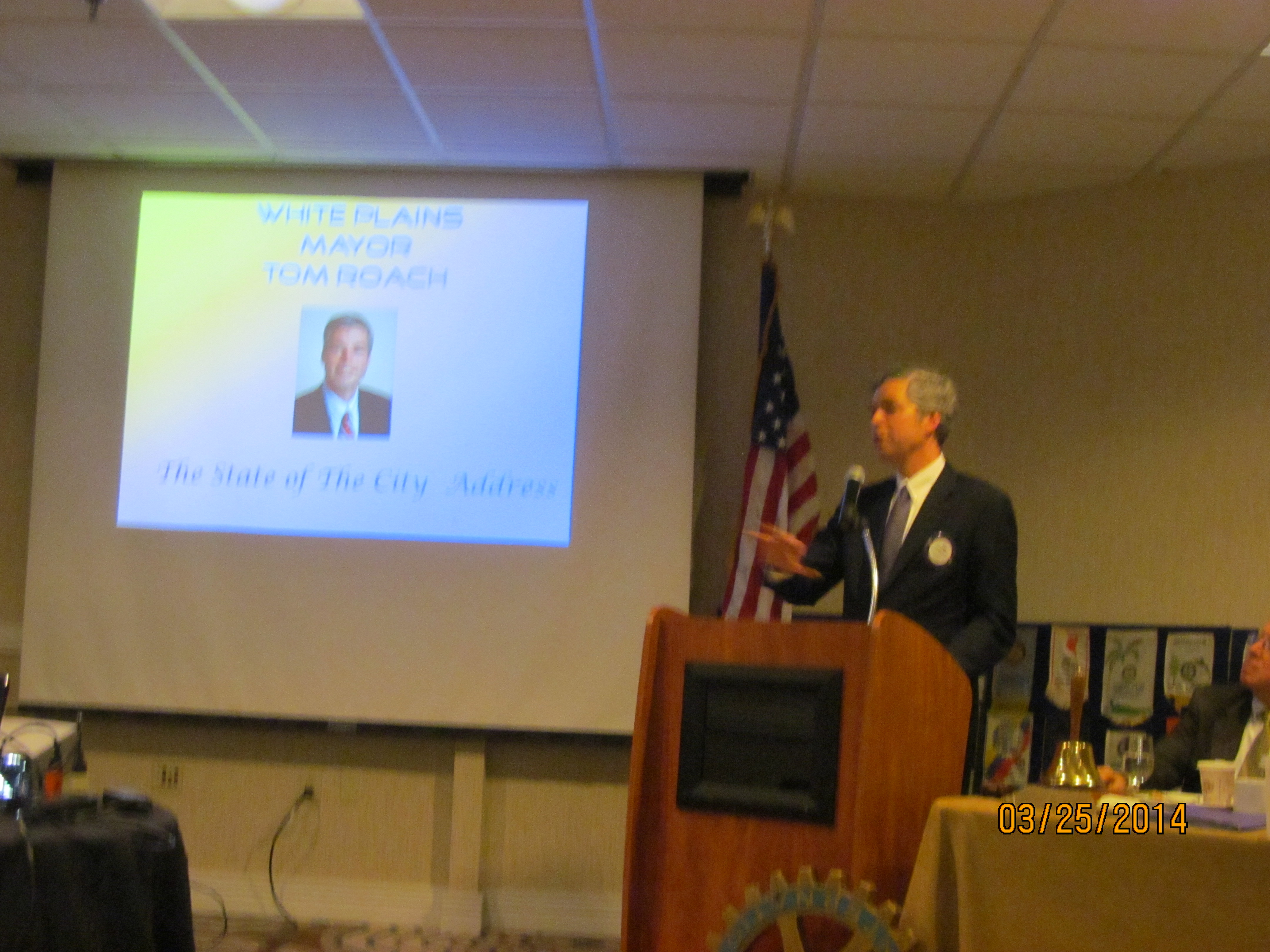
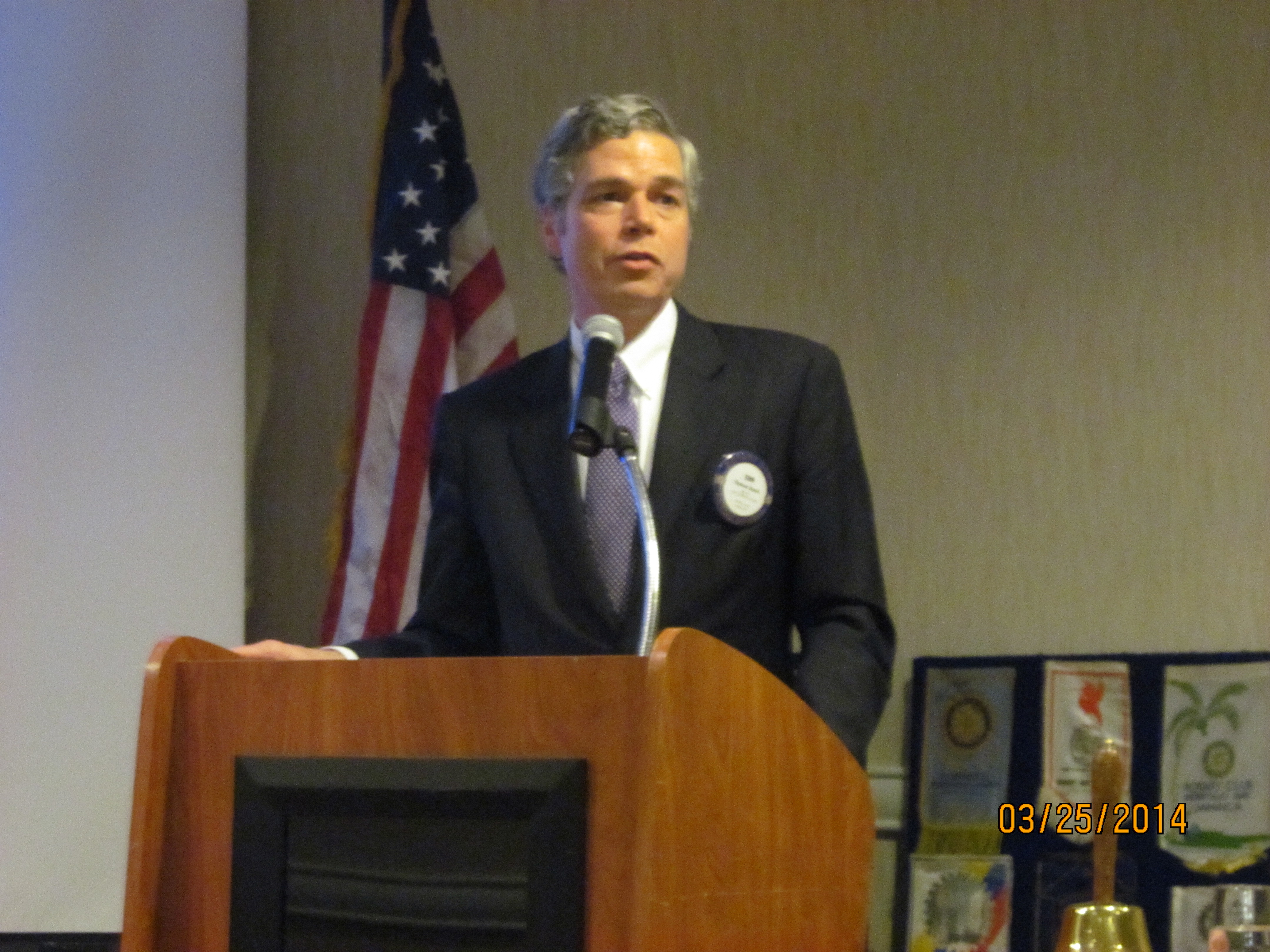
State of the City: Mayor Thomas Roach addressing the White Plains Rotary Club Tuesday.

WPCNR AT LARGE. By John F. Bailey. March 26,2014:

White Plains Mayor Thomas Roach attracted over 50 Rotarians and guests to Tuesday’s meeting of the White Plains Rotary Club at the Crowne Plaza.  Using a mixture of folksy self-deprecating humor and very positive developments starting to unfold, entertained and informed painting a positive “State of the City.”

He closed his 30-minute talk saying the city’s new “AA-1 Stable” bond rating, showed that the city staying within Governor Cuomo’s tax cap and sticking to its money-saving endeavors has created an environment businesses were looking at seriously.

2014325stateofcity 018

“White Plains is number one. There is not one developable or vacant property that is not being looked at,” he said. “We are the kind of environment businesses want.”

He talked in tantalizing candor on these city development issues:

BUS RAPID TRANSIT—Corridor direct to WHITE PLAINS TRAIN STATION.

He lead off with interesting developments coming out of his service  on the Governor’s Mass Transit Task Force.

He said  the force discovered  the majority of commuters from Rockland County do not commute to New York City, but commute to Westchester. This convinced the Task Force that  a rail link across the Tappan Zee Bridge and across Westchester County would not only not be used, but a rail link was cost-prohibitive.

Roach said that the Task Force determined that,  to build commuter rail across Westchester County, a tunnel would have to be built under the Town of Greenburgh and would cost millions.

The Mayor commented that in order to commute by rail to Stamford, the Rockland resident now has to take a train south to 125th Street and change trains to travel to Stamford. The Task Force, he said, saw that Bus Rapid Transit with modern buses, a station-based ticketing system with no fare box on the bus, and frequent buses was more practical and could be used in conjunction with the Westchester County Beeline System.

The plan: to skirt the Route 119 bottleneck into White Plains

Roach said that the Task Force recognized that running the Bus Rapid Transit system along the Route 119 Corridor had its problems. He said he advocated to the Task Force a traffic “Connector Corridor”  to be built through the County Parking lot at the County Center (bypassing the rush hour traffic that bottlenecks Route 119) coming into White Plains perhaps under the tracks.  He reported the Task Force was at this time positive about his suggested approach.

Roach said the city was in the first stages of beginning a feasibility and possibility study using the state $1 Million grant given the City of White Plains to study development around the White Plains Railroad Station. The study would gather ideas about what White Plains citizens want. He noted, too that White Plains is the number one destination out of New York City during rush hour.

New Tappan Zee Bridge will not solve the I-287 wall of traffic

Roach expressed concern that when the new Tappan Zee Bridge is built, unless the daily rush hour jams on I 287 eastbound in mornings and westbound evenings were addressed the new bridge would not be effective. “Traffic starts in White Plains (on I-287),” he said. He said the state is aware of this reality, but has not said how they plan to alleviate it. He points out that even with the 4 lanes eastbound from the new Tappan Zee Bridge, those 4 lanes still would have to hit the wall of traffic of the three lane eastbound I 287 and merge.

2014325stateofcity 023

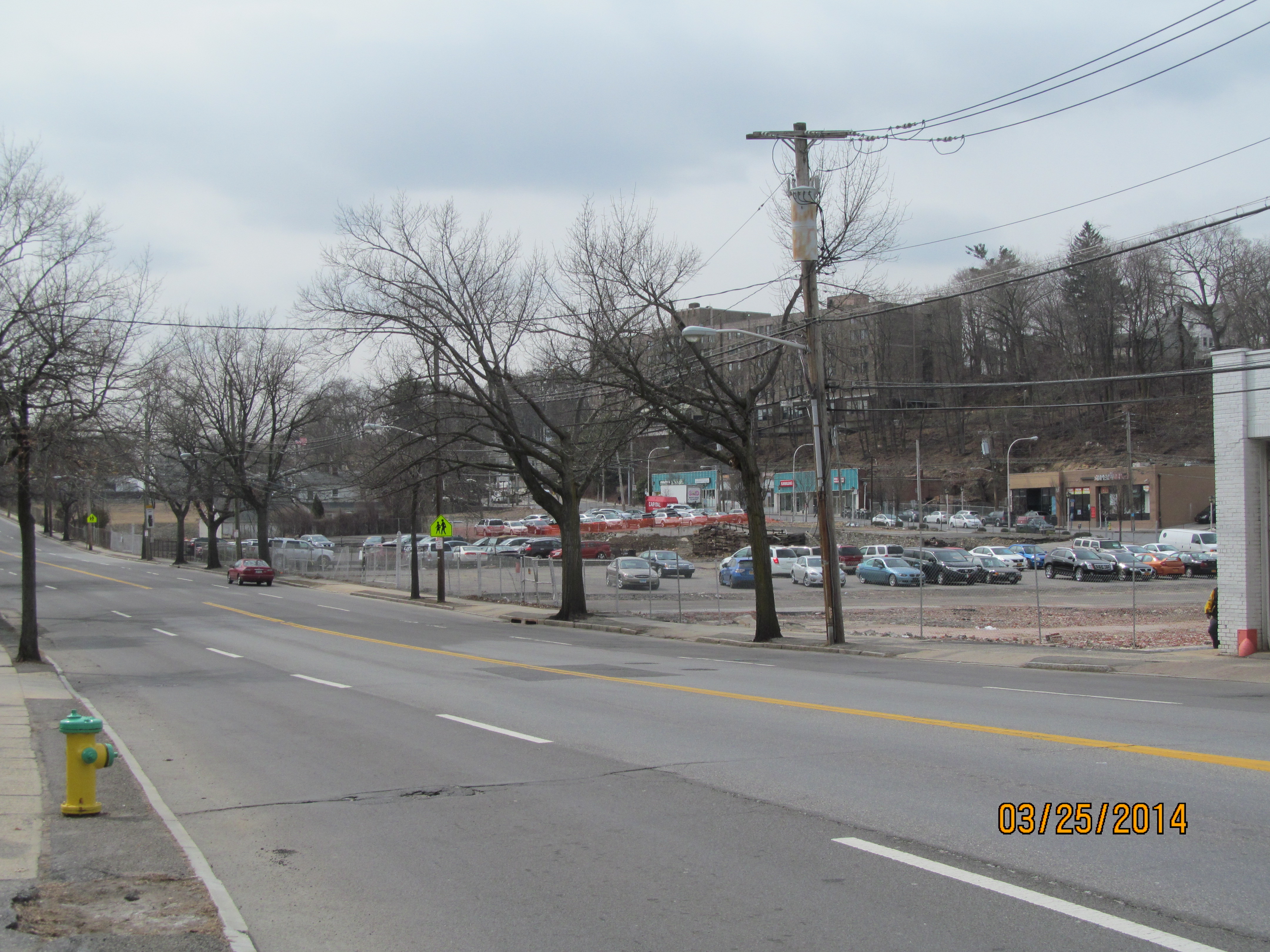
Site of the Grid Properties planned development (in process of being designed). Townhouses, the Mayor said are planned for the North side of Maple Avenue (foreground) and the retail mall would be the farside of the triangular property fronting West Post Road.

The Grid Properties Plan for the West Side on W. Post Road and Maple

The Mayor took on the mystery Grid Properties development currently being tweaked by the Grid organization.

The Mayor said at this point extensive retail would be built on the West Post Road side of the triangular former Sholz property, and would be relieved by a string of townhouses to front on Maple Avenue – no idea on how many, how the parking would be. The Mayor said his philosophy is to give the close-in neighborhoods  adjacent new developments  development “that would enhance them.”

Mark Weingarten, of  DelBello, Donnellan, Weingarten, Wise & Wiederkehr speaking for Grid Properties, asked by WPCNR to confirm the commitment to townhouses on the site with the retail, gave this written statement:

Again, no final decisions have been made as of today. Our client has drawn up many different scenarios for review and analysis. When our client is ready to share its vision with the City and the public, we will inform you.

2014325stateofcity 021

The White Plains Pavilion property looking West Northwest across Maple Avenue.. Crowne Plaza Hotel is at far right.

The White Plains Pavilion Project

The Mayor told Rotary, the owners of the Pavilion are requesting a zoning change for mixed use to redevelop the site.  He noted the zoning change has not been approved by the Common Council yet.

However, the Mayor told Rotary about a design that would have a threshold reminiscent of Rome’s Spanish Steps leading up from the Crowne Plaza Hotel that from the sounds of it would be totally unique in the metropolitan area.

On the north side of the steps, Roach said would be a series retail and restaurants, perhaps at the top of the steps a hotel, and fronting on Maple Avenue would be residential buildings, he said would compliment the new apartments going up on DeKalb. The idea appeared created a buzz in the audience.

The  Cambria Suites Hotel

Mayor Roach told Rotarians that the Cambria Suites hotel going up on Main Street, is scheduled to be finished in June, and would contain a Japanese Steak House and a Chipotle Grill in the hotel itself.

Winbrook Revitalization.

Mayor Roach said the city was close to holding a groundbreaking for the first building of the Winbrook Revitalization (which currently continues to be picketed by the Brotherhood of Operating Engineers, protesting the  use of  non-union labor being used by Jonathan Rose, the developer, work continues). Roach said the complex continues to be seen as a mixed use project with retail and businesses on the Lexington Avenue side, and the new residences being of mixed incomes.

French American School of New York

In the question and answer period that followed, the Mayor said the French American School of New York site plan for the former Ridgeway Country Club is being awaited by the city, and after it is received new public hearings on the site plan would begin again.

He did not mention any details of the 2014-15 city budget that is due the first week in April and was not asked about it.

Posted in Uncategorized

NY Doctor Charged in $85 Million Medicare Fraud

Hits: 378

WPCNR FBI WIRE. From the Federal Bureau of Investigation. March 25, 2014:

A criminal complaint was unsealed Tuesday  morning in Brooklyn federal court charging Dr. Syed Imran Ahmed, 49, with health care fraud in connection with his submission of millions of dollars in false Medicare billings.

Seizure warrants seeking millions of dollars of the defendant’s alleged ill-gotten gains, including the contents of seven bank accounts, were also unsealed.

In addition, a civil forfeiture complaint was also filed today against the defendant’s residence located in Muttontown, New York, valued at approximately $4 million

Further, earlier today search warrants were executed at six locations in New York, Michigan, and Nevada.

The charges were announced by Loretta E. Lynch, United States Attorney for the Eastern District of New York; David O’Neil, Acting Assistant Attorney General of the Justice Department’s Criminal Division; George Venizelos, Assistant Director in Charge, Federal Bureau of Investigation, New York Field Office; and Thomas O’Donnell, Special Agent in Charge, Department of Health and Human Services-Office of Inspector General (HHS-OIG).

As alleged in the complaint, Ahmed engaged in a scheme to submit claims to Medicare for surgical procedures that were not in fact performed.

The complaint cites multiple instances in which either patients told law enforcement officers that they never had the procedures that were billed, or hospital medical records did not contain any evidence that the procedures were actually performed. From January 2011 through mid-December 2013, Medicare was billed at least $85 million for surgical procedures by Ahmed, a sole practitioner.

“As alleged, Ahmed created phantom medical procedures to steal very real taxpayer money. The defendant sought to enrich himself and fund his lifestyle through billing Medicare for services he never performed,” stated United States Attorney Lynch. “We are committed to protecting these taxpayer-funded programs and prosecuting those who steal from them.”

“The Medicare system entrusts doctors to provide patients with the care and services they need,” said Acting Assistant Attorney General O’Neil. “The charges unsealed today allege that Dr. Ahmed billed millions of dollars to Medicare for surgical procedures that he did not actually perform. These charges are yet another example of the Department of Justice’s determination to hold accountable those who abuse the trust placed in them and steal from the system for personal gain.”

FBI Assistant Director in Charge Venizelos stated, “Fraudulently billing the government defrauds every American taxpayer. We will investigate cases of graft and greed to protect important programs for those who need them.”

“For a single physician, the alleged conduct in this case is among the most serious I’ve seen in my law enforcement career,” said SAC for HHS-OIG O’Donnell. “Being a Medicare provider is a privilege, not a right. When Dr. Ahmed allegedly billed Medicare for procedures he never performed, he violated the basic trust that taxpayers extend to health care providers.”

The investigation has been conducted by the FBI and HHS-OIG, brought as part of the Medicare Fraud Strike Force, and supervised by the U.S. Attorney’s Office for the Eastern District of New York and the Criminal Division’s Fraud Section. The case is being prosecuted by Trial Attorney Turner Buford of the Criminal Division’s Fraud Section and Assistant United States Attorneys William Campos and Erin Argo of the U.S. Attorney’s Office for the Eastern District of New York.

The charges in the complaint are merely allegations, and the defendant is presumed innocent unless and until proven guilty. If convicted, the defendant faces a maximum sentence of 10 years.

Since its inception in March 2007, the Medicare Fraud Strike Force, now operating in nine cities across the country, has charged more than 1,480 defendants who have collectively billed the Medicare program for more than $4.8 billion. In addition, HHS’s Centers for Medicare and Medicaid Services, working in conjunction with HHS- OIG, is taking steps to increase accountability and decrease the presence of fraudulent providers.

To learn more about the Health Care Fraud Prevention and Enforcement Action Team (HEAT), go to: www.stopmedicarefraud.gov.

The Defendant:
SYED IMRAN AHMED
Age: 49
Glen Head, New York

Posted in Uncategorized

WPHS SENIOR NAMED NATIONAL MERIT SCHOLARSHIP FINALIST

Hits: 435

WPCNR SCHOOL DAYS. From the White Plains City School District. March 25, 2014:

White Plains High School Senior Claire M. Nataro was been named a 2014 National Merit Scholarship Finalist.  She is among the 15,000 Finalists nationwide, selected from 1.5 million entrants. and is now eligible to earn one of the 8,000 National Merit Scholarships.

A member of the Band and an All-County Musician, Nataro has participated in the New York State School Music Association Festival for the last six years.  She is a private flute teacher and is also a member and current Captain of the school’s Swim Team.  Honors she has received include the Yale Book Award, the AP Scholar Award, and National Honor Society recognition.

Selected as a Semifinalist was Max A. Golden, and the following were named Commended Students:  Louisa C. Abbott, Shamus C. Cardon, Theodore M. Chomiak, Arielle K. Hazi, Sarah A. Lumelsky, Rachel Y. Okun, Vivekanand Tatineni and Samuel L. Woehr.

In the National Achievement Scholarship Program, which provides recognition for outstanding Black American high school students, Ayan S. Waite was named a Winner and Najah A. Banks was named Outstanding Participant.

Five students were named National Hispanic Recognition Scholars:  Brian Laplaca, Kiara R. Barone, David Laguna, Germain Meza and Amanda Soyk.

The National Merit Scholarship Corporation, a not-for-profit organization, was established in 1955 specifically to conduct the National Merit Program, which honors the nation’s academically talented high school seniors and encourages the pursuit of academic excellence.

Posted in Uncategorized

Board of Legislators Review Parking Plan for Playland. Satellite Parking areas; Private Security Force introduced

Hits: 420

WPCNR COUNTY CLARION-LEDGER. From the Westchester County Board of Legislators. March 25, 2014:

Members of the Westchester County Board of Legislators (BOL) raised important questions today during a review of the Traffic and Parking Report for the revitalization of Playland at a meeting of the BOL Labor/Parks/Planning/Housing Committee (LPPH), chaired by Legislator Pete Harckham (D-North Salem).

Executives from Sustainable Playland, Inc. (SPI) attended the BOL committee meeting and imparted further details of their Playland Improvement Plan (PIP), which included several major changes to the traffic flow and parking capacity at Playland made necessary with the opening of a new, 82,000 square-foot Field House planned for Westchester’s iconic 280-acre recreation area and amusement park.

“The goal here is to ensure, through a collaborative and open process, that Playland is a financial success for all the stakeholders, especially the county’s taxpayers,” said Harckham. “The proposed changes to the park need to be made in consideration of a number of questions and different factors. We’re on the right track toward getting the answers we need so the Committee’s analysis can go forward.”

During today’s presentation the legislators learned that some peak attendance dates at Playland would bring in more vehicular traffic than could be handled by the parking areas proposed in the PIP. Construction and planned use of the Field House and Playing Fields will take up some of the existing parking spaces. Also, a new traffic ingress to the part of the Playland property where the Field House will be situated is planned.

“Today, we were given a lot of new information about getting patrons in and out of Playland safely and comfortably, and the impact some of the changes will have on parking availability,” said BOL Majority Leader Catherine Borgia (D-Ossining). “There are now more questions, however, about whether the effort to make Playland a popular year-round destination meshes with SPI’s desire to keep attendance at a certain limit. I am eager to receive more information about how this will be resolved.”

SPI announced today that satellite parking areas will be developed as well, to deal with parking overflow on busy days and nights at Playland.

Also, a private enforcement agency will be hired to keep patrons from parking on neighboring streets and walking over to Playland.

“It was good to have a discussion with SPI to address parking issues at Playland,” said BOL Chairman Michael Kaplowitz (D-Somers). “Parking remains one of the primary issues of concern for the Board of Legislators, as it is for the residents who live near the park.  Legislator Harckham’s committee continues to work through the review process for SPI’s plans, and I’m confident that our oversight here at the Board of Legislators will make the Playland Improvement Plan the best it can be.”


Posted in Uncategorized