WHITE PLAINS WESTCHESTER DAILY NEWS SERVICE VISITS SINCE 2000 A.D. 25TH YEARl REPORTING THE NEWS YOU NEED TO KNOW News Service Since 2000 A.D. 2026 WILL BE OUR 26TH YEAR OF COVERING WHITE PLAINS NEW YORK USA . John F. Bailey, Editor (914) 997-1607 wpcnr@aol.com Cell: 914-673-4054. News Politics Personalities Neighborhoods Schools Finance Real Estate Commentary Reviews Policy Correspondence Poetry Philosophy Photojournalism Arts. The WHITE PLAINS CITIZENETREPORTER. TELEVISION: "White Plains Week" News Roundup, 7:30 EDT FRI, 7 EDT MON & the incisive "People to Be Heard" Interview Program 8PM EDT THURS, 7 PM EDT SAT on FIOS CH 45 THROUGHOUT WESTCHESTER AND, ALTICE OPTIMUM WHITE PLAINS CH 1300 Fighting for Truth, Justice and the American Way. TOP 10 VISITORS FROM AROUND THE WORLD :1. USA. 2.BRAZIL3.VIET NAM 4. CHINA 5. JAPAN 6.UK. 7.CANADA. 8.INDIA. 9.AUSTRALIA 10.IRELAND 11.GERMANY 12..ARGENTINA 13.BANGLADESH 14.RUSSIA. 15.NEWZEALAND. 16. FRANCE. 17.MEXICO. 18.UKRAINE. 19.SOUTH AFVRICA. 20. IRAQ.
WHY WE FORGET ABOUT PAST CATASTROPHES : INDIFFERENCE BROUGHT ON BY MEDIA OVERCOVERAGE.
DAILY RATE OF INFECTIONS IN WESTCHESTER CREEPING UP OVER 1,700 BY END OF APRIL
PLUS VIDEO OF MAYOR TOM ROACH ON THE FINANCIAL STATE OF THE CITY AND COUNCILWOMAN JEN PUJA AND COUNCILMAN JOHN MARTIN ON PASSAGE OF THE NEW CELL TOWER ORDINANCE.
County Executive George Latimer is releasing the following statement regarding Holtec informing the Indian Point Energy Center Decommissioning Oversight Board its plan to begin releasing treated wastewater from the shutdown nuclear power plant into the Hudson River next month.
“The announcement by Holtec to expedite this plan, in the midst of ongoing discussions with State officials, community stakeholders and local municipalities, is an outrageous one.
The impacted communities have far too much at stake for any treated water dumping to occur on a timeline quicker than what was expected.
It is a mistake for Holtec to act before full public vetting of all options and acting without convincing residents and local governments why the other options have been overridden for consideration.
Through the Indian Point Decommissioning Board, which the County has a seat at the table on, the County is requesting an exact list of all elements and components which will be tested for.
I am urging Holtec and all parties involved to suspend their current plans, and to hold continued conversations on this decision and any subsequent actions that may be taken in order to ensure that residents of and visitors to our beautiful, scenic riverfronts are best protected.”
WPCNR THE LETTER TICKER.From Greenburgh Supervisor Paul Feiner. April 5, 2023:
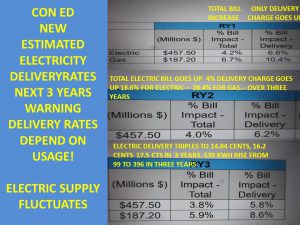
On the 5th of each month the town of Greenburgh posts comparisons on the Greenburgh website – Con Ed rates vs Sustainable Westchester rates. Residents of 29 municipalities in Westchester- including Greenburgh -have enrolled in the ESCO. Residents are automatically enrolled unless they opt out. Sustainable Westchester rates can’t go up or down until October 2024. Con Ed rates can fluctuate. Sustainable Westchester purchases green power (solar, wind)–that is good for the environment.
In recent months Con Ed rates have been lower than the ESCO rates. In March the average Con Ed standard rates was 8.01 cents per kWh. The rates for Sustainable Westchester’s Westchester Power ESCO was 15.13 cents per kWh. Sustainable Westchester also offers residents in the 29 municipalities a non green option which was 13.36 per kWh.
Sustainable Westchester has agreed to send a letter to residents in each of the 29 municipalities advising them that Con Ed rates are currently lower than the ESCOs and providing ratepayers with information as to how to opt out if they wish to. People can opt in or out anytime. The letter from Sustainable Westchester should be sent out next week.
This is what I posted on the town website (click link). The information was provided by Sustainable Westchester
Our customers helped us take the fight to scammers last year by reporting suspicious emails, texts, and phone calls. Each report matters. In 2022, we made significant strides to protect our customers:
We initiated takedowns of more than 20,000 phishing websites and 10,000 phone numbers that were used as part of impersonation scams.
We referred 100s of bad actors across the globe to law enforcement to help them ensure these scammers are held accountable.
PROTECT YOURSELF FROM SCAMMERS
Be careful installing apps or software
Amazon will not ask you to install an app or download software in order to receive a refund or to get help from customer service.
Never pay over the phone
Amazon will not ask you to provide payment information, including gift cards (or “verification cards,” as some scammers call them), for products or services over the phone.
Always verify orders directly with Amazon
Amazon will not include purchased product information in order confirmation and shipping confirmation emails we send to customers. For any questions related to an order, always check Your Orders on Amazon.com or via the “Amazon Shopping” app.
Be wary of false urgency
Amazon will not pressure you to act now. Scammers may try to create a sense of urgency to persuade you to do what they’re asking.
If you receive communication — a call, text, or email — that you think may not be from Amazon, please report it to us at amazon.com/reportascam
Visit the Message Center on our website to review emails from Amazon. For more information on how to stay safe online, visit Security & Privacy on the Amazon Customer Service page.
Events like COVID-19 and mass shootings are hugely impactful to our society. Unfortunately, as time passes, we don’t do a great job at recalling events, integrating those events into our lives, or using those experiences to make future decisions/judgments.
Simply put, we forget.
Why and how
The mechanics of memories are relatively clear: a combination of neurons, a memory center in our brain, a process to consolidate memories during sleep, and a process to retrieve memories.
However, social psychologists have been grappling with a very different and challenging question for almost 100 years—not how we forget, but why.
The field has essentially settled on two overarching reasons:
Infodemic. We are simply inundated with too much information to retain it all. This information overload is at least partially responsible for our forgetfulness.
Biases. To wade through all of this information, we use shortcuts, or heuristics. These are mostly good and effective, but the human brain isn’t like a computer—it’s not just data in, data out. The way we think about things is not purely logical; biases and mental shortcuts have a large effect on memories.
Four biases influence memory
How we remember and make decisions is largely driven by our experiences. It makes it easier to remember certain things while forgetting others. There are many biases contributing to this, but four that are especially relevant:
Immune neglect. Just like our body’s physical immune system helps us stay healthy, we also have an emotional immune system that helps us be psychologically resilient. On balance, this is a good thing, allowing us to bounce back from difficult situations more quickly. The fear, outrage, or other negative emotions that big events arouse often don’t last that long, which impacts judgment and decision-making in the future.
Example: The motivation to make a change feels so strong in the immediate aftermath of a mass shooting, but is often shorter-lived than necessary to implement change. Most people get back to their lives as their emotional immune systems allow them to return to normal.
Availability (or recency) bias. When we make decisions, we don’t weigh the pros and cons equally; some things count more than others for individuals. Things that readily come to mind will sway us more, regardless of their actual importance or value, than those that are harder to recall.
Example: The early days of lockdowns, sanitizing groceries, and masking are, for many people, in the past. This makes the details of those bygone times difficult to recall and causes more recent, less frantic memories to impact our decisions.
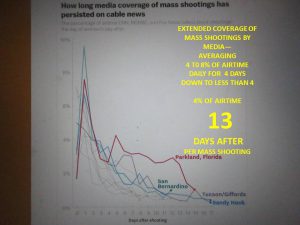
Example: News coverage is a two-way street. As time from an event increases, people are less likely to click on articles about it, and articles are therefore less likely to cover these topics. The media coverage of mass shootings significantly declines over time. This makes it easier to forget for those outside of the directly impacted community.
Hindsight bias. “I knew it all along!” Humans tend to overestimate their ability to predict what, in reality, was an unpredictable event. This can negatively affect our memory and decision-making in the future.
Example: “We shoulda known _____!” This will negatively contribute to decisions about preparing for the future of COVID—or even the possibility of the next pandemic. Overconfidence can be detrimental, as some will feel like they will be able to predict or foresee the next big thing.
Cognitive dissonance. Early 2020 was horrible, and things are much better now . . . but not all the way better. This reconsideration of a past big event—that sucked, but now things are good—can feel off-putting or inconsistent. Wanting to resolve that inconsistency, people may discount how bad things were then, instead focusing on how good they are now.
Example: Each time a mass shooting occurs, millions of people could have the same reaction: wow, that’s horrifying, but I wasn’t personally affected. This inconsistency of thought feels uncomfortable, as we might think we should be feeling 100% bad. To make ourselves feel better, we might convince ourselves that, actually, the shooting wasn’t so bad; these cognitive gymnastics could hinder large-scale responses like long-term government action.
What we can do about it
Although these biases are generally unavoidable, the news isn’t all bad. Studies show that we are particularly prone to using these shortcuts in certain situations, like when we are tired, hungry, or stressed out. Addressing these, before or during decision-making, can help.
What’s more, research indicates that simple awareness of the biases can reduce their influence on us. In other words, we can help short-circuit them by simply shining light.
Bottom line
Memories of the same event do not look the same for everyone. Sometimes the event doesn’t even become a memory at all. Humans have evolved to use mental shortcuts to more smoothly navigate the world.
Unfortunately, this typically means normalizing events—like a pandemic or mass shootings—which will ultimately hurt us in the end, leading to a lack of pandemic preparedness or insufficient pushes for gun reform. This can lead us into the never-ending cycle of panic and neglect unless we actively fight against it.
“Your Local Epidemiologist (YLE)” is written by Dr. Katelyn Jetelina, MPH PhD—an epidemiologist, data scientist, wife. During the day she works at a nonpartisan health policy think tank and is a senior scientific consultant to a number of organizations, including the CDC. At night she writes this newsletter. Her main goal is to “translate” the ever-evolving public health science so that people will be well equipped to make evidence-based decisions. This newsletter is free thanks to the generous support of fellow YLE community members. To support this effort, subscribe below:
Con Ed is seeking permission from the NYS Public Service Commission to raise electric rates over a three year period by an average of 20% for electric rates and 31% for gas rates. They are seeking to upgrade their electric delivery system and upgrade its gas system.
I believe that addressing infrastructure is important. But, also believe that the rate hikes should not be paid for by Con Ed customers instead of by Con Ed stockholders Con Ed continues to report large profits. In 2022 Con Ed reported net income for common stock of $1,620 million or $4.68 a share compared with $1,346 million or $3.86 a share in 2021. Adjusted earnings were $1,620 million or $4.57 a share in 2022 compared with $1,528 million or $4.39 a share in 2021.
The NYS Public Service Commission should take into account Con Ed’s profits when deciding whether a rate hike should be approved.
Con Ed is seeking a rate hike. If you would like to comment before the Public Service Commission please click onto the following link.
WPCNR QUARTERLY STATE OF LIFE SERIES # 7. News & Comment By John F. Bailey. March 29, 2023:
It’s coming.
It is coming up.It is one week away.Good Friday.Let us imagine what it was like.
It is late afternoon now in the Jerusalem of 33 A.D. Jesus of Nazereth has died on the cross in between two thieves. The three crosses can be seen on the distant hill.
He died 1,990 years ago on that cross this April 7. There was no CNN, No Fox News, showing live coverage, no internet, no newspapers,radio or television. No Twitter or Facebook. No Instagram,Skype, or Google.
Nevertheless the message of the man who died on Calvary (The Place of the Skull) spread around the world without mass communication.
His followers, twelve of them were so devoted to His message of love and code of behavior they became the first pacifist activists who spread a message the man they called their Lord had preached to them.
He was Jesus of Nazareth. He had no last name.
Today He is now known all over the world for the message he delivered.
Whether you believe He is the Son of God, or not, He ranks as one of the foremost influences on mankind. More than Plato, more than Socrates, more than any leader or politician, or entertainer whoever lived.
His selfless acts of embracing lepers, the poor, those who sinned were unique.
Such compassion for the downtrodden was unheard of during the time He lived.
It was a time of slavery. No human rights. No care for the sick. When cities were razed and populations slaughtered or enslaved much like the genocides of today. Our world today must feel the same way as it did then.
Jesus of Nazareth introduced a new philosophy that spread throughout the world after His death by crucifixion on this day (maybe, we do not know the exact date), because the community leaders of his own people thought him a threat to their power. And that fear that this simple man was a threat should be a lesson to us all.
If you live by His philosophy of forgiveness you are a person at peace with yourself. If you accept those who are different from you without fear or prejudice, you are a force for spreading His message of peace towards others and good will.
If you help the poor and the sick because you sympathize with them, you are following His way.
If you stand up for truth, point out what is wrong as He did with the Pharisees. You are doing his will.
If you go about doing good for the sake of doing good, you are following His virtue of selflessness.
Jesus of Nazareth’s message whether divine or a code of how we conduct our lives resonated with millions and it spread.
There is no denying He is one of the great philosophers of the human experience, kin to Socrates, the other giant of antiquity thought.
The above print of “The Return from Calvary” painted by Herbert Schmalz shows the last hours of Jesus of Nazareth’s crucifixation around 33 A.D. on Calvary Hill, “the place of the Skull” outside of Jerusalem late in the day He was crucified.
The description on the print describes the somber scene:
The darkness which was on the earth (during His suffering) is clearing away.
One long, dark cloud is hanging over the city like a pall.
The Virgin Mother, weighted down by fatigue and grief, knowing not wither she goes, is being led up some steps, toward “his own” home, by St. John and Mary Magdalene.
In the distance on the top of Cavalry, you can make out the three crosses.
The grief so eloquently captured by this print depicts the very personal loss all of us endure when someone we love passes away, realizing our loss because of all they did for us.
Jesus of Nazareth was a human being who affects us to this day.
One of the great gifts of this man, Jesus of Nazareth, is the celebration of humanity and capacity to care and feel for others that aids persons whether they believe He was the Son of God or not. Or that you will have eternal life if you believe in him.
His philosophies of care, courage, compassion and benevolent action serve the people who try to do those behaviors well because they leave a great personal satisfaction in the heart, the mind, and the spirit.
You do not have to second guess yourself, when you do what is right, humane, merciful, and serves the less fortunate without superiority with nothing to gain for yourself. And if you do not do what is right, if you weaken, you always regret it and remember when you failed to do right.
The peace of mind of action is the least of the great gift of Jesus of Nazareth whose death on the cross is marked the Good Friday coming in one week, April 7
If you act as Jesus did, you will be remembered by all you meet fondly and lovingly, and be comforted that you will live in memories of those you have touched with your love and kindness and caring for eternity to the end of the age.
His simple teachings have great power. Use them. Implement them.
They give meaning to our mystery of life.
They give meaning and purpose to anyone’s life.
For 1,990 years they have made a violent world a better place.