Michael Keating’s Role in Shaping the Politics of the White Plains of Today by White Plains Historian

Hits: 230

WPCNR IT HAPPENED IN OLD WHITE PLAINS. An excerpt from the White Plains Historical Society publication, IT HAPPENED IN OLD WHITE PLAINS by Renoda Hoffman. Published with permission of the Society:

Editor’s Note: Former Councilman and Mayor Michael J. Keating who died Sunday, figured prominently in a tumultuous period in White Plains history. As White Plains historian, Renoda Hoffman recounts in the White Plains Historical Society book, It Happened in Old White Plains: Here is her account of Mr. Keating’s role in the events of the mid-1970s  that changed White Plains politics in her book:

Carl J. Delfino became the city’s eleventh mayor when he took office on New Year’s Day in 1974. Hospitalized for a Toer infection five days later, he suffered a stroke  on January 18th and did not return to his home until March where he remained incommunicado.

Council President Harry Gordon, who had been acting Mayor, resigned on May 3rd, reducing the Common Council to four members, two Republicans and two Democrats. This was followed by so much debating and in-fighting that no agreement on either an acting or interim mayor could be reached.

On May 22, 1974, a State Supreme Court justice ruled that Democrat Michael J. Keating should, as senior councilman, perform as acting Mayor. This settled only one problem.

A Special Election held in July put two more Democrats on the Counil. Mary Ann Keenan  and Wirth Koenig joined fellow Democrats Keating and Alfred Del Vecchio in opposition to Republicans Michael M. Coffey and William Rose, Jr.

On July 18th, Mayor (Carl) Delfino’s resignation was submitted, but nine days before the resignation was to become effective, Delfino died, aged 53. His loss was a shock to the entire community.

On August  14th ,1974, the Democratic Party nominated Keating as their candidate to run for mayor in November. But agreement on who should assume the duties of interim  mayor for the next five months could not be reached. Names were presented to  the council and rejected by tie vote.

To break the deadlock, the name of Richard Maass was presented to the council. Maass was a well-known Democrat respected by bnoth parties and well qualified, although he had never held elective office.

Unexpectedly, Councilman Rose switched his vote to break the tie and the city had its twelfth mayor. On August 20th, 1974. Maass, a 56-year-old investment and real estate  broker, became the first Democrat to serve as mayor since Ffarrington Thompson’s term ended in 1921.

Four months of bitter political fighting was over.

In the November special election, 36-year-old  Michael Keating, an attorney, Philadelphia-born and resident of White Plains for 13 years, was elected mayor. On January 1st, 1975, he was sworn in to complete Delfino’s unexpired term.

In the fall of 1975, (the Mayor’s term then being just two years an election was held  for the next two year Mayor), Councilman Alfred Del  Vecchio, 52-year-old  professional engineer, professor of mechanical engineering at Manhattan College, and Democrat-turned-Republican defeated Keating by a slim margin.

Two years later in 1977, Del Veccho became the city’s first four-year mayor upon passage of a local law amending the city charter. He was re-elected to four-year terms in 1981 and 1985.

Editor’s note: In 1993, with Mayor Del Vecchio seeking a sixth term , Mr. Keating  and Michael Coffey would challenge Mr. Del Vecchio in a Republican Primary in October. Mr. Coffey won and secured  the Republican nomination. against Democrat Sy Schulman. Mr. Del Vecchio was nominated to run on the Conservative line. In the three man race,  Mr. Del Vecchio and Mr. Coffey split the Republican vote and Mr. Schulman won ending Mr. Del Vecchio’s 18 years as Mayor of White Plains. Ms. Hoffman’s book and other exclusive publications and historical items  may be purchased at the White Plains Historical Society Gift shop, at http://www.whiteplainshistory.org/giftshop.html
Posted in Uncategorized

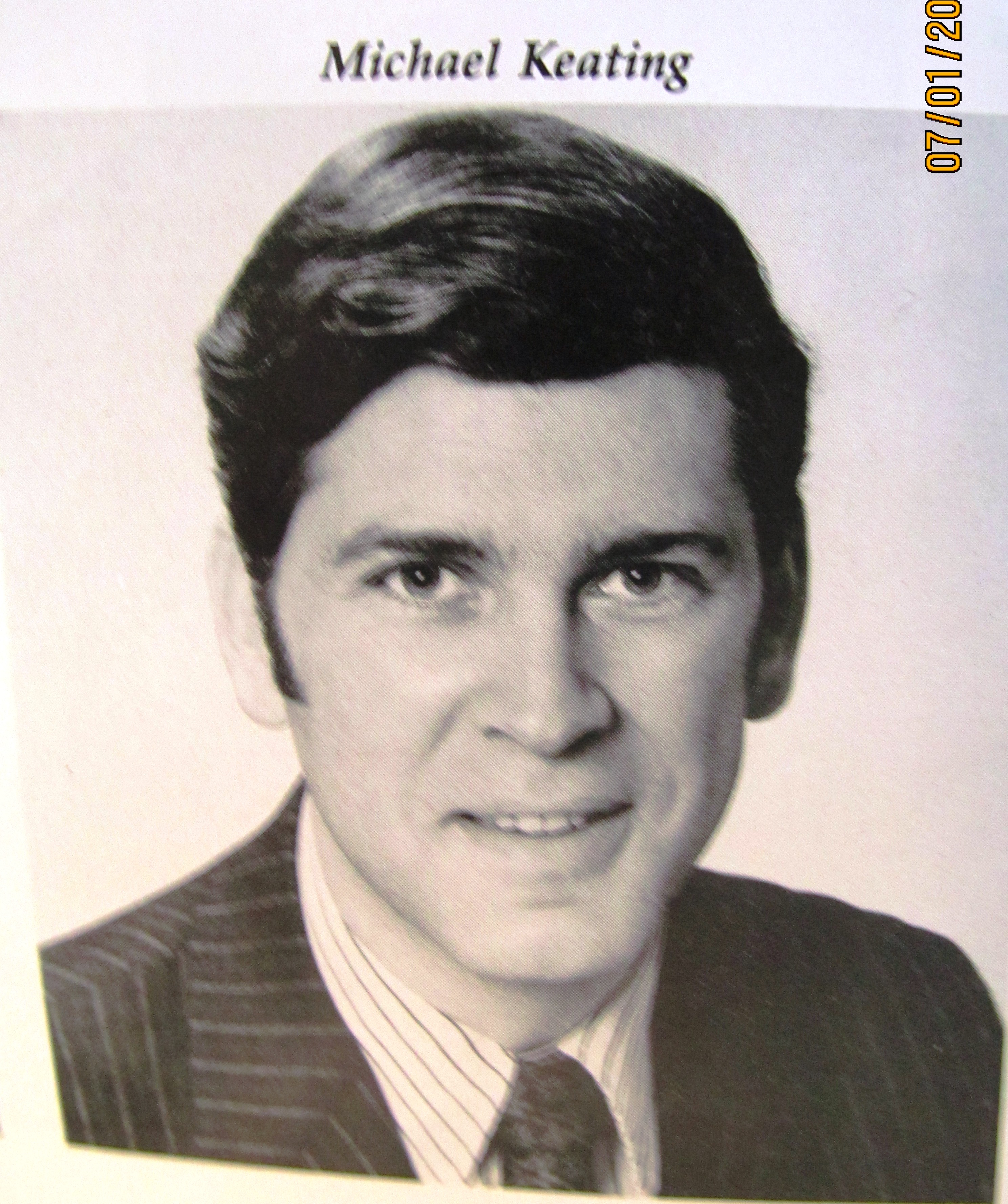
Michael Keating: Former Councilman and Mayor, Dies.

Hits: 271

2014630-city 085
WPCNR MILESTONES. From McMahon, Lyon & Hartnett Funeral Home. July 1, 2014:
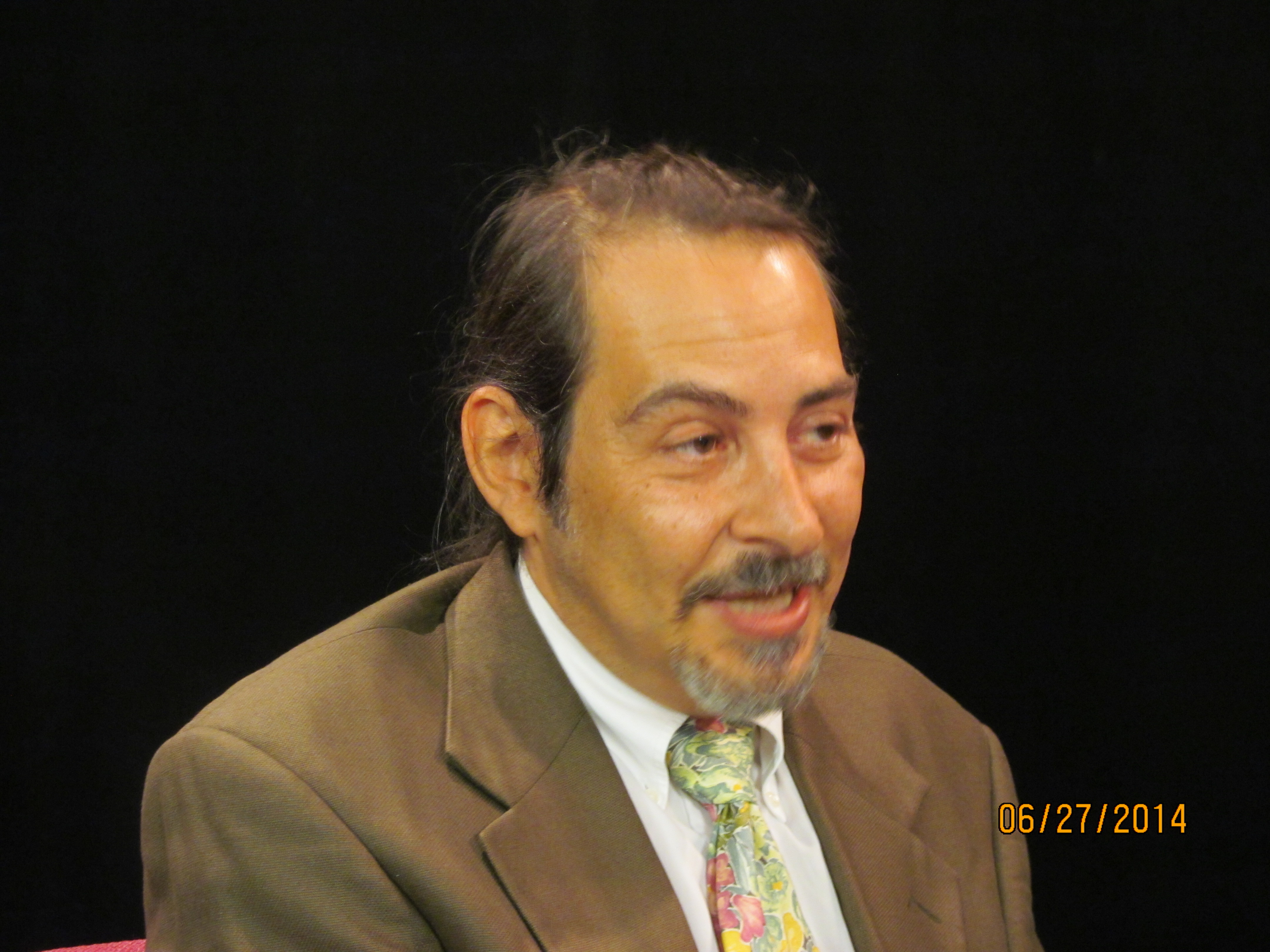
Michael Keating, the former Councilman and Mayor of White Plains, passed away on June 29, 2014 at the age of 75.
He was born in Philadelphia, PA to the late Mary (Jordan) & Patrick Keating on May 31, 1939. Michael married his wife, Rebecca, in Santa Barbara, CA on June 26, 1965. Together they have 2 children: Mary Brooks Keating & James O’Malley Keating, both of White Plains. Also surviving is a grandchild Nico Talia Keating and 2 sisters; Corinne Keating Devereux & Jane Keating Ryan.
Michael was a graduate of Power Memorial Academy in NYC , Villanova & NYU Law School. He was a self-employed attorney. He served on the White Plains Common Council from 1970-1973. He was elected President of the Common Council in 1974 and was appointed Acting Mayor later that year when his predecessor, Carl Delfino, died in office. He was elected to the mayoralty in 1975 serving a one-year term.
As a Councilman, Michael was instrumental in preventing the erection of a huge elevated feeder route into White Plains that would have blighted both the shopping district and certain residential areas of the city (Battle Hill).
As Mayor, he was responsible for major decisions concerning the development of the extensive urban renewal area in downtown White Plains. Those decisions transformed the city into the dynamic urban center that it is today.
Visitation will be Wednesday 2-4 & 7-9PM at McMahon Funeral Home 491 Mamaroneck Avenue, White Plains, New York.
. Mass of Christian burial will be Thursday 10 AM at Mt Carmel Church with interment to follow at Gate of Heaven Cemetery. In lieu of flowers, please make a donation to Red Cloud Indian School, 100 Mission Drive, Pine Ridge, S.D. 57770 in Michael’s name.
Posted in Uncategorized

Governor Cuomo Announces Plan to End “AIDS EPIDEMIC’ in State

Hits: 361

WPCNR ALBANY ROUNDS. From the Office of the Governor. June 29, 2014:

Governor Andrew M. Cuomo today announced a three-point plan to “bend the curve” and decrease new HIV infections to the point where the number of people living with HIV in New York State is reduced for the first time. The end of the AIDS epidemic in New York will occur when the total number of new HIV infections has fallen below the number of HIV-related deaths.

The “Bending the Curve” three-point program includes:

1. Identifying persons with HIV who remain undiagnosed and linking them to health care;
2. Linking and retaining persons diagnosed with HIV to health care and getting them on anti-HIV therapy to maximize HIV virus suppression so they remain healthy and prevent further transmission; and
3. Providing access to Pre-Exposure Prophylaxis (PrEP) for high-risk persons to keep them HIV negative.

“Thirty years ago, New York was the epicenter of the AIDS crisis — today I am proud to announce that we are in a position to be the first state in the nation committed to ending this epidemic,” said Governor Cuomo. “New York State has reached an important milestone in controlling the AIDS epidemic, and through this comprehensive strategy, we are decreasing new HIV infections to the point where by 2020, the number of persons living with HIV in New York State will be reduced for the first time.”

The first report of AIDS occurred 33 years ago on Thursday, July 3, 1981, with some of the first AIDS cases occurring in New York. The momentum to bring the HIV/AIDS epidemic to a close already exists in New York State. New York has eliminated HIV transmission via blood products; virtually ended mother to child HIV transmission; and decreased new HIV diagnoses due to injection drug use by 96% since the mid-1990s.

While the nation as a whole has seen no decrease in the number of HIV diagnoses, over the last decade, New York State has achieved a 40 percent reduction in new HIV cases and significant decreases in HIV incidence across all categories of race, ethnicity, gender, age, and risk. Although the number of new HIV infections has been declining for a number of years, the total number of New Yorkers living with HIV/AIDS has continued to increase. This is because people with HIV can now live a normal life span and the number of HIV/AIDS deaths is also decreasing.

In 2014, there were 3,000 newly diagnosed HIV infections, down from 14,000 newly diagnosed AIDS cases in 1993. The goal is to reduce the number of new HIV infections to just 750 by 2020; about the same as the number of tuberculosis cases in New York State each year.

“Bending the Curve” will precipitate a dramatic downward trend in new HIV infections beyond the current trend. Though this effort will result in increased HIV medication expenses, it is well worth the investment given the human cost, and over time the initiative will pay for itself. Each averted HIV infection saves almost $400,000 in lifetime medical costs, and by 2020, “Bending the Curve” will save the State an additional $317 million and prevent more than 3,400 new cases of HIV.

This plan would not have been possible without the support of our legislative leaders, and several key policies in support of “Bending the Curve” have already been enacted this year in the budget, including:

• The removal of the requirement for written informed consent to get an HIV test, allowing HIV tests to be ordered through a verbal consent like any other medical test.
• Allowing data collected by the health department to be shared with health care providers to find persons with HIV who have fallen out of care.
• A 30% cap of the proportion of an HIV patient’s income that can be spent on rent, keeping persons with HIV stably housed, which improves their ability to stay on their medication.

Additionally, the New York State Department of Health Medicaid Program has successfully negotiated supplemental rebates with the three pharmaceutical companies representing 70% of the HIV market, AbbVie, Bristol-Myers Squibb, and Gilead; this agreement will further decrease the costs to the state for ensuring all HIV-infected persons are on appropriate medications. Additional pharmaceutical companies may join the agreement.

Housing Works CEO Charles King said, “This step by Governor Cuomo, setting a clear goal to end the AIDS crisis in New York State, is absolutely courageous. In doing so, the Governor is reshaping the way we think about the AIDS epidemic and is setting a new standard for leaders of other jurisdictions in the United States and, indeed, around the world.”

New York City Human Resources Administration Chief Special Services Officer Dan Tietz said, “On this LGBT Pride Day, I greatly applaud Governor Cuomo for boldly leading in our three decade long fight to end the AIDS epidemic. We have the science and means to bring HIV infections below epidemic levels and with the Governor’s and Mayor Bill de Blasio’s smart leadership, we can end AIDS in New York by 2020. HRA is now implementing the 30% rent cap, agreed to by the Mayor and Governor in February, which is another part of this effort to save lives and money. Today’s game-changing action will push other leaders in the U.S. and beyond to take the necessary steps to end the HIV/AIDS epidemic for all.”

Harlem United CEO Steven C. Bussey said, “While we are heartened by the progress we have made in confronting the AIDS epidemic in New York State, we know that we still face an epidemic of crisis proportions for many communities. Governor Cuomo’s announcement to create a plan to end AIDS demonstrates the leadership and political will needed to end the epidemic as we know it in New York State.”

Treatment Action Group Executive Director Mark Harrington said, “The goal is ambitious, but grounded in reality. NYS has always been a leader and center of innovation in the fight against HIV/AIDS. We have seen an almost 40% decrease in new HIV diagnoses in the last decade, with fewer new infections each year, while nationally there has been no decline in the number of new HIV infections diagnosed each year. With continued implementation of the Affordable Care Act and the State’s successful Medicaid reform, we’ve gained the momentum necessary to put more people living with, and at risk for, HIV into primary care and the support services necessary to achieve success.”

Gay Men’s Health Crisis CEO Kelsey Louie said, “We applaud the Governor for his decisive leadership and commitment to end AIDS as an epidemic on this 45th anniversary of the Stonewall Riots, a rallying cry to fight back against social injustice. The plan to end AIDS can hopefully result in a dramatic decrease in new infections among MSMs and transgender women, especially within the low income communities of color, some of our hardest hit populations.”

Acting Executive Director of AIDS Community Research Initiative of America Benjamin Bashein said, “ACRIA applauds Governor Cuomo for his bold plan to end AIDS in New York State. We now have the knowledge and the means to dramatically reduce new infections and promote optimal health for those with HIV. Governors Cuomo’s leadership will make New York a model for ending AIDS across the country and around the globe.”

Posted in Uncategorized

Secret New Teacher Contract Proposed by School Board and Teacher Negotiating Team is Rejected by Teachers, 52% to 48%

Hits: 371

WPCNR SCHOOL DAYS. By John F. Bailey. June 27, 2014:

The White Plains Examiner reported in this week’s issue that the White Plains Teachers Association had rejected a third, tentative contract  offered them by the White Plains City School District in the last week.

The clerk to the White Plains Board of Education Michele Schoenfeld confirmed to WPCNR Friday  the White Plains Board of Education had not announced publicly in any public meeting  or news release that a tentative agreement had been reached with the teachers who have been without a contract for two years. There has not been an announcement by the district of the offer, the proposed new contract, or announcement of the rejection of the offer.

The “secret from the public” contract (the district’s third offer to its teachers since 2012) was rejected in a vote held Friday, June 20, one week ago.

2014628teacherscontract 005

Tthe President of the White Plains Teachers Association, Kerry Broderick,  (above, shown in a photo from the WPTA website) told WPCNR Friday the  vote of rejection was  273 “No’s” to 254 “Yes,” a margin of 52% against the contract and 48% in favor.

The teachers have rejected an offer that would have slowed the pace of step increases by paying half the proposed increases in September and the other half in January in the three contract years ahead.  The rejected agreement would have increased salaries across the board by .9 % beginning in 2014-15,  3/4 of a percent in 2015-16, and .4% in 2016-17. The rejected agreement did not offer across the board retroactive salary  step increases for 2012-13 and 2013-14, the year ending in 2 days.

Broderick said reports that no increases would be received by teachers in 2012-13,2013-14   was technically not correct. She told WPCNR that the teachers were paid step and lane (academic degree progress)  increases they were entitled to under the New York State Taylor Agreement the last two years under the previous step chart of the old contract that took effect February 1, 2012

Also part of the rejected contract teachers at the top step of 20 years experience, would have received a $600 one-time payment added to their 2013-14 pay.

For example, in the second year without a contract, 2013-14, a teacher with a BA plus 15 credits towards an MBA in their 7th year in the district this year received a $2,394 salary increase automatically as part of the previous contract effective February 1, 2012 under the Taylor Law provision.  White Plains teachers got step increases in 2012-13 and 2013-14. The proposed  now defeated contract did not add increases to those step increases

There was also one-time incentive of a flat $3,000 one-time cash payment  to induce teachers currently on a health plan other than Statewide Schools Health Insurance (the state schools insurance cooperative) to switch to SWSCHIP

Health care premium payments for teachers in the three years ahead would have gone up from 10.5% to 11.5% beginning July 1,2014; in 2015-16, 11.5% to 12.5% and in 2016-17, 12.5% to 13.5%.

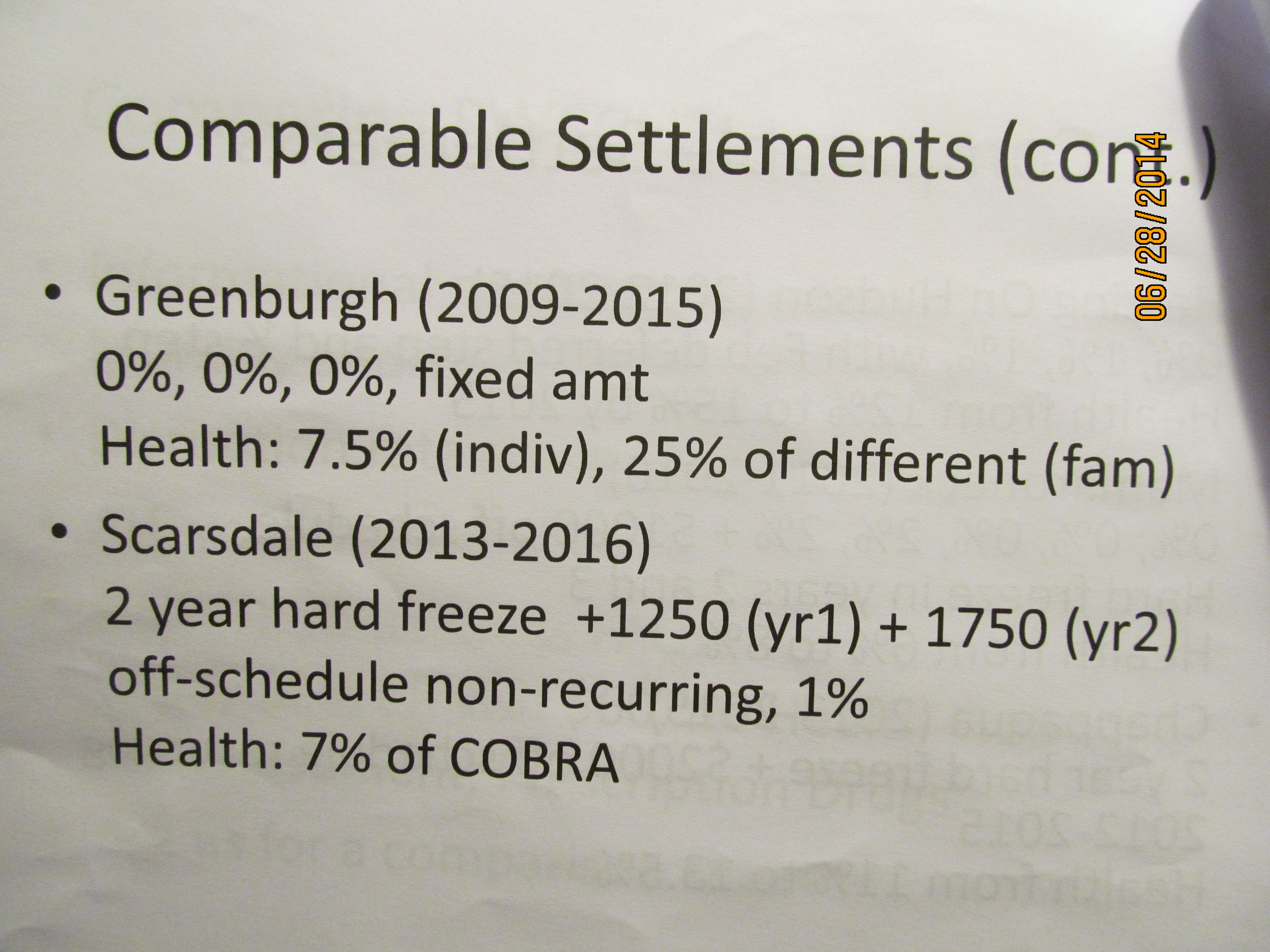
The Memorandum of Agreement notes comparable settlements of school districts in the area:

2014628teacherscontract 0022014628teacherscontract 001


2014628teacherscontract 004

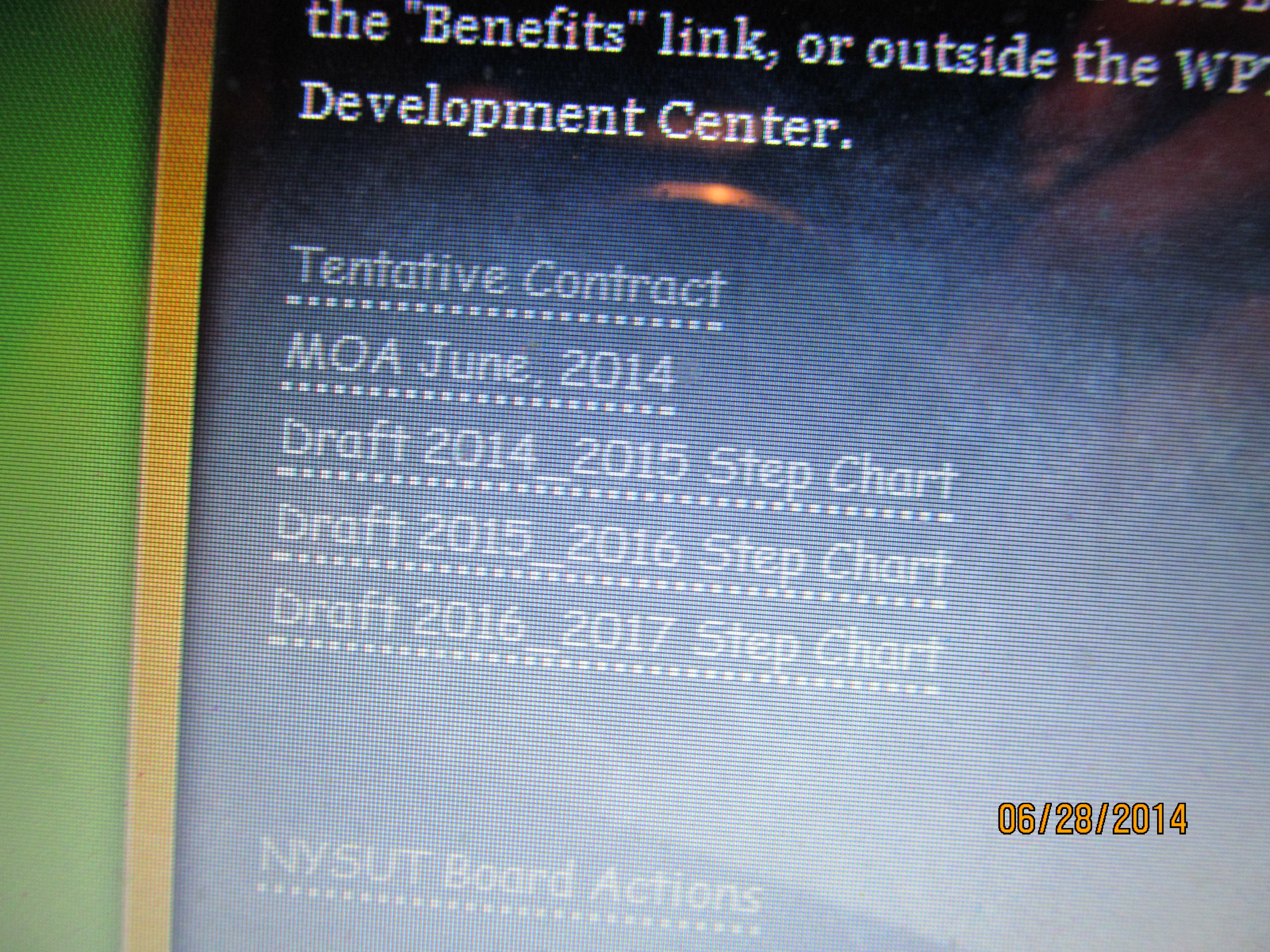
The complex but now in limbo proposal may be viewed, at www.wptaonline.org, the White Plains Teachers Association website by clicking on “Tentative Contract,” “MOA, JUNE 14” and “Draft 2014-15 Step Chart,” “Draft 2015-16 Step Charts,” “Draft 2016-17 Step Charts.”

2014628teacherscontract 003

The previous two offers from the district occurred under the previous Superintendent of Schools, Dr. Christopher Clouet, and  were rejected though Dr. Clouet did not directly negotiate the contracts.

Last week’s losing 52% to 48%  margin was exactly the same of the first contract rejection during Dr. Clouet’s Superintendentship (though Clouet was not involved in the negotiations) in September, 2012, 52% to 48%.  Two months later the contract was reoffered to teachers without change and was resoundly rejectd by a 2 to 1 margin.

Kerry Broderick, President of the White Plains Teachers told WPCNR that the new contract grew out of negotiations begun during the fact-finding process with the Board of Education negotiating team and the Teachers negotiation team.

She said the fact finder (supervising the process) has not made an official report, and Broderick said it was normal that in any fact finding process, negotiations were always possible and considered.

Asked if she had a sense of why the contract that expanded step salary increases to 20 levels, offered generous incentives for teachers willing to reject present health, and offered across-the-board salary increases, after no salary raises for the previous two years was reject, Broderick said she did not know and would have to get a sense of her membership when teachers started preparing for the new school year August 1.

She said she did not participate with her 7-teacher team of negotiators, whom she said represented a cross section aware of all salary levels, seniority and teacher universe demographics. She declined to name negotiators for the school district, but said that Interim Superintendent of Schools Timothy Connors participated.

As of late Friday night, the White Plains Board of Education has not issued a statement.

Posted in Uncategorized

County Legislature Majority Leader Supports HUD Monitor’s Criticism of County Response to Proceeding with I.D.-ing Zoning Roadblocks in Towns Short Affordable Housing.

Hits: 135

WPCNR COUNTY CLARION-LEDGER. From the Westchester County Board of Legislators. June 27, 2014:

Westchester County Board of Legislators (BOL) Majority Leader Catherine Borgia (D-Ossining) released the following statement today in regard to the new assessment report  (released Thursday, see story below)  from the federally-appointed monitor James E. Johnson concerning the housing settlement between Westchester County and the U.S. Department of Housing and Urban Development (HUD):

“I appreciate the diligent efforts of Mr. Johnson and his staff in preparing this thorough analysis of the County’s progress in completing the terms of the housing settlement. By working collaboratively with the monitor and our local municipalities, we are moving forward in making sure the County successfully completes the housing agreement.

“I am grateful for the local officials and leaders for working with the County to clear the logjam around the final steps of the housing settlement. Let there be no doubts that by working collaboratively, we can complete the terms of the settlement and continue to provide housing for our seniors, veterans, young professionals and hard-working families in Westchester.

“The monitor’s report notes that the County needs to do a better job in promoting and educating our residents and local officials about affordable housing, and I could not agree more. County residents are not served by political posturing and reckless misinformation about the settlement. We must work together to create a positive vision for the county’s future that will benefit all Westchester communities.”

Posted in Uncategorized

WHITE PLAINS WEEK PREVIEWS THE FASNY HEARING AND WESTCHESTER COUNTY CRIMINAL LAW EXPERT DISCUSSED THE SUPREME COURT CELLPHONE AND ABORTION BUFFER ZONE DECISIONS ON www.whiteplainsweek.com

Hits: 1

IF YOU MISSED 

WHITE PLAINS WEEK’S

PREVIEW OF THE FASNY HEARINGS LAST WEEK.

SEE IT TONIGHT  ON

www.whiteplainsweek.com

(Download and view)


2014131 002

PETER KATZ     JOHN BAILEY     JIM BENEROFE

ON

THE TROPICAL HEAT WAVE

COUNCILPERSON NADINE HUNT-ROBINSON’S CHALLENGERS

GEDNEY ASSOCIATION HAS ONE LIFELINE LEFT

THE LEFKOWITZ DECISION AND WHAT IT MEANS FOR THE FASNY HEARINGS COMING UP!

CLOUDY FUTURE FOR PLAYLAND BUT ATTENDANCE IS BRIGHT AHEAD

INSIDE THE COUNTY’S NEWEST AFFORDABLE HOUSING IN BRIARCLIFF MANOR

CONSTRUCTION ROUNDUP

ONE OF GOP STRATEGISTS — WILLIAM “F” O’REILLY —  

ASTORINO ACE NOT  PLAYED.


AND

ON PEOPLE TO BE HEARD

“Westchester County’s Most Relevant Interview Program”

you’ve got

2014627lederman 007

 WHITE PLAINS OWN

CHARLES LEDERMAN

Co-CHAIR OF THE WESTCHESTER COUNTY BAR ASSOCIATION CRIMINAL BAR

OUTSTANDING DEFENSE ATTORNEY

ON

THE SUPREME COURT’S DECISION REQUIRING WARRANTS TO SEARCH CELLPHONES.

WHAT IT MEANS FOR POLICE AND FUTURE CONVICTIONS.

THE ABORTION BUFFER DOWN RULING

WHAT IT MEANS FOR FUTURE DEMONSTRATIONS

AND MORE ISSUES AFFECTED BY THE SUPREME COURT

‘DOWNLOAD FROM THE NET FOR THE COMMENTARY FROM THE MAN EO

Posted in Uncategorized

HUD MONITOR: COUNTY DRAGS OUT ANALYSIS OF IMPEDIMENTS TO AFFORDABLE HOUSING IN 17 OF 31 COMMUNITIES: STANDS TO LOSE $5.2 MILLION MORE IN 2012 HUD FUNDS PERMANENTLY PRESENTLY WITHELD

Hits: 353

WPCNR HUD WATCH. From the County Board of Legislators. June 26, 2014:

James E. Johnson of Debevoise & Plimpton LLP, the HUD Monitor appointed to supervise Westchester County compliance with its affordable housing settlement, challenged the county yesterday to do better and put together an acceptable “Analysis of Impediments” to building affordable housing to compete HUD’S demand the city provide 750 of affordable units.

Failire to do so, in a timely fashion will result in a permanent loss of additional $5.2 Million in HUD community development aid  withheld from the county in 2012, bringing the total of aid taken away from the county to $12 Million. He concluded his 70-page chronicle of the dispute to date with this paragraph:

“If the parties are unable to resolve this dispute, the County will lose an additional $3,915,674 in CDBG funds, $846,884 in HOME funds, and $465,789 in ESG funds, a total of $5,228,327 in funds that would aidthe County in furthering the purposes of the Settlement as well as bettering its community.

The uncompromising concluding paragraph ended  a  70-page Progress Report on the ongoing dispute between Westchester County and the Department of Housing and Urban Development over resolving alleged discrimination in zoning in 31 Westchester Communities.

Johnson wrote 17 of the 31 communities have failed to adopt a model ordinance that would remove zoning restrictions. Johnson writes in the report:

“As of March 31, 2014, 17 of the 31 municipalities have failed to adopt a versionof the model ordinance. See Ex. 16 (2014 Q1 Report) at 17. Paragraph 33(c) of the Settlement requires the County to “create and fund campaigns to broaden support for fair housing . . . including public outreach specifically addressing the benefits of mixedincome housing and racially and ethnically integrated communities.” A concerted public education campaign directed at existing Westchester residents would raise awareness and reduce the potential for the local approval process to be used as a vehicle for racialanimus. The County has yet to fulfill this obligation under the Settlement.”

In the report, Johnson blames County Executive Robert P.Astorino for blocking the Board of Legislators initiative to pave the way for creating a zoning code that could meet HUD’S adjustments, writing:

“…the Chairman of the BOL (Mike Kaplowitz) engaged with HUD in an effort to resolve the impasse. In a letter dated May 6, 2014, the Chairman represented that the BOL had the “necessary authority” to provide the requested assurances to HUD, and provided the legal justification for doing so. 

HUD requested that the Chairman provide HUD with: (1) a timeline and benchmarks for enacting a local law that commits the County to providing the necessary assurances; (2) a “plan for completing the required zoning analysis;” and (3) an “explanation of the Board’s authority to subsume traditional executive functions necessary to implement” astrategy to overcome exclusionary zoning practices. As part of its effort to revise the County’s AI (Analysis of Impediments), the BOL asked the Monitor to task his housing experts to conduct an evaluation of the 31 eligible municipality’s zoning ordinances under the federal standard for exclusion 

The Monitor (Johnson) agreed to oversee the analysis, and provided HUD, the BOL, and the County Executive with the proposed methodology to be used in conducting the analysis, and requested that the parties notify him with any objections.

The County Executive (Mr. Astorino) has opposed this approach. In a press release issued on June 5, 2014, he characterized the Monitor’s letter as “a plan to rewrite the 2009 federal affordable housing settlement” in such a way that would give HUD “unprecedentedpower to dismantle local zoning.”  

The County Executive also sent a letter to the 31 eligible municipalities stating that the alleged “changes to the Settlement” would result “in the loss of Home Rule, your authority to control local land use – as guaranteed by the New York State Constitution,” and that “HUD could dictate local zoning changes and open your municipality to never-ending investigations by the federal government.”

Posted in Uncategorized

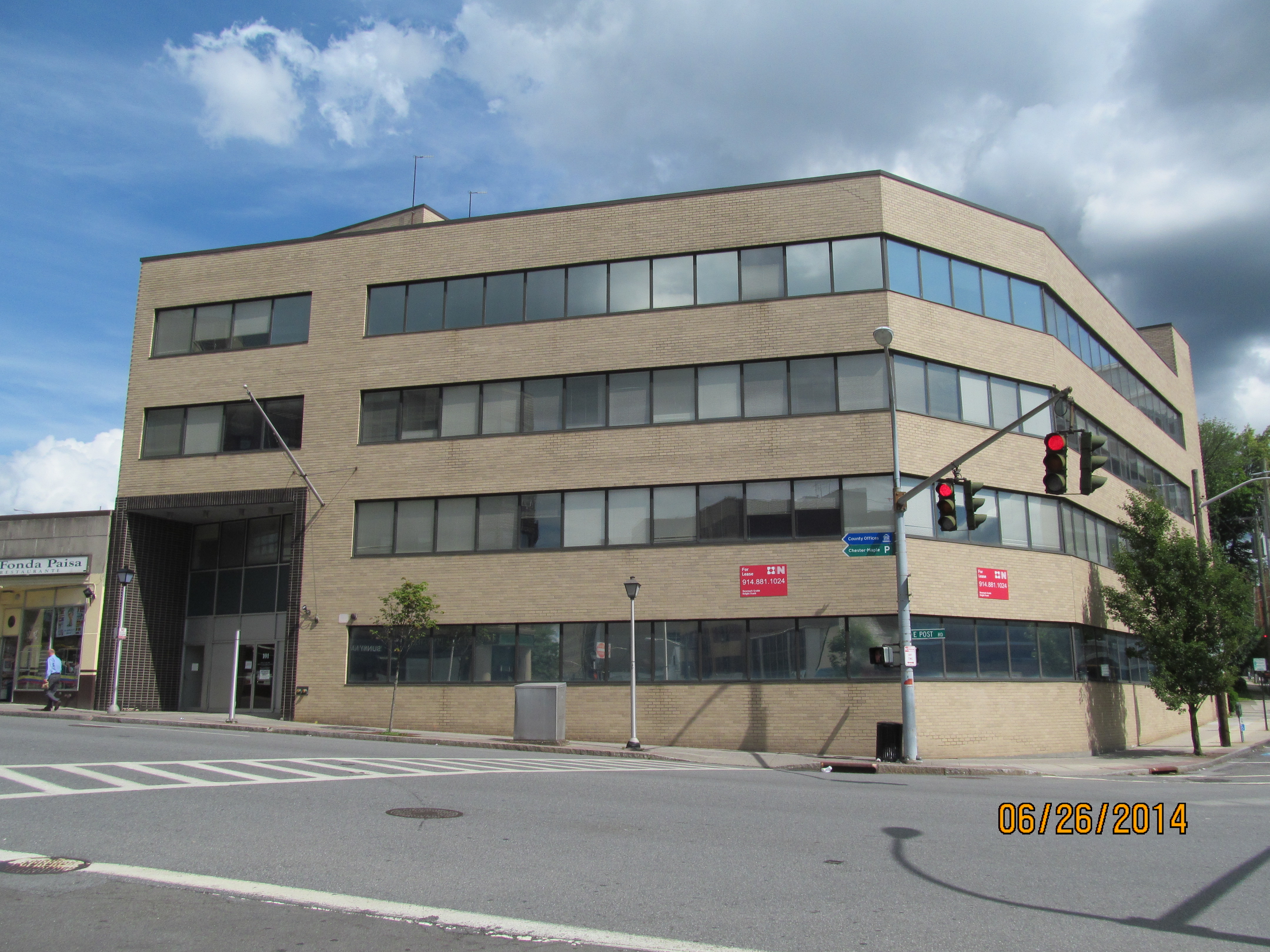
County Exec Astorino Announces $329,250 in IDA incentives for Renovation of 101 East Post Road

Hits: 913

2014627 001

The 101 East Post Road Building–currently empty–bankrolled with IDA tax credits will be renovated to house offices to serve the White Plains Hospital expansion, according to Westchester County spokesperson.The project is expected to cost $6 Million

 image001

Photo (l. to r.): Paul Guillaro, president and CEO of Unicorn Contracting; Bill Weinberg, principal of Bilwin Development Affiliates, LLC; Martin Berger, principal of Saber Dobbs Ferry, LLC; Westchester County Executive Robert P. Astorino; Jim Coleman, executive director of the Westchester County Industrial Development Agency; William M. Mooney III, director of economic development for Westchester County.

WPCNR COUNTY-CLARION LEDGER From the Westchester County Department of Communications. June 26, 2014:

County Executive Robert P. Astorino today announced that Westchester’s Industrial Development Agency (IDA) has approved a series of incentives that will aid a $6,000,000 renovation of 101 East Post Road in downtown White Plains, and two other major economic development projects move forward: a Marriott Springhill Suites in the Village of Tuckahoe; a mixed-used shopping, entertainment, hotel and housing complex in the Village of Dobbs Ferry.

With a total of $83 million in private investment, the projects will create more than 940 new permanent positions as well as 725 construction jobs.

“These businesses have said ‘Yes’ to Westchester and chose to invest here because we are committed to creating an environment that allows them to thrive and succeed,” said Astorino. “Job creation is how we move Westchester forward.”

Construction on 101 East Post Road to Begin in Fall

The renovation of 101 East Post Road in downtown White Plains, proposed by Post Road Associates, LLC, is a $6 million project, which will receive $329,250 in tax incentives through the IDA ($251,250 in sales tax exemption, $78,000 in mortgage recording tax exemption). This project will create approximately 200 permanent jobs and 50 construction jobs.

“This $6 million renovation project will breathe new life into this building and commercial district,” said Paul Guillaro, president and CEO of Unicorn Contracting and general partner of Post Road Associates, LLC. “Thanks to County Executive Rob Astorino and his IDA team, this project was made feasible and will attract quality commercial tenants as well as high-paying jobs that will support the Mamaroneck Avenue retail and restaurant district.”

Construction on the 50,000 square-foot building is expected to begin this fall and will be completed by the spring of 2015.


Posted in Uncategorized

Brush Up Your Shakespeare! City Introduces Shakespeare in a White Plains Park:TWELFTH NIGHT PLAYS Under the Stars July 15-16 in Turnure Park

Hits: 374

WPCNR STAGE DOOR. From the City of White Plains (Edited). June 26, 2014 UPDATED June 27, 2014:

The City of White Plains is bringing Shakespeare’s TWELFTH NIGHT to Turnure Park July 15th and 16th.

The Curtain Call production of William Shakespeare’s Twelfth Night will be held on Tuesday, July 15th and Wednesday, July 16th (rain date July 17th). Show time is at 7:00 p.m. on both nights. This production is free and open to the public.

The  White Plains Performing Arts Center box office, the local city sponsored non-profit theatre was unaware the Mayor’s Office was bringing in this production when contacted by WPCNR Thursday morning. WPCNR’s phone call was the first time they had heard of it.

Curtain Call is a non-profit production based in Stamford, producing plays on a year round basis, a staple of which is the company’s Shakespeare in the Park productions. Curtain Call also provides theatre classes and performance opportunities in the City of Stamford, very similar to the programs of the White Plains Performing Arts Center.

Last year, Mayor Roach received a letter from long time White Plains resident, Karen Hanley, suggesting that the City consider bringing Shakespeare in the Park to White Plains. A summertime tradition that is enjoyed all over the world should be enjoyed here in White Plains as well.

Ms. Hanley has appeared in one Curtain Call Shakespeare In the Park production as a member of the ensemble in Othello last summer, and most recently in the Curtain Call production of When We Are Married in January of this year.

After meeting with Lou Ursone of Curtain Call Productions, the City identified Turnure Park off Lake Street as offering the right setting for such a production. Residents will be familiar with Turnure as the location of the City’s Annual Cherry Blossom Festival. The performance will take place on the Great Lawn of Turnure Park.

Picnicking is encouraged! So gather your friends and family, bring your blankets and lawn chairs, and settle in for what is sure to be a thoroughly enjoyable evening.

“We are so pleased to be able to offer this new, family-friendly event to our residents in conjunction with ArtsWestchester,” said Mayor Roach. “We hope this performance of Shakespeare’s Twelfth Night will herald the start of a wonderful White Plains summertime tradition!”

WPCNR placed a call to the White Plains Performing Arts Center, the city-supported theatre, and the box office persons we spoke to said they were unaware of this production. It was the first time they had heard of it.

Posted in Uncategorized