2,905,611 VISITORS VISIT 8,324,077 TIMES 3 TIMES EVERY DAY IN ONE YEAR. HIGHEST ACTIVITY IN WPCNR HISTORY.White PlainsCitizeNetReporter lifted its worldwide visits from unique visitors to wpcnr.com to 8,324,077,a 1,306,419 increase in visits in one year from 7,017,658 visits to the site last year which covers White Plains and Westchester County. The 8,324,077 visits were made by 2,005,611 unique visitors who visited wpcnr an average of 3 visits a day. ON JULY 20- -2026 visitors have accessed wpcnr and made 3,072 visits an average of 1.6 visits. In the last week 33,495 individual vistors made 54,458 visits, averaging 1.6 visits. In the last month, 152,940 visitors recorded 229,338 visits (1.5 visits)
WPCNR CITY HALL CIRCUIT. REPRINTED FROM THE WPCNR NEWS ARCHIVES OF June 8, 2005:
New York State’s first-ever Juneteenth Celebration highlighted by a mammoth parade down Main Street beginning at 12 noon, followed by a Street Festival on Church Street and Martine Avenues will not only recognize the contributions of African-Americans to America, but will feature a historic display of an original copy of the Emancipation Proclamation, signed by the Great Emancipator, Abraham Lincoln.
Seth Kaller, one of the most respected American historic document dealers, will display a rare signed copy of The Emancipation Proclamation at White Plains’ first Juneteenth Heritage Parade and Festival at Barnes & Noble in the City Center across from City Hall.
The Emancipation Proclamation, signed by Abraham Lincoln, was displayed at Barnes and Noble . The exhibit, also displayed nine other documents relating to slavery, emancipation, and freedom, including original letters by Frederick Douglass, the noted oratorian and Lincoln opponent for President in 1859. The historic display was unveiled by White Plains Mayor Joseph Delfino.
Juneteenth commemorates the final implementation of The Emancipation Proclamation by the Union Army on June 19, 1865, in Galveston, Texas (almost two-and-a-half years after the proclamation was issued). The White Plains celebration included a parade beginning at noon on Mamaroneck Avenue, and a festival between Main and Court Streets. It was the biggest celebration of African American heritage in Westchester County.
“I am pleased that Seth Kaller has offered to participate in the Juneteenth Parade and Festival by displaying this historic document. The Juneteenth Parade and Festival is a celebration of African-American achievement, and promises to be a tremendous event here in our community,” stated Mayor Delfino.
According to Seth Kaller, president of Seth Kaller, Inc., “I am very pleased to be a part of this celebration. Without the Emancipation Proclamation, one could argue that America would not be the free and democratic country that it is today. I have to thank the City of White Plains and the Juneteenth organizers for providing this opportunity for people today to see a document that changed the world.”
Kaller is the leading collection builder of American historical documents and manuscripts. He has purchased and coordinated authentication of more than 50,000 documents during the past 17 years, including working drafts of the U.S. Constitution.
Lincoln signed them to benefit the troops.
Partial Exhibit List of Historic Documents On Display at Barnes and Noble at City Center that day as part of the Juneteenth Heritage Parade and Festival:
The Emancipation Proclamation: The Document That Saved America
“I do order and declare that all persons held as slaves…are and henceforward shall be free.” Authorized Edition, with the complete text, signed by Lincoln, William Seward as Secretary of State and John Nicolay, Private Secretary to the President; January 1, 1863 [printed and signed in 1864].
Frederick Douglass on “The price of liberty…”
“The price of liberty is eternal vigilance and though I see no immediate danger to free institutions in our country I think every American should be on guard and ready to meet the development of any malign force which may endanger the honor, the peace and stability of this great nation.”
Frederick Douglass (1817?-1895) letter signed to E. M. Rasafy, 1880, accepting an offer of membership in an organization called the “National Ciphers.”
Frederick Douglass Speech on the Emancipation Proclamation
“I congratulate you, upon what may be called the greatest event of our nation’s history, if not the greatest event of the century. In the eye of the Constitution, the supreme law of the land, there is not now, and there has not been, since the 1st day of January, a single slave lawfully deprived of Liberty in any of the States now recognized as in Rebellion against the National Government…I congratulate you upon this amazing change—the amazing approximation toward the sacred truth of human liberty.”
Frederick Douglass (1817?-1895) Speech about the Emancipation Proclamation, at the Cooper Institute in New York City on February 6, 1863. Printed in the New-York Daily Tribune, February 7, 1863.
WPCNR THE SUNDAY BAILEY. By John F. Bailey. Republished from The CitizeNetReporter of June 17, 2007:
This week celebrates a great American Father, mine and the other fathers across time who provide an eternal legacy their sons and daughters rely on every day and think about their fathers every day.
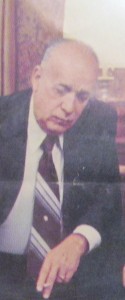
Charles F. Bailey.
He is my father. He was born November 17, 1918.
My father gave me four pieces of advice in life: Always drive an air-conditioned car. Always central air-condition your home. Stay out of court.
And, oh yes, don’t sit in traffic. Take the next exit and wing it.
Always take the service road on the Long Island Expressway. (He would have loved a Garmin.)
In retrospect, his advice has served me well. I am always comfortable. I sit out traffic delays in comfort. I have not made lawyers rich.
CHARLES F. BAILEY MY DAD OF PLEASANTVILLE, NY 1918-1986
He was not an emotional man. He was a banker and always wore suits to work. I have fond memories of going to meet him in the days of steam engines in Pleasantville – when train tracks were at grade with Manville Road at the old stone station.
I was most impressed as a young child by how he always smelled of coal cinders when he got off the train – like commuter’s cologne.
Sadly on today’s electric trains you do not get that. And you always heard those steam engines coming. Chuffing doing serious work.
You could see them coming around the bend but you heard then first. Bell ringing,chuffing, puffing : Clouds of very busy, inspiring industrious black smoke streaming at the horizon down the line.
He’d get off the train.
My mother would move over and he’d drive the old Hudson Hornet home. He always spoke quietly. Never raised his voice. Drank scotch and soda in the winter. “G & T’s” in the summer, martinis with George and Howard two close friends. He smoked Chesterfield, Philip Morris, Marlboros, Kents with the micronite filter.
He set up a Lionel train set in our basement – perhaps our unspoken connection. When I was sent in by train for the first time to meet him at the office during Christmas time, he’d have his secretary Margie greet me at Grand Central Terminal which still is a very big and scary place to me .
He would take me to lunch at Jack’s Monte Rosa Restaurant on 49th Street – which I thought was a very great place. Hub bub, tinkling glasses. Sharp-dressed waiters in white jackets black bow ties.
When I first went to it with him, I was a little disappointed that it was not more glamorous but I was really impressed that Jack the owner greeted him by name. I thought that was great that my Dad was greeted with respect.
When I first started working in Washington, D.C. in 1968 I ate regularly at a restaurant below the television station WMAL-TV where I worked, it was called Marty’s Italian Village. Marty, the owner (who looked like Humphrey Bogart, the only thing missing was the white sport coat) started calling me when I came in around 7 PM, ‘Hi John, how are you?” People would look at me. They thought I was big. I liked that. Feeling big in my small world at $90 a week.)
When my father came to visit me in Washington where I worked. I took him around town. I told him when he got off the plane. “Hi, Dad, welcome to my town.” I wanted to impress him. We’re always trying to impress our fathers. At least I was.
Another Father time was when my Dad came out for Dad’s Day at college.
I mean this was a big thing to me. He watched me do play-by-play of a football game from atop the press box in 15 degree weather. It was cold. But he watched. Acted impressed. He hated cold weather. No watching from the warm press box for him.
Another time he impressed was when I lost a job where I was working at the television station that I was being considered for. I told him how unfair it was, he put things in perspective:
“Puggy, he said, “The film manager wasn’t going to put you in as his Assistant if you were going to be bucking him all the time.” It put things in perspective. No false sentiment. No making me feel better, he was tough enough to teach by being realistic while telling me not to feel sorry for myself.
Then later in my career, I was fired out of a job completely blindsided. He again intervened, saying to me he thought what the agency head had done was a terrible thing. I needed that at the time.
He also, in a very supportive move, told me if I could make $1,000 a night writing a free lance direct mail package, I should keep trying to do that.
Dads are there to say the right things to you at the right time. Sometimes it is not always the right thing, but they try. Often, if you’re lucky, as I was, they say the right thing. Always — when you really really need it. Not the wrong thing.
With my father, who was not really my father, since I was an adopted child, it was never all about him, it was all about you. Making me better, even when it hurt him to say things that were the truth.
When I bought my first house in White Plains. He never criticized the house. But when I sold it, he complimented me, “I think it’s great how you came out of it (the crummy first house).” He was a personal trainer.
The good ones train you to run a race. If you stumble, no one hurts more than they do. When you succeed, no one is prouder. The good ones push you in front of the cameras, they say interview her or him. They did it.
They know what you should do, but they can’t tell you, because you won’t do it if you’re a kid.
But the more subtler of them tell you anywayin hopes it will sink into the rebellious offspring mind. My dad was subtle.
Another fond memory: My father took me camping once at a friend’s cabin in Pennsylvania. Funny thing was there was such a great comic collection we wound up sleeping in sleeping bags on the porch of the cabin. That was funny.
Another time when I was being threatened in college over a position at the radio station, I asked him if I should just abdicate and assign a play-by-play position to the person who was being forced on me. He advised me to “stick to your guns,” so I reported the threat to the Dean.
The position was compromised, but I was never threatened again. He never shared my love for baseball and sports. In fact he never played catch with me all that well or that often.
I mean I could have made the big leagues (pipe dream) if he played catch with me more. But that’s a small criticism. I wish I had more of his financial acumen. But I do not. I married that.
As you grow into your 30s and 40s, little things they say to you you begin to understand.
My father never struck me.
He always disciplined me with quiet words. I have not always been that way as a parent myself, being somewhat volatile. I wish I had his even temperament. He always asked me to take care of my mother. And the only time he really got mad at me was when I had made my mother upset with me.
He was a little like Humphrey Bogart in movie roles in the way he disciplined, I remember he would say admonitions quietly. Such as when I got an F in an English course at college. He told me, that was the last F I would get at Ohio Wesleyan, because the next one he would stop paying my tuition.
That had an effect. And that was when tuition was only $3,000 a year.
I have taken to, after my children have grown, telling them always “Be careful,” “Don’t do anything stupid because someone suggests it,” “Do not go anywhere alone without telling people where you are going,” “Don’t lose your temper,” “Don’t tailgate,” “Don’t stand close to the of a sever drop.” In hopes that when I am not with them, they will remember it when they need it.
I think of him every day of my life. I become more like him every day. He is always lingering in the background of my thoughts. I do not know what he would think of what I am doing now. But, he’d say — “If that’s what you want to do. Do it.” He also would say, “You have to make yourself happy.”
I also think, even today of what advice (laconic as always) he’d give me in a situation. I wish I could discuss property taxes with him. Banking today and how it has become a predator system.
I especially have to salute him, because I am an adopted child.
That alone makes me appreciate his love and acceptance with a sense of awe to this day. He loved me like his own son. Because in his mind, I was. He took responsibility. He did what had to be done.
You never outgrow your need for Dad.
The good ones are immortal, alive and with you in your head when you need them. They are ghosts that comfort always. Haunt you in memory.
Immortality is leaving a good memory of you with the ones who knew you.
Because what you give them, lives on for generations.
Your children will talk of you because of the good things and behaviors you gave them when you needed them and you never lose those tools Dad gave you
MIGRANTS FROM NEW YORK CITY HOUSED IN YONKERS, WHITE PLAINS AND ARDSLEY. MAYORS WELCOME THEM!
COUNTY EXECUTIVE LATIMER ON THE MIGRANTS’ ARRIVALS. STATUS OF WASHINGTON AID (NO JUDGES, NO MONEY, NO STATUS COURT) AS HOMELAND SECURITY CHIEF HEADS TO SWEDEN
GOVERNOR HOCHUL REVEALS TROUBLED YOUTH AND THEIR PROBLEMS UNVEILS LISTENING TOUR FINDINGS
FULL HOUSE FOR THIRD COMPREHENSIVE PLAN WORKSHOP. JOHN BAILEY TAKES YOU THROUGH IT
YOU ARE THERE!
DR. KATELYN JETTELINA SCOOP: NEW COVID VACCINE COMING IN FALL