|
 |
Si quiere leer la versión en español, pulse aquí.

In true Covid-19 fashion, news broke at an inconvenient time. Greetings from Mt. Fuji.
 |
What happened? The Washington Post leaked that CDC is considering replacing the Covid 5-day isolation guidance with “staying home until 24 hours fever free and improving symptoms.”
This is what we know and don’t know, and what this all means in the larger context.
First, what we do know
- Contagiousness has not changed. If infected, you still spread Covid-19 to others for 5-12 days.
- Spreading Covid-19 is less consequential these days, though. Hospitalizations and deaths continue to decouple from infections. (This means ~300 deaths per day—which is still a lot—compared to the peak of 3,500.) Long Covid-19 prevalence is decreasing slowly, but millions still suffer.
- Testing is expensive. Innovation has not kept up. Antigen tests are not positive until days 3, 4, or 5 now.
- The number of paid sick days for Americans is abysmal—23% of Americans have zero (!) paid sick leave. Among those who do have it, the average American has 10 days.
- We are no longer in an emergency. The majority of Americans have put Covid-19 in the rearview mirror. Only 1 in 5 adults are vaccinated.
What we do not know
The actual proposed policy from the actual agency. This was a leak, which means it lacks justification, context, and details. We don’t have the full picture, like whether they will recommend masks, a cautionary period, or what to do for those at high risk.
A leak automatically puts CDC on the defense, which is disappointing as stakeholder engagement, gathering data, and conducting models takes time. Let’s give them time to line up their ducks.
One of the worst things CDC did throughout the emergency was change guidance without clear communication. I’m optimistic this will change.
What would be nice to know
We are always working off incomplete data, but some rough answers would certainly help me, at least, craft an opinion:
- How many people follow the current isolation guidelines? In other words, will this impact community transmission? Data from the U.K., California, and Oregon can help answer this, as they have already implemented similar guidance. Oregon, for example, shared that dropping isolation did not impact community transmission.
- How many people get a fever with Covid-19 infection? Is a fever or improving symptoms correlated with contagiousness for Covid-19? How well does this align with the flu and RSV? Do people know what “symptoms improving” means?
- Is there a risk difference between a symptomatic person on Day X vs. asymptomatic case walking around (which is about 40% of Covid-19 cases)?
Even if we get answers to the science, health policy is also based on psychology, politics, economy, culture, and values:
- What is acceptable to the majority of Americans? 100% protection x 0% adherence = 0% benefit.
- How many sick days are people willing to cash in for Covid-19? How many missed school days is “worth it”?
- Does a 5-day isolation period disincentivize people from testing in the first place?
- How will institutions react? If someone needs to stay home longer, will their employer let them? What will happen at hospitals?
- What do key high-risk stakeholder organizations (i.e., nursing homes, AARP, immunocompromised, health departments, healthcare workers) think?
What is the purpose of public health?
Whether we get answers or not, all of this centers around one core question: What is the purpose of public health? Do we meet people where they are (e.g., people aren’t isolating anyways, so let’s drop), or provide a north star (e.g., this is ideal, although we know most people won’t follow it)?
Ideally, it’s a balance with a clear goal in mind. This has resulted in a tug-of-war throughout the pandemic.
This isn’t abnormal in public health, though. Take car safety. In the 1980s there was incredible pushback on seatbelt laws. But that didn’t stop guidance, and wearing a seatbelt was eventually normalized. Seatbelts had minimal (if any) tradeoffs, though. We don’t tell people not to drive, even though it’s the most dangerous thing people do daily. Instead, public health put in place interventions and recommendations to mitigate harm.
When recommending an intervention to a huge fraction of society, we’d better have strong justification of the benefits and risks, even if acting on the precautionary principle and limited data.
Ideally, guidance comes in tandem with background systematic change after an emergency—ventilation, free vaccines, paid sick leave, normalizing mask usage. I see it in Japan, but it is a fleeting pipedream in the U.S. Of course, a lot of this isn’t in the purview of CDC.
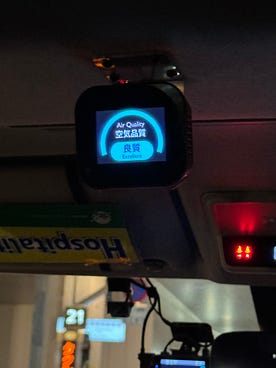 |
Air quality monitor in a Japanese taxi
Bottom line
Health policy is messy and complex, involving weighing tradeoffs that change over time for very diverse 330 million people. We ultimately need guidance that is protective and actionable and feasible. I’m optimistic CDC will provide answers and clarity soon.
Love, YLE
“Your Local Epidemiologist (YLE)” is written by Dr. Katelyn Jetelina, M.P.H. Ph.D.—an epidemiologist, wife. During the day, she is a senior scientific consultant to several organizations, including CDC. At night, she writes this newsletter. Her main goal is to “translate” the ever-evolving public health world so that people will be well-equipped to make evidence-based decisions. This newsletter is free, thanks to the generous support of fellow YLE community members. To support this effort, subscribe below:


