
Si quiere leer la versión en español, pulse aquí. Today, ACIP — CDC’s external scientific committee — had their normally scheduled meeting on all vaccines. YLE only stayed for the Covid-19 discussion. Here are your Cliff notes. Bottom line up front (BLUF)CDC says those over 65 should get a second Covid-19 vaccine this spring. (I’m not convinced that all people over 65 need it, though.) Who is being hospitalized by COVID-19 today?At this winter’s peak, there were 20,000 new hospital admissions and 2,000 deaths due to Covid-19 per week. This is less than previous winters but still higher than flu. Who is being hospitalized?
Why aren’t people getting Covid-19 vaccines?Vaccine coverage is really quite terrible in the United States. CDC is conducting surveys to understand why. This is what they found:
How effective are the fall vaccines?Pretty great and largely comparable to flu vaccines every year.
Some other interesting nuggets:
Context is SO important here. There is a public perception that the vaccines are not as compelling as they were in the pandemic’s beginning. However, the comparison group has changed as collective immunity increased. Most people have been infected and/or vaccinated—nearly 100%. This means VE today is additional protection compared to all the immunity already out there. Is a spring vaccine cost-effective?This is a key consideration for many countries (like the U.K.), as their government provides free vaccines for all. This isn’t a main driving policy consideration in the U.S. Regardless, they found:
Other information
Bottom linePeople hospitalized today for Covid-19 are not up-to-date on their annual vaccine, even among those over 65 years. CDC says those over 65 should get a second Covid-19 vaccine this spring. This follows Canada’s and, somewhat U.K.’s, spring Covid-19 recommendations. I’m not convinced that most people over 65 need a spring vaccine. I will be recommending a spring vaccine to my family members in nursing homes (they are over 90 years old) or those who have multiple comorbidities, like heart disease. I don’t think they need to run to get it, but there will be a small benefit, given that we have multiple waves a year and their T cells (immune memory) are weak against Covid-19. (I think those over 65 who never got a fall vaccine should run.) Love, YLE P.S. ACIP will cover RSV vaccine information tomorrow. YLE will provide separate Cliff notes. |


FLORIDA GIVES MEASLES ROOM TO SPREAD
|
 |
Si quiere leer la versión en español, pulse aquí.


The measles outbreak at a Florida elementary school has grown to 8 cases and counting.
We have measles outbreaks all the time (although the rate is increasing due to vaccine hesitancy), but this one came with a new controversy. The Florida State Health Department released a letter with a surprising new recommendation that contradicts standard of practice guidelines for measles outbreaks in two big ways:
- Isolation. It stated that unvaccinated kids who were exposed to measles could continue to attend school. This is unprecedented. Those with no prior immunity need to isolate for 21 days.
- Vaccination. It failed to recommend kids without immunity get vaccinated. Many parents don’t know that unvaccinated kids can still get protection from a vaccine within 72 hours of exposure. (Also, the standard of care is that if they get vaccinated within 72 hours, they can return to school as long as they don’t develop symptoms.)
Failure to isolate for measles is a major problem
The purpose of requiring unvaccinated children to stay home after measles exposure is to reduce, or rather stop, transmission.
Failure to do so significantly increases the chances of a prolonged outbreak.
We don’t require isolation for most viruses. If kids don’t get a flu shot, they don’t need to skip school if they were exposed to influenza. But measles is different:
- Measles is one of the most contagious viruses known on Earth. The R0—or the number of people an infected person can infect—is much higher than other viruses. Viruses spread exponentially, so in a population that doesn’t have immunity, just a few cases can become many very quickly. This means it takes a huge effort to contain it.
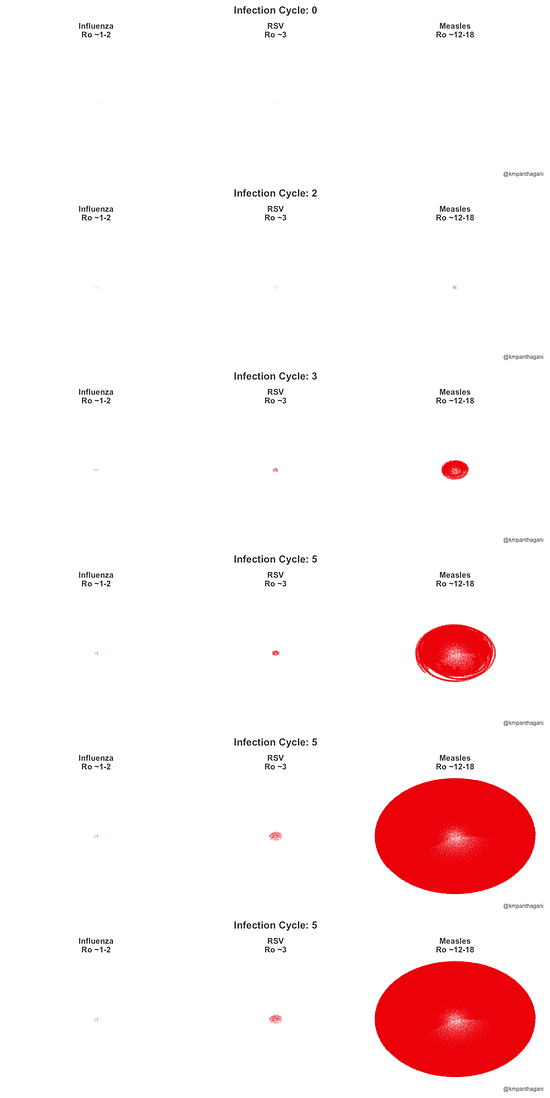
Data visualization by Kristen Panthagani
- Measles is (largely) eliminated (although the U.S. status may change soon). In other words, it’s not spreading at a low level in other parts of the community. We want to keep it that way.
- Measles has a long incubation period. It takes 5-21 days from exposure for symptoms to develop. So even if a child, especially an unvaccinated one, doesn’t have symptoms, they may be contagious and spread it to others, including in the community.
The FL letter tries to justify the decision to let exposed kids without immunity go to school by arguing that the vaccination rates in Florida are high. It’s true that 90% of FL kindergartners are vaccinated, which is high. But not high enough—because measles is so contagious, the threshold for herd immunity against measles is 95%. This means there are pockets in the school, other schools, and a community that measles could burn through.
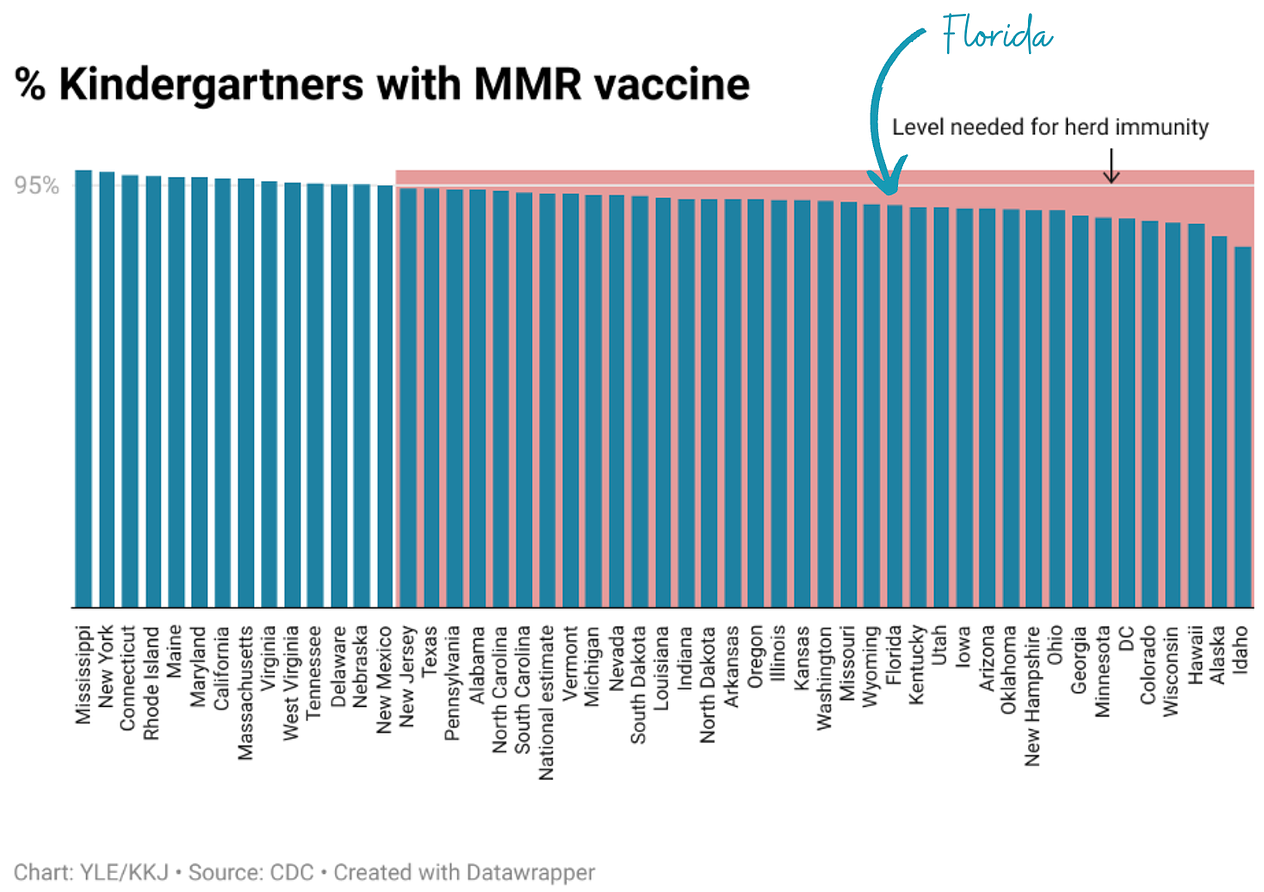 |
Keeping kids home from school is hard, but sometimes it is very necessary
Missing school is not something health officials recommend lightly.
But recommendations are always grounded in tradeoffs: disease severity, the potential for transmission, disruption to parents, childcare, productivity, economy, days of in-person schooling lost.
We have all experienced quarantine and know what a disruption it is to our lives. It is only recommended when truly necessary.
As a parent, the most disappointing part of this letter is the lack of information on actions parents can take.
For example, if they don’t want their child to miss school, they can get vaccinated, even after exposure. It will help reduce the severity of symptoms if infected, too. However, the window is short. Leaving this information out so parents don’t know is another level of deception.
Many have forgotten measles, but it is no joke
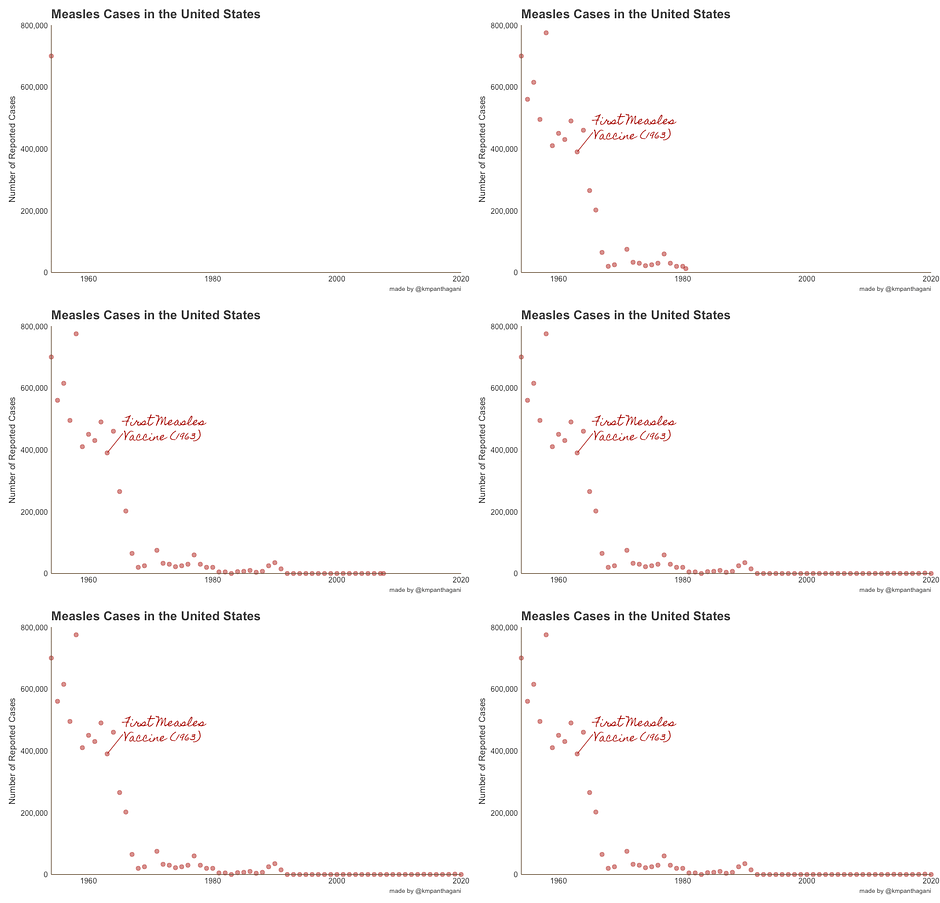
We have the privilege of forgetting measles because vaccines have largely wiped it out. But unfortunately, that privilege means many have forgotten just how bad it is:
- It is extremely contagious. Among unvaccinated, 9 out of 10 people exposed will get infected.
- It can make kids very sick. For people without immunity, 1 in 5 will be hospitalized, 1 in 20 will develop pneumonia (the most common way measles kills young kids), 1 in 1000 will develop encephalitis (infection of the brain, sometimes causing permanent brain damage), and 1-3 in 1000 will die.
- It can cause “immune amnesia,” where the immune system loses its ability to fight other viruses that people were previously immune to.
Bottom line
Measles is not a new virus. We have been studying it for more than a century. There are reasons we have standards of practice, and it’s a slippery slope to think otherwise. Measles is no joke, and containing it should not be up for debate.
We hope parents and the community are paying attention. It takes a team approach to stop infectious diseases. This can mean strengthening immunization requirements or asking for bills requiring transparency about which schools have lower vaccination rates so parents can make informed decisions. The scary question is: What happens when community responsibility breaks down? We hope this is not the road we are headed down.
Love, KP and YLE
HOUSING SHORTAGE INCREASES HOME PRICES, SALES IN WESTCHESTER. HOMES FOR SALE DECREASED 30%
Limited Supply Fuels Price Growth in the Greater New York City Metropolitan Area
(NOTE : Link to ALL regional reports: Market Data (hgar.com).)
In Westchester County, January sales of single-family homes and co-ops decreased 12.7% and 19.2% respectively, while condo sales increased 1.4% compared to January of 2023. The median sales price increased 5.4% to $858,250 for single-family homes and 31.5% to $562,000 for condos. The median sales price for co-ops decreased 1.6% to $182,000.
New condo listings increased 15.5% while new co-op listings declined 18.3%. New listings for single-family homes decreased by just 2.2%. Overall inventory of single-family homes for sale declined by almost 30%, while co-op inventory was down by 37% and condos, 16.3%. Pending home sales rose 6.9% in Westchester as compared to a year earlier.
January home sales continued to decline, while prices increased in most markets in the Greater New York City Metropolitan area, according to a report released today by the Hudson Gateway Association of Realtors (HGAR), based on data supplied by OneKey® MLS. A limited supply and strong demand are responsible for the current market conditions.
However, as the spring selling season approaches, the region’s home sales sector is bolstered by a noticeable increase in pending sales throughout the region, HGAR officials noted.
With the prospect of lower mortgage rates as the Federal Reserve Board considers multiple rate cuts this year, home sales are expected to increase as more homes come to the market beginning in the spring and summer months.
“With mortgage interest rates moving slightly higher now, we continue to experience the trend of people taking a ‘wait and see’ approach before deciding to list their homes for sale, but would caution against trying to time the real estate market based on such marginal changes,” noted HGAR President Carmen Bauman. “Nevertheless, we do anticipate more movement during the Spring with additional inventory on the market.”
Sales of single-family homes declined in all six of HGAR’s coverage areas, while some counties experienced increases in co-op or condo sales. All six regions saw prices increases in all property types.
“While it will take some time to have the HGAR home sales market fully reset from the impacts of high inflation and mortgage interest rates, home sales are projected to rise significantly in each of the next two years as the market steadily returns to normal sales activity,’” said HGAR Chief Executive Officer Lynda Fernandez.
GOVERNOR HOCHUL ASKS PRESIDENT BIDEN FOR “EXECUTIVE ACTION” TO EASE NEW YORK’S IMMIGRANT HOUSING CRISIS
| For Immediate Release: 2/23/2024 |
GOVERNOR KATHY HOCHUL
|
STATEMENT FROM GOVERNOR KATHY HOCHUL ON WHITE HOUSE VISIT
“Today I traveled to the White House for conversations with President Biden, Chief of Staff Zients, Secretary Mayorkas and other White House officials. I had a chance to express my gratitude for President Biden’s leadership of our economy, securing major investments in transportation infrastructure and clean manufacturing that will create tens of thousands of jobs across New York.
“We also had a series of productive meetings, focused on immigration and finding solutions to New York’s migrant crisis. Speaker Johnson and the House Majority’s decision to kill a bipartisan immigration compromise will have devastating consequences for our state. In the absence of legislation, I expressed to President Biden and Chief of Staff Zients that New York would support executive action on immigration.
“These meetings made one thing exceedingly clear: President Biden is the leader our nation needs in these difficult times.”