Student Loans and the Effect on the Cost of a College Education

Hits: 134

WPCNR NEWS AND COMMENT From Kimberly Green and the Online Colleges website. Reprinted with Permission. August 15, 2013:

Student Debt in the U.S. (Part 1)

This is our first article in a three-part series about the nation’s ever-rising student debt levels. The second and third entries will look at student debt from a historical perspective and explore some of the potential consequences of the debt crisis, respectively.

As college costs spiral upwards, unpaid student debt has reached a record high of $1 trillion, slowing down economic growth and causing many young individuals to lose control of their finances. Many politicians, media outlets, and educators are focusing on cuts to state and federal subsidies as the reason behind these astronomical tuition hikes. But while this may be true in cases, it’s not that simple.

Paradoxically, many studies have found the opposite to be true: as federal and state subsidies increase, colleges and universities actually charge more for tuition, exacerbating the student debt crisis. Here we will trace the problem back two decades, examine funding trends and college costs to pinpoint what exactly is behind tuition increases.

Student Debt: The Last 20 Years

Student Debt

The rise in student debt is by no means a new phenomenon – borrowing has gone up every year since 1993. According to the National Center of Education Statistics, average (student) debt began to creep up in 1993, making small jumps from an average of $10,000 per student until it had doubled to $20,000 twelve years later. Then it began to increase very sharply. By 2013, the average debt per borrower hit $30,000.

The rise in borrowing naturally correlates with increasing college costs. The average yearly tuition and room-and-board in 1990-1991 was $8,485 at a public 4-year institution. By 2010, that had leapt up 83%, reaching an average of $15,605 per year.

Concern over this upwards spiral is all over the news, as unpaid loans take a major toll on the economy. And many are worried this is just the beginning.

Tuition rates are predicted to rise over the next two decades, with costs hitting $41,228 per year for in-state public tuition and $92,869 for private colleges in 2029. This ridiculous level of debt could not be sustained by parents in stable careers, much less by students with poor financial history. So why is this happening?

Cuts to State Spending

Budget cuts brought on by the recent recession have taken their toll on the American education system, pushing more students and lenders to take up the slack. Incremental cuts have caused education allocations to drop since 2008, with thirty-six states decreasing funds by more than 20%. As a nationwide average, states cut their education spending by 28% from 2008 to 2013, according to the Center on Budget and Policy Priorities.

Some states have suffered deeper cut more than others. Washington and Florida now provide the lowest amounts of support for their public universities. Spending per student was just about $6,000 for these two states in 2010, barely over half the amount allotted to students in states like Hawaii, Connecticut or Arkansas that year, according to the Department of Education.

Student Debt

When states cut education budgets, where exactly does this money end up? The National Association of State Budget Officers (NASBO) has identified great leaps in Medicaid spending, growing from 22.2% of state expenditures in 2010 to 23.9 in 2012. During the same time period, education spending dropped from 20.4% to 19.8%. NASBO projects that funding will become even more difficult to allocate toward education in upcoming years, due to long-term healthcare demands and pensions.

State funding for education may eventually climb out of the recession pit, as legislators anticipate upcoming economic growth. The Chronicle of Higher Education describes how California governor Jerry Brown is trying to raise expenditures from 4% to 6% in the upcoming year, but it will probably be quite some time before students feel the effects. Moody’s Investors Service still sees massive cuts to key areas like research on the horizon, so wary colleges probably won’t be loosening their budgets any time soon.

Federal Subsidies for Student Tuition

Surprisingly, increases to government spending have also contributed in some real ways to the rising sticker price of a college education. The vast majority of college students who have filed a FAFSA know there is a range of grants and loans available to cover their bills. And of course, these funds are indispensable for the tens of thousands of students who need them in order to attend school. That said, increased funding availability does lead to an increase in price; the more students are given to help pay for college, the more they are willing to spend, and consequently, the more colleges can charge.

A 2012 report by the College Board makes it very easy to see how dramatic rises in tuition mirror sharp increases in federal student aid. The government awarded just around $17 billion in total federal grants (including Pell, LEAP, military, and several others) in 2001. This amount exploded up to $49 billion by 2011. This makes for a 185% increase within a ten-year span.

A very similar trend occurred with federal loans, which jumped from a yearly total of around $47.8 billion to $105 billion over the same period. While enrollment in college-level degree programs rose during this time, graduation rates fell. And unsurprisingly, the number of for-profit secondary institutions also multiplied.

This is a tricky situation. We all agree that deserving students should be granted more, not less, access to higher education and no one wants schools to have to reduce their enrollments or the quality of the educations they offer due to falling budgets. But if we want to lower the burdens on students, schools and taxpayers, we need to focus on allocating federal student aid and loans in a way that isn’t accelerating rises in tuition costs.

So if both cutting and raising government funding makes the student debt situation worse, what is the solution? The question is not about raising or lowering spending, but rather how the money is spent. Heaping thousands of dollars in subsidized loans on young borrowers to cover exorbitant education costs is not the answer, but neither is cutting support for important academic research. It’s a complex equation, but until it’s figured out young graduates are going to be bearing a heavy financial burden.

Posted in Uncategorized

County Exectutive Assigns County Police Officers to Schools in Safe Communities Initiative

Hits: 129

County Executive Robert P. Astorino Monday proposed legislation under his “Safer Communities” initiative that will provide School Resource Officers (SROs) from the county’s Department of Public Safety to the Somers and North Salem school districts for the coming school year.

Both school districts sought assistance from the county in creating dedicated SRO posts in the aftermath of the Newtown, Conn. school shootings last year when Astorino launched Safer Communities.  In addition, existing state police resources are not equipped to provide dedicated SROs to individual school districts, which created an opportunity for county police to help.

The proposed agreement sent to the Board of Legislators this week for approval calls for two county police officers to be assigned as SROs in the Somers Central School District. One officer will be assigned to the Primrose Elementary / Somers High School campus and a second officer will be assigned to the Somers Middle School / Intermediate School campus.

In a separate agreement, another county officer will be assigned as an SRO in the North Salem Central School District, serving the North Salem Middle / High School campus and Pequenakonck Elementary School.

Astorino said the officers would be assigned as SROs for one school year, beginning next month. According to the agreement, the school districts will pay the cost of the police officers’ salaries and benefits during the school year. When school is out, the officers will be assigned to other county patrols, and could be pulled from SRO duty as needed during emergency situations.

In response to the Newtown tragedy, Safer Communities has focused on ways that county and local governments, school districts and nonprofits can collaborate to offer practical and cost-effective ways to pool resources in order to prevent violence.

“The Safer Communities initiative is all about collaborating to bring resources together in ways that protect kids and families across Westchester,” Astorino said. “In this case, the county is stepping in with officers from our Department of Public Safety to fill a void. It’s a perfect example of how we can work together to share resources. What we are doing here is expanding the traditional definition of mutual aid so that we can adapt to current circumstances and share services more effectively.”

Public Safety Commissioner George N. Longworth explained how SROs can help prevent tragedies while fostering a safer environment within the schools.

“School Resource Officers work closely with school administrators to provide a safe and secure environment for students and staff. They maintain a visible presence at school buildings and grounds and provide a broad range of services to educators and students at the schools where they are assigned. We look forward to having a successful partnership with the Somers and North Salem school communities,” Longworth said.

For example, he said, School Resource Officers assist administrators in developing school security and emergency response plans, participate in lockdown drills, monitor hallways and parking areas, help screen visitors, perform security checks on exterior doors, direct traffic when needed and provide security at school and sporting events that draw large crowds.

SROs also provide student referrals to youth agencies and programs, participate in community-based drug and alcohol prevention programs, prevent or address bullying, and work with teachers to educate students about the dangers of underage drinking, drug abuse, driving while intoxicated, “cyber bullying” and “sexting.”

“Having an actual police officer in the schools, working directly with teachers and administrators and interacting with the students makes a huge difference and reassures parents that their kids are safe when they drop them off at school. We’re grateful for this partnership with the county and can’t wait for the start of a brand new school year,” said Deborah D’Agostino, President of the North Salem Central School District Board of Trustees.

Westchester County police officers have served as School Resource Officers at the Anne M. Dorner Middle School in Ossining and Walter Panas High School in Cortlandt.

Longworth said SROs are a good fit for the county police because the department’s patrol needs expand significantly in summer months. In summer when schools are closed the SROs will be deployed to busy county parks and pools, he said.

County Legislator Michael Kaplowitz who represents part of Somers supports the measure. “The safety of our children is our highest priority,” Kaplowitz said. “I am pleased that we will be able to provide the Somers and North Salem school districts with the officers they requested. At the same time, the agreement is fair to all Westchester taxpayers. The school districts will pay for the full and fair cost of these officers while they are working in the schools.”

MORE ABOUT ASTORINO’S SAFER COMMUNITIES INITIATIVE

Launched earlier this year, Astorino’s Safer Communities initiative has begun a close collaboration between the county’s departments of Public Safety, Health and Community Mental Health, local police chiefs, school superintendents, civic leaders and clergy. In addition to coordinating law enforcement responses and violence prevention, the program has also focused on educating the public about available mental health services and programs in close coordination with individual school districts.

“After Sandy Hook, we all asked what we could do to prevent this from happening again,” Astorino said. “As county executive and a father of three young children, I want to be part of the solution. The Safer Communities initiative has been good start.”

In May, Safer Communities held a school safety symposium with leading experts from federal law enforcement agencies, which focused on preventing school and college violence. More than 300 civic leaders, schools officials, local law enforcement, social workers, psychologists, mental health agency directors, advocates and family members attended the first-of-its-kind event. Astorino has directed county officials to release a report on the group’s findings later this year.

In June, the county announced a separate partnership with Mount Vernon that dedicates six county police officers to beat patrols in the city during the summer. That program has already had a serious impact on crime within the city, yielding more than one hundred arrests.

Posted in Uncategorized

White Plains JazzFest 2013 Gets in the Groove September 6

Hits: 133

ArtsWestchester, the City of White Plains, and the White Plains BID will presenting the White Plains JazzFest 2013 from Friday, Sept. 6 thru Sunday, Sept. 8.

This 2nd annual event will have two ticketed events as well as free events. Space is very limited for the ticketed events and we don’t want you to miss out on any of the great music. Get your tickets NOW! Both ticketed events will be held at ArtsWestchester, 31 Mamaroneck Avenue. For tickets visit: www.artsw.org/jazzfest.
Not only will you be enjoying a cool time but your donation will support JazzFest 2013* as well.
Friday, Sept. 6 at 8 pm
Latin Jazz, Food & Spirits
Bobby Sanabria & Quarteto Ache
$35 Individual Ticket, $50 Patron Sponsor
Includes light refreshments, courtesy of Sofrito and Pernod Ricard USA.

AND
Saturday, Sept. 7 from 9 pm – midnight
Jazz ‘Til Midnight
Dennis Bell Jazz NY with Lynette Washington Butch Jones Quintet
$20 Admission includes complimentary beverage, courtesy of Pernod Ricard USA.

VISIT OUR WEB SITE FOR A COMPLETE LIST OF ALL EVENTS AND PARTICIPATING RESTAURANTS.

Oh, did we mention this also will be an International Food Festival? No. Well, we just did…say it can’t get any better than this.

* Your donation is tax-deductible to the extent permitted by law.
Posted in Uncategorized

Ray Kelly, Former NYPD Commissioner to Address Business Council of Westchester r

Hits: 102

The Business Council of Westchester announced  that New York City Police Commissioner Raymond W. Kelly, the longest serving Police Commissioner in the city’s history, will be the keynote speaker at its Annual Fall Dinner to be held Wednesday, October 23 at the Hilton Westchester.

“We are absolutely thrilled to have Ray Kelly as the keynote speaker for our Annual Fall Dinner. His long and distinguished career in law enforcement and counterterrorism has drawn praise both nationally and internationally. Commissioner Kelly’s efforts in reducing the city’s crime rate has helped spur economic growth in New York City, which has benefited Westchester’s economy as well. We look forward to his keen insights on some of the most pressing security issues facing our nation today,” said Marsha Gordon, President and CEO of the Business Council of Westchester.

Kelly was appointed Police Commissioner by Mayor Michael Bloomberg in January 2002, making him the first person to hold the post for a second, separate tenure. He also served as Police Commissioner under Mayor David Dinkins from 1992 to 1994. Under Commissioner Kelly’s leadership, the NYPD became the first municipal police department in the country to develop its own counterterrorism bureau and global intelligence program. Commissioner Kelly also established a Real Time Crime Center, a state-of-the-art facility that uses data mining to search millions of computer records and put investigative leads into the hands of detectives in the field. Under his tenure, NYPD has driven crime down by 40% from 2001 levels.

A 43-year veteran of the NYPD, Commissioner Kelly served in 25 different commands in the department before being named Police Commissioner. A combat veteran of the Vietnam War, Commissioner Kelly retired as a colonel from the Marine Corps Reserves after 30 years of service. He holds a BBA from Manhattan College, a JD from St. John’s University School of Law, an LLM from New York University Graduate School of Law, and an MPA from the Kennedy School of Government at Harvard University.

For information on sponsorship opportunities for the Annual Fall Dinner, contact Allison Calvert at (914) 948-2110.

Posted in Uncategorized

EPA Ignores 2 County Requests for Extension of Ultraviolet Treatment Deadline. EPA and Justice Dept. Decline to Comment on Whether WP and Scarsdale Water is “Safe” EPA declines comment on Why it Would Not Drop Suit.

Hits: 0


WPCNR WATER NEWS. By John F. Bailey. August 10, 1013:

Earlier this week, David Simms, spokesperson for the Westchester County Department of Communications, told  WPCNR  the lawsuit filed in Federal Court in White Plains by the U.S. Attorney’s Office  alleging the county of violating the was “ a complete surprise to the county,” and that White Plains and Scarsdale drinking water is safe because the EPA has never cited the water as being unsafe to drink (as a result of the ultraviolet testing failure to comply as of yet).

Simms added that the county had told the EPA they would be unable to meet the deadline of putting ultraviolet treatment into effect because the cost of running a line to the Mount Pleasant reservoir to bring White Plains and Scarsdale ultraviolet-treated water was approximately $100 Million and the county was seeking a less expensive solution. Simms said the county never heard back from the EPA.

Herbert Hadad, spokesperson for the U.S. Attorney’s Office, told WPCNR  the law suit filed Tuesday   being a surprise  was not exactly true.

Hadad said the U.S. Attorney’s office had been in  discussions with the county on issues concerning the county’s being charged with violating the Safe Drinking Water Act.

The exact charge in the suit accuses the county that  “Westchester, through its Water District No. 1, has failed  to comply with an SDWA rule that requires municipal drinking water suppliers to treat all unfiltered surface water for Cryptosporidium, a microscopic parasite. Cryptosporidium can cause cryptosporidiosis, a potentially fatal gastrointestinal illness in humans with symptoms that include diarrhea, nausea and abdominal cramps. There is no known treatment for cryptosporidiosis, and symptoms may persist for two weeks  or longer in otherwise healthy adults and can be life-threatening for more vulnerable individuals.”

Simms, confronted with this comment from the U.S. Attorney’s Office, acknowledged that in December of 2012, eight months ago, the county was presented with a consent order by the Department of Justice that the County was asked to sign admitting they had failed to comply with the ultraviolet light treatment directive and had missed the deadline for compliance. Simms told WPCNR, the county refused to sign the consent order because the county attorneys objected to the county being described as a purveyor of  water, which is actually purchased from New York City, or a supplier, or seller of water.

Simms acknowledged that negotiations over what he described as  legal definitions and “standing”. Simms said the county also did not want to sign a consent order acknowledging non-compliance and opening itself up to massive fines, over

Last month, Simms said Deputy County Executive Kevin Plunkett went to the Environmental Protection Agency and explained the $5 Million solution the county has devised to run a spur line from the Kensico Dam Delaware Acqueduct to White Plains and Scarsdale to bring the county into compliance.

Simms said at that time Mr. Plunkett asked the EPA for an extension to implement the $5 Million plan, which Plunkett explained in detail. Simms told WPCNR the plan, if the County Board of Legislators passed the funding request (which Simms said the County Board has had since April), could be completed by next summer.

Simms said the EPA did not react one way or another to Plunkett’s request  for an extension. The county, Simms said had already made fixes to Yonkers and Mount Vernon the other two  communities in District 1.

The next thing that happened was the filing of the law suit August 7.

WPCNR asked Environmental   Protection Agency spokesman, John Martin why the EPA would not grant an extension for the county to implement the treatment, and why since the county has devised a solution, would it not withdraw its lawsuit, and set up a timetable for the compliance. Mr. Martin said the EPA would not comment because the suit is a Justice Department matter.

He referred me to Herbert Hadad, spokesperson for the U.S. Attorney’s Office.  I asked Hadad if once a U.S. Suit was brought, whether it had to be decided by a Judge who manufactures a settlement , and brought to a conclusion, or whether the originating plaintiff could asked the U.S. Attorney’s Office to drop the suit, or settle the suit by setting up a terms of compliance.

I also asked him if the EPA and the Justice Department would declare the White Plains water and Scarsdale water “safe” to drink  at this time.

Haddad said,  “The Office declines to comment.”

The suit has to be responded to by the county within 21 days (approximately August 28).

Simms said the county would be seeking a dismissal bec;ause the county feels it has no “standing” in the matter; is not a seller of water; and does not own the water, and would argue the suit “has no merit.”

Fines if imposed, on the county from April 2012, if the “fix” was completed by summer, 2014, would amount to 790 days which would equal $30 Million. (at $37.50 a day), still about $70 Million less expensive than the original running of pipe to Mt. Pleasnt solution,

Posted in Uncategorized

With New Hires, Police Department Still 16 Officers Short of Full Strength. 49 Retirement Eligible Officers Could Retire at any Time.

Hits: 130

WPCNR POLICE GAZETTE. By John F. Bailey. August 10, 2013:

With the hiring of 8 new officers, the White Plains Police Department, remains 16 officersl below their full compliment of men and women, 210, according to James Parlow, Treasurer and Benefits Administrator of the White Plains Police Benevolent Association.

Barlow released the information for the WPPBA on request from WPCNR. He said that the department faces a situation where 49 officers can take retirement if they wish at any time, which would further lower the patrolpower the department can put on the street.

According to a statement issued to WPCNR, by Mr. Parlow, writing on behalf of the WPPBA,

“The eight recent police hires brings the total  number of sworn officers to 194.  Bear in mind that we have one sergeant  retiring next week and another sergeant who should be retired shortly due to a  disability. 

Additionally, we have 49 officers who can retire as of today.  Of  the 38 supervisors (including the two sergeants mentioned above), 30 can  retire as of today.

Our official number, unless City Hall cut it without telling us, is 210. Before it was increased to 210 around 2004, we had 202 officers. So we are clearly not  at maximum staffing.


Posted in Uncategorized

Sylvia Muccio, Westchester Synchronized Skating Pioneer, E.J. Murray Rink Builder of Champions Passes Away.

Hits: 544

2009311-sylvia[1]

Sylvia Muccio
of Team Image. At the Synchronized Skating Championships, 2008 when she coached Team Image to 4th Place in the Intermediate National Championship. In 2009, Her team won the National Intermediate Championship
1958-2013

WPCNR MILESTONES. August 8, 2013:

Sylvia J. Muccio, of Tarrytown, passed away with her family by her side on Wednesday August 7th, after a long battle with cancer.  She was 55 years old.

Sylvia was born on July 14,  1958 in Chicago to her beloved parents Eugene and Patricia (nee Zbikowski) Taglialavore. She arrived in New York in 1983 from Chicago and changed the skating community as we know it.

She introduced Synchronized Skating to the New York Metro Area.  She began her coaching career at the E.J. Murrays Skating Center, Yonkers, New York, where she collaborated with others to create elaborate skating shows which then began the introduction of the art of Synchronized Skating to young skaters and founded Team Image Synchronized Skating in 1987.

Sylvia is survived by her loving husband, Stephen M. Muccio, of 29 years, her children, Anthony and Nicole.  She is also survived by her beloved parents and siblings, Antoni &  Joseph Taglialavore and  her sister Stella Carmasine, as well as her 5 nieces and nephews. In lieu of flowers donations can be made to the Sylvia J. Muccio Scholarship Fund to be established.

Funeral Mass Saturday 10 AM at Our Lady of Mt. Carmel Church, Elmsford, NY with cremation to follow at Ferncliff Cemetery, Hartsdale. The family will be present on Friday from 2-4 & 7-9 PM at F. Ruggiero & Sons, Inc.-732 Yonkers Avenue, Yonkers, NY 10704 (914)-375-1400 www.ruggieroandsonsfh.com

Posted in Uncategorized

New Tests Impact: White Plains Scores Drop Sharply in 2012-13 Grades 3 to 8

Hits: 220

2013807 116

Test Results for Grades 3 to 8 White Plains Schools on the new 2013 State Assessment Tests

WPCNR SCHOOL DAYS. By John F. Bailey. August 7, 2013:

The 2012-13 Assessment Test Scores for the White Plains City Schools dropped dramatically as a result of the new test format and content in th 2012-13 State Assessments.

In 2012, district students test performances showed sustained progress with 52% of Fifth Graders passing the ELA Proficiency tests and 64% Passing Math.

At the 8th Grade level in 2012,  59% of White Plains 8th Graders passed the ELA Proficiency Tests and 74% passed the Math Assessment.

On the new 5th Grade tests that were administered last spring, the number passing ELA went down to 29%. In Math, the 2013 Fifth Graders passing math dropped to 28.2% — down 36%.

At the 8th grade level, in 2013, 36.6% of Eighters passed the ELA Assessment — down 23%. In math just 34.3%  of White Plains Eighth Graders passed — down 40%.

At the third Grade Level  in 2013, 33.1% passed ELA snf 31.8% passed math.

A school board member contacted by WPCNR, told me, the Interim Superintendent of Schools Timothy Connors said he and Assistant Superintendent for Curriculum and Instruction, Jessica O’Donovan would be analyzing the results.

Posted in Uncategorized

State Assessments Scores As Expected (with Harder Tests) DOWN. Promoted as New Baseline to Move Forward

Hits: 150

WPCNR SCHOOL DAYS. From the New York State Education Department. August 7, 2013:

State Education Commissioner John B. King, Jr. today released the results of the April 2013 grades 3-8 math and English Language Arts (ELA) assessments.

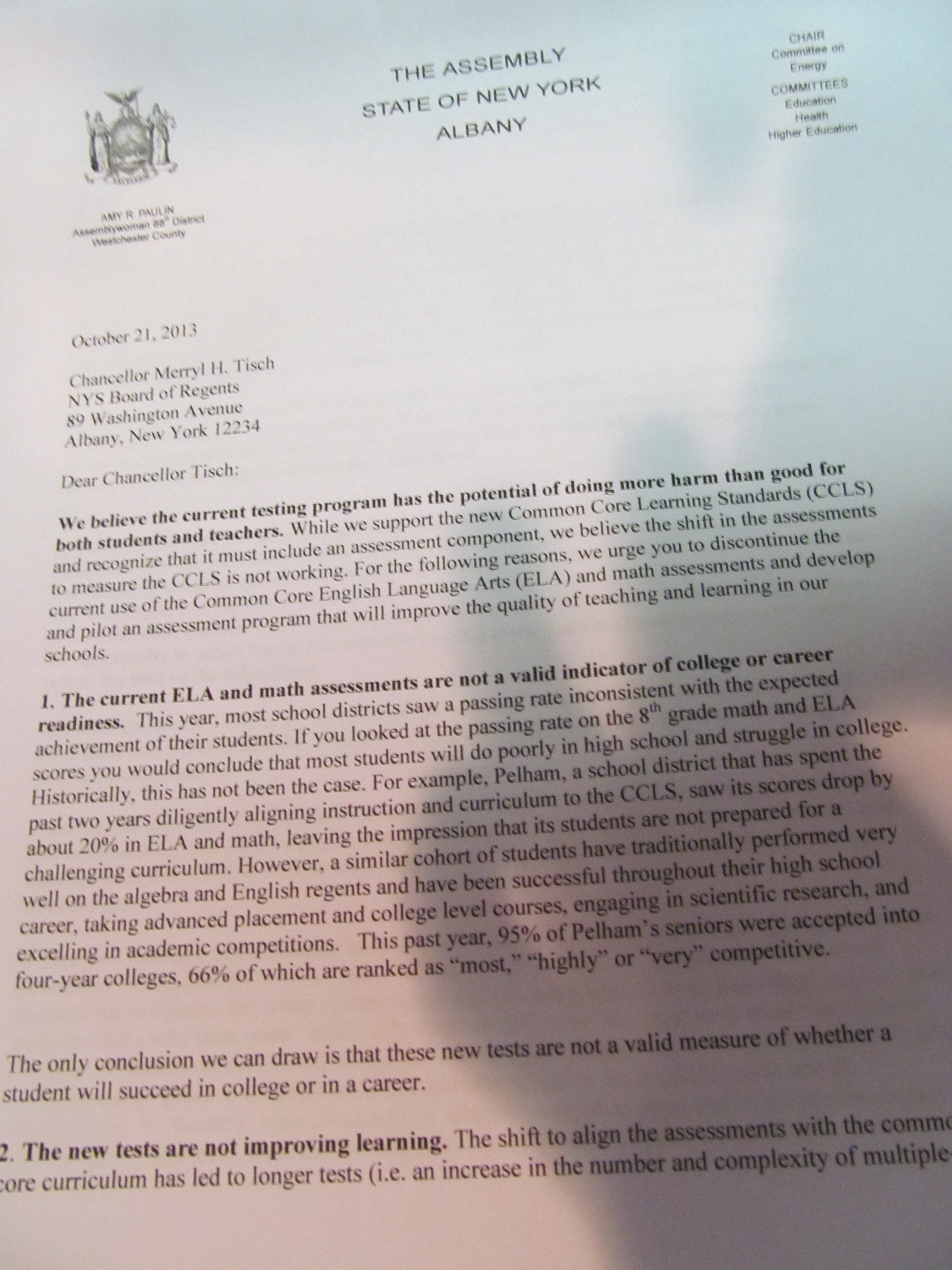
This year’s state assessments are the first for New York students to measure the Common Core Learning Standards that were adopted by the State Board of Regents in 2010.  King said that, as expected, the percentage of students deemed proficient is significantly lower than in 2011-12.

This change in scores – which will effectively create a new baseline of student learning – is largely the result of the shift in the assessments to measure the Common Core Standards, which more accurately reflect students’ progress toward college and career readiness.

King emphasized that the results do not reflect a decrease in performance for schools or students.  The new assessments are a better, more accurate tool for educators, students, and parents as they work together to address the rigorous demands of the Common Core and college and career readiness in the 21st century.

“The world has changed, the economy has changed, and what our students need to know has changed,” Board of Regents Chancellor Merryl H. Tisch said.  “These scores reflect a new baseline and a new beginning. We have just finished the first year of a dramatic shift in teaching and learning.  Teachers, principals, superintendents and school boards have worked extraordinarily hard to implement the Common Core.  With the right tools, the right training, and continuous feedback and support, our teachers –the best teaching force in the country — will make sure all our students are prepared for college and career success in the 21st century.

“Our students face very real challenges.  But it’s better to have our students challenged now – when teachers and parents are there to help – than frustrated later when they start college or try to find a job and discover they are unprepared.”

“These proficiency scores do not reflect a drop in performance, but rather a raising of standards to reflect college and career readiness in the 21st century,” King said.  “I understand these scores are sobering for parents, teachers, and principals. It’s frustrating to see our children struggle.  But we can’t allow ourselves to be paralyzed by frustration; we must be energized by this opportunity.  The results we’ve announced today are not a critique of past efforts; they’re a new starting point on a roadmap to future success.

“We all share the same goal: to make sure all students in New York have the skills and knowledge to be successful in college and careers.  With the Common Core, we’re building a ladder toward that goal; the assessment scores are a measure of where our students are on that ladder and give us a clearer, more accurate picture of the climb ahead.”

King said these new results are consistent with other indicators of the college and career readiness of New York State students including the National Assessment of Educational Progress (NAEP), New York State student performance on the SAT and PSAT, and college and career ready scores on New York State’s high school Regents exams.

King noted that the scores will not negatively impact district, school, principal, or teacher accountability. 

No new districts will be identified as Focus Districts and no new schools will be identified as Priority schools based on 2012-13 assessment results.  The student growth scores used in teacher and principal evaluation result in similar proportions of educators earning each rating category (Highly Effective, etc) for student growth in 2012-13 as 2011-12.  The State provided growth scores to be used in teacher and principal evaluations are based on year-to-year comparisons for similar students.

Earlier this month, King sent a memo to school district superintendents, urging them to recognize that this is the first year of the new assessments and recommending judicious and thoughtful use of each measure of the State’s multiple measures evaluation system.

2017 the Target for Meeting the Standard

In addition, the Department is providing guidance for districts to ensure that students are not negatively impacted by the new proficiency rates.  The first cohort of students required to pass Common Core-aligned Regents exams for high school graduation will be the class of 2017.    The Board of Regents has asked the Department to adjust its guidance on Academic Intervention Services (AIS) as well.

The “cut” scores used to rate students’ proficiency level on a scale of 1-4 were set by a panel of 95 teachers, principals and other educators from around the state at a five-day conference in June.

Tisch and King both expressed concern that the learning gap for low income students, African-American and Hispanic students, and English Language Learners remains unacceptable.

Summary of Statewide 3-8 Exam Results:

  • 31.1% of grade 3-8 students across the State met or exceeded the ELA proficiency standard; 31% met or exceeded the math proficiency standard
  • The ELA proficiency results for race/ethnicity groups across grades 3-8 reveal the persistence of the achievement gap: only 16.1% of African-American students and 17.7% of Hispanic students met or exceeded the proficiency standard
  • 3.2% of English Language Learners (ELLs) in grades 3-8 met or exceeded the ELA proficiency standard; 9.8% of ELLs met or exceeded the math proficiency standard
  • 5% of students with disabilities met or exceeded the ELA proficiency standard; 7% of students with disabilities met or exceeded the math proficiency standard

Across the Big 5 city school districts, a smaller percentage of students met or exceeded the ELA and math proficiency standards than in the rest of the state:

  • In Buffalo, 11.5% of students met or exceeded the ELA proficiency standard; 9.6% met or exceeded the math proficiency standard
  • In Yonkers, 16.4% of students met or exceeded the ELA proficiency standard; 14.5% met or exceeded the math proficiency standard
  • In New York City, 26.4% of students met or exceeded the ELA proficiency standard; 29.6% met or exceeded the math proficiency standard
  • In Rochester, 5.4% of students met or exceeded the ELA proficiency standard; 5% met or exceeded the math proficiency standard
  • In Syracuse, 8.7% of students met or exceeded the ELA proficiency standard; 6.9% met or exceeded the math proficiency standard

A summary of the test results, as well as individual school and district results, are available at: http://www.p12.nysed.gov/irs/pressRelease/20130807/home.html.


Posted in Uncategorized

WHITE PLAINS, SCARSDALE WATER SAFE TO DRINK, COUNTY SAYS. AND EPA AGREES.

Hits: 116

.

WPCNR WATER NEWS. By John F. Bailey.  August 7, 2013:

White Plains and Scarsdale tap water is safe to drink.

Westchester County was notifying doctors and interested parties today who called the county asking whether White Plains and Scarsdale drinking water was safe to consume after it was reported the county was sued in federal court  over a delay in implementing an EPA regulation.

David Simpson, a spokesman for the Department of Communications told WPCNR Thursday “Yes, the water is safe for drinking and any other use and the EPA agrees. No agency has disputed that. “

Simpson also said  the County Health Department said there  has never been a case of  gastrointestinal disease caused by the parasite the EPA wants the county to install advanced treatment procedures to eliminate in supplying White Plains and Scarsdale.

Concerns had been raised by the filing of a lawsuit yesterday in Southern District Court by the Environmental Protection Agency in federal court for the county failure to install ultraviolet water treatment equipment to kill the parasite, Cryptosporidium found in the drinking supply for White Plains (according to the White Plains city water report of 2012).

Not One Case.

Simpson said the gastrointestinal disease caused by Cryptospridium  is a reportable disease which hospitals and doctors must report.

Simpson said the Westchester County Health Department has never had one case diagnosed caused by this parasite ever reported. Nationally in 2010, only 8,000 cases were reported nationwide, he said

Health Department confirms:

Caren Halbfinger, spokesperson for the Westchester County Department of Health issued this statement:

About two thirds of the 300,000 customers who live in District  1 already receive water that is in compliance with this regulation, and the county is working on a solution to bring the water that goes to the northern part of the district into compliance for the remaining one-third of the district.

The water in District One is safe to drink.

The same water that District One draws from, in the Kensico Reservoir, is sampled weekly by the NYC Department of Environmental Protection and no elevated levels of cryptosporidium have ever been found that would trigger a public health advisory.

Further, the health department would know if water was causing any illnesses in Westchester, and it has not. Cases of cryptosporidiosis, the illness this bacteria can cause, are reportable to the county health department and there have been no cases attributed to the water supply.


Not a word from EPA on the County “Delay” Until Yesterday.

Simpson added that in 2006, a law was passed by congress requiring water to be treated for this parasite. The county had, he said until April 2012 to install the ultraviolet treatment in the District 1 towns (Mount Vernon, Scarsdale, White Plains, Yonkers.

The county piped water from the Kensico reservoir to Mount Vernon and Yonkers, but decided that it would cost $100 Million to run a pipe up to the Mount Pleasant reservoir   to make the fix for White Plains and Scarsdale.

Simpson said the county informed the EPA in 2011 they could not meet the April 2012 deadline, and had not heard from the EPA since, while they explored a less expensive solution.

No Warning.

Simpson said the EPA had not given any indication before the suit was filed in Southern District Court yesterday that they were in any disagreement with the delay and the county search for a less expensive solution. “It (the suit) came as a complete surprise to us.” Simpson said.

Asked if this was a systemic communication proplem between the EPA and the Justice Department, Simpson said WPCNR should speak to the EPA about that.

The county, Simpson said, was not pausing in their attempt to fix the problem with the $5 Million fix running a pipe up from the Kensico reservoir.

Simpson said design work had been done to run a spur of pipe off the Delaware acqueduct from the Kensico reservoir and the request for the $5 Million bond issue has been with the Board of Legislators for their approval since April.

The Mayor’s Office and the Commissioner of Public Works was contacted by WPCNR as to the issue of whether White Plains water was safe to drink, but neither has returned WP

Posted in Uncategorized