Hits: 130
WPCNR THE LETTER TICKER. From The Gedney Association. December 2, 2016:
|
Hits: 130
WPCNR THE LETTER TICKER. From The Gedney Association. December 2, 2016:
|
Hits: 2

THE “REIMAGINED” WHITE PLAINS MALL — LOOKING EAST DOWN HAMILTON AVENUE. DR MARTIN LUTHER KING JR BOULEVARD IS AT CENTER BASE OF GRAPHIC. THE RITZ CARLTON CONDOMINIUMS AND TOWERS ARE UPPER CENTER OF PICTURE.
WPCNR COMMON COUNCIL CHRONICLE EXAMINER. By John F. Bailey. November 28, 2016:
Two weeks before White Plains gets its first look at what Parsons Brinkerhoff, the MTA, and the city transit center steering committee propose for redevelopment of the transit center,(based on collected citizen-preferences), owners of the White Plains Mall 200 Hamilton Avenue, presented a project Monday night to the Common Council that will reimagine the 1972-built mall into a residential community, public space and restaurant destination with regional appeal.

THE REIMAGING: THE ENTRANCE IS ON DR. MARTIN LUTHER KING JR BOULEVARD. RED REPRESENTS RESTAURANTS AND RETAIL. THE LIGHT GREEN REPRESENTS APARTMENT RESIDENCES.THE SMALLER GREEN SPACE IS THE FOOD/CRAFT HALL AND PUBLIC SPACE.
Hamilton Avenue would include a bike lane access to the new railroad hub envisioned as part of the transit district redevelopment, with a widened median. Entrance to the new concept Food/Craft Hall openair space would be off Dr. Martin Luther King Jr. Boulevard, with a fountain on the corner of Barker and MLKJBLVD.
A 28 story, 260 unit apartment building would be built on the corner of Hamilton and Cottage Place, diagonally across from the Residence Inn. Adjacent to the 28 story would be a 15 story apartment, complex with 120 units, and on Martin Luther King Jr. Boulevard, 100 units with an additional 120 units fronting Hamilton Avenue. The residential components surround the property with retail (mostly restaurants) at street level on the sides.
The Martin Luther King, Jr. Boulevard frontage would be re developed into restaurants and stepped heights of residential units. Parking would be in garages inside the structure and a private greenspace created on the roof of the interior garage, 7 stories above the street for use of apartment residents.
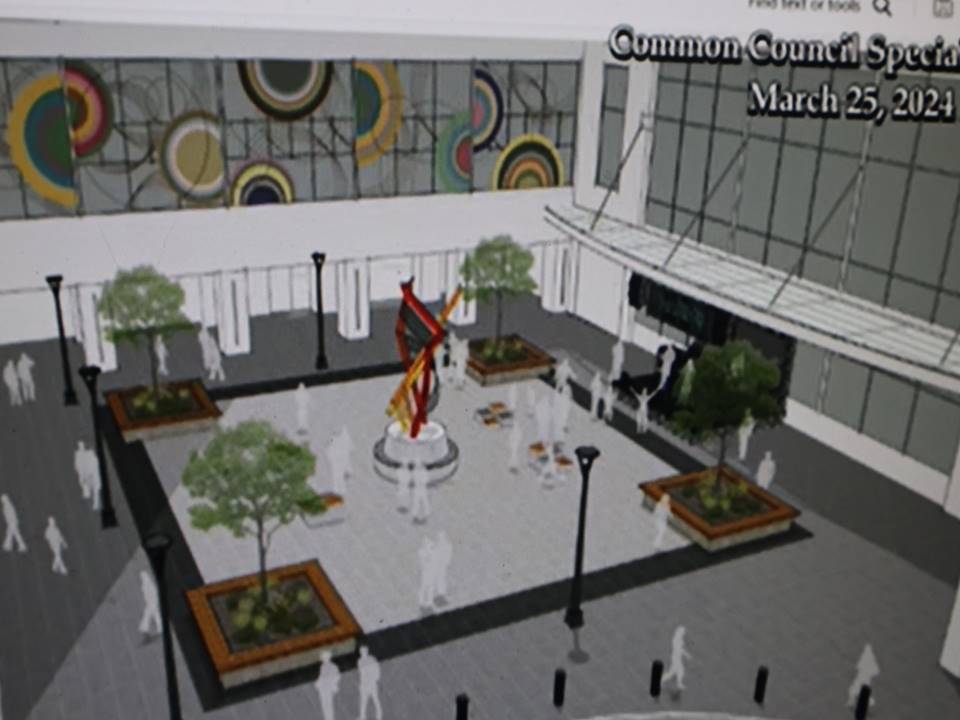
The public would have use of the public space reminiscent of those in old Spanish courtyards, sprawling in scope for concerts, with enticing kiosk food concessions and traditional contemporary restaurants surrounding the interior courtyard. Mr. Null coined this public space the Food Craft Hall. It would be accessible by a street entrance on Martin Luther King Jr Boulevard where the present mall is entered now.

The Corner of Barker and Dr. Martin Luther King Jr Boulevard looking south to entrance of the public space and parking.
The proposal suggests thee rental complexes of 28 stories at the highest and stepping down to surround the “mall block” with residential with an open air public space and food kiosks inside. The apartments are planned to incorporate the city requirement that 20% of the units be classified as affordable housing linked to income.
The plan is to build the “reimagined” mall in three years from the time it is approved (5 years out ). Streetscapes is spearheading design of the project which attorney for the project.
William Null said the concept follows the national trend of providing rental housing to repopulate downtowns with street attractions, restaurants, entertainment that appeal to persons in their 20s and 30s, who seek the best of suburban and city worlds, close to public transit so they do not have to have a car.
Mayor Thomas Roach chairing the work session, said the concept fits in with the transit district mission to bring safer and an appealing environment for pedestrians, bicyclists, and create a lively environment around the central transit district.
Hits: 402
WPCNR QUILL & EYESHADE. From the New York State Department of Taxation and Finance. November 28, 2016:
The $4.9 Million September Sales Tax boom did sustain momentum in October for the City of White Plains. The retail pace fell to $3,982,450 compared to the $4.9 Million the city raked in in September.
The $3,982,450 October White Plains “handle” was $328,613 lower than the $4,311,063 generated in October, 2015 (a 7.6% decline, year to year for the month).
White Plains, four months into the city fiscal year 2016-17 is up ½% $16,787,530 to $16,690,601 coined in July, August, September and October in 2015.
Westchester County now going into the last two months of its 2015 year is up ½% over 2015, $414,480,802. Should the County equal sales tax receipts of November and December of 2015, it will top $501,858,187, an all time record over 2015’s $499,527,981.
However, the county’s ambitious forecast of a 14% sales tax receipts increase was obviously way too high.
The county has never had more than a 4% sales tax receipts increase in the years WPCNR has been observing county sales tax trends.
The county answer to the bungled forecast is to lease the Westchester County Airport to an independent operator and cover the $15 Million shortfall with an upfront payment from the airport operator. The County Legislature is dubious about this solution.
Hits: 350
WPCNR COMMON COUNCIL CHRONICLE-EXAMINER. November 28, 2016:
Tonight at 6 PM at City Hall, the Common Council will see a presentation by developers of the White Plains Mall defining their design for a 28 story residential and mixed use (retail included) on the White Plains Mall site.
In addition the council will hear according to the agenda, a Sunrise Solar proposal for a series of solar panels on the Gedney Yard, (city-owned property), and the New York Power Authority will make a presentation on their “Implementation Program.”
Hits: 941
PETER KATZ
JIM BENEROFE
JOHN BAILEY
WHITE PLAINS WEEK
ON
THANKSGIVING
THE TAPPAN ZEE ETERNAL TRAFFIC JAM
TRUMP IN TRANSITION COMMENTARY
THE DOWNTOWN TRANSIT DISTRICT SURVEY FLAW
THE HOUSING MARKET IN WHITE PLAINS
WATER RATES GOING UP
AND MORE
ON YOUTUBE NOW AT
and
Hits: 353
WPCNR Thanksgiving Portfolio, all photos by WPCNR:
On this Thanksgiving, let us remember the band of hardy intrepid souls who crossed an ocean in a boat no bigger than a large Chris Craft and settled in an unforgiving landscape and started a country in the cold landscape of New England.
They were helped by Indians who welcomed them, without whom they would not have survived. And, remember, those pilgrims were immigrants. A salute to this brave band.
They sailed into a bay, dropped anchor and just carved out a living after living in incredible conditions in a ship’s hold for weeks, crossing the storm-tossed North Atlantic. Here are some views of America’s first hometown captured by the WPCNR Roving Photographer.

Plymouth Rock Landing. Plymouth, Massachusetts.
The Mayflower II. Plymouth Harbor.

Indian Statue of Squanto welcoming the Pilgrim Settlers. Plymouth.

Governor William Bradford Statue on the Shores of Plymouth Harbor

“Plymouth Rock,” The landing place of the pilgrims. 
Settlers Home, left, circa 1690. 
Church, Plymouth late 1700s. .

The Jury: Old Burial Ground, Plymouth. Last resting place of the pilgrims overlooking Plymouth Harbor. The sacrifices, bravery and perseverence of these persons stand as examples to Americans today. How are we doin’?
Hits: 157
(WPCNR Editor’s Note: The following is reprinted from the Columbia Journalism Review which has predictions from a South African journalist as to what the American press can expect from the new Trump administration:)
DEAR FRIENDS IN AMERICAN JOURNALISM,
Ordinarily, it is you who offer the rest of the world advice about press freedom, and the accountability architecture of democratic societies, so I understand that it may be strange to hear it coming back at you, but this will not be the last inversion that the election of Donald Trump delivers.
You have some deep resources to draw on for the battle that is closing around you. For starters there is your Constitution, which offers stronger protections than just about any comparable legal framework. And your money, greatly diminished, and unevenly distributed to be sure, but orders of magnitude more plentiful than what your counterparts elsewhere have to call upon. You also have reserves of talent, creativity, and commitment far larger than you are given credit for by your critics, and right now by angry, bewildered, and wounded friends.
But one thing you don’t have, is experience of what to do when things start to get genuinely bad.
Your free press is a beautiful, important thing, even when it is besieged and bedraggled. Perhaps especially then.
Take it from those of us who have worked in places where the institutional fabric is thinner, the legal protections less absolute, and the social license to operate less secure. Not outright dictatorships, but majoritarian democracies where big men—and they are usually men—polish their image in the mirror of state media or social media, while slowly squeezing the life out of independent institutions.
When Donald Trump ditched his press pool twice within days of being elected, and launched a series of Twitter attacks on The New York Times, a lot of you sounded surprised. As if you expected him to become a different person once the anointing oil of the Electoral College had touched his brow. Of course there was nothing surprising about his conduct. Rule number 1 of surviving autocracy, as Masha Gessen reminds us, is “Believe the Autocrat.”
Related: Journalism’s moment of reckoning has arrived
When Mr. Trump threatened during the campaign to review America’s libel law framework, he was setting out his stall, not bluffing. When he threatened to sue, when he mocked a disabled reporter, when he made clear his affinity for Vladimir Putin and Peter Thiel, he was issuing a warning.
Of course, not being surprised doesn’t mean you shouldn’t be outraged. As Gessen also wrote, to survive autocracy, you have to preserve outrage, and your free press is a beautiful, important thing, even when it is besieged and bedraggled. Perhaps especially then.
The rest of us get irritated with you at times, in the manner of less privileged relatives, but you have given the rest of us a good deal over the years, standards to aspire to, innovation to build on, voices of great clarity. Here is some advice in return, mostly from India and South Africa, where an ostensibly free press is confronted with regulatory, economic, and political pressures that come with majoritarianism.
1. Get used to the end of access as you know it.
The president-elect loves to see himself on magazine covers. Don’t kid yourself that this means you will enjoy meaningful access to his administration on the terms you are familiar with. There will be a lot less trading of micro-scoops for favorable coverage, the transactional stock-in trade of capital city reporting everywhere. In India for example, after Narendra Modi took power, journalists were banned from government offices they had once wandered freely. They were kicked off the presidential plane. Modi granted no interviews to the domestic press for over a year. His ministers and senior officials whispered privately that they had been ordered not to speak to the press.
Losing this kind of access isn’t all bad. It reminds you that your job is to hold power to account, rather than to join its club. Outsider status can be bracing. But it comes with the choking off of other kinds. Twitter and Instagram posts substitute for the tough back-and-forth of press conferences, officials stonewall legitimate queries, and you wait to publish, because right of reply matters, accuracy matters to you. Not to them.
So you take to the law. But freedom of information filings will be slowed-walked to death or irrelevance, as they increasingly are in India, and other countries where the first flush of enthusiasm over FOIA legislation has replaced with a deepening chill.
In one case I was involved in in South Africa three presidents fought us over seven years and two trips to the constitutional court before we won. By then it was too late to do anything but prove a point.
So you have to cultivate other ways to get the data that you need and the democratic process demands.
There are going to be a plenty of officials who are deeply uncomfortable with the direction of the administration. Some of them are your sources already, no doubt. But you will need them much more. Especially the awkward squad. The mid-level career bureaucrats, the ones deep down the cc list, the ones who may not have the secretary’s ear, or the inside scoop on how many almonds the president eats at night.
And you are going to need a knowledge of strong encryption if you are going to keep them safe under a regime that has the most sophisticated surveillance capabilities ever imagined, and a president-elect with history of vindictiveness.
You might think the worst of access culture is already over in Washington. We’ve seen the videos from the White House correspondents dinner. It really isn’t.
So it will feel strange, this new world. It cuts to your sense of who you are, the proximity to power and the capacity for actual influence that makes up for your shitty paycheck and the trolls all over your timeline, but on balance, it is a more honest place, and it is the only one available.
2. Get used to spending more time in court.
You are going to need to litigate to get access to information, but you are also going to have to defend, a lot. Some of the attacks will come from proxies suing over your reporting on corruption, conflicts of interest, and general sleaze. We never lost a suit like that during my time in South Africa, and there were plenty, but we burned countless hours and money we really didn’t have, both of which would have been better spent on more reporting.
In India, where the protections are weaker, obscure activists in country towns launch suits against reporters, editors, and proprietors routinely, seeking immense damages in the overburdened and sometimes compromised provincial courts. Anyone who has worked in an Indian newsroom can describe for you what the words “chilling effect” really mean.
You obviously can’t back down in the face of these efforts, but you can use them as crusading opportunities, both spreading the story and popularizing your sense of mission. You should be quite unembarrassed about this. You should probably also think about some kind of pooled legal defence fund for smaller outlets.
It will feel strange, this new world. It cuts to your sense of who you are, the proximity to power and the capacity for actual influence that makes up for your shitty paycheck and the trolls all over your timeline, but on balance, it is a more honest place.
Much more frightening, of course, are the moments when the proxies step aside, and the full might of the security establishment is brought to bear. Your Espionage Act is a truly terrible piece of legislation. Some kind of elite consensus has spared reporters and editors its full force since 1917, but word is the elite consensus is over.
Being fingerprinted for journalism is a very strange experience, you don’t want it to become a normal one.
Related: Covering Trump: An oral history of an unforgettable campaign
3. Get used to being stigmatized as “opposition.”
Mr Trump was quick out of the blocks on this one with his “professional protesters incited by the media” tweet. His subsequent attacks on the Times fit a familiar pattern: call out one prominent enemy pour encourager les autres, and let the trolls do the rest. This will escalate. The basic idea is simple: to delegitimize accountability journalism by framing it as partisan.
In South Africa linking the press with the opposition was a routine trope, on really bad days ruling party figures would add the CIA or foreign capitalists.
A member of parliament once asked me, during hearings on a draconian new intelligence law that the national editors’ body objected to “tell me, are you still South African when you go home at night?”
Narendra Modi, on the other hand, never names his enemies, but the liberal-leaning NDTV carries the brunt of his ire, with one of its channels recently ordered to go off air for a day as punishment for allegedly compromising security with its coverage of a militant attack. And his ardent social media fans do much of the work for him. Steel yourself and take a look at Barkha Dutt’s mentions sometime to see the Indian version of Steven Bannon’s white nationalist horde.
“Paid media,” “presstitutes,” “Lutyens journalists” (the equivalent of Beltway insiders) are all routine slurs from India’s ruling party, meant to associate the press with the old, corrupt elite and the opposition Congress Party.
The frustrating thing about this approach is that it works quite well, and it is going to work REALLY well in America next year.
Why should anyone care about your investigation of the president’s conflicts of interest, or his tax bills, if they emanate from the political opposition? The scariest thing about “fake news” is that all news becomes fake. Yours too.
The challenge is to maintain a tough, independent, journalistic politics, a politics of accountability, equity and the rule of law without straightforwardly aligning with the partisan opposition. In places like Venezuela, where private media have been forced into a purely oppositional stance, the result has been a shrinking of real spaces for dissent and accountability.
This is a tough line to walk, because people on both sides of the political divide actually want you to fail at it. But it is among your most important tasks.
Related: ‘The goal is not to fear Trump, but for Trump to fear you’
4. When they can’t regulate you away, they will try to buy you out or suck up your oxygen.
Congressional funding for public broadcasting is limited here, as is its audience, so one avenue of media capture is foreclosed. But crony billionaires will be lurking all around the fringes of a distressed industry, happy to tolerate losses in return for a voice. India has hundreds of loss-making TV channels and newspapers. In South Africa, the main English language daily group has been bought out by a presidential crony, and gutted. But you can look closer to home for examples, perhaps to Las Vegas.
Some media owners, already ensconced, will tack to the prevailing wind. Gently at first, so you hardly notice it. Completely in the end.
And where that doesn’t work, the president’s people will start, or boost, their own alternatives, and seek to route around you. Breitbart is just beginning.
Organizing journalists is a great deal worse than herding cats. We have egos that are at once giant, and fragile. We like to own the story, all of it. We are rubbish at management. But some among you have these skills.
5. You are going to have to get organized.
My sense is that American journalists aren’t much for formal structures that reach across the profession and represent its interests. The protection of the First Amendment, and your establishment credentials have been enough, by and large. You don’t have a press council, or a meaningful editors’ body, or strong unions.
In the new world, journalism Twitter isn’t going to be an adequate safeguard.
You need to band together around positive principles—independence, accountability, ethical standards, and the defence of your rights, which must be fought for both in the broad constitutional brushstrokes and the narrow detail of regulation and practice. Judging by the recent barrage of anti-semitic and racist threats to journalists, you will also need to address both the climate of hate and specific concerns around safety.
Organizing journalists is a great deal worse than herding cats. We have egos that are at once giant, and fragile. We like to own the story, all of it. We are rubbish at management. But some among you have these skills. Get it together to push them forward.
Also, find some allies outside of your usual circles. In South Africa, for example, our campaigns for freedom of information were vastly more credible when they were undertaken in partnership with organizations with their roots poor communities who could speak to the importance of transparency in ensuring access to clean water, safe streets, and healthcare.
I’M SORRY TO LECTURE. But I am worried. We all are. In the countries where I’ve spent my working life, the press still matters, but there is less of it, and the whole accountability ecosystem has become unbalanced. For all its real and urgent problems, US journalism is still the City on a Hill. The fading of its light will be disastrous not just for Americans, but for all of us.
Nic Dawes is the former editor in chief of South Africa’s Mail & Guardian and was until recently Chief Content Officer at India’s Hindustan Times. He now heads media at Human Rights Watch in New York.
Hits: 374
WPCNR LETTER TICKER. From the Gedney Association. November 21, 2016:
Dear John
As a follow up to last week’s Annual Meeting, our board and concerned residents have compiled some of the key points of FASNY’s new site plan proposal. The new project elements present a different set of impacts.
PROJECT BASICS:
DEVELOPMENT/CONSTRUCTION:
TRAFFIC:
CONSERVANCY:
CHANGES IN CITY GOVERNMENT:
Anyone interested in obtaining a digital copy of new site plan can contact us at info@gedneyfarms.net. A .pdf version of the map below can be downloaded by clicking here: Alternative Site Layout Plan.
Hits: 395
Dear friend,
The ugly political discourse of the campaign did not end on Election Day. In many ways it has gotten worse, demonizing our differences and trying to make us afraid of anyone different. The divisiveness must stop and New Yorkers will not be bystanders to injustice. That is not the New York way.
This morning, I spoke at Abyssinian Baptist Church to remind New Yorkers that it is more important today than ever that we continue to stand up for tolerance and justice. We must stand against sexism and racism and bigotry wherever we see it. We must stand up for the rights of immigrants because we know our diversity is a strength, not a weakness.
I am a son of immigrants. Son of Mario Cuomo, who is the son of Andrea Cuomo, a poor, Italian immigrant who came to this country without a job, without money, or resources and he was here only for the promise of America.
So if there is a move to deport immigrants then I say start with me.

New York State is the progressive capital of the nation, and its social conscience. New York is the laboratory of the American experiment in democracy. New York is the welcome mat to the world. Ellis Island is where generations signed the American compact.
The Statue of Liberty stands in our harbor and New Yorkers hold the torch. Today, that torch must be held higher and that torch must shine brighter than ever before.
Andrew
PS: Watch today’s full speech here and read about the actions we are taking to protect civil rights and combat hate crimes.
Hits: 909
ON
THE WHITE PLAINS GRAFFITI OUTRAGE
THE CHAMBERLAIN DECISION
PLANNING BOARD APPROVES FASNY SITE PLAN UNANIMOUSLY SENDS TO COMMON COUNCIL
WHITE PLAINS WEEK GOES TO CUBA– JOHN BAILEY EXCLUSIVE!
SEE IT NOW ON YOU TUBE AT