

MUSK, FAUCI, TRUST IN SCIENCE AND HOW TO MAKE IT SURVIVE

By Dr. Katelyn Jetelina, Your Local Epidemiologist December 14, 2022. Reprinted with permission.

Si quiere leer la versión en español, pulse aquí.

Trust in public health is eroding, and the implications are far reaching. We, as a field, have to fix this.

Over the weekend

Any forward-facing scientist can tell you that receiving dangerous messages has been a common occurrence throughout the pandemic. But the hate, resentment, frustration, and anger was crystallized in one instance over the weekend: Elon Musk—the world’s richest man and new owner of Twitter—wrote the post below.

Elon Musk @elonmusk

My pronouns are Prosecute/Fauci10:58 AM ∙ Dec 11, 20221,176,815Likes177,693Retweets

Five words, that were wrong on so many levels, garnered more than 1.17 million “likes,” 177,000 retweets, and international attention in mass media. Anyone who dared to disagree received a wave of truly grotesque comments. Even Musk noticed as he followed up on his original tweet with: “Truth resonates…”

Of course, the viral reaction is due to many things: social media algorithms, a polarized country, politics, misinformation, disinformation, opinions about Twitter, opinions about Elon. I also think Musk is trying to deflect negative attention from himself.

It’s also a reflection of humans’ difficulty coping with randomness—people need someone to blame for the pandemic, the fear they experienced, the people they lost, or the jobs and livelihoods that were changed. The viral reaction was also an indication that people finally felt heard.

But all of the above also overlap with public health. And, their accumulation has been funneled into one sentiment towards our field: distrust.

Change in trust

Every year, the Pew Research Center conducts a survey with Americans on public confidence in certain groups. Overall, trust in scientists has decreased throughout the pandemic, but ever so slightly. Interestingly it remained higher than public confidence in business officials, the military, public school principals, religious leaders, police officers, and elected officials.

If we compare the responses based on political affiliation, though, the story becomes jarring: confidence in scientists among Republicans dropped significantly. In fact, 1 in 3 Republicans have no confidence at all.
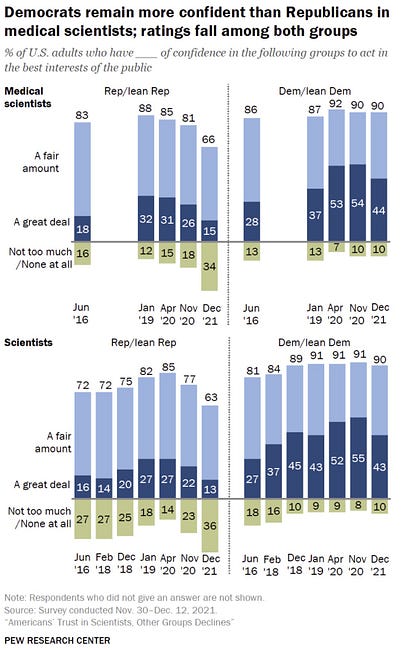
Furthermore, declines in trust in science were most pronounced among White adults. Americans with higher levels of education expressed more positive views of scientists than those with lower levels of education.

This is a huge problem, as trust equals lives

An Oxford report continually assesses country-level factors that most strongly predict COVID-19 deaths. The answer?

Not pandemic preparedness. Not government. It was interpersonal trust—a measure of how much people think they can trust another citizen who they don’t already know. In other words, public health worked better in high-trust countries.
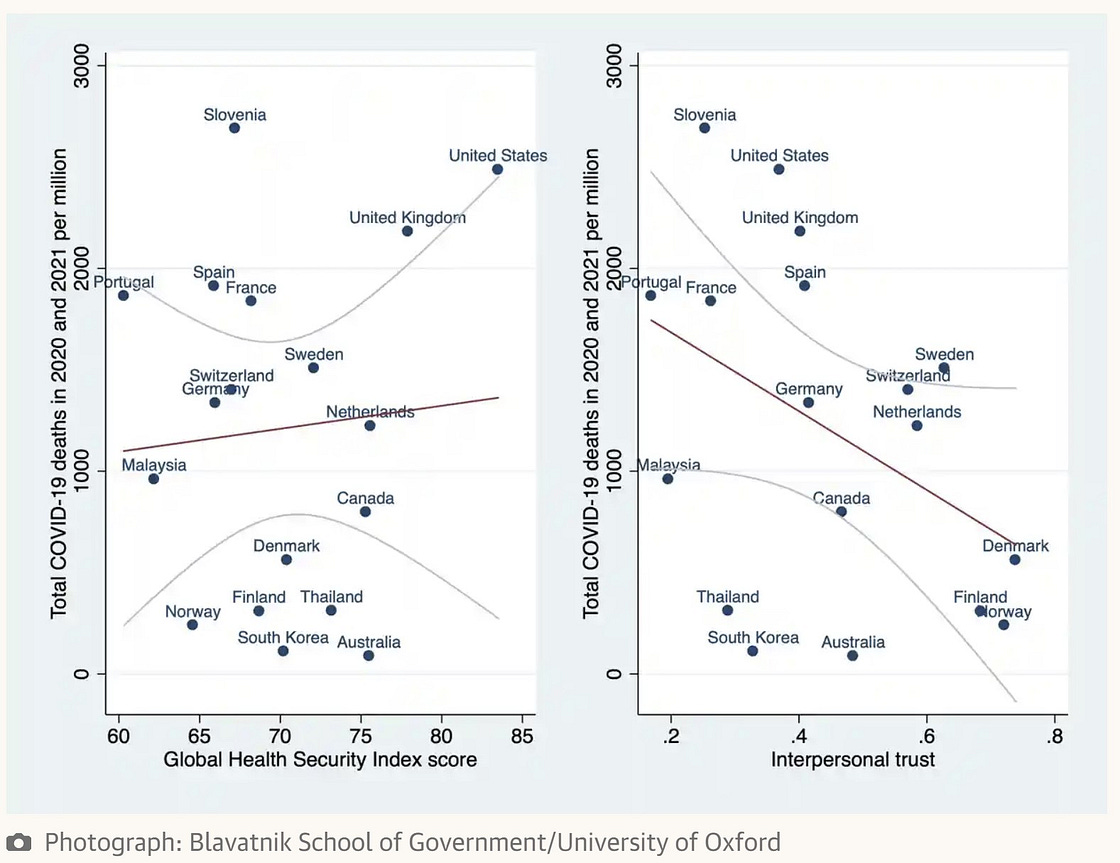
We cannot have one group trust public health and another not.

This is not how viruses work.

Infectious diseases violate the assumption of independence—what one person does directly impacts the person next to them.

This is unlike cancer or diabetes, for example. Everyone has to be against a virus, or the virus thrives.

Perhaps most concerning is that this isn’t going to be our last pandemic. Since the 1918 flu, we’ve seen diseases emerge faster and faster. Public health also touches on our daily lives beyond infectious diseases: what we eat, social problems, gun violence, and all other acute and chronic medical problems. We need the trust of the community to move the needle for any of these.

What to do?

As the field of public health copes, self-reflects, and digests the past three years and weighs how to build for a better future, we have to make it our goal, our opportunity, to improve trust.

As one scientist said, “You earn public confidence in small drops and you [lose] it in buckets.”

Bottom-up engagement is absolutely necessary. We need to enter conversations with humility.

A conversation about false dichotomies (lock down vs. throwing caution to the wind) is necessary.

A conversation about disease vs. the needs of a community is necessary.

An honest conversation on what we (CDC, state epi, local epi, leaders, communicators) got wrong, got right, and why.

What does this look like? I have a few ideas:

  1. Listening sessions. Not hearing and not telling, but listening to people and trusted messengers who are not in “our world.” Bringing them into the solution. It will be painful. It will be time consuming. But it has to be done.
  2. A COVID-19 commission that is congressionally mandated, like the 9/11 commission. There is text in the PREVENT Act, but it’s not clear if PREVENT will pass.
  3. Preparation for the future. Putting communication at the center of pandemic preparedness. This is still not being done. Building capacity for effective scientific communication needs to be a core of our national strategy. As I’ve written before, a lot needs to be done in this area.

I’m sure there are more and even better ways. And I would love to hear your thoughts in the comments. But the fact of the matter is there is no one solution.

And this is going to take a whole lot of time.

Bottom line

We need to understand why five words in a Tweet carry so much weight in public health and threaten our entire profession. Will trust in science survive the pandemic? 

Maybe. It depends on what we, as a field, do next.

If we don’t win hearts and minds, we won’t win against this virus or the next. Trust is key in public health.

Our scientific work depends on it. Our health depends on it. Our lives depend on it. Now everyone needs to act like it.

That includes, you, Mr. Musk.

(Editor’s Note: Locally, on Sunday December 11 in Westchester County, 299 persons tested positive to start the week of covid surveillance. Rockland County had 72 new cases. Orange County, 56, Dutchess, 42 and Putnam County 37, Ulster, 17. The Mid-Hudson Region saw 540 person test positive for covid of 9,863 Lab-verified tests an infection rate of 5%. Nassau County and Suffolk County reported 1,158. Of 19,797 tested in those 9 counties (Mid-Hudson and Nassau and Suffolk) there were 1,678 positives in one day an infection rate of 8% . New York City reported 2,376 new cases. )

Posted in Uncategorized

COUNTY EXECUTIVE VETOS LEGISLATORS BAN FLAVORED TOBACCO BILL. CITES COMMUNITY OBJECTIONS FROM BLACK AND MIDEASTERN CITIZENS.

OFFERS ALTERNATIVE WESTCHESTER TOBACCO FREE EDUCATION PROGRAM AND WESTCHESTER TOBACCO FREE ENFORCEMENT TO “STAMP OUT” ILLEGAL SALES TO THOSE UNDER 21.

WPCNR County Clarion-Ledger. By John F. Bailey. December 13, 2022:

Westchester County Executive George Latimer has vetoed the County Board of Legislators bill that would ban sale of flavored tobacco products in Westchester County.

Mr. Latimer cited strong objections received from community leaders in African American and Middle East communities that the law was not fair.

As an effort to support the spirit of the legislators’ bill he announced a sweeping Tobacco Education Program to involve communities, youth groups, educators, health and law enforcement to delvelop a program that would educate children about the dangers of tobacco.

The Education program will be supplemented by establishing a Tobacco Enforcement Program in cooperation with county and local police throughout the county to “stamp out” sales of tobacco to persons under 21.

The County describes the two programs this way:

Westchester Tobacco Free – Education

The County will fund and implement a robust $3 million dollar public education campaign to all residents, highlighting the dangers of tobacco usage, offering efforts to help smokers quit smoking, and to support local community efforts to reduce smoking. This will include a new direct grant Program to community-based non-profits directly involved in tobacco-cessation as part of their anti-addiction efforts, and particularly those groups like local NAACP branches who have advocated for efforts to reduce smoking in communities of color.

The Program will be crafted with the assistance and oversight of members of the Board of Legislators to ensure the County is reaching all smokers, regardless of their geographic or demographic status. This effort will involve our Health Department, Community Mental Health Department, Youth Board and other related departments and offices of Westchester County Government to ensure its success.

Westchester Tobacco Free – Enforcement

The County will develop a multi-level Program, working with state and local government resources to ensure improved enforcement of our existing Tobacco 21 age limit. Under the leadership of Deputy County Executive Ken Jenkins, the County will convene a conference with representatives from law enforcement agencies, prosecutorial and judicial offices, business leaders and youth organization leaders to develop a thorough plan to make sure no person under the age of 21 is able to obtain any type of tobacco product, which is clearly illegal by means of County, State and Federal law.

Posted in Uncategorized

Westchester County Executive Latimer Signs $2.4 Billion 2023 County Budget. 9% Budget Increase from 2022.

WPCNR COUNTY CLARION-LEDGER. From the Westchester County Department of Communications. December 13, 2022:

Watch the Budget Signing Here: https://www.youtube.com/watch?v=5NlQ3grEN7E

Westchester County Executive George Latimer signed his 2023 Westchester County Budget, cutting the County Property Tax Levy by $6 million dollars, flanked by members of the Westchester County Departments of Emergency Services, Corrections, Probation and Public Safety. The Budget was passed by the County Board of Legislators earlier in the day, bipartisan 17-0.

Latimer said:“I am signing this budget today and thinking of all the families who are preparing for the holidays – this budget is for them. We have cut taxes again and have done so while also expanding the programs and services they have come to depend on. I am proud of this budget, and our collaboration with the Board of Legislators; this is what honest and fair governing is, that is who we are as an administration and as a County.”

The total budget is $2.365 billion and includes Latimer’s fourth County property tax cut in a row. 

Editor’s Note: The 2022 County Budget was 2.2 Billion. The new 2023 budget increases spending 9% to 2.4 billion. The inflation rate announced today by the U.S. government for the first 11 months of 2022 was 7.3%. If the budget continues on this trend of increasing at 9% the budget will exceed $3 Billion in 2026.

Closing 2022 with projected $65.9 million operating surplus

No borrowing for tax certs

No borrowing for pension

No use of fund balance

2023 Budget contains no borrowing or one-shots

No borrowing for tax certs

No use of fund balance

No borrowing for cash flow

County Board of Legislators Chairwoman Catherine Borgia: “Westchester County is stronger and in a better state financially, and we are paying it forward to our residents. We’ve prioritized meaningful investments in areas that affect our constituents every day. Parents receiving subsidies can now pay less out of pocket to afford better quality childcare. We’re closing the digital divide by expanding internet access throughout the County. We’ve increased funding for community-based organizations providing services directly to those who need them. I am excited for all that we will accomplish in 2023 through mutual commitment and collaboration with the County Executive’s Office.”

The 2023 Budget funds the Departments of Corrections, Public Safety, Probation and Emergency Services at the highest levels in Westchester County history:

·         Correction $156.6 million

·         Public Safety $59.1 million

·         Probation $50.2 million

·         Department of Emergency Services $13 million

Acting Public Safety Commissioner Terrance Raynor said: “I am pleased and proud to stand with County Executive Latimer as he signs a budget that not only fully funds our Department, but exceeds where we were last year. The 2023 Budget enables us to provide the critical law enforcement services that the people of Westchester expect and deserve.”

The County is also focusing on food assistance, the Budget has $2 million in funding for Feeding Westchester and food pantries around the County.  Additionally, for Child Care, the Budget reduces the parent share from 27% in 2018 to 5% in 2023. 

Economic Development accounts for $6 million in the 2023 Operating Budget, with a focus on the Life Sciences, Tourism and Healthcare Sectors. This includes $1.4 million for the Downtown Improvement Grant (DIG) Program.


Economic Development Director Bridget Gibbons
 said: “The County Executive’s consistent investment in economic development to support our existing businesses and inspire the launch of new businesses in Westchester creates a business friendly environment in the County. Life sciences companies, advanced manufacturing companies, tech startups and others are thriving here, and we are proud to provide training, education and other resources to support them.”

The Budget allots $218.7 million for the County Health Department, that includes $1 million for maternal mortality.  Additionally, the budget is expanding funding to Federally Qualified Health Centers/Neighborhood Health Centers by $1 million bringing the total to $3 million.

The 2023 Budget has $17.2 million for the Department of Community Mental Health (DCMH), specifically the Project Alliance Mobile Crisis Response Team, $6.1 million for Crisis Network and 988 Suicide Crisis Lifeline, $565,000 for Opioid Response and Overdose Prevention Initiative and $737,892 Early Childhood Mental Health Services.

DCMH Commissioner Michael Orth said: “Through County Executive Latimer and the Board of Legislators’ ongoing commitment to serving the people of Westchester County, they have made a statement that mental health matters. They have made a statement that addiction and co-occurring disorder need attention. And, they have told all of us here in the County that we matter.”

The Budget has $1.3 million for the Human Rights Commission, money that will be used to fund an additional investigator.

Youth Bureau funding is $4.7 million dollars in the Budget, including $3.1 million for Invest in Kids and funding for new programs based on the youth needs assessment.

Posted in Uncategorized

WESTCHESTER EXPERIENCES 2ND STRAIGHT WEEK OVER 2,000 NEW COVID CASES: 2,184 DEC 4-10

31 CASES A DAY COUNTYWIDE. POSSIBLE 8,000 CASES JANUARY 9.

Thanksgiving 2022 socializing infections parallel a year ago.

WPCNR CORONAVIRUS SURVEILLANCE. Statistics from the New York State Covid Tracker. Observation & Analysis by John F. Bailey December 12, 2022:

The verdict is in on Westchester County Thanksgiving performance.

Guilty of spreading covid at a rate 1 person  to 6 others.

The 1,379 persons who tested positive for covid the week of November 20 to November 26 lead up to Thanksgiving spread of covid to 2,102 persons in the 7 days after Thanksgiving weekend from Sunday through the holiday.

In the two week contagious period of those 1,379 persons, 2,184 more new persons were infected with covid.

The week after Thanksgiving generated new cases at the average rate of 300 new persons testing positive lab-verified a day. That rate was sharply up from 200 a day the previous 2 weeks.

LAST WEEK SAW ACCELERATED INFECTIONS BEGINNING SUNDAY THROUGH SATURDAY. NOTE THE RISE NOT ONLY IN WESTCHESTER COUNTY BUT IN ORANGE, ROCKLAND, DUTCHESS AND ULSTER COUNTIES.

The second week of December ended Saturday continued the 301 daily new infections rate.

What does this mean for Westchester County in the coming weeks?

The covid tracker provides the only real indicator of where infections are headed.

We no longer have school district reports of number of student, faculty and staff cases which was such a help last year enabling the district to reopen safely in the spring. Now, we have no idea where the schools are in student & staff infections of covid.

This unsubstantiated decision was caused by the State Health Department that decided  school districts did not have to report infections of school populations.Why not?

 That was not a good decision.

Now, I repeat we have no idea how infections of  school children and teachers and staff are managing this obvious spread that is happening. I only assume parents are confident that their children are O.K. Assumptions are not facts.

We do know that Long Island and New York City hospitals are overrun with respiratory, covid and flu cases, ccording to sketchy reports last week. The Center for Disease Control named Westchester a high risk area and urged return to mask-wearing indoors. Note the word urged. Urging is not enforcing.

The Purchase College is complying sendingout an email Friday saying that on all buildings on campus persons must wear masks indoors.

We also know that the 6 other counties in the Mid-Hudson Region are up sharply in infections. Orange, Rockland Dutchess Ultser Counties were up. Orange reported 136 cases Thursday, 87 Friday, 58 Saturday. Rockland 111, Thursday, 110 Friday, 43, Saturday; Dutchess 104 Thursday,46 Friday,28, Saturday.

Now where is Westchester heading?

Will  the laissez-faire covid attitude of Westchester continue? What happens if it does?

Last year at exactly this time, Westchester reported  1,960 new cases the 6th of December; and 2,791 the 11th of December. The daily rate of infections was 280 the first week, and the second the daily infections averaged 400 a day. The infections those first two weeks of December one year ago numbered 4,751. Those infections were from a population that did not have vaccines.

This year in Westchester County ,the first two weeks of December with full vaccinations, and boosters available, children vaccines available, for a year, What were the Westchester infections?

The last two weeks were 2,102 last week and 2,184, a total of 4,286, just 465 less that last year this week when there were no vaccines! How can this be?

The weeks ahead.

THE 277 DAILY RATE OF INFECTIONS THE LAST 7 DAYS PRIOR TO SATURDAY MEANS AN ADDITIONAL 300 A DAY GET COVID AND START SPREADING IT TO 6 PERSONS. THE POTENTIAL FOR THOUSANDS OF CASES BY JANUARY 9 FOR WESTCHESTER ALONE IS A VERY REAL POSSIBILITY 7,000 TO 8,000 OR MORE CASES BY MID-JANUARY.

Currently Westchester County last Friday was averaging of 27.6 daily new infections (per 100,000 of population)

To translate that for you, Westchester has 1,004,477 people you divide that by 100,000 and you multiply that daily figure of 27.6 for Westchester that gives you 277 new cases daily.

In one week, you get 1,939 infections by next week, December 17 (note very close to the 2,184 this week). Now if those 1,939 new cases spread it from each of them to 6 others you will get by December 24, 3,102 cases.

Bear in mind infections accumulate each day at varying rates. If each person socialized more irresponsibly, did not wear a mask and goes into crowds a lot, unmasked those new infections a week could balloon.

That is what happened last December. By December 31, the County– conservatively– given the present 1 person spread to 6 others you would get  4,963 infections and by January 8, 7,942.

With the same number of infections as we have this year (with no vaccines available), Westchester took the blow of 5,397 infections the week of December 18 of 2021, 12,063 on the week Christmas; 26,002 the week of Dec 25 to January 1, 2021, 25,294 the week of January 2 to 8, 2022, and 16,782 the week of January 9 to 15, 2022. We had to lock down.

Is there any official in the state, any State Senator or Assemblyman going to do that?

What do you think?

We are on our own.

Be careful out there.

Posted in Uncategorized