
STATE OF AFFAIRS:”REPRIEVE IS HERE” MARCH 21 FROM YOUR LOCAL EPIDEMIOLOGIST

(Reprinted with permission)

Happy spring! With warmer weather comes a calming of the respiratory season. Hopefully. Viruses are definitely still circulating, but we are seeing some encouraging signs.

A look back

Doctor visits for fever and a cough (i.e., “influenza-like illnesses” or “ILI”) were back to pre-pandemic levels this season, but had some uncharacteristic patterns:

  1. Shifted to earlier in the season;
  2. Descended as quickly as it ascended (ILI usually peters out);
  3. Stalled just above epidemic levels for weeks.

ILI just dipped below epidemic levels.

Hospitalizations for respiratory viruses peaked in December, which is ~3 months early. COVID-19 continues to take the lead for hospitalizations. Interestingly, RSV, COVID-19, and flu peaked at different times. This no doubt helped our healthcare systems and makes me continue to wonder if there is some sort of virus-to-virus interaction (RSV pushes flu and then pushes COVID-19, for example).

Black=overall; Red=COVID-19; Blue=Flu; Green=RSV; Solid line=current season; Dotted line=2018-2019 season. Source CDC

Different age groups experienced very different risks of hospitalization this winter:

  • 0-4 years: RSV was out of control, peaking at 65 hospitalizations per 100,000. This was 244% higher than the 2018-2019 season. (We really need an RSV vaccine for our kiddos.)
  • 65+ years: COVID-19 clearly led hospitalizations.
Hospitalizations per 100,000. Black= overall; Green=RSV; Blue= Flu; Red=COVID (Keep in mind that the y-axis is different, which drives me insane, but beyond my control).

During this respiratory season (week 40-week 10), we lost 64,180 Americans to COVID-19. This number is higher than any pre-pandemic flu season (see yellow in graph below).

Excess deaths (red line below) continue to be above the “epidemic threshold” (black line). We haven’t had a national conversation defining the new baseline. What do we now consider normal given that we have an additional threat in our repertoire? As we move out of the pandemic phase, this black line needs to shift up.

Source CDC

A look forward

SARS-CoV-2 in wastewater is nosediving. However, levels in the Northeast have started to plateau. If this trend continues, having a high baseline throughout the year would be incredibly inconvenient.

SARS-CoV-2 continues to mutate quickly, as expected. The international community is keeping an eye on two Omicron subvariants:

  • XBB.1.9- In the U.K., this is causing a slow uptick across metrics, including hospitalizations. In the U.S., the growth advantage of this subvariant is only ~35%. (As a comparison, the original Omicron had a 500% growth advantage causing the tsunami.) In other words, we shouldn’t fret.
  • XBB.1.16–This has a case growth advantage of ~250% in India (17% increase in deaths). But, it’s hard to tell how much this is due biased testing and/or changing behavior due to the celebration of Holi.

XBB.1.16 could possibly disrupt a quiet spring in the U.S. But, a wave is not only dependent on weather, a new subvariant, or changing behavior, but also the number of susceptible people. This precise number is incredibly difficult to grasp because it depends on a number of factors: Who has been infected, when, and by what variant?

In other words, future waves are getting harder and harder to forecast.

With COVID-19 declining, flu may have the opportunity to start inclining for an out-of-season resurgence, especially since the Flu B strain hasn’t shown its colors yet in the Northern Hemisphere. No signs yet, but time will tell.

Norovirus

Norovirus wasn’t part of the “triple-demic” winter talk, but positive tests keep going up. It’s not entirely clear how high this will go, but in pre-pandemic times it typically peaked in March. Regardless, wash your hands.

Bottom line

Every pandemic winter has been unique and, thus, created unique challenges. While disease levels may be back to normal, the usual patterns are off. It may be years until we know how COVID-19 permanently changes the landscape.

In any case, reprieve is now here. For parents, flu and RSV are in the rearview mirror. For older adults and immunocompromised people, COVID-19 is declining. It will sure be interesting to watch how the rest of the year plays out.

Love, YLE


“Your Local Epidemiologist (YLE)” is written by Dr. Katelyn Jetelina, MPH PhD—an epidemiologist, data scientist, wife. During the day she works at a nonpartisan health policy think tank and is a senior scientific consultant to a number of organizations, including the CDC. At night she writes this newsletter. Her main goal is to “translate” the ever-evolving public health science so that people will be well equipped to make evidence-based decisions. This newsletter is free thanks to the generous support of fellow YLE community members. To support this effort, subscribe below:

Posted in Uncategorized

NEW! FIRST QUARTER WPCNR STATE OF LIFE SERIES ON WHITE PLAINS, WESTCHESTER AND THE WORLD.

WPCNR QUARTERLY NEWS & COMMENT. By John F. Bailey March 24, 2023:

It is the last week of the first quarter of 2023.

This week marks the beginning of a new series of that WPCNR hopes to continue at key intervals in the year ahead.

It used to be leaders used to do State of Everythings in a county, a city, a state, but these addresses are now sporadic at best and given to favored groups and not on a regular basis.

This is a unique opportunity for me to fill the breach this comprehensive lack information gap has left you the concerned, the bewildered, eager for information, what there is of it, what reality is, and what the future can bring.

I am writing this quickly to bring you a full week’s up date on where White Plains, Westchester, New York Stage, the Mid-Hudson Regions are in coping with their lives, expectations of government, things to watch for, situations to be alarmed about. You might call the States of Life series a reality report. You may not agree that what I write is true real or what, but my observations are put forth in your best interests to sort out your personal priorities always moving forward and elicit your own personal opinions which can be forwarded to [email protected].

Posted in Uncategorized

STATE SENATOR SHELLEY MAYER ON ALBANY


Dear Friends,

It was another busy week in Albany, with a snowstorm putting session on pause for a day, the One House Budget Resolutions being introduced and passed in each house of the Legislature, and several of my bills passing the Senate.  

The Senate One House Budget Resolution represents the Senate’s priorities and policy positions. I am pleased with many aspects of our budget, including important measures for education. Read more about it below.

With the April 1 deadline approaching, negotiations continue between the Governor, Senate, and Assembly, and I remain hopeful that a final budget will be put forth with policies that are reflective of the needs of all New Yorkers, and those in District 37. 

This Friday, I will co-host a Women’s History Month panel alongside Majority Leader Andrea Stewart-Cousins, featuring three women writers from Westchester County. More details on this event and how to join are below.  As always, if there is anything my office can assist you with, please email me at [email protected] or call (914) 934-5250. Warm regards,Shelley B. MayerState Senator37th DistrictLegislative Update
One House Budget Proposals In response to the Governor’s proposed budget, the Senate and the Assembly have each presented their own budget resolutions. 

Education: Our resolution proposes historic investments in schools – including the full phase in of the Foundation Aid Formula. We propose to continue and increase our investment in full-day Pre-K for four- year-olds, to provide universal free breakfast and lunch for every eligible school in New York, and to increase investments in our 853, 4201, and Special Act schools to help put them on a sustainable path for the future. I am proud to be part of a Senate Majority that believes deeply in investing in our education system that serves the next generation and supports the diverse needs of our students.

Housing Compact: 

The Senate resolution also responds to the Governor’s housing proposal by rejecting the mandatory housing growth targets and the overriding of local zoning while increasing the available incentives for smart growth and creating a land use advisory council to review municipal growth over the next three years.

The Senate also included language in support of the principles of placing reasonable limits on residential rent increases and ensuring tenants are not removed from their homes without “good cause,” as well as providing $250 million for a new Housing Access Voucher Program.

We are committed to addressing the affordable housing crisis in a way that honors the unique character and existing efforts of all of our communities. Our work is not complete.

The Governor’s office, the Senate, and Assembly will begin negotiations to craft our final enacted budget, due April 1st. I will continue to fight for the needs of Westchester residents and all New Yorkers, and I look forward to providing details about the final budget. Here’s a description of the NYS budget process which shows the stages of the process
Posted in Uncategorized

STATE CUTS COVID CASE REPORTS TO ONCE A WEEK FRIDAYS

WPCNR COVID SURVEILLANCE. Statistics from NYS Covid Tracker. Observation and Analysis by John F. Bailey. March 20, 2023:

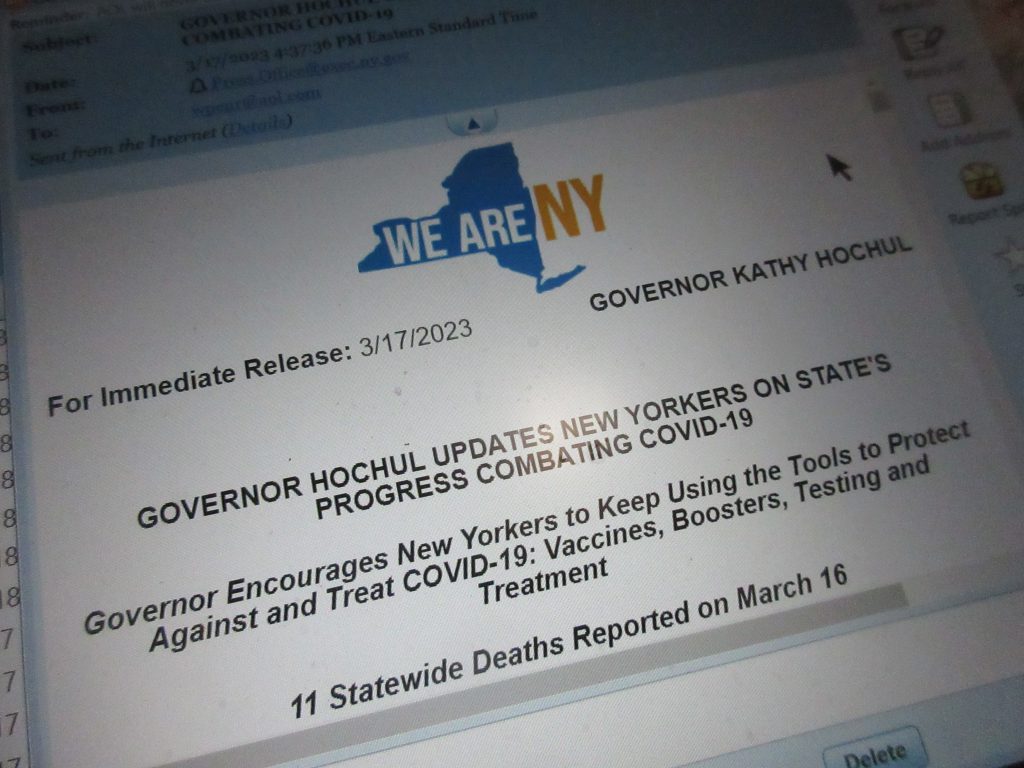
In Governor Kathy Hochul’s Friday Covid Update, (pictured above) the state announced it is cutting back on its daily covid reports of new covid cases and other statistics by county across the state to once a week on Fridays.

The reports that have been used by reporters throughout the state to monitor the rise and now 12-week decline in cases in Westchester County, will no longer be available to note trends.

This anticipated suspension of the detailed reports, first announced by the national Center for Disease Control a month ago when the covid emergency was declared over officially on May 11 by President Biden, will now hamper the public and the press abilities to tell what is going on with the pandemic.

The official notice issued Friday from the Governor’s Office reads:

“Starting today, March 17, and ahead of the federal government’s planned expiration for the COVID-19 public health emergency on May 11,

New York State’s COVID-19/vaccine news release will be issued weekly on Fridays until further notice. 

The latest COVID-19 and vaccine data will continue to be available 24/7 on the New York State Department of Health’s online tracker.

Additionally, the State Department of Health is assessing changes to COVID data collection and reporting in collaboration with local health departments and health care providers, in order to alleviate the burden on providers and leverage other data sources to maintain its ability to monitor the state of the disease and health care delivery system capacity.

The agency remains committed to responding to the COVID-19 threat and continues to encourage New Yorkers to use the tools to protect against and treat COVID-19: Vaccines, boosters, testing and treatment. “

Posted in Uncategorized