
JOHN BAILEY AND THE NEWS EVERY WEEK ON WHITE PLAINS WEEK FOR 22 YEARS
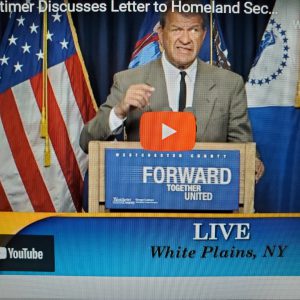
THE LETTER FROM LATIMER TO HOMELAND SECURITY

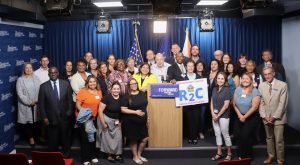
DENNIS HANRATTY OF MT VERNON UNITED TENANTS ON THE HORROR OF EVICTION COURT

HAIL TO THE VETERANS!
JOHN BAILEY AND THE NEWS EVERY WEEK ON WHITE PLAINS WEEK FOR 22 YEARS
THE LETTER FROM LATIMER TO HOMELAND SECURITY
DENNIS HANRATTY OF MT VERNON UNITED TENANTS ON THE HORROR OF EVICTION COURT
HAIL TO THE VETERANS!
WPCNR COUNTY CLARION-LEDGER. From Westchester County Department of Communications (Edited) June 1, 2023:
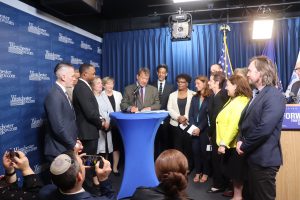
Westchester County Executive George Latimer has signed into law a bill creating the Office of Housing Counsel located within the Department of Social Services which will provide free legal counsel to individuals in housing matters involving eviction.
Latimer said: “Housing is a necessity. Plain and simple. This legislation will help Westchester residents who are facing hardships remain in their homes, easing the burden on our social services and lowering the number of our neighbors facing a crisis in their living situations. I commend the Board of Legislators for their work on this trailblazing legislation here in Westchester.”
According to the 2020 Annual Homeless Assessment Report (AHAR) to Congress by the U.S. Department of Housing and Urban Development, New York State has the highest rate of homelessness in the country, with 92,000 New Yorkers experiencing homelessness. Even worse, in a 2016 report by Stout Risius Ross, a staggering 1.2 million households are behind on rent and landlords are actively trying to evict more than 236,000 tenants statewide. According to the Right to Counsel NYC Coalition, 220,000 evictions are pending in New York courts, including town, village, and justice courts.
Currently, low-income tenants in Westchester County do not have guaranteed access to legal counsel in eviction proceedings.
Across the state an overwhelming majority of landlords are represented during eviction proceedings, whereas most tenants are not.
According to the Westchester County Right to Counsel Coalition (“WCRTCC”), in normal years, when more than 10,000 eviction proceedings are filed in Westchester County Courts, 93% of landlords are represented by counsel, while only 7% of tenants have attorneys. Programs that provide legal counsel at no cost to low income tenants, have proven to be very successful at preventing evictions and protecting tenants’ rights
This legislation will establish an Office of Housing Counsel within the County Department of Social Services for establishment of a County-wide program to provide access to legal services for income-eligible tenants and occupants. Meaning, a person whose household income is at or below 300 percent of the federal poverty guidelines or 60% of the County Average Medium Income who has legal standing in a covered proceeding.
A covered proceeding is any proceeding in any court in the County or any administrative agency administering housing programs which involves:
· the eviction of a covered individual,
· challenges to rent increases based upon a landlord’s failure to provide proper notice,
· maintaining or restoring a covered individual’s occupancy of a residential rental premises,
· possession of a residential premises for the non-payment of rent or a holdover; restoration or maintenance of essential services, and
· a proceeding which would result in the termination of tenancy, rental subsidy, or other rental assistance.
The legal services provided to covered individuals pursuant to this program will be at no cost to the clients. Additionally, community engagement and education to inform tenants of their ability to access legal counsel will be undertaken to help residents learn about this important program.
This legislation will establish an Office of Housing Counsel within the County Department of Social Services for establishment of a county-wide program to provide access to legal services for income-eligible tenants and occupants. Meaning, a person whose household income is at or below 300 percent of the federal poverty guidelines or 60 percent of the county Average Medium Income who has legal standing in a covered proceeding.
The legal services provided to covered individuals pursuant to this program will be at no cost to the clients. Additionally, community engagement and education to inform tenants of their ability to access legal counsel will be undertaken to help residents learn about this important program.
The measure passed the Board of Legislators unanimously.
Board of Legislators Chairman Vedat Gashi said: “At the Board of Legislators, we are always looking for ways to improve the lives of the residents of Westchester. This legislation does just that. I thank my colleagues on the Board for their diligent work, the County Executive and his staff for their efforts to bring this to fruition and I look forward to working with the dedicated County staff on its implementation.”
Legislator Catherine Borgia said: “This law sets a gold standard for access to housing counsel. Once the office is in operation, tenants will have access to brief legal representation or full legal representation on a host of housing matters, including eviction proceedings, landlord’s failure to provide proper notice of rent increase, maintaining or restoring essential services to the tenant, among others. Even before the pandemic, it was obvious that housing costs were too high, causing economic strain for Westchester families and harming local economies. In 2019, I spent time in several local courts and I saw how unrepresented tenants were outmatched in court. The end of the pandemic-era eviction moratorium has created a huge jump in eviction proceedings, increasing risk of homelessness for families already struggling with high costs.”
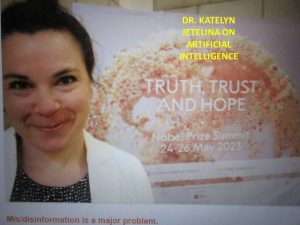
By DR. KATELYN JETELINA (Reprinted with permission)
Last week I was invited to the Nobel Prize Summit on information integrity at the National Academy of Science.
I’ve attended quite a few of these types of events lately—discussions on mis- and disinformation’s impact on truth, trust, and hope. I keep noticing the same themes bubbling up. Here are a few thoughts.

Truth is now debatable.
The major challenge in scientific communication is that the truth is now networked by peers.
Because of this, disinformation and misinformation are eroding public trust in science, becoming a threat to the planet, and costing lives.
But it goes beyond a pandemic—climate change, routine vaccinations, gun violence, reproductive health. Everyone—the private sector, government, researchers, and communities nationally and internationally—is rightfully worried.
The problems are just getting started.
Before AI, false news spread 6 times faster than the truth on social media.
AI will accelerate the speed, reach, complexity, and innovation of disinformation.
It will create more effective content that plays on human emotion and, thus, goes viral and changes human behavior.
A prime example emerged last week when an AI-generated image displayed an explosion at the Pentagon, which impacted the stock market.

AI will diminish safety for those of us on the front lines of communication, too.
AI-generated deep fakes will make it impossible to discern what is true and what is not true.
The threats and smear campaigns will only get worse. For example, the president of another country shared fake porn pictures of a reporter covering an important story.
What is trustworthy? And who is trustworthy? These questions are going to get more difficult to answer with time.
There is a lot of talk about the problem. There is a lot of doom and gloom from leadership.
I don’t think this is useful.
We know what to do, but I’m getting increasingly frustrated with inaction. We need to coordinate and mount a proactive and reactive response to address the biosecurity that it is:
There is really fantastic work being done on the ground by volunteers, trusted messengers, and entrepreneurs in both of these spaces. But the support is suboptimal—to say the least—casting doubt on the sustainability.
There is a lot of finger-pointing.
Everyone thinks someone else should be doing something. And, of those who are doing something, little of their work is supported. Institutions are needed for the long-term solution:
We have a problem and we are moving at a snail’s pace—on the backs of effective volunteers who find themselves shouting for support into the abyss.
We aren’t helpless, but inaction is hindering progress.
Government, private industry, academic institutions—just do something. That’s how we move toward truth, trust, and hope.
Love, YLE
“Your Local Epidemiologist (YLE)” is written by Dr. Katelyn Jetelina, MPH PhD—an epidemiologist, data scientist, wife. During the day she works at a nonpartisan health policy think tank and is a senior scientific consultant to a number of organizations, including the CDC. At night she writes this newsletter. Her main goal is to “translate” the ever-evolving public health science so that people will be well-equipped to make evidence-based decisions. This newsletter is free thanks to the generous support of fellow YLE community members. To support this effort, subscribe below: