WPCNR Common Council Chronicle. By John F. Bailey. January 6, 2003: The long running classic “221 Main” continued its long run playing at “Common Council Theatre” Monday evening, bringing forth a series of new revelations from a dramatic cast.
Mr. Stackpole of the Planning Board recounted the history of how elimination of the Bar Building developed as part of the plan. He said the Planning Board became convinced that the bulk, parking needs, and space needed to extend Court Street required the Bar Building to go. He also pointed out how the Bar Building was not the work of a major architect, did not represent a distinctive style, and had no significant history.

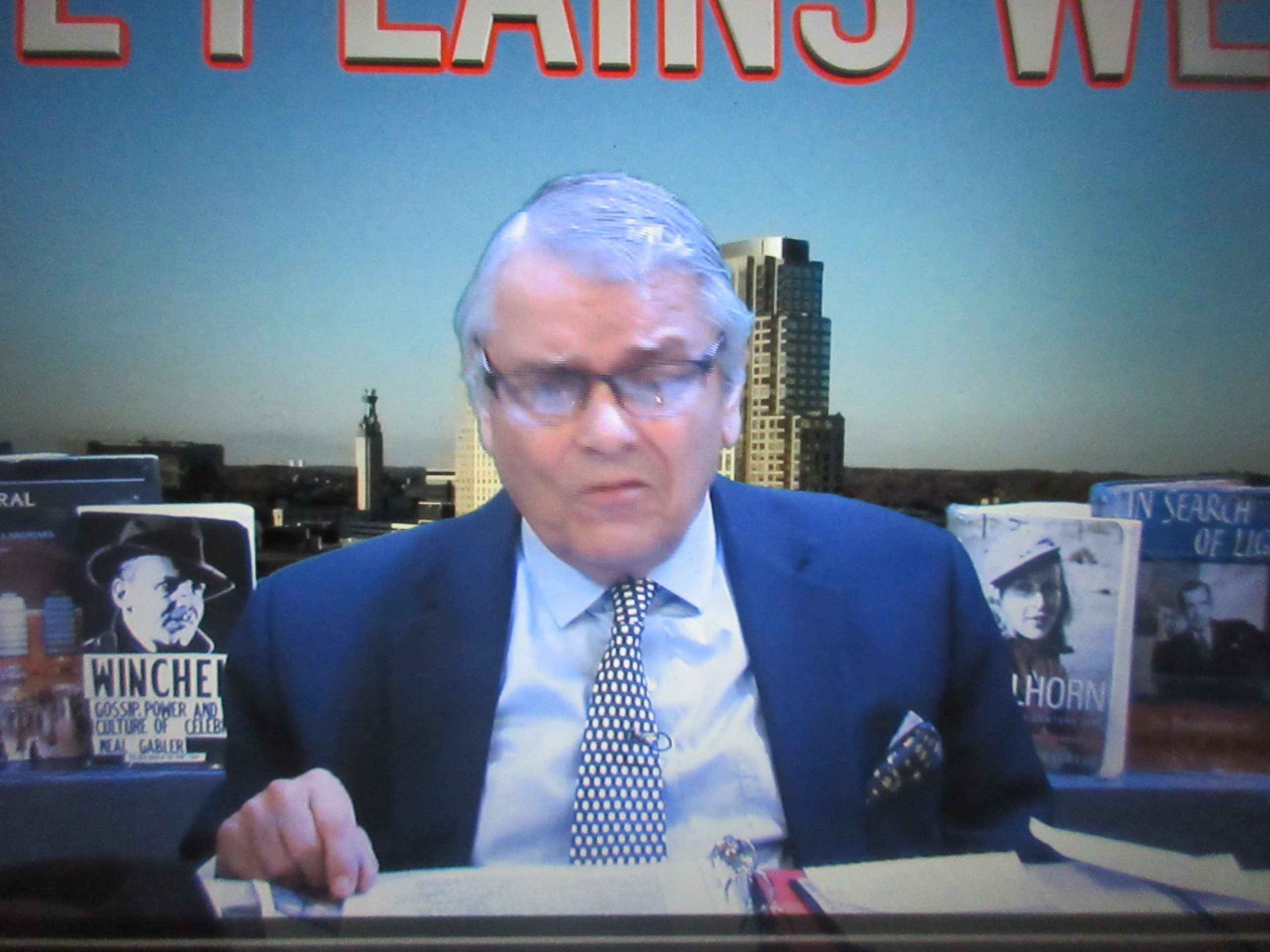
Jack Harrington, shown, with back to camera on the WPGA-TV telecast of Monday evening’s Public Hearing,former President of the White Plains Historical Society, indignantly denied that the Historical Society was being “used,” by Anthony Longhitano, owner of the Bar Building, saying the Society was continuing their mission to preserve buildings of significance in the city. Harrington revealed that Mr. Longhitano had sat down with Mr. Harrington to fill out an application to have the Bar Building designated an historical landmark in New York State on September 18, the first time this has been publicly stated. A letter to Michael Seymour from the New York preservation agency confirmed that it could be “considered” for historical preservation in Mid-October.
Mr. Longhitano, as you recall, in his appearance at the Common Council December 1 did not reveal he had either applied for preservation status or had been notified of his building being “considered.”
Harrington added that the Bar Building was a piece of a block of seven historic buildings in the city, including, The Kennedy, 2 William Street, The North Court Building, The Bar Building, Grace Church, The Lawyers Title Building and City Hall. Harrington was magestically indignant and earnest as only Jack Harrington can be, turning to the gallery, looking at developer Louis Cappelli, and referred to his (Harrington’s) long history on the Conservation Board, and characterized the mission of the Conservation Board as being a group of citizens who defined “what they expect in their city and what they expect from developers who come into the city.”
Allowed with respect by Council Clerk to continue well past his five minute time limit, Harrington refuted early statements by Robert Stackpole, that the Bar Building did not fit the criteria for historic preservation or landmark status. Harrington, reading from what is believed to be Longhitano’s application, said the Bar Building qualified on the basis that it played an ongoing role “in the broad patterns of our local history,” and that it “embodies distinct character of a type, or period.”
The Levine Planning Course
Robert Levine, the architect intimately involved in persuading the Common Council with Mr. Stackpole and William Rose, that one big building was too much and to bring in Frederick Bland to design the City Center project, in 2001, said 221 Main was “A rare planning opportunity not to be repeated for a long time.” He cited “4 Major Planning Courses” for the Council to proceed with the project.
1.) The Court Street extension was a key objective the city needed to secure.
2.) The inclusion of the entire Bar Building into the site “is essential”.
3.) The Council had to prevail on the developers, Mr. Cappelli and Mr. Longhitano to come to the table and negotiate a sale of the Bar Building.
4.) “Then and only then can we take up the issues of density, parking below ground, designs of buildings.”
Two speakers warned the council of violating the constitutional amendment prohibiting seizure of private property, referring to the possibility that the Council could choose to use eminent domain to seize the Bar Building property to develop the full scale of the Cappelli Hotel-Office complex.
Duelling Barristers.
Anthony Longhitano’s attorney, Carl Finger, reiterated his comment that other alternative building designs were not being considered by the Cappelli organization, saying he felt the Council should encourage alternatives that would allow both projects, Longhitano’s and Cappelli’s to be constructed on the same site in consort.

Mark Weingarten, (shown above on White Plains Government Access Television Monday night), the attorney for Louis Cappelli, with the Super Developer looking on, rejected Mr. Longhitano’s olive branch, pointing out that Mr. Longhitano’s plan for redeveloping the Bar Building takes the entire back of the Bar Building, meaning the tenants there “would have to move anyway.”
Weingarten pressed the attack on another front, warning the Common Council not to confuse the difference between exercising the discretion of using eminent domain and the power to do so. Weingarten told them, “you have that power,” saying the right of using eminent domain for the public benefit has been upheld up to the Supreme Court: “You have the legal authority to do so, you may want to use it (eminent domain) on the next one (project)”.
Weingarten laid on some harsh reality, saying that “without the Cappelli project, Court Street doesn’t happen.” He asked rhetorically who would pay for the extension of Court Street (about $3-4 Million) if Mr. Cappelli doesn’t do it?
Bar Building Red Herring
Ken Worden, CoPresident of the Highlands Civic Association, said he’d been asked by his association to speak. He said the Council is focusing to much on the Bar Building, instead of considering the bulk, impact, and infrastructure effects of the Cappelli Hotel project. “The only Council concern (should be) is the basic project itself.” Worden said the Environmental Impact Statement was “chockful of problems,” that “Mr. Adler’s (traffic) solutions boggle the mind, and fly in the face of common logic.” He said the problems of the Bar Building would be decided between Mr. Cappelli and Mr. Longhitano, but the problems of “bulk, infrastructure, impact have to be decided by you.(The council).”
An attorney noted that the Bar Building future extension and expansion pictured in the New York Times Westchester Section over the weekend, appeared to him not to involve removing tenants from the back of the building as Mr. Weingarten had noted. Mayor Delfino refuted this to the attorney, saying “one of the troubles here is people state things that aren’t true. I’m not here to argue. When presented to me, it did take the back of the building.”
Another person worried about businesses already closing and moving out along the Main Street corridor. However, later in the Council meeting, permits were renewed for Paparazzi and Coughlin’s two restaurants who are staying and liking what is happening in White Plains. Decision was tabled on a matter involving the number of parking spaces for a doctor’s office, at 170 Maple Avenue pending a discussion with the business.