WHITE PLAINS WEEK TONIGHT THE AUGUST 9 REPORT 7:30 PM EDT ON FIOS 45 WPOPTIMUM CH 76 AND WWW.WPCOMMUNITYMEDIA.ORG

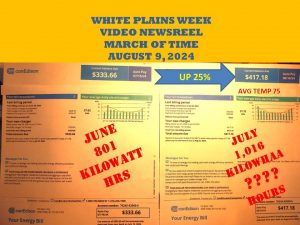
HEAT WAVE ENDS AFTER CON ED RATES AND  RESIDENTS USAGE TURN THE MONEY HEAT ON

THE COUNTY SURGE IN COLORECTAL CANCER IN ADULTS UNDER 40–FREE SCREENING TESTS URGED CLIPS FROM THE LATIMER AND HEALTH COMMISSIONER REPORTS–MUST SEE

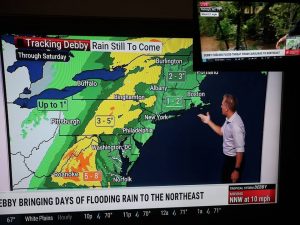
WESTCHESTER DODGES DEBBY

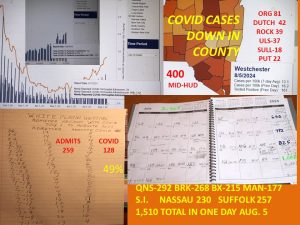
COUNTY DOWN IN NEW CASES OF COVID BUT ON TRACK FOR 4,000 CASES FOR MONTH OF AUGUST. WHITE PLAINS HOSPITAL STILL SEEING 50% OF ADMISSIONS TESTING POSITIVE FOR COVID

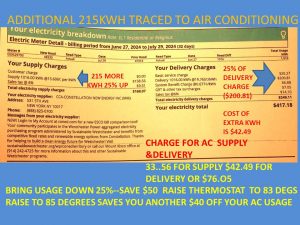
HOW AIR CONDITIONING AFFECTED YOUR ELECTRIC BILL 

HOTEL TAX RELIEF FOR LONG TERM HOTEL RESIDENCIES RECEIVING COUNTY ASSISTANCE

CRACK DOWN ON CORPORATE LONG TERM LEASES REQUIRING THEM TO PAY HOTEL TAX.

FBI CONTINUES TO CRACK DOWN ON BUSINESS FRAUD

WITH JOHN BAILEY AND THE NEWS THIS WEEK EVERY WEEK

ON WHITE PLAINS WEEK FOR 23 YEARS

Posted in Uncategorized

AUGUST 8 — YOUR LOCAL EPIDEMIOLOGIST ON STATE OF AFFAIRS USA– COVID UP UP AND UP!

From Covid-19 Peaks to New Viral Threats: What You Need to Know

State of Affairs: August 6

Happy August! I’m back from summer vacation. My little family explored all three gorgeous national parks in Washington State, which required much-needed unplugging.

The YLE team is refreshed and ready for the fall season! I hope you are, too. Let’s dive into the state of affairs.

Covid-19: Up, up, and away


We are knee-deep in a substantial Covid-19 infection wave. Wastewater levels—a good indicator of community spread—remain high and continue to increase, especially in the South and the West, where levels are coming close to last winter’s.

(CDC; annotations by YLE)

Thankfully, immunity keeps our hospitals from overflowing at this point, but severe disease trends continue to mirror infections. For example, in California, hospitalizations this summer are as high as last winter.

(Source: CDC; annotations by YLE)

This pattern—2024 summer rates reaching winter rates— is not unique to the U.S. Covid-19 hospitalizations in the U.K., Spain, and Australia all show similar trends.

Covid-19 hospitalizations trends across the globe

The height of this summer wave is surprising to me, as we would hope that summer waves get smaller and smaller over time. So, three unanswered questions are top of my mind: 

  1. Why is this happening? I don’t know. The newest subvariant doesn’t have so many mutations that I would predict this would happen. Vaccination rates are about the same as last year, which also wouldn’t explain it. Could this be due to the CDC changing its isolation guidelines to be more relaxed in February? Probably not, given similar patterns in other countries.
  2. Will we have a milder winter? We can hope that the immunity we have built up will lead to a milder winter, which would be a welcome reprieve to health systems. 
  3. Are biannual waves the future? Many (including me) hypothesize Covid-19 will eventually become a winter virus, like flu. But clearly Covid-19 is still unpredictable and will likely take another decade to find a rhythm.

Other updates


Epidemiologists are monitoring these other viral outbreaks. You have nothing to do, but here is an update so you can follow the scientific discovery ride.

H5N1 (bird flu): Continues to spread


We are keeping an eye on H5N1 because of the potential for it to become a pandemic.

H5N1 continues to spread among animals. USDA has reported 171 dairy cow herds in 13 states with confirmed H5N1 infection.

Four big developments have occurred since the last YLE update.

  1. More humans have been infected, but no onward spread. This year a total of 13 people have been infected with bird flu: four from sick dairy cows and nine from poultry. This is a lot of cases, considering U.S. had 1 H5N1 human case last year and zero before. The human tally recently increased thanks to a big outbreak in Colorado, when several workers got sick after culling (killing) infected poultry. As far as we can tell, this outbreak wasn’t because the virus mutated; instead, it was the environment—it was over 100 degrees at the farms, so workers didn’t wear PPE (understandably), and massive industrial fans to cool the area spread feathers (and virus). So far, cases have been mild (red eye and respiratory symptoms), and there is no ongoing human transmission.
  2. We are missing human cases. Given our limited human (and animal) testing, it shouldn’t be a surprise that we are likely missing human cases. In Texas, scientists tested the blood of 14 previously symptomatic farm workers and found 2 workers had antibodies. This could be evidence that they had H5N1 at one point. (However, it’s also possible because of the type of test used that these antibodies reflect infections from seasonal flu [H1N1]). We don’t think there is an asymptomatic spread. Another study in Michigan tested the blood of 35 workers who were exposed to infected herds but never had symptoms, and none were positive.
  3. There are no signs of it “burning out.” The genetic sequences of bird, cow, and human cases suggest the U.S. has created a new reservoir of H5N1 that can spill over into poultry and humans all year round.
  4. All eyes are on the upcoming seasonal flu. If one of these farm workers gets infected with H5N1 while sick with seasonal flu, the risk of a pandemic skyrockets, as the virus can easily swap genes to become more adaptable to human spread. CDC is funding an extensive seasonal flu vaccine campaign for farmworkers to prevent a nightmare.

We still don’t have an updated CDC risk assessment of an H5N1 pandemic (called iRAT), which is surprising. (The last iRAT was published in April 2023 after minks were infected in Spain. They rated the pandemic risk as “moderate.”) The U.K. recently raised their risk assessment (from 3 → 4) given the U.S. outbreak.

Mpox (Monkeypox): Surging in Africa


The WHO is considering naming the ongoing mpox outbreak a public health emergency of international concern.

Case counts continue to explode in Africa, with over 37,000 cases and 1,400 deaths. The Democratic Republic of Congo (DRC) has been the epicenter, accounting for over 96% of this year’s cases and deaths. The vast majority of deaths (85%) are among children. The Africa CDC has heightened its monitoring and declared the risk “high.”

In a surprising turn of events, mpox has mutated. Mpox is primarily divided into two clades (types): Clade I and Clade II. Clade I, found predominantly in Central African countries, tends to be more severe. The new strain, called Clade 1b, is severe and can be transmitted human to human.

Unfortunately, many patients in Africa lack the resources that can keep mpox at bay, like vaccinations, treatments, and access to care. In the United States, for example, where only Clade II—the less severe strain—is spreading, cases are far lower than in 2022. Even if the more severe strain landed in the U.S., we don’t think it would be as detrimental as it is in Africa.

Mpox cases in the United States; Graph by YLE

Bottom line

Covid-19 infections are surging this summer. There are things you can do—stay up to date on vaccines, mask indoors and in crowded areas, and get that indoor air flowing. Concurrently, H5N1 continues to march into the upcoming flu season, increasing the risk of another pandemic, and WHO is considering another mpox emergency. As always, we’ll keep you updated as things change.

Love,

The YLE Team

Posted in Uncategorized

WESTCHESTER POWER VS CON EDISON JULY 2024. CON ED RATES TILL LOWER

WPCNR THE LETTER TICKER. AUGUST 7, 2024:

The Town of Greenburgh participates in a Community Energy Program known as Westchester Power. Everyone is enrolled in the ESCO unless you opt out. Once you opt out you are never enrolled back in unless you ask to re-enroll.

Con Ed rates have continued to be lower than the ESCO this month.  If you want to opt out you should e mail [email protected] or call  Sustainable Westchester at 914-242-4725 ext 111. If you are having difficulty opting out please e mail me at [email protected]

This electricity supply program is managed by the local nonprofit Sustainable Westchester on behalf of the 29 participating municipalities in Westchester County.

The program empowers the county and its residents to actively work towards a vision for a healthy and sustainable future by supporting renewable energy. Residents benefit from the fixed price program model that provides cost control assurance on their electric supply charges.

Westchester Power Contract – July 2024 Rate Comparison

The Westchester Power program offers two supply options for 100% Renewable and Standard. These rates are fixed until 10/31/2024.  The rates are going down after October.

As of November 1 Greenburgh is participating in a 50% renewable energy option.  The monthly rate will be 12.18 cent /kWh from November 1, 2024  through November, 2025.  Con Ed rates change each month. The ESCO rates can’t change.

July 2024 Residential Rates

Average Con Edison  11.50 cent kWh

Standard Rate  13.685 cents kWH

WP 100% Renewable 15.449 cent kWh

Below is an approximate electricity cost comparison for a hypothetical Greenburgh

resident in July who consumed 500 kWh of electricity for the month. For information on

how to find the cost comparison for your electricity usage, click here.

– For a Greenburgh resident on the ConEd supply, that customer would have been

charged roughly $57.50 for their electricity supply

– For customers enrolled in Westchester Power under the 100% Renewable fixed

rate, the charge would have been roughly $77.24

– All Westchester Power Standard user’s charge would have been $68.42

Westchester Power is the cornerstone of regional climate action


In 2023 alone, program participants Greenburgh residents, in particular, have mitigated approximately 24,900 metric tons of carbondioxide, equivalent to 5,900 gas-powered cars off the road for a year.

 Westchester Power Program Benefits

1. Fixed Rates provide a price cap and insurance against volatile energy market spikes, unlike variable monthly utility rates

2. 100% Renewable Energy at rates competitive to other comparable ESCO products

3. Without Westchester Power, consumer choices are limited to the utility (primarily fossil-fuel-based energy at variable rates), or an ESCO, which can be difficult to navigate and engage in predatory practices.

To learn more about the program, visit sustainablewestchester.org/wp/conedterritory

PAUL FEINER

Greenburgh Town Supervisor

Posted in Uncategorized

AUGUST 7 — COUNTY EXECUTIVE LATIMER GIVES PRESTORM BREIFING

Westchester County Executive George Latimer Holds Weather Briefing on Incoming Storm


Watch the News Conference Here:

https://www.youtube.com/watch?v=NoSb0If_3EU


(White Plains, NY) – Westchester County Executive George Latimer held a press briefing to address the incoming storm set to impact the region. County emergency responders recommend residents set aside several days’ worth of non-perishable food, water and medicine, and keep other critical supplies on hand like flashlights and batteries in case they are stuck in their homes without power. Residents should also have a “go-bag” ready in case they are asked to evacuate on short notice during an emergency.

Commissioner Richard G. Wishnie of the Department of Emergency Services recommended that residents create an emergency preparedness kit that includes a:

  • Gallon of water per person per day;
  • Three-day supply of canned, packaged or other shelf-stable, ready-to-eat food

foods that can be stored, including ready-to-eat canned meats and fish, protein or fruit bars, dry cereal and granola, peanut butter, nuts, crackers and canned fruit or juice;

  • Manual can opener and eating utensils;
  • Flashlights and batteries;
  • First aid kit;
  • Battery-powered or hand-crank radio.

Westchester County Health Department Commissioner Sherlita Amler, MD, said: “Before any major storm hits, residents should make a list of their medications, charge their cellphones and laptops, and fill their vehicle gas tanks, too. Residents with oil tanks at home should top off their tanks and tighten the cap to prevent spills. Above-ground tanks should also be strapped to a secure fixture to prevent tipping in case of flooding.”

Amler said food and generator safety are essential during and after any power outage or emergency. The Westchester County Health Department suggests the following tips:

  • Before a storm hits, set your refrigerator to the coldest setting to keep food fresh longer if you lose power.
  • Keep your refrigerator closed as much as possible. Do not assume refrigerated foods are safe.
  • Foods that are fully frozen are safe to use.
  • Foods that have warmed to room temperature for more than two hours or have come into contact with flood waters should be discarded. When in doubt, throw it out.
  • During a prolonged outage, discard these foods if they were not kept below 45 degrees Fahrenheit: meat, poultry, seafood, cold cuts, hot dogs, eggs, cream, sour cream, yogurt, milk, custards, puddings, soft and shredded cheeses, cut fruit, cooked vegetables, pasta, casseroles, unbaked cookie and bread dough, gravy, creamy salad dressings, fish sauces, hoisin sauce, opened spaghetti sauce and garlic in oil.
  • After disposing of spoiled food, disinfect the refrigerator to avoid further contamination.
  • Discard any cans of food that are rusted, dented or open.
  • If appliances are wet, turn off the electricity at the main fuse box or circuit breaker. Then, unplug appliances and let them dry out. Have appliances checked by a professional before using them again.
  • Storm clean-up can produce a great deal of garbage, which invites insects and rodents. Store your garbage in watertight, rodent/insect-proof containers with tight-fitting covers.

Commissioner Terrance Raynor of the Department of Public Safety reminded motorists to stay off the roads unless absolutely necessary during severe weather.  Flash-flooding can quickly swamp vehicles and put motorists in significant danger.

Raynor said: “Over the years, County Police officers have responded to rescue numerous motorists who have been stranded in rising water when their cars have stalled on flooded roadways. In addition to likely damaging your vehicle, you may also be putting your life at risk.”

Residents and business owners with generators are reminded of the following safety tips:

  • Never run a generator in a basement, garage, porch or carport. Generators produce carbon monoxide that can quickly be lethal indoors.  Only operate a generator outdoors and away from open windows.
  • Do not exceed the rated capacity of your generator. Overloading your generator can damage it and any appliances connected to it. Fire may result.
  • If your generator has a detachable fuel tank, remove it before refilling. If this is not possible, shut off the generator and let it cool before refilling.

If you lose power, call Con Edison or NYS Electric and Gas directly. The phone numbers are: Con Ed power outage or gas and electrical service problems: (800) 75-CONED; NYSEG electricity power outage: (800) 572-1131; NYSEG gas power outage: (800) 572-1121.

Wishnie said families should also consider what additional preparations to make for people with special needs or who care for the elderly, infants or pets. Family members also should plan for how they will communicate if local phone service is not available or is overwhelmed by high demand.

Practical tips on these and other topics can be found at: https://emergencyservices.westchestergov.com/severe-weather

or https://www.ready.gov/

Posted in Uncategorized