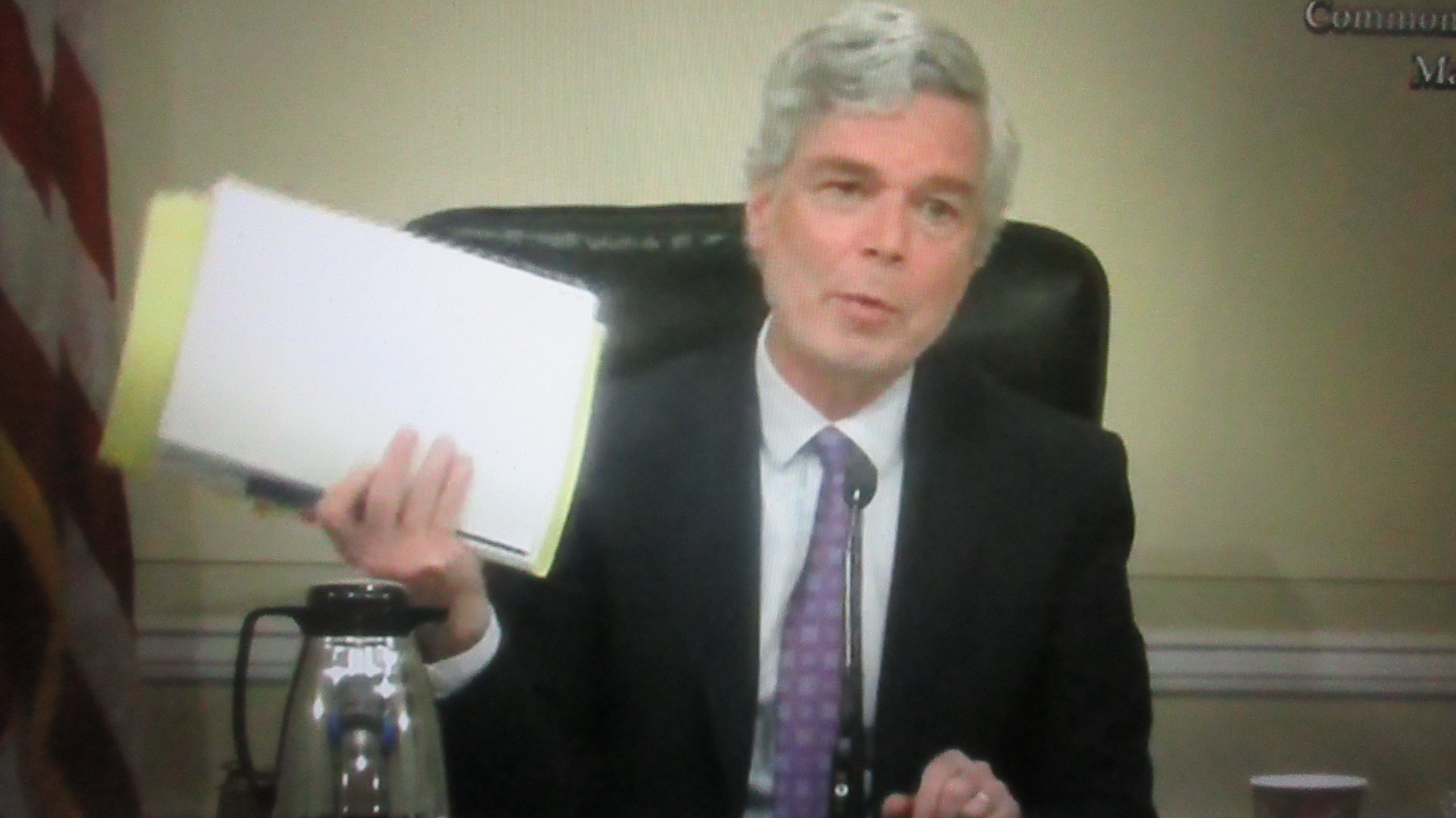
WPCNR CITY HALL CIRCUIT. Interview with City Executive Officer Paul Wood. December 16, 2008: WPCNR interviewed Mayor Joseph Delfino’s Executive Officer on the layoffs announced Monday by the Mayor and the police and fire contracts scheduled to be voted upon by the Common Council this evening. The Police and Fire unions assume a 12-hour duty tour and 24-hour duty tour with first year raises of 3.75% and second and third year raises of 4% in the new contracts. Mr. Wood discussed with WPCNR the cuts in the workforce first, and the union settlement second. Here is that interview:

Paul Wood, Executive Officer. City of White Plains.
WPCNR: On the job cuts, how will the work done by the part-time persons being let go be handled?
Paul Wood: We changed full-time positions hours to cover the cuts in the part-time positions. You saw what happened in Yonkers, now everybody’s crying that they laid off 300 people. If we don’t do anything, we get criticized us for doing nothing, if we do something, we it’s going to be painful, and we’re trying to minimize the pain, but if we were doing nothing, everybody’d be screaming we were doing nothing.
WPCNR: Would the part-time workers being replaced by hours, does that mean overtime for the full-time workers?
Paul Wood: No absolutely not – in their work schedules. They’ll be working regular time.
WPCNR: There’s supposedly a hiring freeze, does that mean the Budget Analyst advertised for is not going to be hired?
Paul Wood: The only position that’s been released to be hired is the Budget Analyst. ( Advertised last Sunday at $56,000)
WPCNR: Are you planning on keeping David Birdsall as Acting Budget Director?
Paul Wood: Let’s look at it this way too, John: $300,000 was cut from the reserve by the Democrats (Councilmen). We voted against our own budgeYes. Mr. Birdsall as the acting Budget Director. We had a very good Budget Analyst (Sandra Bullock) who left us to become treasurer in Cortlandt. She was the last one standing. I can’t function like that. The Council doesn’t want to consolidate the departments and yet when we go and try and go and create a budget department, then they’re angry about that and so it’s damned if you do and damned if you don’t.t. That money may have been able to fund these part-time positions. That’s where the anger should be.
WPCNR: Why cannot you use Undesignated Fund balance to cover?
Paul Wood: We can’t use (undesignated) fund balance until we run a deficit. It’s against the law. So, I can’t go into fund balance now and fund the position. It has to wait until we’re running a deficit, then I can go into fund balance, but that $300,000 that was cut from the reserve may have lessened the pain.
I feel bad for Recs and Parks the most because they got caught midseason. You asked why we chose to do this at this time. Two years ago we did the same thing, mid-year cuts. Obviously as I said, people would be screaming and hollering that we did nothing, if we did nothing, even if though there’s no tangible evidence (of a deficit). We’re just going by intuition. We feel revenues are going to be down. That’s something we cannot control. But, what we can control is the expense side. If we didn’t do anything people would be yelling and screaming. When we do something, people are yelling and screaming. It’s damned if you do and damned if you don’t again, so it’s like we’re preparing for the worst and hoping for the best. Unfortunately they, Ebersole got caught in the middle, all Rec and Parks had left was basketball and Ebersole (rink programs). There wasn’t any other places to go (to cut).
WPCNR: Does the Rec Department pay for any parades?
Paul Wood: The parades are all paid for by their own sponsors.
WPCNR: What did the Rec Department spend on the first six months?
Wood: Camps, concerts, noontime concerts. More sporting activity in the parks during the summer. That’s why I’m saying if we have the opportunity next budget season, to examine their whole budget, rather than in a six month time slot, some of these (eliminated part-time) positions will be returned.
WPCNR: How much is the city spending on the New Year’s Eve Ball Drop?
Wood: $12,000.
WPCNR How much is the city saving dropping these part-time persons?
Wood: Ebersole alone is about $20,000. The DPW, six workers, $35,000.
WPCNR: Are the Commissioners and Deputy Commissoners going to take any pay cuts?
Paul Wood: No. I can’t do that.
WPCNR: Why not?
Wood: Because their salaries are set at the beginning of the year.
WPCNR: Well, that doesn’t stop us from cutting it.
Paul Wood: Why do you think they’re overpaid? They’re underpaid.
WPCNR: I didn’t say that. I asked. They make far more than these part-time workers so I would think a cut would hurt them less than the part-time workers.
Paul Wood: And we’d lose a lot of good people (Commissioners). Most of the Commissioners and Deputy Commissioners work 12 hour days. The majority of them took a pay cut, I consider it a pay cut, last year because they didn’t get a pay raise as the same rate of inflation (3% was the raise). And inflation has been up over 4 forever.
WPCNR: Not really, Paul.
Paul Wood: It was over four, only in the last year. If you get a raise of 3% and there are some months 5.7% and 4.7% then it’s 2.7% less than you worked the previous year for. Contrary to what everyone says, o.k.?, we’re not giving raises that outpace inflation. It’s been made up by somebody. It’s just not true.
The other thing is, why don’t we cut the management. This city has grown by 7,000 people. That’s a village in this county. We’ve got less people (because we’ve got a hiring freeze on), doing more work , including police and firemen by the way. That fire (at 20 N. Broadway) could have been a major disaster. They did excellent work.
I’ve got one person in the budget department, for crying out loud. Gina (Cuneo-Harwood) did all that work for two years and it nearly killed her. And she had two other people in the budget department. Everyone has left because the salaries elsewhere are better. I lost my budget analyst to Cortlandt, you know why? The salary was better.
I’m not cutting salaries on persons who are working their fingers to the bone here, in a city that’s grown by 10,000 people where we have less of a head count (on the payroll) than we had ten years ago, because we’re not hiring people. It would be absolutely ludicrous to say we’re going to start cutting salaries. Who’s going to work here? You’re not going to have anybody left. There’s no fat. That’s the problem. There simply is not a lot of fat here (in the budget). There’s more activity. With a hiring freeze on they’re working twice as hard.
WPCNR: Is the City Budget 08-09 running a deficit at this time?
Wood: No.
WPCNR: Then these cuts are in anticipation?
Wood: Yes.
WPCNR: So if we are on target, than why cut?
Wood: If we do nothing and end the year with a huge deficit, people are going to say we sat around here and did nothing.
WPCNR: But you have the fund balance to make that up?
Wood: Don’t forget we budgeted fund balance the more of that that gets eaten up means there’s less fund balance to put in next year’s budget, then after that, God forbid, we have another bad year we end up with no fund balance.
WPCNR: But what good is an (undesignated) fund balance doing, doing nothing?
Wood: The fund balance that we allocated to 2008-2009 was about 9 or 10 Million dollars some of that will definitely get used up and we’ll still probably have to run a deficit. You can’t be in a position we’re in and go in to fund balance. It just has to run a deficit and then we’ll have to use some more fund balance in next year’s budget. You’re right. We should be using fund balance now in the time of a recession. That’s what it’s there for. People refer to it as a rainy day fund, and it’s raining like Hell, so there’s no reason not to use it.
WPCNR: Couldn’t that be used now?
Wood: No, because you don’t get all your numbers in til the end of the year.
WPCNR: Since you’re not running a deficit…?
Wood: But we’re very confident we will be running a deficit by year end, that I can assure you.
WPCNR: When will you know what the deficit is?
Wood: Probably won’t know anything definitive until April or May, and even then we won’t definitively know.
WPCNR: There’s no way the city cannot take a short term bond, (rather than lay off)?
Wood: No. You can’t bond for jobs.
WPCNR: There must be some financial instrument … you’ve explored all avenues of apparently what is a short term cash problem.
Paul Wood: It may be. In July, or April, when we do the new budget, we may be hiring back some of these people. Some of these people laid off from Ebersole will be working for us in the summer any way. We’re worried about $20,000 at Ebersole. It doesn’t sound like much but it is. It contributes. There are no sacred cows. I can’t have one department be pained and another one left untouched, just because everybody loves the rink. The fact is that everyone should be jumping for joy that we’re reinventing government here by saving part-time salaries, changing the schedules of full time employees and having them cover, so there’s very little minimal impact to our services so that the public is not getting reduced services, it’s just that we’re having our full people work different hours – which they’re not happy about by the way. That’s too bad. They are lucky they have jobs at this point. In order not to reduce full-time jobs. They have longer time with the city. They move into another department and bump another person out. You don’t want to do that to full-time employees. One of the mayor’s best friends is affected by these cuts. We don’t like doing it.
WPCNR: So if the city was in such good shape in August, how come we have to cut now?
Paul Wood: If we don’t do anything now, ok, by the time we get the bad news, how much we’re going to run a deficit, all the departments will have spent all their money and there will be nothing to pull back. So we have to do it in anticipation that we’re going to have a bad year here. We can’t….we’re not an island. If Yonkers laid off 300 full time employees, Mount Vernon’s laying off people, everyone, New Rochelle, same thing. There’s things that everyone is doing because the economy is obviously in a tailspin. We cannot anticipate, although our sales tax was up, which is fantastic, god willing and everything being equal, we’re on budget, and we don’t have to make the cuts we have to make. As you can see from the Mayor’s memo, we have to reinvent the way we do things we just can’t keep raising taxes. We have to look at operations and how we can save money for the future. We’ve got to look at long term solutions, not just emergency, got to do it.
The Rec department unfortunately already had programs under the way. The DPW six part-timers, we hire them every season, and they’re not going to be hired. We’re not going to open the Renaissance Square Fountain for a month. The same guys that prepare the ballfields will come back and prepare the ball fields first then come back and open the fountain.
THE POLICE AND FIRE SETTLEMENT
WPCNR: In light of the belt tightening, what is the justification for the police and fire settlements?
Paul Wood: That’s very easy. First of all the numbers are well below the CPI which is 4.72%. You want to go to mediation on that, and come walking away with a 4.72. I don’t think so.
WPCNR: But that is only very recent that number…
Paul Wood: It’s only been very recent, it was up to 5.7 two months ago. But you go to mediation and they look at the snapshot, and they look at the economy and of course they’re going to say, got to give them 4s and 4-1/2s.
Number 2 they made a ton of concessions. When you look at the contract we have, they started out with a list of 20-24 items, each one (union) including longevity, which is normally given in a contract. They wanted additional money for tuitions. They wanted a host of things.
We began to talk about the schedule. With the schedule change (12 Hour tours for police) I get on police 2 to 4 extra police per shift, O.K.? That ‘s like hiring four to eight extra cops that I’m not going to have to hire. That’s 4 to 8 cops. That’s a lot of money
With the firemen, they made a major concession, both did, on training. We were spending a load of money on overtime, because they had to pay these guys overtime when they were on training, which was ridiculous. Both police and fire removed that from their contracts. That’s going to save a ton of money.
Firemen gave up one extra day, when we figure that out over the year that works out to hiring almost two more firemen. Two more salaries, two more firemen. We have two more on the streetThat’s fantastic. I put more on the street. I can run at a higher vacancy rate which we are doing. The money that that saves us is incredible. Six cops, benefits and salary, that about $400,000, $500,000. Two firemen, that’s $200,000 right there. So that alone helps us, the work changes, schedule changes.
We used the schedule changes (12 hour tours for Police; 24 Hour tours for firemen), as bargaining chip to do away with 14 other items.
When you look at the CSEA contract that the county gave out, when you look a similar police and fire contracts that were settled at the same amounts or more, than what we’re proposing to settle at, you will see longevity increases. That affects everybody. That’s where they hide the percentage, so when you say Greenburgh or the CSEA got a 3.5% increase, no they didn’t, they got a 4-1/2% increase because they got a bump in longevity and they got all those other perks that are hidden in those contracts.
They’re getting nothing here, absolutely nothing. The only thing they are getting is a differential for managerial, like lieutenants and captains, (1%) and that is only to make them equal to most of the other cities in the county. Right now, White Plains police and fire are toward the bottom of the scale of salaries across the board for the cities and towns we look at.
If you recall eight or nine years ago, we had a thing called badge drain. That’s what we’re afraid of. We don’t want to start investing hundreds of thousands of dollars in police and firemen then having them leave the city to go somewhere else because they’re so well trained. This increase will only put them in the middle of the scale of where we’ve surveyed.
It’s also, when you look around, not unthinkable, these increases. They’re on par with what everyone else is getting, they’re below CPI, unlike a letter writer who keeps complaining we’re giving raises beyond the rate of inflation. The Hell we are. That’s not true. Not true. It’s over four. According to the U.S. Bureau of Labor Statistics. If you go to mediation at this snapshot in time.
This is one helluva contract. There are only four things on the table and none of them are significant. In fact, the amount of money this will save on overtime, the training concessions the unions made, they gave up increases in longevity.
Their contract by the way is considered the model contract. They say every contract in the city should be like the police, who contribute towards their medical. You can’t ask two unions, who are the model contract on medical benefits, to cut back on their medical insurance. That’s ridiculous, you’d get laughed out of the room. They’re saying look, we’re the model and this is one of the reasons why we wanted to settle with them, because they are the model (on medical benefits), and that’s what we intend to do.
WPCNR: If this contract has them giving so much, as you say, why did they accept it?
Paul Wood: A couple of reasons. They realize the hard economic times we’re in. Number two, the chart changes not only work very well for the administraton. They also work very well for the individual, fire fighter or police. They wanted the chart (schedule) changes. So we used it as a bargaining chip. When Commissioner (Frank) Straub did the analysis, we figured we could do this, and were able to offer that, everything else came off the table. Because this is what they’ve been seeking for years.
Seventy-five per cent of all fire departments operate on this schedule. Policemen do 12 hour shifts throughout the country. It started in California and it’s been continuing. We have some police on 12 hour shifts. We have 12, 10, 8 hour shifts. They say it gives them additional time off. They don’t have to go back to work for 12 hours. It was a bargaining chip we used. But it also works extremely well for the city. It allows us to cut back on hiring and gives us and extra 1.6 firemen. And the training was killing us on overtime – a major concession on their part.