WPCNR’s News & Comment By John F. Bailey. February 12, 2016 From the WPCNR ARCHIVES UPDATED.
Today marks the birthday of Abraham Lincoln, whose Presidential performance during the Civil War (1861-1865) was perhaps the most admirable of any American President.
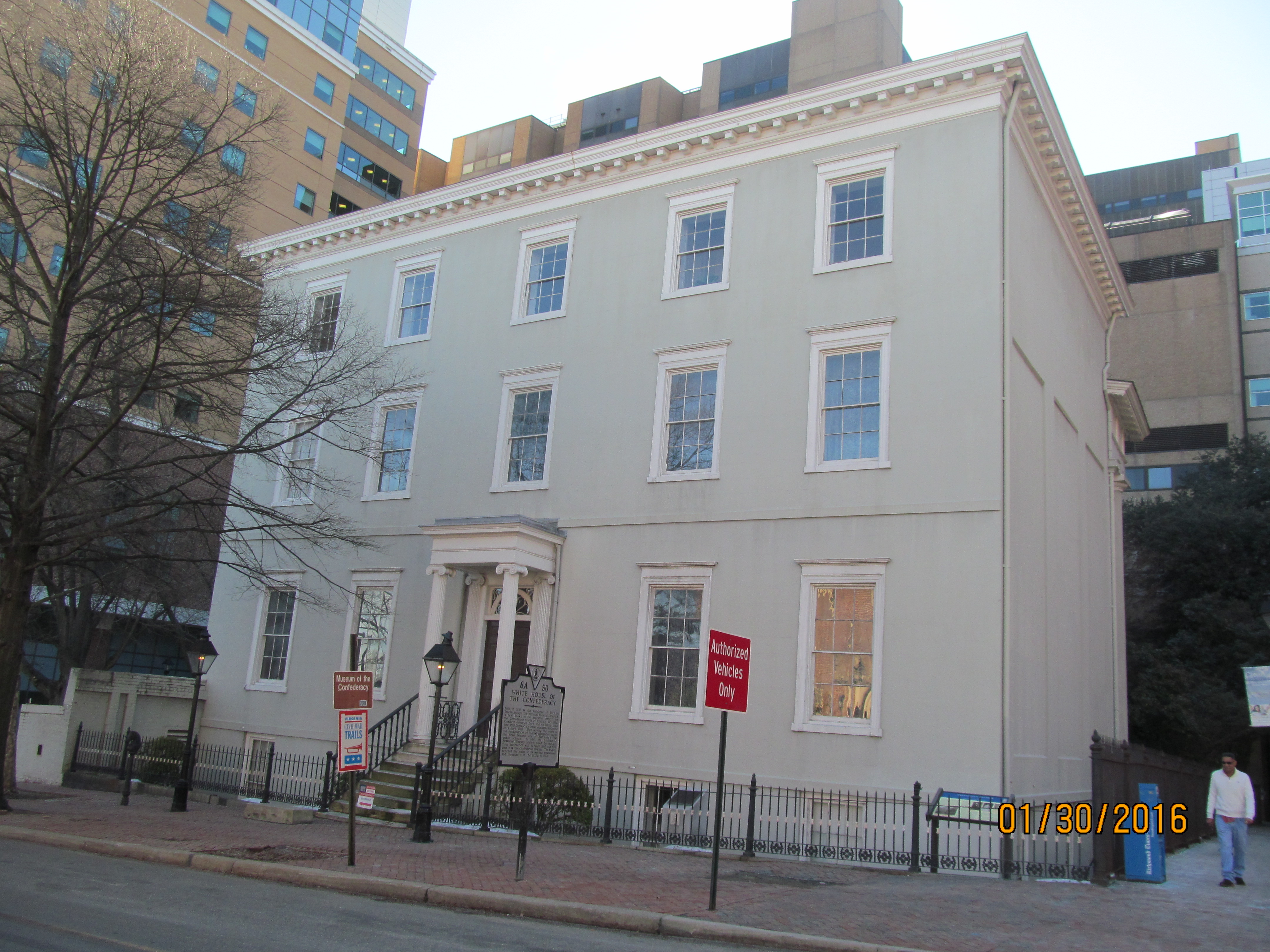
When I strode through the official “White House of the Confederacy” in Richmond, Virginia two weeks ago today
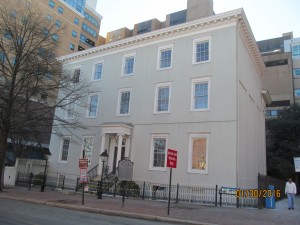
The “White House of the Confederacy,” Richmond, Virginia. President Abraham Lincoln met with one of his Generals in the Library (lighted window)within hours after Union troops had secured Richmond. In being in that room two weeks ago, I was awe struck by the spirit of the President and also by the spirits of the Confederate opposition that discussed strategy with Jefferson Davis the President of the Confederacy in the room on the second floor…a conference room: Lee, Jackson, the Confederate Generals. That room is on the second floor of this house. The ghosts in this historic home speak to us today.
Lincoln had to create things as he went, dealing with a complex political issue: slavery, while deciding to fight a war to preserve a divided nation.

How did Abraham Lincoln handle pressure and political opportunists? He did not have press agents and spinmasters and talk show hosts and superior punditry critiquing his every move and loading him up with advice.
Though he did have the “crusading editors” and “editorial boards” of his day. Let’s take a look at the Big Guy from Illinois
In the days of Lincoln, media coverage was simply print media. However, the amount of reporting on the burning issues of the day was far more detailed than today with dozens of newspapers presenting the chronicles of burning issues. For Lincoln’s presidency was the presidency of the nation’s greatest crisis in its eighty-five year history:
The Civil War.
It is interesting to note how President Lincoln conducted himself in dealing with America’s interests, its factions, pulling him to free the slaves.
When Lincoln was running for the Presidency in 1860 at the Republican Convention in riproaring Chicago, he was up against James Seward, a powerful New York politician. However, the western states at the time were highly distrustful of the New York political machine. (Has anything really changed? They are still distrustful today!)
Lincoln won over support by taking a position of what was good for the nation as a whole.
Taking a Position and Working To it
Lincoln first gave notice of his potential for the Presidency when he impressed Horace Greeley, influential editor of the New York Tribune with a fiery speech at the Cooper Union in February, 1860, delivering a sharp criticism of the South, hard on the heels of South Carolina’s secession from the Union. The speech included these words,
You say you will not abide the election of a Republican President. In that supposed event, you say, you will destroy the Union; and then, you say, the great crime of having destroyed it will be upon us! (The northern states) That is cool. A highwayman holds a pistol to my ear, and mutters through his teeth, “Stand and deliver, or I shall kill you, and then you will be a murderer!”
Greeley printed the speech in his Tribune the next day, scooping the other New York papers, by simply asking Lincoln for a copy of the speech. The subsequent printing in the popular Trib, sent Mr. Lincoln on his way. As William Harlan Hale’s biography of Mr. Greeley (Horace Greeley: Voice of the People)describes the scene at “The original Trib’s” offices, as remembered by Amos Cummings, a young proofreader:
Amos Cummings, then a young proofreader, remembered the lanky westerner appearing over his shoulder amid the noise of the pressroom late at midnight, drawing up a chair, adjusting his spectacles, and in the glare of the gaslight reading each galley (of the Cooper Union speech) with scrupulous care and then rechecking his corrections, oblivious to his surroundings.
A Comeback President
Lincoln had been a highly successful politician from Illinois in the 1830s and 1840s. He was three times elected to the state legislature, and The Kunhardts’ The American Presidency reports he was “a recognized expert at forming coalitions…he learned how to keep secrets, how to trade favors, how to use the press to his advantage. And he cultivated his relationship with the party hierarchy.”
Graff’s book writes that Lincoln was described as “ruthless,” that he “handled men remotely like pieces on a chessboard.” Humor and frankness were character traits.
Lincoln was elected a congressman, only to serve just one term.
Lincoln had been practicing corporate law privately and had lost interest in politics by 1854, until the repeal of The Missouri Compromise, which had restricted slavery to the southern states. Lincoln felt stirred to come back. He spoke out against the spread of slavery, running for the senate in 1858 against William Douglas, unsuccessfully.
Saving the Union His Mantra
As the furor over slavery and the South’s threats to secede grew, a crisis of spirit and purpose in this nation which makes today’s concerns about terrorism as a threat to America, pale in comparison, Lincoln realized that the Union was the larger issue.
He expressed this in response to Horace Greeley, editor of the New York Tribune, an influential figure at the Republican (Whig) Convention in Chicago in 1860. Greeley was the kingmaker at the 1860 Chicago convention who eventually swung the western states for Lincoln, giving the man from Illinois the nomination on the third ballot over William Seward, the candidate of the Thurlow Weed “New York Machine.”
Greeley then tried to influence the President-Elect to free the slaves. (Lincoln was being lobbied by the still-powerful Weed-Seward faction to compromise with the southern states on the issue of slavery).
Standing Tall Against Pressure.
Lincoln refused to free the slaves as one of the first acts of his presidency, standing firm to hold the union together, when he announced his attention not to do so, on his way to Washington after being elected. His words in this time of international tension, are worth remembering as America considers starting a war for the first time. Lincoln said:
I have often inquired of myself what great principle or idea it was that kept this Confederacy (the Union, he means), so long together. It was not the mere matter of separation of the colonies from the motherland, but that sentiment in the Declaration of Independence which gave liberty not alone to the single people of this country, but hope to all the world, for all future time. It was that which gave promise that in due time the weights would be lifted from the shoulders of all men, and that all should have an equal chance.
Seeing the Big Picture.
After Fort Sumter was fired upon, Lincoln was pressured harder to free the slaves. Still, Lincoln held firm. Mr. Greeley published a blistering open letter to the President, he called “The Letter of Twenty Millions,” meaning his readers (slightly exaggerated)in The New York Tribune.
Greeley’s letter took the President to task for not freeing the slaves now that the Civil War was on, writing, “all attempts to put down the rebellion and at the same time uphold its inciting cause are preposterous and futile.”
President Lincoln responded with an open letter which Greeley published in The Tribune. President Lincoln’s letter is instructive as to how a President moves in crisis, when a nation is ripped apart to calm and state his position. He begins with a conciliatory tone, calming Greeley’s bombast:
…If there be perceptible in it (Greeley’s letter) an impatient and dictatorial tone, I waive it in deference to an old friend whose heart I have always supposed to be right.
As to the policy I “seem to be pursuing,” as you say, I have not meant to leave any one in doubt. I would save the Union. I would save it in the shortest way under the Constitution.
The sooner the national authority can be restored the nearer the Union will be – the Union as it was.
If there be those who would not save the Union unless they could at the same time save slavery, I do not agree with them.
If there be those who would not save the Union unless they could at the same time destroy slavery, I do not agree with them.
If I could save the Union without freeing any slaves, I would do it – if I could save it by freeing all the slaves, I would do it – and if I could do it by freeing some and leaving others alone, I would also do that.
What I do about slavery and the colored race, I do because I believe it helps to save this Union, and what I forbear, I forbear because I do not believe it would help to save the Union.
I shall do less whenever I shall believe what I am doing hurts the cause, and I shall do more whenever I believe doing more will help the cause.
I shall try to correct errors when shown to be errors, and I shall adopt new views so fast as they shall appear to be new views.
I have here stated my purpose according to my views of official duty, and I intend no modification of my oft-expressed personal wish that all men everywhere could be free, Yours
A. Lincoln
(Editor’s Note:That is Presidential! It leaves no doubt as to who is in charge and who is responsible and why. How refreshing!)
Wearied by War
Horace Greeley described the toll the Civil War had taken on Mr. Lincoln, seeing him in person shortly before General Robert E. Lee surrendered. Greeley wrote:
Lincoln’s face had nothing in it of the sunny, gladsome countenance he first brought from Illinois. It is now a face haggard with care and seamed with thought and trouble…tempest-tossed and weatherbeaten, as if he were some tough old mariner who had for years been beating up against the wind and tide, unable to make his port or find safe anchorage…The sunset of life was plainly looking out of his kindly eyes.”