Hits: 209

WAKE UP COLD SNAP SUNRISE THIS MORNING 7:30 A.M. EST
Hits: 209

WAKE UP COLD SNAP SUNRISE THIS MORNING 7:30 A.M. EST
Hits: 203
WPCNR THE LETTER TICKER. From Paul Feiner, Greenburgh Town Supervisor. December 14, 2023:
Hits: 217
INDEPENDENT REDISTRICTING COMMISSION TO “DISCHARGE ITS CONSTITUTIONAL DUTY… THE “NY CONSTITUTION DEMANDS THAT PROCESS, NOT DISTRICTS DRAWN BY COURTS.”
WPCNR COURTSIDE. From the New York State Court of Appeals Decisions. December 13, 2023:
The Court of Appeals of New York State in a 60 page decision released yesterday, (with key paragraphs excerpted in context below) has ordered New York State Election Districts of 2022 to be redrawn by reconvening the Independent Redistricting Commission with a terse opening paragraph from Chief Judge Rowan Wilson. The decision vote was 4 to 3.
You can read the complete decision here: https://nycourts.gov/ctapps/Decisions/2023/Dec23/90opn23-Decision.pdf
“In 2014, the voters of New York amended our Constitution to provide that legislative districts be drawn by an Independent Redistricting Commission (IRC). The Constitution demands that process, not districts drawn by courts. Nevertheless, the IRC failed to discharge its constitutional duty. That dereliction is undisputed. The Appellate Division concluded that the IRC can be compelled to reconvene to fulfill that duty; we agree. There is no reason the Constitution should be disregarded.
(Editor’s note:) The paragraphs in context below taken from the Judge Wilson’s decison)explain the Court reasoning to direct the Independent Redistricting Commission to redraw the districts before the 2023 elections:
The members of the IRC aligned with the legislature’s supermajority declined to oppose the petition, but the remaining IRC Commissioners moved to dismiss the proceeding as untimely and for failing to state a cognizable claim for relief under either the Constitution or this Court’s decision in Harkenrider. Having successfully intervened, the Harkenrider petitioners also moved to dismiss the petition as untimely and on the basis that, in Harkenrider, this Court had already remedied the constitutional defect identified by petitioners by directing the enactment of new, nonpartisan maps.
Supreme Court granted respondents’ motions to dismiss, agreeing that the Constitution required the Harkenrider redistricting maps to remain in place until the next census. On appeal, a divided Appellate Division reversed, granted the petition, and “direct[ed] the IRC to commence its duties forthwith” (217 AD3d 53, 62 [3d Dept 2023]). According to the Appellate Division, petitioners’ claim against the IRC was timely because – 8 – No. 90 – 8 – it “accrued” on March 31, 2022, the date on which the Harkenrider Supreme Court ruled that the 2021 legislation purporting to allow the legislature to proceed absent a second IRC submission was unconstitutional (217 AD3d at 58).
On the merits, the Appellate Division concluded that Harkenrider “exclusively addressed the Legislature’s constitutional violations and, thus, did not remedy the IRC’s failure to perform [its nondiscretionary constitutional] duty” (id.). The Appellate Division also reasoned that the Constitution authorized judicial intervention in redistricting only “to the extent . . . required” to remedy a violation of law and, in Harkenrider, “the Court was not ‘required’ to divert the constitutional process beyond the then-imminent issue of the 2022 elections” (217 AD3d at 60 [emphasis omitted]). Thus, in the Appellate Division’s view, the congressional map adopted pursuant to Harkenrider was “merely an interim map for the purpose of the 2022 elections” and the IRC could be compelled to produce a second congressional map for the legislature’s consideration (217 AD3d at 58). Two Justices dissented. Initially, the dissenters would have rejected the petition as time-barred because petitioners unreasonably failed to demand the IRC perform its legal duty until five months after the IRC failed to act. Alternatively, the dissenters would have affirmed Supreme Court’s denial of the petition because “the failure of the IRC to act . . . was . . . part and parcel” of our holding in Harkenrider that the originally enacted maps violated the Constitution’s procedural requirements (217 AD3d at 68 [Pritzker, J. dissenting]).
Further, this Court’s remedy had already “repaired the procedural and substantive infirmities in a manner directly set forth in the NY Constitution” (id. at 68-69). Since a constitutionally-enacted “congressional map has been established and remains in place” for the duration specified in the Constitution—namely, until the next federal census—the dissenters concluded that petitioners lacked any clear legal right to relief (id. at 70). Respondents appealed as of right on double dissent grounds (see CPLR 5601 [a]).
For the reasons detailed below, I would reverse and dismiss the proceeding. II. Petitioners seek to compel the IRC to fulfill its constitutional duty “by submitting a second round of proposed congressional districting plans for consideration by the [l]egislature” (Amended Petition at 5 [¶ 14], 20 [Prayer for Relief]). As is proper, I will begin with the timeliness of this claim for relief, which the majority chooses to ignore for the first 24 pages of its opinion.
It is well-settled that a proceeding in the nature of mandamus to compel “must be commenced within four months . . . after the respondent’s refusal, upon the demand of the petitioner . . . to perform its duty” (CPLR 217 [1]; see Matter of Waterside Assoc. v New York State Dept. of Envtl. Conservation, 72 NY2d 1009, 1010 [1988]; Matter of De Milio v Borghard, 55 NY2d 216, 220 [1982]; Austin v Board of Higher Educ. of City of N.Y., 5 NY2d 430, 442 [1959]).
As we have cautioned, however: “This does not mean that the aggrieved party can, by delay in making [a] demand, extend indefinitely the period during which [they are] required to take action. If [they do] not proceed promptly with [the] demand [they] may be charged with laches” (Austin, 5 NY2d at 442, citing 22 CarmodyWait, New York Practice, §§ 289, 297, pp. 379, 388-390; see also Matter of Sheerin v New – 10 – No. 90 – 10 – York Fire Dept. Articles 1 and 1B Pension Funds, 46 NY2d 488, 496 [1979]; Matter of Devens v Gokey, 12 AD2d 135, 137 [4th Dept 1961], affd 10 NY2d 898 [1961]).
To avoid application of laches in this context, a “demand must be made within a reasonable time after the right to make [it] occurs” (Matter of Devens, 12 AD2d at 136) or, at the latest, “after the petitioner knows or should know of the facts which give [them] a clear right to relief” (Matter of Granto v City of Niagara Falls, 148 AD3d 1694, 1695 [4th Dept 2017] [internal quotation marks omitted]; Matter of Barresi v County of Suffolk, 72 AD3d 1076, 1076 [2d Dept 2010], lv denied 15 NY3d 705 [2010]; 24A Carmody-Wait 2d § 145:880).
In furtherance of the policies underlying CPLR 217 (1), four months has been deemed the longest possible period in which service of a demand can be considered reasonable (see Matter of Norton v City of Hornell, 115 AD3d 1232, 1233 [4th Dept 2014], lv denied 23 NY3d 907 [2014]; Matter of Zupa v Zoning Bd. of Appeals of Town of Southold, 64 AD3d 723, 725 [2d Dept 2009]; Matter of Blue v Commissioner of Social Servs, 306 AD2d 527, 528 [2d Dept 2003]; Matter of Thomas v Stone, 284 AD2d 627, 628 [3d Dept 2001], lv dismissed 96 NY2d 935 [2001], lv denied 97 NY2d 608 [2002], cert denied 536 US 960 [2002]; Matter of Densmore v Altmar-Parish-Williamstown Cent. School Dist., 265 AD2d 838, 839 [4th Dept 1999], lv denied 94 NY2d 758 [2000]; Devens, 12 AD2d at 137; Matter of Amsterdam City Hosp. v Hoffman, 278 AD 292, 297 [3d Dept 1951]). Unexcused delay of more than four months requires dismissal of the proceeding, even in the absence of any prejudice (see Matter of Sheerin, 46 NY2d at 495-496; Devens, 12 AD2d at 137). – 11 – No. 90
Straightforward application of these well-settled principles can lead to only one conclusion: petitioners’ claim was filed far too late. Petitioners seek enforcement of the IRC’s duty to submit second-round maps to the legislature, but they did not demand that the IRC fulfill its constitutional duty when the commission announced on January 24th that it was deadlocked and therefore would not comply. Nor did petitioners make any demand when the IRC’s constitutional deadline for the submission of second-round maps came and went on January 25th. Petitioners remained silent as the legislature introduced its own redistricting legislation on February 1st, removing the process entirely from the IRC and signaling that the legislature would proceed with redistricting despite the IRC’s abdication of its constitutional duty.
Petitioners also sat idle when the infirm redistricting legislation was delivered to the Governor and signed into law on February 3rd. Petitioners’ inaction continued throughout the entire Harkenrider litigation. Significantly, at oral argument before this Court on April 26, 2022, both the Harkenrider petitioners (intervenors here) and the state respondents acknowledged that mandamus relief “could have” been sought against the IRC at an earlier point, evidencing that the availability of such relief was always well understood (oral argument tr at 33, 46). Indeed, counsel for the Speaker of the Assembly stated that “there could have been a lawsuit brought by petitioners against the . . . members of the commission but the . . . time passed” (id. at 46 [emphasis added]).
Even after our decision in Harkenrider, most petitioners remained idle with respect to mandamus relief or chose to pursue alternative relief. Most notably, lead petitioner Hoffmann sought an order in the United States District Court for the Southern District of – 12 – No. 90 – 12 – New York requiring that the gerrymandered maps enacted by the legislature be used in the impending 2022 congressional elections (Doc. No. 1, complaint at 3, 13, in De Gaudemar v Kosinski, No.1:22-cv-3534 [SD NY May 2, 2022]). The District Court harshly rejected that request to “hav[e] the New York primaries conducted on district lines that the State says are unconstitutional,” referring to it as an attempt to “impinge[]” on “[f]ree, open, rational elections” (Doc. No. 92-2, transcript at 15, 40, in De Gaudemar, supra).
Only after these efforts failed, the special master maps were certified, and several more weeks had passed did petitioners finally seek mandamus relief against the IRC. There is no excuse for this extravagant delay. Even assuming petitioners’ claim would have been deemed premature on January 24th—the day the IRC announced its stalemate—they had a clear right to mandamus relief against the IRC on January 25th, when the 15-day constitutional deadline elapsed without any second-round submission by the IRC.
Further, it is unfathomable that petitioners can argue that even after the Governor signed the legislature’s maps into law on February 3rd, it remained unclear whether the IRC would act to deliver a second set of maps. Because these events were unequivocal, petitioners’ commencement of this proceeding on June 28th was “well beyond four months after they knew or should have known of the facts that provided them a clear right to relief” (see Matter of Granto, 148 AD3d at 1696).
Plainly, by then the ship had sailed. Petitioners agree that this proceeding is governed by a four-month time limit, but argue that such period should be measured from March 31, 2022, the date the Harkenrider trial court declared the 2021 legislation unconstitutional. However, the 2021 legislation neither relieved the IRC of its mandatory constitutional duty to submit second-round maps nor concealed petitioners’ clear right to mandamus relief arising from the breach of that duty on January 25th.
The 2021 legislation provided merely that “[i]f the commission does not vote on any redistricting plan or plans, for any reason, by the date required for submission of such plan,” the legislature could enact its own redistricting plan (L 2021 ch 633 § 1 [emphasis added]). Nothing in that language purports to modify the IRC’s underlying constitutional duty to submit maps to the legislature, which is the very action petitioners now seek to compel. Moreover, it is a bedrock legal principle that statutes are subordinate to the Constitution and are void in the event of any conflict. Thus, even if the legislature had intended to relieve the IRC of its mandatory constitutional obligation, the only way to do so was to amend the Constitution.
The legislature clearly understood this: it initially submitted the 2021 legislation to the People in the form of a ballot initiative for a proposed constitutional amendment. In rejecting that proposal, the People signaled their strong preference for the constitutionally mandated process, which—as I will explain— leaves remediation of any IRC breakdown primarily to the courts. The legislature’s response was to ignore the voters’ will and circumvent the Constitution by enacting the same provisions as an ordinary statute. That unsubtle effort to subvert the IRC’s role was legally ineffective for the reasons stated above.
Hits: 0
Hits: 195
WPCNR NEWS & COMMENT. DECEMBER 11, 2023:
A ONCE AND PAST TIME MIRRORS THE AMERICAN FUTURE.
Editor’s Note: I am a student of history. I look back to see what the past can tell us. In light of the political climates around the world today, that are facing turmoil within, it is worth noting with alarm how quickly a nation’s resolve and self-esteem and thoughts can be corrupted into thinking might is right.. I was leafing through Mein Kampf, Adolf Hitler’s 800 page summary of his philosophies and went back to look at some of his speeches.
His speech of July 15, 1932 delivered before the Reichstag, Germany’s congress, has striking parallels to the America of today. His speech was to convince the German nation to vote his party a majority so he could institute his “philosophies.” Mr. Hitler exceeded in infamy, death and destruction the most hideous dictators in history. When I read this speech, I did an exercise in my head, substituting “America” for references to “Germany” in the speech. It chilled me.
Adolf Hitler, Appeal to the Nation, 15 July 1932
[1] Speech for the Reichstag Vote on July 31, 1932 [2] …
The great time of decision has arrived. Destiny has given Germany’s present rulers more than thirteen years to prove themselves and to show what they can do. They themselves pronounce the most damning judgment on themselves, for by the very nature of their propaganda today they acknowledge the failure of their efforts.
Once they wanted to govern Germany better than it had been governed in the past, and all they can say about their art of governing is that Germany and the German People are not yet dead. In those November days in 1918 they solemnly swore to lead our nation, and especially the German work force towards a better economic future. They have had almost fourteen years to keep that promise, and they cannot cite a single German trade or profession as evidence of their success.
The German farmer is in dire straits, the middle class is ruined, the hopes of many millions of people that social conditions would improve have been dashed; a third of the work force, male and female, is unemployed and thus without a livelihood. The national government (Reich), the local authorities and the individual German states are overburdened with debt, everywhere finances are in disarray and the public purse is empty.
How much more could they have destroyed? But the worst thing is that they have destroyed the Nation’s faith, leaving it utterly without hope or confidence. In thirteen years they have not succeeded in mobilizing the forces dormant within our nation. On the contrary! In their fear of awakening the nation they have created dissension, pitting town against country, salaried workers against civil servants, blue collar workers against white collar workers, Bavarians against Prussians, Catholics against Protestants and so on.
The energies of our race have been consumed solely in dealing with its own internal problems. What remained for the world outside Germany were fantasies, fantastic hopes of cultural awareness, international law, the world conscience, conferences of ambassadors, the League of Nations, the Second International, the Third International, proletarian solidarity and so forth. And the world treated us accordingly. And so, slowly the destruction of Germany has progressed and only a maniac could hope that the forces which caused this decline could now achieve the nation’s regeneration. If the parties currently in power are serious about saving Germany, why haven’t they done so? If they really wanted to save Germany, why hasn’t it happened? If the men of these parties honestly intended to do that, then their programs must have 2 been wrong. If their programs were right, then they themselves could not have genuinely wanted to save Germany, or else they were simply too ignorant or too weak.
After thirteen years during which they have totally destroyed Germany, the time has finally come now to eliminate them, too. Whether the current parliamentary parties survive is not important, what matters is to save the German nation from complete destruction.
It is our duty to defeat these parties because to ensure their own survival they are constantly compelled to divide the nation. For years they have told the German working man that he could ensure his own salvation unassisted. For years they have fooled the farmer into believing that only his own organization would help him. The middle class was supposed to be saved from ruin by middle class parties and industry saved by industrial parties. Catholics were was supposed to seek refuge in the Centre Party (Zentrum) and Protestants in the Christian Social People’s Service (Christlichsozialer Volksdienst). Yes, and in the end the home owners got their own political representation just like the renters, the salaried workers and the civil servants.
But now these attempts to divide the nation into classes, estates, professions and confessions and to lead them one by one towards a better economic future have finally failed.
On the day when we founded our National Socialist movement we were already convinced that the fate of the individual German is inseparably linked with the fate of the entire nation. If Germany is ruined the worker cannot prosper in favorable social conditions nor can the entrepreneur; and neither will the farmer be able to save himself nor the middle class. No, the ruin of the Reich, the collapse of the nation means the ruin and destruction of us all! No one confession and not a single German tribe (Stamm) will escape the fate which will overtake us collectively.
On the day when the National Socialist movement was founded we had long since realized that it was not the proletariat which would triumph over the middle class, nor the middle class which would triumph over the proletariat. In the end it would be the international financiers alone who would triumph over both. And this is precisely what has happened!
Recognizing this process of decay thirteen years ago I and a handful of others formed a new movement, whose very name is intended to proclaim the new national community. Socialism cannot exist unless it is served by the power of the intellect, nor can there be social well-being unless it is protected and its existence ensured by the strength of a nation. And there can be no nation and thus no nationalism unless the millions of intellectual workers are joined by the millions of manual laborers and the millions of farm workers.
As long as nationalism and socialism march onward as separate ideas they will be vanquished by the united forces which oppose them. On the day when these two ideas unite as one, they will be invincible!
And who would deny that when everything in Germany is falling apart and in decline, when both the economy and political life are grinding to a standstill or are already at an end, one single organization has enjoyed an unheard of and astonishing upswing?
Thirteen years ago with seven men I began this task of unifying Germany, and today more than 13 million have joined our ranks! But it is not their number which matters; what matters is the kind of person they are! Thirteen million people from all walks of life, thirteen million workers, farmers and intellectuals, thirteen million Catholics and Protestants from all the German regions and tribes have formed an inseparable alliance. And thirteen million Germans have recognized that the future of each of them lies only in the collective struggle and collective success of all of them.
Millions of farmers have now realized that whether they themselves understand the necessity for their existence is not important. What matters is to enlighten those in other walks of life and other professions about the German farmer and to gain their support for him.
And today millions of working men have also realized that in spite of all theories their future does not lie in international organizations. What matters is that their fellow Germans realize that without German farmers and German workers Germany cannot be strong. And similarly millions of middle class intellectuals have come to realize how unimportant their sense of their own worth is, unless the millions of other Germans ultimately recognize the importance of the German intelligentsia.
Thirteen years ago we National Socialists were laughed at and scorned. Today our opponents are laughing on the other side of their faces! A community of believers has come into being which will slowly overcome the absurd prejudices about class and social status. A community of believers who are determined to take up the struggle to preserve our race, not because they are from Bavaria or Prussia, or Württemberg or Saxony, not because they are Catholics or Protestants, workers or civil servants, middle class citizens or salaried employees and so forth, but because they are all Germans.
From this feeling that an inseparable bonds unites them all has grown a sense of mutual respect, and from this respect has come understanding and from that understanding the tremendous power which moves us all.
This is why we National Socialists march forward to each election with the sole commitment that the next day we will resume our efforts to achieve the reorganization of our body politic. For we are not fighting for seats in parliament or cabinet appointments; we are fighting on behalf of our fellow Germans whom we want to – whom we shall -reunite in an inseparable community with a common destiny.
The Almighty who has allowed our numbers to grow from seven to thirteen million in thirteen years, will also permit the thirteen million to form the nucleus from which will grow a new German nation. We believe in a nation. It is for this German nation that we are fighting, and, like thousands of fellow Germans before us, it is to this German nation that we are ready – if called upon – to dedicate ourselves with body and soul.
If the nation does its duty, the day must come when once again we shall have a Reich with honor and freedom – work and bread!
Hits: 206
|
BY DR. CAITLIN RIVERS
(REPRINTED WITH PERMISSION)

|
|||||||||||||||
Welcome to the Northeast edition of Outbreak Outlook! It is only available to paid subscribers. If you wish to become a paid subscriber and access region-specific information, please click the Subscribe Now button below. Thanks for reading! -Caitlin

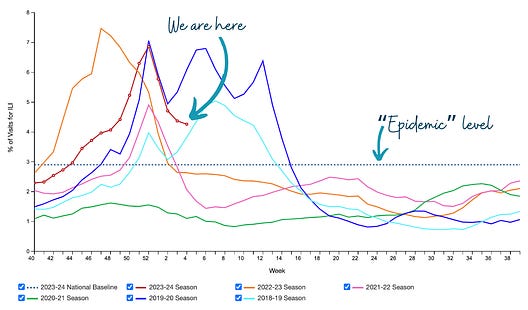
Influenza like illness (ILI) is definitely on the rise in the Northeastern region. The percentage of visits to the doctor for fever and cough or sore throat rose to 3.8% during the week ending December 2, up from 3.4% the week prior. By comparison, last year’s regional peak was 8.6%. I expect that increases will continue for at least a while longer.
By state: At the state level, there are some nuances. New York saw a sizable increase, rising 0.7 percentage points to 5.6%. New Jersey also posted a concerning jump of 0.6 points to 5.2%. These levels are really quite high, so be safe out there.
Rhode Island and New Hampshire rose 0.5 and 0.4 points respectively, to around 1.7-1.1%. More moderate ILI increases were seen in Pennsylvania (+0.3 points to 2.1%) and Connecticut (+0.2 to 3.2%).
Vermont, Massachusetts and Maine experienced slight upticks under 0.2 percentage points for the week. No Northeastern states reported a decline in ILI.
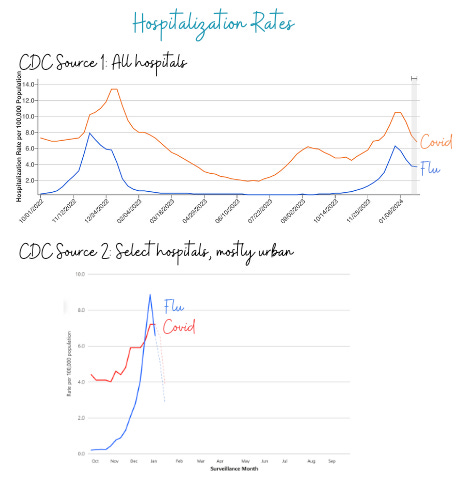
Covid-19 is also increasing in the region, following a brief dip around Halloween. The rate of new weekly hospitalizations per 100,000 population is now 7, which is similar to the mini-wave we saw over the summer. Last winter the region reached 18, but I doubt we’ll see that again this year, based on current trends.
By state: New Hampshire saw a concerning jump of 1.8 new admissions per 100,000 to 6.3. Massachusetts and Maine also posted sizable increases, rising 1.5 and 1.1 points respectively.
New Jersey, New York, and Rhode Island rose between 1.1-0.2 hospitalizations per 100,000. Pennsylvania saw a smaller 0.1 uptick week-over-week.
Connecticut remained essentially flat, while Vermont experienced a decline of -0.8 admissions to 7.0 per 100,000.
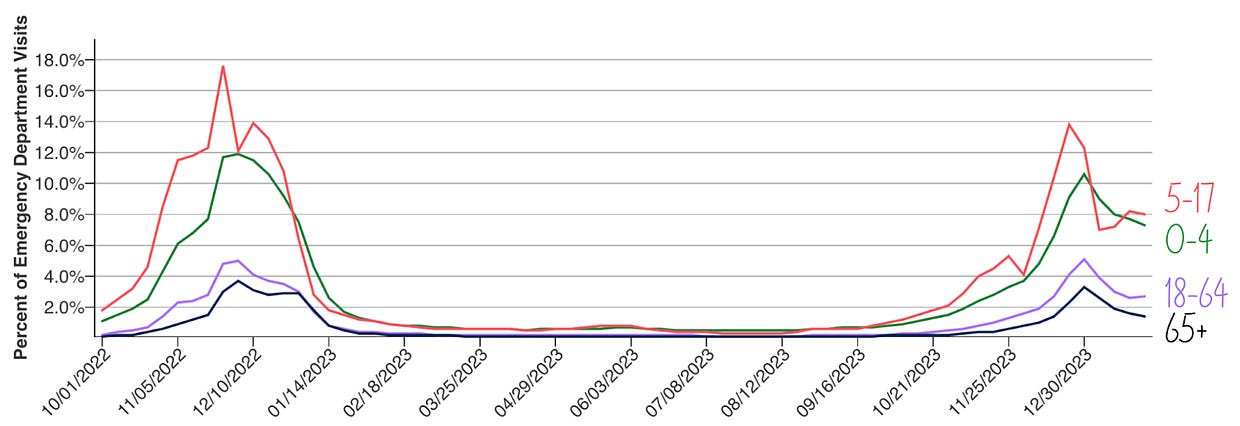
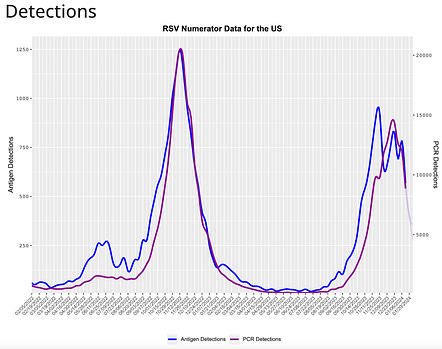
RSV activity in the Northeast might be improving – reported PCR test positivity dropped slightly last week, to 11.9%, from 13.8% the week before. I have my fingers crossed that this decline is real, and that we are at or near peak season.
Maine saw a dramatic jump, from 28% PCR test positivity up to 36%. New Hampshire, New Jersey, New York, Connecticut, and Vermont all saw more modest increases.
Massachusetts held steady at around 18% PCR test positivity – hopefully that means the outbreak is peaking there, and will begin to decline soon. Pennsylvania registered a slight dip in cases, down to 12%. (There is insufficient data for Rhode Island.)
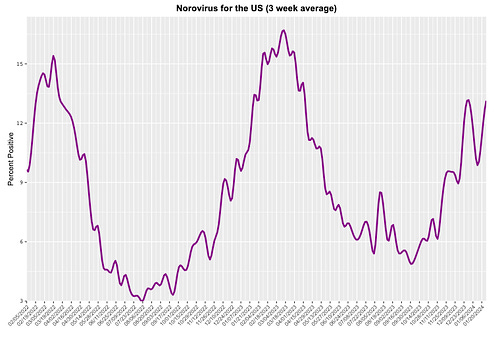
I’m monitoring several other respiratory viruses. .
The following foods are being recalled because they are contaminated. Please check your cupboards and throw out any of these items:
New this week:
Previously reported:
If you have food allergies, you may wish to review these FDA safety alerts and USDA alerts for foods with undeclared allergens.
Hits: 226
|
![]() |
Si quiere leer la versión en español, pulse aquí.
Harvard invited me to review a new book, Within Reason, by Dr. Sandro Galea. I don’t personally know Dr. Galea, but this has to be one of the most impactful books I’ve read yet. It forces reflection (As I say below, “It was like being forced to look in the mirror after a war”). But more importantly, I hope this book will ignite a critically important debate in public health. Go get the book. Please send me your thoughts *after* you read. I’m eager to hear them.
Here is my review, originally published in Harvard Public Health Magazine.
If the pandemic taught us one thing, it’s that public health must be reimagined for the 21st century. Although there were major success stories, like saving more than three million lives with vaccines, the fragmented, underfunded, and inequitable U.S. public health system was cracked wide open for all Americans to see. And it wasn’t pretty.
Within Reason, written by Sandro Galea, dean of Boston University’s School of Public Health, names another uncomfortable dimension of the pandemic: Public health—traditionally a very liberal field— took a turn towards illiberalism. A liberal perspective means considering different points of view, celebrating differences, and remaining open to the possibility of being proved wrong. Conversely, illiberalism stifles debate and minimizes dissenting views.
In a three-part book of short essays compiled from his blog, The Healthiest Goldfish, Galea enlists many examples to substantiate his viewpoint: the field’s propensity to communicate with certainty in the midst of so much uncertainty (think cloth masks); the perils of groupthink; and public health’s tendency to favor pragmatic paternalism by, for example, keeping nursing homes locked down after vaccines were available.
These tendencies are perhaps understandable. During an emergency, time costs lives. The height of the pandemic happened amid incredible political instability, disinformation, and outright hostility towards public health workers, all of that sanctioned by political leaders. (Polarization affected public health, too.)
But Galea argues that if we continue on this path, the public health field will continue to lose trust among Americans. This means our efforts to combat infectious diseases and other health threats will have less impact, and communities will pay the price, with increasing morbidity and mortality.
As an epidemiologist, I found this book hard to read. It was like being forced to look in the mirror after a war, still bathed with the blood, sweat, and tears of the pandemic. To be clear: I agree with many of Galea’s points. I’ve made (and admitted) to many of the mistakes he outlines, like dismissing new pieces of information because of politics rather than evidence. And we, in public health, need to recognize these mistakes. I appreciated Galea’s approach to balancing the fine line between constructive criticism, hope, and action.
I disagree with some details in this book, though. For example, Galea implies that many in public health were wrong to push back so fiercely on ideas like the Great Barrington Declaration—an open letter that advocated for isolating the vulnerable while allowing infections to spread among lower-risk populations before vaccines were available. Given the epidemiological, logistical, and ethical concerns about this approach—especially coming, as it did, before widespread access to COVID-19 vaccines—we needed experts to push back, not automatically embrace that approach.
Also, this book mostly circles around the loss of trust from one group: Republicans. And rightfully so. A new poll from the Pew Research Center shows trust in scientists has rapidly declined among Republicans. Not so with Democrats. But my quibble is: Why, and more importantly how, should public health privilege one group’s information and health needs over another? How should public health balance an increasingly individualized society, given public health is about serving the greater good? These are tough questions to answer.
I presume many people in public health will feel the same way about the book: Some things we agree with, some are hard realities to face, and some things we disagree with. But I think Galea’s book will stir up the conversation in needed ways. In a healthy society, a tug-of-war between the values and morals that anchor public decision-making is not only expected, but also needed to advance and improve.
Galea provides tangible solutions on how to return to public health’s liberal roots, with a roadmap that focuses on human connection and communication: Keep an open mind; do rather than say; speak with humility; act pragmatically according to the data; get better at weighing trade-offs. But most of all, listen. Engage in dialogue about what solutions are possible. Test ideas with outside feedback. Look beyond biases that blind us. Be open to rigorous and even heated debates. Relinquish power.
At the heart of the book is a critical question: What does public health look like in the 21st century? This is a question for every one of us—for those of us working in public health, critics of public health, those in medicine; and, most importantly, for everyday people affected by public health decision-making. In an increasingly politicized environment—amid an information landscape that rewards outrage, not thoughtful consideration—and with new health threats emerging faster due to climate change, figuring out an answer is crucial but far from easy.
Thankfully, as Galea writes, “Public health is by nature forward-looking.” And we are at an inflection point. We must learn. We must strive for hope.
Millions of lives depend on it.
“Your Local Epidemiologist (YLE)” is written by Dr. Katelyn Jetelina, MPH PhD—an epidemiologist, wife. During the day, she is a senior scientific consultant to several organizations. At night, she writes this newsletter. Her main goal is to “translate” the ever-evolving public health world so that people will be well-equipped to make evidence-based decisions. This newsletter is free, thanks to the generous support of fellow YLE community members. To support this effort, subscribe below:
Hits: 242
|
Hits: 333
|
||||||||||||||||||||||||||||||||||||||||||||||||||||||||||||||||||||||||||||||||||||||||||||||||||||||||||||||||||||||
|
Hits: 325

JOHN BAILEY AND THE HARD NEWS YOU NEED TO KNOW
THIS WEEK EVERY WEEK ON WHITE PLAINS WEEK
FOR 22 YEARS 2001-2023

LATIMER RUNS! PRIMARIES BOWMAN IN THE 16TH
CONGRESSMAN JAMAAL BOWMAN FAR RIGHT REACTS TO LATIMER ANNOUNCEMENT

THANKSGIVING COVID BAD PERFORMANCE BY WESTCHESTER:
EPIDEMIOLOGIST DR. JETELINA:22,000 TO 50,000 HOSPITALIZATIONS BY MID WINTER ACROSS U.S.A
JN-1 CIVID VARIANT ON WAY RAMPAGING ACROSS EUROPE

WHO’S LIVING IN THE 16TH CONGRESSIONAL DISTRICT? PROFESSOR ROLANDI ANALYZES
LATIMER’S CHANCES WITH THE MINORITY MAJORITY DISTRICT

CHALLENGE TO REDRAWN DISTRICT 16 HEARD BY COURT OF APPEALS NOV 15–
“NO DECISION YET”

WHAT INFLATION? COUNTY, CITY DOWN IN SALES TAX COLLECTIONS
WHERE’S THE INFLATION FACTOR GONE?