
HANK O’DAY (Elected 2010)
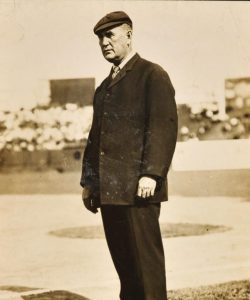
A player, manager, umpire and scout for more than 40 years in the National League, Hank O’Day remains the only person to serve the league in so many capacities. I thank Cliff Blau, the Sabermatician for reminding me of Hank’s election.
But it was as an umpire where O’Day made his greatest mark on history in some of baseball’s greatest games.
And it’s as an umpire that O’Day earned election to the National Baseball Hall of Fame, just the 10th arbiter to be inducted.
Born on July 8, 1862 in Chicago, O’Day made his major league baseball debut in 1884 as a pitcher for the Toledo Blue Stockings. In his seven-year career, O’Day went 73-110 with clubs like the Pittsburgh Alleghenys, Washington Nationals and New York Giants.
In 1889, O’Day won two games with a 1.17 ERA in the World Series to help the Giants to a 6-3 win over Brooklyn of the American Association. Coming off that successful postseason, O’Day had his best season in 1890, going 22-13. But en route to throwing more than 300 innings, he began to have arm trouble. That was the last season he would play in the big leagues, and O’Day ended his playing career in 1893 in the minors.
He wasn’t gone for long. O’Day returned to the National League as an umpire in 1895 and spent 30 years calling games.
O’Day was chosen to umpire the first modern World Series in 1903 as the only NL ump. He worked in nine other World Series, second-most in baseball history.
In 1908, O’Day was involved in one of the most controversial plays in history. As the plate umpire during a Cubs vs. Giants game, O’Day watched as Al Bridwell of New York appeared to hit a walk-off single to win the game. Fred Merkle, the Giants’ 19-year-old first baseman, was on first base at the time and never advanced from first to second when Moose McCormick – the runner on third base – scored, a common practice of the era. Cubs players produced a ball, and Chicago second baseman Johnny Evers tagged second base, claiming Merkle was out and that the run didn’t count because of the force out. O’Day ruled in favor of the Cubs – and Chicago later won a makeup game to win the National League pennant.
O’Day was the home plate umpire for no-hitters in four decades and also umpired the game in 1920 that featured the only unassisted triple play in World Series history – one of 10 World Series appearances.
In 1912, O’Day took a break from umpiring to manage the Cincinnati Reds. They finished 75-78 and in fourth place. He returned to umpiring in 1913, only to manage again in 1914, taking over the Cubs from Evers. After another fourth place finish at 78-76, O’Day returned to umpiring for good.
O’Day retired following the 1927 season and remained active in the National League as a scout for new umpires.
O’Day passed away on July 2, 1935. He was elected to the Hall of Fame in 2013.
The Basics
Did you know that Hank O’Day during his 35-year career as an umpire in the major leagues, made 246 ejections during his career?
The first player he threw out was Connie Mack on September 6, 1895
He threw out John Mcgraw 5 times.
He threw out the legends, Cap Anson in 1897 on September 22 on an argued non interference call.
The first time he threw out John Mcgraw was also on a interference he did not call on June 30 1897
He also threw out Rabbit Maranville 3 times, twice for fighting.
Joe Tinker, Honus Wagner, Frank Chance, Roger Bresnahan who invented the face mask.
Hughie Jennings, Miller Huggins (for arguing balls and strikes) and Clark Griffith the catcher on a home plate call.
246 ejections over 35 seasons is an average of only 7 a year. An indication that Mr. O’Day whose nickname was “The Reverend” had a cool demeanor not like the hot heads umpiring in the major leagues today.
WILLIAM J. KLEM
(BILL)
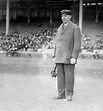
Elected to the Hall in 1953 was born in 1874 in Rochester, NY.
Bill was know as “The Old Arbitrator,” He umpired in the National League for 37 years and retired in 1941. He worked only behind the plate because of his excellent consistency of the strike zone. He is know as the “Father of Modern Day Umpire

THOMAS SENRY CONNOLY
(TOM)
Elected to the Hall in 1953 was born in 1870 in Manchester, England.
Tom was one of the first two umpires inducted into the Hall. Umpired in the National league for two years then to the American league and retired in 1931. He worked the American Leagues first game on April 24, 1901. Connolly was appointed the leagues first umpire-in-chief and served in that capacity until 1954.

WILLIAM GEORGE EVANS
(BILLY)
Elected to the Hall in 1973 was born 1884 in Chicago, IL.
Billy was at the time the youngest umpire in league history in 1906 at the age of 22. His career lasted until 1927 and after retiring he became an executive for many MLB Teams.
JOHN BERTRAND CONLAN
(JOCKO)
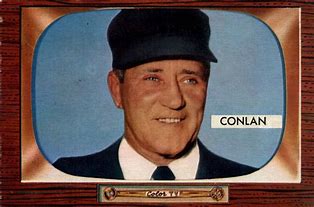
Elected to the hall in 1974 was born in 1899 in Scottsdale, Az.
Jocko became an umpire by accident as umpire Red Ormsby was over taken with heat exhaustion during a White Sox – Browns game in 1935. He was asked to fill in for Red and the next year became an umpire. He became a National League umpire in 1941 and retired in 1964
ROBERT CALVIN HUBBARD
(CAL)
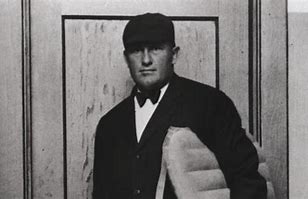
Elected to the hall in 1976 was born in 1900 in Keytesville, Mo.
Cal became an American League umpire in 1936. He worked the minor leagues for eight seasons. A hunting accident cut his umpiring career short he retired in 1951. He was also inducted into the Pro Football Hall of Fame as well as the College Hall. He owns that distinction as being first.

ALBERT JOSEPH BARLICK
(AL)
Elected to the Hall in 1989 was born in 1915 in Springfield, Il.
Al worked in the National League for 27 seasons. His five decades as an umpire are remarkable. He began his umpire career in 1940 at age 25. He retired in 1971.

WILLIAM ALOYSIUS McGOWAN
(BILL)
Elected to the Hall in 1992 was born in 1896 in Wilmington, De.
Bill had a thirty year career as an umpire in the American League starting in 1925. He had a colorful style and never changed throughout his career. He umpired 2,541 consecutive games. Bill was known as the “iron man” among umpires.

NESTOR L. CHYLAK JR
Elected to the Hall in 1999 was born in 1922 in Dunmore, Pa.
Nestor fought in the Battle of the Bulge and received the Silver Star and the Purple Heart and was seriously wounded in battle.
He umpired for 25 years in the American League beginning his career as an umpire in 1954. He suffered a mild stroke and was forced to retire in 1978. He was stationed at first base when Bill Mazeroski hit his homerun in the 1960 World Series to win the seventh game.

HAROLD DOUGLAS HARVEY
(DOUG)
Elected to the Hall in 2010 was born in 1930 in South Gate, Ca.
Doug was a National League umpire crew chief for 18 years. He worked 31 seasons and a total of 4,673 games. He mentored many young umpires and his main emphasis was on timing. He was well know as an umpire who controlled the game. He worked the plate in Game One of the World Series in 1988 when Kirk Gibson hit his famous pinch hit homerun.
THERE ONLY NINE ON THE LIST OF HALL OF FAME UMPIRES