How Blacks Got to Play Professional Football.

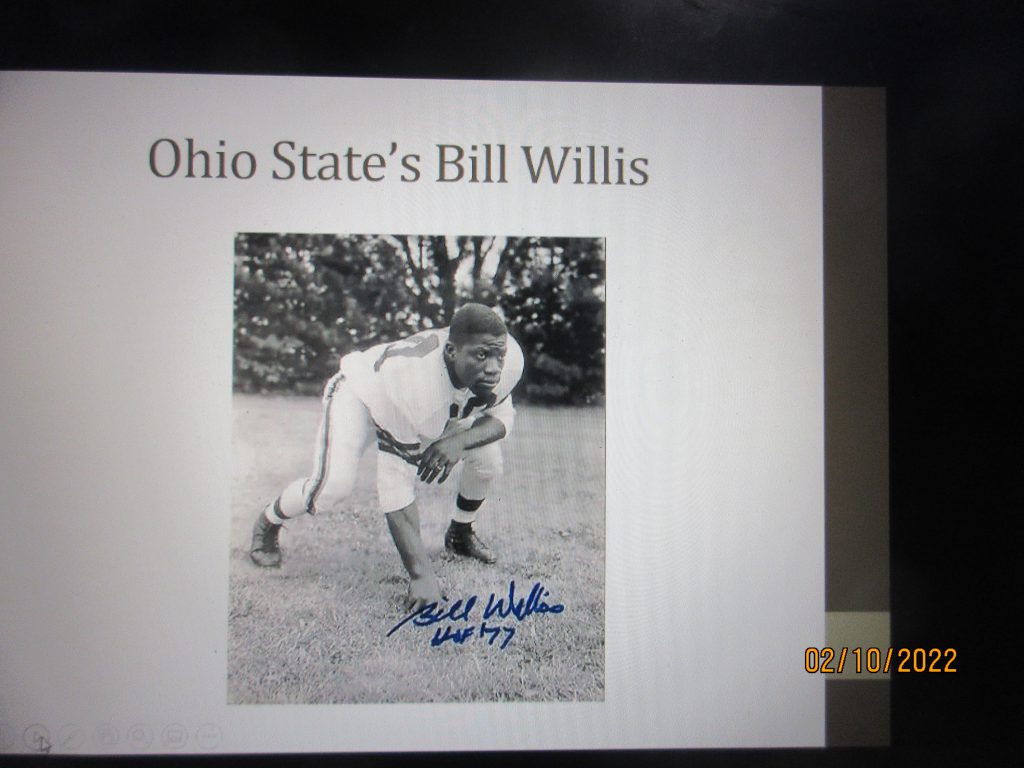
BILL WILLIS PLAYING ON OHIO STATE IN THE 40S—ONE OF THE TWO FIRST BLACKS TO PLAY PROFESSIONAL FOOTBALL THANKS TO PAUL BROWN. Marion Motley (below) the Fullback’s Fullback is the other.

WPCNR THE SUNDAY BAILEY. By John F. Bailey. February 13, 2022:

Do you know?

I didn’t until last week.

John Vorperian, host of White Plains TV’s Beyond the Game on Tuesdays and Fridays, shined a bright light last week  into a  rarely explained phenomenon : how Black football stars first came to play professional football.

This evening Eastern Standard Time, we will see America’s most watched television program all year.

Some 80 million people will watch the NFL Championship with probably three quarters of the players of color. (The league now, John told us Thursday evening via zoom in his presentation provided by the White Plains Public Library , is made up of 70% Black players.)

How it got to be that way was the fascinating topic of John’s talk.

I had heard of black players in the early 1950s when I was a kid, Marion Motley of the old Cleveland Browns, and of course the great Jim Brown of Syracuse and the Browns.

Jim Brown was the greatest running back I ever saw play when I watched the old Browns and the New York Giants play when the Giants were Giants from 1956 through 1963.

The Football Giants coached by Jim Lee Howell had a lot of black stars, Emlen Tunnel, Mel Triplett, Rosey Grier, Roosevelt Greer. I did not as an 11 year old know that this was only a recently introduced trend.

John Vorperian changed all that for me Thursday night with his one hour talk explaining how the World War II situation, and how one man, Paul Brown believed in an athlete’s ability not what the color of his skin was.

Mr. Vorperian highlighted how in the early 40s the NFL did not have any black players. He detailed how when college players who had served in World War II came back, and were eligible to enroll in colleges they played football, most notably at UCLA, Ohio State and  became standouts. One of them was Marion Motley below.

From The Pros by Robert Riger with Tex Maule.

Marion Motley was signed by Mr. Brown and brought to his upstart Cleveland Browns in the All-American Football Conference

Paul Brown, the Cleveland Browns Coach who was coach of Massillon High School where he became a legend for the successful teams he fielded, had allowed black athletes on his high school teams, unheard of at the time. 

Paul Brown went on to Ohio State where he also was successful. After coaching for the Navy Training Center team, he took a job as coach of the Cleveland team in the new All American Football Conference, a league set up to compete with the NFL. Coach Brown signed Bill Willis and Marion Motley whom he had coached at Ohio State to play for the Browns.

Mr. Willis and Mr. Motley were the first black players to play professional football.

Football players from UCLA were signed to play in the All American Conference. Paul Brown is credited as the coach who introduced black players to the NFL.

I never knew that.

According to Wikipedia, Paul Brown never looked at race or made predeterminations about players. He gave them a chance.

Brown judged on their ability to help his teams from Massillon to the Cincinnati Bengals who play in the SuperBowl this afternoon. Not dismissing them because they were black. How incredibly refreshing.

Paul Brown and the Cleveland Browns with the first black players to play in the NFL, winning the NFL Championship in 1950.

John Vorperian told the story of George Preston Marshall owner of the Washington Redskins who would not have a black player on his teams. Marshall was a disgrace to the NFL into the 1960s.

Vorperian has been a curator of the character and reality of sports the last two decades  week after week on his shows. He has been the irrepressible interviewer who asks questions players, coaches, sportswriters, authors love to answer and enlighten.

Beyond the Game  shines a sensitive light on the true reality of sports personalities, sports past and present. He is also a member of the Jackie Robinson Organization where he speaks on Jackie’s contributions to breaking the color line in baseball. John, in his professional career is nationally recognized for his work in promoting fair family court treatment of the less fortunate children and parents.

Last week’s program pointed how just as Branch Rickey the executive of the Brooklyn Dodgers and Jackie Robinson because they were brave, and just as Paul Brown in the case of Motley and Willis playing for him changed history, attitudes, and turned around two centuries of prejudice. Because they did a noble courageous, deed.

Vorperian’s talk which will be available soon via zoom recording I believe on the White Plains Library website  is must-see for you to get acquainted with how the NFL got Black quarterbacks, Black coaches (not as many as they should have), who inspire and perform despite the odds.

Posted in Uncategorized

Abraham Lincoln and His Legacy to American Public Administration

Posted on  by John Bailey

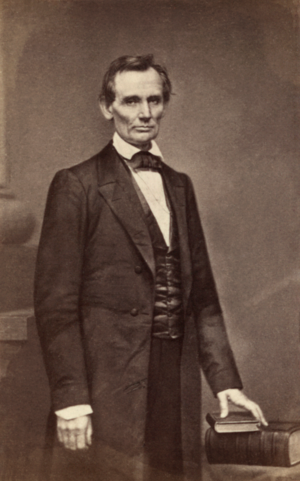
Abraham Lincoln 1860. By Matthew Brady

Editor’s Note: Stephen R. Rolandi, a frequent contributor to WPCNR.com and White Plains Week published this article in a recent issue of American Society for Public Administration. The views expressed are those of the author and do not necessarily reflect the views of ASPA as an organization. Republished here with permission of the author. (c) 2021, Stephen R. Rolandi

By Stephen R. Rolandi
February 8, 2021

This being the month of February, many of us celebrate Ground Hog Day (February 2nd), hoping that spring will soon arrive, as well as Chinese (Lunar) New Year, the Year of the Ox, on February 12th; and of course, Valentine’s Day on February 14th.  

If you are like me and historically inclined, you might also mark February 12th as the birthday of our 16th American President, Abraham Lincoln (1809-1865). I have had a long and continuous admiration for our 16th President. I have travelled to Springfield, Illinois to see Lincoln’s law office and home. Many years ago, my late parents gave me a half dollar coin issued by the United States Mint in 1918 to commemorate the 100th anniversary of Illinois’ admission to the Union.

This year marks the 212th anniversary of Lincoln’s birth, and I believe it is a fitting time not only to examine his career as the nation’s Chief Executive during the bloodiest war in American history, but also his contributions to public service and impact on American public administration.

Lincoln was not popular in his time; indeed, he was elected in 1860 in a four way race with only 39% of the popular vote. He won re-election in 1864 with the Confederate states that had left the Union in 1861 not participating in that election; and with the support of Union soldiers who voted in overwhelming numbers for him.

In addition to preserving the Federal Union during the Civil War, as well as his issuance of the Emancipation Proclamation, Lincoln had many accomplishments:

  • During his administration, the Federal departments of Agriculture and Veterans Affairs were begun, in an effort to assist farmers (the United States in the mid-19th century was to a large extent, an agricultural nation), as well as the nation’s veterans starting to return from the Civil War;
  • Recognizing the importance of education (Lincoln, you recall, had only about one year of formal education, and was largely self-taught and worked as an apprentice before becoming an attorney), the Morrill-Land Grant Act was signed into law to permit the establishment of land grant colleges to teach engineering, military tactics, science and other subjects;
  • Lincoln recognized that the increasing level of government services would require different funding streams, and during his administration, the Revenue Act of 1862 became law which also established the Office of the Commission of Internal Revenue within the Treasury Department—in time this would lead to the establishment of the progressive income tax system in the United States;
  • The first steps towards a national banking system and currency in the United States saw fruition with the passage of the National Banking Act of 1863;
  • He recognized the need to reform the Federal government civil service, and took the first steps in that direction with the 1863 evaluation of the French customs service which recommended competitive examinations. This led ultimately in 1883 with the passage of the Pendleton Act and establishment of the U.S. Civil Service Commission—today known as the Office of Personnel Management (OPM).

Taken together, along with other policy initiatives, many historians consider Lincoln’s Presidency to be the foundation of the modern administrative state.

Indeed, it was Leonard D. White who said that, “Administrative history was primarily the record of war and military government.” We can also see that many domestic and economic sector accomplishments occurred as an outgrowth of the war effort. Lincoln became a paradigm for future chief executives.

Perhaps for me his most important contribution was preserving the principles of constitutional government during a period of one of the gravest crises in American history. Lincoln was cognizant of relating his actions to the spirit and meaning of the Constitution.

There are many, many works about Abraham Lincoln’s life, career and Presidency. More books about some aspect of him continue to be published. Some of my favorite books about the career and Presidency of Abraham Lincoln that I would recommend are the following:

  • Lewis E. Lehrman, “Lincoln at Peoria: The Turning Point” (2008)
  • Daniel Farber, “Lincoln’s Constitution” (2003)
  • Harold Holzer, “Lincoln As I Knew Him” (1999)
  • Ted Widmer, “Lincoln On the Verge: Thirteen Days to Washington” (2020)
  • Doris Kearns Goodwin, “Team of Rivals: The Political Genius of Abraham Lincoln” (2005)

If I had to recommend a single book on Lincoln, it would probably be Doris Kearn’s work on Lincoln, how he won the Republican party Presidential nomination against more prominent contenders, and how he led his cabinet—consisting nearly of all the Presidential contenders he faced in 1860—during the Civil War. I should mention that Kearn’s work reportedly influenced Barack Obama when he assumed the Presidency in 2009.

Lincoln’s experience as a war time chief executive gives us many perspectives, not only on the role of the executive in decisionmaking as well as leadership, but also for his lasting contributions towards the institution of the American Presidency and constitutional government. He is, in my opinion, more relevant than ever today as we as a nation face the perfect storm of crises—the Covid-19 pandemic, a weakened national economy and a distinct threat to our democratic institutions and the rule of law.

 Happy Birthday, Mr. President!


Author: Stephen R. Rolandi “retired” in 2015 after serving with the State and City of New York. He holds BA and MPA degrees from New York University, and studied law at Brooklyn Law School. He teaches public finance and management as an Adjunct Professor of Public Administration at John Jay College of Criminal Justice (CUNY) and Pace University. Professor Rolandi is a Trustee of NECoPA; President-emeritus of ASPA’s New York Metropolitan Chapter and was Senior National Council Representative. He has also served on many other association boards in New York City, Westchester County (New York State) and Washington, DC. You can reach him at: [email protected] or [email protected] or at 914.536.5942.

Posted in Uncategorized