WPCNR WHITE PLAINS LAW JOURNAL. By Dan Seidel. October 27, 2022:
(Editor’s Note:) The Appellate Court 2nd Department in Brooklyn has upheld the legal binding of the 1925 covenant attached to the Ridgeway Country Club property in a decision issued Tuesday
Dan Seidel, in the statement below, the attorney who handled the Action 1 of the Appeal, which he and John Sheehan filed on the involving environmental issues on the property explains the impact of the decision to WPCNR this morning in this analysis:
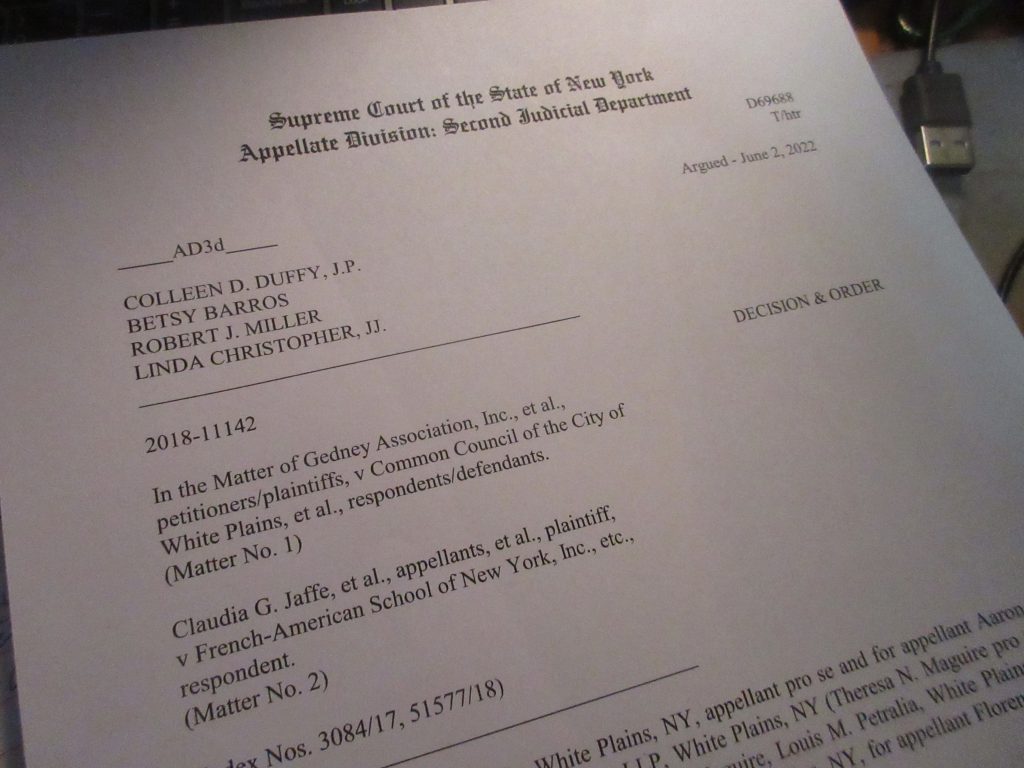
“Yesterday, the Appellate Division, 2nd Dept., published its decision in the “2nd part” of the Appeals filed against Judge Lefkowitz’s decision to allow FASNY to build its school on the old Ridgeway Country Club property.
There were 2 appeals: one by Gedney Association, John Sheehan and me. Dan Seidel, on SEQRA/Environmental/Common Council issues and a second (called “Action #2) contesting the school placement on the property due to a “deed restriction” in Gedney Farms deeds concerning “institutional use”.
When the Ridgeway property was sold in its entirety to Farrell Builders, without contingencies, the property zoned 3/4 acre single family use, as of right, Gedney Assoc, Sheehan and Seidel made a prompt decision to withdraw their appeal as their issues were now moot – it would be a waste of the Court’s time to read all the papers and hear the matter if the matter was moot.
If Action #1 was NOT withdrawn and the Court was made to read papers on moot issues, there was a very good chance Gedney, Sheehan and Seidel COULD be sanctioned and have to pay costs (statutory and printing) to FASNY.
The Action #2 Appeal was not withdrawn, was prosecuted and the decision published yesterday was issued on their arguments, the Appellate Court deciding that Judge Lefkowitz made the correct decision/conclusion, but should have afforded those plaintiffs in Action #2 a chance to prosecute a “declaratory judgment” on the definition of “institution” – again the Appellate Court deciding that a school could be considered legit under a vague and undefined deed restriction.
The Appellate Court decided against the plaintiffs in Action #2, Action #1 having already been withdrawn with no costs to be awarded to any party, and DID award costs AGAINST the plaintiffs in Action #2 (the deed restriction appeal) to be paid to the defendant FASNY. The Appellate Court “sent the case back to Supreme Court” for the assessment and awarding of costs to FASNY.
The costs of the Appellate printing could be in the tens of thousands of dollars – receipts for those costs must be produced to the Clerk of the Supreme Court, Judgments Section.
The plaintiffs in Action #2 can appeal that award of costs, but the same Appellate judges will be assigned THAT appeal (if filed) and may render a harsher decision on THAT appeal against those plaintiffs, IF an appeal is undertaken.
Bottom line is that White Plains won, kept the property development as “low impact environmentally sensitive grounds” and will get yearly property and school taxes from the McMansions to be built. The action against Judge Lefkowitz’s decision, I am assuming, is finally over.
This is my take on the decision.
The decision may be read at this link: https://www.nycourts.gov/courts/AD2/Handdowns/2022/Decisions/D69688.pdf
| WPCNR IMMIGRATION INTELLIGENCER. From the New York Immigration Coalition. October 27, 2022: Today, news broke that settlement talks for Ramos v. Nielsen have collapsed, leaving more than 250,000 people who currently have Temporary Protected Status (TPS) at risk of deportation. The New York Immigration Coalition decries this breakdown of negotiations, and demands that President Biden restore TPS for El Salvador, Honduras, Nepal, and Nicaragua, while also providing a pathway to citizenship. Murad Awawdeh, Executive Director, New York Immigration Coalition released this statement: “Today’s news that the settlement negotiations over TPS have collapsed is shocking and disturbing for people and families across our country. TPS has allowed people whose home countries continue to be at risk of violence or climate disaster to raise families, secure jobs, and build futures in the United States. The breakdown of these negotiations threatens to disrupt the lives of more than 250,000 people for no justifiable reason. As President Biden continues to stall on passing meaningful immigration reform, while supporting policy designed to appease conservative voters during midterm elections, he cruelly fails the millions of people he pledged to protect during his presidential campaign. In light of this devastating news, the Biden administration must immediately restore TPS for El Salvador, Honduras, Nepal, and Nicaragua. President Biden must also provide a pathway to citizenship for the 11 million people who call our country home but lack any permanent protections. We can no longer look to the courts for protection as they continually deny relief and relentlessly endanger the lives of immigrants and refugees.” |
We are seeing an uptick in RSV and the flu in the Northern Hemisphere and particularly in the United States. Given an anticipated uptick in COVID-19, the media is coining this the “triple threat.” Here is the current state of affairs and what it means for you.
RSV is a common virus that typically circulates during the fall, winter, and spring. Before the pandemic, everyone could count on being infected at least once before they reached the age of 2. Thereafter, people are typically infected multiple times throughout their lifetime.
Most people recover in a week or two, but it can be serious for two groups:
Overall, RSV is on the rise. As shown below, the percent positivity rate is above 10-15% in the U.S.—this means RSV is spreading faster than we can test for it and is causing an exponential growth in cases. However, we aren’t at record numbers yet. In fact, we are still below our very unusual 2021 summer surge. Almost all states are showing the same general trend.
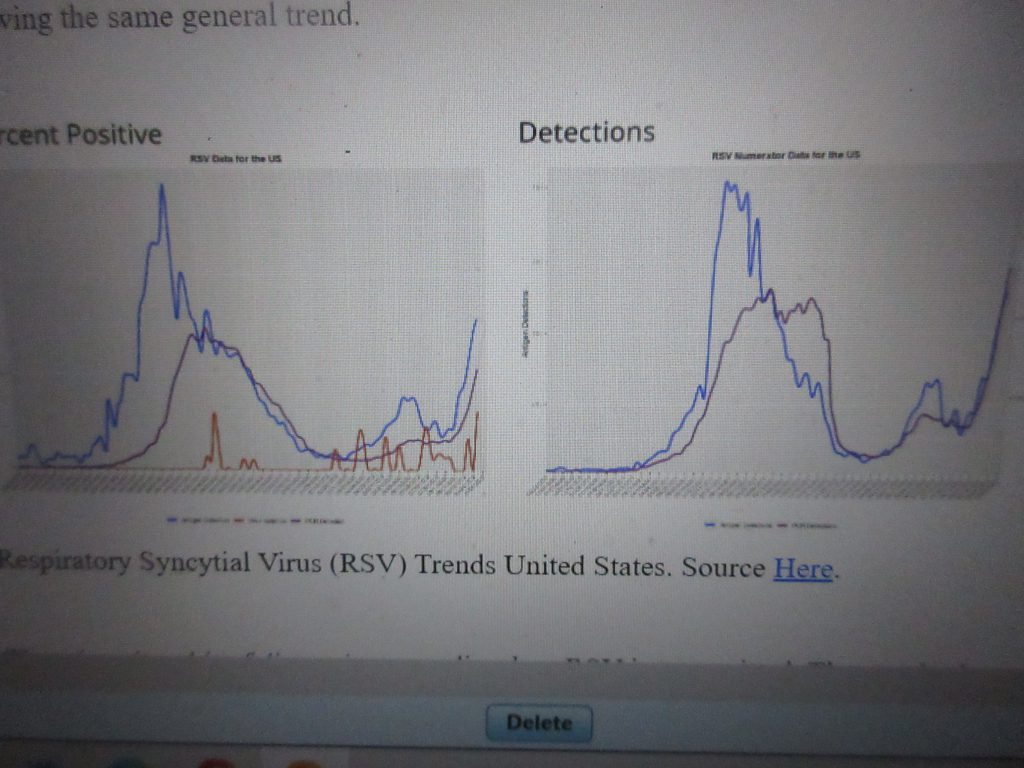
Respiratory Syncytial Virus (RSV) Trends United States. Source Here.
There is quite a bit of discussion regarding how RSV is transmitted. The standard precaution for healthcare workers is hand washing, hospital gowns, and gloves. (Notice masks are not recommended.) These precautions stemmed from older studies showing the main mode of RSV transmission is primarily through large particles in the eye or nose or directly touching contaminated surfaces. RSV does have small particles that travel far, but this doesn’t seem to be a main mode given this older research.
There is currently no vaccine for RSV. However, last week we received very good news from two manufacturers (GSK and Pfizer) that vaccines in development for adults were highly effective: 82% efficacy rate for GSK and 86% for Pfizer. We can’t expect a vaccine for this season, but maybe next year.
The official “flu season” started two weeks ago and case numbers are higher and earlier compared to the past two pandemic years and compared to before the pandemic. (See red triangles in the graph below.)
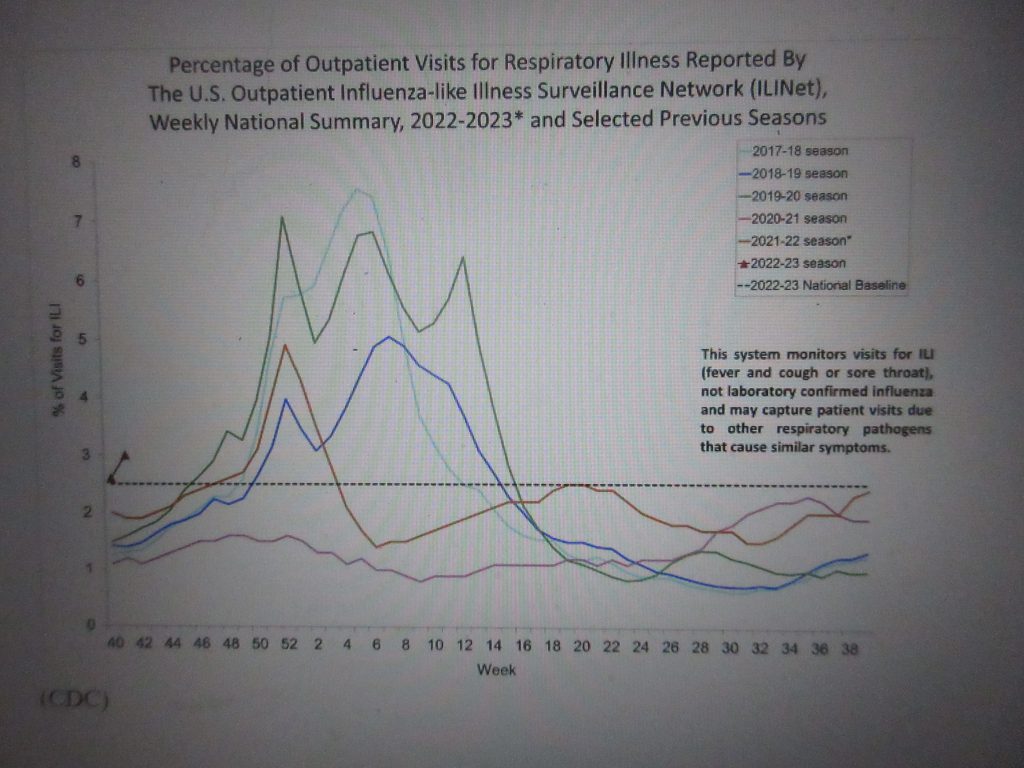
(CDC)
Flu rates are highest among 0-4 year olds, but cases in every age group are increasing. We are seeing regional trends with the flu, as the South has the most activity but East Coast states are starting to increase, too, particularly New York.
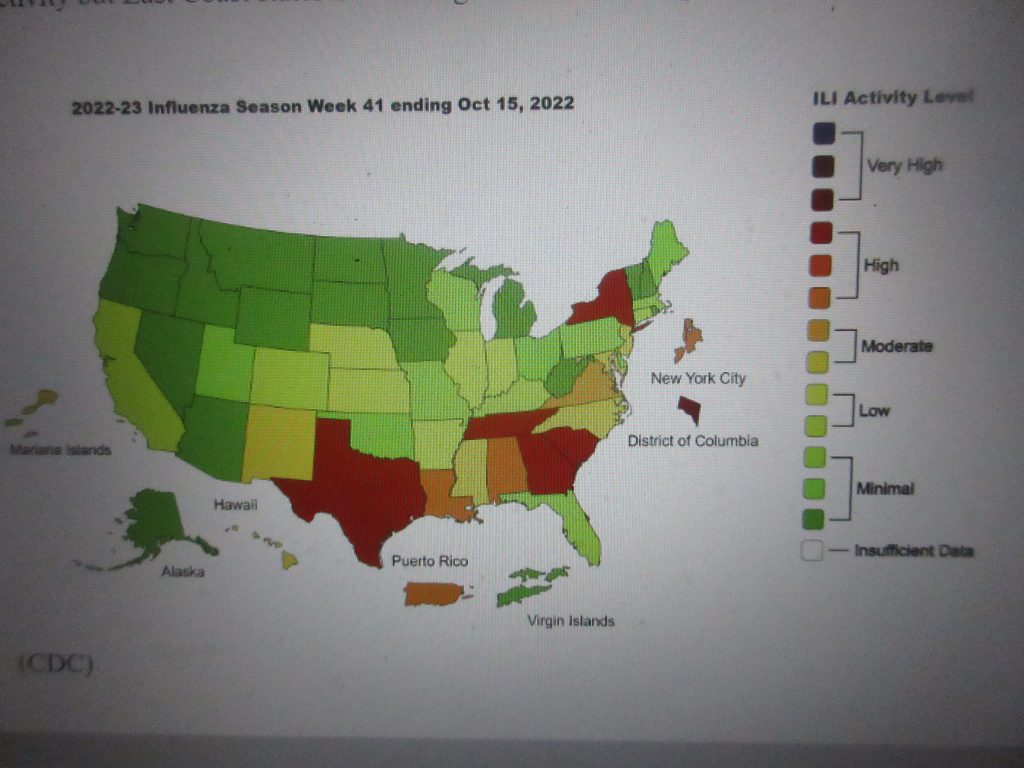
(CDC)
Flu viruses can be detected up to 5-7 days after becoming sick, but people are most contagious in the first 3-4 days after symptoms begin. Symptoms typically begin about 2 days (but can range from 1-4 days) after flu viruses infect a person’s respiratory tract. Some people can be infected with flu viruses and have no symptoms but still spread the virus.
There is a flu vaccine. We won’t know how well the flu vaccine works until next year (we collect real world data in real time), but lab data is indicating the vaccine is a good match this year. Unfortunately, flu vaccine uptake dropped during the pandemic.
Then there is COVID-19, which is calming down in Europe, even in Germany. We are also getting good news from Singapore, where the Omicron subvariant XBB took hold and caused an infection wave. Thankfully their XBB infection wave was smaller than the BA.5 wave. (We expected the opposite.)

In the U.S., wastewater is stalling, while the Omicron subvariants, and particularly BQ.1.1, take hold. BQ.1.1 has now grown to 16% of reported cases. We typically see a variant’s impact at around 50%, so we still have some time.
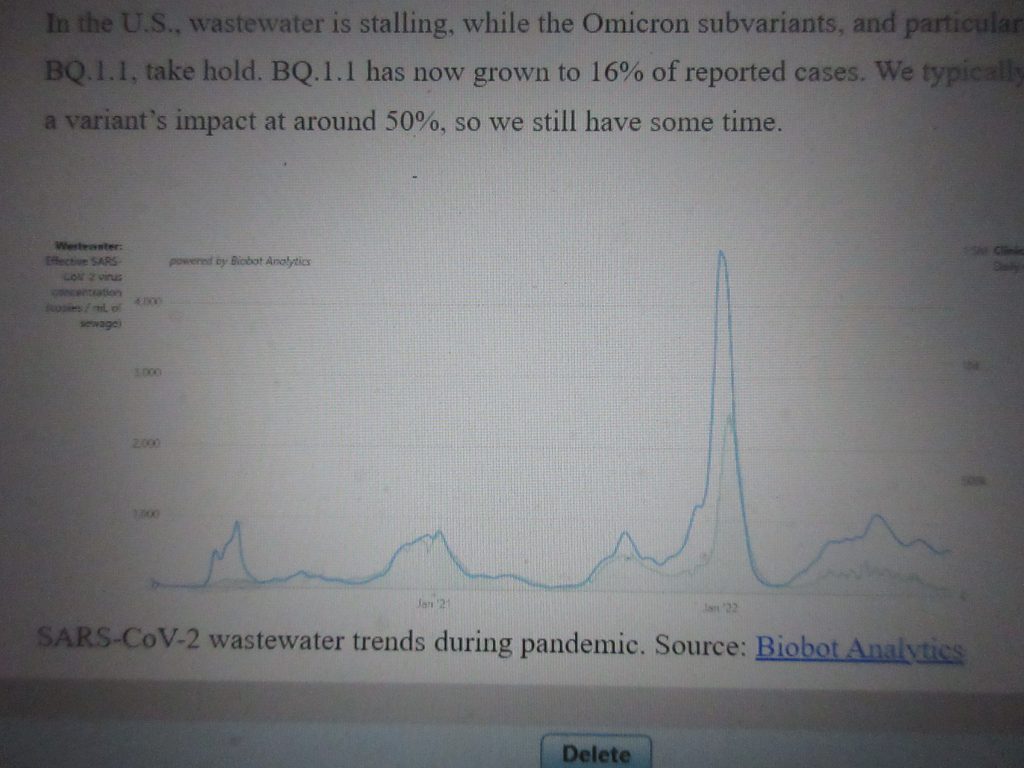
SARS-CoV-2 wastewater trends during pandemic. Source: Biobot Analytics
However, hospitalizations have started to rise for those over the age of 65, which is not a welcoming trend given that subvariants have yet to take over.
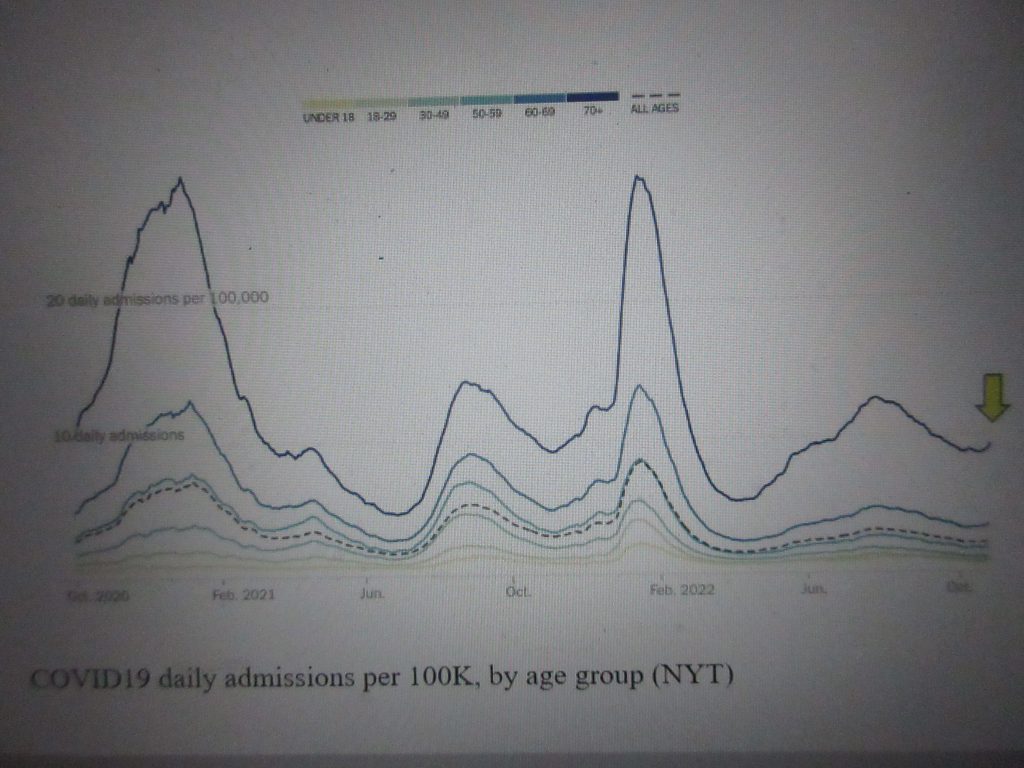
COVID19 daily admissions per 100K, by age group (NYT)
It’s becoming a petri dish out there. The triple threat specifically, though, isn’t in full throttle yet. This is clearly displayed in Chicago’s weekly surveillance report below where some viruses are rising but not all.
Respiratory Virus Laboratory Surveillance in Chicago
Will a triple threat come? This is one of the biggest debates among epidemiologists— the concept of whether we are witnessing virus-virus interaction. We know very little about how well viruses co-circulate with each other. For example, is flu spiking early because COVID-19 isn’t spiking yet? Maybe. Could RSV spike, then decline, then COVID-19 take over, then decline, then flu spike, and then decline? Maybe. Or, could they all spike at the same time? Maybe. We just don’t know what will happen, but a resurgence is expected.
This winter also depends on the strength of our healthcare system. The combination of our usual viruses co-circulating with COVID-19, burnt out healthcare workers, understaffed hospitals (in 2021, over 330,000 workers left healthcare), and staff being out for illnesses themselves, does not paint a pretty picture.
Lots of viruses are spreading right now and it’s a bit earlier than normal. We don’t have a triple threat yet, but I don’t think we want to see one, as I’m concerned for our healthcare systems. Do your part by getting vaccinated, staying at home while you’re sick, and other measures like washing hands, wearing a mask, and getting that airflow moving.