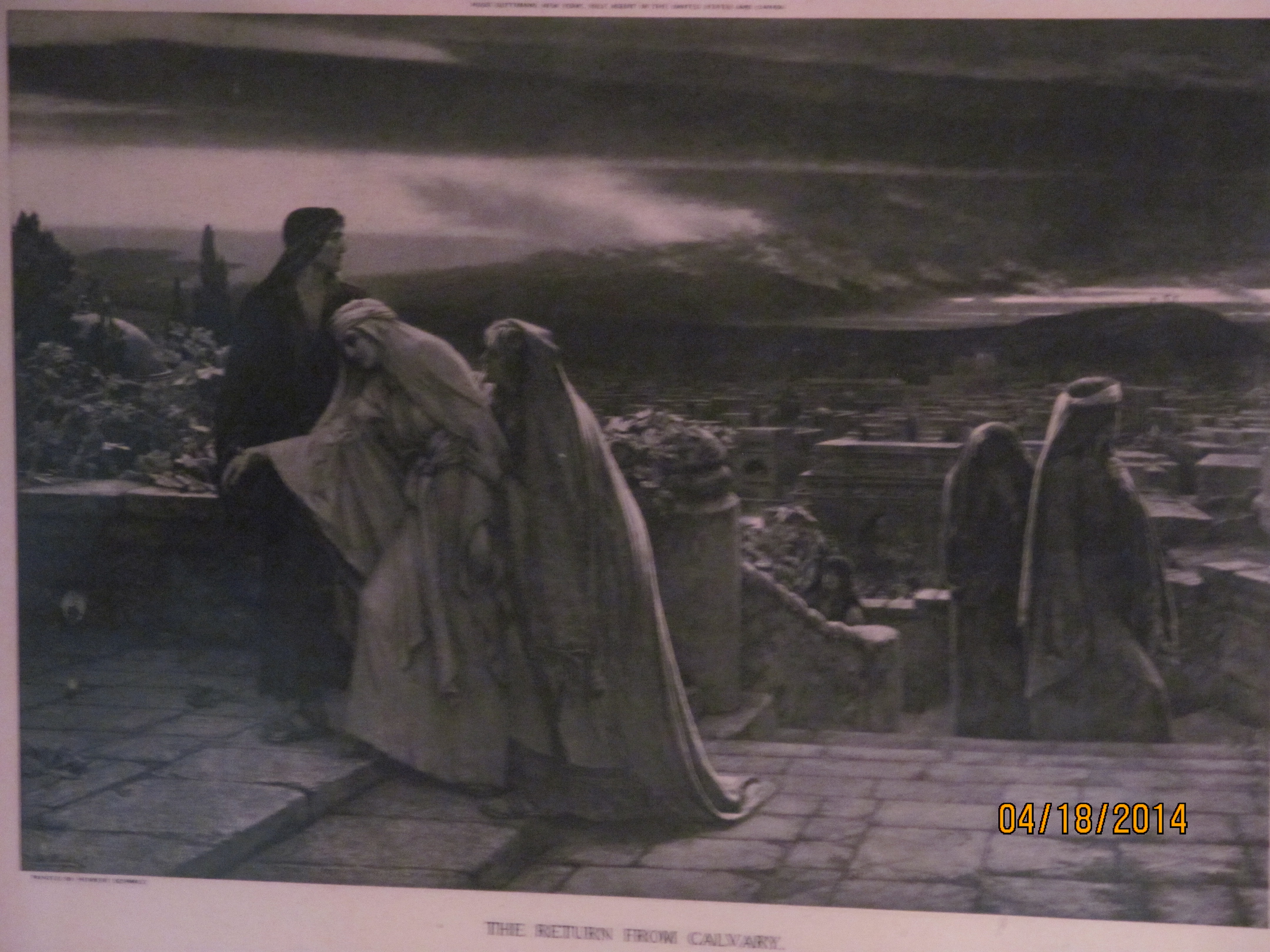
The Return from Calvary

Hits: 158

The Return from Calvary

2014418wallach 021

WPCNR NEWS & COMMENT. By John F. Bailey. April 14, 2017. Republished from WPCNR of the Distant Past.:

He died 2,000 years ago on a cross. There was no CNN, no internet, no newspapers,radio or television. No Twitter or Facebook. No Instagram,Skype, or Google.

Nevertheless the message of the man who died on Calvary (The Place of the Skull) spread around the world without mass communication.

His followers, twelve of them were so devoted to His message of love and code of behavior they became the first pacifist activists who spread a message the man they called their Lord had preached to them.

He was Jesus of Nazareth.  He had no last name.

Today He is now known all over the world for the message he delivered.

Whether you believe He is the Son of God, or not, He ranks as one of the foremost influences on mankind. More than Plato, more than Socrates, more than any leader or politician, or entertainer whoever lived.

His selfless acts of embracing lepers, the poor, those who sinned were unique.

Such compassion for the downtrodden was unheard of during the time He lived.

It was a time of slavery. No human rights. No care for the sick. When cities were razed and populations slaughtered or enslaved much like the genocides of today.

Jesus of Nazareth introduced a new philosophy that spread throughout the world after His death by crucifixation on this day (maybe, we do not know the exact date), because the community leaders of his own people thought him a threat to their power. And that fear that this simple man was a threat should be a lesson to us all.

If you live by His philosophy of forgiveness you are a person at peace with yourself. If you accept those who are different from you without  fear or prejudice, you are a force for spreading His message of peace towards others and good will.

If you help the poor and the sick because you sympathize with them, you are following His way.

If you stand up for truth, point out what is wrong as He did with the Pharisees. You are doing his will.

If you go about doing good for the sake of doing good, you are following His virtue of selflessness.

Jesus of Nazareth’s message whether divine or a code of how we conduct our lives resonated with millions and it spread.

There is no denying He is one of the great philosophers of the human experience, kin to Socrates, the other giant of antiquity thought.

The above print of “The Return from Calvary” painted by Herbert Schmalz shows the last hours of Jesus of Nazareth’s crucifixation around 33 A.D. on Calvary Hill, “the place of the Skull” outside of Jerusalem late in the day He was crucified.

The description on the print describes the somber scene:

The darkness which was on the earth (during His suffering) is clearing away.

One long, dark cloud is hanging over the city like a pall.

The Virgin Mother, weighted down by fatigue and grief, knowing not wither she goes, is being led up some steps, toward “his own” home, by St. John and Mary Magdalene.

In the distance on the top of Cavalry, you can make out the three crosses.

The grief so eloquently captured by this print depicts the very personal loss all of us endure when someone we love passes away, realizing our loss because of all they did for us.

Jesus of Nazareth was a human being who affects us to this day.

One of the great gifts of this man, Jesus of Nazareth, is the celebration of humanity and capacity to care and feel for others that aids persons whether they believe He was the Son of God or not. Or that you will have eternal life if you believe in him.

His philosophies of care, courage, compassion and benevolent action serve their practioners well because they leave a great personal satisfaction in the heart, the mind, and the spirit.

You do not have to second guess yourself, when you do what is right, humane, merciful, and serves the less fortunate without superiority with nothing to gain for yourself. And if you do not do what is right, if you weaken, you always regret it and remember when you failed to do right.

The peace of mind of action is the least of the  great gift of Jesus of Nazareth whose death on the cross is marked this day.

If you act as Jesus did, you will be remembered by all you meet fondly and lovingly, and be comforted that you will live in memories of those you have  touched with your love and kindness and caring  for eternity to the end of the age.

His simple teachings have great power. Use them. Implement them.

They give meaning to our mystery of life.

They give meaning and purpose to anyone’s life.

For 2,000 years they have made a violent world a better place.

Posted in Uncategorized

Sports Officials Rarely “Ref” More than 3 Years–Growing Problem for High School Sports

Hits: 92

WPCNR VIEW FROM THE UPPER DECK. By Tim Leighton From the National Association of High School Associations. April 12, 2017:

Long odds stare at an official before he or she even takes that first step onto a court, field or sheet of ice. New officials face a journey filled with criticism and angst that, ultimately, lead most to quickly and defiantly blow the final whistle on the avocation.

The rewards of officiating aren’t immediately realized in the face of sportsmanship issues that have created an exodus of officials that is at an alarming rate.

National surveys reveal an average of about only two out of every 10 officials return for their third year of officiating. The low return rate is paving the way to a nationwide shortage of officials that has high school administrators scrambling to cover games. It is also prompting high school associations across the country to formulate creative ways to retain the officials they have rostered.

“Year 3 is when we cross our fingers,” said Mark Uyl, an assistant director with the Michigan High School Athletic Association. “It is like the freshman year in college. It is a make-or-break kind of year. Every state association in the country is feeling the effects of an officials’ shortage. It is getting harder and harder, not only to recruit new officials, but to retain them for years to come. That is the challenge that confronts us.”

Solutions can’t come soon enough for Matt Percival, the activities director at Eastview High School in Apple Valley, Minnesota, in suburban Minneapolis-St. Paul. With game-time looming, it is common for Percival to be scrambling, moving quickly to fill officiating vacancies, primarily at the sub-varsity levels.

Percival said moving games to different days of the week has been implemented, and this travel may continue to ensure that games will be staffed with officials.

“The problem isn’t new,” he said. “It’s gotten progressively worse over the years. One of the most stressful things for an AD is when officials aren’t assigned or don’t show up. When that happens, no one benefits.”

Programs to combat the challenges of recruiting and retaining officials are popping up throughout the country by state associations.

The Minnesota State High School League (MSHSL) has offered discounted registration fees to new officials, as well as reduced rates when they return for their second and third seasons of officiating. In 2015, the MSHSL launched a “Thank A Ref” campaign encouraging its member schools to show support for officials.

Schools responded with public-address announcements during games, news releases to newspapers and on-court recognitions. Establishing and strengthening existing mentorship programs with Minnesota officials’ associations is ongoing.

The MHSAA website is dotted with photos of officials posing with mentees and sharing their purpose statements.

The South Dakota High School Activities Association advertises the need for officials with a classified adstype section on its website, identifying games that need officials.

“We are losing officials because of sportsmanship issues from participants, coaches and fans,” said Pete Vrieze, commissioner of the Middle Border Conference in northwestern Wisconsin. “We certainly lose officials to other things as well, but for the most part, on-court issues are driving newer and younger officials away. They say ‘the heck with it’ and aren’t interested in spending their free time in oftentimes volatile situations.”

Veteran officials and officiating administrators agree that establishing strong mentorship programs are vital to helping new and younger officials cope with negative on-court situations. Those relationships
help provide stability to a new or younger official and provide a sounding board to help get through troublesome times.

“When things go south for an official, you’ve got to have that sounding board, someone that knows and understands what they are going through,” Uyl said. “The biggest thing you do as a mentor is listen and then reinforce all of the positives of officiating. Ninety- to 95-percent of the officiating avocation is a great, great thing.”

Vrieze oversees the mentorship program as the director of basketball operations for the Minneapolis Officials Association, a pioneer organization in Minnesota that for decades has provided football and basketball officials for the MSHSL.

“As officials, if we don’t get a pat on the back once in awhile, it can be a discouraging thing,” Vrieze said. “We need mentors with passion, someone that wants to help others. We aren’t interested in veteran officials that are worried about losing their assignments to new and younger officials. We need officials to have the mentality that I need to train officials not to replace me, but to work with me.”

Not advancing through the officiating ranks quickly enough is also contributing to the avocation’s struggles to maintain a strong roster of officials.

“We are in the ‘I’ generation and them asking why I wasn’t there yesterday,” said Harry Kitts, a retired Minnesota educator who officiated and was an assignor for more than four decades.

Kitts officiated for four years in Iowa before beginning his officiating journey in Minnesota in the 1969-70 school year. Most of the officials in that era were educators who would work games following the school day. If officials weren’t available, coaches would be recruited to work games.

Working a doubleheader was commonplace, too. There was no such thing as just a varsity assignment as is the case now. If you were a varsity-caliber official, you were also required to work the B-squad game prior. Kitts said officials accepted all and any assignments given to them, unlike today when officials present specific criteria of the games they will work to their assignor.

Despite his experience in Iowa, Kitts was not assigned a varsity game in his first season in Minnesota. His first varsity game would not come until his second season. He credits working with a veteran official who gave him his chance to show his skills. Kitts would move on to work 20 MSHSL state tournaments.

“Officials are too anxious these days to sprint right to the top and to do a state championship game right away,” Kitts said. “Officials need training. They must learn and work their way up, just like anything else. When officials don’t feel like they are climbing the ladder quickly enough, they often quit out of frustration.”

State association administrators remain focused and diligent that the campaigns to recruit and retain officials will be a success.

“Our success and experience in officiating give us the confidence moving forward,” Uyl said.

Posted in Uncategorized

STATE INCREASES WHITE PLAINS SCHOOL DISTRICT AID $328,176 TO $24.984,900. Will Fund expenditures approved for use of State Aid

Hits: 73

WPCNR SCHOOL DAYS. From the New York State Assembly. April 12, 2017 UPDATED April 19, 2017:

The state of New York released its final 2017-18 School Aid totals per School District Tuesday, and White Plains Public Schools  share is going up 1.7% to $24,984,900, its highest aid ever.

Acting Superintendent of Schools told WPCNR the $328,176 increase would not be assigned to any specific expenditure but would be used to supplement funding of any increases in state aid approved specific expenditures.


Posted in Uncategorized

PHOTOGRAPHS OF THE DAY: THE DAFS ARE BACK!

Hits: 118

WP_20170410_17_07_29_Pro

We’re back! The Daffodils opened up on Monday in White Plains, New York, USA.


WP_20170410_17_07_57_Pro

Not to be outdone, the Grape Hyacinths smugly followed the Dafs’ debut

WP_20170411_17_57_50_Pro

Being told  “Come on out, the weather is fine,” the rest of the Dafs came on out Tuesday


WP_20170410_17_13_05_Pro

Which meant it was warm enough to get out the lawn furniture and pour a long tool cool, heady brew

Posted in Uncategorized

White Plains Historical Society Gala To Honor Christine Roithmayr as “Citizen Extraordinaire” May 4

Hits: 99

WPCNR MILESTONES. From the White Plains Historical Society. April 11. 2017:

The White Plains Historical Society at its Annual Dinner will honor Christine Roithmayr as the Society’s 2017 “Citizen Extraordinaire” Thursday May 4th 6:00pm-9:00pm at the Woman’s Club of White Plains, C.V. Rich Mansion, 305 Ridgeway.

New York State Assemblyman David Buchwald will introduce Ms. Roithmayr at the award ceremony.

Ms. Roithmayr is being acknowledged for her outstanding work for the March of Dimes Birth Defects Foundation, as well as her charitable work as President of the Woman’s Club of White Plains Foundation, her leadership of the ‘100 Acts of Kindness’ volunteer projects and many other contributions in support of our White Plains community.

“We’re glad to have this opportunity to recognize Ms. Roithmayr who has devoted a lifetime of positive, unselfish giving to our entire community and greater area,” said White Plains Historical Society president John Vorperian.

The event will also have a multi-media presentation “Theodore and Franklin, New York’s Royal Family – the Roosevelts” by St. John’s University Professor Howard Ehrlich.  A past Director of the Theodore Roosevelt Association, Professor Ehrlich has been directly involved with Sagamore Hill, the historic Long Island home of Theodore Roosevelt.

Catering will be provided by Caperberry Events of White Plains.  Tickets to the Historical Society’s Annual Dinner may be purchased online at www.whiteplainshistory.org.

Posted in Uncategorized

Salvation Army Honors Giants’ Harry Carson and Barbara Vrooman in 125TH Anniversary Gala April 20 at The Crowne

Hits: 126

WPCNR WEST SIDE STORY. From The Salvation Army. April 10, 2017:

The Salvation Army White Plains Corp is holding its 125th anniversary Gala Thursday , April 20, 2017, 6:30PM to 9:00PM at the White Plains Crowne Plaza Hotel, 66 Hale Avenue, White Plain s, NY.

This year’s honorees are NY Giant Legend and Pro Football Hall of Farner Harry Carson and Local Community  Volunteer  Barbara Vrooman.

The Corps’ Inaugural Gala titled “Remembering Our Past,  Reshaping  Our  Future” celebrates  the Salvation Army  White Plains’  storied  history  and current  commitment  of assistance to all of the City’s residents and  Public Safety  Personnel.  In that spirit,  the Corp selected to highlight and commemorate these two worthy individuals Harry Carson and Barbara Vrooman  for their own noted charitable  activities  and energetic actions in aiding others.

Gala tickets are $125.00 per person. A special limited edition keepsake journal is being prepared for this monumental event with listings beginning at $25.00. There will also be a silent auction  that evening.


-END-


Posted in Uncategorized

High Sales, Sharp Decline in Number of Properties on Market, Sluggish Prices Mark 4-County Real Estate Performance in 20017 First Quarter

Hits: 86

WPCNR REALTY GO ROUND. From the Hudson Gateway Association of Realtors. April 10, 2017:

Westchester County with a high number of homes for sale,  posted a  7.1% increase in sales of single family houses, the dominant housing type in the four-county region.

Rockland County increased most in sales, 29.3% more from 1st quarter, 2015, among the four counties. Its best performing large-volume sectors were single family houses, 23.7%, and  condominiums, 37.2%.

Orange County followed second with an overall 11.6% increase, and Westchester followed third with 4.4%. Putnam County posted a 2.0% decline in home sales in the first quarter.

High sales rates, a sharp decline in inventory, and an uneven pattern of price increases across the region marked 2017’s first quarter entry to the real estate market recovery of    the past five years.

Realtors participating in the Hudson Gateway Multiple Listing Service, Inc. (HGMLS), a subsidiary      of the Hudson Gateway Association of Realtors, Inc. (HGAR), reported  a  grand  total  of  3,700  closed transactions in the four-county region during the  first  three  months  of  2017,  a  9.1%  increase or 309 units more than last year’s first quarter results.

The closings largely resulted from sales and market activity during the winter months of 2016 and early 2017, and comprised single-family  houses,  condominiums, cooperatives, and 2-4 family houses.

HGMLS has been observing the shrinking inventory situation with a watch as to whether or when the diminishing stock in the region will create pressure for price increases.

The four-county end-of-quarter inventory has shrunk by 20.3% from 2016 to 2017, and no individual county posted less than a 20% decrease, yet the effect on prices has been mixed.

Westchester, for example, posted a 5.3% increase in its first-quarter single family median1 sale price, from $569,950 in 2016 back to $600,000 in 2017,  but that is where it had been in 2014 and 2015. The mean sale price has fluctuated between $769,000 and $849,000 for the same period, but there is no clear trend line for price increases as yet.

Rockland County achieved a significant 6.5% increase in the median sale price of its single-family houses,  which  was   posted   at   $425,000   for   the  first  quarter.   Rockland  also  fared  well  with its condominium  sector, achieving a 10.7% increase in the median to $217,500.   Orange County    also appears to have shed excess inventory and posted a 7.0% increase in the median sale price of a single-family house, to $230,000. Putnam Country, having the smallest volume market of the regional foursome and subject to wide statistical swings as a result, posted a first quarter median     sale  price of a single-family house at $295,000, just a slight 1.7% decrease from last year.

 Not too much has changed since last year with respect to key factors affecting the local, state and national real estate markets. In Westchester, in particular, the unemployment rate remains quite low and much new job-creating investment is expected in the coming months. The Dow and other equity markets have been setting records in recent months. Mortgage interest rates have remained at record lows. The Federal Reserve is signaling a measured pace for any future increases in rates. Perhaps  the only truly dark cloud on the horizon is the prospect of an overhaul of the nation’s tax code which could severely injure the housing market — or maybe help it? Either way, that won’t happen until much later in the year.

Otherwise, the HGAR real estate market is in excellent shape for continued high sales volume with manageable price increases in some sectors.

Posted in Uncategorized

GOVERNOR CUOMO ON HIS STATE BUDGET AS SENATE PASSES BUDGET

Hits: 114

WPCNR ALBANY ROUNDS. From Governor Cuomo’s Press Office. April 10, 2017:

We’ve embraced the politics of unity  

These have been trying times for our state and nation. One of the lessons that could be taken from the 2016 election is that our values are all being questioned, blamed and attacked. In recent months, we’ve seen a surge in bias-motivated threats, harassment and acts of violence.

We heard the argument that the success of the middle class is being directly impeded by our policies of diversity and inclusion. We have seen the federal government attempt and fail to take a wrecking ball to our health care system, and attempt and fail to create a religious test for immigration. Soon, Congress will start scrambling to cut taxes for the few at the expense of everyone else.

In New York, we say no. We have rejected the politics of division and are forging our own path. With our agreement on a $153 billion budget for 2017, New York State has issued a bold and optimistic statement of our values. We are saying without equivocation: New York is moving forward. This budget agreement invests in our middle class, cuts taxes for working families, strengthens our economy and expands opportunity for all. And it does so even while keeping the rate of spending at an all-time low — held to 2% for the past seven years.

In a response to the most intense period of domestic turbulence in half a century, and with the middle class feeling increasingly ignored and frustrated, our budget makes clear that progressive beliefs, far from being impediments to the middle class, are in fact the foundation upon which the middle class was built in the first place, and on which it will grow stronger.

New York state senate passes $153.1B budget nine days late

With this budget, New York becomes the first state in the nation to provide tuition-free college at our excellent public universities for families making up to $125,000 per year. Nearly 80% of New York families qualify for the program. New York is well-positioned to benefit from the industries of tomorrow, and this budget ensures that our young people will have a full and equal opportunity to compete for high-paying jobs, without having to incur a mountain of debt in the process. To further emphasize the significance of education, the budget also increases access to electronic books to further cut college expenses.

And we are also making record investments in educational outcomes all across the state. With increases of $386.8 million in New York City and $1.1 billion statewide, New York State’s total educational investment amounts to $25.8 billion, the most in history, ensuring that our children and teenagers are provided with every opportunity to succeed.

The budget includes other significant advancements. For too long, the soaring price of prescription drugs has prevented our most vulnerable from accessing the lifesaving treatment they need. Not anymore. We are capping the price of prescription drug spending in Medicaid to ensure equal access for all.

This budget advances the pursuit of social justice. Draconian punishments for youthful offenders have ruined countless lives, so we are finally raising the age of criminal responsibility to 18 and stopping young people from being jailed on Rikers Island after Oct. 1, 2018. The budget also commits $10 million to the nation-leading Liberty Defense Project, which will provide free legal assistance to immigrants, regardless of their citizenship status, and enforces our anti-discrimination and hate-crimes laws in every instance of prejudice through the newly established $1 million Hate Crimes Task Force.

Building on the state’s historic $100 billion infrastructure program, this budget also advances world-class projects, including the new LaGuardia Airport already underway, a completely transformed Penn Station, the long-awaited Bruckner-Sheridan Interchange and the Kosciusko Bridge. Today, we are not just planning what we will need in the 21st century, we are building it. And by continuing to strengthen organized labor by allowing members to deduct dues from their taxes, we are ensuring that while these workers are building the new New York, they will continue to sustain our middle class.

There is no doubt that challenges lie ahead, especially with an ultra-conservative Congress committed to policies that will hurt the middle class and the most vulnerable among us. In keeping with our duty to be responsible, this budget has incorporated enough flexibility to allow for as-yet-unknown federal policies, and to protect New Yorkers’ rights.

Never has New York achieved more, built more or produced more impactful legislation. Guided by our shared belief in a better tomorrow, we will continue working until the bright light of opportunity shines on everyone. During these times of anxiety and uncertainty, New York will continue 

Posted in Uncategorized

State Reaches Budget Agreement: UBER/LYFT APPROVED UPSTATE BUT TIGHTLY REGULATED; FREE TUITION; EXTENSION OF MILLIONAIRE TAX STAYS; TAX CUTS FOR MIDDLE CLASS

Hits: 99

WPCNR ALBANY ROUNDS. From the Governor’s Office. (EDITED) April 8, 2017:

Governor Andrew M. Cuomo, Senate Majority Leader John Flanagan, Senate Independent Democratic Conference Leader Jeffrey Klein, and Assembly Speaker Carl Heastie today announced an agreement on the FY 2018 State Budget. The agreement continues the state’s record of fiscal responsibility, holding spending growth to 2 percent while reducing taxes, making investments in education, enacting comprehensive criminal justice reforms, creating good-paying jobs, and rebuilding New York’s infrastructure.  

About the FY 2018 Budget

  • State Operating Funds spending is $98.1 billion in FY 2018 – an increase of 2 percent. (State Operating Funds exclude Federal funds and capital).
  • All Funds spending is $153.1 billion for FY 2018.
  • Increases Education Aid by $1.1 billion, including a $700 million increase in Foundation Aid, bringing the new Education Aid total to $25.8 billion or an increase of 4.4 percent.
  • Increases Medicaid State share funding to $23.5 billion.
  • Extends tax rate on millionaires – 45,000 taxpayers impacted, 50 percent non-residents, preserving as $3.4 billion in revenue next year.
  • Begins Middle Class Tax Cut – saving taxpayers $250 on average next year, and 6 million New Yorkers $700 annually when fully effective.
     

Statement from Governor Andrew M. Cuomo:

“With this Budget, New York is once again showing what responsible government can achieve. The result is a Budget that advances the core progressive principles that built New York: investing in the middle class, strengthening the economy and creating opportunity for all.  

“This Budget enacts the Middle Class Recovery Act to continue the Empire State’s upward trajectory and creates a path forward for those striving to get ahead. By making college at our world-class public universities tuition-free, we have established a national model for access to higher education, and achieved another New York first.

“For too long, draconian punishments for youthful mistakes have ruined the lives of countless young New Yorkers. By coming together, we reversed this injustice and raised the age of criminal responsibility once and for all so that 16- and 17-year-olds are no longer automatically processed as adults.

“This Budget continues the progress we have achieved to improve the lives of New Yorkers, and build a stronger, better Empire State that truly lives up to its motto: Excelsior.”
 

Reducing Taxes to Record Lows for Middle-Class New Yorkers

The Budget continues to lower Personal Income Tax rates for middle-class New Yorkers. With the middle class tax cuts of 2012, rates were lowered from 6.85 percent to 6.45 percent for taxpayers in the $40,000-$150,000 income bracket, and to 6.65 percent in the $150,000-$300,000 income bracket. Under these new reforms, the rate will drop even further this year and will continue to drop all the way to 5.5 percent and 6 percent, respectively, when the cuts are fully phased in.

These new lower tax rates will save middle class New Yorkers nearly $6.6 billion in just the first four years, with annual savings reaching $4.2 billion by 2025. As the new rates phase in, they will be the state’s lowest middle class tax rates in more than 70 years. When the tax cuts begin, they will benefit 4.4 million filers, growing to 6 million filers when fully phased in.

Investing Record $25.8 Billion in Education

The FY 2018 Budget continues the progress made to strengthen educational outcomes and increase access to high-quality learning across New York State. It increases Education Aid by $1.1 billion, including a $700 million increase in Foundation Aid, bringing the new Education Aid total to $25.8 billion or an increase of 4.4 percent. Under Governor Cuomo, education aid has increased by $6.2 billion, or 32 percent, over six years.

Establishing the First-in-the-Nation Excelsior Scholarship Program to Provide Tuition-Free College for Families Making up to $125,000 & Investing in E-Books

The Budget enacts the Governor’s landmark Excelsior Scholarship program to make college affordable at SUNY and CUNY two- and four-year colleges for working- and middle-class families. The program provides free tuition to families making up to $125,000 per year, and nearly 940,000 New York families are eligible for the program.
 
The new initiative will be phased in over three years, beginning for New Yorkers making up to $100,000 annually in the fall of 2017, increasing to $110,000 in 2018, and reaching $125,000 in 2019. The Excelsior Scholarship is a ‘last mile’ program, which extends the state’s existing generous aid programs, including the nearly $1 billion Tuition Assistance Program and any applicable federal grants, and fills in any remaining gaps to cover the full cost of tuition.
 
New Yorkers must be enrolled in college full-time, averaging 30 credits per year and completing their degree on-time. The program includes built in flexibility, allowing students to pause and restart the program, due to a hardship, or take fewer credits one semester than another. Students must also maintain a grade point average necessary for the successful completion of their coursework. Under the program, New Yorkers will be required to live and work in-state for the number of years they received the Excelsior Scholarship. The Budget also includes a generous Maintenance of Effort to assist in meeting the operational needs of SUNY and CUNY.
 
As the cost of textbooks can be prohibitively expensive, the Budget also invests $8 million to provide open educational resources, including electronic-books, to students at SUNY and CUNY. At the state’s direction, SUNY and CUNY will use this funding to target high-enrollment courses, including general education, to maximize student savings.  
 
Under the FY 2018 Budget, a new Enhanced Tuition Award will also enable students attending private not-for-profit colleges to receive financial assistance to complete their college degree. The program provides a maximum award of $3,000, requires private colleges to provide a match and freeze student tuition for the duration of the award – maximizing the financial benefit to the student. The Enacted Budget includes $19 million for the program.
 
Enhancing the Middle Class Child Care Tax Credit

The Budget enacts an enhanced middle class child care tax credit that will help more than 200,000 middle-class families make their child care more affordable. The new tax credit would supplement the current New York State Child and Dependent Care Tax Credit and more than double the benefit for families earning between $60,000 and $150,000, bringing the total credit from $169 to $376 per household on average.

Protecting New Yorkers from the Soaring Cost of Prescription Drugs

Under the FY 2018 Budget, New York is the first state in the nation to cap the growth of prescription drug spending in its Medicaid program, which has grown 25 percent over the past three years. The agreement provides the Department of Health with a range of tools to lower the cost of prescription drugs, including the ability to drive down the cost of certain drugs whose price is high relative to its therapeutic benefits. This unprecedented agreement enables the Medicaid program to allocate more resources for other essential health services and ensures high-quality care across New York State.  

Combating the Opioid Epidemic

In 2016, the Governor signed into law a comprehensive plan to combat the heroin and opioid epidemic in New York State. The FY 2018 Budget builds on this progress by investing over $200 million to support prevention, treatment and recovery programs targeted toward chemical dependency, residential service opportunities, and public awareness and education activities.

Raising the Age of Criminal Responsibility

The FY 2018 State Budget raises the age of criminal responsibility to 18-years-old and ensures that young people who commit non-violent crimes receive the intervention and evidence-based treatment they need. New York was previously one of only two states in the nation that automatically processed all 16- and 17-year-olds as adults in the criminal justice system, no matter their offense.

The new measures will be phased in over time, raising the age of juvenile delinquency from age 16- to 17-years-old beginning on October 1, 2018, and subsequently raising the age of criminal responsibility to 18-years-old on October 1, 2019.

Further, young people will no longer be permitted to be housed in adult facilities or jails. Young people under the age of eighteen will no longer be placed or held at Rikers Island in New York City no later than October 1, 2018. They are to be placed in specialized juvenile detention facility certified by the New York City Administration for Children’s Services and the State’s Office of Children and Family Services, and in conjunction with the State’s Commission of Correction and the New York City Department of Corrections.

The state will also create a Raise the Age implementation task force, with committee members designated by the Governor. Additionally, individuals who have been crime free for ten years after serving a sentence will be able to apply for the sealing of previous criminal convictions.

Delivering $2.5 Billion in Funding to Combat Homelessness and Increase Access to Affordable Housing

The FY 2018 Budget continues funding for the state’s $20 billion comprehensive, five-year plan for affordable and supportive housing to ensure New Yorkers who are homeless or at risk of homelessness have safe and secure housing. The Budget includes $2.5 billion in funding to advance the creation of 100,000 new affordable and 6,000 supportive housing units.

Enacting “Affordable New York” Housing Program

Under the FY 2018 Budget, developers of new residential projects with 300 units or more in certain areas of Manhattan, Brooklyn and Queens will be eligible for a full property tax abatement for 35 years if the project creates a specific number of affordable rental units and meets newly established minimum construction wage requirements. The units must remain affordable for 40 years. For all other affordable developments in New York City, the period of affordability and abatement eligibility would be tied to the number of affordable units. This new program will create an estimated 2,500 new units of affordable housing per year.

Cutting Property Taxes and Costs of Local Government

The FY 2018 Budget continues the Governor’s efforts to relieve the property tax burden and builds on the success of the 2 percent property tax cap. The typical New York homeowner pays 2.5 times more in local property taxes than in state income taxes. The Budget will empower citizens to control the cost of local government by requiring counties to assemble local governments to find efficiencies for real, recurring taxpayer savings. To ensure transparency and an active role for citizens in reducing their tax burden, public hearings and comment periods will be required as part of the development of the shared services plans.

Extending Hurrell-Harring Settlement Reforms for Indigent Defendants across New York

The provision of quality criminal defense by the government to individuals who cannot otherwise afford counsel is of paramount importance, as the United States Supreme Court ruled in Gideon v. Wainwright. In 2014, the State successfully negotiated an agreement in Hurrell-Harring et al. v. State of New York et al., a lawsuit filed against the state and five counties based upon an alleged failure to provide the necessary level of indigent defense services in those counties, to bring true reform to public defense systems that were failing.  
 
To ensure fair and equal representation for all accused individuals, the FY 2018 Budget includes resources to develop the framework through which the state will fund one hundred percent of the costs necessary to extend the reforms provided for in the Hurrell-Harring settlement to all 62 counties in New York.

Providing Budget Flexibility to React to Potential Loss of Federal Aid

Given the looming threats from Washington, the FY 2018 Budget provides flexibility for the state to adjust spending during the fiscal year to account for a significant loss of federal aid. If federal support is reduced by $850 million or more, the New York State Director of the Budget will develop a plan to make uniform spending reductions. This plan would take effect automatically unless the legislature passes their own plan within 90 days.

Delivering Ride Sharing Across New York
    
The FY 2018 Budget authorizes Transportation Network Companies (TNC), such as Lyft and Uber, to operate across New York and creates uniform licensing standards. The Department of Motor Vehicles will have broad oversight of rideshare companies and will ensure compliance with all laws, rules, and regulations required as part of a TNC’s operational license.

TNC companies will be required to maintain minimum insurance coverage levels of $1.25 million while a TNC driver is traveling to pick up a passenger and until the drop-off is completed. The state will also establish minimum standards to ensure passenger safety, including mandatory background checks, ongoing monitoring for traffic safety, anti-discrimination protections, and zero-tolerance drug and alcohol policies.

The Budget also establishes a statewide task force to study and deliver recommendations on accessibility needs to protect and provide transportation to vulnerable populations. Necessary workers’ compensation coverage will also be provided to rideshare drivers through enhancements to the Black Car Fund. Finally, a statewide board will be established to review the impact of this newly authorized industry across the state.

Providing $2.5 Billion for Clean Drinking Water for All New Yorkers

To ensure that current and future New Yorkers have access to clean water, the Budget initiates the $2.5 billion Clean Water Infrastructure Act. This investment will protect public health, safeguard the environment, and preserve the state’s water resources. These funds will help local governments address water emergencies, pay for local infrastructure construction projects, underwrite land acquisition for source water protection, and investigate and mitigate emerging contaminants in drinking water. These projects will improve the quality and safety of municipal drinking water distribution, filtration systems, and wastewater treatment infrastructure.

Enacting Comprehensive Workers’ Compensation Reform

The Budget includes meaningful workers’ compensation reforms that provide cost savings for businesses and better protections for injured workers. The new reforms ensure that the most significantly injured workers have the right to be considered for lifetime benefits. The reforms will also ensure swift access to hearings for injured workers not receiving benefits, create a clear formulary for prescription drugs, and provide relief for first responders exposed to a traumatic event at work. Concurrent with expanded worker protections, businesses will be achieving overall savings, bringing much needed relief to municipal and private employers. Changes include establishing more definitive limits on caps and updating medical guidelines to reflect advances in modern medicine.

Increasing Direct Care Professional Salaries
 
The Budget includes a landmark agreement that will provide New York’s 120,000 direct care professionals with a 6.5 percent raise over the next two years. These increases will help state-funded non-profits that specialize in the care of vulnerable New Yorkers not only recruit and retain employees, but continue to provide the same level of excellent care that have made them the backbone of New York’s developmentally disabled and behavioral health system.

Posted in Uncategorized