WEATHER ALERT FROM WESTCHESTER COUNTY DEPT. OF EMERGENCY SERVICES, HEAVY RAIN, FLOODING WINDS 20MPH GUSTS TO 30 TO 40

WESTCHESTER COUNTY WEATHER ALERT


(White Plains, NY) – The Westchester County Department of Emergency Services is monitoring heavy rains and strong wind gusts predicted to persist in our area. Already saturated grounds combined with forceful wind gusts could cause downed trees, power lines and power outages. ConEdison is currently reporting customer outages; please check their website for the most up-to-date numbers and locations. If you have trouble with your electric service or want to report a downed power line, call ConEdison at 1-800-752-6633.

Residents should expect road closures and should be especially mindful of the Bronx River Parkway and Saw Mill River Parkway. The Westchester County Department of Public Safety reminds residents not to drive around road barriers. Additionally, coastal flooding is possible in the Sound Shore communities as well as along the Hudson River.

As with all storms, charge all cell phones, and have flashlights and extra batteries ready and accessible. In an emergency, always call 9-1-1.

(EDITOR’S ACTUALITY: THESE WERE THE CONDITIONS AT 5 P.M. WINDS AT 20 WITH GUSTS TO 30 AND 50 MPH WIND HOWLING OUT OF THE EAST AND PELTING, STINGING RAIN  IN THE FACE AND YOU COULD NOT WALK AGAINST THE WIND IT WAS PUSHING YOU BACK, BACK, BACK. (VIDEO ACTUALITY BY WPCNR. CLICK ARROW TO SEE THE FEEL)

Posted in Uncategorized

COUNTY SALES DOWN 10% IN JAN. FEB. CARRYOVER DEFICIT REACHES $38 MILLION

WHITE PLAINS SALES DOLLARS EVEN WITH LAST YEAR: RECORD $56 MILLION IN SALES TAX REVENUE POSSIBLE.

WPCNR QUILL & EYESHADE. Statistics from New York State Department of Taxation and Finance. Observation & Analysis by John F. Bailey. April 3, 2024:

Westchester County sales tax receipts continued soft  on revenue of  $132,039,180 the first two months of 2024, down  10% $14,649,682 from the first 2 months of 2023, when the county received $146.7 million.

The trend added to the Westchester County sales tax decline (it ended 2023 with), at a $23.7 million shortfall in projected sales tax receipts. The continued decline unless spending increases robustly raises the  sales tax gap growing monthly to $38 Million.

If this trend continues, the county deficit they ended 2023 with — $23.7 Million dollars below projected sales tax revenue in 2023, could significantly increase.

The county collected $70,697,235 in January 2024 according the New York State Department of Taxation & Finance. In January a year ago, the County collected $79,248,711 (when inflation was running 8 to 9%).

The 2024  February number is $67,440,451 compared to January 2024 handle of $70.697,235. That’s still down 4.6% in a month.

If Westchester sales do not increase sharply the next 10 months it will be hard to make up $38 Million in 10 months. The county needs to increase sales revenues $10 million a month to get back to even in the current sales tax.

The current softness, running about $70 Million monthly if revenues do not increase  will end up at $840 MILLION, around $100 million short.

The county to ask for a sales tax increase from the state of 15% and use fund balance for the rest, leaving the county in fiscal balance in 2025. This is the lowest start to the fiscal year I have seen since I have been following the sales tax barometer.

Can the county use their fund balance to make up deficit?  Can more Governor Hochul help bail out the county? Can the county place a 35% surcharge beginning next month to cover the ballooning deficit. Can spending be slashed 35%.

Right now $840 million is the projected sales tax revenues if sales taxes continue flat and the carry over deficit has to be met. Or perhaps a budgeting finesse can balance the budget. Or we can cross our fingers and hope Westchester residents open their wallets.

Meanwhile on the other side of town

White Plains sales tax revenues have caught up and are on the way to a $56.7 Million sales tax revenue bonanza– all time high.

After 8 months of the White Plains 2023-24 fiscal year, White Plains is at $38,051,172 in sales tax revenues, virtually even with the first 8 months of the previous year, 2022-23 when the city collected $38,185,211…only 1/3 of a percent lower.

If White Plains continues to hit the numbers from last spring in March April, May and June, the city will receive $18,572,365 in tax receipts which will top previous highs in sales tax revenues bringing in $56.7 million

Posted in Uncategorized

AVIAN FLU ANALYSIS- LOW RISK FOR SPREADING. FROM DR. JETELINA AND DR. RIVERS

View in browser

Si quiere leer la versión en español, pulse aquí.


Avian flu: Birds, cows, and now a human

What do we know? What do we not know?

There has been much in the news about dairy cows in Texas getting sick with avian influenza, and now a human is sick. Here is what we know, what we don’t know, and what this may (or may not) mean.

The avian flu timeline is accelerating 

The version of bird flu, or avian flu, that is making the news has existed for over 20 years. We even have a name for it—highly pathogenic avian influenza virus A(H5N1), or HPAI for short. In birds, it’s highly contagious and deadly.

While it can infect humans (usually when a human has direct contact with a bird through, for example, hunting), the virus has never been able to spread efficiently among humans. 

But the more this virus jumps from animal to animal or human, the more chance it has to mutate to infect humans. And things have been heating up lately:

  • Birds experienced an infection lull from 2016 to 2022.
  • Beginning in 2022, the U.S. experienced the largest and longest outbreak in U.S. history among birds, first among wild birds and then domesticated birds, like commercial chickens. These outbreaks caused eggs to be expensive and harder to find.
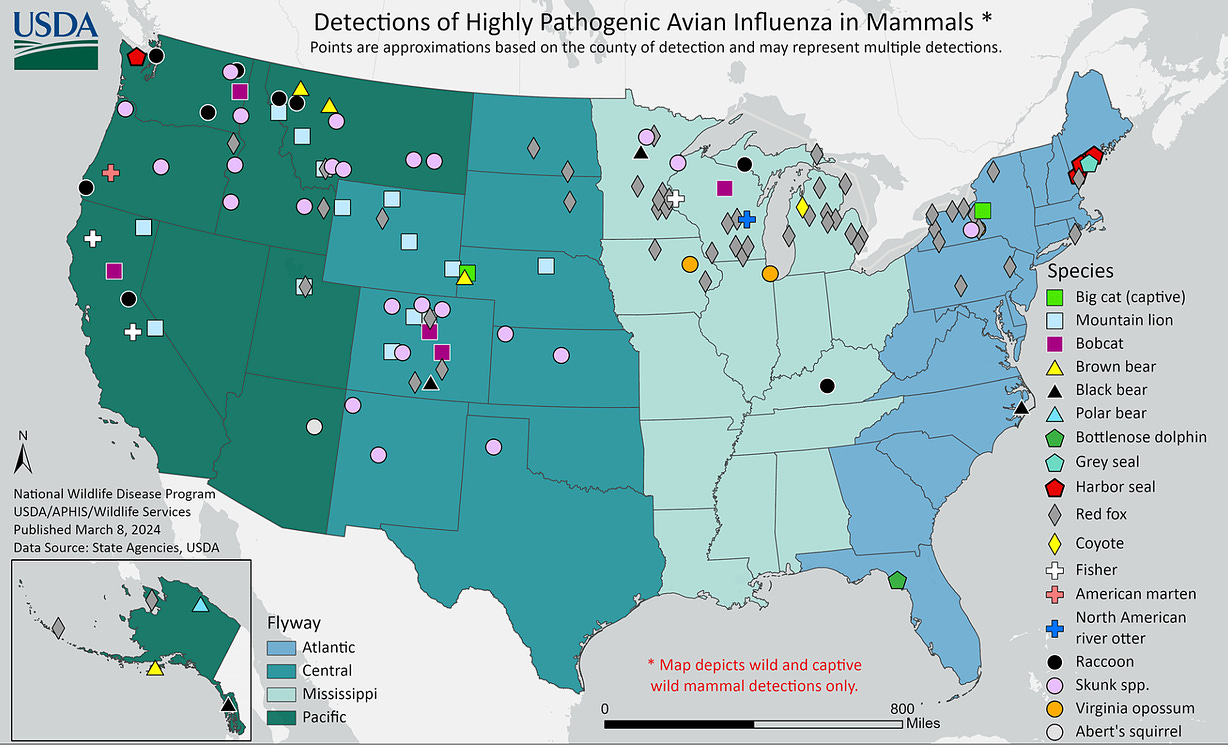
  • Then, we started detecting avian flu in mammals worldwide—seals, bears, mountain lions, and foxes, just to name a few.

This brings us to today 

Last week, officials announced that HPAI infections had been detected in cows on several dairy farms across five states. We then learned that cows in other states got sick once transported from the original farm, suggesting cow-to-cow transmission. This marks the first HPAI infection in cows in the United States.

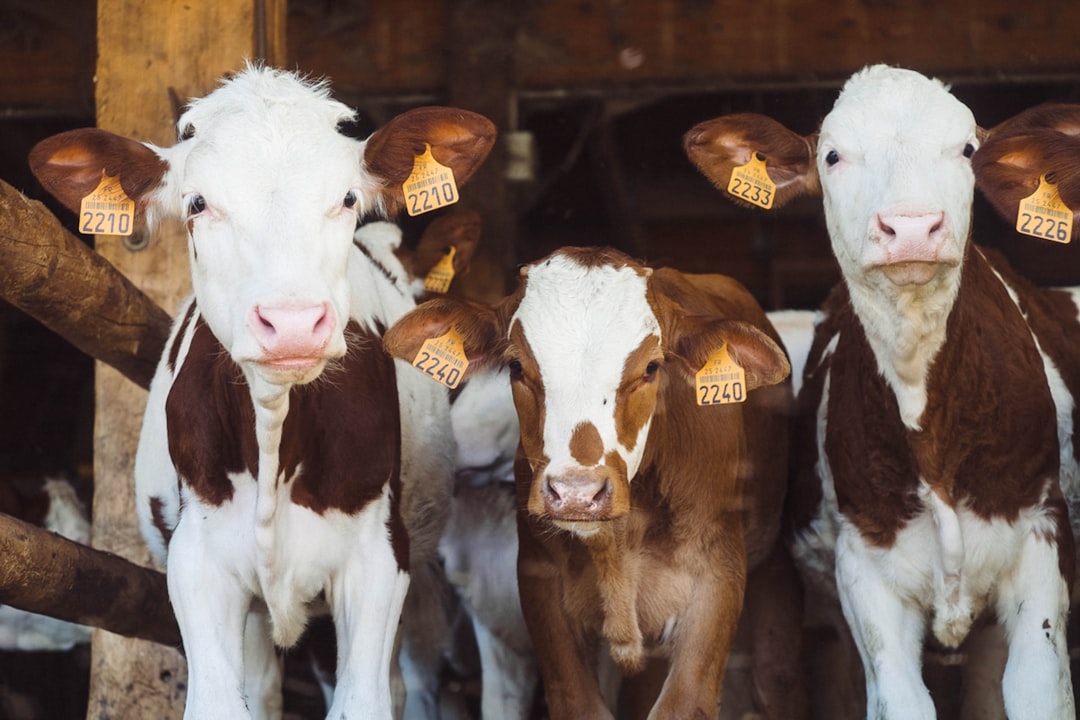
cows at farm

Photo by Annie Spratt on Unsplash

Yesterday, news was released that a person in Texas was infected with HPAI after working closely with the cows.

What we know

  • Lab scientists analyzed the virus that infected the cows and found:
    • It’s the same exact virus that is infecting birds, which suggests it jumped from bird to cow.
    • We are very familiar with this virus. So much so that we know where it would need to mutate to spread better from human to human. Based on preliminary analysis, the virus has not mutated in a key spot, which is great news. 
  • The person infected had very mild symptoms—eye inflammation—and is on antiviral medication. This is good news, as the few cases of human HPAI on record have tended to be severe.
  • A cow isn’t a pig, which is great news. Pigs are dangerous hosts for HPAI because they have avian and human receptors. They are known as “mixing vessels” for influenza viruses. As far as we know, this is not the case for cows.
  • We have well-established flu vaccine pipelines and some stockpiled materials to make a matching human vaccine quickly, if necessary. We also have antivirals that can help prevent infection and severe illness. 

What we do not know

Three main questions scientists are trying to answer:

  1. Did the virus mutate to become better adapted to cows? This will require more studies, which are already underway.
  2. Where else is it? Only a few farms are affected right now. However, viruses spread. The impact on milk supply and prices in the future is unclear. 
  3. Is the virus able to transmit onward from here? It would not be surprising if there were more human cases in people who had direct contact with cows. What we don’t know is if the virus will be able to transmit onward to other humans. For example, in the latest case, we don’t know if any of the person’s contacts became infected. Epidemiologists will closely track this. 

Is there any risk to me today? 

At this point, the risk to the average person is close to nil unless you’re working with wild animals, birds, or cows.

While this virus impacts the milk supply of individual cows, milk in our grocery stores is still safe to drink. Milk from sick cows is not allowed to enter the commercial supply, and milk is pasteurized—a major safety step in which milk is heated to kill pathogens, including influenza viruses.

Raw milk is unlikely to be safe, and it’s definitely not recommended anyway due to other health risks.

Bottom line 

Public health eyes have been on this HPAI sucker for decades, and avian flu is finding more mammals around us. This is unsettling, but scientists continue to pay close attention. In the meantime, it may be smart to implement lessons learned from the Covid-19 emergency quickly. The time to prepare is now.

Love, YLEs (Katelyn and Caitlin)

Posted in Uncategorized