2,905,611 VISITORS VISIT 8,324,077 TIMES 3 TIMES EVERY DAY IN ONE YEAR. HIGHEST ACTIVITY IN WPCNR HISTORY.White PlainsCitizeNetReporter lifted its worldwide visits from unique visitors to wpcnr.com to 8,324,077,a 1,306,419 increase in visits in one year from 7,017,658 visits to the site last year which covers White Plains and Westchester County. The 8,324,077 visits were made by 2,005,611 unique visitors who visited wpcnr an average of 3 visits a day. ON JULY 20- -2026 visitors have accessed wpcnr and made 3,072 visits an average of 1.6 visits. In the last week 33,495 individual vistors made 54,458 visits, averaging 1.6 visits. In the last month, 152,940 visitors recorded 229,338 visits (1.5 visits)
Statement From Adeel Mirza On Westchester District Attorney Race
“I ran for District Attorney because, after almost two decades in the Westchester DA’s office, I had the experience to run the office, reform it, and keep families safe. Throughout this campaign, I have had the incredible opportunity to visit every corner of our county, meeting people, leaders, and activists who care deeply about our communities’ futures. I am deeply grateful for the support and encouragement from every corner of this county.
The District Attorney’s office is a vital piece of that future, and whoever holds the office must be someone who holds our Democratic values – and always has. That is why, after much reflection and conversations, I have decided to stop campaigning and back William Wagstaff for District Attorney.
I have gotten to know William throughout this race, and he is kind, generous, thoughtful, and reform-minded. He will run the office with integrity and keep families safe while pursuing justice for all, regardless of race, religion, ethnicity, gender identity, or economic status.
What we can not have is a District Attorney who has run on the Republican and a Conservative Party lines – We need a Democrat who has always been staunchly pro-choice and supports common sense gun legislation.
William Wagstaff will be a District Attorney we can be proud of, and I am asking all my supporters to vote for him.
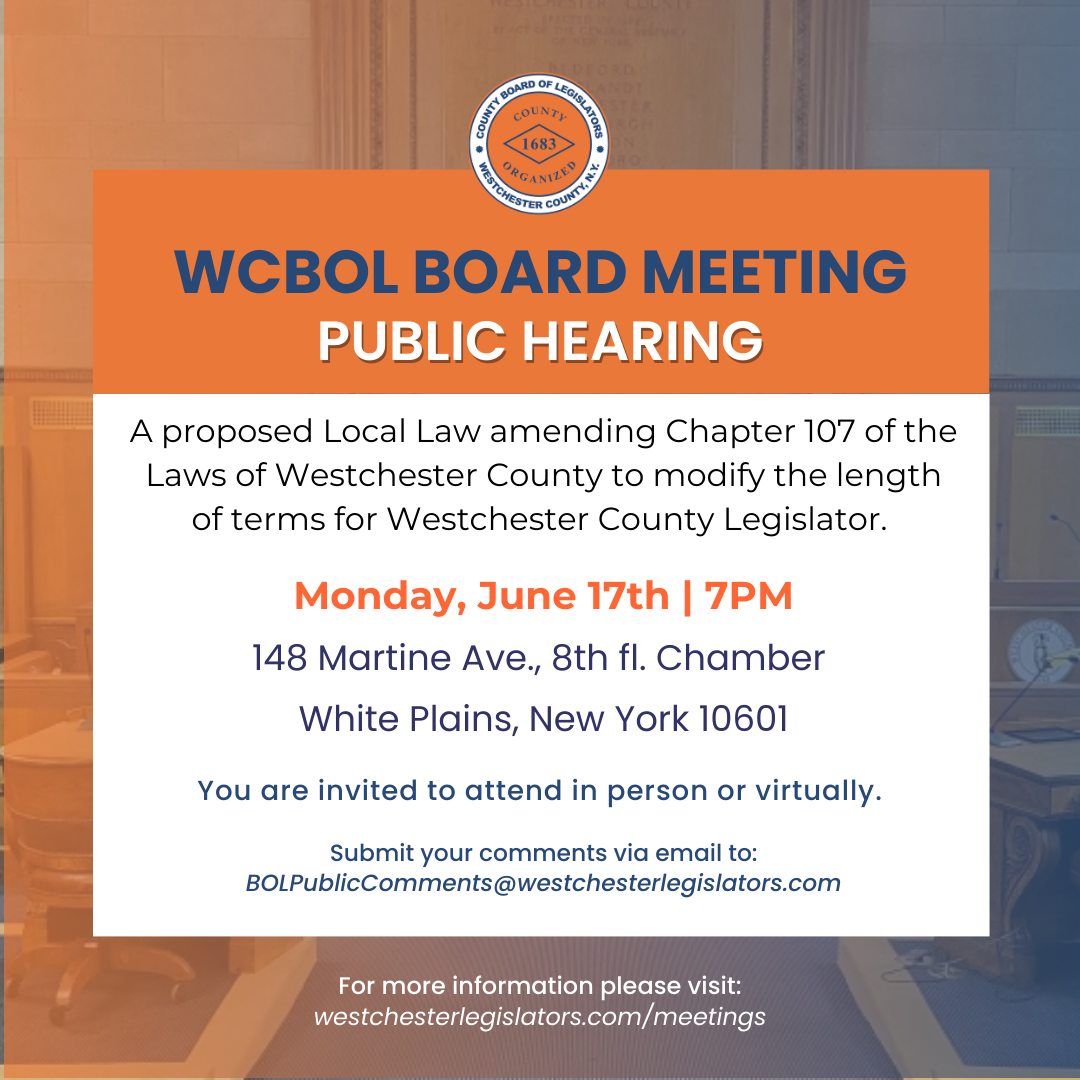
We at the Board of Legislators are consistently working to find ways to be more efficient. Right now we are taking up a bipartisan proposal that would put the decision in the hands of you, the voters, to increase the number of years per term for a County Legislator from 2 years to 4 years without adjusting the previously set 12-year term limit. This proposal follows the standard set by more than half of the counties in New York that already have 4 year legislative terms.
The public hearing where the community can voice their opinions on this proposal will be held in the Westchester County Legislative Chambers at the meeting scheduled for this coming Monday, June 17th, at 7:30pm. For more information on how to speak, submit comments or watch, click here.
Changing the term length would be a tremendous step toward better addressing the needs of constituents and managing complex issues in the county and districts. Rather than perpetually campaigning, we will be able to prioritize crafting legislation, delivering resources, and shift our attention away from politics and back to the reason we were elected in the first place, to more adequately represent the needs of all Westchester residents.
Moving from a two-year term to a four-year term would also reduce the cost associated with coordinating and administering elections for taxpayers. Reducing the frequency of elections would significantly lower those costs, and would allow for those funds to go toward important issues such as public safety, infrastructure investments, and administering crucial social services.
If passed by the Board of Legislators and signed by the County Executive, the decision will be put up for a County-wide referendum for you to vote on during the November 5, 2024 general election.
Last week, Fauci testified before a special House subcommittee.
While the subcommittee’s main focus was Covid-19 origins, other topics snuck in, including the 6-foot social distancing policy during the pandemic. This was a key measure taken to slow down spread, including at schools, businesses, and places of worship.
A level-headed evaluation of decisions and policies made during the pandemic is helpful and needed, but that’s not at all what happened here. Instead, there were empty, unhelpful questions lacking nuance and depth, and at worst, unhinged harassment of public servants.
The result?A dangerous wave of “pandemic revisionism”—headlines and viral social media accounts taking soundbites of the hearing and concluding that pandemic policies were worthless or that public health officials just made stuff up.
Americans deserve (and need) so much better.
6-foot rule: Where did it come from?
Last week, the subcommittee blamed Fauci for the 6-foot policy. Fauci responded saying he was unaware of studies supporting the 6-foot social distancing guidelines. He then clarified that it wasn’t based on randomized control trials.
Dr. Anthony Fauci, former Director of the National Institute of Allergy and Infectious Diseases, testifies during a House Select Subcommittee on the Coronavirus pandemic at Capitol Hill, Monday, June 3, 2024, in Washington. (AP Photo/Mariam Zuhaib)
There are a few problems with this exchange:
This wasn’t a Fauci decision. The 6-foot guideline was decided by CDC.
This policy wasn’t pulled out of thin air. During the Bush administration, this key strategy was put into the pandemic playbook in 2007 and again in 2017. It was based on our knowledge of flu at the time, which showed droplets as a main form of transmission (rather than aerosols). Given that Covid-19 was a novel virus, pulling from a pandemic playbook was the right decision.
Even though 6 feet was not the “perfect distance,” it still helped prevent transmission.
9
The mistake was not updating the policy quickly enough. It turns out Covid-19 has droplets, but its main mode of transmission is aerosols (i.e., airborne). In the summer of 2020, more than 200 scientists sent a letter to the WHO urging them to recognize this, as it would impact policy decisions. However, it took over a year for the CDC and WHO to officially recognize it. Why? And why did the U.S. go with 6 feet while the WHO went with 1 meter? Now, these are questions that would be useful to answer.
You won’t get a randomized control trial in times of an emergency. We were losing thousands of people per day. We have to move quickly and with suboptimal information. This is why preparedness is so important. Even so, some questions we ethically can’t answer with an RCT.
It ignores what we learned. When the world works on one thing, we learn leaps and bounds. One example is how much we learned about the power of air ventilation and filtration.
But these points are coming far too late.
Millions this week received the wrong and dangerous message that the 6-foot rule was based on no science thanks to this botched exchange, erroneous headlines and viral tweets. Clawing back the narrative for the next response—such as bird flu where droplets may be an important driver of a disease — will be incredibly difficult. (!–Editor’s Note)
Attacking scientists is also not the answer.
It’s reasonable to ask Fauci why he made certain decisions, what conversations he was a part of, or what his thinking was at the time. After all, he was one of the key decision-makers.
However, vilifying, attacking, and ripping apart public servants is unacceptable, undeserved, and certainly unhelpful in propelling us forward. Some tweets, like the one below by Elon Musk, was viewed more than 44 million times.
Public health leaders stepped up during a time of great uncertainty using systems too old to succeed while losing, at its peak, 3,500 people a day.
They had to make incredibly difficult decisions, often with incomplete information, many of which were valid decisions based on the data at the time.
Yes, they made mistakes, but their service was heroic and patriotic, too.
We can live with these two truths.
If not, we risk losing public health leaders — why would someone step up when this is how they’re treated?
We need a far better approach.
A proper diagnosis with the breadth, depth, and fairness the Covid-19 emergency deserves, driven by critical thinking and diverse perspectives:
Why weren’t we prepared?
What decisions were made, when, why, and by whom?
What mistakes were unavoidable and avoidable?
What could have saved more lives?
How could we have a better balanced, holistic view of health?
What tangible steps will be taken to do better in the future?
There is precedent for such an approach: the 9/11 Commission. However, a united, national diagnosis seems less likely as the months pass.
Thankfully, some groups have taken it upon themselves to start patching together answers:
Will this be enough for the future? Especially with no funding to make the changes needed?
Time will tell, but this is a gamble given that health threats are coming faster.
Bottom line
The United States lost more than 1 million lives—worse per capita than any other developed nation. We deserve to know why and what steps are needed to ensure this doesn’t happen again. However, resorting to unhinged attacks and disingenuous waves of pandemic revisionism will only hurt us in the end.




 9
