Hits: 209


Hits: 209
Hits: 272
WPCNR THE SUNDAY BAILEY. By John F. Bailey. February 13, 2022:
Do you know?
I didn’t until last week.

John Vorperian, host of White Plains TV’s Beyond the Game on Tuesdays and Fridays, shined a bright light last week into a rarely explained phenomenon : how Black football stars first came to play professional football.
This evening Eastern Standard Time, we will see America’s most watched television program all year.
Some 80 million people will watch the NFL Championship with probably three quarters of the players of color. (The league now, John told us Thursday evening via zoom in his presentation provided by the White Plains Public Library , is made up of 70% Black players.)
How it got to be that way was the fascinating topic of John’s talk.
I had heard of black players in the early 1950s when I was a kid, Marion Motley of the old Cleveland Browns, and of course the great Jim Brown of Syracuse and the Browns.
Jim Brown was the greatest running back I ever saw play when I watched the old Browns and the New York Giants play when the Giants were Giants from 1956 through 1963.
The Football Giants coached by Jim Lee Howell had a lot of black stars, Emlen Tunnel, Mel Triplett, Rosey Grier, Roosevelt Greer. I did not as an 11 year old know that this was only a recently introduced trend.
John Vorperian changed all that for me Thursday night with his one hour talk explaining how the World War II situation, and how one man, Paul Brown believed in an athlete’s ability not what the color of his skin was.
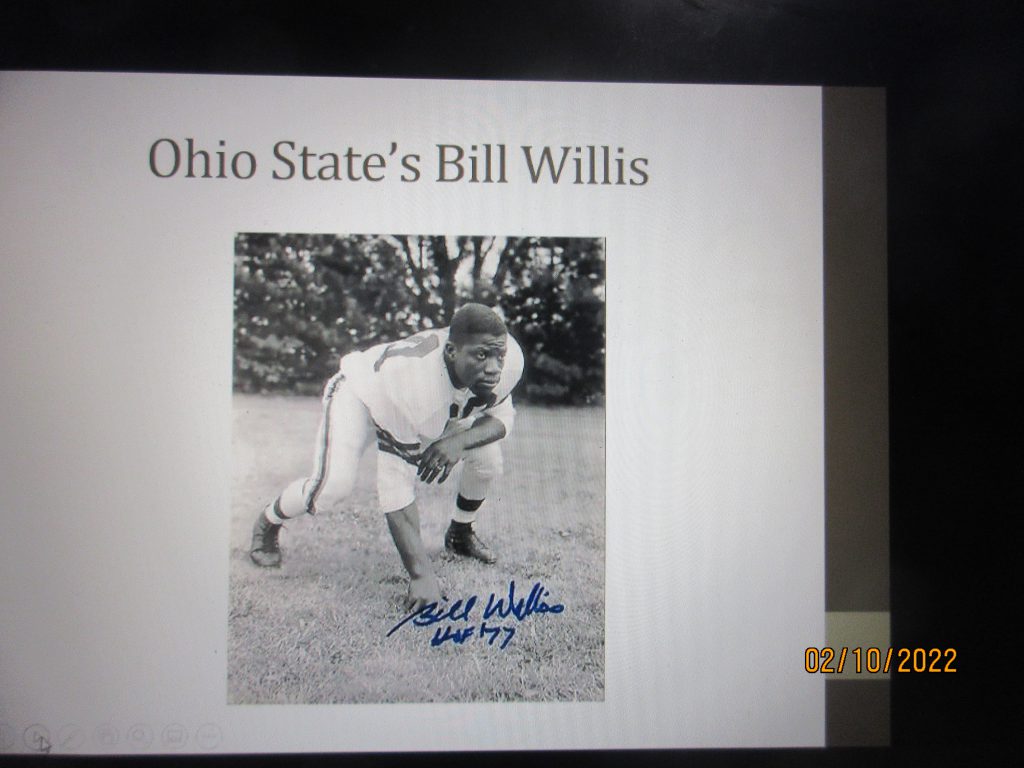
Mr. Vorperian highlighted how in the early 40s the NFL did not have any black players. He detailed how when college players who had served in World War II came back, and were eligible to enroll in colleges they played football, most notably at UCLA, Ohio State and became standouts. One of them was Marion Motley below.


Marion Motley was signed by Mr. Brown and brought to his upstart Cleveland Browns in the All-American Football Conference
Paul Brown, the Cleveland Browns Coach who was coach of Massillon High School where he became a legend for the successful teams he fielded, had allowed black athletes on his high school teams, unheard of at the time.
Paul Brown went on to Ohio State where he also was successful. After coaching for the Navy Training Center team, he took a job as coach of the Cleveland team in the new All American Football Conference, a league set up to compete with the NFL. Coach Brown signed Bill Willis and Marion Motley whom he had coached at Ohio State to play for the Browns.
Mr. Willis and Mr. Motley were the first black players to play professional football.
Football players from UCLA were signed to play in the All American Conference. Paul Brown is credited as the coach who introduced black players to the NFL.
I never knew that.
According to Wikipedia, Paul Brown never looked at race or made predeterminations about players. He gave them a chance.
Brown judged on their ability to help his teams from Massillon to the Cincinnati Bengals who play in the SuperBowl this afternoon. Not dismissing them because they were black. How incredibly refreshing.


John Vorperian told the story of George Preston Marshall owner of the Washington Redskins who would not have a black player on his teams. Marshall was a disgrace to the NFL into the 1960s.
Vorperian has been a curator of the character and reality of sports the last two decades week after week on his shows. He has been the irrepressible interviewer who asks questions players, coaches, sportswriters, authors love to answer and enlighten.
Beyond the Game shines a sensitive light on the true reality of sports personalities, sports past and present. He is also a member of the Jackie Robinson Organization where he speaks on Jackie’s contributions to breaking the color line in baseball. John, in his professional career is nationally recognized for his work in promoting fair family court treatment of the less fortunate children and parents.
Last week’s program pointed how just as Branch Rickey the executive of the Brooklyn Dodgers and Jackie Robinson because they were brave, and just as Paul Brown in the case of Motley and Willis playing for him changed history, attitudes, and turned around two centuries of prejudice. Because they did a noble courageous, deed.
Vorperian’s talk which will be available soon via zoom recording I believe on the White Plains Library website is must-see for you to get acquainted with how the NFL got Black quarterbacks, Black coaches (not as many as they should have), who inspire and perform despite the odds.
Hits: 260

Hits: 238
Hits: 337
Posted on by John Bailey
Editor’s Note: Stephen R. Rolandi, a frequent contributor to WPCNR.com and White Plains Week published this article in a recent issue of American Society for Public Administration. The views expressed are those of the author and do not necessarily reflect the views of ASPA as an organization. Republished here with permission of the author. (c) 2021, Stephen R. Rolandi
By Stephen R. Rolandi
February 8, 2021
This being the month of February, many of us celebrate Ground Hog Day (February 2nd), hoping that spring will soon arrive, as well as Chinese (Lunar) New Year, the Year of the Ox, on February 12th; and of course, Valentine’s Day on February 14th.
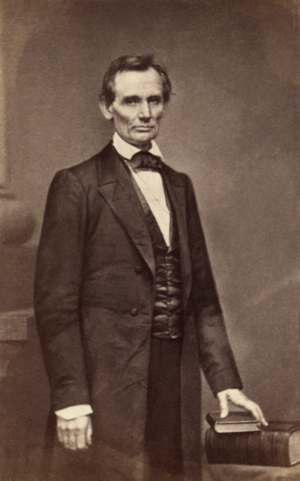
If you are like me and historically inclined, you might also mark February 12th as the birthday of our 16th American President, Abraham Lincoln (1809-1865). I have had a long and continuous admiration for our 16th President. I have travelled to Springfield, Illinois to see Lincoln’s law office and home. Many years ago, my late parents gave me a half dollar coin issued by the United States Mint in 1918 to commemorate the 100th anniversary of Illinois’ admission to the Union.
This year marks the 212th anniversary of Lincoln’s birth, and I believe it is a fitting time not only to examine his career as the nation’s Chief Executive during the bloodiest war in American history, but also his contributions to public service and impact on American public administration.
Lincoln was not popular in his time; indeed, he was elected in 1860 in a four way race with only 39% of the popular vote. He won re-election in 1864 with the Confederate states that had left the Union in 1861 not participating in that election; and with the support of Union soldiers who voted in overwhelming numbers for him.
In addition to preserving the Federal Union during the Civil War, as well as his issuance of the Emancipation Proclamation, Lincoln had many accomplishments:
Taken together, along with other policy initiatives, many historians consider Lincoln’s Presidency to be the foundation of the modern administrative state.
Indeed, it was Leonard D. White who said that, “Administrative history was primarily the record of war and military government.” We can also see that many domestic and economic sector accomplishments occurred as an outgrowth of the war effort. Lincoln became a paradigm for future chief executives.
Perhaps for me his most important contribution was preserving the principles of constitutional government during a period of one of the gravest crises in American history. Lincoln was cognizant of relating his actions to the spirit and meaning of the Constitution.
There are many, many works about Abraham Lincoln’s life, career and Presidency. More books about some aspect of him continue to be published. Some of my favorite books about the career and Presidency of Abraham Lincoln that I would recommend are the following:
If I had to recommend a single book on Lincoln, it would probably be Doris Kearn’s work on Lincoln, how he won the Republican party Presidential nomination against more prominent contenders, and how he led his cabinet—consisting nearly of all the Presidential contenders he faced in 1860—during the Civil War. I should mention that Kearn’s work reportedly influenced Barack Obama when he assumed the Presidency in 2009.
Lincoln’s experience as a war time chief executive gives us many perspectives, not only on the role of the executive in decisionmaking as well as leadership, but also for his lasting contributions towards the institution of the American Presidency and constitutional government. He is, in my opinion, more relevant than ever today as we as a nation face the perfect storm of crises—the Covid-19 pandemic, a weakened national economy and a distinct threat to our democratic institutions and the rule of law.
Happy Birthday, Mr. President!

Author: Stephen R. Rolandi “retired” in 2015 after serving with the State and City of New York. He holds BA and MPA degrees from New York University, and studied law at Brooklyn Law School. He teaches public finance and management as an Adjunct Professor of Public Administration at John Jay College of Criminal Justice (CUNY) and Pace University. Professor Rolandi is a Trustee of NECoPA; President-emeritus of ASPA’s New York Metropolitan Chapter and was Senior National Council Representative. He has also served on many other association boards in New York City, Westchester County (New York State) and Washington, DC. You can reach him at: srolandi@jjay.cuny.edu or srolandi@pace.edu or at 914.536.5942.
Hits: 186

Fogg carried this request to Mr. Bennett and told Lincoln Bennett was and of course very far from wishing to misrepresent you….would print any correction desired—-but only if it appeared over either Lincoln’s signature or Fogg’s.
Bennett was adamant: “To issue it editorially or by his correspondent would be to acknowledge the Herald or its correspondent in error.”
Fogg advised Lincoln to let the matter die, say he did not believe the correction he offers would pay.
Lincoln wrote Fogg: “You have done precisely the right thing in the matter with the Herald. Do nothing about it. Although it wrongs me, and annoys me some, I prefer letting it run its course, to getting it in the papers over my own name.”
Lincoln also rejected Mr. Haycroft’s making a statement to The Herald, saying the only purpose in writing him was to assure Haycroft “I had not charged you with an attempt to inveigle me into Kentucky to do me violence.’
The sequence is intriguing in what it says about Lincoln’s judgment and how to diffuse a situation that could drag on in a media frenzy, something the present media does all tooooooooo frequently. I see it every day on the front pages and the news networks.
The press was making interpretations of what politicians meant by statements even then.
Hits: 253



PLUS JOHN MARTIN COUNCILMAN THE RISING TIDE OF REVENUE
PLANNING COMMISSIONER CHRIS COMEZ ON THE NEXT STAGE OF THE MASTER PLAN CREATION


Hits: 2017
WPCNR POLICE GAZETTE. From Cyprus Police Economic Crime Investigation Office. Most current analysis 2018. February 11, 2022.
Editor’s Note: On this Valentine’s Day weekend, it has come to this reporter’s attention that more and more social websites, hundreds, thousands, millions maybe actually require the lovelorn and the lonely seeking romance, companions, to pay a fee for “coins” or membership in order to correspond on the website to persons who write they are interested in them, who express an interest in them The fees payable after you join or sign up are usually quite low, but these sites ask for payment via credit card. After you join the site!
Whether or not the website personalities and photos are even legitimate real people (there are millions of these lonely people advertising all over the world on hundreds of lovelorn websites, and some look like real people, others models), are possibly suspect.
Since many of such romance sites are based abroad in Cyprus, the United Kingdom, Africa, and elsewhere and yes, the USA, I did a search of the Cyprus Police involvement with fraud related to such sites.
If you are a woman or a man filing profiles on these sites, you should be aware they are not free and correspondence ability is limited until you pay that fee to join raging as low as $4 or $5 as a fee to ‘correspond back”. This has been going on since 1996, but has expanded exponentially over the five years.
The Cyprus Police original article below issued in 2018 apparently has not been changed since then, but it can be accessed at https://www.police.gov.cy/police/police.nsf/All/4B7A1882CFBE9EABC22584000041D65D
CYPRUS POLICE ECONOMIC CRIME INVESTIGATION OFFICE
This Unit at Police Headquarters deals with cases of fraud that are committed in all Police Divisions. It investigates serious and complex cases and responds to requests by foreign countries for information and co-operation concerning the investigation of cases of fraud.
The Office investigates cases that are submitted by Police Units and Government Services to the Commander of Crime Combating Department.
A) Advice on the prevention of fraud committed via the Internet, mobile telephones and post
– A key factor in the prevention of fraud is being cautious and suspicious of any letter, unsolicited e-mail, or sms which comes from an unknown sender.
– If you receive a message or letter saying that you have won the lottery abroad and you are asked to send your personal information so that you can receive the so-called amount won, do not respond. Just ask yourself – who or what organisation gives away large amounts of money for free? No one.
– If you receive a message or letter saying that you have inherited property abroad and especially in Africa, don’t believe it. Even if they ask for help to transfer from Africa, property that supposedly belongs to you for an exchange, do not respond, even out of curiosity.
– If you receive a message from your bank saying that for some reason they want to supposedly check your bank account number or the number of your credit card or pin numbers, do not believe it. Your bank will never contact you in this way about such matters. If you respond, you run the risk of not being compensated by the bank. It is better to contact your bank immediately, in another way, to verify the claim.
– Be aware of the fact that you run great risks when you make online purchases. If you don’t know the suppliers avoid making such purchases. If it is absolutely necessary to purchase something, verify before paying, that the particulars / information given by the seller are not bogus, so that you can contact him/her later if s/he fails to fulfil the agreement made.
– If you are selling something over the Internet, do not agree to accept payment by cheque or credit card. There is a great possibility that they are forged or stolen and you will have to pay compensation later.
B) On-Line Buying and Selling
It is the most common form of fraud on the Internet. In such cases various so called buyers or sellers appear on the Internet. The two most common goods bought and sold on the Internet are cars and mobile telephones. When the fraudsters receive the money, they do not send the products(s). It is then virtually impossible to find them because in all cases the particulars and information they give not only on the Internet but also to banks and transfer offices are false.
Fraudsters usually:
– Appear to be selling goods at prices that are much lower than usual so that they can attract customers
– Contact the victim initially by e-mail
– After the initial e-mail, they communicate with the victim by telephone or further e-mails
– Pretend to be the owners and use various names. They therefore manage to trick their victim. It is then impossible or extremely difficult to track them down.
– Use, not only various names, but also titles like “Company Director”, making the whole procedure appear to be more “formal” and “official”, really “convincing” the victim.
– As far as the sale of vehicles is concerned, fraudsters send, by e-mail, fake registration documents to the victim describing the vehicle.
– In order to achieve their goals and deceive victims, they use the websites of so-called transfer companies which guarantee the “safe” collection of money on behalf of their “customers” when the payment is made by the victim. These websites immediately disappear from the Internet and cannot be traced except in cases where fraudsters attempt again to cheat their victim, providing him/her with even more fake information. If they feel that their victim will continue to pay, they tell them all sorts of lies, such as “the Customs Authorities must be paid”.
– Tell the victim to pay through the WESTERN UNION (WU) or by depositing the money in some bank account. In this case offenders use or “rent” the bank accounts of students or unemployed persons who receive a small amount of money in exchange for the use of their bank account by someone else. These persons usually act as bearers, receiving instructions from the offenders to immediately withdraw the money that was deposited in their account and to send it to them, (deposit it in their account) usually using the Western Union.
– If the payment is made to a company, a straw or legal one concerned with the collection of money on behalf of third persons, the money is usually transferred to Eastern Asia and later back to Europe or Africa.
Advice:
Don’t forget that there are many risks involved in buying goods on- line, over the Internet. If you don’t know the suppliers avoid such purchases. If it absolutely necessary to do so, before paying make sure that the suppliers’ particulars are not fake so that you can find him/her if case the terms of agreement are not met.
Internet Fraud
Introduction
Technological developments and especially advancements in computing and the wide use of the Internet have brought about great changes in everyday life both in private life and the workplace. As a rule, this development has improved our quality of life as we can have access to unlimited information which is useful in education, business and communication.
However, the use of the Internet just like every sector of human activity can be taken advantage of by those involved in new forms of criminality, like child pornography, illegal gambling, identity theft, business data and record theft, industrial espionage and various forms of fraud.
The most frequent offence committed on the Internet is Fraud and the various forms it takes. The offenders aim at obtaining amounts of money in an easy, quick manner.
Definition
Generally the term “Internet Fraud” includes any form of fraud in which offenders use e-mails and websites to present to Internet users various fake sites with the intent to defraud and make financial gains.
The danger of not being aware
All Internet users are potential victims of Internet fraud and this is a temptation for fraudsters that are covered by anonymity. Offenders do not have to go out looking for victims but can easily “phish” them. Indeed, in most cases individuals become victims without even being aware of it. There are also others who, despite suspecting that something is wrong, they take risks because they are attracted by the unknown. Offenders take advantage of the fact that Internet users are not aware of the risks they run if they enter an unknown web-site, respond to a message send by someone unknown or “click” to take an unknown path. Therefore, Internet users have to be informed to take their own safety measures, in co-operation with their suppliers. Prevention is therefore most important because when someone loses his/her money, it is difficult if not impossible to get it back. Finding the offenders is difficult because they do not present their real identity – the addresses they give are fake or non-existent and their telephone numbers are not registered (so-easy card).
Origin
This type of fraud occurs world-wide but it is more common in countries with high standards of living like the United States and European countries where the Internet is widely used. Offenders come mainly from African countries, especially Nigeria, from Eastern European countries, South East Asia and China. They do not only operate within their countries, but they have expanded to various countries, mainly the USA, Holland and Spain. The Nigerians especially, have created their own “school” which is known throughout the world as the “Nigerian Mafia”. They are usually well-educated persons who are forced to leave their country because of its bad economic state.
Cyprus
There doesn’t appear to be a serious problem in Cyprus but there has been an increase in the number of complaints. It is believed that there will be a great increase in these complaints in the future. Cyprus Police considers this area important, and in order to protect Cypriot society, it has set up a special office at Police Headquarters which investigates this type of cases as well as other types of cyber crime, such as child pornography, an offence which has unfortunately been increasing.
No Cypriots have as yet been found to be guilty of this type of crime. There have been cases though where Cypriots have been victims of fraud from abroad and some cases have been reported to the Financial Crime Investigation Unit at Police Headquarters. It is believed that many persons have fallen victim to Internet fraud but have not reported it to the Police out of embarrassment at being cheated. This is the case world-wide so it is difficult to know the true extend of Internet fraud.
The main forms of Internet Fraud
The main forms of Internet fraud are the following:
Identity Theft and “Phishing”
In such cases fraudsters create phony websites which look just like the sites of banks. The customers of these banks are asked to follow, step by step, certain instructions – they are instructed to enter their personal information, including their bank account number, credit card numbers and pin numbers. The sender asks users to “confirm” their personal information for made up reasons such as the bank is going through a process of improving or changing its security system. In this way fraudsters gain access to accounts that are connected to the Internet and immediately transfer amounts from the account of the unsuspecting victim to other accounts which are usually abroad. Usually these bank accounts are opened using false personal information. The accounts into which the money is deposited may also belong to intermediaries who are usually poor persons agreeing to the use of their accounts for a small payment. Having obtained personal information on bank cards fraudsters also make bogus cards in the name of the victims. They either use them themselves or sell them to others and withdraw money from automatic cash machines in third countries. These problems arise when banks and other organizations which accept Internet exchanges do not have satisfactory security systems or the victims themselves are not appropriately informed about the way their electronic accounts work.
It is very difficult to detect such cases. In one specific case, sums of money from Cyprus were transferred through the Internet to bank accounts in Latvia. Cypriot detectives went there and with the help of the Latvian authorities managed to find the person in whose name the sums had been transferred. It turned out that the person was homeless and that his personal information had been used for a small payment.
Investigators also find that in most cases, fraudsters have access to the Internet from Internet cafes.
Recently there have been seven complaints by a bank in Cyprus that considerable amounts of money had been stolen from the accounts of its customers through “phishing”, a similar way to the one described above. Investigations found out that this was done through Nigerian students who acted as intermediaries.
Buying and Selling
This is the area where fraud most commonly takes place. In these cases various sellers or buyers of goods appear on the Internet. The prises of the goods offered are usually extremely low so as to attract customers. Communication is carried out through e-mail and fraudsters ask to be paid either by a bank payment or through an international courier. When they receive the payment, they don’t send the goods. Locating them is virtually impossible because in all cases the information they give on the internet, concerning banks and transfer offices is fake.
In the case of purchasing, fraudulent buyers order the goods from legitimate companies which accept payment by credit card or cheque. These cards or cheques however prove to be fake. In some cases the payment is made by a cheque of a larger amount than the price of the goods bought and the fraudulent buyers ask for the return of the excess amount.
Advance fee fraud
This type of fraud includes the case involving the well-known fraudulent letters sent by the Nigerian Mafia. The fraudsters, up until recently, used to send letters by post or fax. They now send them by e-mail.
With these letters they try to deceive people through all sorts of lies. They tell victims that they will supposedly offer them huge amounts of money if they help them transfer money, diamonds and other riches from inheritance in Africa to the victim’s account for safekeeping. Initially they ask for bank account information and then for an advance fee for expenses. If you respond you lose your money and the senders disappear and cannot be traced since the information they gave is false. In one case, a Cypriot was tricked into going to Holland. There they showed him fake bank offices where he deposited approximately 30000€ supposedly to be used as expenses for the transfer of a large inheritance from Africa to Holland. The Dutch authorities said that such cases were very common and they only record them, they don’t investigate them because it is impossible to find the offenders. Other similar cases of fraud are those involving money supposedly won in a lottery. These letters usually come from Spain and Australia and inform the receiver that he/she has won a large amount of money. If there is a response, then the fraudsters ask for an advance fee for the transfer of the fictitious “winnings”.
Romance Scam
It is one of the most recent types of fraud, but it is developing fast. In this case crooks take advantage of people’s loneliness and wish to find a partner. They supposedly take on the role of intermediary on the Internet. Initially, in order not to arouse suspicion, they ask for a small amount of money, supposedly for some small expenses. They then ask for more money, supposedly for more expenses, such as the travel expenses of the “groom” or “bride” that never comes.
Credit Card Fraud
There are various ways in which credit card fraud can occur. These are:
(1) Theft of personal information – the pin number on automatic Teller Machines is stolen by being recorded by special equipment or a small camera. This is the most widely used method in Cyprus.
(2) Entrapment of credit cards in Automatic Teller Machines and use of special equipment and small cameras simultaneously, so that the code number is monitored. As soon as the user leaves the vicinity, the offender withdraws the card and uses it him/her self.
(3) Theft of cards and code numbers by various skillful persons and immediate use of the card by the thief. The cards are stolen from post boxes, cars or bags.
(4) Copying/stealing card information and using it immediately or transferring/copying it to new empty cards. This is done when customers pay for goods or services. Those responsible are the persons selling the goods, waiters etc.
(5) Stealing the card number when a customer pays for goods in shops or other places.
(6) Theft of information on cards, over the Internet.
Protection Measures
If a card is lost or stolen, then the owner must immediately contact his/her bank and JCC. Special care and caution should be taken when using credit cards in Automatic Teller Machines. If there is any suspicion of the presence of any foreign object in any machine then the bank and the police should be informed immediately. Card owners must make sure that no persons unknown to them are around when using a card.
Card owners should keep their receipts so that they can check their accounts on a monthly basis.
A pin number should always be memorised and not written anywhere.
Card holders and users are advised to use the special cards issued by banks when carrying out transactions on the Internet.
Investment Fraud: Advice to Investors
In recent years, in Cyprus and abroad, there have been a number of persons, physical or legal, who offer various investment plans which finally prove to be bogus. These plans usually offer extremely high capital returns, which cannot be feasible.
Fraudsters usually
– Try to sell complicated monetary products which cannot be easily understood by consumers. Do not allow persons unknown to you to handle your money.
– Try to impress people by dressing elegantly and appearing to be successful businessmen and businesswomen.
– Make you feel uncomfortable. They take advantage of your feelings making you feel greedy, insecure, unhappy, and discontent with your self and your knowledge and abilities to handle money matters.
– Don’t forget that investments are liable to risks. If they offer an investment plan and promise you that there are no risks, you should ask yourself if this is in fact true.
Remember that once fraudsters achieve their aims, they disappear together with your money.
How to Protect Yourself
The only way to protect your self from becoming a victim of fraud is to be extremely careful. When you don’t know something, seek advice from experts. Examine carefully the investment plans offered to you and find out about the specific person(s) you are dealing with. Don’t forget: “The best protection against fraud is being knowledgeable and cautious.”
Remember that the smart investor:
– Knows or finds out the names of the people s/he is dealing with or who they represent
– Does business only with persons and companies s/he knows and trusts
– keeps record of conversations, meetings, noting important points mentioned as well as the names, dates and times they took place
– Seeks and finds information on the persons and companies with which s/he is about to deal with
– Verifies the information s/he gathers
– Makes sure that s/he fully understands the terms and conditions of the investment plan
– Asks for a detailed explanation on anything that s/he does not understand
– Makes certain that the company is legal by referring to the relevant inspection authorities – the Central Bank of Cyprus, the Stock Market and the Inspector of Insurance Companies
– Does not give away any personal information or any information regarding his finance or other personal matters before s/he certifies that the company is legal
– Does not make rush decision
– Never hesitates to ask questions. The more questions he/she asks, the better
– Asks for information on a regular basis, keeps up-to-date on the progress of his/her investments and always follows his/her investment goals
– Reports to the relevant Inspection Authorities any attempt(s) of fraud against him/her.
If something appears too good to be true, then there is every possibility that it isn’t.
For further information for investors you can refer to http://www.cysec.gov.cy
Hits: 280
I want to give you an update on our progress in the pandemic and the blueprint for moving forward. Our overall cases, positivity rate, and hospitalizations are down, while our hospital capacity, vaccination rates and booster rates are up. Back on January 9, the peak of the winter surge, there were nearly 382 cases per 100,000 people. Today, there were under 31 cases per 100,000 people — among the lowest in the nation. The numbers are clear — we are seeing major improvement on the key metrics we’ve been tracking throughout this pandemic.
We are not where we were in early December, and I want to thank New Yorkers for doing the right thing to help us get through this winter surge. But make no mistake about it: This pandemic is not over. Our fight against COVID-19 continues, and I’ve put together a five-point toolkit that ensures we keep New Yorkers safe and plan for the future, including a first-in-the-nation effort to help those experiencing long-term effects from COVID. We’re moving in the right direction and our winter toolkit lays out our path forward.
Given the rapid decline of cases and hospitalizations, we are now lifting the statewide mask-or-vaccine requirement for indoor businesses starting today, February 10. Counties, cities and businesses can still choose to require masks. The mask requirement remains in effect statewide for specific settings like health care facilities, nursing homes, and schools.
We’re continuing to track many key metrics and to take steps to keep kids safe, including sending every K-12 student home with two COVID tests ahead of the Midwinter break. I’ll continue looking closely at the numbers and working with education partners, and I will make an assessment on school masking in early March.
THE LATEST ON THE NUMBERS
THIS WEEK’S COVID TRENDS. As of February 9, 2022, 4,398 New Yorkers are hospitalized with COVID-19. Our 7-day percentage positivity average is 3.88%, which is down from 5.51% last week. There were 30.88 cases per 100K statewide.
Per the CDC as of February 10, 2022, 85.0% of adult New Yorkers have completed their vaccine series. So far, 36,341,991 total vaccine doses have been administered, with 47,976 doses administered over the past 24 hours.

Photo of the Day: Yesterday, I laid out my plan for a new phase of COVID response (Photo by Don Pollard)
ANSWERING YOUR QUESTIONS
Every week, we’re answering some commonly asked questions about COVID-19 and vaccinations. You can submit a question for a chance to get your question answered in next week’s newsletter. Submit your question here.
QUESTION: What can you do to ensure students are kept safe in schools from COVID-19? (Heather, Ontario County)
ANSWER:
I know how important it is to make sure our kids are safe and in the classroom. As part of our winter surge plan, we’ve distributed over 14 million tests to students in public, charter, and private schools. Masks are still required at schools throughout the state and I am working with teachers, administrators, school boards, & parents on any future guidance. The vaccines are among our best tools to keep our kids safe in schools, and New Yorkers age 5 and up are eligible to get the vaccine. You can learn more about how we’re keeping kids and staff safe in schools here.
New Yorkers, thank you for being smart, doing the right thing, and helping us to get through this winter surge. Let’s keep working together to fight the pandemic and keep each other safe.
Ever Upward,
Governor Kathy Hochul
Hits: 232