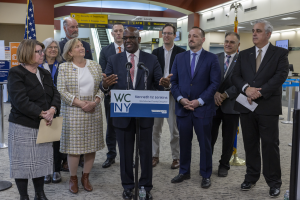
JANUARY 21– COUNTIES’ STATEMENT ON 2027 NY STATE BUDGET

Hits: 106

Joint Statement from NYSAC President Philip R. Church and NYSCEA President Hon. J. Ryan McMahon, II

Governor Hochul’s SFY 2027 Executive Budget reflects a clear recognition of the fiscal and operational challenges facing New York amid ongoing federal uncertainty. We commend the Governor for advancing a spending plan that protects the State and counties from disruptive federal cost shifts, including preserving the local Medicaid cap—an action projected to save counties and New York City $9.2 billion in FY 2027 alone.

We are especially encouraged by the Governor’s continued commitment to local infrastructure investment, which is essential to supporting housing development, attracting businesses, and strengthening regional economies.

The Executive Budget commits $3.75 billion over five years for clean water infrastructure and proposes a $425 million Environmental Protection Fund to protect water quality and build climate resilience. The Budget also includes $50 million in new funding for the County Infrastructure Grant Program, increasing the maximum award to $1.5 million, and recognizing that counties must have the resources to prepare sites and build the infrastructure necessary for housing and economic development projects to move forward.

We also commend the Governor for making substantial investments to support job creation, economic development, and affordable housing across the state. This includes $150 million for Regional Economic Development Councils, $200 million combined for the Downtown Revitalization Initiative and New York Forward, $300 million for the POWER UP Fund to create shovel-ready sites, $100 million in capital funding for Pro-Housing Communities, and $170 million to expand and strengthen land banks.

Most importantly, the Executive Budget maintains core local assistance programs and avoids new unfunded mandates during a period of declining federal aid. The Governor’s budget represents the first step in this process and as we move forward, counties look forward to working with the Governor and Legislature to ensure that the aforementioned priorities remain in the final budget and that local governments have the tools, flexibility, and resources needed to deliver essential services, grow local economies, and meet the needs of New Yorkers in every community.

Posted in Uncategorized

JANUARY 21– SENATOR GILLEBRAND NOTES ADDITIONAL FUNDING SECURED FOR NEW YORK STATEE

Hits: 108

GILLIBRAND SECURES MORE FOR NEW YORK IN RECENTLY PASSED FEDERAL FUNDING PACKAGE

Bill Includes Funding for Environmental Conservation, Science, Technology, Research, Economic Development, and More

Washington, D.C. –

Today, U.S. Senator Kirsten Gillibrand, a member of the U.S. Senate Appropriations Committee, announced that several of her priorities were included in the just-passed Fiscal Year (FY) 2026 Energy and Water Development, Commerce-Justice-Science, and Interior and Environment funding bills.

In addition to the $65 million in funding Gillibrand personally secured for New York projects as congressionally directed spending items, she secured the following big wins for federal programs and agencies that invest directly in New York via these appropriations bills.

“This funding package is a huge win for New Yorkers,” said Senator Gillibrand. “These federal dollars will help bolster economic development, aid in efforts to protect our environment, and preserve our state’s historic sites for future generations. I was proud to deliver these funds despite the Trump administration’s opposition to many of these priorities, and I will continue fighting to bring home critical federal funding for New York.”


Advancing Science, Technology, and Research

  • $8.75 billion for the National Science Foundation, which will help counter the Trump administration’s proposed cuts, providing support for nearly 10,000 new competitive research awards and more than 250,000 scientists, technicians, teachers, and students.
  • $157.85 million for the construction of a world-leading Electron Ion Collider at Brookhaven National Laboratory on Long Island.
  • $111 million for the Laboratory for Laser Energetics Omega facility at the University of Rochester.
  • $80 million for the National Sea Grant College Program, which will contribute to the research, outreach, and educational work of New York Sea Grant.


Investments in Environmental Conservation, Stewardship, and Remediation

  • $528 million for geographic programs that help protect, restore, and improve New York watersheds and water bodies. Specifically, this includes:
    • $369 million for the Great Lakes Restoration Initiative
    • $93 million for the Chesapeake Bay Program
    • $40.5 million for the Long Island Sound
    • $25.5 million for the Lake Champlain Basin Program.
  • Nearly $90 million for the West Valley Demonstration Project to support the clean-up and remediation of nuclear waste at this site in Western New York.
  • $67 million for National Oceanic and Atmospheric Administration (NOAA) National Marine Sanctuaries, including the newly created Lake Ontario National Marine Sanctuary off the coast of Jefferson, Oswego, Cayuga, and Wayne Counties.
  • $37 million for the U.S. Forest Service’s Urban and Community Forestry Program to support growing and maintaining urban forests and green spaces.
  • $11.75 million for the Delaware River Basin Restoration Program to support wildlife, improve water quality, and enhance recreational access to the basin, which includes parts of New York’s Southern Tier, Hudson Valley, Mohawk Valley, and Capital Region.
  • $2.55 million for the National Estuary Program to protect and restore some of New York’s most significant estuaries, including:
    • $850,000 for the Long Island Sound
    • $850,000 for the New York-New Jersey Harbor Estuary Program
    • $850,000 for the Peconic Estuary Partnership.

Promoting Economic Development and Energy Affordability

  • $329 million for the Weatherization Assistance Program, of which approximately $28 million is expected to help New York households increase the energy efficiency of their homes and lower their energy bills.
  • $247 million to support three Federal-State Regional Commissions that operate in New York: the Appalachian Regional Commission, the Northern Border Regional Commission, and the Great Lakes Authority. These agencies support economic development in Upstate New York via targeted funding and technical assistance for a variety of economic development activities across the state.
  • $175 million in funding for Manufacturing Extension Partnerships (MEP) nationwide. New York’s ten MEP centers provide crucial technological assistance and support for manufacturing in New York, leveraging federal investment to create or save one manufacturing job for every $1,490 in federal funding. Gillibrand also secured language to barring the Trump administration from defunding New York’s MEP network throughout Fiscal Year 2026.


Promoting Historic Preservation and National Parks

  • $36 million increase in funding for the Historic Preservation Fund, which provides grant funding and technical assistance to preserve and restore historical and cultural sites like Fort Ticonderoga and the National Women’s Hall of Fame in Seneca Falls. This increase includes a $4.9 million set-aside for grants to preserve historic sites like the many in New York that are related to the nation’s semiquincentennial anniversary in 2026. $4 million for memorial sites that honor the victims of the September 11th terrorist attacks.
  • $2.2 million for New York’s four National Heritage Areas, including:
    • $709,000 for the Erie Canalway National Heritage Corridor
    • $500,000 for the Champlain Valley National Heritage Partnership
    • $500,000 for the Maurice D. Hinchey Hudson River Valley National Heritage Area
    • $500,000 for the Niagara Falls National Heritage Area.

Posted in Uncategorized

JANUARY 21–BOILING WATER ADVISORY LIFTED IN GREENBURGH

Hits: 115

BOIL WATER ADVISORY LIFTED

(White Plains, NY) – The boil water advisory has been lifted by the Westchester County Health Department for all the residents in the following areas in the Town of Greenburgh served by Greenburgh Consolidated Water District #1:

  • Between  Sprain Brook Parkway and  Central Park Avenue including Central Park Avenue corridor (north of Jackson Avenue and Fort Hill Avenue, south of Underhill Road)


  • Between Central Park Avenue and Bronx River Parkway (north of Clifton Road and Inverness Road, south of Old Army Road and Edgemont Road)


  • All streets on both sides of Central Park Avenue (north of old army and Underhill Road, and south of North Healy Avenue).

Test results of water samples taken by the town of Greenburgh were satisfactory.

Since Sunday, January 18, 2026 these residents and businesses were strongly advised to boil all tap water at a rolling boil for a minimum of one minute prior to drinking it or using it to prepare food, wash dishes by hand or brush teeth. The boil water advisory was issued as a precaution to protect residents from potential contamination caused by ground water infiltration into water mains as a result of the reduction in water main pressure caused by the water main break/repair.

If you have any questions or concerns, please contact Greenburgh Consolidated Water District #1 at (914) 989-1900 or Westchester County Health Department at (914) 813-5000.


Posted in Uncategorized

JANUARY 20–YOUR LOCAL EPIDEMIOLOGIST RETURNS! MEASLES OFF TO UGLY START.

Hits: 116

Forwarded this email? Subscribe here for more

Enjoying this newsletter? Why not share it with a friend?


I’m back from the Amazon jungle, where monkeys, anacondas, and piranhas somehow felt calmer than everything happening in the U.S. landscape. One cartoon captured the moment here perfectly:

Source: Art by Tuerannja

What’s happening here is not normal. It’s dark and disorienting, and it’s hard to keep all the balls in the air, including our health. So I’ll continue to pull together a clear snapshot of what’s happening in public health (“translated,” timely, and actionable) to make things a little easier on your end.

This week: infectious diseases are moving, policy shifts are reshaping health protections, and communities are navigating new realities, including how to respond to ICE. But there is also real, meaningful good news. I’m finding myself holding onto that more these days.

Let’s get into it.


Infectious disease “weather” report

Measles. This year is off to a rough start—the worst January in more than 30 years. The U.S. has already reported hundreds of measles cases. That’s especially concerning because January is usually a slower month for measles. School breaks often slow spread, and temperatures help measles peak later, closer to spring.

Number of measles cases in the United States. Source: CDC; Annotated by Your Local Epidemiologist.

Most of the cases are coming from a large and fast-growing outbreak in South Carolina:

  • 243 cases in just the past 10 days
  • 558 total cases since October
  • 96% of cases are unvaccinated
  • 90% are children
  • 531 people are in quarantine, meaning weeks of missed school or work
  • Spread has reached other states, including North Carolina, Colorado, and Washington

This outbreak could easily become larger than last year’s Texas outbreak.

Number of measles cases per week in South Carolina. Source: Yale School of Public Health.

Another outbreak in Utah and Arizona has reached 433 cases since late last year, but the pace there seems to be slowing.

Like wildfires igniting in dry tinder, measles ravages areas with low vaccination rates. A new tool from Boston Children’s Hospital, Harvard Medical School, and the Icahn School of Medicine at Mount Sinai highlights high-risk pockets. Zooming in on the South Carolina hot zone shows multiple very high-risk zip codes. Some news outlets reports some schools have less than 30% vaccination rate. (Measles herd immunity requires 95%.)

What this means for you: Check out your zip code here. If you’re fully vaccinated, you are very well protected, even if you live in a “high-risk” area. If there’s an active outbreak and you have a baby under 12 months, talk with your pediatrician about early vaccination at 6 months.

Winter respiratory illnesses

Visits for fever, cough, and sore throat are finally dropping. That’s good news. But respiratory seasons often have two waves. Schools are back in session, and different flu strains—like Flu B—can take over. Flu season often lasts into March, so we’re not done yet.

Source: CDC; Annotated by Your Local Epidemiologist.

Covid-19 levels are moderate nationwide but vary by region. The Midwest is seeing very high levels, followed by the Northeast. Overall, things seem to be slowing, which suggests another relatively mild Covid winter.

Source: CDC; Annotated by Your Local Epidemiologist.

What does this mean to you? There are still plenty of sick people around. Wash your hands, consider masking in crowded indoor spaces, and stay home when you’re sick.

Toss this supplement out

LiveItUp Super Greens has been recalled due to a Salmonella outbreak that has sickened more than 45 people and hospitalized 12 nationwide. If you have it, toss it:

  • Expiration dates August 2026–January 2028
  • Sold online, including Amazon

Source: FDA


EPA pollution rules no longer count lives

One of the most important ways the U.S. government protects public health is by regulating pollution so that companies’ activities don’t harm people’s health or the environment. The Environmental Protection Agency (EPA) sets and enforces limits on air, water, and soil pollution under laws like the Clean Air Act.

When the EPA evaluates a new regulation, it typically uses cost-benefit analysis to compare:

  1. Costs— what companies (and sometimes consumers) will have to spend to comply (e.g., upgrading equipment, changing processes).
  2. Benefits — how much better off the public will be if pollution goes down, including fewer illnesses, fewer hospital visits, less lost work time, and lives saved. To do this, economists estimate the value of reduced health risks in dollar terms, including a widely used figure called the value of a statistical life. This is essentially the amount society is willing to pay for reductions in mortality risk and has ranged from $6.8 million under the Bush administration to roughly $9.8 million under Biden.

Last week, the EPA announced a big change. For some major air pollutants, such as fine particles and ozone, cost-benefit analyses will no longer include the dollar value of health benefits. This is a significant shift because health benefits, especially avoided premature deaths, historically accounted for a large share of the quantified benefits in air pollution rules. This tilts the math in favor of corporate interests. Pollution rules now appear far more costly, making it easier for companies to push for weaker protections.

What happens nextCompanies now have stronger legal arguments that pollution rules cost “too much.” Expect lawsuits aimed at weakening air quality standards.

Who is most at risk? The effects won’t be immediate, but they will add up over time. Communities near highways, factories, and industrial sites, which are often low-income or historically marginalized communities, are likely to be hit hardest.

What can you do? Track your local air quality. AirNow uses official data and can be found in your phone’s weather apps. PurpleAir offers community-level data, though it’s less precise (but getting better). Also, you may want to purchase an indoor air filter (Wirecutter has some good ones).


ICE and public health

The scenes of fear, trauma, and threat to safety in communities, like in Minneapolis, are hard to watch. And many are not just watching, they are living it, like my daughter’s school friend.

This situation has direct and indirect impacts on health, as it changes how families live, work, and, critically, how and when they seek medical care. When people worry about enforcement on the way to a clinic or hospital, many delay or avoid care even for serious conditions, which can worsen illness and increase community health risks.

What this means for you: Communities can still be a source of strength. Educators play a critical role in schools. Clinical care teams, whose primary role is to ensure patient safety, can take actionable steps to support these communities within the clinical setting.

But this is new territory. Marisa, YLE’s correspondent in New York, pulled together resources for you to help support families carrying this burden. She also took a deeper dive into the data and noted the recent rollback of protections for sensitive locations. Check it out here:

Your Local Epidemiologist in New York
The ripple effects of deportations
Immigration, one area experiencing significant policy change, is inextricably linked to public health. News of ICE raids has been all over the media, but what does that mean, and how do they affect New Yorkers…
Read more

Bright spots this week

Exhale. There is good news.

  • Funding restored
    • The American Academy of Pediatrics had $12 million in grants reinstated after a court order.
    • $2 billion for mental health, substance use treatment, and overdose prevention was restored to SAMHSA after bipartisan pressure. This was less than a day after cuts affected 2,000+ organizations.
  • Overdose deaths are falling. From August 2024 to August 2025, overdose deaths dropped in 45 states. This is in big thanks to naloxone access, service expansions, and improved treatment. There’s still work to do, but this is progress to celebrate.

Monthly opioid deaths, United States. Data: CDC

  • Cancer survivorship is at an all-time high. Seventy percent of U.S. cancer patients diagnosed between 2015 and 2021 reached five-year survival. Gains were seen even among some of the deadliest cancers, including liver, lung, and multiple myeloma. Better prevention, screening, and treatments are saving and extending lives.
  • New hope for multiple myeloma. A recent trial of a new immunotherapy combination showed that more than 80% of patients remained alive and progression-free for nearly three years (compared to 30% of patients who didn’t receive the therapy).

In case you missed it


Bottom line

Please be healthy and safe out there. And remember, power comes not only from the top down, but also from the bottom up.

Love, YLE


Your Local Epidemiologist (YLE) is founded and operated by Dr. Katelyn Jetelina, MPH PhD—an epidemiologist, wife. YLE reaches more than 425,000 people in over 132 countries with one goal: “Translate” the ever-evolving public health science so that people will be well-equipped to make evidence-based decisions.

This newsletter is free to everyone, thanks to the generous support of fellow YLE community members. To support the effort, subscribe or upgrade below:

Posted in Uncategorized

JANUARY 19–NORTHEAST OUTBREAK OUTLOOK IMPROVING!

Hits: 97

Posted in Uncategorized

JANUARY 19– GREENBURGH WATER DISTRICT UPDATE — WATER BACK ON TODAY

Hits: 121

WPCNR ADVISORY. From Town of Greenburgh Supervisor Paul Feiner. January 19 7:50 AM:

Just spoke with the Deputy Commissioner of Public Works who advised me that they are cutting the pipe right now and that water should be back on today.

He did not provide me with an estimated time – said it’s a very big job and probably will take at least a few hours. But – the good news is that the water will be back on later today –hopefully sooner rather than later.

I apologize for the inconveniences that 1,000 families have experienced during this water break. We are doing whatever we can to expedite the repairs.  Please boil water, as per county Health Department recommendations after water goes back on.

PAUL FEINER

Posted in Uncategorized

JANUARY 19–MARTIN LUTHER KING JR. DAY

Hits: 99

WESTCHESTER COUNTY EXECUTIVE KEN JENKINS STATEMENT ON MARITN LUTHER KING JR. DAY


“Today, we honor the life and legacy of Dr. Martin Luther King Jr., a leader whose courage and commitment to justice reshaped our nation. Dr. King challenged America to live up to its highest ideals and reminded us that equality and dignity must be extended to everyone, not just promised in words but delivered through action.

“As Westchester County’s first Black County Executive, I am keenly aware that my ability to serve in this role is tied directly to Dr. King’s legacy. His leadership helped dismantle barriers that once made opportunities like this impossible for so many.

At the same time, he reminded us that equality is not a destination, but a responsibility that must be carried forward by every generation.

In Westchester, that means striving to create a community where opportunity is real, justice is fair and every resident can live a dignified life.”

Posted in Uncategorized

JANUARY 28—1O:45 EST–GREENBURGH HOPEFUL OF WATERMAIN BREAK REPAIRED BY MONDAY MORNING

Hits: 114

WPCNR ADVISORY. FROM GREENBURGH TOWN SUPERVISOR PAUL FEINER 10:45 PM EST, JANUARY 18:

There has been a loss of water or reduced water  south of the Greenburgh/WHite Plains border.

About 1,000 Greenburgh households have been impacted.

The aforementioned area will be temporarily  without water as necessary repairs are made.

The fire departments have been notified and extra measures have been taken for their readiness to still respond to emergencies.

The Water department is hopeful that the water will be restored by tomorrow morning. Please boil water when water is restored, as per County Department of Health recommendations. Sorry for the inconveniences and aggravations.

I have asked the Town Board to discuss -going forward- improving the communication process with residents the next time there is a pipe break.

PAUL FEINER

Greenburgh Town Supervisor

Posted in Uncategorized

CITY SERVICES ON DR.. MARTIN LUTHER KING JR. DAY

Hits: 97

In observance of Martin Luther King Jr. Day, all City offices will be closed on Monday, January 19.

There will be no paper recycling on Wednesday, January, 21. I

If you live on a Monday/Thursday garbage collection route, your trash will be picked up Tuesday and Thursday.

If you live on a Tuesday/Friday garbage collection route, your trash will be picked up on Wednesday and Friday.

Paper pick up will resume on Wednesday, January 28. Thank you for your cooperation in keeping our City clean.

Thank you, The City of White Plains

Posted in Uncategorized

JANUARY 18–6:15 PM– GREENBURGH WATER MAIN STILL UNDER REPAIR. “SOMETIME TONIGHT” EXPECTED TO BE REPAIRED

Hits: 138

WPCNR ADVISORY From Greenburgh Town Supervisor Paul Feiner. January 18, 2026:

BOIL WATER ADVISORY FROM WESTCHESTER HEALTH

Just left the location of the water main break impacting 1,000 residents of Greenburgh.

Spoke to the foreman and crew members and was advised that they are still working on the repairs. But, have no estimate when the work will be completed.

THey do believe that the work should be completed sometime tonight but this  was a very big break. And, the pipe that broke was installed before 1954.  Westchester County has issued a boil water advisory–see below.

We are very sorry that residents are being inconvenienced. We’re doing the best we can to expedite the repairs.  Again—apologies for any negative impact this is having on your lives.

PAUL FEINER

Greenburgh Town Supervisor

Westchester County Health Department is responding to a water main break that may impact up to approximately 1,000 residents in Greenburgh, with possible effects extending into portions of White Plains.

The Westchester County Department of Health’s Division of Environmental Health is actively working with the Town of Greenburgh and its water operators to monitor the situation, support repair efforts and ensure appropriate water quality testing once service is restored.

When water service returns, affected residents will be placed under a Boil Water Notice as a precautionary measure. The notice will remain in effect until further testing confirms the water supply is safe for consumption and residents are officially notified that the advisory has been lifted.

BOIL WATER ADVISORY ISSUED

A boil water advisory has been issued by the Westchester County Department of Health and will remain in effect at least through Tuesday, January 20, 2026 and until further notice as a precautionary measure related to water main break/repair for all customers in the following areas served by the Greenburgh Consolidated Water District #1 in the Town of Greenburgh:

Between  Sprain Brook Parkway and  Central Park Avenue including Central Park Avenue corridor (north of Jackson Avenue and Fort Hill Avenue, south of Underhill Road).

Between Central Park Avenue and Bronx River Parkway (north of Clifton Road and Inverness Road, south of Old Army Road and Edgemont Road).

All streets on both sides of Central Park Avenue (north of old army and Underhill Road, and south of North Healy Avenue).

A boil water advisory means that those in the affected area are strongly advised to boil all tap water at a rolling boil for a minimum of one minute prior to drinking it or using it to prepare food, wash dishes by hand or brush teeth. The advisory does not extend to bathing, washing clothes or using a dishwasher.

The boil water advisory was issued as a precaution to protect residents from potential contamination caused by ground water infiltration into water mains as a result of the reduction in water main pressure caused by the water main break/repair.

Updates will be provided by the Greenburgh Consolidated Water District #1 in a timely manner and as they become available.  If you have any questions or concerns, please contact Greenburgh Consolidated Water District #1 at (914) 989-1900 or Westchester County Health Department at (914) 813-5000.

Stay informed. Sign up for email alerts about the Town of Greenburgh by clicking https://www.greenburghny.com/list.aspx There is a new “Public Hearings Alert” solely to notify you of all public hearings scheduled by the Greenburgh Town Board, Planning Board and Zoning Board of Appeals. Enter your email address and click on “Public Hearings Alert” on the list to get the public hearing alerts.

Posted in Uncategorized