
WPCNR NEWS & COMMENT. From the Columbia Journalism Review. August 23:
EDITOR: The following essay and research paper was sent to me by the Columbia Journalism Review. It reveals an embarrassment to journalism, and I feel it deserves attention:
IN MANY NEWSROOMS THERE ARE NO REPORTERS OF COLOR By Alex T. Williams
Last month I wrote about how editors have explained a lack of minority journalists in newsrooms as a “pipeline problem” (i.e., editors claim they aren’t hiring minorities because there aren’t enough minority applicants), but data collected from colleges and newsrooms across the country rejects this idea. The problem isn’t a lack of qualified candidates; it’s unequal hiring.
But there’s another problem: Minority journalists are more likely to leave journalism than their white counterparts. As a PhD student interested in the future of journalism, I wanted to study this issue from a new vantage point. So in addition to looking at retention rates in newsrooms, I also requested unpublished data from the American Society of News Editors (ASNE) to review how many reporters of color a typical newsroom employs. Even with low expectations, the results were surprising.
Illustrating what many journalists of color refer to as “being the only one in the room,” newspapers with a circulation of less than 50,000 typically employ 0 reporters of color in their newsrooms. While this number is frustrating for a number of reasons, I want to focus on the burden it places on reporters of color when they are hired, and how that burden may affect retention.
Take, for example, a passage published by Rebecca Carroll last year in The New Republic, in which she reflects on what it was like to work as a black journalist for 15 years before finally quitting the media industry:
At the start of each new job, where I was almost invariably the only black editor on staff (unless it was a black publication—I have worked at a few), I would be heralded for my “voice” (and the implicit diversity it brought), until that voice became threatening or intimidating, or just too black.
Now consider that for the last 30 years, ASNE has estimated a retention rate for newspaper employees. In 22 of those 30 years, the retention rate for minority journalists has been lower than Caucasians. In 2015, the difference was more pronounced than ever, with 78 percent of minorities being retained compared to 86 percent of white journalists.
Combine lower retention rates with unequal hiring, and the number of minority journalists in newsrooms hovers around 13 percent. Looking specifically at newspaper reporters in the 2015 ASNE census, Black, Hispanic, Asian, and Native Americans are each under-represented compared to their portion of the population.

Graph by Alex T. Williams
To understand the cause of this imbalance, we need to look at the actual number of reporters of color, not just the percentage. We can analyze what a typical newsroom looks like by using the median number of reporters.
According to the ASNE 2015 census data, newspapers with a circulation of less than 50,000 typically employ 0 reporters of color in their newsrooms, as previously mentioned. But while larger newspapers are more likely to employ journalists of color, it’s important to note that out of about 1,400 daily newspapers in the US, approximately 1,250 of them have circulations less than 50,000. These smaller newspapers are often where young journalists begin their careers.
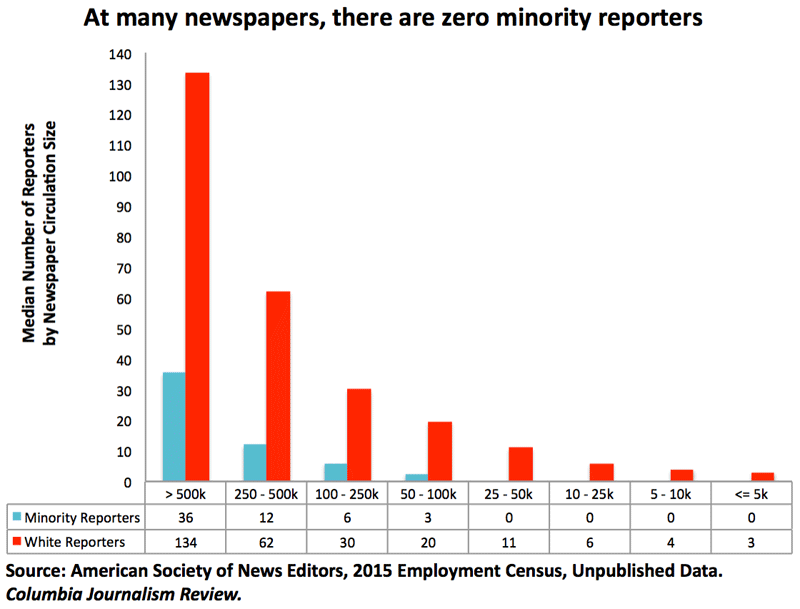
Graph by Alex T. Williams
These low numbers are troubling not only because of what they illustrate about the current state of diversity, but also because of the burden they place on minority reporters when they are hired.
At NPR’s Code Switch, Gene Demby recently interviewed Scott Page, a professor at the University of Michigan who studies how diversity improves decision making at organizations, to explore the pitfalls of “being the only one in the room.”
“One question you can ask is how many people of a particular group have to be in a room for them to speak,” Page said. That is, having a woman in a room doesn’t affect a whole lot if she doesn’t feel comfortable speaking up. And while he has found that the presence of just one member of a minority group in a room can positively influence the rest of the group to be more cognizant of their own language and behavior, that’s different from actually hearing out that person’s ideas.
What Carroll and Demby both point out is that it’s taxing if you are the lone dissenting voice in the room, particularly when you are forced to represent entire communities against the opinions of people who outrank you. Yet the common argument for more diverse newsrooms is improved coverage—which requires minority journalists to challenge and change the status quo.
Given this tension, a 2009 study on minority journalists is worth reviewing. The research team, led by Professor Katsuo A. Nishikawa, wanted to resolve a paradox: Why have some studies found that hiring minority journalists improves coverage of minority communities, while others have found no effect?
After interviewing 18 journalists, the authors concluded that journalists of color acted as “watchdogs” by pointing out stories that needed more nuance and improving the selection of new topics and resources. However, they explain:
A lone voice, asking the pointed question, waving the red flag, might well be drowned out by a chorus of often more senior and influential White voices … diverse newsrooms have the potential to transform the stereotypical, two-dimensional portrayals of minority communities into more accurate, multi-layered depictions. A critical mass of minority journalists committed to that goal, however, is necessary to bring about that transformation.
Since the typical newsroom at a newspaper with a circulation under 50,000 does not even employ one reporter of color, we are clearly a long way from realizing that transformation. And as a result, too often the status quo wins out, with talented reporters of color leaving the field in frustration.
Alex T. Williams is a PhD student at the University of Pennsylvania. His writing his been published by the Pew Research Center, Poynter, and The Washington Post’s Monkey Cage. Find him on Twitter@AlexT_Williams or on his website.