WHITE PLAINS WESTCHESTER DAILY NEWS SERVICE VISITS SINCE 2000 A.D. 25TH YEARl REPORTING THE NEWS YOU NEED TO KNOW News Service Since 2000 A.D. 2026 WILL BE OUR 26TH YEAR OF COVERING WHITE PLAINS NEW YORK USA . John F. Bailey, Editor (914) 997-1607 wpcnr@aol.com Cell: 914-673-4054. News Politics Personalities Neighborhoods Schools Finance Real Estate Commentary Reviews Policy Correspondence Poetry Philosophy Photojournalism Arts. The WHITE PLAINS CITIZENETREPORTER. TELEVISION: "White Plains Week" News Roundup, 7:30 EDT FRI, 7 EDT MON & the incisive "People to Be Heard" Interview Program 8PM EDT THURS, 7 PM EDT SAT on FIOS CH 45 THROUGHOUT WESTCHESTER AND, ALTICE OPTIMUM WHITE PLAINS CH 1300 Fighting for Truth, Justice and the American Way. TOP 10 VISITORS FROM AROUND THE WORLD :1. USA. 2.BRAZIL3.VIET NAM 4. CHINA 5. JAPAN 6.UK. 7.CANADA. 8.INDIA. 9.AUSTRALIA 10.IRELAND 11.GERMANY 12..ARGENTINA 13.BANGLADESH 14.RUSSIA. 15.NEWZEALAND. 16. FRANCE. 17.MEXICO. 18.UKRAINE. 19.SOUTH AFVRICA. 20. IRAQ.
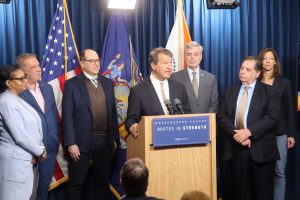
Presenting at NYS Sheriff’s Association Conference
League was seen at the NYS Election Commissioners Conference
Check out all the upcoming events!
A Tuesday Legislative Update?!
We were so busy last week we didn’t have even have time to post! Check out what we we’ve been up to!
New York Voting Rights Act in Action!
Last week, voters in Mount Pleasant New York filed one of the first lawsuits in the state based upon the New York Voting Rights Act. Hispanic voters in the area alleged that the towns at-large voting method does not adhere to the NYVRA as it does not allow for equal representation for Hispanic voters. Read more about the lawsuit here! The Legal Defense Fund backs the allegations and urged the town to make changes. Read their letter here.
Budget Released
The Executive Budget has officially been released! We were pleasantly surprised to see
sufficient funding for the Public Campaign Finance Board as well as some funds set aside for
local boards of elections. Keep your eyes peeled for a more in-depth analysis to come!
Tomorrow starts the budget hearings which typically run from 9am-8pm each day.
The budget briefing book can be found here and the detailed bills can be found here.
We presented our findings on voting in jails at the NYS Sheriff’s Association Conference
The League was invited to present its recent report on voting in jails at the annual NYS Sheriffs’ Association meeting which was held this week. Laura Ladd Bierman, LWVNYS Executive Director, introduced the League and the survey and process used for the study. Hazel Weiser, Project Manager for the study and member of the LWVNYS Criminal Justice Reform Committee, presented the results of the survey and offered assistance by local leagues in getting detainees registered, educated and voting in the jails. While full programs for voter engagement was found in jails in 12 counties, many counties were found to have minimal programs or no programs. The purpose of the presentation was to offer assistance by the League to the Sheriffs in getting more detainees registered and voting. The Sheriffs were receptive and follow-up is being planned. The full report can be found here.
LWVNYS was at the New York State Election Commissioners Conference
Each year I have the incredible honor to celebrate my birthday at the semi annual NYS Election Commissioners Conference!
This year, I was joined by LWVNYS Board member and Election Specialist, Kate Doran, along with advocates from the Brennan Center,
Common Cause, and Citizens Union. Many sessions were focused on gearing up Boards of Election for the 2024 election season.
We spoke with Commissioners from across the state (many of whom had lovely things to say about their local League!). The most common concern for 2024 was recruiting poll workers and staffing for local boards.
Tell me more about Vote Early by Mail?
The lawsuit is in progress; in the meantime, the new law will still be in effect. Do you have questions about how Early Vote by Mail
will work?
Check out the State Board of Elections guidance here! This page makes it easy to compare vote early by mail and the absentee ballot process.
Mark Your Calendars!
New York is Not Disposable Advocacy Days: February 27th
The New York Waste Reduction Coalition is hosting an in-person advocacy day at the NYS Capital in Albany, NY on Tuesday, February 27th
to advance the Bigger Better Bottle Bill and the Packaging Reduction and Recycling Infrastructure Act.
If you plan to attend the in-person Advocacy Day on Tuesday, February 27, we will gather at Westminster Presbyterian Church located at
Join the State League the League’s state issue specialists on February 3rd at 10:00AM for a virtual event about the 2024 legislative session. This program will take a look at how the New York State League adopts and takes action on issues and sets legislative priorities. We will also introduce the various state issue specialists, how members can get engaged in their work, and what the expected hot topics are for the 2024 legislative session. Register for this program here.
Anddddd respiratory illnesses have peaked. This means we are in the smack middle of the season, as we still need to go down the wave.
Here is your state of affairs.
Influenza-like illnesses: High but declining
The number of people seeking healthcare for respiratory illnesses—fever, cough, or sore throat symptoms—is still high but declining rapidly. In previous years, we’ve seen multiple humps, so don’t be surprised if this starts increasing again.
Outpatient Respiratory Illness Visits (Source: CDC; Annotated by YLE)
If we look at the “big three,” flu, RSV, and Covid-19 have seen improvement. Flu is causing the most symptom burden, while Covid-19 continues to lead to severe disease.
Given that we are at the peak of the season, how is healthcare capacity?
It is incredibly difficult (if not impossible) to gauge through data.
This is because what happens internally (diverting care, delayed election surgeries, increased staffing for more beds, expedited discharge planning) isn’t reflected by numbers reported by hospitals. So we rely on anecdotes on the ground, like this one from Boston-based Massachusetts General Hospital a few days ago:
Almost four years after the start of the COVID-19 pandemic, Massachusetts General Hospital … continues to struggle daily with unprecedented overcrowding – particularly in its Emergency Department (ED). For the past 16 months, the MGH ED has operated nearly every day in “Code Help” or “Capacity Disaster” status.
This is concerning because it’s poorly timed with burnout and staff shortages. This will impact everyone’s care. We must figure this out if this is the “new normal.”
Now, a deeper dive into the “big three.”
Covid-19: Very high but declining
Covid-19 wastewater activity is still “very high.” In fact, it’s higher than it was last year. However, on a national level, activity is declining quickly. This basically means the newest subvariant (JN.1) is running out of new infection pathways.
There is still a lot of variability on the local level. For example, many cities—like San Jose, Chicago, and Miami—have yet to peak.
Wastewater SARS-CoV-2 viral activity level on a national level (Source: CDC; Annotations by YLE)
Covid-19 continues to be the leader in severe disease, like hospitalizations. Covid-19 is currently causing about 3 times more deaths than the flu.
It doesn’t have to be like this.
Covid-19 vaccination rates remain abysmal (41% among those over 65 compared to 75% flu vaccine coverage). If we look at the UK, where more than 70% of the eligible population is vaccinated for Covid-19, flu hospitalizationspassed those for Covid-19 this season.
Flu peaked around New Year’s and started to decline quickly. However, we typically see patterns disrupted once school starts again, which happened this year. Flu rates stabilized among kids 5-17 years old, while the other age groups continued to decline.
Percent of Emergency Department Visits for Flu, by age. (Source CDC; Annotated by YLE)
RSV numbers remain higher than this time last year but continue to decline.
National percent positivity rate of RSV tests (Source: CDC)
Hospitalizations among young children are nosediving. Adult RSV patterns are following pediatrics (as usual).
RSV hospitalization rates by age (Source: CDC; Annotations by YLE)
Other things I’m paying attention to
Spring vaccines? Many people are asking whether we will have spring Covid-19 vaccines for those over 65 again. I don’t know. But I do know that CDC’s advisory board—ACIP—has their regularly scheduled meeting at the end of February. I will keep you updated.
Measles. Beyond those discussed in the previous YLE post, another outbreak was reported in Washington state (6 measles cases linked to a family gathering). In addition, the U.K. Health Security Agency (UKHSA) declared a national incident for measles, which is a strong signal showing increased concern. Currently, 319 measles cases are linked to an outbreak in the West Midlands.
Charcuterie meats. The CDC warned of a Salmonella outbreak linked to charcuterie meats. They’re advising the public not to eat the Busseto Charcuterie Sampler from Sam’s Club or the Fratelli Beretta brand Antipasto Gran Beretta from Costco.
Bottom line
There is still a lot of sickness out there, but we are finally headed towards relief. One can’t help but wonder how this season, particularly the strain on hospitals today, would be different if more people got vaccinated.
Stay healthy out there!
Love, YLE and Andrea Tamayo
Andrea Tamayo is an intern at YLE. She is a science journalist and master’s student at the University of California, Santa Cruz Science Communication Program. You can find more of her stories at andreactamayo.com.
“Your Local Epidemiologist (YLE)” is written by Dr. Katelyn Jetelina, M.P.H. Ph.D.—an epidemiologist, wife, and mom . During the day, she is a senior scientific consultant to several organizations, including CDC. At night, she writes this newsletter. Her main goal is to “translate” the ever-evolving public health world so that people will be well-equipped to make evidence-based decisions. This newsletter is free, thanks to the generous support of fellow YLE community members. To support this effort, subscribe below:
Welcome to the Northeast edition of Outbreak Outlook! It is only available to paid subscribers. If you wish to become a paid subscriber and access region-specific information, please click the Subscribe Now button below. Thanks for reading! -Caitlin
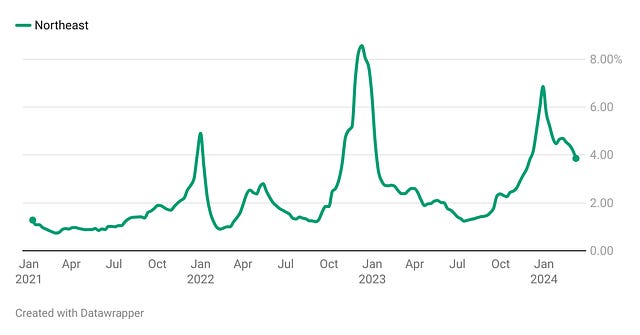
Influenza-like illness (ILI) declined across the Northeast this past week, reinforcing my optimism that the region is past peak activity after a late December surge. Around 5.2% of visits to the doctor were for fever and cough or sore throat during the week ending January 13, down from 5.8% the week prior.
Northeast Region: ILI Activity
Percent of doctors visits for ILI symptoms
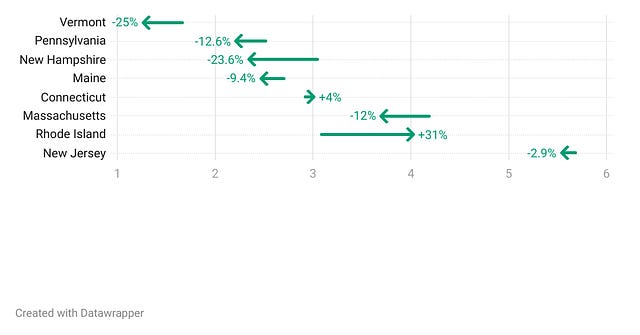
Outpatient ILI: The percentage of doctors visits for fever and cough or sore throat declined in most states across the region. ILI drops occurred in Vermont (-0.1 to 1.7%), Maine (-0.3 to 2.7%), Rhode Island (-0.5 to 2.6%), Connecticut (-0.6 to 3.4%), Pennsylvania (-0.6 to 2.8%), Massachusetts (-0.8 to 4.3%) and New Jersey (-1.1 to 6.5%). Only New Hampshire saw a slight uptick (+0.1 to 3.1%).
Northeast Region: Change in ILI Activity
Percent of doctors visits for ILI symptoms
Hospitalizations for influenza: In terms of influenza hospitalization rates, Vermont posted an increase this past week (+3.8 new admissions per 100K). Most other Northeastern states posted dramatic declines, including Maine (-1.2 per 100K), Rhode Island (-1.3), Massachusetts (-1.7), Pennsylvania (-1.1), New York (-1.1) and New Jersey (-1.1).
Wastewater concentration: Wastewater data also supports my conclusion that the Northeast has reached peak flu season. Wastewater concentration has declined markedly, after a late December peak.
Spotlight on NY: In New York state, ILI fell to 2.5%, which is fairly low compared to other states in the region. However, there has been an unusual uptick in in the central part of the state, so caution is warranted. In New York City, ILI activity remains very high at 9%. And although the outpatient ILI metric is decreasing, hospitalized cases of influenza actually increased, so again additional caution is warranted.
COVID-19
Overall, Covid-19 activity is easing in the region. Leading indicators like wastewater positivity and ER visits are improving in most states. We aren’t seeing uniform declines in hospitalizations just yet, but I think that will change in the upcoming weeks.
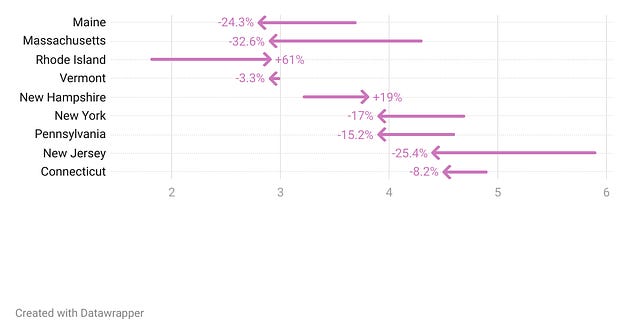
Hospitalizations: The Northeast region saw a mix of increases and decreases in Covid-19 hospitalization admission rates over the past week. Of the 9 states, 1 saw increase and 8 saw decreases. The only increase was in Connecticut, which rose 2.1 per 100,000 population. On the flip side, Maine posted the biggest decrease at 3.2 per 100,000. Other states with drops included New Hampshire (-2.6) and Vermont (-2.3). Marginal declines were seen in Pennsylvania (-1.8), Massachusetts (-1.9), and Rhode Island (-1.7).
Northeast Region: Change in New COVID-19 Hospitalizations
Weekly new hospitalizations per 100,000
Test positivity and emergency department visits: Both test positivity and the percentage of visits to the emergency department that are for Covid-19 dropped across the region.
Spotlight on CT: I checked secondary metrics like test positivity and ER visits in Connecticut specifically, which was the only state to see an increase in hospitalizations. I found that ER visits are falling in the state, so hospitaliations should soon follow.
Wastewater concentration: On the bright side, wastewater concentration dropped quite a bit in the Northeast, after peaking in late December. This gives me additional confidence that the winter wave is receding or will soon.
RSV
RSV activity in the Northeast has fallen for 6 weeks in a row now, with PCR test positivity currently at 6.6%, down from a recent high of nearly 14%. Looking ahead, I expect activity to continue to fall in the weeks ahead, likely dropping below the 5% threshold by the end of this month. Activity should continue to fall and remain low through the remainder of winter and spring until the season resumes in early fall.
Northeast Region: RSV Activity
Test Positivity, Percentage
Norovirus
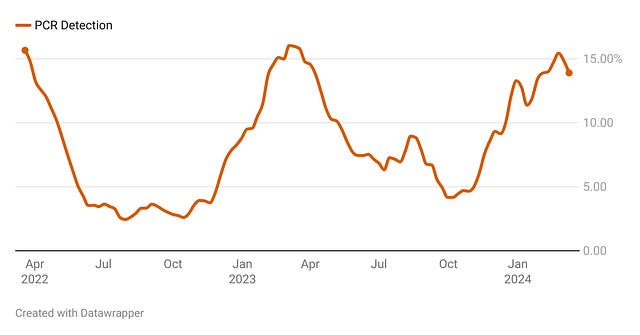
Norovirus activity has slowed a bit in the northeast, with test positivity dropping below 12%. Test positivity has been in the 10% to 14% range since mid-December. For comparison, last year test positivity peaked at 16% in early March. For this reason, I expect the norovirus season to continue for a while yet, but I am glad for the temporary reprieve.
Northeast Region: Norovirus Activity
Test Positivity, Percentage
Other bugs
Seasonal coronavirus activity, a frequent cause of the common cold, is increasing rapidly, which is typical for this time of year. Expect some stuffy noses in the weeks ahead.
Human metapneumovirus and parainfluenza virus, two causes of influenza-like illness, remain low. Adenovirus activity also appears to remain low.
Food recalls
The following foods are being recalled because they are contaminated. Please check your cupboards and throw out any of these items:
Pet food sold by Blue Ridge Beef (more info). Pet food can pose a risk to humans through cross contamination.
If you have food allergies, you may wish to review these FDA safety alerts and USDA alerts for foods with undeclared allergens.
In other news
Several animals with rabies have been reported in the region. This is not uncommon; the Eastern United States experiences periodic animal cases, especially in raccoon and bat populations. These contribute to the spread of rabies to domestic animals and occasionally to humans. Anyone who received a bite from an unknown animal or comes into any kind of contact with a bat should immediately call the health department or seek medical care to be evaluated for post-exposure prophylaxis (preventive shots).
The New York State Department of Health has issued a $300,000 penalty to a Nassau County midwife for falsifying immunization records. The scheme affected roughly 1,500 school-aged children from throughout the state. All affected children must be fully up to date with all age-appropriate immunizations, or be in the process of receiving their missing vaccinations, before they can return to school. The vaccination scheme began at the start of the 2019-2020 school year, shortly after the elimination of non-medical exemptions for required school immunizations.
The Old Polo Grounds, my brother-in-laws favorite ballpark
WPCNR THE SUNDAY BAILEY. News & Comment By John F. Bailey. January 21, 2024. Reprinted from the WPCNR Archives.:
The best league of all is not any of the professional leagues.
It is the Hot Stove League, the league where every team and your team wins.
Because you talk about the coming season.
The Hot Stove League refers to the decades when baseball was the National Pastime. It no longer is, you rarely see pickup games around town anymore. Now they play football and basketball, and if they play baseball they are in organized rec leagues, or little league which still places emphasis on playing the best players. (I wonder if this season they will install the 9 seconds to hit and 18 seconds to pitch major league rules.)
( Full Disclosure: I was 0 for 3 in Little League and struck out three times, and never caught a flyball in rightfield where I was played in the 1957 season. Why? Because the coaches never spent time to teach me how to catch a fly ball.)
But then neither is any professional sport really a national pastime.
They are television entertainment, and as we learn more and more they do not have the health and well-being of players or fans as one of their first concerns.
Can anyone explain to me why there is no heated tarp on the Kansas City and Buffalo fields? How cheap! Playing games in 0 degree temperatures putting fans in danger of frostbite? Paying fans, not groundskeepers on staff to shovel out the stadium? What an amateur operation.
In America more people still see baseball games than any other sport. It is still the sport you do not have to be big or tall to play. You have to develop instincts and situational awareness. And if your’re a girl, you can play fast pitch softball a really lightning like game.
When I was a kid we listened to the World Series on the radio in the afternoons during school. Sympathetic teachers occasionally announced the score. It was what you talked about if you were a boy.
We’d race home in Pleasntville (we walked to school then) to catch the last few innings on tv if we had one. Series Games started at.1 PM or sometimes 12 noon.
Now there are so many playoff games leading in to the World Series that the series is played at night in cold weather and the games end late in the evening when we kids in our 70s have to go to bed.And Texas a wild card wins the Series.
When I was growing up in the 1950s, baseball’s World Series concluded the first week of October (in glorious autumn had low sun and fantastic endings.
Brooklyn’s sinker baller, Johnny Podres, 7th Game October 4, 1955, shutting out the Yankees.
The day Brooklyn will never forget.
Podres shutting out the Yankees in Game 7 in 1955; the Don Larsen no-hitter, in 1956, saved by Mickey Mantle’s one-hand backhand robbery of a Gil Hodges drive in the left center gap, saving the no-hitter.
Mantle Fifth Game 1956, coming from right centerfield in full stride catching up and backhanding Gil Hodges line drive o preserve Don Larsen’s perfect game.
Lew Burdette winning three games in 1957; the White Sox playing the Dodgers in 1959; Willie Mays” Over-the-Shoulder robbery of Vic Wertz in 1954; If you saw those moments, or “saw them on the radio,” as Terry Cashman sang, you remembered them always.
‘Willie” robs Vic Wertz in the 8th– 450 feet from home plate to save Game One–1954
When it is 10 degrees like it is right now on the 21stth of January, old-timers would gather around a hot stove in small town general stores across the great continent and talk baseball about the coming season.
Arguments would ensue on who was the best Mantle or Mays or The Duke (at least in NY). In Chicago the lament was the long-suffering Cubs who never had winning season. Until 1969 when the Mets overtook them.
You aren’t having those discussions this year because nobody is making moves because of the lockout.
Baseball today, like baseball has always been does not care about the fans. The old owners would build teams and sell off their good players as Connie Mack did when he built three championship teams 1911 Philadelphia Athletics, the 1930s Philadelphia Athletics and the Philadelphia Athletics of the late 40s, poised to win, they even had a batting champion, Ferris Fain, but Mr. Mack disbanded that team.
Calvin Grifith did that too with the Washington Senators of the mid-20s, and early 30s, they never contended after the mid-1930s.
Then we have the modern examples the owner of the Montreal Expos, who moved them to Miami. Nowadays in free agency days you never have a great player play a long time for team, or hardly ever. Fans hated it when the Mets traded away Tom Seaver and Nolan Ryan.
The Red Sox traded away Babe Ruth for cash and did not win again until 1946.
Are you getting the idea? This is what fans talked about in the cold dead of winter, the shoveling of snow.
At this time of year we could hardly wait for spring training which should start in three weeks. I loved listening to exhibition games on the radio hearing the Yankee play-by-plqy from St. Petersburg and eagerly hearing about Gordon Windhorn who was just tearing the Grapefruit League in Florida apart in 1959. He hit something like 400 in spring training. He made the team and went 0 for 11 in his first two weeks of games and the Yankees traded him. But Gordon gave young fans hope. He had, though a Topps baseball card.
The Hot Stove League warmed us until the ritual of the baseball season would return.
I was reminded of this when the best brother-in-law in America called me last week while I was trying to put together this week’s White Plains Week.
He is a Giants fan, and he called to tell me about a website devoted to the Polo Grounds, the old home of the New York Giants before they moved to San Francisco, he called to share with me the views of the ghost ballpark, and how the pictures stirred his memory.
In the lee of Coogan’s Bluff. The Polo Grounds“Willie’s” Rookie Topps Card 1951
He recalled Willie Mays the Giants centerfielder, whom he mused could have become the all time home run leader had he not only played 34 games in 1952 and all of 1953 in military service. Larry surmised that Willie could have hit 40 to 50 homers in those years of service, giving him 760 possible homers for his career, best Henry Aaron and possibly Barry Bonds, the current homerun all-time leader (762), despite his use of steroids.
I remembered that Mickey Mantle, the Yankee young star did not lose any years to military service. Larry was surprised by that.
Mickey Mantle’s Rookie Card, 1951.
According to Major League Baseball and I quote, “ While playing high school football, Mantle was kicked in the left ankle. An infection developed which resulted in chronic osteomyelitis. Mantle was classified 4-F the first time he was examined, but his draft board decided to re-examine him and disqualifed him twice more. We mused that Mays may have very well hit over two hundred homers naturally. Based on his record.
This led Larry to remember the winningest left-hander of all-time—Spahnie, Warren Spahn who won 363 games.
Spahnie–Baseball’s Winningest Southpaw
I said yeah, I saw him pitch in 1958 in the World Series shutting out the Yankees, 3-0, and then again in 1965, losing 2-1 in a game I think against the Giants in Shea Stadium. Even in his 40s, he went 8 innings. And he pitched every 4th day. He was crafty, had a sweeping curve ball that sunk and was unafraid to use it. Spahn served in the Navy in World War II losing 4 seasons serving his country in the Pacific.
He returned to the Boston Braves in 1946 and in his first six years back from the Navy he won 21, 15,21,21,22 and 23 games with the old Braves.
If he had been pitching in his service years he possible could have won at least 15 or 20 a year in those 4 years giving him 423 wins lifetime. We talked about his pitching motion, the high leg kick, and his pitching deep into games. (He went 10 innings against the Yankees in the sixth game of the 1958 World Series.)
In the cold 36 degree day Larry was experiencing that day last week in the south, and I was experiencing at 17 degrees in White Plains, the Hot Stove League of our own was keeping us warm, feeling the sunshine on our faces of early spring.
Larry remembered the first game he ever saw, in Yankee Stadium no less.
“I remember the thing most was how green the grass was as we walked into the lower box seats.’ I agreed with a huge smile over the miles of phone line, “Absolutely it hit me with its emerald majesty, the blasts of color from the billboards in the farflung bleacher adds “FYING A,’ “BALLENTINE BEER & ALE” ”. Images of the Big ball Park were real again in our recall of our shared experience in a ballpark.
We warmed to the task. Talk turned to the Giants-Dodgers Playoff of 1951, and he wondered who had pitched for the Dodgers. I said I could not understand why Charlie Dressen the Dodger manager at the time called in Ralph Branca to face Bobby Thompson, who had homered off Branca earlier in the series.
Then I remembered Willie Mays was on deck. However I had to leave the phone to see what pitcher had Branca relieved. I was shocked to discover it was “Big Newk,” who had entered the 9th inning after going 8 innings, handcuffing the Giants.
Dressen figured Newcombe was done after he coughed up three hits and Dressen took him out.
But Branca was not a regular reliever. He won 1, lost 2, and saved 3 in relief in 1951. He came in fired two fastballs to Thompson and the second fastball landed in the left field stands winning the pennant. If Thompson knew the second fastball was coming he still had to hit it.
Just talking with Larry about that game brought me back from my January bad news-17 degrees- covid funk.
This faded into conversation about pitching and baseball memories came rushing back.
Larry recalled when Juan Marichal , then 24 years old the great Giant righthander was locked in a late inning pitching duel with Warren Spahn. Alvin Dark, the Giant Manager, Larry remembered asked Marichal whether he wanted to come out. Marichal, “I ain’t coming out. As long as that old man is pitching. I’m pitching.’
Usually in the Hot Stove League, we’d be talking about the coming season, and in the Hot Stove League every team had made changes which would have them be contenders. Just anticipating the lazy atmosphere of spring training made you impatient if you were a fan in the ‘50s.
I loved that old ball park, the Polo Grounds. It had soul. I loved the old Yankee Stadium with its grand stand to the sky with original façade with a rake in the upper deck stands that hung over the box seats giving you God’s view of the game.
In my last moments of life I will be thinking baseball, my daughter and my wife, my parents, the day in 1961 when my father took me to a Yankee-Tiger night game in sweltering 95 degree heat. (My Dad hated the heat, especially humid heat).
The game goes 9 innings, 3 hours, with the Tigers putting ducks on the pond every inning. Casey changing pitchers every inning. Then the Yankees string 3 singles together in the bottom of the ninth with 2 out to win it. My father never even mentioned leaving the game early.
There was the first game he took me to in Yankee Stadium in 1956 when I was 11. It was Indians and the Yankees in a Wednesday afternoon game. The Yanks won 3-2 when Billy Martin kicked the ball out of the thirdbaseman’s bare hand as the third sacker was trying to tag him out. Martin was a dead duck, but he kicked the ball out of his hand and scored. My father in the only burst of fan interest I ever saw from him, said “Did you see that? He kicked the ball out of his hand.”
I see that play in my replay of memory perfectly to this day.
I miss that Hot Stove League, where there’s never a losing season, you can taste the crisp refresher and stretch in the middle of the 7th, and the great plays, the greats play and cavort on the endless green once more.
So thanks Larry for that call. It was like old times.
I was interviewed by Mr. John Bailey for his show called “People to Be Heard” regarding the legacy of Rev. Dr. Martin Luther King, Jr. and other issues. Below is a link to watch the interview.
El Sr. John Bailey me entrevistó para su programa llamado “People to Be Heard” sobre el legado del Reverendo Dr. Martin Luther King, Jr. y otros temas. A continuación se muestra un enlace para ver la entrevista.
NASSAU SUFFOLK, ORANGE, ROCKLAND, DUTCHESS ULSTER, PUTNAM, SULLIVAN AND WESTCHESTER NEW COVID CASES COMBINED HAVE 2,906 FOR THE WEEK. NEW YORK CITY REPORTED 15,321 CASES IN 7 DAYS LAST WEEK (2,881 DAILY)
WPCNR CORONAVIRUS SURVEILLANCE.Statistics from New York Covid Tracker. Observation & Analysis by John F. Bailey. January 17, 2024:
Westchester Reported 1,984 new persons coming down with covid January 7-13, the second week of the month.
The Westchester new covid cases on Saturday were 38% more than reported by the five boroughs New York City new cases of 1,234 on one day Saturday according to New York State Department of Health.
For the week January 7 to 13, the Westchester 1,984 cases compared to 15,321 new covid cases in New York City
The number persons in Westchester County also reported one day in which covid cases confirmed by New York State positiveS based on persons coming in after they had had an antigen test (self administered), exceeded lab-verified PCR tests.
WPCNR has long suspected that antigen tests taken by individuals that show positive have been ignored until they start to feel sick then they go and get tested are confirmed positive.
Last Thursday, January 12 of the 380 new Westchester covid positives, only 163 tests were confirmed PCR tests and 217 were found positive among antigen test self-administered persons.
WPCNR has long suspected before antigen tests were available for the home that the reason positives were higher than NY Health Department numbers that persons were not getting tested, They were going to work or sending students to school, until they got sick then went in to be treated, and tested positive.
No one in official capacity in Health Departments or in county or town positions have pointed this possibility. I noticed this in August of 2023 when antigen test-positives were separarated out in the daily totals.
The growing number of antigen positive indicate Individuals that show positive have been ignored the positive until they start to feel sick then they go and get tested and are confirmed positive. This behavior, of persons ignoring positive antigen results until they got symptoms, may be contributing to the obviously growing suburban counties that are approximately have the New York City population are now infecting more than all five boroughs of the city.
The first week in December 2023, Westchester had 764 covid infections, of those infections 387 (51%) tested positive through an antigen test and were confirmed. Last week ending January 13, 6 weeks later, of 1,984 covid cases last week , 1,325 were confirned with PCR tests, and 717 (54%) were confirmed positive as a result of antigen tests.
What do I take from this? People relying on antigen tests as they they go about their lives in (“post-covid times,”) if they do not take an antigen test, or if they do, and it is positive,but they do not feel sick, but for one reason or another do not want to miss work, get treated, not socialize, they could be spreading the disease to more persons who do not have it because they are infected with the virus.
The fact that in six weeks Westchester infections of covid have gone from 764 infections that week of Dec 3-9 to– 1,984 5 weeks later as of January 13, indicates that though antigen test positives make up about 54% of all new covid infections, it cannot be overlooked as a factor that many are thinking they are not sick after they take an antigen test even if positive or worse do not self-test after socializaations, until you feel sick could be a source of the spread we are experiencing, combined of course with not having all your vaccines, or worse out socializing in schools, parties, large events.
The JN.1 variant is highly contagious if you have the variant in your respiratory system you can spread it inside of 1 hour to another person.
This could be why the middle to end of the week reported infections are soaring and have been doing so since the New Years weekend.
Monday through Friday the last two weeks: Daily New Cases Day by Day in Westchester
WEEK SUNDAY MONDAY TUESDAY WEDNESDAY THURSDAY FRIDAY SAT TOTAL
3/31-JAN 6 202 265 426 378 303 272 196 2,036
JAN 7-13 154 397 321 275 289 380 168 1,984
In the Mid-Hudson Region, Westchester led all 7 counties with 1,984 infections of covid, followed by Orange with 99, Rockland, 50 and Dutchess 45. Ulster, Putnam and Sullivan had 20, 14,and 11 respectively.
Nassau and Suffolk continue to average 700 infections a week between both counties.
Westchester averaged 29.3 infections a day for 7 days per 100,000 per population, there are 10.04 sections of 100,000 in the county This 29 a day in new infections resulted in 294 infection a day in the county for 7 days which works out to 2,059 a week.
Multiply that by 4 times and the month of January could see 8,236 infections by the end of end of the month. In the last three weeks, the 2,191 infections the week of Dec 24-31 in Westchester County have spread the disease to 2 persons in 2 weeks ended Saturday slightly increasing the 1 spreading to 1 person that resulted in keeping the numbers of new infections slightly lower the last two weeks.
Yesterday I got a Google News alert: “Measles.” Yes, measles. In the 21st century. At the height of winter. (Measles typically spreads in spring.) What’s going on?
Two active and unrelated measles outbreaks among unvaccinated people: Philadelphia and New Jersey
A Delaware children’s hospital on alert after an unvaccinated patient exposed 30 others
Two DC airports on alert for an unvaccinated, infected international traveler
An explosion of measles cases in the U.K. in the past month (255 cases)
This sure seems like a lot. Is measles increasing?
A measles case here or there is not abnormal. We see them every year. Cases typically come from international travelers, but sometimes locally acquired outbreaks emerge among unvaccinated pockets.
As you may also notice above, measles has epidemic cycles. It flares up every four to five years—2008, 2011, and 2019. We can also see this pattern during the pre-vaccine era (see below).
It is exactly 5 years since the last flare-up, which suggests this may be a bad year. Of course, the pandemic could throw off patterns, but we aren’t off to a great start.
What is (and is not) a way forward?
Measles is preventable. And, in the PA outbreak, one unvaccinated child went to daycare while infected, defying isolation.
People are disappointed and shocked that fellow parents wouldn’t vaccinate their children. People are angry that their loved ones may get exposed as a result, especially since babies under 12 months old cannot be vaccinated.
I share a lot of the frustration. But I remember what Dr. Sandro Galea said during the pandemic, “We cannot finger-wag our way to a healthier world.”
Is there collective amnesia? Let’s fix it.As generations age, the memory of mid-20th-century diseases like measles fade. This is a blessing and a curse.
Some don’t know why this disease is bad or if this vaccine is safe. This is understandable. The onus is on public health—we need to equip trusted messengers to start communicating, as measles is:
The most contagious disease, with an infected person infecting an average of 12-18 others (assuming no immunity in the population). In some cases, a single person has infected hundreds of people.
It’s not “just a fever or a rash.” While most people who get measles will recover, it can harm the body in every way possible. Measles can wipe out a huge fraction of immune memory to other diseases, causing an increase in all-cause deaths.
The risks of infection far outweigh the risks of the vaccine, as shown beautifully by the New York Times below.
(Source: New York Times)
Is this a consequence of individualism? Let’s engage. One of the biggest challenges is the rise of individualism, as it goes against public health’s DNA: a collective response for the good of the population. We desperately need to engage with people who find individualism increasingly important. Develop interventions with them.
Is this due to a recent and dramatic decline in trust? Let’s do something about it. Mistakes were made during the pandemic. Misinformation is supercharged by social media.
Bad actors, like the disinformation dozen, drive the majority of anti-vax content.
Politics are further dividing individual health. Many people talk about these challenges (it’s even the theme of Davos this week!),
Unfortunately, measles is off to a great start in 2024. We expect trends to increase.
We need to heed the underlying warning. A laissez-faire approach to public health, on both sides, will not work. Harrowing stories like Roald Dahl’s below will creep into the 21st century. We can do better.
Love, YLE
NOTE: If you’re in Philadelphia, the Health Department has added several additional vaccination sites to ensure that children and adults who need the measles, mumps, and rubella vaccine can get vaccinated at no cost. Check for locations here.
A big thanks to Edward Nirenberg for his help pulling a lot of the research integrated above.
“Your Local Epidemiologist (YLE)” is written by Dr. Katelyn Jetelina, M.P.H. Ph.D.—an epidemiologist, wife, and mom. During the day, she is a senior scientific consultant to several organizations, including CDC. At night, she writes this newsletter. Her main goal is to “translate” the ever-evolving public health world so that people will be well-equipped to make evidence-based decisions. This newsletter is free, thanks to the generous support of fellow YLE community members. To support this effort, subscribe below: