JANUARY 22–WHITE PLAINS KINDERGARTEN TOURS BEGIN WITH GEORGE WASHINGTON SCHOOL. DUAL LANGUAGE Informational meeting at 6 p.m. on Thursday, January 22, in the White Plains High School Media Center.

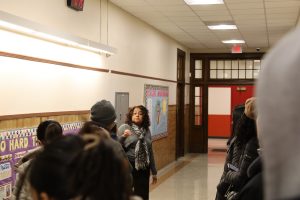
PRINCIPAL LAURA MUNGIN LEADS PARENTS  OF INCOMING KINDERGARTEN STUDENTS INTO GEORGE WASHINGTON SCHOOL TUESDAY MORNING.(Photo courtesy George Washington School.)
WHITE PLAINS N.Y. (January 22, 2026) — Parents of incoming kindergarten students were welcomed at George Washington Elementary School Tuesday morning for the school’s first kindergarten tour of the school year. The schedule for the remaining tours can be found on the district website by clicking here or visiting the calendar.

Principal Laura Mungin and Assistant Principal Joseph Onativia greeted families in the auditorium, giving them an overview of what to expect at their school. They also answered frequently asked questions, such as the offerings for before and after school care (which are available at each elementary school through the White Plains Youth Bureau).
“If you haven’t become familiar with the five schools, please, I encourage you to visit all five,” said Ms. Mungin. “We offer pretty much the same things in terms of curriculum and programming. 
But each building really does have its own personality, and you know what’s a good fit for your kiddo.”
Along with the other four schools, George Washington utilizes curriculum such as Arts and Letters, Fundations, Heggerty Phonemic Awareness and more. You can read more about the elementary program and kindergarten registration by viewing the fact sheet here.
Mr. Onativia reviewed some of the other ways the school supports students, such as with Responsive Classroom, an approach which integrates engaging academics with social-emotional learning. The school also holds community-based morning meetings to build a strong school community and has an engaged PTA which helps support students.
Like each of the other elementary schools, Ms. Mungin explained that each kindergarten class has a teaching assistant to support students. George Washington Elementary School offers a dual language program, which is also available at Post Road and Church Street. Ms. Mungin noted that the first cohort of dual language students recently graduated high school, with several of them receiving the Seal of Biliteracy on their diplomas.
To learn more about the dual language program, visit the Dual Language webpage or attend the informational meeting at 6 p.m. on Thursday, January 22, in the White Plains High School Media Center.
At the end of the presentation, Ms. Mungin and Mr. Onativia answered questions from parents. They gave answers about lunchroom protocols, the dual language program, student screening (students are screened before school starts to ensure they are thoughtfully placed in classes), and more. They also explained the special education process and how students with Individualized Education Programs (IEP’s) are placed.
Families were then led around the school, seeing what the school is like when classes are in session and visiting the media center, cafeteria and gymnasium. They continued asking questions as they traveled the halls and ended the tour at the bus circle.
Posted in Uncategorized

JANUARY 21– COUNTIES’ STATEMENT ON 2027 NY STATE BUDGET

Joint Statement from NYSAC President Philip R. Church and NYSCEA President Hon. J. Ryan McMahon, II

Governor Hochul’s SFY 2027 Executive Budget reflects a clear recognition of the fiscal and operational challenges facing New York amid ongoing federal uncertainty. We commend the Governor for advancing a spending plan that protects the State and counties from disruptive federal cost shifts, including preserving the local Medicaid cap—an action projected to save counties and New York City $9.2 billion in FY 2027 alone.

We are especially encouraged by the Governor’s continued commitment to local infrastructure investment, which is essential to supporting housing development, attracting businesses, and strengthening regional economies.

The Executive Budget commits $3.75 billion over five years for clean water infrastructure and proposes a $425 million Environmental Protection Fund to protect water quality and build climate resilience. The Budget also includes $50 million in new funding for the County Infrastructure Grant Program, increasing the maximum award to $1.5 million, and recognizing that counties must have the resources to prepare sites and build the infrastructure necessary for housing and economic development projects to move forward.

We also commend the Governor for making substantial investments to support job creation, economic development, and affordable housing across the state. This includes $150 million for Regional Economic Development Councils, $200 million combined for the Downtown Revitalization Initiative and New York Forward, $300 million for the POWER UP Fund to create shovel-ready sites, $100 million in capital funding for Pro-Housing Communities, and $170 million to expand and strengthen land banks.

Most importantly, the Executive Budget maintains core local assistance programs and avoids new unfunded mandates during a period of declining federal aid. The Governor’s budget represents the first step in this process and as we move forward, counties look forward to working with the Governor and Legislature to ensure that the aforementioned priorities remain in the final budget and that local governments have the tools, flexibility, and resources needed to deliver essential services, grow local economies, and meet the needs of New Yorkers in every community.

Posted in Uncategorized

JANUARY 21– SENATOR GILLEBRAND NOTES ADDITIONAL FUNDING SECURED FOR NEW YORK STATEE

GILLIBRAND SECURES MORE FOR NEW YORK IN RECENTLY PASSED FEDERAL FUNDING PACKAGE

Bill Includes Funding for Environmental Conservation, Science, Technology, Research, Economic Development, and More

Washington, D.C. –

Today, U.S. Senator Kirsten Gillibrand, a member of the U.S. Senate Appropriations Committee, announced that several of her priorities were included in the just-passed Fiscal Year (FY) 2026 Energy and Water Development, Commerce-Justice-Science, and Interior and Environment funding bills.

In addition to the $65 million in funding Gillibrand personally secured for New York projects as congressionally directed spending items, she secured the following big wins for federal programs and agencies that invest directly in New York via these appropriations bills.

“This funding package is a huge win for New Yorkers,” said Senator Gillibrand. “These federal dollars will help bolster economic development, aid in efforts to protect our environment, and preserve our state’s historic sites for future generations. I was proud to deliver these funds despite the Trump administration’s opposition to many of these priorities, and I will continue fighting to bring home critical federal funding for New York.”


Advancing Science, Technology, and Research

  • $8.75 billion for the National Science Foundation, which will help counter the Trump administration’s proposed cuts, providing support for nearly 10,000 new competitive research awards and more than 250,000 scientists, technicians, teachers, and students.
  • $157.85 million for the construction of a world-leading Electron Ion Collider at Brookhaven National Laboratory on Long Island.
  • $111 million for the Laboratory for Laser Energetics Omega facility at the University of Rochester.
  • $80 million for the National Sea Grant College Program, which will contribute to the research, outreach, and educational work of New York Sea Grant.


Investments in Environmental Conservation, Stewardship, and Remediation

  • $528 million for geographic programs that help protect, restore, and improve New York watersheds and water bodies. Specifically, this includes:
    • $369 million for the Great Lakes Restoration Initiative
    • $93 million for the Chesapeake Bay Program
    • $40.5 million for the Long Island Sound
    • $25.5 million for the Lake Champlain Basin Program.
  • Nearly $90 million for the West Valley Demonstration Project to support the clean-up and remediation of nuclear waste at this site in Western New York.
  • $67 million for National Oceanic and Atmospheric Administration (NOAA) National Marine Sanctuaries, including the newly created Lake Ontario National Marine Sanctuary off the coast of Jefferson, Oswego, Cayuga, and Wayne Counties.
  • $37 million for the U.S. Forest Service’s Urban and Community Forestry Program to support growing and maintaining urban forests and green spaces.
  • $11.75 million for the Delaware River Basin Restoration Program to support wildlife, improve water quality, and enhance recreational access to the basin, which includes parts of New York’s Southern Tier, Hudson Valley, Mohawk Valley, and Capital Region.
  • $2.55 million for the National Estuary Program to protect and restore some of New York’s most significant estuaries, including:
    • $850,000 for the Long Island Sound
    • $850,000 for the New York-New Jersey Harbor Estuary Program
    • $850,000 for the Peconic Estuary Partnership.

Promoting Economic Development and Energy Affordability

  • $329 million for the Weatherization Assistance Program, of which approximately $28 million is expected to help New York households increase the energy efficiency of their homes and lower their energy bills.
  • $247 million to support three Federal-State Regional Commissions that operate in New York: the Appalachian Regional Commission, the Northern Border Regional Commission, and the Great Lakes Authority. These agencies support economic development in Upstate New York via targeted funding and technical assistance for a variety of economic development activities across the state.
  • $175 million in funding for Manufacturing Extension Partnerships (MEP) nationwide. New York’s ten MEP centers provide crucial technological assistance and support for manufacturing in New York, leveraging federal investment to create or save one manufacturing job for every $1,490 in federal funding. Gillibrand also secured language to barring the Trump administration from defunding New York’s MEP network throughout Fiscal Year 2026.


Promoting Historic Preservation and National Parks

  • $36 million increase in funding for the Historic Preservation Fund, which provides grant funding and technical assistance to preserve and restore historical and cultural sites like Fort Ticonderoga and the National Women’s Hall of Fame in Seneca Falls. This increase includes a $4.9 million set-aside for grants to preserve historic sites like the many in New York that are related to the nation’s semiquincentennial anniversary in 2026. $4 million for memorial sites that honor the victims of the September 11th terrorist attacks.
  • $2.2 million for New York’s four National Heritage Areas, including:
    • $709,000 for the Erie Canalway National Heritage Corridor
    • $500,000 for the Champlain Valley National Heritage Partnership
    • $500,000 for the Maurice D. Hinchey Hudson River Valley National Heritage Area
    • $500,000 for the Niagara Falls National Heritage Area.

Posted in Uncategorized

JANUARY 21–BOILING WATER ADVISORY LIFTED IN GREENBURGH

BOIL WATER ADVISORY LIFTED

(White Plains, NY) – The boil water advisory has been lifted by the Westchester County Health Department for all the residents in the following areas in the Town of Greenburgh served by Greenburgh Consolidated Water District #1:

  • Between  Sprain Brook Parkway and  Central Park Avenue including Central Park Avenue corridor (north of Jackson Avenue and Fort Hill Avenue, south of Underhill Road)


  • Between Central Park Avenue and Bronx River Parkway (north of Clifton Road and Inverness Road, south of Old Army Road and Edgemont Road)


  • All streets on both sides of Central Park Avenue (north of old army and Underhill Road, and south of North Healy Avenue).

Test results of water samples taken by the town of Greenburgh were satisfactory.

Since Sunday, January 18, 2026 these residents and businesses were strongly advised to boil all tap water at a rolling boil for a minimum of one minute prior to drinking it or using it to prepare food, wash dishes by hand or brush teeth. The boil water advisory was issued as a precaution to protect residents from potential contamination caused by ground water infiltration into water mains as a result of the reduction in water main pressure caused by the water main break/repair.

If you have any questions or concerns, please contact Greenburgh Consolidated Water District #1 at (914) 989-1900 or Westchester County Health Department at (914) 813-5000.


Posted in Uncategorized