Hits: 55
|
|
|


|
|
|
|

|
Hits: 55
|
|
|
|
|
|
|
|
Hits: 85
Hits: 0

Herb Score pitching in Municipal Stadium in Cleveland in the 1950s
WPCNR VIEW FROM THE UPPER DECK. By “Bull Allen” May 7, 2025:
It was a sultry night in Cleveland’s Municipal Stadium 1957 with baseball’s hottest pitching talent scheduled to pitch against the New York Yankees. The tragic Herb Score.
I will never forget this night.
I was listening to the game on WINS which carried the Yankees that year and Herb Score was on the mound for the Tribe.
He was smoke. As a rookie he went 16-10 in 1955 as a rookie southpaw, fanning 245 batters in 227 innings pitched, a strikeout an inning, and 20-9 in 1956, striking out 263 in 249 innings. His fastball was overpowering, curve devastating, changeup you were never ready for. He was first pitcher in major league history to average a strikeout an inning. His 245 strikeouts as a rookie was broken by Dwight Gooden of the Mets.

Score’s pitching motion was electric, compact and swift, landing on both feet ready to field.
As a 12 year old I was tuned in as the baseball season had just turned 3 weeks old. Mel Allen was at the mike. Score got the first Yankee hitter, then Gil McDougald stepped to the plate. McDougald lined a pitch right back at Score that hit him in the face, squarely in the eye.
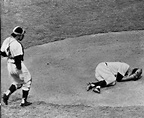
Score on the ground after being hit in his right eye May 7, 1957
McDougald said he heard the thud of the ball he had hit as it struck Score in the face, saw the blood streaming out. McDougald started to go to the mound, shattered by what his hit had done.
FLASH FORWARD 68 YEARS TO THIS PAST Sunday at Yankee Stadium.
The Yankee starting pitcher in the first inning, was hit in the back of his knee by a line drive hit so hard it lined off the pitcher’s leg into rightfield. I do not know whether it is one of the new Torpedo Bats that have been launching rocket shots into the stands around the major leagues this season.
I want TO warn major league baseball they are one deadly hard line drive off a Torpedo Bat away from a dead pitcher felled by a shot in the face. There has not been a player killed in baseball since 1920 when Roy Chapman was killed when he hit in the head by a pitch.
If Torpedo Bats continue to be allowed, pitchers should be outfitted with face masks, catchers, too.
Score was not killed by the line drive to his eye. But his career was ruined.
Today if a pitcher is hit in the face by a lightning “got-all-of-it-on-the-fat-sweet-spot” of a torpedo bat, it will kill him.
It is only a matter of time before this happens.
Score was 24 at the time with a great future in baseball when he got hit. But in an instant, his career was shattered. He took the mound again in 1958, but was not nearly as effective. Never winning more than 9 games in one year.
The reason Score said was that he tore a tendon in his arm while pitching on a damp night against the Washington Senators and sat out the rest of the season.
In 1959, he had shifted his pitching motion in a bid to avoid another, similar injury. “The reason my motion changed”, Score told the author of The Curse of Rocky Colavito, “was because I hurt my elbow, and I overcompensated for it and ended up with some bad habits.”

HERB at the Mike for the Tribe
He stayed with the game he loved though, returning as play-by-play man for the Tribe (Cleveland Indians).
In 1964 he became a broadcaster for the Indians where he stayed behind the mike to 1998. His last broadcast was the 7th game of the 1997 World Series, the only Series the Indians had been in since 1954.
Score died in 2008. He is remembered as a reminder of how fate deals you a bad break, and Mr. Score showed fans how to accept one’s fate with grace and perseverance.
Score was a beloved figure in Cleveland, voted a member of the Cleveland Indians Hall of Fame.
Baseball is a hard, poignant, unfair game.
You have to be mentally tough to play it and its bad hops.
Now 69 years later the memory of what happened to Herb is a warning for pitchers everywhere that they should consider face masks to prevent a concussion, or life-ending injury if they take a Torpedo shot in the face.
Major league baseball is exploring protective helmets for pitchers designs but not masks. Lightweight hockey masks should be explored, because heavier thicker bats are being developed due to the massive popularity of the torpedo bats.
Hits: 101
WPCNR CAMPAIGN 2026 By John F. Bailey May 7, 2026:
Jill Iannetta, City Clerk of White Plains explained today the length of the upcoming terms the newly appointed councilpersons and their challengers will serve should they win one of the seats.
Ms Iannetta described the terms as “staggered” based on the former incumbents terms the appointed new councilpersons are replacing.
Iannetta explained to WPCNR that Councilpersons Nick Wolff and Evelyn Santiago (elected to council this fall) would serve full four year terms, replacing John Martin and Justin Brasch on the Council (Mr. Brasch ran for Mayor in November is now the Mayor who is on the Common Council).
The City Clerk said the new Councilpersons appointed by Mayor Brasch Thomas Caruso and Virginia Simmons are serving different length terms.
Caruso, Ms. Iannetta said is appointed to replace Richard Payne who resigned from the Council after being elected to a new full term. Payne resigned from the Council in December.
Since Payne was elected for another four years but chose not to serve, Iannetta said Caruso would have a full four year term which would expire December 31st, 2029, should he retain the vacant Payne seat
Virginia Simmons, however, Ms. Iannetta pointed out is appointed to replace Jen Puja who was elected to the County Legislature to represent District 5 in the November 2025 election, with two more years remaining in the Puja term.
As a result Ms. Simmons’ appointed term expires December 31,2027.
Iannetta said that Simmons– should she win the Special Election would have to run with two other councilpersons terms of whom are up in 2027:
Jeremiah Frei-Pearson and Victoria Presser terms expire in 2027 creating a three-seats-in-contention council election in 2027.
WPCNR observes that the challenging candidates John Cambareri and Kathy Guglielmo and the appointed candidates would win either a 2 year term on the council if one of them should defeat appointee Simmons, but if one of the challengers defeats Mr. Caruso, the challenger would win a 4 year term on the council.
What I wonder about is whether the longer term seat (Caruso’s) and the shorter term seat (Simmons appointee) would be decided by first two highest total votes or if the seats would have one challenger facing the appointed incumbent which would be definitely an advantage to the appointee. Serving 2 years is less money than 4 years. If you organized by highest vote totals as determining who win the seats, the challengers have a better chance of winning. Going 1 on 1 by length of term is a disadvantage.
Hits: 88

TONIGHT 8 PM ON FIOS 45 AND OPTIMUM CH 86– JOHN BAILEY INTERVIEWS
SUPERINTENDENT OF SCHOOLS DR JOSEPH RICCA
ASSISTANT SUPERINTENDENT FOR BUSINESS ANN VACCARO-TEICH
ON THE NEW BUDGET AND WHAT IT ACCOMPLISHES AND WHY IT MAKES SENSE
AVAILABLE 24-7 ON WHITE PLAINS TV AT
WWW.WPCOMMUNITYMEDIA.ORG
Hits: 113
|
 |
Enjoying this newsletter? Why not share it with a friend?
|
|
|
|||||||||||||||
The past week has been pretty wild for public health. On top of our usual New York programming, we’ve been getting a lot of questions about the evolving hantavirus situation on the cruise ship. So yesterday, Katelyn from YLE National and I sat down for a Substack Live to talk through what we’re hearing, what we know so far, and how we’re thinking about the risk.
You can watch that conversation here.
The bottom line up front is that there is currently no risk to New Yorkers. YLE National shared some details earlier this week if you want more information. I’m following it closely and will report back with relevant updates.
Okay, back to New York. Today I’m covering a measles case in Manhattan, what a district court decision means for access to abortion medication by mail, the official closing of Purdue Pharma and the aftermath of the opioid crisis, and “flesh-eating bacteria,” which, spoiler alert, you really don’t need to panic about.
The NYC Department of Health has reported a possible measles exposure in Manhattan this week. Anyone who visited Norma’s Restaurant in Hell’s Kitchen on April 26, 5:00 – 8:00 PM may have been exposed. Monitor for symptoms until May 17th.
Potentially exposed people should contact their health care practitioner if they develop measles symptoms, which usually start like a cold and progress to a rash.
So far, there haven’t been additional cases. If you do develop symptoms, it’s important to call your doctor or clinic before you visit in person so special precautions can be taken to prevent further spread.
In last week’s post, I went into more detail on vaccination recommendations and guidance on titer checks. You can find those details here.
Last week, a federal appeals court in Louisiana ruled that mifepristone, one of the two medications most commonly used for medication abortion, cannot be shipped by mail anywhere in the country. This would mean that patients could no longer receive mifepristone by mail after a telehealth appointment and would need to get it in person from a clinician or other approved clinic.
Almost immediately, one of the companies that makes the drug (Danco Laboratories) filed an emergency appeal. The Supreme Court temporarily paused the ruling for one week, so as of this writing, mifepristone can still be mailed. But the pause is temporary and the situation could change quickly.
It’s important to understand, as YLE National covered in detail this week, that the abortion medication misoprostol is still available to be shipped by mail. Misoprostol is typically used in combination with mifepristone, but it can also be used safely and effectively on its own for medication abortion.
The legal fight matters for New York for a few reasons:
What you need to know:
What to do: If you or someone you know needs medication abortion via telehealth, access continues through Planned Parenthood and NYC Health + Hospitals telehealth. If you have a pending prescription or appointment, contact your provider now to confirm your protocol. I’ll be watching for any Supreme Court updates, and share them as they come—I expect this story to keep evolving relatively quickly.
On May 1, 2026, Purdue Pharma—the company that launched OxyContin in 1996, which fueled the opioid crisis—officially ended its operations.
This follows years of litigation from state attorneys general, including New York’s Letitia James, over Purdue’s misleading and aggressive marketing of opioids. The company faced thousands of lawsuits over its role in the opioid epidemic and has previously pleaded guilty.
Here are the details and what they mean for New York:
This is a landmark moment in the story of the opioid crisis. But the more important question is what comes next. And when I read this news, I breathed a huge sigh of relief.
There are still so many complicated emotions wrapped up in this, including grief, heartbreak, anger, exhaustion, and many others. But right now I’m holding on to hope for the future. Hope that we will continue to support the communities that have been devastated by this crisis. Hope that settlement dollars will actually reach the people and programs that need them. And hope that we can do better to prevent something like this from happening again.
The important question now is: what comes next?
Overdoses in NYC finally dropped in 2024 after years of increases. (I covered it here.) But overdoses are still extremely high—NYC recorded more than 2,000 overdose deaths in 2024. This translates to someone dying of an overdose every few hours. Opioids are still the main driver, with fentanyl being the most common substance involved.
 |
Overdose deaths in NYC. Figure from the NYC Department of Health and Mental Hygiene.
This settlement matters, but only if it reaches the people who need it most. New Yorkers in the Bronx, Brooklyn, Upper Manhattan, and Staten Island have been hit especially hard by overdose deaths. We need to ensure this money is used to expand treatment, harm reduction, prevention, and recovery services for the communities bearing the heaviest burden.
What to do:
“Flesh-eating bacteria” sounds like something from a horror movie, but it’s a real headline that’s been making the rounds in New York news.
The phrase is scary, and frankly, might be designed to get clicks, but the actual risk to the public is still low.
Here’s what’s going on: Researchers at Stony Brook have detected Vibrio vulnificus in several Long Island waters, including Sagaponack Pond, Mecox Bay, and Georgica Pond. This bacteria naturally lives in warm saltwater or brackish water, especially as water temperature rise.
Most people do not need to worry. Severe infections are rare—about three cases in NYC annually, and about 150-200 cases across the U.S. But when infections happen, they can be serious: CDC notes that about one in five people with Vibrio vulnificus infection die, sometimes within a day or two of becoming sick.
The people who should pay the closest attention are older adults, people who are immunocompromised, and people with liver disease, diabetes, cancer, HIV, or weakened immune systems.
There are two main routes of infection:
Symptoms can include watery diarrhea, stomach cramps, nausea, vomiting, fever, or chills. Wound infections can cause redness, swelling, discharge, severe pain, or blistering. Seek care quickly if symptoms develop after water or seafood exposure.
What to do:
Researchers are pointing to nitrogen runoff (from fertilizers), algal blooms, and rising ocean temperatures as potential drivers of the bacteria.
The headlines here are definitely scarier than the risk. But the practical guidance is simple and worth following: keep wounds out of warm coastal water, and seek care quickly if symptoms develop.
Tick activity in the Northeast is high and continuing to increase.
 |
Emergency department visits for tick bites in 2025 (black) and 2026 (green). Figure from CDC.
Pollen is high in South New York, but doesn’t look too bad upstate. But take this with a grain of salt—you may be more or less sensitive. For example, even though allergies for NYC are “medium-high,” I feel like they are hitting me like a truck this week.
 |
Pollen levels from pollen.com
You’re all caught up! Have a great end to the week, and I’ll see you next week.
Love,
Your NY Epi
Dr. Marisa Donnelly, PhD, is an epidemiologist, science communicator, and public health expert. This newsletter exists to translate complex public health data into actionable insights, empowering New Yorkers to make informed and evidence-based health decisions.
Thanks for your financial support of Your Local Epidemiologist in New York! I couldn’t do this without you. — Marisa
Hits: 132

(PHOTOS COURTESY, WESTCHESTER COUNTY)
WESTCHESTER COUNTY EXECUTIVE KEN JENKINS DELIVERS 2026 STATE OF THE COUNTY ADDRESS
***Watch the State of the County Address Here***
***Read the State of the County Address***
(White Plains, NY) – Westchester County Executive Ken Jenkins delivered his second State of the County Address, outlining a year of measurable progress, continued investment and a people-first approach to governing – centered on affordability, public safety, mental health, housing and economic growth.
Speaking before the Westchester County Board of Legislators, led by Chairman Vedat Gashi, Jenkins framed his address around the voices and experiences of residents across the County.

From the podium, Tom Roach led the Pledge of Allegiance and Westchester County Department of Correction Sergeant Joetta Crump delivered the National Anthem. A diverse and meaningful series of opening prayers followed. President of the Westchester Board of Rabbis Rabbi Leora Frankel offered the first invocation, followed by Arun Bhagirath of the Hindu Temple of the Tri-State. Westchester Muslim Center Imam Shaffieq Chace continued the interfaith reflection, and Westchester County Director of Faith Based Initiatives Rev. Kym McNair brought the prayer segment to a close.
Majority Leader Judah Holstein and Minority Leader Margaret A. Cunzio escorted Jenkins to the podium.
In the opening of this speech, Jenkins said: “The State of our County isn’t something I read on a page—it’s something I see in the people I meet every single day. Because when you meet the people of Westchester, you understand the state of this County.”
Strong Fiscal Foundation
The County Executive started off the State of the County address highlighting the County’s finances. Westchester County once again earned the highest possible “AAA” bond ratings from both S&P Global Ratings and Fitch Ratings, reflecting strong financial management, healthy reserves and long-term fiscal stability.
Additionally, Jenkins addressed the tax increase head-on. He said: “I made a promise to you that I would always lead with honesty and with reality, not politics. And the truth is this: it would be irresponsible—truly irresponsible—for me to hold the line or cut taxes while the needs of our residents are growing every single day.”
Jenkins pointed out that the average annual impact of the tax increase is $60 a year adding, “it was the right thing to do and I appreciate you all supporting this decision.”
Public Safety Progress
Another pillar of the speech was continued strides in public safety. The County reported significant declines in crime across all seven-index categories in 2025 compared to 2024:
· Overall crime down 17%
· Violent crime down 25%
· Property crime down 15%
In 2025, compared to 2024, crime is down across the board. All of the seven major index crime categories saw a decline — from violent crimes like murder, rape, robbery and aggravated assault, to property crimes including burglary, larceny and motor vehicle theft.
Additionally, Mount Vernon was one of five police departments in New York State to report zero shooting incidents from January through March 2026.
Jenkins thanked Governor Kathy Hochul for her support, as well as the Westchester County Department of Public Safety and all the local municipal departments.
Addressing Housing Affordability
Jenkins highlighted the County’s efforts to approve funding for projects that will create and preserve hundreds of homes across Westchester. These efforts include supportive housing for young people aging out of foster care, expanded opportunities for first-time homebuyers, and the development of safe, modern apartments for families and seniors.
Peekskill – 41 North Division Street: Converting a vacant office building into 22 affordable and supportive housing units, including homes for youth aging out of foster care.
Greenburgh – 175 Winthrop Avenue and 14 Payne Street: Building nine single-family homes for first-time homebuyers.
Ossining – 80 Main Street: Bringing 25 long-vacant units back online as affordable housing.
Tarrytown – Franklin Courts Apartments: Rehabilitating 70 existing public housing units and adding 20 new ones.
White Plains – 19 Greenridge Avenue: Converting an office building into six new residential units.
Croton-on-Hudson – 1–3 Croton Point Avenue: Developing 100 homeownership units for first-time buyers.
Bedford – 12 McLain Street: Creating four new affordable homes for first-time homeowners.
Yonkers – 632–636 South Broadway: Constructing 160 new rental units for families.
Mental Health and Human Services
Also highlighted was the County’s continued prioritization of care for residents facing some of life’s most difficult challenges – those who are struggling, vulnerable, or seeking a second chance. During the speech, one such initiative highlighted was the County’s Lives Forward Program, a partnership between the Department of Community Mental Health and the Department of Correction. The Program provides training for justice-involved individuals living with mental health and substance use challenges, preparing them to become dual-certified peer counselors. Since its launch, multiple cohorts have graduated, with participants moving into meaningful roles supporting others on their path to recovery.
Among those graduates is Alfredo Roldan, who, after overcoming significant personal challenges, successfully completed the program, passed New York State certification exams, and now serves as a peer counselor with Family Services of Westchester. His journey reflects the Program’s impact and the broader potential for recovery and reintegration.
The Westchester County Mental Health Safety Net Clinic was showcased, restoring the County’s direct role in providing outpatient mental health services for the first time in nearly 15 years.
The County also expanded outreach and awareness of the 988 Suicide & Crisis Lifeline, a free, confidential, 24/7 resource, through partnerships with local businesses, community organizations, and the Department of Public Works and Transportation.
Jenkins said: “Government is measured by whether we are willing to help people rebuild their lives. This is what progress looks like.”
Economic Growth and Workforce Development
Underscored was also the County’s commitment to small businesses. Over the past five years, the County’s MWBE initiatives have facilitated more than $250 million in contracts, expanding opportunity across Westchester.
The County is investing in its workforce through initiatives like Connect Westchester and County-wide job fairs, connecting residents directly to employers. Programs like the Element 46 Tech Accelerator are supporting entrepreneurs as they launch and grow in Westchester.
Westchester also secured an approximately $820,000, three-year grant from The Taft Foundation to launch the Partnership for Inclusive Internships Program with The Arc Westchester Foundation and AHRC New York City, expanding opportunities for individuals with disabilities.
The County continues to strengthen its partnership with Rensselaer Polytechnic Institute (RPI), building a direct pipeline from education to employment in high-growth fields like engineering, AI and quantum computing. A new degree completion program with RPI and SUNY Westchester Community College allows students to earn a bachelor’s degree without ever leaving Westchester.
Jenkins said: “Let me be clear – while we are proud to partner with globally respected institutions like RPI, we are equally proud that we already have outstanding colleges and universities right here in Westchester that are shaping futures every single day. Institutions like Pace University, Mercy University, Iona University, Sarah Lawrence College, Purchase College and SUNY Westchester Community College are producing talent, driving innovation, and opening doors of opportunity for students across our County. Westchester is not waiting for the future to arrive – we are educating it right now.”
Sustainability and Infrastructure
Westchester County’s recently released Waste Reduction Study underscores the County’s leadership in sustainability while outlining a path for continued progress.
With a recycling rate exceeding 50%—well above the state average—and strong infrastructure already in place, including material recovery facilities and food scrap and yard waste programs, the County has built a solid foundation. Now, it is setting its sights on New York State’s goal of an 85% recycling rate by 2050.
Jenkins also reaffirmed the County’s position on energy policy. Jenkins said: “Restarting the Indian Point Energy Center is not welcome in Westchester County… We do not need it – and we do not want it.”
Welcoming the Lenape People
During the speech, Jenkins also announced that the Lenape Nation will be housed at the Ward House in Tuckahoe. While the newly purchased property still needs to undergo considerable renovation, Jenkins says it only makes sense to have the original occupants of the land return.
Jenkins said: “But also, as we approach the 250th anniversary of our nation, we need to take a moment – not just to celebrate – but to reflect. Because our story as a country didn’t begin 250 years ago. It began long before that – with the people who first called this land home, long before the clock on those 250 years ever started.”
And it’s in that spirit of reflection and recognition that, earlier this year, Westchester County took an important step forward by purchasing the historic Ward House in Tuckahoe. On March 16, 1777, a violent clash between Patriots and Loyalists left Captain Samuel Crawford mortally wounded next to the home. His body was never returned, taken to a British prison, but his legacy endures.
Jenkins said: “While that is an important part of our history, the land, and who lived on that land is also an important part of our history. And now, Westchester County is taking a step to help the Lenape people return home to Westchester County.”
Transportation and Innovation
Emphasizing that we now “live on our phones,” Jenkins applauded the advancements with contactless OMNY payments on Bee-Line buses, along with solar-powered bus stop lighting and a $3 million dollar zero-emission micro transit pilot.
Jenkins also highlighted the County’s work at Westchester County Airport (HPN), moving forward with long-overdue improvements to its airport terminal to better meet the needs of travelers. The current terminal no longer meets basic expectations, and the County is addressing these challenges directly. To lead the project, the County selected HNTB, a nationally recognized leader in airport planning and design, while maintaining full County ownership and operational control. Jenkins emphasized that this effort is focused on modernization—not expansion.
Consumer Protection
Jenkins underscored his commitment to responsive government by making County services easier to access and easier to navigate. The Department of Consumer Protection is now offering office hours by appointment to better serve residents and contractors seeking assistance. This new option allows individuals to schedule time for one-on-one guidance on matters such as contractor license applications, document review and other consumer protection services. Appointments can be made online, through links provided in contractor license materials or by calling the office directly.
Jenkins said: “This is about meeting people where they are—providing personalized service, reducing delays and helping applicants move through the process more efficiently.”
Health
Jenkins also took the time to highlight legislation he is pushing that would prohibit the sale of e-cigarettes and vaping devices designed to look like everyday items such as highlighters, pens, USB drives, toys, drink containers and backpacks.
The proposed law would ban the sale or transfer of these deceptive devices, establish escalating fines for violations, and authorize the Westchester County Board of Health to enforce the measure.
Rev 250
Jenkins took the time to highlight that history will be coming to life this summer in a powerful and unforgettable way. For a limited time, Westchester will be showcasing one of the most significant documents in American history – the Holt Broadside printing of the Declaration of Independence.
The document is currently awaiting a special box for its transport and display, and then will go on loan and on public display at the Neuberger Museum of Art at SUNY Purchase. This rare printing is one of the earliest surviving versions of the Declaration, produced in July 1776 to share the news of independence across the colonies.
Beginning this summer and continuing through the end of the year, residents, families and students will have the opportunity to experience this extraordinary piece of history up close.
It is more than an exhibit—it is a moment. A chance to stand in front of the very words that helped shape our nation, right here in Westchester County.
Closing Message
Jenkins closed his address by returning to the central theme of his administration.
He said: “If anyone asks what is the State of our County—tell them it is not found in a report, a spreadsheet or a speech… The State of our County is our people… your struggles, your resilience, your hopes—and your voices.
“The State of our County is strong. The State of our County is hopeful. And the State of our County is you.”
He called on residents to move forward together—with courage, with compassion, and with confidence in what can be built side by side.
In a moment that brought both pride and a sense of summer nostalgia into the room, Jenkins closed by looking ahead to something generations of Westchester families hold dear—the reopening of the iconic Dragon Coaster at Playland Park this summer.
“I’ll meet you at the Dragon Coaster,” he said—ending the night on a note of optimism, tradition and the shared experiences that continue to define Westchester County.
State of the County Video Series
***Video 1 – Year in Review***
***Video 2 – Real People, Real Impact***
***Video 3 – Preserving Our Past, Inspiring Our Future***
***Video 4 – The Historic Ward House Welcomes the Lenape People***
Hits: 120

Enjoying this newsletter? Why not share it with a friend? In August 1986, a stomach ulcer medication called Cytotec arrived on pharmacy shelves across Brazil. It came in a small box, and on the label, printed clearly, was a warning: do not take it if you are pregnant because it can cause miscarriage. Abortion had been illegal in Brazil since 1890, so women who needed one faced a brutal menu of options that were dangerous, expensive, and often deadly. In fact, unsafe abortions were one of the leading causes of maternal death in the country. But then, in a five-year span, Brazil’s maternal mortality rates fell 21%. It turned out that Brazilians in need of an abortion read the “do not use if pregnant” warning on Cytotec bottles and quickly realized that it worked as an abortion option. Word moved through whisper networks from neighborhoods in Recife to pharmacies in São Paulo, and Brazilian pharmacists started to recommend the product for safely terminating pregnancies as a workaround around the criminalization of abortion. Brazilian doctors started calling the Cytotec medication “Saint-otec” because far fewer women were dying from abortion complications thanks to this ulcer pill. That was nearly forty years ago. Today, American courts threaten access to abortions in the U.S. with the restriction of mifepristone, an abortion pill used in ~65% of U.S. abortions, which dominates every headline. The legal, medical, and public health implications are enormous. But regardless of what happens in courts, American women have access to the same lesser-known option that changed everything in Brazil. Most don’t know it exists. The other option: Misoprostol onlyIf you’ve been following the news about medication abortions, you’ve probably been picturing one pill. But for a medication abortion in the U.S., patients are given two: mifepristone (”mife”) followed by misoprostol (”miso”). The legal cases have focused entirely on mife, because it was specifically approved by the FDA in 2000 for abortion. Miso’s FDA approval, by contrast, still officially says “stomach ulcers.” This is the same ulcer drug Brazilian women figured out forty years ago. It has simply been used off-label for abortion, labor induction, postpartum hemorrhage prevention, and more ever since. Why isn’t miso only routinely used in the U.S.?Clinical consensus holds that the combined regimen (mife+miso) is slightly more effective at ending a pregnancy than miso alone. This is primarily based on pooled data from a wide range of studies that included various ways people can use the medication, i.e., different dosages, routes of administration, and dose intervals. But when scientists review studies on the currently endorsed miso-only regimen (3+ doses of 800 ug miso taken every 3 hours), miso-only may be more effective than commonly thought. A 2024 analysis looked across eight study groups that examined 3+ doses of miso only: ~90% had a complete abortion (compared to ~95% expected for the combined mife+miso regimen).
Source: Moseson et al., “How effective is misoprostol alone for medication abortion?” NEJM Evidence. 2024;3(6). DOI: 10.1056/EVIDccon2300129 Miso only for abortion is also safe: only 0.7% of ~12,000 users from a 2019 meta-analysis had a blood transfusion or were hospitalized for abortion-related reasons. Some people worry that using miso only may be a more physically uncomfortable way to terminate a pregnancy than mife+miso due to the gastrointestinal effects of miso, but the comparative research on this is weak. A Cochrane Review concluded no difference in side effects, except maybe more diarrhea with miso-only. More research is needed, and some is already underway. Researchers are leading a randomized controlled trial in the U.S. to collect MUCH more detailed data on the side effects of the miso-only regimen compared with the mife+miso regimen, so that patients and providers alike know what to expect. Restricting mife is still unconscionableThe medical evidence is overwhelmingly clear: use of these pills is medically safe—safer than other medications we routinely use, and certainly safer than childbirth. The National Academies of Sciences, Engineering and Medicine even released a comprehensive report emphasizing the safety of abortion care, including medication abortion. These medications are also highly effective for ending pregnancies and result in a complete abortion in nearly all cases. In fact, in March 2022, the WHO strengthened its guidelines on medication abortion, taking into account evidence over the past decade on self-managed medication abortion as a safe and effective model of abortion care (not “just” as a last resort).
A study in the Lancet assessed self-managed abortion using medications compared to clinician-managed abortion in a health facility among more than 1,000 people aged 14-50 years old. The study found that 96.9% of people who self-managed had a complete abortion using pills alone—the same high effectiveness seen in clinical studies of medication abortion effectiveness. Source: Aiken et al., 2022, Lancet. What this means for youAs this plays out in court in a loud, confusing, and exhausting way, one of the quietest forms of harm in reproductive health care is when people don’t know all their options, and the choice gets made for them. Abortion is one of the more common health experiences we have, so having information for yourself or your loved ones is imperative.
No matter what happens with this current case on mife, patients will continue to need abortion pills, and dedicated clinicians and advocates will still have a solid option to provide them. Bottom lineRestricting access to mife is epidemiologically baseless given 26 years of robust safety and effectiveness data. Yet, even if Americans ultimately end up with constrained choice, not all medication abortion is off the table. People will still have access to a safe and effective method of medication abortion care: miso only. Let’s hope it doesn’t come to this, but whisper networks still work, just ask Brazil. Pass it on. Love, YLE and HM Heidi Moseson, PhD, is a reproductive epidemiologist and scientist at Ibis Reproductive Health. She studies abortion access in the U.S. with a particular focus on self-managed abortion with medications. Your Local Epidemiologist (YLE) is founded and operated by Dr. Katelyn Jetelina, MPH PhD—an epidemiologist, wife. YLE reaches over 425,000 people in over 132 countries with one goal: “Translate” ever-evolving public health science so that people are well-equipped to make evidence-based decisions. This newsletter is free to everyone, thanks to the generous support of fellow YLE community members. To support the effort, subscribe or upgrade below: |
Hits: 159

WPCNR CAMPAIGN 2026: By John F. Bailey. May 5, 2026:
Kathy Guglielmo and John Cambareri have had their signature petitions approved to be on the ballot to challenge the two councilpersons appointed by Mayor Justin Brasch to replace two council persons who left the Common Council in the last two months of 2025.
Former Councilwoman Jen Puja was elected to the Westchester County legislature to represent White Plains, Scarsdale and Harrison in District 5, Benjamin Boykin’s former District.
Former councilperson Richard Payne ran for a second term as councilman in November and won election, but announced his resignation from the Council in December take a position of employment abroad.
Mayor Brasch appointed Thomas Caruso to the former Payne seat and Virginia Simmons to fill the Puja vacancy.
Mr. Cambareri ran for Common Council in the Brasch Lolis campaign this year but did not win.
Mis Guglielmo is a first time candidate. She is a long time resident of White Plains.
Whenever a councilperson is appointed to complete a term of a person leaving the position before the former incumbent’s term is completed, the appointee to the seat is required to stand for another election to win election again to either a full term or to complete the remainer of a term.
The Republican candidates and the administration appointees are contesting for full terms of 4 years each.
Hits: 133
Westchester Medical Center Doctors to Rally Over “Absurd” Time-Tracking System
Frustrated with New CEO’s Refusal to Address Administrative Burdens, Doctors to Speak Out
Westchester, NY—After more than a year of pushing back against a “highly burdensome” new employee time-tracking system, resident physicians at the center of care at Westchester Medical Center (WMC) and other facilities will hold a brief “unity break” AT THE MEDICAL CENTER TODAY AT NOON to demand change from CEO Dr. David Lubarsky.
Unionized with the Committee of Interns and Residents (CIR/SEIU), leaders among the group of 400-plus resident physicians say the irrational swipe-in-based tracking system is fundamentally at odds with their day-to-day as doctors.
The young physicians, who are salaried and who do not receive overtime pay, work up to 80 hours a week at the main WMC hospital and facilities across the region. Under the new system, they sometimes have to drive long distances through traffic to return to WMC from another site–just to swipe in.
“This is truly an absurd system given the nature of our work as resident physicians,” said Dr. Zachary Weiss. “By refusing to meet with us, management is showing a fundamental lack of regard for our well-being, and hugely disrespecting our dedication to providing excellent care to people across Westchester and beyond.”
Despite numerous requests for meetings to discuss possible solutions, and the hospital administration relaxing its policy for its attending physicians, Dr. Lubarsky and his team have failed to even meet with the union doctors about their concerns. Dr. Lubarsky started his role at Westchester Medical Center in early 2025 after leaving the University of California-Davis.
Hits: 121

Enjoying this newsletter? Why not share it with a friend? Hantavirus, allergies and common cold, Covid-19 spring vaccine, and good newsThe Dose (May 5)
Spring is beautiful, but it may also be making you feel miserable. Ticks are out in record numbers, pollen is everywhere, and the common cold is hitting its seasonal peak. Meanwhile, an unusual hantavirus outbreak on a cruise ship sounds like a movie plot, but it’s a sharp reminder of why global health connectivity matters. I’ll walk you through what disease detectives are piecing together, answer a Covid vaccine question, and close with some good news. Let’s dig in! Disease weather reportTicks keep on ticking–NORTHEAST LEADS IN TICK BITE ER VISITSIt’s an unusual year for ticks. Emergency department (ED) visits for tick bites are running at roughly 114 per 100,000 people per week, nearly double the typical rate at this time in previous years (60-70 per 100,000).
The Northeast is bearing the brunt of it, with the Midwest running a close second. It’s not clear whether this is just an earlier year or a worse year overall. Time will tell.
Data from CDC; Annotated by Your Local Epidemiologist. ED data are a remarkable window into public health because data are quick, and so many Americans use emergency departments as their primary or urgent care. Why are people going to the ED for a tick bite? Four main reasons:
What this means for you: Prevention goes a long way. Most pathogens can only be transmitted after a tick feeds for some time, so call your physician if one has been attached more than 36–48 hours. Use tweezers for removal (the only recommended method). And remember: nymphs are the size of a poppy seed. Feeling crummy? It’s likely the common cold and/or allergiesThe common cold is approaching its spring peak while other respiratory viruses become dormant. If you’re feeling crummy right now, it’s probably a cold.
Percent of positive tests for respiratory viruses. Source: NREVSS; Annotated by Your Local Epidemiologist Or it may not be a virus at all. Much of the U.S. is suffering from allergies, and allergy season is getting longer and more intense. Plants are releasing pollen about 40 days earlier than they used to and stopping about two weeks later, thanks to rising temperatures. Higher CO2 levels mean more pollen per plant.
Pollen.com map What this means for you: Check the pollen forecast, rinse your nose with saline (use distilled water), and shower before bed to wash pollen off. For medication, go with second-generation antihistamines like Zyrtec over Benadryl (Benadryl has been around since the 1940s but carries more side effects.) Always check with your doctor. Also, here is a great room-by-room guide you may find useful. Spotlight: What hantavirus and a cruise ship are reminding usOver the weekend, news broke of a small but alarming outbreak aboard a cruise ship traveling from Argentina to South Africa: three deaths, one critically ill, and three additional suspected cases of hantavirus. (Two cases have been confirmed so far.) Hantavirus kills 40–60% of those it infects, making it one of those viruses that would make a terrifying movie. While it is very rare, random cases do pop up—even in the U.S.—when rat droppings are aerosolized. (You may remember Gene Hackman’s wife, Betsy Arakawa, died last year in New Mexico.) But this situation is unusual because multiple cases are suspected within a very confined space, and the ship is coming from Argentina, which is home to a particularly nasty strain of hantavirus. (More below.) So disease detectives are working urgently to piece together what happened to these seven people, assess the risk to everyone else on that ship, and the risk to South Africa (and the world) waiting at the other end. Five questions, specifically, are worked in parallel:
Answers to these questions will come, but there is a silver lining. This is unfolding in South African waters. South Africa has very fast data, is home to some of the world’s best epidemiologists, and is a true team player in the world of global health, willing to work with (and alert) other countries. What this means for you: Risk to Americans is essentially nil right now, and the probability of a pandemic remains very, very low. But let this be a reminder that diseases don’t see borders. As the U.S. pulls back from institutions like the World Health Organization, it weakens epidemiologists’ ability to communicate across countries, ultimately undermining our ability to protect Americans. Question grab bagMy grandpa asked me this, so I suspect it’s on a lot of minds: Do I really need a spring Covid shot? My answer to him: It’s messy, but I would say yes. Current CDC guidance recommends two updated doses per year for people over 65: one in fall, one in spring. A recent CDC study (blocked from publication by political appointees, but valid) found that the winter vaccine continues to provide 55% additional protection against severe disease and death. Last year, around 40,000 people still died from Covid-19. That said, robust data comparing one versus two annual doses are genuinely scarce. What we do know: summer Covid waves have occurred for six straight years, and recent summer waves have been larger than winter ones. If that pattern holds, June or July is when things pick up, making late May the sweet spot for vaccination. Age matters, too. Older immune systems have a harder time holding onto immunological memory, which is why the guidance skews toward more frequent boosting for seniors. The data aren’t perfect, but for older adults, the benefits still outweigh the risks. Good news
Bottom lineWe may be out of the winter season, but public health never gets boring. Stay healthy out there! Love, YLE Your Local Epidemiologist (YLE) is founded and operated by Dr. Katelyn Jetelina, MPH PhD—an epidemiologist, wife. YLE reaches over 425,000 people in over 132 countries with one goal: “Translate” ever-evolving public health science so that people are well-equipped to make evidence-based decisions. This newsletter is free to everyone, thanks to the generous support of fellow YLE community members. To support the effort, subscribe or upgrade below: |


