Hits: 245
Welcome to this week’s regional edition of Outbreak Outlook! It is only available to paid subscribers. If you wish to become a paid subscriber and access region-specific information, please click the Subscribe now button below. Thanks for reading! -Caitlin
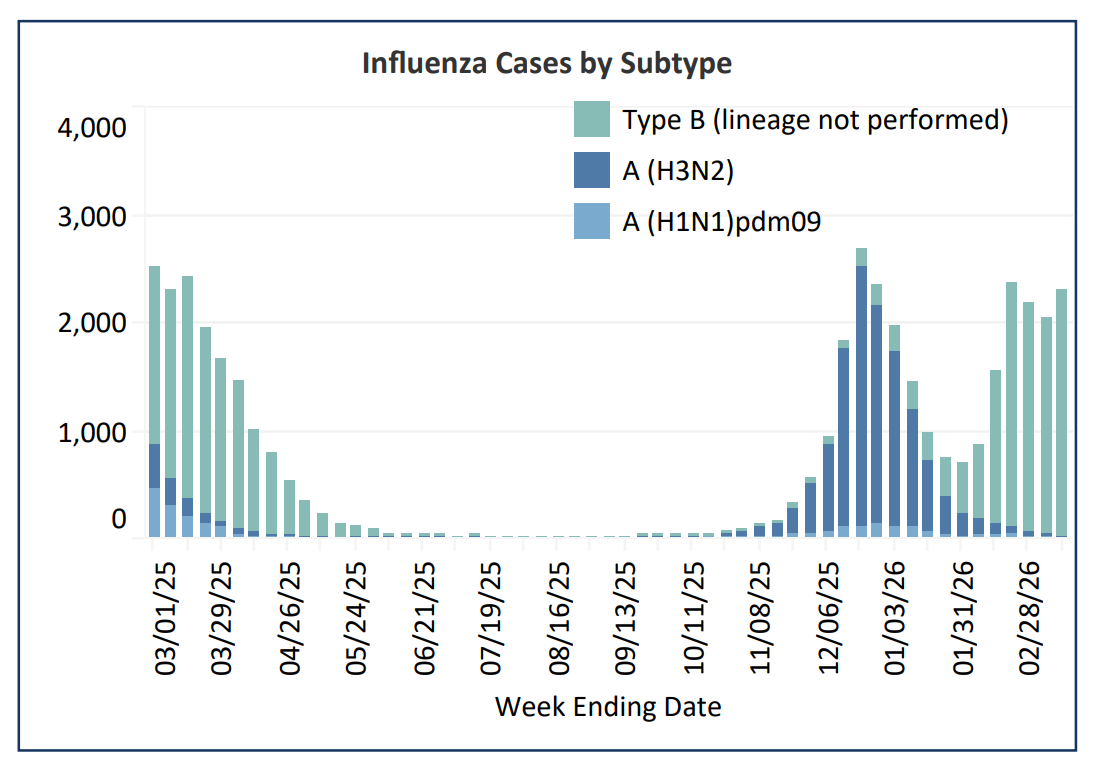
Respiratory DiseasesInfluenzaOutpatient influenza-like illness (ILI) activity in the Northeast continued to drift lower this week, with most states declining or holding flat at relatively low levels. New Jersey remained the clear outlier, with outpatient ILI holding essentially flat at 4.3%, barely changed from 4.2% the prior week. Emergency department (ED) visits were also flat at 2.1%. In fact, more school outbreaks have been reported so far in March than there were in both January and February. A huge majority of typed cases in New Jersey are type B, which is typical this time of year. However, it is unusual to see this persistence of activity far into the season.
Source: New Jersey Massachusetts is contending with lower activity, but it increased during the last reporting week. Outpatient ILI edged up to 2.8% from 2.6% and ED visits rose to 1.4% from 1.2%. As with New Jersey, a great majority of cases are type B. The Outer Boston area is most affected. Northeast: Outpatient influenza-like illness (%)
% of visits to the doctor that are for fever and cough or sore throat
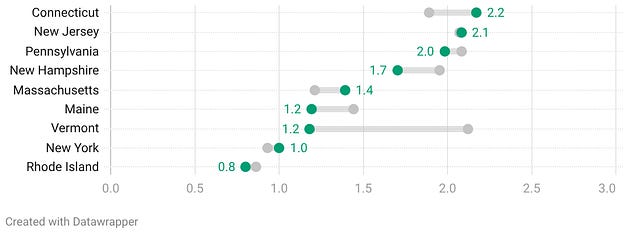
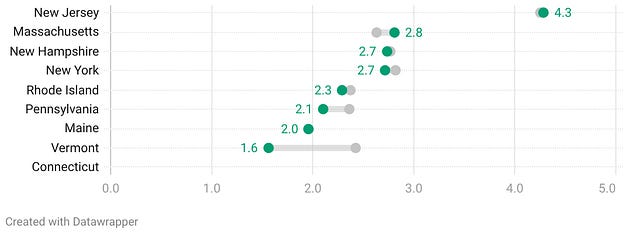 All other states reporting outpatient ILI came in below 3.0%. New Hampshire (2.7%), New York (2.7%), Rhode Island (2.3%), Pennsylvania (2.1%), and Maine (2.0%) all declined slightly or held steady. Vermont saw the sharpest drop in the region, falling to 1.6% from 2.4%, with ED visits also declining sharply to 1.2% from 2.1%. Connecticut had no outpatient ILI data but ED visits rose to 2.2% from 1.9%, and hospitalizations increased to 1.4 per 100,000 from 1.0. New York hospitalizations declined to 1.3 per 100,000 from 1.9. Northeast: ED visits for influenza (%)
% of visits to the emergency department that are for influenza
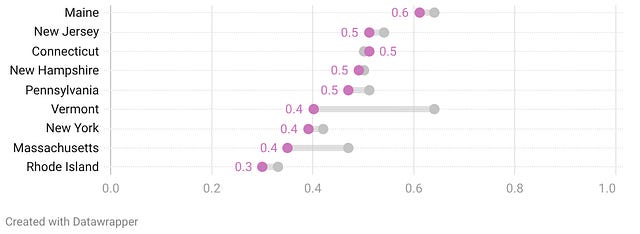
 COVID-19Covid-19 activity continued to decline across the Northeast this week, with ED visits at low levels throughout the region. Maine reported the highest ED visit rate at 0.6%, essentially flat with the prior week, with wastewater declining from moderate to low. In New Hampshire, ED visits held flat at 0.5% while wastewater rose from low to moderate. As I’ve said recently, wastewater signals have been a little divergent from clinical indicators. The latter are more reliable (albeit lagged) so I don’t put too much stock in this wastewater bounce. Northeast: Covid-19 wastewater concentration
Wastewater concentration of SARS-CoV-2
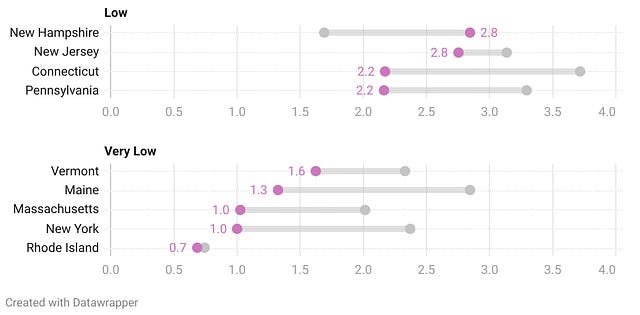 The rest of the region is broadly improving. Connecticut, New Jersey, and Pennsylvania all reported around 0.5% for ED visits, flat to slightly declining, with wastewater declining within the moderate range. Vermont saw a notable drop in ED visits to 0.4% from 0.6%, with wastewater falling from moderate to low. New York and Massachusetts each reported 0.4%, both declining, with wastewater falling to low levels; New York hospitalizations declined to 1.7 per 100,000 from 2.2 and Connecticut hospitalizations fell to 1.0 per 100,000 from 1.3. Rhode Island was the quietest in the region at 0.3%, with wastewater at minimal levels. Northeast: ED visits for Covid-19 (%)
% of visits to the emergency department that are for Covid-19
 RSVRSV emergency department visits were mixed across the Northeast, with the northern area of New England seeing slight increases while other states declined. Vermont led the region at 1.0%, up from 0.9%, and New Hampshire reported 0.8%, up from 0.7%. Massachusetts came in at 0.6%, down slightly. Northeast: ED visits for RSV (%)
% of visits to the emergency department that are for RSV
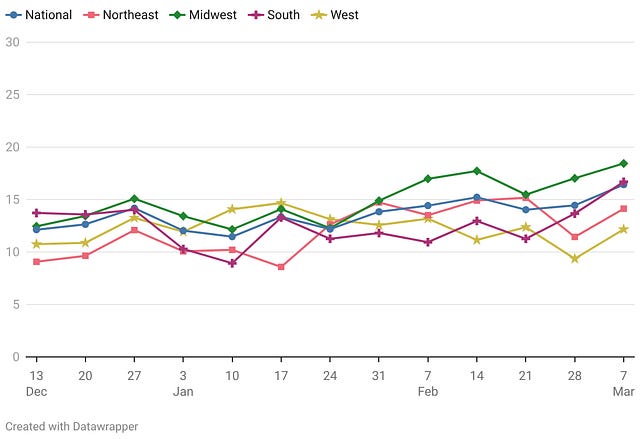
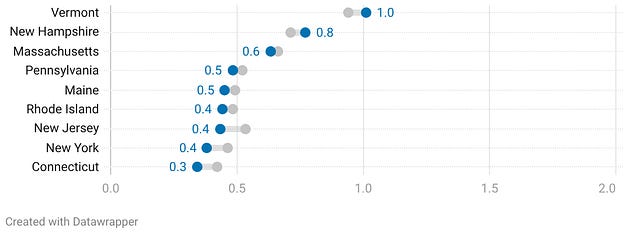 The remaining states were all at 0.5% or below: Pennsylvania and Maine each at 0.5%, and Rhode Island, New Jersey, New York, and Connecticut ranging from 0.3% to 0.4%, all declining. On hospitalizations, Connecticut saw RSV hospitalizations rise to 4.4 per 100,000 from 3.5, which is a sizeable increase for a state with relatively low ED activity. New York hospitalizations declined slightly to 3.0 per 100,000 from 3.3. NorovirusNorovirus activity continues to remain high in the Northeast and around the country. Test positivity increased from 11.4% to 14.1%. Test positivity has remained above 10% since around January. This is typically peak season (or even a little late for peak season) so I hope to see relief soon. Norovirus weekly percent positive tests (%)
Data reported to NREVSS
 Food recallsThe following foods are being recalled because they are contaminated. Please check your cupboards and throw out any of these items: New:
Previously Reported:
In other news
|